By Kevin E. Noonan —
 On April 29th, Ambassador Robert Lighthizer, U.S. Trade Representative (USTR), issued the 2020 Special 301 Report. In a press release, the USTR stated that "[t]he Trump Administration is committed to holding intellectual property rights violators accountable and to ensuring that American innovators and creators have a full and fair opportunity to use and profit from their work." The press release also asserts that "[o]ver the last year, USTR has secured strong and enforceable obligations on intellectual property in our historic agreements with China, Canada, and Mexico. The two reports issued today illustrate the Administration's commitment to protecting intellectual property rights and combatting counterfeiting and piracy in online and physical markets."
According to the Executive Summary of the Report, "[a] top trade priority for the Administration is to use all possible sources of leverage to encourage other countries to open their markets to U.S. exports of goods and services, and provide adequate and effective protection and enforcement of U.S. intellectual property (IP) rights." In tune with the more combative rhetoric on trade adopted by the Trump Administration, the Summary repeats last year's exhortation that:
This Report provides an opportunity to call out foreign countries and expose the laws, policies, and practices that fail to provide adequate and effective IP protection and enforcement for U.S. inventors, creators, brands, manufacturers, and service providers. The identification of the countries and IP-related market access barriers in the Report and of steps necessary to address those barriers are a critical component of the Administration's aggressive efforts to defend Americans from harmful IP-related trade barriers.
The Report cites four countries for particular consideration upon being placed on the Priority Watch List. Regarding China, the Report characterizes placement on the list due to "U.S. concerns with China's system of pressuring and coercing technology transfer, and the continued need for fundamental structural changes to strengthen IP protection and enforcement, including as to trade secret theft, obstacles to protecting trademarks, online piracy and counterfeiting, the high-volume manufacturing and export of counterfeit goods, and impediments to pharmaceutical innovation." The Report states that "[o]ver the past year, the United States' engagement of China began to demonstrate key progress with the signing of the U.S.– China Economic and Trade Agreement in January 2020, which the Report maintains "requires changes in China's acts, policies, and practices, including structural reforms and other changes to China's legal and regulatory regime to address numerous longstanding concerns of a wide range of U.S. industries."
India is cited (again) for "lack of sufficient measurable improvements to its IP framework on long-standing and new challenges that have negatively affected U.S. right holders over the past year," which include ones that "make it difficult for innovators to receive and maintain patents in India, particularly for pharmaceuticals, insufficient enforcement actions, copyright policies that do not properly incentivize the creation and commercialization of content, and an outdated and insufficient trade secrets legal framework." The Report newly asserts that,"[i]n addition to these long-standing concerns, India also further restricted the transparency of information provided on state-issued pharmaceutical manufacturing licenses, continues to apply restrictive patentability criteria to reject pharmaceutical patents, and still has not established an effective system for protecting against the unfair commercial use, as well as the unauthorized disclosure, of undisclosed test or other data generated to obtain marketing approval for pharmaceuticals and certain agricultural chemical products."
Indonesia is on the Priority Watch List, according to the Report, due to the reported lack of adequate and effective IP protection and enforcement" which continues to "raise serious concerns . . . with respect to patentability criteria and compulsory licensing." Counterfeiting and piracy are also cited for being "pervasive" and IP enforcement as being "weak."
The Report also notes that Chile has "not delivered on IP commitments made to the United States" and that Trinidad and Tobago has not pressed "enforcement actions against operators that broadcast unauthorized cable and satellite channels."
The Report is promulgated pursuant to Section 182 of the Trade Act of 1974, as amended by the Omnibus Trade and Competitiveness Act of 1988 and the Uruguay Round Agreements Act (enacted in 1994). The Trade Representative is required under the Act to "identify those countries that deny adequate and effective protection for IPR or deny fair and equitable market access for persons that rely on intellectual property protection." The Trade Representative has implemented these provisions by creating a "Priority Watch List" and "Watch List." Placing a country on the Priority Watch List or Watch List is used to indicate that the country exhibits "particular problems . . . with respect to IPR protection, enforcement, or market access for persons relying on intellectual property." These watch lists are reserved for countries having "the most onerous or egregious acts, policies, or practices and whose acts, policies, or practices have the greatest adverse impact (actual or potential) on the relevant U.S. products."
The USTR reviewed "more than 100" of this country's trading partners and identified ten countries on a "Priority Watch List" (decreased by one from last year) and another 23 countries on the "Watch List" (decreasing by two from last year), all relating to deficiencies in intellectual property protection in these countries. The Priority Watch List in the 2020 Report includes Algeria, Argentina, Chile, China, India, Indonesia, Russia, Saudi Arabia, Ukraine, and Venezuela (Kuwait being removed from the list this year). Countries on this list "present the most significant concerns this year regarding insufficient IP protection or enforcement or actions that otherwise limited market access for persons relying on intellectual property protection." On the Watch List this year are Barbados, Bolivia, Brazil, Canada, Colombia, Dominican Republic, Ecuador, Egypt, Guatemala, Kuwait, Lebanon, Mexico, Pakistan, Paraguay, Peru, Romania, Thailand, Trinidad & Tobago, Turkey, Turkmenistan, the United Arab Emirates, Uzbekistan, and Vietnam (Costa Rica and Greece being removed from the list this year).
The Report also notes the USTR's continued efforts to enhance public engagement. In addition to written comments (www.regulations.gov, Docket Number is USTR 2019-0023), from 75 interested parties, including 25 trading partner governments, there was a public hearing on February 26, 2019 that heard testimony from six "representatives of foreign governments, [and 20 representatives from] industry, and non-governmental organizations" (where the comments and a transcript and video of the hearing are available on the USTR website).
The Report states that "[i]n virtually all countries identified in this Report, IP enforcement is lacking," due to, inter alia, "[in]adequate or effective border enforcement against counterfeit and pirated goods" (including Brazil, China, Colombia, Hong Kong, India, Indonesia, Nigeria, Paraguay, Singapore, Thailand, Turkey, the UAE, and Vietnam), and that in such countries "customs officials lack authority to take ex officio action to seize and destroy such goods at the border or to take such action for goods in-transit."
The Report also notes efforts with several countries (including Argentina, Australia, Canada, China, Colombia, Ecuador, Egypt, Indonesia, Japan, Korea, Mexico, New Zealand, Saudi Arabia, Thailand, Turkey, the United Arab Emirates (UAE), and Vietnam) "to address concerns related to IP protection, IP enforcement, and market access barriers with respect to pharmaceuticals and medical devices so that trading partners contribute their fair share to research and development of new treatments and cures."
Particularly mentioned are copyright issues, including online and broadcast piracy (Argentina, Bulgaria, Canada, Chile, China, Colombia, Dominican Republic, Greece, Guatemala, India, Mexico, the Netherlands, Romania, Russia, Saudi Arabia, Switzerland, Thailand, Ukraine, Vietnam, "and elsewhere") and unlicensed government use of copyrighted software (Argentina, Brazil, China, Egypt, Indonesia, Kenya, Mexico, Nigeria, the Philippines, Romania, Russia, Thailand, Ukraine, and Vietnam).
The Report also cites "restrictive patentability criteria that undermine opportunities for export growth" (Argentina, India, and Indonesia) and "a lack of effective protection against unfair commercial use, as well as unauthorized disclosure, of test or other data generated to obtain marketing approval for pharmaceutical and agricultural chemical products" (Argentina, China, Egypt, India, and Saudi Arabia).
As it did the past several years, the Report also chides India and China for inadequate trade secret protection, which puts "U.S. trade secrets at unnecessary risk" and "negative market access effects" from the European Union's geographical indications (GIs) protections.
The Report also announces removal of certain countries from the Watch List because they have taken significant steps to address concerns in last year's Report. Costa Rica, for example, has taken "concrete steps . . . to address unlicensed software use in the central government and to implement an online recordation system to improve border enforcement," and Greece has taken positive steps "to address the widespread use of unlicensed software in the public sector through the allocation of significant funds to purchase software licenses, progress in online enforcement, and the introduction of legislation to impose fines on those possessing counterfeit products, with the understanding that the United States will continue to monitor its enforcement effort." Jamaica passed a new Patent and Design Act, and Kuwait has updated its copyright laws and regulations, according to the Report, and "significantly increase[ed] its in-country IP enforcement activities," albeit "ongoing concerns remain regarding the protections granted to copyright holders and the availability of counterfeit goods in the country." Finally, Switzerland is recognized for "long-awaited" changes in its Copyright Act, specifically with regard to online protection and enforcement (although, here again the Report states that "[t]he United States will carefully monitor the implementation, interpretation, and effectiveness of the newly enacted legislation and will engage with the Swiss government on these and other IP issues").
This portion of the Report once again ends by stating that "the Office of the U.S. Trade Representative looks forward to working closely with the trading partners identified in this year's Report to address these and other priority concerns."
Results of 2019 "Out of Cycle" reviews discussed in the Report (which "provide an opportunity to address and remedy such issues through heightened engagement and cooperation with trading partners and other stakeholders") include Malaysia, during which the US and Malaysia "held numerous consultations with a view toward resolving outstanding issues" (as they did last year), despite which the USTR has decided to extend review in 2020, wherein the USTR will "press Malaysia to complete actions to fully resolve these concerns in the near term). Also in 2020 the USTR plans on conducting an Out of Cycle Review of Saudi Arabia, directed to protection against unfair commercial use and unauthorized disclosure of testing and other data related to obtaining marketing approval for pharmaceutical products.
The Report contains two Sections (on "Developments in Intellectual Property Rights Protection and Enforcement" and "Country Reports") and two Annexes on particular issues (the statutory bases of the Report, and government technical assistance and capacity building efforts). In Section I, the Report reiterates its raison d'etre, that:
Intellectual property (IP) infringement, including patent infringement, trademark counterfeiting [(or imply "counterfeiting")], copyright piracy [("piracy")], and trade secret theft, causes significant financial losses for right holders and legitimate businesses around the world. IP infringement undermines U.S. competitive advantages in innovation and creativity, to the detriment of American businesses and workers. In its most pernicious forms, IP infringement endangers the public, such as through exposure to health and safety risks from counterfeit products such as semiconductors, automobile parts, apparel, footwear, toys, and medicines. In addition, trade in counterfeit and pirated products often fuels cross-border organized criminal networks and hinders sustainable economic development in many countries. Fostering innovation and creativity is essential to U.S. economic growth, competitiveness, and the estimated 45 million American jobs that directly or indirectly rely on IP-intensive industries. USTR continues to work to protect American innovation and creativity in foreign markets employing all the tools of U.S. trade policy, including the annual Special 301 Report.
It then reviews "initiatives for strengthen IP protection and enforcement," which includes "examples of initiatives to strengthen IP protection and enforcement; illustrative best practices demonstrated by the United States and our trading partners; [and] U.S.-led initiatives in multilateral organizations; and bilateral and regional developments." It also highlights areas of continued concern, including "counterfeits, online piracy, forced technology transfer, innovative pharmaceutical products and medical devices, and geographical indications (GIs)." As in earlier years, it mentions how important IP protection is to innovations in the environmental sector. Finally, Section I includes a discussion relating to "the importance of full implementation of the World Trade Organization (WTO) Agreement on Trade-Related Aspects of Intellectual Property Rights (TRIPS) and developments on the U.S. use of WTO dispute settlement procedures to resolve IP concerns."
In a section entitled "IP Protection and Enforcement and Related Market Access Challenges," the Report discusses innovation in the pharmaceutical industry, medical devices and market access concerns. In this regard, the Report states that "USTR has been engaging with trading partners to ensure that U.S. owners of IP have a full and fair opportunity to use and profit from their IP, including by promoting transparent and fair pricing and reimbursement systems." These efforts have included "ensur[ing] robust IP systems; reduc[ing] market access barriers to pharmaceutical products and medical devices, including measures that discriminate against U.S. companies, are not adequately transparent, or do not offer sufficient opportunity for meaningful stakeholder engagement; and has pressed trading partners to appropriately recognize the value of innovative medicines and medical devices so that trading partners contribute their fair share to research and development of new treatments and cures" (echoing the "fair share" mantra recited by the President in stump speeches and tweets). The Report calls out in this regard the following efforts in particular countries:
• Canada and Mexico: in the context of renegotiating the North American Free Trade Agreement (NAFTA), secured strong IP provisions in the United States-Mexico-Canada Agreement (USMCA), including provisions that "ensure that national-level government processes for the listing and reimbursement of pharmaceutical products and medical devices are transparent, provide procedural fairness, are nondiscriminatory, and provide full market access for U.S. products." The Report notes that the USMCA was signed into law in the U.S. on January 29, 2020;
• China: "[s]ecured enforceable commitments" to "(1) establish a mechanism for the early resolution of potential pharmaceutical patent disputes, including a cause of action to allow a patent holder to seek expeditious remedies before the marketing of an allegedly infringing product, so that innovative pharmaceutical companies can effectively enforce their rights in China; (2) provide patent term extensions to compensate for unreasonable patent office and marketing approval delays that cut into the effective patent term; and (3) permit the use of supplemental data to meet relevant patentability criteria for pharmaceutical patent applications";
• Korea: as part of renegotiating the U.S.-Korea Free Trade Agreement (KORUS FTA), engaged to secure "meaningful reforms on longstanding issues . . . "to ensure transparency with respect to pharmaceutical and medical device pricing and reimbursement policies and non-discriminatory treatment for U.S. pharmaceutical exports";
• Japan: engaged "to ensure transparency and fairness and address other concerns with respect to pharmaceutical and medical devices pricing and reimbursement policies";
• Indonesia: "pressed" to "fully resolve concerns regarding Indonesian patent law, including patentability criteria, local manufacturing and use requirements, and the grounds and procedures for issuing compulsory licenses";
• Argentina: "raised concerns" regarding the scope of patentable subject matter, protection against unfair commercial use and, like in many emerging countries, unauthorized disclosure of "undisclosed test or other data generated to obtain marketing approval for pharmaceutical and agricultural chemical products"; and
• United Arab Emirates (UAE): "encouraged" this country "o issue regulations to provide effective protection against unfair commercial use, as well as unauthorized disclosure, of undisclosed test or other data generated to obtain marketing approval for pharmaceutical products."
Once again this year, the Report highlights compulsory licensing as a particular concern with regard to pharmaceuticals and medical devices, because these practices are antithetical to "promot[ing] affordable healthcare for American patients today and innovation to preserve access to the cutting-edge treatments and cures that they deserve tomorrow." The Report states that "[s]uch actions can undermine a patent holder's IP, reduce incentives to invest in research and development for new treatments and cures, unfairly shift the burden for funding such research and development to American patients and those in other markets that properly respect IP, and discourage the introduction of important new medicines into affected markets." Compulsory licenses should be issued in "extremely limited circumstances" and only after the government (and presumably the patent rights holder) has made "every effort" to obtain the patent owners' authorization on commercially reasonable terms. Trading partners identified by the Report as requiring U.S. involvement in this aspect of trade include Chile, Colombia, Egypt, El Salvador, India, Indonesia, Malaysia, Russia, Turkey, and Ukraine.
More generally, the Report points to "non-transparent" and discriminatory practices and "unreasonable regulatory delay" as being of concern to the USTR and administration. In contrast, national systems that accelerate approval based on regulatory in other countries (including Egypt and Greece) are praised in the Report.
The Report notes that stakeholders from the pharmaceutical and medical device industries have identified industries that have expressed concerns regarding the policies of several trading partners, including Algeria, Australia, Canada, China, Japan, Korea, New Zealand, and Turkey (the same countries identified in this regard in last year's Report) with regard to "issues related to pharmaceutical innovation and market access," citing specific examples falling within these general categories for each country.
The Report next turns to technology transfer issues, purported to be means for incentivizing innovation by indigenous peoples and "localization." In this portion of the Report, compulsory technology transfer is emphasized as causing difficulties for American innovators. The Report identifies the anti-innovation cycle of imposing such measures to incentivize local innovation, which leads to create market entry barriers and thus discourages foreign (i.e., U.S.) investment, which not only hurts domestic industry in those countries but also can produce "non-market distortions" which in turn can lead to "suboptimal outcomes." The Report sets forth a litany of these practices, including requirements for technology transfer as the price for regulatory or other governmental approval; directing (an escalation of the Report's complaints from last year's "permitting") state-owned enterprises to seek "non-commercial terms" for IP licensing or otherwise; providing unfair competitive advantage to local industry (if only passively by permitting U.S. IP-rights infringement); "failing to take meaningful measures to prevent or deter" cyber-intrusions; giving preference to local products and services dependent on indigenous IP; "[m]anipulating the standards development process to create unfair advantages for national firms"; and conditioning regulatory approval or other governmental approvals on disclosure of confidential business information and then "failing to protect such information appropriately." China, Indonesia, and Nigeria are particularly cited for these concerns (unlike last year, Turkey is not).
Trade secret protection, or lack of it, is also a concern discussed in the Report. It cites "growing need for trading partners to provide effective protection and enforcement of trade secrets" in "a wide variety of industry sectors, including 'ICT' [information and communications technologies], services, pharmaceuticals and medical devices, environmental technologies, and other manufacturing" areas. The Report cites "various sources, including the U.S. Office of the National Counterintelligence Executive" for reporting these concerns, particularly with regard to China. Trade secret theft can arise in "a variety of circumstances," including permitting (or not stopping) departing employees from taking with them trade secret information-containing electronic storage devices, failed joint ventures, cyber intrusion and computer hacking, misuse of trade secrets disclosed to government agencies as part of a regulatory approval process. The Report notes particular difficulties in China and India regarding "effective remedies," or that (in some countries) government regulations or policies require disclosure of trade secrets such as software source code, including Brazil, Indonesia, Malaysia, and Nigeria. While asserting that "[t]he United States uses all trade tools available to ensure that its trading partners provide robust protection for trade secrets and enforce trade secrets laws," the Report cites on a positive note that efforts by the European Union and Taiwan to strengthen their trade secret regimes. The USTR also "strongly supports" the work of the Organization for Economic Cooperation and Development (OECD)'s work on trade secret protection.
The Report next addresses geographical indications (GIs) issues, saying (again) that the U.S. "is working intensively through bilateral and multilateral channels" to improve U.S. access to a variety of goods having geographic specificity, particularly with regard to the European Union. The EU GI "agenda remains highly concerning, because it significantly undermines the scope of trademarks and other IP rights held by U.S. producers and imposes barriers on market access for American-made goods that rely on the use of common names, such as parmesan or feta." Many of these products are protected by trademarks that predate the issuance of the GI. Because "[t]rademarks are among the most effective ways for producers and companies, including small- and medium- sized enterprises (SMEs), to create value, to promote their goods and services, and to protect their brands," GI's "undermines trademark protection and may result in consumer confusion to the extent that it permits the registration of GIs that are confusingly similar to prior trademarks" according to the Report.
The Report asserts that the EU "pressures trading partners to prevent all producers, other than in certain EU regions, from using certain product names" with as a consequence "American producers and traders either are effectively blocked from those markets or must adopt burdensome workarounds" (illustrated by appending "-like," "-style"," or "imitation" to the particular name). Part of the reason for U.S. concern is frankly admitted to be that "[t]he United States runs a significant deficit in food and agricultural trade with the EU," comparing $1 billion in cheese exports from the EU to the U.S. with $3.6 million in imports into the EU from the U.S. last year. More worrisome is the EU's extension of GI designations into other goods, including "non-agricultural products, including apparel, ceramics, glass, handicrafts, manufactured goods, minerals, salts, stones, and textiles." The U.S. is "continu[ing] to urge the EU to not implement certain proposed changes to the EU's Common Agricultural Policy, which, if adopted, would transfer much of the GI application review process to interested EU Member States and sharply reduce the period for filing a reasoned basis in support of an opposition to register a GI."
The Report also notes that the EU is pursuing its GI agenda in "multilateral and plurilateral bodies," including "expanding the World Intellectual Property Organization (WIPO) Lisbon Agreement for the Protection of Appellations of Origin and their International Registration to include GIs, thereby enshrining several detrimental aspects of EU law in that Agreement." The Report characterizes these efforts as a "break with the long-standing WIPO practice of consensus-based decision-making" and consequently voted to "deny the United States and 160 other WIPO countries meaningful participation rights in the negotiations." Those efforts have apparently been successful, the Report stating that "[i]n 2020, the EU became party to the Geneva Act of the Lisbon Agreement."
The Report also notes that the U.S. response is to address the issue in so-called "free trade" agreements and bilateral agreements with other nations, including Argentina, Australia, Brazil, Canada, Chile, China, Colombia, Ecuador, Indonesia, Japan, Jordan, Malaysia, Mexico, Morocco, Paraguay, the Philippines, Singapore, South Africa, Tunisia, Ukraine, Uruguay, and Vietnam.
The Report next turns to online and broadcast piracy of copyrighted works, citing the "increased availability of broadband Internet connections around the world" as being a "boon" to the U.S economy and foreign trade. But while advances in technology have enabled U.S. creative producers to better distribute copyrighted materials, it has also made the Internet "an extremely efficient vehicle for disseminating infringing content, thus competing unfairly with legitimate e-commerce and distribution services that copyright holders and online platforms use to deliver licensed content." A variety of forms of this issue are discussed in the Report, which names Argentina, Bulgaria, Canada, Chile, China, Colombia, the Dominican Republic, Greece, India, Mexico, the Netherlands, Romania, Russia, Switzerland, Thailand, Ukraine, and Vietnam as having "high levels of online piracy and lack effective enforcement." A particular form of copyright piracy (particularly of music), termed "streamripping," is practiced (or ineffectively prevented) in Canada, Mexico, the Netherlands, Sweden, and Switzerland. Illicit Internet Protocol Television and signal theft by cable operators as significant sources of copyright is identified as a problem in Argentina, Brazil, Chile, China, the Dominican Republic, Hong Kong, India, Indonesia, Mexico, Peru, Saudi Arabia, Singapore, Taiwan, Thailand, and Vietnam, with China being called out as a source for the devices that are used for these practices. Signal theft by cable operators continues to be a particular concern in the Report, which asserts that typically, "infringers circumvent encryption systems or otherwise unlawfully access cable or satellite signals to access content," including from "overspill" with hotels remaining a common site for this type of infringement. Finally, the Report identifies illicit camcording as a concern, identifying Argentina, Brazil, Ecuador, Peru, Russia, and Taiwan as countries that do not have effective enforcement mechanisms to discourage the practice, and names Canada, Japan, and the Philippines as countries that have adopted effective laws and enforcement practices to prevent illicit camcording.
The final extensive discussion in the Report regards border control and criminal enforcement against counterfeiting. Counterfeit goods (including "semiconductors and other electronics, chemicals, automotive and aircraft parts, medicines, food and beverages, household consumer products, personal care products, apparel and footwear, toys, and sporting goods") "make their way from China" and other countries, particularly those having an "ineffective or inadequate IP enforcement system." Citing a March 2019 OECD study entitled "Trends in Trade in Counterfeit and Pirated Goods," the cost of such counterfeiting was $509 billion in 2016, which is equivalent to 3.3% of 2016 total global trade (with China accounting for 57%, $239 billion, of that trade).
The Report states that such counterfeit goods harm "consumers, legitimate producers, and governments," particularly with regard to medicines, automotive and airplane parts, and food and beverages" because the counterfeit products do not meet the "rigorous good manufacturing practices used for legitimate products." The Report enunciates difficulties that arise due to the use of legitimate sources of trade ("legitimate express mail, international courier, and postal services") for transporting counterfeit goods in small consignments or shop unmarked goods to which a counterfeit trademark are affixed at their final destination. These practices inhibit trademark enforcement efforts, particularly in countries that require a counterfeit to be "completed" at the time of importation and inspection at national borders.
The Report states that the U.S. continues to "urge" its trading partners to "undertake more effective criminal and border enforcement against the manufacture, import, export, transit, and distribution of counterfeit goods" and states that the Office engages trading partners bilaterally, through trade agreement and international organizations on this issue. Another problem is the reentry into channels of commerce of counterfeit goods after they have been seized at national borders and transshipment through 'free trade zones"; the Report uses the UAE, particularly Dubai, as an example of this practice that accounted for $16 billion in counterfeit goods in 2016. Particular instances of trade in counterfeit medicines and global patterns of such drugs (e.g., India being a major supplier of counterfeit drugs to African countries) are also discussed in the Report.
Copyright administration and royalty payments, particularly with regard to collective management organizations (BMI, ASCAP) are next discussed, with concern arising that "CMO systems in several countries are reportedly flawed or nonoperational," citing India, the UAE, and Ukraine as examples.
Trademarks and impediments to obtaining and enforcing them in some countries make up the next topic in the Report, with Brazil, China, India, Malaysia, and the Philippines, having "slow" opposition proceedings and Russia and Panama having no administrative opposition proceedings. Even registering (i.e., making a record of) trademarks is problematic in some countries, with "unnecessary administrative and financial burdens" imposed on owners and there being unnecessary difficulties in maintaining and enforcing trademarks (albeit without naming any countries where these and other difficulties contained in the Report have arisen). There are also issues with cybersquatting and particularly with country code top-level domain names (ccTLDs) for U.S. rights holders.
Government use of unlicensed software is also discussed, with Argentina, Brazil, China, Egypt, Greece, Guatemala, Indonesia, Kenya, Mexico, Nigeria, Paraguay, the Philippines, Romania, Russia, Thailand, Turkey, Ukraine, and Vietnam being identified as countries where "further work on this issue remains" to be done.
The Report sets forth efforts related to initiatives for improving IP protection resulting in countries not being put on the Watch List (Costa Rica, Greece, Jamaica Switzerland), and Kuwait being removed from the Priority Watch List for "taking further steps to reform its system of copyright protection and enforcement by passing the 2019 Copyright and Related Rights Law and the Implementing Regulations." A particular irritant noted in last year's Report, BeoutQ, "the notorious online and satellite piracy service reportedly operating out of Saudi Arabia" and states it was taken offline in 2019.
Also noted is participation by 59 member states in the 1991 Act of the International Union for the Protection of New Varieties of Plants Convention (UPOV 91), which member states to "grant IP protection to breeders of new plant varieties, known as breeder's rights," and 104 member states of the WIPO Performances and Phonograms Treaty and the WIPO Copyright Treaty, which have "raised the standard of copyright protection around the world, particularly with regard to online delivery of copyrighted content."
Section I of the Report also has a section of "Illustrative Best IP Practices by [U.S.] Trading Partners, which expressly recites Thailand and India for "[c]ooperation and coordination among national government agencies involved in IP issues"; Spain, India, Thailand, and Vietnam for IP awareness and educational campaigns; Brazil, Malaysia, and Jamaica for "[s]pecialized IP enforcement units"; and several governments (Romania, Singapore) for active participation of government officials in technical assistance and capacity building."
The Report discusses multilateral (WTO) and regional (APEC) and bilateral (TIFA) agreements and specific instances where such agreements are being pursued in furtherance of U.S. trade objectives. Also included is a discussion of implementation of the WTO TRIPS Agreement.
Section I of the Report ends by mentioning the role of intellectual property and the environment and intellectual property and health as areas of concern raised by stakeholders in their comments. The Report contains an affirmation of the provisions regarding IP and public health set forth in the Doha Declaration and states that "[t]he United States is firmly of the view that international obligations such as those in the TRIPS Agreement have sufficient flexibility to allow trading partners to address the serious public health problems that they may face." And the final portion of this section of the Report discusses efforts at dispute resolution of IP matters under the GATT/TRIPS provisions as they are implemented by the WTO.
Finally, the last portion of Section I of the Report relates to dispute settlement and enforcement. It states that while the U.S. will use all available means to resolve concerns, including bilateral dialogue and enforcement tools such as those provided under U.S. law, the WTO, and other dispute settlement procedures, as appropriate." Efforts between the U.S. and China are specifically mentioned with regard to "a range of unfair and harmful Chinese acts, policies, and practices related to technology transfer, IP, and innovation." Other enforcement actions, mostly of historical significance, are also discussed.
Section II of the Report is a detailed, country-by-country discussion for each country on the Priority Watch List and the Watch List, relating to the activities (or lack thereof) of each country that results in placement of that country on these lists.
As it has for the past several years (and across otherwise very different Administrations), the U.S. Trade Representative Special 301 Report provides insights into both the concerns of U.S. IP rights holders and the Administration's intentions to work with, cajole, coerce, or threaten other countries to increase protection for IP rights of U.S. IP rights holders. For anyone paying adequate attention to these Reports year-to-year, the complaints, and even the language enunciating these complaints, remains dispiritingly the same, suggesting that despite pronouncements of small victories efforts to reduce unfair trade practices globally have fallen far short. Nevertheless, as with last year's Report, the tone and tenor of this Report is robustly assertive regarding IP rights and America's intention to negotiate international agreements and confront its trading partners in ways that protect American innovation and commercial interests first and foremost regardless of consequences.
For additional information regarding this and other related topics, please see:
• "U.S. Trade Representative Releases 2019 Special 301 Report," April 29, 2019
• "U.S. Trade Representative Releases 2018 Special 301 Report," April 29, 2018
• "U.S. Trade Representative Issues 2017 Special 301 Report," May 4, 2017
• "U.S. Trade Representative Issues 2016 Special 301 Report," May 19, 2016
• "U.S. Trade Representative Issues 2015 Special 301 Report," April 30, 2015
• "U.S. Trade Representative Issues 2014 Special 301 Report," May 19, 2014
• "U.S. Trade Representative Issues 2013 Special 301 Report," May 30, 2013
• "U.S. Trade Representative Issues 2012 Special 301 Report," May 1, 2012
• "U.S. Trade Representative Releases Special 301 Report on Global IPR," May 4, 2011
• "U.S. Trade Representative Releases Special 301 Report on Global IPR," May 19, 2010
• "New Administration, Same Result: U.S. Trade Representative's Section 301 Report," May 6, 2009
• "Congressmen Criticize U.S. Trade Representative over Special 301 Report," July 1, 2008
• "U.S. Continues Efforts to Protect Patent Rights Abroad," April 29, 2008

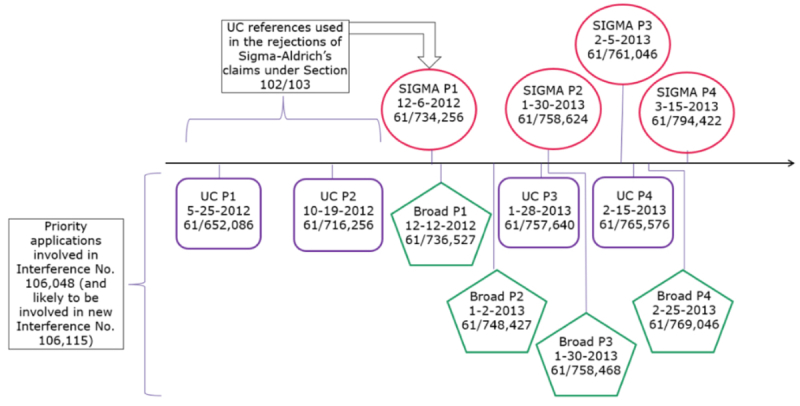
 For several years, Sigma Aldrich has been prosecuting several applications (including USSNs 15/188,911; 15/188,924; and 15/456,204) claiming CRISPR technology that (it alleged) would be deserving of an interference with University of California's U.S. Application Nos. 15/9547,718 and 15/981,809, and reserving the right to supplement its request to include other patents and patent applications owned by the University of California Berkeley et al. (collectively "CVC") as well as those of owned by The Broad Institute and colleagues (see "Sigma-Aldrich Wants Its Piece of CRISPR Pie" and "Sigma-Aldrich Tries Again"). Such an interference, if declared, threatened to upset the CVC/Broad apple cart regarding CRISPR-Cas-9 patent ownership, Sigma–Aldrich alleging an earlier priority date than the Broad's earliest date and 3-7 months after CVC's earliest date: