• By Kevin E. Noonan –

    Judge Newman_1Not surprisingly, the Special Committee of the Federal Circuit after an Oral Hearing on July 10th voted unanimously to maintain the suspension (see "Judge Newman Suspended for One Year by Federal Circuit") handed down against Judge Pauline Newman on July 23, 2023 until such time that the Judge complies with the Order that she "undergo specified full neuropsychological testing and a neurological examination with independent experts selected by the Committee and to turn over medical records to the neurologist and . . . that Judge Newman sit for an interview."  In response, Judge Newman has submitted evidence from her personal physicians and brought suit in the D.C. District Court (see "Judge Newman and the On-Going Attempts to Remove Her from the Federal Circuit"), which suit was dismissed and is on appeal before the District of Columbia Circuit Court (see "Judge Newman's Suit Comes to an End").

    The Court has made public the Special Committee's 97 page Report and Recommendation setting forth its evidentiary and legal rationales for the decision to maintain the suspension.  One notable aspect is the numerous citations and references that "[t]he Committee had amassed extensive ("voluminous") evidence [elsewhere in the Report specified as "393 pages of supporting evidence"] raising concerns that Judge Newman may suffer from cognitive impairments material to her job.  According to the Special Committee '[o]ver the past year, Judge Newman's conduct has not changed" although whether that is said in reference to the Judge's refusal to comply or further incidents of distressing behavior is not clear (tellingly, the Report states that "Judge Newman continues to refuse to cooperate with the Committee's orders and continues to thwart the Committee's ability to fulfill its responsibilities under the Judicial Conduct and Disability Act (Act)", suggesting the basis for the Special Committee's conclusion is the former).  The Report asserts that "Judge Newman has not presented any information to undermine the voluminous record the Committee compiled last year raising serious concerns about Judge Newman's cognitive state," and dismisses the "handful of occasions over the past year in which [Judge Newman] delivered some public remarks or sat for an interview."  The Special Committee asserts it has "strong concerns established by the extensive record compiled by the Committee showing troubling signs of cognitive decline" which include "angry and abusive behavior towards staff, with many witnesses describing increasingly erratic behavior in 2023."  And the Special Committee rejects Judge Newman's contention that the Judge's continuing litigation against these sanctions provides a basis for the Judicial Council to "refrain from addressing her continuing misconduct with an additional sanction."  One justification for the continuing sanction enunciated by the Special Committee is that staying sanctions "would seriously impair the public interest [by] impair[ing] the expeditious functioning of the self-policing mechanism in the Act that Congress intended to allow the judiciary to swiftly address issues of disability" [and] "in light of the extensive record developed in this case, permitting Judge Newman to resume hearing cases would raise a serious risk that litigants may be having their disputes decided by a judge who is not fit for executing the duties of her office."

    The Report also addresses (and dismisses) three types of "new" information submitted in support of Judge Newman's response to the Committee's Order to Show Cause why the sanctions should be lifted.

    The first is the Supreme Court's reliance upon Judge Newman's position (in dissent of an en banc decision by the Federal Circuit) in Rudisill v. McDonough, 601 U.S. 294 (2024).  The Report dismisses this argument, contrasting one example with the "voluminous evidence"** adduced by the Special Committee.

    The Report also finds unpersuasive examples of Judge Newman's public activities and participation in four conferences or interviews over the past year, saying these do not "eliminate the concerns about her cognitive state already found sufficient to support the medical examination orders."  The Report goes on further to say:

    The question under the [Judicial Conduct and Disability Act] process at issue concerns disability for fulfilling the particular duties of her office, which require abilities involving short-term memory, clarity about and concentration in working with numerous concrete facts, and stamina in doing so with multiple cases—abilities that go well beyond the ability to be or seem coherent in the settings Judge Newman now highlights.

    Turning to Judge Newman's assertions that "no one, including her regular treating physicians and other medical professionals, save for members of this Committee, has suggested that Judge Newman's behavior or medical data would indicate need for any neuropsychological or psychiatric examinations," the Report responds that "[to] the extent Judge Newman claims that no one except the Committee found that the evidence of record created a reasonable basis for the Committee to order medical examinations and production of medical records, that is incorrect.  All eleven of Judge Newman's colleagues at the Federal Circuit unanimously found such a reasonable basis, . . . and all seven members of the JC&D Committee affirmed."  The Report also asserts that Judge Newman has provided no evidence regarding her physicians' assessment and judgment, nor that these physicians subjected the Judge to "the full battery of neuropsychological testing that the Committee has been seeking for over a year."  "The evaluations of Judge Newman by physicians of her choosing did not carry sufficient probative value to undermine the basis for the Special Committee's concerns" according to the Report.

    The Report goes on to say that:

    Far from providing evidence to allay the ample concerns supporting the medical examination orders, Judge Newman's response—by what is absent from it—has reinforced the concerns about cognitive impairment.  Nothing in the response faces up to her conduct, and why it raises various concerns, including regarding cognitive impairment, or presents meaningful evidence of changed circumstances.  Indeed, Judge Newman appears, even now, to be unable to grasp that her behavior toward staff has been inappropriate and has had a serious impact on court staff.

    (It is somewhat ironic that the Special Committee seems to refuse to accept evidence from Judge Newman's physicians but places great weight on "sworn testimony from staff members in multiple units within the Court including the Clerk's Office, IT, HR, General Counsel's office, and Judge Newman's own chambers"; and that "[t]his testimony detailed interactions with Judge Newman that indicated 'significant mental deterioration' manifested in highly inappropriate and unprofessional behavior by the judge," which regardless of their probity seems to put greater weight on lay opinion rather than professional opinions bound by medical ethics (and it cannot fairly be said that the sources making up the "voluminous evidence" are entirely neutral — it is worth considering how solicitous anyone would be who felt personally aggrieved in such a situation.)

    The Report further asserts in justification of continuing sanctions the existence of "overwhelming evidence of Judge Newman's troubling interactions with staff" that "continues to provide a reasonable basis for concern over Judge Newman's ability to discharge the duties of her office."  While seeking (apparently) to minimize the burdens of the required testing ("Those medical examinations are quite limited in the burden they place on Judge Newman.  The required neurological evaluation should last 30–45 minutes and will not involve invasive procedures, such as blood work or imaging studies.  The required neuropsychological testing involves a clinical interview, administration of questionnaires related to personality and mental health symptoms, and cognitive testing.  No aspect of the process is physically invasive, and the entire examination is likely to take up to six hours") they are also qualitative in nature and thus will depend entirely on medical opinions by (necessarily) strangers.

    The Report also dismisses Judge Newman's call that her suspension be lifted and the Special Committee's decision on sanctions be stayed during the course of her appeal, because "if [Judge Newman's] mental status is in question then permitting her to sit on panels while the appellate case progresses is not possible," further stating:

    As the Judicial Council concluded, failing to act where there is voluminous evidence raising a reasonable concern that she may suffer from a mental disability "would breach our obligations under the Act, display disregard for the rights of litigants bringing their cases before this Court, ignore the rights of court staff to be free from increasingly dysfunctional behavior in the workplace, and undermine public confidence in the judiciary."

    In brief summaries, the Report asserts that "[t]he Judicial Council found Judge Newman to have committed misconduct by non-cooperation with its investigation," that "Judge Newman's refusal to cooperate was a serious matter because it prevented the Committee from being able to fulfill its assigned task under the Act—namely, making an informed assessment (and recommendation for the Judicial Council) about whether Judge Newman suffers from a disability," and that because Judge Newman's conduct has not changed the appropriate sanction the Special Committee recommends for "[t]hwarting the Committee's ability to complete the process established by Congress for determining whether a life-tenured judge suffers from a disability" is "a further one-year sanction during which Judge Newman will not be permitted to hear cases at the panel or en banc level.

    "This sanction is not for past misconduct.  Instead, it addresses Judge Newman's continuing misconduct through her continuing refusal to cooperate with the Committee's orders," the Report states.

    The Report is accompanied by copies of some e-mail correspondence relating to squabbles concerning whether Judge Newman was (or was not) invited to professional and social functions at the Court, as well as the transcript of the Oral Hearing.  Judge Newman's counsel, Gregory Dolan, after fielding questions from the bench reached the Constitutional basis that Judge Newman has raised in the Judge's complaint before the District Court (abridged somewhat here for clarity), Dr. Dolan arguing:

    "Our separation of powers are not meant to allow fellow judges to self-impeach even for terrible misconduct" and the recourse is to recommend to the Judicial Conference that Judge Newman be impeached, counsel making the point that even should the medical exams verify that Judge Newman is not competent the Judicial Council cannot remove her.

    "[T]he interesting part about it is taking the test or not taking the test doesn't change the outcome.  Judge Newman is and will remain an active judge of this Court until she retires, dies, or is impeached."

    "[T]he Committee has repeatedly declined to state that it will be even bound by the test results, a simple step that it might help us to determine things.  But the Committee has never said, not once, that if the doctors give her the green light, [Judge Newman] will be restored to the bench."

    "But the point is that no one except members of this Committee — not people who see Judge Newman socially, not people who have seen Judge Newman professionally, not people who have been on various panels with Judge Newman, not the Supreme Court that affirmed her opinion — thought that Judge Newman is in need of a mental competency exam.  It's only this Committee and the physician who has never seen or evaluated or talked to Judge Newman.  So you have medical evidence on one hand and complaints by disgruntled staff on the other hand.  Respectfully, I think medical evidence warrants more weight."

    "All of that having been said, there are still opportunities to resolve this, as we have suggested on multiple occasions.  And if the Committee is truly interested in figuring out is Judge Newman able or unable to perform this function, rather than just keeping it to itself, there is an opportunity to get a neutral decisionmaker involved and actually resolve it.  So there are off-ramps here, but Judge Newman will not submit to a 'my way or highway' approach.  And I understand it may be frustrating to the Committee, but Judge Newman is an Article III judge nominated, confirmed, and appointed by the President.  She gets to hold her office on good behavior, and she intends to do so."

    It is clear that neither Judge Newman nor the Special Committee is willing to take advantage of these opportunities to resolve this matter amicably.  Nothing has changed, except that Judge Newman is one year older.  The waiting game continues.

    **What is that "voluminous evidence"?

    According to the Report the "voluminous evidence" amounts to:

    Affidavits prepared after more than 20 interviews with Court staff reflect consistent reports of deeply troubling interactions with Judge Newman that suggest significant mental deterioration including memory loss, confusion, lack of comprehension, paranoia, anger, hostility, and severe agitation.  Critically, these reports are not isolated incidents of occasional forgetfulness based on a few interactions with only one or two staffers.  To the contrary, they come from interactions with staff members across a broad range of departments from the Clerk's Office to Information Technology (IT), to Human Resources (HR), to the General Counsel Office, to Judge Newman's own chambers staff.  And contrary to Judge Newman's assertions, the reports indicate that the behaviors suggesting that Judge Newman may have a disability emerged over two years and increased in frequency and severity.  Judge Newman has never specifically disputed any of the staff accounts, many of which are independently substantiated by Judge Newman's own emails attached as exhibits.

  • By Kevin E. Noonan –

    Supreme Court Building #3It has been one of Justice Gorsuch's signature judicial goals to overturn the Court's Chevron U.S.A., Inc. v. Natural Resources Defense Council, Inc. decision and while it has taken seven years for a case to arise giving him the opportunity to persuade his colleagues to do so, the Loper case provided that opportunity (regardless of the amount of effort or lack of it required to accomplish the goal).

    The concurrence sets out the issue not as one between the co-equal branches of our government but as "between individuals and the government," providing a populist gloss otherwise not mentioned in either the majority opinion or dissent (and perhaps providing a glimpse into the philosophical underpinnings of the Justice's passion for overturning Chevron).  Terming the Chevron approach to be a "radically different approach" the Justice's opines that over time "the error of this approach became widely appreciated" and uses as evidence the Court's refusal to apply the doctrine since 2016 (nicely illustrating the judicial maneuver decried by Justice Kagan in her dissenting opinion of "overruling-through-enfeeblement").  As stated right at the outset, the Justice has penned his concurrence to "address why the proper application of the doc­trine of stare decisis supports that course" (something the dissent vigorously opposes and the majority opinion discussed more cursorily).

    The Justice begins his concurrence with his history of judicial norms, including stare decisis over time, seeking to clarify what in his view is the proper role of judges and to what extent they are (or should be) bound by prior decisions.  In England, the judge's role was limited to specifically not make law (which was restricted to the King and Parliament) but to interpret it in the context of the historical consolidation of England into a single kingdom.  But a judge's opinion and "the law" were not considered "one and the same thing," the Justice providing his own citation to Blackstone (1 W. Blackstone, Commentaries on the Laws of England 71 (1765)).  Rather than bind later judges, an earlier judge's decision was considered to be "evidence" of what the law was which varied with the weight later judges gave them.  These distinctions were also considered regarding the effect on later cases of "[d]icta, stray remarks, and di­gressions" (given less weight but were not considered entirely worthless) as opposed to "[a]n opinion's hold­ing and the reasoning essential to it."

    The relevance of this historical/rhetorical sojourn, according to the concurrence, is that "there are good reasons to think that the common law's understandings of judges and precedent outlined [herein] crossed the Atlantic and informed the nature of the 'judicial Power' the Constitution vests in federal courts" under Article III.  These include that in addition to being drafted and adopted "against the back­drop of these understandings" there are specific passages in our Constitution that support the Justice's insight and interpretations (in his view, of course) throughout that document (which are set out in the concurring opinion).  In this context is the important principle that the judiciary is a "neutral party" [that can] 'interpret and apply' the law without fear or favor in a dispute between others," citing Osborn v. Bank of United States, 9 Wheat. 738, 866 (1824) (the need thereof being consistent with the rather adversarial view of "citizens and their government" espoused at the beginning of the concurrence, rather than mere allocation of the capacity to decide between different branches of those citizens' government).  And the concurrence suggests that the limited power of stare decisis in England was transported to this country due to these similarities (suggesting darkly a broader attack on established legal principles that could lead to unbridled judicial hegemony over established law).  "Plucking" (or at least cherry picking) from numerous 19th Century decisions and extrajudicial statements by past statesmen (Including Abraham Lincoln) the concurrence weaves a tapestry swathed in apparent reasonableness diminishing the power of stare decisis as never being binding on future courts but rather providing evidence or guidance regarding what the later law should or could be.  The Justice's conclusion from these assessments are summarized in the opinion as three "lessons":

    First, "a past decision may bind the parties to a dispute, but it provides this Court no authority in future cases to depart from what the Constitution or laws of the United States ordain."  This principle is supported by consideration of "flawed" decisions and when that flaw is constitutional or related to particular statutes and the Court's capacity for correction (and thus not bound by stare decisis).

    Second, "[w]hile judicial decisions may not supersede or revise the Constitution or federal statutory law, they merit our 'respect as embodying the considered views of those who have come before,'" citing Ra­mos v. Louisiana, 590 U. S. 83, 105 (2020).  A judge must "weigh his view of what the law demands against the thoughtful views of his predecessors" which are "a font of established wisdom richer than what can be found in any single judge or panel of judges."  Precedent's primary power is the power to persuade later judges, the concurrence maintains.  (Ironically, the principles of workability and reliance, the first of which was used by the majority to support their decision to overturn Chevron, "do not often supply reason enough on their own to abide a flawed decision" but do they provide sufficient motivation to overturn it?).

    Third, "it would be a mistake to read judicial opinions like statutes" because judicial decisions "render a judgment based only on the fac­tual record and legal arguments the parties at hand have chosen to develop" (those decisions being made before a backdrop of earlier decisions and settled law being unmentioned).  The concurrence properly notes that judges must "appreciate the possibility that different facts and different legal arguments may dictate a different outcome (but unspoken is the principle that this does not imply that these differences mandate or permit changes in settled law).  The concurrence, placing the blame on the innately digressive characteristic of judges, asserts that many decisions are infused with "va­pours and fumes of law" (citing 2 The Works of Francis Bacon 478 (B. Montagued. 1887)) (apparently meaning dicta) that "cannot 'control the judgment in a subsequent suit,'" citing Cohens v. Virginia, 6 Wheat. 264, 399 (1821).

    The upshot of these considerations in the concurrence is the judicial Goldilocks principle that there is a "just right" amount and degree of precedential authority that such earlier decisions can be given (that "sweet spot" being defined only by the decision maker to which the issue is posed).  Citing Brown v. Davenport, 596 U. S. 118, 141 (2022), the Justice asserts that over reliance on stare decisis can "turn stare decisis from a tool of judicial humility into one of judicial hubris."

    The concurrence applies these "lessons" to Chevron as follows:

    Lesson 1, because Chevron deference contra­venes the law Congress prescribed in the Administrative Procedure Act.

    Lesson 2, because Chevron deference runs against mainstream currents in our law regarding the sep­aration of powers, due process, and centuries-old interpre­tive rules that fortify those constitutional commitments.

    Lesson 3, because to hold otherwise would effectively require us to endow stray statements in Chevron with the authority of statutory language, all while ignoring more considered language in that same decision and the teach­ings of experience.

    The concurrence's explication of these conclusions mirror the analysis in the majority opinion (and won't be repeated here; see "Loper Bright Enterprises v. Raimondo (2024)") except to the extent they do not.  Regarding the APA in Lesson 1 the concurrence is concerned that an agency can interpret a statute outside the scope of what a court has, can, or would do, and such interpretations can be changed at any time by the agency that could "effectively overrule not only their own past interpretations of a law but a court's past interpretation as well."  Lesson 2 "cannot rescue Chevron deference in Justice Gorsuch's opinion because "[i]f stare deci­sis calls for judicial humility in the face of the written law, it also cautions us to test our present conclusions carefully against the work of our predecessors" (reiterating the arguments here and in the majority opinion regarding "how our predecessors traditionally understood the judicial role in disputes over a law's mean­ing"; these arguments include citations to Marbury v Madison, The Federalist, and United States v. Dickson, 15 Pet. 141, 162 (1841) (Story, J.).  And again raising the possibility that a court would need to defer insofar as "the government could propound a 'reasonable' view of the law's meaning one day, a different one the next, and bind the judiciary al­ways to its latest word" or that the Executive could override judicial precedent.  Giving the Executive branch due respect does not require courts to defer wherein "by no means [can the Executive's decisions] con­trol the action or the opinion of this court in expound­ing the law with reference to the rights of parties litigant before them," citing Irvine v. Marshall, 20 How. 558, 567 (1858).  Justice Gorsuch's assessment of the Chevron regime is that "it did not merely depart from our precedents.  More nearly, Chevron defied them."

    The concurrence also sees a parallel between King George's efforts to dominate the colonial judiciary and Chevron, and the American response to the King's effort by making "considered judgment to build judicial independence into the Constitution's design [by] vest[ing] the judicial power in decisionmakers with life tenure" under Article III (as well as other bases for judicial independence).  In the Justice's view, Chevron deference undermines all that (citing many of the aspects of the Chevron regime recited in the majority opinion's grounds for overturning Chevron).  The opinion sees Chevron as enabling the Executive branch to "effectively judge the scope of their own lawful powers," citing Arlington v. FCC, 569 U. S. 290, 296–297 (2013).  And citing Blackstone the interpretive powers granted the Executive bureaucracy echoes the capacity Blackstone warned about should "magistrates" be permitted to "discard an old meaning and assign a new one to a law's terms, all without any legislative revi­sion" under circumstances where a "reasonable bureaucrat may change his mind year-to-year and election-to-election," thereby reducing or destroying public certainty (wherein "the people are left to guess about their legal rights and responsibilities" as a result).

    Justice Gorsuch's analysis of the Chevron regime is frankly disparaging, terming the determinations of ambiguity to be something of a "Snark hunt" (some judges see it everywhere, some judges never see it) but in any case where these decisions always inure to the "benefit" of the Federal government (and the courts' assessment of whether the agency's interpretation of the statute is also fraught with ""wildly different" approaches and reached wildly different conclusions" even in similar cases, citing Kavanaugh, Fixing Statutory Interpretation, 129 Harv. L. Rev. 2118, 2152 (2016) (the cases before the Court on appeal illustrating this situation in the Justice's view).

    The concurrence also has little use for claims that allegiance to Chevron involves reliance interests, asserting that "the whole point of Chevron defer­ence is to upset [reliance interests]," ostensibly because "executive officials can replace one 'reasonable' interpretation with another at any time, all without any change in the law itself" (citing National Cable & Telecommunications Assn. v. Brand X Internet Services, 545 U. S. 967, 982–983 (2005), as an example of such changes in how agencies interpret the law; tellingly that decision arose prior to any of these changes).  The concurrence purports to be concerned with the effects of such changes on "ordinary people" because "sophisticated entities" (and, ominously, "their lawyers") can take steps (from "keeping up" with such changes to lobbying), illustrating the "ordinary people" example with Buffington v. McDonough involving an Air Force veteran injured in the line of duty that fell afoul of regulations ("self-serving," according to the Justice) involving disability benefits.  The concurrence asserts that the government used Chevron to convince a court that the Department of Defense's interpretation of the statute resulting in the loss of those benefits was reasonable (it was not sufficiently unreasonable for the Court to grant certiorari, apparently).  The Justice also includes the story of a case in which he presided at the appellate court in which the Board of Immigration Appeals overturned an earlier interpretation of a rule to the detriment of immigrants who had relied on it (other examples among the "so many" are further cited in the opinion).  The concurrence pits "the Constitution, the APA, and our longstanding precedents" against government claims that Chevron deference "has become a 'fundamenta[l] . . . ground rul[e] for how all three branches of the government are operating together,'" further illustrating the fundamentally adversarial tone of the concurrence (and to a lesser degree the majority opinion).

    The concurrence also characterizes Chevron as "a counter-Marbury revolution, one at war with the APA, time honored precedents, and so much surrounding law" that is the result of "endow[ing] a stray passage in a judicial decision with extraordinary authority."  In Chevron, a "bare quorum" of the Chevron Court (the same quorum reaching the majority's decision) affirmed the Environmental Protection Agency's definition of the term "stationary sources."  According to the concurrence, from "bits and pieces" of this decision arose the Chevron analytical regime that the concurrence and majority opinions so mightily complain about, wherein much of these bits and pieces of legal analysis not arising from positions taken by the government (and of course not taking into account the majority's and concurrence's concerns regarding contrary considerations  under the APA).

    The concurrence attempts to normalize the disregard for stare decisis in the Court's overthrow of Chevron by first "blaming" deceased former Justice Scalia for promoting the Chevron regime in NLRB v. Food & Commercial Workers, 484 U.S. 112, 133–134 (1987), and then, acting like a repentant apostate losing faith with its consequences and arguing for the Court to reconsider it in Northwest Environmental Defense Center, 568 U.S. 597, 617–618, 621 (2013), and Perez v. Mortgage Bankers Assn., 575 U.S. 92, 109–110 (2015).  The concurrence notes that several current members of the Court began to show similar reservations, so much so that the Chevron decision was effectively ended (by what Justice Kagan's dissent terms "overruling-through-enfeeblement") until this case raised the opportunity to, in Justice Gorsuch's words, "place[] a tombstone on Chevron no one can miss."

    Ultimately, the concurrence bases its justification for overturning Chevron as an opportunity to correct mistakes, and certainly there is an argument to be made that if there is a Court where it can be inappropriate to use stare decisis as a guiding principle (insofar as it prevents mistake correction) it is the Supreme Court (see "Alternative Reasoning for Supreme Court's Life Sciences Subject Matter Eligibility Jurisprudence").  But that aspect of the Court's power under Article III comes with the need for due consideration of the consequences, something apparently understood by the dissent more readily than either the majority or the concurrence, for whom it appears that correcting doctrinal error is more important that (potentially) throwing into chaos how the laws enacted by Congress are executed (and inflating the powers of unelected judges to counter the policies of their elected officials).  This decision creates another governance experiment in a system whose very existence is an experiment.  If it fails during the tenure of any of the Justices who concurred with this decision it can be hoped that in their turn they will have the "judicial humility" to admit their mistakes.

  • By Kevin E. Noonan –

    Senate SealRecent history of Congress's performance as a legislative body has been, to be kind, mixed, and a great many bills, resolutions, and other activities have appeared to be more for show than to accomplish anything worthwhile.  President Truman's characterization of the 80th Congress as the "Do Nothing" Congress might effectively be resurrected; after all, that Congress passed 906 bills while, in contrast, the current Congress (the 118th) has passed 253 bills.  In some ways this is good, analogous to Hippocrates' exhortation to "First, do no harm" and this is particularly true when it comes to proposals to amend patent and regulatory laws in an effort to "do something!" about drug prices.  Many of these proposals (see "House Bill Would Allow HHS Secretary to Authorize Competitive Licenses for Drug Patents; A Solution in Search of a Problem"; "More Ill-conceived Remedies from Congress Regarding Prescription Drug Costs"; "Even More Ill-Conceived Remedies from Congress Regarding Prescription Drug Costs") have involved as their underlying motivation to blame patents and patent laws as the cause of the undesired outcome of the generic (Hatch-Waxman) and biosimilars (under the Biologics Price Competition and Innovation Act, BPCIA) regimes, which have not miraculously produced (more) affordable drugs.

    Recently, the Senate passed S.150 entitled the Affordable Prescriptions for Patients Act.  Those paying attention might recall that Senator Cornyn (R-TX) introduced this bill (joined by Senator Blumenthal (D-CT) and seven other Senators) at the beginning of the 118th Congress and it arrives, like a sheep in wolf's clothing, being the result of the unappreciated benefits of the "sausage-making" (or perhaps "breadcrumb-making") aspects of the legislative process.  The earlier bill (see "FTC to the Rescue Regarding High Drug Prices and Patents") set forth a list of prohibited behaviors and activities, including patent thicketing (defined as "an action taken to limit competition by a patentee with respect to a drug [wherein] the Federal Trade Commission (FTC) determines that the patentee improperly limited competition by obtaining patents [as defined in the statute], and wherein "an action by a drug manufacturer that constitutes patent thicketing shall be considered to be an unfair method of competition in or affecting commerce in violation of section 5(a)."  It also empowered the FTC to investigate whether "the anticompetitive effects of the action do not outweigh the pro-competitive effects of the action" (saying that patent thicketing was prima facie anticompetitive behavior).  The bill also prohibited "product hopping."

    Perhaps because the Senators don't think FTC Chairwoman Lina Kahn needs any more encouragement (or arrows in her regulatory quiver), the bill passed by the Senate is much more restricted in scope and contains no express role for the FTC (paradoxically, the title remains "An Act to amend the Federal Trade Commission Act to prohibit product hopping, and other purposes" but contains no amendments to the FTCA).  While still aimed at what the Senators believe is anticompetitive behavior by branded drug and biologics makers, the provisions themselves are directed towards amendments to the Patent Act and to the BPCIA.  These amendments provide:

    • Amendments to 35 U.S.C. § 271(e)(2) that include under the definition of an act of infringement "the biological product, a method of using the biological product, or a method or product used to manufacture the biological product";

    • New subsection 7(A) added to 35 U.S.C. § 271(e)(2) that limits the number of patents that can be asserted in an infringement action by a reference product sponsor under section 351(i) of the Public Health Service Act (42 U.S.C. § 262(i)) to a total of 20 patents that claim a biological product, a method of using the biological product, or a method or product used to manufacture the biological product, with the further limitation that not more than 10 of such patents have issued after the date specified under section 351(l)(7)(A) (42 U.S.C. § 262(l)(7)(A)), i.e., after expiration of the 12-year exclusivity period for a reference biologic product under the BPCIA;

    • To this limitation on the number of patents asserted under section 351(l)(3)(A) (42 U.S.C. § 262(l)(3)(A)) (the initial round of litigation under the "patent dance") are those that have an actual filing date of more than 4 years after the date on which the reference product is approved, and those that include a claim to a method for a manufacturing process that is not used by the reference product sponsor.

    In addition, courts are empowered to increase the number of such patents asserted by a reference product sponsor, provided that the request is made without "undue delay," in the interest of justice, or for good cause shown.  Bases for such good cause include instances where the biosimilar applicant fails to provide the information on its abbreviated biologics license and ancillary information under § 351(k)(2)(A) of the Public Health Service Act (42 U.S.C. § 262(k)(2)(A)) (a tactic successfully employed by Sandoz in its BPCIA litigation against Amgen; see "Sandoz Inc. v. Amgen Inc. (2017)").  Further grounds for "good cause shown" are if there is a "material change" in the biological product (or process with respect to the biological product) by the biosimilar applicant or if the patent otherwise prohibited by its issue date under section 351(l)(7)(A) (42 U.S.C. § 262(l)(7)(A) was due to failure of the Office to issue the patent or for Patent Office delay under 35 U.S.C. § 154(b), or other reasons "determined appropriate by the court."  The Act also provides standards for courts to apply for "good cause" to include "whether the reference product sponsor has provided a reasonable description of the identity and relevance of any information beyond the subsection (k) application that the court believes is necessary to enable the court to form a belief with respect to whether a claim of infringement under this section could reasonably be asserted."  Further, the limitations on the number of patents, their subject matter, and when they were granted relative to the approval date of the reference product is limited to those instances where the biosimilar applicant has complied with ("completes all actions required by") the provisions of §§ 351(l) (2)(A), (3)(B)(ii), (5), (6)(C)(i), (7), and (8)(A) (the conditions imposed on a biosimilar applicant during the patent dance by the BPCIA).  On the other hand, these provisions do not apply "with respect to any patent that claims, with respect to a biological product, a method for using that product in therapy, diagnosis, or prophylaxis, such as an indication or method of treatment or other conditions of use."

    These amendments shall only apply to any abbreviated biologics license application submitted for approval after the date of enactment of the Act.

    (And illustrating the "sausage-making" aspect, the bill also contains a provision increasing a portion of the Medicare Improvement Fund under Section 14 1898(b)(1) of the Social Security Act (42 U.S.C. § 15 1395iii(b)(1)) from $0 to $1,800,000,000.)

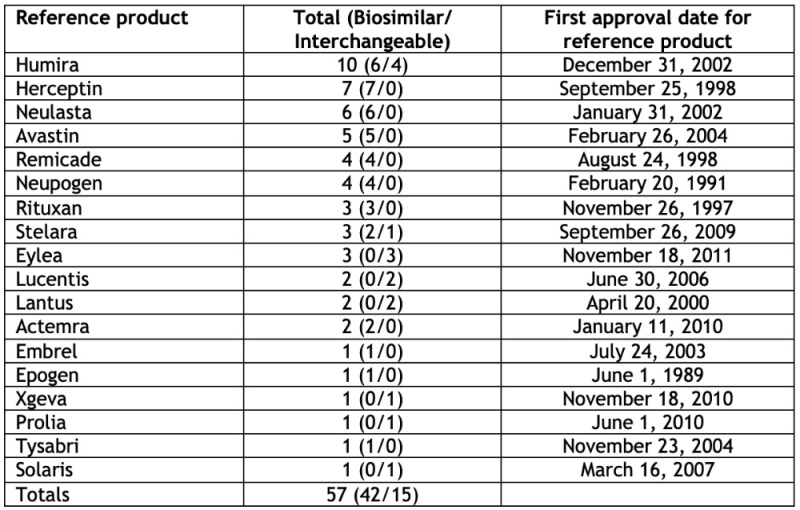
    While S.150 likely will have an effect on biosimilar litigation and market entry it should be appreciated that these effects are limited to address a historical anomaly:  because most biologic drugs facing competition were approved by FDA prior to enactment of the BPCIA they do not benefit from the 12-year market exclusivity provided under that statute.  The timing of these approvals is shown in the table, which also illustrates one basis for biosimilar competition for these drugs:

    Table
    The patents protecting the drug product itself, and at least the initial indications, have in most cases expired (the Humira patents, for example, expired in 2016) and consequently reference product sponsors have sought (and obtained) patents on novel indications, formulations, and manufacturing methods, Humira being something of a poster child for these "patent thicketing" efforts; see "Mayor and City Council of Baltimore v. AbbVie Inc. (7th Cir. 2022)".  But this response to the change of circumstances for biologic drugs is at best temporary, and later-approved drugs, having their 12-year exclusivity period to be co-extensive with the timetable envisioned by the drafters of the patent dance provisions of the BPCIA, should have much less incentive to "thicket" their patent portfolios.  Paradoxically, if S.150 is enacted it will also provide a roadmap for reference product sponsor behavior to avoid the effects of the law in reducing the number of patents available for assertion during BPCIA litigation.

    "Do something!" is the exhortation to Congress from interest groups and the public when it comes to drug prices, and patents are an easy target.  There are more systemic (and likely more effective) ways to address the problem, and those targets are beginning to be investigated (see Robbins & Abelson, The Opaque Industry Secretly Inflating Prices for Prescription Drugs, New York Times, June 21, 2024; FTC Deepens Inquiry into Prescription Drug Middlemen, May 17, 2023).  Unweaving the threads of the American healthcare system being responsible for "high" drug prices is much more difficult to accomplish than making patents and pharmaceutical companies the culprit, and thus it is likely that this trend of demonizing the only source of new drugs to address heretofore intractable diseases will continue.

  • Federal Circuit Calls "No Bet" on Beteiro's Asserted Patents

    By Andrew Velzen

    Federal Circuit SealRecently, the Court of Appeals for the Federal Circuit (CAFC) issued an opinion in Beteiro, LLC v. DraftKings Inc.[1]  This case is yet another case where the Federal Circuit upheld invalidity under § 101.  Here, the patents in question were directed to monitoring gaming / gambling activities at various physical locations, primarily with the idea that a user can be located in one location, but place wagers at a computer in a different location.

    In my view, the opinion illustrates what is, at best, a strained § 101 analysis.  The court simply could not get past what it viewed as a substantial imbalance of non-technical content to technical content in the specification.  Notwithstanding, though, there are certainly ways in which Beteiro could have better structured their claims and specification to withstand § 101 scrutiny.  Herein, I'll briefly discuss both of these points.

    Case Summary

    As a preliminary point, I think it's prudent to at least briefly summarize the procedural posture of the case and the Federal Circuit's decision.  The appeal to the CAFC arose based on multiple lawsuits filed by Beteiro against various gaming entities (DraftKings, PointsBet, BetMGM, Betfair, etc.) in the District of New Jersey.  In those lawsuits, Beteiro asserted patent infringement of four different patents.  Worth noting, despite claiming priority back to applications from 2002, 2003, and 2008, each of the asserted patents was filed in 2016 or later (i.e., each of the asserted patents was prepared and filed after the U.S. Supreme Court's decision in Alice Corp. v. CLS Bank International).  Notwithstanding, each of the defendants (now appellees) filed a motion to dismiss alleging that the asserted patents were invalid under § 101.  The District Court agreed and Beteiro appealed to the CAFC thereafter.

    Claim 2 of U.S. Patent No. 10,255,755 was deemed by the parties, the District Court, and the CAFC as representative of all the asserted claims for purposes of § 101 analysis.  This claim recites:

    2.  A computer-implemented method, comprising:
        detecting, with or using a computer which is specially programmed for processing information for providing for a placement of a bet on or regarding a gaming activity, a gambling activity, or a sporting event, a posting of information regarding the gaming activity, the gambling activity, or the sporting event;
        
    generating, with or using the computer, a notification message regarding the gaming activity, the gambling activity, or the sporting event;
        
    initiating, with or using the computer, a communication link with a first communication device and transmitting the notification message to the first communication device as an electronic transmission, or transmitting, from the computer, the notification message as an electronic mail message, wherein the electronic mail message is received by or received at a first communication device, wherein the first communication device is associated with an individual;
        
    receiving, with the computer, a bet message transmitted from the first communication device or from a second communication device, wherein the second communication device is associated with the individual, and further wherein the first communication device or the second communication device comprises a global positioning device, wherein the global positioning device determines a position or location of the first communication device or the second communication device, and further wherein the bet message contains information regarding a bet to be placed on or regarding the gaming activity, the gambling activity, or the sporting event, and information regarding the position or location of the first communication device or the second communication device; and
        
    determining, with or using the computer, whether the bet is allowed or disallowed using the information regarding the position or location of the first communication device or the second communication device and, if the bet is allowed, processing information for placing the bet for or on behalf of the individual, or, if the bet is disallowed, processing information for disallowing the bet [emphases added].

    The above-emphasized portions are where the CAFC focused the bulk of its analysis under § 101.  After said analysis, the CAFC ultimately affirmed the determination of invalidity.

    Court's § 101 Analysis

    As is rote at this point, in order to analyze whether a claimed invention is directed to patent-eligible subject matter, the Federal Circuit applied the Alice/Mayo test (i.e., Step 1 — Is the claim directed to a process, machine, manufacture, or composition of matter; Step 2A — Is the claim directed to a judicial exception to eligibility, such as an abstract idea; and Step 2B — Does the claim amount to significantly more than the judicial exception to eligibility).[2]  It bears noting that the patent examiner who examined these patent applications explicitly evaluated eligibility for the claims under § 101 and found them patent-eligible based on their recitation of a particular machine or processor.

    Step 2A

    Under Step 2A of the Alice/Mayo test, the CAFC agreed with the District Court that the claims were directed to the abstract idea of "exchanging information concerning a bet and allowing or disallowing the bet based on where the user is located."  In doing so, the CAFC indicated that the claims include many alleged "well-settled indicators of abstractness."  Setting aside the fact that that phrase borders on word salad, these so-called "indicators" included: (1) the claims broadly reciting generic steps of detecting information, generating and transmitting a notification based on the information, receiving a message, determining, and processing information; (2) the claims being drafted using largely result-focused functional language, while containing no specificity about how the purported invention achieves the results; (3) the claims being analogous to claims held abstract in other CAFC cases; and (4) the claims being analogous to longstanding "real-world" activities.

    Regarding item (1) above — Like many claims, if you abstract away all the substance and merely recite some gerunds, claims can quickly devolve into sounding rather patent-ineligible.  Regarding item (2) above — Whether something is described overly functionally is rather subjective.  Beteiro's claims recite "a computer," "a first communication device," "a second communication device," and "a global positioning device" and also describe communications among those devices.  Obviously, more detail can always be provided in a claim, but not without the cost of narrowing the claim.  Beteiro did not want to limit their claims to any particular type of communication protocol or type of communication devices, nor did Beteiro want to provide any additional unnecessary details about the "computer" or "communication devices."  Further, clearly Beteiro did not need to incorporate such narrowing details (at least in the patent examiner's opinion) in order to demonstrate that the claims were new and non-obvious.  Hence, the CAFC demanding that additional technical details be added to the claims for § 101 purposes when Beteiro already recited multiple devices performing different acts seems dubious.

    The CAFC's claim in item (3) is questionable, at best.  The Federal Circuit referenced Affinity Labs of Tex., LLC v. DIRECTV, LLC and Intell. Ventures I LLC v. Capital One Bank (USA) as allegedly containing analogous claims to Beteiro's.  The claims at issue in those cases, however, do not refer to any sort of "global positioning device" and are certainly much less tailored to communication protocols between devices.[3]  For example, the claim considered in Affinity Labs was:

    1.  A broadcast system, comprising:
        a network based resource maintaining information associated with a network available representation of a regional broadcasting channel that can be selected by a user of a wireless cellular telephone device; and
        
    a non-transitory storage medium including an application configured for execution by the wireless cellular telephone device that when executed, enables the wireless cellular telephone device:
            
    to present a graphical user interface comprising at least a partial listing of available media sources on a display associated with the wireless cellular telephone device, wherein the listing includes a selectable item that enables user selection of the regional broadcasting channel;
            
    to transmit a request for the regional broadcasting channel from the wireless cellular telephone device; and
            
    to receive a streaming media signal in the wireless cellular telephone device corresponding to the regional broadcasting channel, wherein the wireless cellular telephone device is outside of a broadcast region of the regional broadcasting channel, wherein the wireless cellular telephone device is configured to receive the application via an over the air download.

    Likewise, the claim considered in Intell. Ventures recites:

    1.  A system for providing web pages accessed from a web site in a manner which presents the web pages tailored to an individual user, comprising:
        an interactive interface configured to provide dynamic web site navigation data to the user, the interactive interface comprising:
        
    a display depicting portions of the web site visited by the user as a function of the web site navigation data; and
        
    a display depicting portions of the web site visited by the user as a function of the user's personal characteristics.

    These claims are only analogous to Beteiro's claims at a relatively high level of abstraction.  For example, neither relate to gambling / gaming in any sense.  Further, the primary purpose of both claims above is to determine what is displayed to a user, whereas the primary purpose of Beteiro's claims is to determine whether to allow or disallow a bet.

    Regarding claim (4) — Analogizing claim language to "real-world" activities, while sometimes done in § 101 cases, has always struck me as a bit ironic.  Namely, if claims are more akin to physical "real-world" activities, those claims are somehow less patent-eligible.  The "real-world" is the exact opposite of "abstract."  Thus, this flavor of analysis is essentially equivalent to saying "the claimed invention is not abstract, therefore it is an abstract idea and patent-ineligible."  It simply strains credulity.

    To illustrate the "real-world" nature of Beteiro's claims, the CAFC points to an analogy posited by the District Court of a teller at a casino that straddles state lines.  This analogy is absurd.  As an initial point, I'm not aware of any real casinos that actually fit this description (i.e., where you can place bets in two different states within the same casion).  In fact, I'd assume casinos intentionally avoid this issue so they don't have to simultaneously deal with multiple sets of state laws.  Hence, this issue rarely, if ever, comes up in the context of placing physical bets at a teller.  Oppositely, with modern technology, the issue of confirming location comes up in >90% of all sports bets placed.[4]  Further, even if the scenario proposed by the District Court / CAFC did come up in reality, there would be no "global positioning device" or "communication device(s)" needed or used because the bettor and the teller would be in the same physical location.  Hence, any attempted patent claim to this fabricated "real-world" scenario would look totally different than Beteiro's claims.

    On behalf of eligibility, Beteiro argued that their claims involved technological improvements and, therefore, are not directed to abstract ideas.  According to the CAFC, though, because the claims do not provide an improvement to the way computers operate nor do they solve a technical problem, the claims remain abstract ideas.

    Step 2B

    Under Step 2B of the Alice/Mayo test, Beteiro argued that the inclusion of a global positioning system (GPS) device in their claims was unconventional, which should provide for a path to patentability.  The CAFC attempted to refute this point by referring to the relatively limited discussion of GPS in the specification.  In particular, the lengthy specifications of the asserted patents only includes a single sentence concerning a mobile phone with an equipped GPS device.  Given this, the CAFC concluded that the inclusion of the GPS device on a mobile phone must have been conventional at the time.  This is, at the very least, a dramatic departure from the CAFC's Berkheimer decision.[5]  Regardless, in the CAFC's view, because the inclusion of a GPS on a mobile phone was routine, conventional, and well-understood, the inclusion of the GPS cannot convert a claim that is otherwise patent-ineligible into patent-eligible.

    This also raises an interesting procedural point.  Because this appeal arises from a motion to dismiss, any factual disputes need to be resolved in Beteiro's favor.  Further, Beteiro contended in its complaint that the use of GPS for gaming was unconventional in 2002 (their earliest priority date), and provided evidence to support this.  In 2002, for example, the iPhone had yet to be created.  Even so, the CAFC disregarded this contention based solely on what was (and was not) in the specification.  In doing so, the court cited to the recent AI Visualize case:[6]

    Conclusory allegations, or those "wholly divorced" from the claims or the specification, cannot defeat a motion to dismiss. And a patentee that emphasizes a claim's use of certain technology, for example, a general-purpose computer, fails at step two when the intrinsic record establishes that the technology is conventional or well-known in the art.

    While the Beteiro patents may not have described how one incorporates GPS devices into mobile phones, in detail, I think the court's reliance on the above precedent borders on dubious.  Beteiro's claims did specifically recite a "communication device" that "comprises a global positioning device, wherein the global positioning device determines a position or location of the first communication device or the second communication device."  Hence, Beteiro's allegations were not "'wholly divorced' from the claims."  Still, the court drew a distinction between Beteiro's complaint and the complaint in Cellspin Soft, Inc. v. Fitbit, Inc. where the contentions were purportedly much more rooted in the patent-in-suit.[7]

    Lastly, it is perhaps worth mentioning that the CAFC rightly wholly disregarded the patent examiner's previous consideration of § 101 issues under well-established law.  Regardless, though, the patent examiner apparently applied pre-Alice caselaw and relied on the existence of one or more physical components in deciding that the claims were patent-eligible.  This was clearly an overbroad view by the patent examiner.

    Suggested Improvements to Bolster Claims Under § 101

    The above clearly highlights, yet again, just how sticky § 101 is for patentees, even when physical devices (e.g., mobile devices and/or GPS sensors) are involved.  Perhaps, though, there are some ways that Beteiro could have reframed their specification or claims that would have provided a stronger bulwark for a § 101 analysis.  In that vein, let's highlight a few of them.

    One step that Beteiro could have taken, and which is explicitly contemplated by the CAFC opinion, would be to bolster the description of the GPS device in the specification.  Had the specification dedicated more space to technical details about the inclusion of the GPS device in a mobile device, the court clearly thinks that would help patentability (e.g., by demonstrating how the GPS device is a technical improvement) or, at the very least, would have provided fodder to get over a motion to dismiss under § 101 (i.e., because the additional technical details could raise a genuine question of material fact over whether inclusion of a GPS in a mobile device was truly well-understood, routine, and conventional).

    There are likely other technical details besides how a GPS device is integrated into a mobile device that could have been included in the specification to show that the use of a GPS device in the claimed way was unconventional.  For example, additional details on the ways in which the mobile device communicates the measured GPS data to the gaming facility computer (e.g., message communication protocols, formats in which the GPS data is communicated, where the GPS data is stored, how the GPS data is accessed / used by the gaming facility computer, etc.) could have been included.  Such additional details would not only serve to demonstrate the level to which the inventors had considered the importance of communicating the GPS data, but would also show why the inclusion of GPS data is central to the claimed invention serving its intended purpose.  Any of these technical details about the GPS could have been explicitly recited in the claims, as well, if Beteiro wanted to further strengthen their § 101 position.

    Additionally, as is sage advice these days in almost any patent application that might need to pass muster under § 101, the specification could have laid out a technical problem to be solved and how the claims provide a technical solution.  The claims and specification clearly address what is, in the eyes of the CAFC, non-technical problems (e.g., gambling jurisdiction and legal compliance).  This is simply not helpful based on current § 101 jurisprudence.  Instead, if the specification had couched the discussion in terms of the gaming facility computer being unable to reliably determine the location of the mobile device based on conventional messaging between the two, and then later provided the GPS device as a means of enabling a reliable determination of location in the invention, the court may have been more inclined to find that the claims amounted to "significantly more" (based on the claims providing an arguably technical solution to a technical problem).  While this borders on quibbling about semantic differences, unfortunately, that is the present state of the law under § 101.

    In addition to the changes to the specification described above, there are certainly some modifications that could have been made to the claims (many without requiring modification to the specification at all).  One that I would suggest, and this is purely psychological, is to remove references to "gaming activity," "gambling activity," "sporting event," etc. from the claims.  While these terms shouldn't impact a court's view or an examiner's view eligibility under § 101, they implicitly connote non-technical concepts to some readers.  Thus, anecdotally, their inclusion makes patent-eligibility a bit more of an uphill battle.  Hence, broadening the claims to only refer to things like "requests" and "confirmations" rather than "bets" could only help (at least in terms of § 101).

    Conclusion

    Ensuring compliance with jurisdictional regulations is of paramount importance to the gambling industry.  Further, Beteiro's claimed invention was, at least in the eyes of the patent examiner, a novel and non-obvious way of doing so using a GPS device. While it may seem pedestrian to use a GPS device for such purposes by modern standards, in 2002, it was likely anything but. Still, the morass that is post-Alice § 101 has claimed yet another victim.  If you're hoping to see more clarity in § 101 law soon, I wouldn't bet on it (pun intended).

    Beteiro, LLC v. DraftKings, Inc. (Fed. Cir. 2024)
    Panel: Circuit Judges Dyk, Prost, and Stark
    Opinion by Circuit Judge Stark

    [1] https://cafc.uscourts.gov/opinions-orders/22-2275.OPINION.6-21-2024_2337276.pdf

    [2] Note that the CAFC opinion basically glosses over Step 1 of the Alice/Mayo test.  Hence, what I am calling "Step 2A" is referred to as "Step 1" by the Federal Circuit and what I am calling “Step 2B” is referred to as "Step 2" by the Court. The nomenclature does not matter so much, but I prefer to go with the more traditional naming that contemplates the full eligibility analysis.

    [3] Affinity Labs of Tex., LLC v. DIRECTV, LLC, 838 F.3d 1253 (Fed. Cir. 2016); Intell. Ventures I LLC v. Capital One Bank (USA), 792 F.3d 1363 (Fed. Cir. 2015)

    [4] https://www.gamingtoday.com/revenue/ (On July 14, 2024 – "In most markets, more than 90% of sports betting is online.  For markets where mobile wagering is heavily favored, like New York and New Jersey, more than 90% of betting happens online")

    [5] Berkheimer v. HP Inc., 890 F.3d 1369 (Fed. Cir. 2018) ("Whether something is well-understood, routine, and conventional to a skilled artisan at the time of the patent is a factual determination.  Whether a particular technology is well-understood, routine, and conventional goes beyond what was simply known in the prior art.  The mere fact that something is disclosed in a piece of prior art, for example, does not mean it was well-understood, routine, and conventional.")

    [6] AI Visualize, Inc. v. Nuance Commc’ns, Inc., 97 F.4th 1371 (Fed. Cir. 2024)

    [7] Cellspin Soft, Inc. v. Fitbit, Inc., 927 F.3d 1306 (Fed. Cir. 2019)

  • By Michael Borella

    USPTO SealAs required by President Biden's Executive Order 14110 ("Safe, Secure, and Trustworthy Development and Use of Artificial Intelligence"), the U.S. Patent and Trademark Office has published an update to its subject matter eligibility guidance for examiners regarding inventions employing artificial intelligence (AI).  As this is the first update to the USPTO's subject matter eligibility guidance in almost five years, there was some hope that it would address stakeholders' long-held concerns.  These include the difficulty of crafting claims and a specification directed to an invention that incorporates AI, especially in view of the dramatic disparity in how examiners apply the law in view of the USPTO's previous guidance.

    However, the updated guidance is remarkably non-substantive at best, and at worst appears to take the position that advances in AI and uses of AI are ineligible unless they are implemented in specific hardware circuitry or cause a significant change to the state of an ancillary system.  Moreover, the updated guidance largely reads as general eligibly guidance with few actual AI-specific considerations.

    Indeed, the updated guidance makes it painfully clear that it (like the USPTO's previous guidance on the topic) "does not create any right or benefit, substantive or procedural, enforceable by any party against the USPTO."  In other words, examiners are free to ignore the updated guidance as they see fit, which is how examiners have approached the USPTO's previous subject matter eligibility guidance over the last decade.

    In any event, it is not until the halfway point of the updated guidance that it addresses the USPTO's currently eligibility test.  In particular, the updated guidance focuses on Step 2A, prong one (determining whether a claim recites a judicial exception) and step 2A, prong two (determining whether the claim integrates the recited judicial exception into a practical application of the exception).  Unfortunately, the USPTO largely employs hypothetical examples in doing so.

    Regarding Step 2A, prong one, the USPTO reminds us that "USPTO personnel must draw a distinction between a claim that 'recites' an abstract idea . . . and one that merely involves, or is based on, an abstract idea."  In the former case, the claim requires further eligibility analysis and in the latter case the claim is eligible.

    The USPTO sets forth three hypothetical examples of claims that do not recite an abstract idea: (i) custom and specific circuits designed to implement arrays of neurons and synaptic weights, (ii) a processor, livestock herd monitor, and transmitter collectively arranged for monitoring health and activity in a herd of dairy livestock animals, and a "treatment method comprising administering rapamycin to a patient identified as having Nephritic Autoimmune Syndrome Type 3."  Notably, only the first of these examples even relates to AI.

    The USPTO goes on to state that examiners should identify specific claim limitations that fall within the three groupings of abstract ideas:  mathematical concepts, certain methods of organizing human activity, and mental processes.  This leads to the rather absurd result that more specific recitations in a claim (which are encouraged by a large number of Federal Circuit eligibility opinions) can ultimately render a claim ineligible, whereas broader recitations of the same invention (which are discouraged by these Federal Circuit eligibility opinions) can result in a claim being eligible because it does not recite an abstract idea.

    Regarding math, the USPTO essentially repeats it's thin and unworkable distinction between claims that recite mathematical concepts and claims that are based on or involve a mathematical concept.  In practice, examiners do not understand this distinction and the USPTO's terse discussion in the updated guidance suggests that they are not alone.  To state what should be obvious, all science and engineering advances involve mathematical concepts in one way or another — a claim that recites "taking the sum of a first output and a second output" should not be subject to more scrutiny than a claim that recites "determining a result based on a first output and a second output."

    The certain methods of organizing human activity category has been viewed expansively by the courts and some examiners to include anything remotely related to human activity.[1]  Here, the USPTO relies on three recent Federal Circuit eligibility opinions to flesh out the category.  The problem is that all three examples found claims to be ineligible.  It would be nice if the USPTO could provide at least a hint of what might not fall within this gaping chasm of a category.

    On mental processes, the USPTO continues to apply what can only be considered a legal fiction.  In essence, the current practice is that any invention that, even in theory, could be performed by one or more human beings with thought, pencil and paper, or other tools, is a mental process even if it would take millions of years to obtain a useful result.  Indeed, the mental process category encompasses processes that are not performed mentally.

    Here, the USPTO at least gives us one example of an invention that (in its view) does not recite a mental process ("a specific, hardware-based RFID serial number data structure [that is] uniquely encoded").  However, when compared to the other examples that do recite a mental process (e.g., "the collection of information from various sources and understanding the meaning of that information"), the USPTO appears to be slicing the bacon transparently thin.[2]

    Moving on to Step 2A, prong two, the USPTO reiterates that examiners should determine whether "there are any additional elements recited in the claim beyond the judicial exception(s), and [evaluate] those additional elements individually and in combination to determine whether they integrate the exception into a practical application of that exception."  Despite the USPTO's reminder that claims are to be considered "as a whole" in this inquiry, such language is, in practice, a paper tiger.  Neither the USPTO nor the courts have ever explained what it means to consider claims as a whole, and both have routinely considered claims piecemeal while contending that they are actually considering claims as a whole.

    There are three ways to find a claim non-abstract under Step 2A, prong two — where the claim (i) improves the functioning of a computer, (ii) improves another technology or technical field, or (iii) is meaningfully limited to a particular technological environment.  But none of these have been defined in the case law, much less clearly defined.  The USPTO notes that specific solutions to specific problems are more likely to be eligible, but provides little insight that fleshes out this notion.  Instead, the USPTO again falls back on case law examples.

    These examples demonstrate that an eligible invention may look ineligible if you tilt your head three degrees to the left and vice-versa.  For example, a very specifically-worded claim for determining haplotype phase based on pedigree data in human genetic sequences was an improvement over prior attempts to do so, but not a "technical" improvement because the entire claim was putatively a mathematical process that ran on general-purpose computers.

    While the USPTO touted the claims of McRO, Inc. v. Bandai Namco Games America Inc. as an example of eligibility (which it is despite a lot of math being calculated by a general-purpose computer driving the thrust of the claimed invention), in practice it is rare that making an analogy to these claims will sway an examiner.  Instead (tilting their heads three degrees to the left), examiners typically conclude that any claim similar to McRO actually recites an ineligible abstract idea executing atop a non-specific chunk of silicon.[3]  In other words, there is little or no appreciable difference between the haplotype claim and those of McRO despite one being eligible and the other not.

    Toward the very end of the updated guidance, the USPTO addresses AI-assisted inventions.  It states:

    For the subject matter eligibility analysis under 35 U.S.C. 101, whether an invention was created with the assistance of AI is not a consideration in the application of the Alice/Mayo test and USPTO eligibility guidance and should not prevent USPTO personnel from determining that a claim is subject matter eligible.  In other words, how an invention is developed is not relevant to the subject matter eligibility inquiry.

    Thus, the words of the claim matter but the use of AI in developing the underlying invention does not.  Aside from this clear statement, the updated guidance is cagey in general and surprisingly thin on AI-specific content.[4]

    Practitioners have looked forward to iterations of the USPTO's subject matter eligibly guidance to add clarity and expedite prosecution.  After a decade of such guidance, it is clear that the USPTO's example-based approach has failed.  The chosen examples do not clarify the murky principles and distinctions that the words of the guidance set forth.  Moreover, the USPTO's reasoning regarding these examples is contradictory, muddled, opaque, and ultimately not helpful.  The greatest evidence for this is how different examiners apply the guidance in dramatically different ways.

    Again, the fault lies with the Federal Circuit's incoherent parade of patent eligibility horribles masquerading as judicial decisions.  But instead of acknowledging that the emperor is stark raving naked, the USPTO once again tries to pretend otherwise.

    It is time to stop.

    [1] One of my favorite examples is the examiner I spoke to who insisted that fully-automated navigation of a self-driving vehicle was a method of organizing human activity because the goal of the invention was to deliver people from point A to point B.

    [2] Credit for this confusion should be placed at the feet of the Federal Circuit, the decisions of which these examples are based.  

    [3] A relevant definition of "analogy" in the American Heritage Dictionary is "[a] form of reasoning based on the assumption that if two things are known to be alike in some respects, then they are probably alike in other respects."  Too many examiners seem to think that, to be analogous, two things must be exactly the same.

    [4] The USPTO has released three new sets of example claims to support the guidance.  They were not specifically addressed herein and may be discussed in a subsequent article.  In short, they do not provide enough further insight to render the updated guidance particularly helpful.

  • By Kevin E. Noonan –

    Judge Newman_1Today, D.C. District Court Judge Christopher R. Cooper put an end to Judge Pauline Newman's lawsuit against her colleagues, granting the Federal Circuit Judicial Council's motion to dismiss Judge Newman's suit on due process and 4th Amendment grounds (see "Judge Newman and the On-Going Attempts to Remove Her from the Federal Circuit").

    To recap, Judge Newman filed a complaint in May 2023, asserting 12 claims:

    Claim I asserted "improper removal [and] violation of separation of powers" based on Article III (life tenure of federal judges) and Article I (giving the House of Representatives the sole authority to remove a judge through impeachment after trial by the Senate).

    Claim II asserted that the Judicial Complaint is ultra vires for "improper removal [and] violation of separation of powers."

    Claim III alleged Fifth Amendment violations of due process because the members of the Special Committee are also purported witnesses to the alleged judicial misconduct.

    Claim IV asserts a First Amendment violation for unlawful prior restraint for the gag order.

    Claim V asserted that the gag order is also ultra vires as being an unlawful prior restraint on speech.

    Claim VI asserted a Fifth Amendment violation for unconstitutional vagueness of the provisions of the Disability Act.

    Claim VII asserted that the activities are ultra vires for unconstitutional examination because "[n]either the Act nor the U.S. Constitution authorizes compelling an Article III judge to undergo a medical or psychiatric examination or to surrender to any investigative authority her private medical records in furtherance of an investigation into whether the judge suffers from a mental or physical disability that renders her unable to discharge all the duties of office."

    Claim VIII also asserted a Fifth Amendment violation for unconstitutional vagueness regarding the Act's investigative authority.

    Claim IX alleged a Fourth Amendment violation for an unconstitutional search regarding the "compelled medical or psychiatric examination of an Article III judge without a warrant based on probable cause and issued by a neutral judicial official or a demonstration of constitutional reasonableness."

    Claim X alleged a Fourth Amendment violation for an unconstitutional search and seizure of a "compelled surrender of private medical records."

    Claim XI alleged a Fourth Amendment violation for "lack[ing] either a warrant issued on probable cause by a neutral judicial official or a constitutionally reasonable basis for requiring Plaintiff to submit to an involuntary medical or psychiatric examination."

    Claim XII alleged a Fourth Amendment violation for "lack[ing] either a warrant issued on probable cause by a neutral judicial official or a constitutionally reasonable basis for requiring Plaintiff to surrender her private medical records none of which bear on her fitness to continue serving as an Article III judge."

    The District Court previously dismissed Counts II, III, IV, VI, X and XI for lack of subject matter jurisdiction and Count I and parts of Count VII under Fed. R. Civ. P. 12(b)(6).  Thus, only Counts V, VII (in part), VIII, and IX remained before the Court, which was the subject of Judge Newman's motion in opposition (see "Judge Newman's Suit Continues") and the Judicial Council's reply (see "Special Committee of the Judicial Council of the Federal Circuit Replies").

    Judge Newman's legal arguments were that, first, as an Article III judge she is "constitutional officer of this Republic, and not merely a federal employee" who "does not have a supervisor and does not need to meet any performance metrics to keep her job."  "Congress alone has the power to remove her," her brief in opposition asserted.

    Second, the operative statute, the Disability Act, lacks a definition of what constitutes a disability nor what factors are to be considered.  Rather than relying on medical professionals, her brief asserted, the determination is left "in the hands of lay people like Chief Judge Moore and her colleagues, all without providing them with any tools to determine when a disability exists."

    Third, there is no provision in the statute for judicial review of any Orders or actions taken pursuant to the statute, permitting violations of the Fourth Amendment, including "invasive searches of private medical information" and allowing "self-executing" administrative orders to be promulgated by the Judicial Council, "a wholly administrative body."  The result is a regime where the Council can "employ and manipulate entirely standardless criteria in order to start and to continue investigations into and to impose unconstitutional sanctions on Article III judges."  In this regard, the brief reminds the District Court that the putative grounds and factual justifications for the Council's Orders have "evolved" in the year since the proceedings began.

    The Judicial Council replied, arguing with regard to Counts VIII and IX that the orders it issued under the statute, 28 U.S.C. § 353(c), are per se reasonable and do not implicate the Fourth Amendment.  Regarding Judge Newman's Count V challenge of the disability provisions of the statute for vagueness, the Judicial Council argued that Judge Newman failed the requirement of a facial challenge to show that "the law in question is impermissibly vague in all of its applications," citing Crooks v. Mabus, 845 F.3d 412, 417 (D.C. Cir. 2017), and, on the merits, argued that the Act is not constitutionally vague because the Act permits a judicial council to "take action where a 'judge is unable to discharge all the duties of office by reason of mental or physical disability" under 28 U.S.C. § 351(a).  And with regard to Count VII, the Judicial Council argued that that Judge Newman has not asserted any reason "to doubt the sufficiency of [the standard that] "an investigation [is] as extensive as [a Judicial Council] considers necessary" (other than the implication that this is no standard at all, being entirely discretionary to the whims of the Court's Judicial Council), and that the constitutional clarity of the statute is "settled law."

    The District Court's opinion granting the Judicial Council's motion to dismiss addresses the four remaining Counts in two groups: Counts VII and IX on unconstitutionality grounds and Counts V and VII for vagueness.  For Count VIII and Count IX comprised facial challenges on 4th Amendment grounds against the Judicial Conduct & Disability ("JC&D") Act, 28 U.S.C. §§ 353(a), (c) empowering the Chief Judge to form a committee to investigate the allegations against Judge Newman.  Judge Newman alleged that § 353(c) "violates the Fourth Amendment to the extent it authorizes a compelled medical or psychiatric examination of an Article III judge" (Count VIII) or "a compelled surrender of medical records belonging to an Article III judge" (Count IX) "without a warrant based on probable cause."  The opinion recites the burden for prevailing on such a facial challenge to be that the statute is "unconstitutional in all of its applications," citing Wash. State Grange v. Wash. State Republican Party, 552 U.S. 442, 449 (2008).  The Court found the statute not to be facially invalid because a special committee under the statute could engage in investigations that "do[] not run afoul of the Fourth Amendment," citing Florida v. Bostick, 501 U.S. 429, 434 (1991); United States v. Miller, 425 U.S. 435, 443 (1976); and United States v. Simons, 206 F.3d 392, 395–96, 398 (4th Cir. 2000) (notably, all of which had to do with court employees, a status which Judge Newman argued does not properly describe an Article III judge ("it should be noted that Judge Newman is not an employee, but an independent constitutional officer and that neither Chief Judge Moore, nor the Special Committee, nor the Judicial Council are her 'supervisors'" as was the case in many of the decisions cited by Defendants in their Motion").  The opinion rejects the distinction Judge Newman drew that a Chief Judge could always interrogate a court employee, on the grounds that a special committee could not do so (but apparently ignoring the fact that this special committee had as a member the Chief Judge herself).  The Court also ignored Judge Newman's distinctions with the circumstances of City of Los Angeles, Calif. v. Patel, 576 U.S. 409, 415, 418 (2015), and further applies more general standards for facial challenges (e.g., regarding drones and the FAA; see Brennan v. Dickson, 45 F.4th 48 (D.C. Cir. 2022), that seem somewhat far afield from the case before the Court).

    Regarding Count V and Count VII for vagueness, Judge Newman's contentions were that the JC&D Act violates the due process clause of the Fifth Amendment and were unconstitutionally vague.  As for Count V, the Court says that statutes are not impermissibly vague "merely because they 'require[] a person to conform his conduct to an imprecise but comprehensible normative standard, whose satisfaction may vary depending upon whom you ask,'" citing United States v. Bronstein, 849 F.3d 1101, 1107 (D.C. Cir. 2017).  Based upon "the text, legislative history, and implementing rules of the JC&D Act, section 351(a)" the Court held the statute not to be unconstitutionally vague.  According to the Court, the text defines the standard of conduct to be the "duties of [judicial] office" (which is not vague inter alia because "judges, the only individuals against whom § 351(a) can be enforced, are well aware of their duties" and because judges swear an oath to "faithfully and impartially discharge and perform all the duties incumbent upon" them" under 28 U.S.C. § 453).  The Court also relies upon the legislative history to the effect that the statute is directed towards "judicial transgression" (which, on its face, seems to be more directed to outcome rather than process, which is what seems to be at issue here and behind Judge Newman's complaint).  Citations to the Code of Judicial Conduct and the Canons of Judicial Ethics of the American Bar Association also seem inappropriate in this case because, after all, the basis for Judge Newman's suspension was contrary to neither of these canons but was based on the Judge's allegations that the "independent neurological testing and provide it relevant medical records" was outside the scope of the special committee's powers and an infringement on her due process and privacy rights.  And the "[e]xamples of disability" including "substance abuse, the inability to stay awake during court proceedings, or impairment of cognitive abilities that renders the judge unable to function effectively" under JC&D R. 4(c) of the Rules for Judicial-Conduct and Judicial-Disability Proceedings do not seem to apply to Judge Newman's circumstances, either, although they are cited by the Court in support of the lack of vagueness in the statute.  The Court rejects Judge Newman's rebuttals to the special committee's arguments as being subjective ("which is not unconstitutional") and interprets the distinctions Judge Newman makes between a federal employee and an Article III judge by citing definitions of "judicial independence" as "not giv[ing] 'judges "absolute freedom from" discipline or sanctions that fall short of removal or salary diminution," quoting McBryde v. Comm. to Rev. Cir. Council Conduct & Disability Ords. of Jud. Conf. of U.S., 264 F.3d 52, 65 (D.C. Cir. 2001)), citing these as "accepted limits on judicial independence."

    Regarding Count VII, the Court asserts that the investigative provisions of the JC&D Act fall within the scope of prohibition in neither of two scenarios:  "[I]f it leaves judges and jurors free to decide, without any legally fixed standards, what is prohibited and what is not in each particular case, . . . or permits them to prescribe the sentences or sentencing range available," citing Beckles v. United States, 580 U.S. 256, 266 (2017), and  El-Shifa Pharm. Indus. Co. v. United States, 607 F.3d 836, 856 n.4 (D.C. Cir. 2010).  This is because, in the Court's view, "[i]t does not vest a special committee with authority to decide what judicial conduct is or is not permissible, nor does it allow a committee to choose the proper penalty for such conduct."  The Court finds the scope of the special committee's powers to be consistent with activities of federal prosecutors and agencies.  The Court further rejects what the opinion terms "tangential arguments" by Judge Newman, the first that the statute provides no standards (the opinion having set forth its opinion on these standards) and the second that the special committee can compel the Judge to disclose private documents and "directly sanction" her for not doing so (the opinion characterizing this argument as "repackaging" an argument made in an earlier round of motions that the Court rejected, and further that the special committee has no enforcement power, which is reserved to the Judicial Council which have such power).

    Thus ends Judge Newman’s attempts to regain her position on the Federal Circuit (absent appeals, of course).  This unfortunate situation has harmed the stature of the Court.  Judge Newman deserved better.  Her wonderful and admirable legacy, on the other hand, remains and will be long remembered.

  • By Kevin E. Noonan –

    Supreme Court Courtroom
    In addition to Justice Gorsuch's concurrence (to be discussed in a later post), the three "liberal" Justices on the Court differed from their colleagues and thought overturning the Chevron precedent to be both erroneous and unnecessary.  Their dissent, written by Justice Kagan and joined by Justices Sotomayor and Jackson, took a dim view of the majority's legal reasoning and the consequences of their decision.

    Instead of looking into the Court's distant past for support, the dissent begins by reminding the majority (and us) that "[f]or 40 years, Chevron U. S. A. Inc. v. Natural Resources Defense Council, Inc. . . . has served as a cornerstone of administrative law."  Unlike the majority, who apparently believe that the Chevron precedent renders judges unable to judge, the dissent apprehends that under this precedent "a court uses all its normal interpretive tools to determine whether Congress has spoken to an is­sue" (and if so "the agency's views make no difference").  It is in the instances where Congress has not spoken clearly, and "if the court finds, at the end of its interpretive work, that Congress has left an ambiguity or gap" that the issue is joined whether the agency or the courts, in the first instance decides how the law will be interpreted and applied.  The dissenting Justices believe that the agencies, not the courts, are (usually, but not exclusively) best equipped to make these choices and that this allocation of decision-making is the right choice ("the rule is right") and (inherently at least) consistent with Congressional intent.  This is because such decisions can involve "scientific or technical subject matter," or require an understanding of "complex and interdependent regulatory programs," neither of which are usually within a court's skill (or knowledge) set.  The current regime also accommodates the "chain of command" between the agencies and the President, "who in turn answers to the public for his policy calls" (and is accountable thereto; this, after all was the line of reasoning used by the Chief Justice in upholding the constitutional validity of the Affordable Care Act in National Federation of Independent Business v. Sebelius).

    The dissent accuses the majority of "flipping the script" on this "almost obvious choice," with "[a] rule of judicial humility giv[ing] way to a rule of judicial hubris."  This is the most recent of a pattern of the Court "too often tak[ing] for itself decision-making authority Congress assigned to agencies," the dissent citing National Federation of Independent Business v. OSHA, 595  U.S. 109 (2022), West Virginia v. EPA, 597 U.S. 697 (2022), and Biden v. Nebraska, 600 U.S. 477 (2023), in support of this allegation.  As a consequence, the majority has turned the Court "into the country's administrative czar" "[i]n one fell swoop."  And in doing so, the majority has made a "laughing-stock" of stare decisis, which the dissenting Justices assert "remind judges that wisdom often lies in what prior judges have done" and provide "a brake on the urge to convert 'every new judge's opinion' into a new legal rule or regime," Justice Kagan reciting the dissent in Dobbs v. Jackson Women's Health Organization, 597 U.S. 215, 388 (2022), quoting 1 W. Blackstone, Com­mentaries on the Laws of England 69 (7th ed. 1775) (trumping the majority's basis on our history with legal opinion contemporaneous with the Founders).  And paralleling the majority's suggestion that Congress could overrule their decision by statute (a false assertion based on the legal grounds for that decision), here the dissent asserts as one basis for considering erroneous the majority's dismissal of stare decisis in this case is that Congress, for the past forty years, has not done so by overruling Chevron (making the application of stare decisis "supercharged" in this instance).  The dissent characterizes the majority's opinion as "a bald assertion of judicial authority" that "disdains restraint, and grasps for power."

    The dissent also provides its own explication of the origins of the Chevron doctrine and consequences it has had on administrative law for the past four decades.  That origin is the unavoidable ambiguities that arise when Congress enacts laws and sometimes where those ambiguities are intentional; see, e.g., the Biologics Price Control and Innovation Act (the subject of a later post), where Congress could not have unintentionally delegated to the Food and Drug Administration responsibility for developing a biosimilar approval pathway (the statute is replete with instructions that "the Secretary" shall act to implement the specific provisions recited therein).  In addition, the dissent sets forth the myriad ways Congress through intent or mistake could so delegate, or for which the issue addressed by the agency could not have been anticipated by the drafters (indeed, at its core the issue is the extent to which Congress passes to the Executive branch the responsibility to execute and enforce the laws; for example, once Congress has declared war legislators do not then micromanage how the President or Secretary of Defense, much less military commanders prosecute the war on the battlefield).  The dissent discusses instances from the case law developed over the past four decades to illustrate the point, including Teva Pharmaceuticals USA, Inc. v. FDA, 514 F. Supp. 3d 66, 79–80, 93–106 (DC 2020) (regarding the definition of a protein under 42 U.S.C. § 262(i)(1); Northwest Ecosystem Alliance v. United States Fish and Wildlife Serv., 475 F. 3d 1136, 1140–1145, 1149 (CA9 2007) (defining "distinct populations" of certain species of squirrels); Bellevue Hospital Center v. Leavitt, 443 F. 3d 163, 174–176 (CA2 2006) (defining "geographic areas" related to hospital reimbursement); Grand Canyon Air Tour Coalition v. FAA, 154 F. 3d 455, 466–467, 474–475 (CADC 1998) (defining noise levels permissible by aircraft over the Grand Canyon); and Chevron itself, regarding "stationary sources" of air pollution).  The dissent recognizes that in each case the statutory language had more than one reading that would be "reasonable" and that the question that thus arises is "Who decides which of the possible readings should govern?"

    The answer over the past forty years has been that the agencies should decide, and courts defer in instances where there isn't a "single right answer" (otherwise neither the courts nor the agencies decide, because Congress has spoken; see Ki­sor v. Wilkie, 588 U. S. 558, 588 (2019)).  And under Chevron when a court, "after using its whole legal toolkit" finds that there is no unambiguous definition by Congress, the Court has (and should) defer to the agency tasked with implementing the law and (presumably) having the technical and experiential knowledge and expertise to be in the best position to do so, the dissent stating that "the court must cede the primary interpretive role").  The role of the courts, as the dissenting Justices see it, should be (and has been) "only as a backstop to make sure the agency makes a reasonable choice among the possible readings."  (In a footnote, the dissent explicates several routine instances and circumstances where what Congress intended is presumed, including ones against extraterritoriality of U.S. laws, prospective (rather than retrospective) application of the laws, and against repeal by implication.)  The rationale for agencies rather than courts to resolve ambiguities (the "why" the dissent provides) set forth in the dissenting opinion include the idea that "agencies often know things about a statute's subject matter that courts could not hope to" know (particularly when the statute implicates scientific or technical questions, illustrated by Justice Kagan by the portion of the biosimilar statute regarding when an amino acid polymer is considered a protein, the Justice posing that the first question facing a court trying to resolve the ambiguity would be "What even is an alphaamino acid polymer?").  Another example is the decision regarding distinct vel non species of squirrels; in this case, the dissent speculates that "[a] court could, if forced to, muddle through that issue and announce a result" but reasons that the specialized expertise of the Fish and Wildlife Service would "do a better job of the task."

    The dissent next addresses a different scenario, wherein the ambiguity arises from "a complex regulatory regime" and how it functions effectively.  Taking the squirrel example again, the dissent cites instances where prior decisions can be understood by the agency (but perhaps slightly less effectively, seeing as the cited earlier case law might be effectively understood by a court).  The dissent's better point is that an agency makes these distinctions all the time as part of its operations as an agency, while courts address these issues much more sporadically.  A similar scenario, and an agency's superior ability to reasonably interpret the law, cited in the dissent involves the Medicare reimbursement issue involving the term "geographic area" mentioned above, the dissent positing:

    It would make sense to gather hard information about what reimbursement levels each approach will pro­duce, to explore the ease of administering each on a nation­wide basis, to survey how regulators have dealt with simi­lar questions in the past, and to confer with the hospitals themselves about what makes sense[,]

    and suggesting that the Department of Health and Human Services is better equipped to make these assessments.  (In this regard, the majority's suggestion that evidence from the parties and amici can substitute seems particular jerry-rigged in comparison.)

    Turning to the policy rationale, the dissent minimizes the legal basis for the decisions the majority's decision shifts from the agency to the courts.  Using the regulation of noise levels over the Grand Canyon as an example, the dissent recognizes that the question of "How many flights, in what places and at what times, are consistent with restoring enough natural quiet on the ground?" is "a policy trade-off of a kind familiar to agencies—but peculiarly unsuited to judges."  In addition to expertise and familiarity, the dissent asserts that because Federal agencies are "subject to the supervision of the President, who in turn answers to the public," citing Kisor, Congress may rely on the "accountable actor" to better use "wise policy to inform its judgements" rather than an independent judiciary (turning on its head the majority's argument of the historical antecedents and necessity of judicial primacy).

    The dissent recognizes that deference is not always the answer, stating that the Chevron regime had been "fine-tuned" over time in recognition of this reality.  The majority's disparagement of these refinements as evincing flaws in the system "are anything but" according to the dissent, citing Epic Systems Corp. v. Lewis, 584 U.S. 497, 519–520 (2018) (which precludes an agency from interpreting a statute it does not implement); United States v. Mead Corp., 533 U.S. 218, 226–227 (2001); and Encino Motor­cars, LLC v. Navarro, 579 U. S. 211, 220 (2016) (for instances where the agency fails to use, or use properly, its "rulemaking or adjudicatory authority").  The dissent notes that the Court has even fashioned an "extraordinary cases" exception to Chevron's general rule of deference, in instances where questions of vast "economic and political significance" are involved, citing King v. Burwell, 576 U.S. 473, 485-486 (2015).

    The result of Chevron and its forty years of application has been a "carefully calibrated framework [that] 'reflects a sensitiv­ity to the proper roles of the political and judicial branches'" according to the dissenting Justices' assessment, citing Pauley v. Beth En­ergy Mines, Inc., 501 U.S. 680, 696 (1991).  That framework is expressly set forth in the dissent:

    Where Congress has spoken, Con­gress has spoken; only its judgments matter.  And courts alone determine when that has happened: Using all their normal interpretive tools, they decide whether Congress has addressed a given issue.  But when courts have decided that Congress has not done so, a choice arises.  Absent a legislative directive, either the administering agency or a court must take the lead.  And the matter is more fit for the agency.  The decision is likely to involve the agency's sub­ject-matter expertise; to fall within its sphere of regulatory experience; and to involve policy choices, including cost-benefit assessments and trade-offs between conflicting val­ues.  So a court without relevant expertise or experience, and without warrant to make policy calls, appropriately steps back.  The court still has a role to play: It polices the agency to ensure that it acts within the zone of reasonable options.  But the court does not insert itself into an agency's expertise-driven, policy-laden functions.  That is the ar­rangement best suited to keep every actor in its proper lane.  And it is the one best suited to ensure that Congress's stat­utes work in the way Congress intended.

    The dissent then addresses and rejects the majority's "points in reply."  First is the assertion that courts, not agencies, have any "specialized competence" in resolving the ambiguities that raise the questions before the Court.  The dissent responds, "Score one for self-confidence; maybe not so high for self-reflection or -knowledge" (and later calling the majority's position "malarkey") and while acknowledging a court's capacity to "construe legal texts, hopefully well" credits the first step of the Chevron test to "take full advantage of that talent."  The reason for deference under Chevron, the dissent asserts, is when a "court must admit that standard legal tools will not avail to fill a statutory silence or give content to an ambiguous term."  The question is not one of legal acumen but rather "one or more of: subject-matter expertise, long engagement with a regulatory scheme, and policy choice," in which courts "'have no special competence'—or even legitimacy."

    The majority's second argument is that the existence of an ambiguity or gap in statutory language does not "necessarily reflect a congressional intent that an agency" have "primary interpretive authority."  The dissent concedes the premise, but the basis for the Chevron regime is a presumption that is applied in a case-by-case basis because while it "does not maintain that Congress in every case wants the agency, rather than a court, to fill in gaps" there needs to be a "default rule" regarding which would be the best source of the best resolution of the ambiguity or gap.  The majority's contention that ambiguities and gaps are unintentional is an insufficient justification for the dissent, first because many are not unintentional (in the sense of being unforeseen) and second (the dissent asks) why should that matter, if it is merely an inherent consequence of the legislative process and execution of the statutes by the appropriate agency?  (And the dissent's rejoinder, as in the majority on the converse position is that if Congress doesn't want the agency to take this role "all it needs to do is say [so]").  Which Congress has never done (being "the proof . . . in the [legislative] pudding") and has in fact rejected proposed legislation that would have abolished the Chevron regime "across the board," citing S. 909, 116th Cong., 1st Sess., §2 (2019) (still a bill, not a law); H. R. 5, 115th Cong., 1st Sess., §202 (2017) (same).

    Turning to the majority's reliance on the Administrative Procedures Act (APA) and its putative incompatibility with Chevron purported in the majority opinion, the dissent asserts that Chevron and the APA are "perfectly compatible."  In the dissent's view, Section 706 (cited extensively in the majority opinion) merely provides for judicial review of agency actions.  Citing academic legal authorities, the dissent says that the text itself "does not resolve the Chevron question" as the majority interprets it to do.  As the dissent sees it, the deficiency is that Section 706 does not set forth any standard for judicial review, either deferential under Chevron or de novo as the majority opinion would have it.  The dissent notes that Section 706 does specify standards of review, for example deference to agency factfinding (substantial evidence) and policymaking (abuse of discretion).  The dissent differs with the majority's conclusion that Congress would have included similarly deferential review standards for legal questions if that was its intent; there are other portions of the Section where a de novo standard of review is set forth (resulting in references to standards of review "running around Section 706").  The dissent also notes that most "respected commentators" (including contemporaneous writers such as Professor Kenneth Culp Davis) agree with the preference in the Section for deferential review ("They did not see in their own time what the majority finds there today"), citing examples (perhaps not the commentators that the majority Justices read or respect) and conceding in a footnote that at least one such "respected commentator" took the contrary view agreeing with the majority.  But this is a new interpretation of the APA by the Supreme Court, which until this decision did not appreciate the invalidating contradictions between Chevron and the APA asserted by the majority (although this is a feature of most instances where the Court reverses longstanding precedent, perhaps accounting for the rarity thereof).  And history is not on the majority's side, either according to the dissent, insofar as courts had become more deferential to administrative agencies during the New Deal (and to be fair, World War II), citing Justice Breyer's contribution to an administrative law treatise for this information and Supreme Court decisions, Gray v. Powell, 314 U. S. 402 (1941) and NLRB v. Hearst Publications, Inc., 322 U.S. 111 (1944), as examples of deferential judicial review of agencies' statutory interpretation.  The dissent asserts additional cases (to counter the majority's allegation that these Justices "plucked" these two cases as exceptions) and dismisses the majority's reliance on purportedly inconsistent instances of deference pre-APA as making the majority's further argument that Section 706 prohibits deference "fall[] flat."

    Finally, the dissent addresses the abandonment of stare decisis by the majority on the basis that while not intended to be an "inexorable command" to do so requires "far more" than the majority provides in its opinion.  The extent of this "far more" for the dissent is "above and beyond thinking it wrong."  This is particularly the case where, as here, the decision "will cause a massive shock to the legal system, 'cast[ing] doubt on many settled constructions' of statutes and threatening the interests of many parties who have relied on them for years," citing Kisor.  Stare decisis is a doctrine of "judicial modesty" that, like Chevron itself, "tell judges that they do not know everything, and would do well to attend to the views of others."  As a practical matter, the dissent asserts that the Court itself has upheld Chevron "at least 70 times" and the inferior courts have made decisions based on Chevron on "thousands and thousands of occasions" (more than 18,000 at last count).  And the dissent criticizes the majority for "overruling-through-enfeeblement" of decisions a majority disagrees with by refusing to apply a precedent and disparaging it in those opinions as the basis to overrule (finding equally feeble the majority's argument/evidence that the Chevron regime is "unworkable" due to there being "no single 'answer' about what 'ambiguity' means," which seems to be a reasonable definition of ambiguity).  Paradoxically, the dissent contends, Chevron promotes agreement between how judges interpret ambiguous statutes (as compared with de novo review) and thus does not deserve the majority's contention that it causes "too much judicial divergence."  Perhaps equally paradoxically in the dissent's view the regime the majority impose to replace Chevron is itself problematic to implement, and these Justices see the deference to an agency's "body of experience and informed judgment" under Skidmore v. Swift & Co., 323 U. S. 134, 140 (1944), to be at future risk for judicial meddling (it would not take much to infer a similar judgment about the majority's opinion here).

    "At its core," the dissent concludes, "Chevron is about respecting that allocation of responsibility—the conferral of primary authority over regulatory matters to agencies, not courts" coming from a time when "when we [the Court] knew what we are not."  The majority, according to the dissent, does not respect that judgment, giving courts "power to make all manner of scientific and technical judgments," "the power to make all manner of policy calls, including about how to weigh com­peting goods and values," and "puts courts at the apex of the administrative process as to every con­ceivable subject—because there are always gaps and ambi­guities in regulatory statutes."  "In every sphere of current or future federal regulation," the dissent asserts, "expect courts from now on to play a commanding role" which "is not a role Congress has given to them" but "a role this Court has now claimed for itself, as well as for other judges."

    Albeit easy to cast along conventional philosophical lines, both the majority and dissenting opinions were outcome-oriented, although the dissent was frankly so while the majority opinion dressed up this aspect with a patina of history and how the Founders would consider the question (in an age where the modern concept of an administrative agency was unknown).  Indeed, the majority was almost disdainful toward the consequences of wiping out forty years of precedent to reach their outcome, showing somewhat flexible allegiance towards stare decisis and other legal principles.  This attitude is fraught with at least some danger, insofar as the Court's institutional authority is intimately related to and dependent upon its institutional integrity.  To the extent that the majority reject Chevron as being completely wrongly decided (even going so far as to dismiss the Court's judgment by six Justices in a decision supported by just as many (or few) here) both are brought into question.

  • The Demise of Chevron Deference

    By Kevin E. Noonan –

    Supreme Court Building #2Not surprisingly, the Supreme Court overturned the "Chevron deference" principle from its 1984 Chevron U.S.A., Inc. v. Natural Resources Defense Council, Inc. decision in Loper Bright Enterprises v. Raimondo (and it did so expressly and with no equivocation, stating "Chevron is overruled").

    This case (decided below on Chevron principles) arose over a dispute involving regulation on fishing (and the amount thereof) in an area within 200 nautical miles beyond the U.S. territorial sea (12 nautical miles from shore).  The regulations were enacted under the Magnuson-Stevens Fishery Conservation and Management Act (16 U.S.C. § 1801 et seq.) and are administered by the National Marine Fisheries Service (NMFS).  These regulations are intended to prevent overfishing and are promulgated by the NMFC based on recommendations by eight regional councils comprised of coastal state representatives, stakeholders (e.g., fishermen), and members of the NMFC.  The NMFC, for its part, includes mandatory limitations on annual catch and specifies ("prohibit, limit, condition, or require") types and amount of fishing gear permitted to be used, as well as requiring a certain proportion of the catch to be used in scientific research.  At issue in this case was the requirement that "one or more observers be carried on board" domestic vessels "for the purpose of collecting data necessary for the conservation and management of the fishery" under § 1853(b)(8), the cost of which to be borne by "(1) foreign fishing vessels operating within the exclusive economic zone (which must carry observers), [under] §§1821(h)(1)(A), (h)(4), (h)(6); (2) vessels participating in certain limited access privilege programs, which impose quotas permitting fishermen to harvest only specific quantities of a fishery's total allowable catch, [under] §§1802(26), 1853a(c)(1)(H), (e)(2), 1854(d)(2); and (3) vessels within the jurisdiction of the North Pacific Council, where many of the largest and most successful commercial fishing enterprises in the Nation operate, [under] §1862(a)," albeit capping the costs for the latter two categories, with parties in noncompliance being subject to sanctions imposed by the Secretary of Commerce.  This case arose when the NMFC changed its practices to newly impose these fees on Atlantic herring fishermen (to which they objected because it could reduce their annual returns by up to 20%).  (The circumstances under which some of the petitioners fished included having to pay observers in some instances where no herring were caught at all, due to vagaries in their catch on a particular fishing trip.)

    Petitioners' argument was that while Congress provided the agency with "broad implicit authority" to impose this program it also expressly provided by statute a requirement for three industry funding programs that did not include herring fishing.  The Court granted certiorari expressly to decide whether Chevron should be "overruled or clarified."

    The opinion, written by the Chief Justice and joined by the five conservative Justices (with the three liberal Justices dissenting) first sets forth the relationships between the three branches of the federal government, starting with Article III, from which the Court recognizes that the judiciary is the final arbiter of the "interpretation of the law" (as the "the proper and peculiar province of the courts," citing Alexander Hamilton in The Federalist Papers No. 78).  The opinion recited, from Marbury v, Madison to the present day, its consistent allegiance to the supremacy of the courts in interpreting the laws Congress enacts while "according due respect to Executive Branch interpretations of federal statutes."  However, such respect cannot "supersede" the judiciary's judgment, "[o]therwise, judicial judgment would not be independent at all."

    The opinion then presents a disquisition regarding the expansion of the Executive branches de facto powers under President Roosevelt's New Deal, maintaining that from that time until the Chevron decision "the Court continued to adhere to the traditional understanding that questions of law were for courts to decide, exercising independent judgment."  The opinion notes that determinations of fact were a different matter (and it might be noted should remain so under Dickinson v. Zurko, at least with regard to factual matters before the Patent and Trademark Office), being binding on courts if there was "evidence to support the findings," citing St. Joseph Stock Yards Co. v. United States, 298 U.S. 38, 51 (1936), under the principle that Congress had the power to designate agencies for fact-finding within the ambit of their expertise.  However, the opinion reminds, the Court did not extend agency deference to questions of law, citing United States v. American Trucking Assns., Inc., 310 U.S. 534, 544 (1940); Social Security Bd. v. Nierotko, 327 U.S. 358, 369 (1946); and Medo Photo Supply Corp. v. NLRB, 321 U.S. 678, 681–682, n. 1 (1944), as examples, while reiterating the principle that decisions of the Executive Branch were entitled to "great weight" under American Trucking Assns.  In this regard, the opinion also assesses the Court's decision in Skidmore v. Swift & Co., 323 U.S. 134 (1944), having the effect that decisions by agencies based on their "specialized expertise" could be resorted to properly by litigants and courts for "guidance even on legal questions" under certain circumstances ("the thoroughness evident in its consideration, the validity of its reasoning, its consistency with earlier and later pronouncements, and all those factors which give it power to persuade, if lacking power to control").

    The opinion also sets forth what it considers cases decided anomalously wherein agencies' legal interpretations were given deference.  These include Gray v. Powell, 314 U.S. 402 (1941) (due to Congress having given the agency the authority to make the legal determination at issue), and NLRB v. Hearst Publications, Inc., 322 U.S. 111 (1944) (same).  But the opinion particularly identifies these cases as exceptions "cabined to fact-bound determinations," and thus consistent with the Court majority's general theme of judicial supremacy, including in other (legal) aspects of these outlier decisions.  Accordingly the opinion can place even these cases permitting agency legal determinations to be consistent with this general (and Constitutionally mandated) rule.  And even regarding factual agency decisions the opinion terms the Court's treatment thereof to be "far from consistent," citing several learned treatises and Davies Warehouse Co. v. Bowles, 321 U.S. 144, 156 (1944), for this assessment.

    Despite this history, the Court's judgment (leading to its overturning Chevron) of more  recent judicial history is that the degree of deference to agencies' legal interpretation was departure from this earlier jurisprudence, contrary to the provisions for judicial review under the Administrative Procedures Act (APA) and particularly 5 U.S.C. § 706.  The opinion cites as the political motivation for the APA Congress's appreciation for "a check upon administrators whose zeal might otherwise have carried them to excesses not contemplated in legislation creating their offices," albeit based on the Court's interpretation of that intent enunciated in United States v. Morton Salt Co., 338 U.S. 632 (1948); somewhat ironically the opinion also cites a decision, Bowen v. Michigan Academy of Family Physicians, 476 U.S. 667, 670–671 (1986), handed down only two years after Chevron that the APA was enacted as part of a "comprehensive rethinking of the place of administrative agencies in a regime of separate and divided powers" that impliedly did not impact the scope and reach of Chevron, at least at that time and that iteration of the Court.  In reciting the majority's appreciation of the parsing of responsibilities between agencies and the courts by the APA (§ 706), the opinion finds codification of "the unremarkable, yet elemental proposition" of judicial primacy as set forth earlier in the opinion "dating back to Marbury" and thus finding a legislative imprimatur on this principle the enunciation of which should be unnecessary under the majority's interpretation of the Constitutional grounds therefor.  The majority recognizes in contrast there are certain instances where  Congress "mandate[s] that judicial review of agency policymaking and factfinding be deferential" under § 706(2)(A)(abuse of discretion) and § 706(2)(E)(lack of substantial evidence).  But to the extent the APA was intended to be "the fundamental charter of the administrative state," Kisor v. Wilkie, 588 U.S. 558, 580 (2019), the opinion posits that "Congress surely would have articulated a similarly deferential standard applicable to questions of law had it intended to depart from the settled pre-APA understanding that deciding such questions was" reserved exclusively for the courts, which Congress in the majority's opinion did not do ("The text of the APA means what it says," an assertion supported to the majority's satisfaction by the legislative history and "various [contemporaneous] commentators").

    In something of a rhetorical aside, the majority opinion recognizes that when expressly authorized by Congress (citing in footnotes 29 U.S.C. § 213(a)(15) of the Fair Labor Standards Act, 42 U.S.C. § 5846(a)(2) of the Atomic Energy Act, and 33 U.S.C. § 1312(a) of the Environmental Protection Act), agencies can exercise "a certain degree of discretion," such as in giving meaning to statutory terms, citing Batterton v. Francis, 432 U.S. 416, 425 (1977), or to "'fill up the details' in a statutory scheme," citing Wayman v. Southard, 10 Wheat. 1, 43 (1825), in a way that gives agencies some "flexibility" regarding the scope and meaning of terms like "appropriate" and "reasonable," citing Michigan v. EPA, 576 U.S. 743, 752 (2015).  Nevertheless, the majority opinion asserts that "the best reading of a statute" is that even under these exceptional circumstances "the role of the reviewing court under the APA is, as always, to independently interpret the statute and effectuate the will of Congress subject to constitutional limits" (and of course, even recognizing these exceptions the majority's legal analysis, set forth below, precludes Congress from generally conferring broad interpretive powers on administrative agencies).

    With this explication as prelude, the majority contends and bases the opinion on "[t]he deference that Chevron requires of courts reviewing agency action cannot be squared with the APA."  In explaining their bases for this conclusion, the majority notes the history regarding legal review of agency decisions between enactment of the APA and Chevron as being on a "statute by statute" basis.  Chevron (ironically noted as being "decided . . . by a bare quorum of six Justices") changed all that, or course, in a "marked departure from the traditional approach."  In this regard, the opinion expressly setting forth the Chevron doctrine as it has been developed in the almost four decades since it was handed down by the Court.  The threshold question is whether Congress evinced a clear intent regarding ("ha[d] directly spoken to") the legal issue in question; if so, "that is the end of the matter."  If not, the Chevron Court enunciated (without "mentioning the APA, or acknowledging any doctrinal shift") a "two-step process":  first, "whether Congress has directly spoken to the precise question at issue" and second, in instances where a reviewing court has determined Congress did not so speak (or is ambiguous) to decide whether the agency's interpretation is "based on a permissible construction of the statute" and defer thereto, ignoring "traditional interpretive tools." Asserting that, initially the Chevron decision "seemed destined to obscurity," citing a retrospective law review article, the majority characterizes subsequent reading and application of the two-step test as the "governing standard" within a few years of the decision.  Moreover, this judicial metamorphosis was justified as being consistent with Congressional intent and based on agency expertise, citing in support Smiley v. Citibank (South Dakota), N. A., 517 U.S. 735, 740–741 (1996); Cuozzo Speed Technologies, LLC v. Lee, 579 U.S. 261, 276–277 (2016); Utility Air Regulatory Group v. EPA, 573 U.S. 302, 315 (2014); and National Cable & Telecommunications Assn. v. Brand X Internet Services, 545 U.S. 967, 982 (2005), raising at least some questions on the continued viability of these decisions.

    The doctrinal issue in the majority's view is the failure of subsequent decisions (and the impossibility thereof in the majority's view) for reconciling the Chevron framework with the APA.  The opinion sets forth the contradictions supporting the majority's view of that impossibility using the express statutory language of § 706.  This amounts to courts "mechanically afford binding deference to agency interpretations, including those that have been inconsistent over time" (emphasis in opinion), "even when a pre-existing judicial precedent holds that the statute means something else."  And in doing so the opinion asserts "Chevron turns the statutory scheme for judicial review of agency action upside down."  Chevron (and the dissent, according to the majority opinion) confuse ambiguities in a statute with a delegation of statutory interpretation to the agency.  It has been the role of the judiciary to "routinely confront statutory ambiguities in cases having nothing to do with Chevron—cases that do not involve agency interpretations or delegations of authority" according to the opinion, statutes often having ambiguities needing interpretation and this having always been the role of the judiciary to resolve.  Recourse to "permissible" agency interpretation "makes no sense" unless it is an interpretation by a court according to the opinion.  "Chevron gravely erred . . . in concluding that the inquiry [i.e., statutory construction] is fundamentally different just because an administrative interpretation is in play," the opinion states.  And when the issue is an ambiguity regarding the proper scope of an agency's powers "abdication in favor of the agency is least appropriate" (emphasis in opinion).

    The majority reject the government's justifications in favor of Chevron (being consistent with Congressional intent based on subject matter expertise, "uniform construction" of the law, and leaving policy decisions to political actors) based on the judiciary's greater expertise in deciding legal issues, as set forth in Kisor and here because the majority recognize that "[c]ourts . . . do not decide such questions blindly" and have the parties and amici to rely upon for such technical information.  Thus the majority find unnecessary courts deferring to agency interpretation of the law under Chevron (and as often in questions of judicial interpretation the Court notes that "to the extent that Congress and the Executive Branch may disagree with how the courts have performed that job in a particular case, they are of course always free to act by revising the statute").  Regarding uniform construction, the majority reject this reasoning, inter alia, because "there is little value in imposing a uniform interpretation of a statute if that interpretation is wrong."  And "[t]he view that interpretation of ambiguous statutory provisions amounts to policymaking suited for political actors rather than courts is especially mistaken" in the majority's view as misunderstanding ("a profound misconception") of the courts' role, if only because "the Framers crafted the Constitution to ensure that federal judges could exercise judgment free from the influence of the political branches."  The opinion sets forth succinctly the majority's view of judges' role in the process, having the obligation "to independently identify and respect such delegations of authority, police the outer statutory boundaries of those delegations, and ensure that agencies exercise their discretion consistent with the APA."

    Putting the final nail in Chevron's coffin, the opinion states that "Chevron's justifying presumption is . . . a fiction," citing judicial utterances from Justice Gorsuch and Justice Thomas and using a history of the Court's decisions "pruning its presumption[s]" underlying Chevron as evidence thereof "in an effort to match Chevron's presumption to reality," citing for procedural distinctions United States v. Mead Corp., 533 U.S. 218, 230 (2001), and Justice Breyer's quotation of Mead to that effect in Christensen v. Harris County, 529 U.S. 576, 597 (2000) (Breyer, J., dissenting), as well as the distinctions raised by the Court in Encino Motorcars, LLC v. Navarro, 579 U S. 211, 220 (2016), again relying on Mead, and for substantive applications (or refusal to apply Chevron) King v. Burwell, 576 U S. 473, 486 (2015).  The Court has required express delegation, as in West Virginia v. EPA, 597 U.S. 697, 723 (2022) (quoting Whitman v. American Trucking Assns., Inc., 531 U.S. 457, 468 (2001), and refused to apply Chevron principles to judicial review questions, Adams Fruit Co. v. Barrett, 494 U.S. 638, 649 (1990); or schemes not administered by the agency, Epic Systems Corp. v. Lewis, 584 U.S. 497, 519–520 (2018) (there being "mixed signals" by the Court in criminal applications, comparing Abramski v. United States, 573 U.S. 169, 191 (2014), with Babbitt v. Sweet Home Chapter, Communities for Great Ore., 515 U.S. 687, 704, n. 18 (1995).  These decisions amount to a "byzantine set of preconditions and exceptions, [wherein] some courts have simply bypassed Chevron, saying it makes no difference for one reason or another" (followed by a footnote setting forth six examples and a spate of scholarly assessments).

    This analysis ends with the reality that the Supreme Court "has not deferred to an agency interpretation under Chevron since 2016," citing Cuozzo.  And the majority's opinion that "[a]t best, our intricate Chevron doctrine has been nothing more than a distraction from the question that matters:  Does the statute authorize the challenged agency action?" while "at worst, it has required courts to violate the APA."

    The only remaining issue for the majority is the question of stare decisis, a doctrine whose relevance is fraught with ambiguity for the Supreme Court (see "Alternative Reasoning for Supreme Court's Life Sciences Subject Matter Eligibility Jurisprudence").  Here the majority rejects the contention that stare decisis requires the Court to uphold Chevron ("It does not").  Applying the stare decisis considerations ("the quality of [the precedent's] reasoning, the workability of the rule it established, . . . and reliance on the decision," citing Knick v. Township of Scott, 588 U.S. 180, 203 (2019) (quoting Janus v. State, County, and Municipal Employees, 585 U.S. 878, 917 (2018)) "all weigh in favor of letting Chevron go."  This is because the majority believe the principles enunciated in Chevron have been "fundamentally misguided," primarily because none of the cases applying this precedent have "grappled with the APA" (at least not how  these six Justices believe it needs to be grappled with).  The opinion cites the efforts to "revise its foundations and continually limit its application" and the "cottage industry" of legal scholars "attempting to decipher its basis and meaning," as well as concurring and dissenting opinions in earlier decisions by the Court "questioning its premises," with citations supporting this assertion.  With evident disdain, the majority assert that Chevron "[f]or its entire existence" was but a "rule in search of a justification," citing Knick, adding "if it was ever coherent enough to be called a rule at all."  As a practical matter, the majority believe the Chevron rule is "unworkable," due in part to the ambiguous meaning(s) to the requirement that a statute is ambiguous to justify deference to an agency's legal interpretation(s).  Legal principles that are "in the eye of the beholder" result in arbitrary decisions, the majority maintain, being "an impressionistic and malleable concept" (the majority citing the dissenting opinion here as "proving the point" insofar as the guidance for courts to "reach Chevron's second step when it finds, 'at the end of its interpretive work,' that 'Congress has left an ambiguity or gap'" as "being no guide at all").  "The statute still has a best meaning, necessarily discernible by a court deploying its full interpretive toolkit" is the majority's guiding principle and a case being an "agency case" does not relieve a court of its responsibility to interpret the statute (and excoriating the dissent's "test" as being "all the dissent can come up with, after four decades of judicial experience attempting to identify ambiguity under Chevron," as evidence of the "futility of the exercise").  The majority see nothing but failed attempts at clarifying the Chevron doctrine and in the process becoming "an impediment, rather than an aid, to accomplishing the basic judicial task of 'say[ing] what the law is'" under Marbury.  "At this point, all that remains of Chevron is a decaying husk with bold pretensions" in the majority's opinion, not worthy of being retained on stare decisis principles.

    Turning to reliance interests (which form another basis for retaining earlier decisions on stare decisis grounds), the majority do not find the characteristics of a "stable background rule" that would justify maintaining the Chevron precedent.  In addition to courts ignoring or turning away from the rule, the doctrine does not provide "a clear or easily applicable standard," citing Janus.  Indeed, the majority opine that Chevron "affirmatively destroys" reliance interests by granting "a license authorizing an agency to change positions as much as it likes, with '[u]nexplained inconsistency' being 'at most . . . a reason for holding an interpretation to be . . . arbitrary and capricious,'" citing Brand X Internet Services.  And Chevron "allows agencies to change course even when Congress has given them no power to do so," according to the majority, which "fosters unwarranted instability in the law," and leaving "an eternal fog of uncertainty" as a result.  It is the Court's responsibility to correct its mistakes and not an occasion for the law to change erratically; in order for the law to "develop in a principled and intelligible fashion," citing Vasquez v. Hillery, 474 U.S. 254, 265 (1986), the Court must "leave Chevron behind.

    Finally, the majority disavows any interpretation that this decision should call into question earlier decisions relying on or invoking the Chevron standard, based on statutory stare decisis principles and because "[m]ere reliance on Chevron cannot constitute a "'special justification'" for overruling such a holding, because to say a precedent relied on Chevron is, at best, "just an argument that the precedent was wrongly decided," citing Halliburton Co. v. Erica P. John Fund, Inc., 573 U.S. 258, 266 (2014) (quoting Dickerson v. United States, 530 U.S. 428, 443 (2000)).

    The closing paragraph provides Chevron's epitaph:

    Chevron is overruled.  Courts must exercise their independent judgment in deciding whether an agency has acted within its statutory authority, as the APA requires.  Careful attention to the judgment of the Executive Branch may help inform that inquiry.  And when a particular statute delegates authority to an agency consistent with constitutional limits, courts must respect the delegation, while ensuring that the agency acts within it.  But courts need not and under the APA may not defer to an agency interpretation of the law simply because a statute is ambiguous.

    This decision has been met with predictions that it will result in release of an unbridled judiciary on the workings of the administrative state (the propensity for the judiciary to act in this fashion pre-Loper has been discussed; see "The Tyranny of the Judiciary").  That is not the only outcome, and alternatives and potential outcomes (as well as an explication of the dissent in Loper) will be the subject of future posts.

    Loper Bright Enterprises v. Raimondo (2024)
    Opinion by Chief Justice Roberts, joined by Justices Thomas, Alito, Gorsuch, Kavanaugh, and Barrett; concurring opinions by Justice Thomas and Justice Gorsuch; dissenting opinion by Justice Kagan, joined by Justice Sotomayor, joined by Justice Jackson as it applies to No. 22–1219; Justice Jackson took no part in the consideration or decision of the case in No. 22–451

  • By Michael Borella

    USPTO Building FacadeAny patent attorney who has been in the business for more than a few years understands from experience that some USPTO examiners are tougher than others.  This should not be surprising, as each examiner is an individual who is applying their own experience and knowledge during the examination process, which inherently includes some degree of subjectivity.

    Nonetheless, we all have experienced examiners from time to time that appear to be exceptionally difficult.  These examiners are more likely than most to reject claims on multiple grounds and be less responsive to applicants' rebuttals.  Some are unwilling to engage in productive conversations during interviews.  Most have low allowance rates.

    With analytics tools now readily available to applicants and their attorneys, we can obtain concrete statistics about these examiners, and then analyze their prior prosecution histories in order to better understand their individual proclivities and nuances.  It has become generally accepted in the field that the examiner that is assigned to an application can be as determinative on its outcome as the application itself.  If an application is assigned an unusually tough examiner, there often is relatively little the applicant can do to obtain an allowance short of an appeal or filing a continuation in hope of obtaining a more reasonable examiner.

    In an effort to better understand these tough examiners, we undertook a study to identify and analyze what we call the low allowance rate examiner (LARE).  These are examiners who not only have a low allowance rate, but also have had an allowance rate significantly below that of their art unit for a non-trivial period of time.  In other words, we wanted to identify a handful of examiners who are true outliers in terms of their examination practice.  The goal is to determine just how difficult these examiners are and in which art units these examiners are found.

    For our purposes, a LARE is defined as an examiner who meets all of these criteria:

    • Has an overall allowance rate below 10%;
    • Has an overall allowance rate more than 25% below the average of their current art unit; and
    • Has examined more than 100 applications.

    These criteria help us identify examiners are not only outliers in general, but also outliers among their own art unit peers.  Further, rookie examiners who may not have examined enough applications to establish a pattern of behavior are omitted.  Additionally, we only considered applications that were filed on January 1, 2010 or later in this study to exclude considering too many examiners who have since retired.

    Notably, these criteria exclude many examiners who have low allowance rates.  In searching the Juristat USPTO database, we identified a large number of examiners with allowance rates below 25% (the current overall average allowance rate at the USPTO is 73%).  Further, many examiners with allowance rates below 10% are in art units with low allowance rates (more on that later), so these examiners are not exceptions when compared to their peers.  We also noticed many newer examiners with allowance rates below 10% but without the requisite number of applications examined.

    We used Juristat's database and its analytical tools to identify LAREs.  After manually eliminating some examiners whose statistics were extremely skewed based on what appeared to be administrative nuances,[1] we identified 24 LAREs.[2]

    We have to be careful here — just because an examiner is identified as a LARE does not mean that they have engaged in any malfeasance.  An examiner may have a low allowance rate because they specialize in examining subject matter that has a low allowance rate.  Further, the Juristat data is a reflection of the USPTO public database and is necessarily not up to date (e.g., it will only reflect Office actions mailed in 2023 or 2024 that are not subject to the 18-month publication delay).  Thus, some of these LAREs might not qualify if this unpublished data were considered.  Nonetheless, we are convinced that these LAREs are true outliers because we intentionally made the selection criteria extremely restrictive.

    First, some demographics.  The average number of examined applications for LAREs is 211.5 and two-thirds have 10 or more years of experience as examiners at the USPTO.  All LAREs have at least 4 years of experience.  This clearly establishes that most LAREs are highly-experienced examiners and very few are junior examiners.

    The average allowance rate for LAREs is 6.4%.  In other words, if your application is assigned to a LARE, there is a 93.6% likelihood that it will not be allowed — a devastating number.  Further, the average art unit allowance rates for these LAREs is 52.73%.[3]  So, even though these LAREs tend to be in art units with average allowance rates that are lower than the overall USPTO average, LAREs are still quite anomalous.

    As noted, all LAREs have an allowance rate that is at least 25% below that of their art unit average.  The difference between LARE allowance rates and their art unit averages ranged from 27% to 77%.  At the high end of this spectrum, we found an examiner with an 8% allowance rate in an art unit with an average allowance rate of over 85%.

    One LARE had an allowance rate below 1%, which was 50% lower than their art unit average.  Another LARE had an allowance rate between 1% and 2%, which was 38% lower than their art unit average.  Yet another LARE had an allowance rate between 3% and 4%, which was over 57% below their art unit average.  These were the most extreme examples in terms of low allowance rate.

    It should surprise nobody that 21 of 24 LAREs were in Tech Center 3600.  This area of the USPTO is notorious for low allowance rates as it is where most business method and many software applications are routed.  Since these types of applications are unusually susceptible to § 101 rejections, we see a rather high rate of such rejections from Tech Center 3600 LAREs.

    To add some color the § 101 issue, we considered the last 20 substantive Office actions from each LARE and calculated the rate of § 101 rejections for each.  Unsurprisingly, it was 70% for Tech Center 3600 LAREs and much lower (0%-5%) for the other 3 LAREs.  Two of the LAREs gave § 101 rejections 100% of the time and five more gave § 101 rejections 90%-95% of the time.

    One of the reasons for such high § 101 rates may go beyond the nature of the subject matter being examined.  Anecdotally, in conversations with Tech Center 3600 examiners, some have told me that they feel pressured by their supervisors to give § 101 rejections for every single application unless they have a really good reason to do otherwise.  Further, experienced examiners in Tech Center 3600 may understand that the PTAB is highly unlikely to reverse a § 101 rejection, especially for business method and software inventions.[4]  Thus, an appeal to the PTAB is not a viable option for applicants and the examiner has a very low likelihood of being reversed on appeal.

    Moreover, the USPTO has utterly failed to police the slop in some examiner' § 101 rejections, including conclusory reasoning, ignoring claim elements, not understanding the concept of the prima facie burden on examiners, employing vigorous hand waving over dependent claims, ignoring technical improvements in the claims and the specification, and erroneously thinking that concrete tangible inventions can be "abstract."[5]  These factors may incentivize examiners to provide § 101 rejections regardless of whether such rejections are truly warranted.

    Given that an application examined by a LARE is almost certainly not going to be allowed, what can applicants do?  While one can file a continuation or continuation in part with a different claiming strategy, this approach typically results in the continuation being assigned to the same examiner.  A better strategy is to do everything you can to front-load the application so that it does not get routed to art units known for having LAREs.  This involves avoiding business language in the specification, repeatedly describing the invention's technical benefits, and using art unit steering tools to avoid such art units.

    Notably, the LAREs identified in this study were all in the 1620 (organic chemistry), 2860 (printing, measurement and testing), 3620 (business methods), 3640 (aeronautics, agriculture, fishing, trapping, plant and animal husbandry, weaponry, nuclear systems), 3670 (construction), 3680 (business methods), 3690 (business methods), and 3710 (amusement and education) art units.  These art units should be avoided at all costs through careful up-front drafting.

    But the elephant in the room is why the USPTO allows LAREs to continue as examiners for years or decades.  The USPTO appears to have very little oversight of examiners, especially senior examiners.  If the USPTO is unable or unwilling to provide this oversight and to at least explain why so many LAREs and other examiners with low allowance rates exist, an independent oversight board should be established to conduct such a study and provide recommendations to the Department of Commerce.

    Finally, if the USPTO takes issue with any of this data or our methodology, it should conduct its own study of LAREs and make the results available to the public.  As noted above, the USPTO has access to examination data that is non-public and may be able to shed more light on this issue.

    [1] For example, we omitted an examiner with an allowance rate of 0.1% who appeared to have been associated with hundreds of applications that they did not examine.

    [2] We are going to be careful not to provide information that clearly identifies individual examiners.  Thus, while we have precise numbers for all of the metrics discussed herein for each LARE, we will apply some rounding up or down in order to make such identification harder. In all cases, however, LARE behavior is so extreme that any fuzziness that we add to their statistics is not significant and does not impact any of our conclusions.

    [3] This number is an average of an average and therefore is not a robust statistic.  Nonetheless, we present it for informational purposes and because producing a more accurate measure would require an excessive amount of manual effort.

    [4] In 2022, the PTAB affirmed examiner § 101 rejections from Tech Center 3600 at a blistering rate of 97%.  See https://www.patentdocs.org/2023/01/ptab-remains-hostile-to-section-101-appeals.html.

    [5] Much blame should be assigned to the Supreme Court's legislating from the bench, the Federal Circuit's self-contradictory lines of § 101 case law, and USPTO administration for not providing examiners with clear § 101 examination guidance.

  • D Young & CoD Young & Co will be offering its next European biotech patent law update on June 25, 2024.  The webinar will be offered at three times:  9:00 am, noon, and 5:00 pm (BST).  D Young & Co European Patent Attorneys Simon O'Brien and Nathaniel Wand will discuss the latest European biotech patent case law developments, including the following:

    T 910/21: New purpose of treating the same disease
    T 209/22: Novelty-sufficiency squeeze based on clinical trial
    T 1255/21: Lack of inventive step in view of clinical trial protocol
    T 1252/20: The definition of "substance or composition" in medical use claims
    T 1920/21: Limits to "diagnostic method" exclusion

    While there is no fee to participate, attendees must register in advance.  Those wishing to register can do so here.