• CalendarJune 9, 2020 – "Discussion with Senior PTAB Judges on PTAB Operations in Light of COVID-19" (Intellectual Property Owners Association) – 2:00 pm (EDT)

    June 9, 2020 – "The Global Migration of IP" (LexisNexis and IPWatchdog) – 12:00 pm (ET)

    June 10, 2020 – "Practical Strategies for Agile IP Management" (CPA Global) – 16:00 CEST

    June 11, 2020 – "Litigation Funding Underwriting: How Good Is Your Patent Case?" (Intellectual Property Owners Association) – 2:00 pm (EDT)

    June 17, 2020 – "Strategies for Speeding up or Slowing Down Patent Prosecution" (J A Kemp) – 16:30 to 17:30 pm GMT (Greenwich Mean Time)

  •     By Donald Zuhn

    Federal Circuit SealIn April, the Federal Circuit affirmed a decision by the U.S. District Court for the Eastern District of Texas granting summary judgment in favor of Repro-Med Systems, Inc., finding that Repro-Med did not infringe U.S. Patent No. 8,961,476.  EMED Technologies Corp., which owns the '476 patent, had filed suit against Repro-Med, asserting that Repro-Med's safety needle devices infringed the '476 patent.

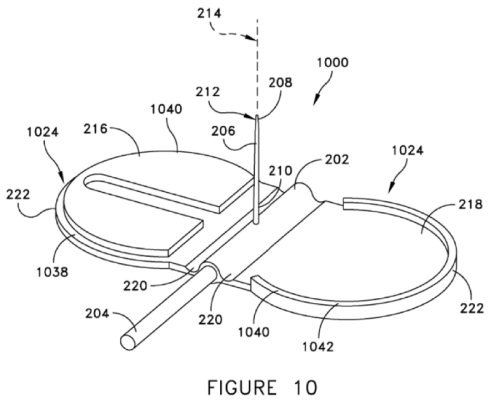
    The '476 patent is directed to medical needle devices with built-in safety structures to protect users from the sharp tip of the medical needle, with the specification describing various embodiments, and the relevant embodiment being depicted in Figure 10:

    Image 1As shown in Figure 10, the safety device includes a needle 208 between a pair of opposing "wings" 216 and 218, which when rotated into a closed position, house the needle into a "groove" (which is not labeled in Figure 10, but which is shown in the figure as a narrow recess in wing 216).

    In response to EMED's complaint, Repro-Med petitioned for inter partes review of claims 1-10 of the '476 patent.  The Board instituted the IPR and found claims 1-8 and 10 to be unpatentable.  In an earlier decision, the Federal Circuit affirmed the Board's determination, leaving claim 9 as the only claim at issue before the District Court.  Claim 9 depends from claim 8, which depends from claim 1.  Claims 1, 8, and 9 recite (with emphasis in claims 8 and 9 from the panel opinion):

    1.  A device for protecting a user from a sharp tip of a medical needle, the device comprising:
        a central body portion;
        the medical needle having a first end in fluid connection with a delivery tube, and a second end distal from the central body portion including the sharp tip;
        a pair of wings, each wing of the pair of wings having an inner region and an outer region, the inner region of each wing in attachment to the central body portion, the outer region of each wing extending away from the central body portion, the pair of wings disposed in opposition to one another with the medical needle positioned therebetween, and the pair of wings being selectively positionable from an open position to a closed position, where the wings in the open position are spaced apart from each other to expose the medical needle to al-low placement of the medical needle into a treatment site and delivery of a medicinal fluid, and wherein the wings in the closed position cover the medical needle to protect against accidental needle stick injury from the medical needle;
        a mechanical fastener disposed on at least one wing of the pair of wings, the mechanical fastener con-figured to selectively attach the pair of wings together with the medical needle positioned therebetween so as to protect against accidental needle stick injury from the sharp tip of the medical needle;
        the mechanical fastener including a lip extending along at least a portion of a perimeter of at least one wing of the pair of wings, and a mating portion along a perimeter of at least one other wing of the pair of wings, and wherein the mating portion and the lip are configured to align the at least one wing relative to the at least one other wing in the closed position.

    8.  The device in accordance with claim 1, wherein at least one of the pair of wings is formed with a groove having a size configured for housing at least a portion of the medical needle when the pair of wings are in the closed position.

    9.  The device in accordance with claim 8, wherein the groove is formed in a single one of the pair of wings.

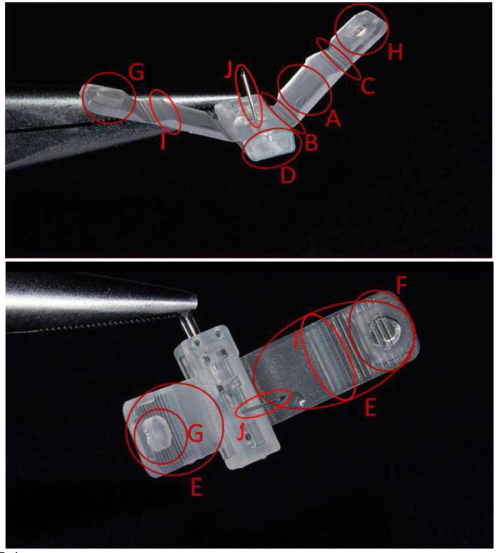
    In response to EMED's assertion of infringement, Repro-Med argued that its safety needle devices differ with respect to the exposed length of the needle as measured from the housing to the sharp tip.  Repro-Med provided the annotated figures and description of those figures set forth below:

    Image 2

    [E]ach wing (E) has a needle facing surface that in-cludes a smooth rectangular section (A) interposed between two thinned areas (B and C). A first thinned area (B) is provided between the housing (D) and the wing (E), thereby allowing each wing (E) to move between open and closed positions. A second thinned area (C) is provided between the rectangular section (A) and the outer section (F) of the wing (E) bearing the plug (G) and the wing (E) bearing the socket (H). This second thinned area (C) allows the outer section (F) of each wing (E) to bend relative to its adjacent smooth rectangular section (A), allowing the plug (G) and the socket (H) to engage and thereby lock the wings together in the closed position about the medical needle. Each of the rectangular surface sections (A) have a ridge (I) adjacent the second thinned area (C), the ridge (I) extending perpendicular to the length (J) of the medical needle extending from the housing.

    At trial, the District Court construed several terms relating to the "groove" of claim 9, determining that the term "groove" means "a long narrow cut or depression," and adopting the parties' agreed-upon constructions of the claimed groove "having a size configured for housing at least a portion of the medical needle" to mean "having a size designed for housing at least a portion of the medical needle that includes the sharp tip," and the phrase "wherein the groove is formed in a single one of the pair of wings" to mean "wherein the groove is formed in only one of the pair of wings."  Repro-Med moved for summary judgment of noninfringement, and a magistrate judge recommended that summary judgement be granted in favor of Repro-Med.  Because there is no space to house the needle in Repro-Med's safety needle devices, the magistrate recommended a finding of no literal infringement.  The magistrate also recommended a finding of no infringement under the doctrine of equivalents because treating portions of Repro-Med's safety needle devices as the claimed "groove" would vitiate the claim limitations of "a groove having a size configured for housing at least a portion of the medical needle when the pair of wings are in the closed position" and "wherein the groove is formed in a single one of the pair of wings."  The District Court adopted the magistrate's recommendation and granted summary judgment of noninfringement in favor of Repro-Med.

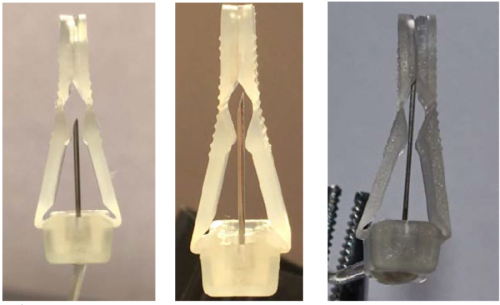
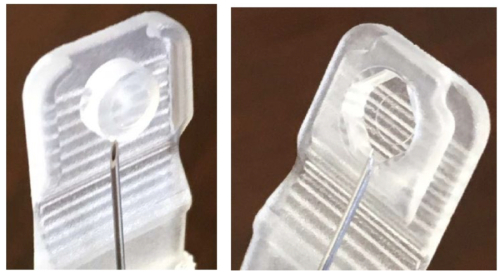
    The Federal Circuit begins by explaining that under the District Court's constructions, which neither party disputed, the claimed groove is a "a long narrow cut or depression" formed in "only one of the pair of wings," "ha[s] a size designed for housing at least a portion of the medical needle that includes the sharp tip," and must perform the specific function of housing the needle "when the pair of wings are in the closed position."  The opinion notes, however, that Repro-Med's safety needle devices lack a "groove" as claimed and protect the user from the needle in a different way:

    Image 3

    Image 4
    Although EMED argued that the "groove" is self-evident in the images above, the Federal Circuit disagreed, explaining that "EMED's theory fails to account for the requirement that the groove 'house[s]' the needle 'when the pair of wings are in the closed position.'"  The Federal Circuit therefore agreed with the District Court that there was no genuine dispute that Repro-Med's safety needle devices do not contain the claimed groove, and therefore do not literally infringe claim 9 of the '476 patent.

    With respect to infringement under the doctrine of equivalents, the Federal Circuit noted that the claims explicitly require that the "groove" must house the needle when the wings are in the closed position, and explained that "[t]o extend the claimed 'groove' to encompass structures that do not house the needle would vitiate that claim limitation."  The Federal Circuit, therefore, affirmed the District Court's grant of summary judgment of noninfringement.

    EMED Technologies Corp. v. Repro-Med Systems, Inc. (Fed. Cir. 2020)
    Nonprecedential disposition
    Panel: Circuit Judges Chen, Schall, and Hughes
    Opinion by Circuit Judge Chen

  • IPO #2The Intellectual Property Owners Association (IPO) will offer a one-hour webinar entitled "Discussion with Senior PTAB Judges on PTAB Operations in Light of COVID-19" on June 9, 2020 at 2:00 pm (EDT).  Hon. Jacqueline Wright Bonilla, Deputy Chief Administrative Patent Judge; Hon. Michael W. Kim, Acting Vice Chief Administrative Patent Judge for Operations; and Hon. Michael P. Tierney, Vice Chief Administrative Patent Judge, all of the Patent Trial and Appeal Board (PTAB) at the U.S. Patent and Trademark Office (USPTO); and Todd R. Walters of Buchanan Ingersoll & Rooney will discuss PTAB operations and recent trends and developments in practice before the PTAB in light of COVID-19.  Topics to be addressed include maintaining schedules, handling requests for extensions of time, complying with statutory mandates, depositions, oral hearings, and unique issues that have arisen in light of current events.

    There is no registration fee for IPO members for this webcast (the fee for non-members is $150).  Additional information regarding the webcast can be found here.

  • IPO #2The Intellectual Property Owners Association (IPO) will offer a one-hour webinar entitled "Litigation Funding Underwriting: How Good Is Your Patent Case?" on June 11, 2020 at 2:00 pm (EDT).  Charles Agee of Westfleet Advisors, Eric Carlson of Burford Capita, and Christopher Lee of Lee Sheikh Megley & Hahn will give attendees sophisticated insight into how funders decide in which cases they will invest and what determines the pricing; how the calculus has changed since the advent of IPRs; surprises patent owners and law firms may encounter in their search for funds; and what work a law firm needs to accomplish on a case before seeking funding.

    The registration fee for the webinar is $135 (IPO member) or $150 (non-member) (government and academic rates are available upon request).  Those interested in registering for the webinar can do so here.

  • J A KempJ A Kemp will be offering a webinar entitled "Strategies for Speeding up or Slowing Down Patent Prosecution" on June 17, 2020 from 16:30 to 17:30 pm GMT (Greenwich Mean Time).  Ravi Srinivasan and Mark Roberts of J A Kemp will look at the procedural options that the EPO offers to streamline prosecution as well as initiatives to increase speed of processing and ways for avoiding fast grant, and explore practical tactics for achieving both outcomes.  Topics to be covered will include:

    • The EPO's acceleration procedure, PACE
    • The Patent Prosecution Highway
    • Early Certainty Programme
    • Waiver practice
    • Reasons for slowing down prosecution
    • Practical tips to defer grant

    Those wishing to register can do so here.

  • LexisNexisLexisNexis and IPWatchdog will be offering a webinar entitled "The Global Migration of IP" on June 9, 2020 at 12:00 pm (ET).  Gene Quinn of IPWatchdog.com; Mike McLean, formerly of TechInsights; Will Mansfield and Dr. Dirk Caspary of PatentSight® – A LexisNexis Company will show how the migration pattern for two technologies (LED and lithium-ion batteries (LIB)) can be understood from the development of IP portfolios at these locations and find a candidate for the "next technology to move."  The panel will examine and discuss:

    • patent ownership data and why data accuracy is extremely important for reliable analytics
    • companies that own strong portfolios in LED and LIB technologies
    • the origin of these patents; and portfolios in this technology that significantly grew in countries to which manufacturing transitioned
    • how to identify another technology that is ready for a migration in its manufacturing hub

    There is no registration fee for this webinar.  However, those interested in registering for the webinar, should do so here.

  • CPA GlobalCPA Global will hosting a webinar entitled "Practical Strategies for Agile IP Management" on June 10, 2020 beginning at 16:00 CEST.  Nadine Stuttle of Duff & Phelps, Gordon MacSween and Peter Thelen of CPA Global will address the following questions:

    • What opportunities can we seize as we evolve toward a 'new normal'
    • What has the impact been on in-flight change programmes?
    • What has been the human impact and how have different people/teams reacted?
    • What will the enduring effects be?
    • How have perceptions/openness to new ways changed?
    • How have priorities changed

    Those interested in registering for the webinar can do so here.

  • By Kevin E. Noonan

    LionLions (Panthera leo) once were a widely distributed group of terrestrial mammals, ranging during the Pleistocene (from about 2,580,000 to 11,700 years ago) in Eurasia, Africa, and North America, with species that included the still-extant modern lions (Panthera leo leo), the cave lion (Panthera leo spelaea), and the American lion (Panthera leo atrox).  From the Pleistocene to modern times, all lion species except the modern lion have gone extinct (the cave and American lions in the late Pleistocene, about 14,000 years ago), and their modern range is limited to Sub-Saharan Africa and an isolated group restricted to the Kathiawar Peninsula of Gujarat State in India.  In modern times, lion populations present in southwestern Eurasia were eradicated in the 19th and early 20th Centuries, and lions (particularly the Barbary lion, the Cape lion, and lion species endemic to the Middle East) disappeared through extinction from Northern Africa during the 20th century.  Modern extirpation of lion populations is almost completely a consequence of human population growth, predation, and restriction of traditional environmental ranges, what is euphemistically called "anthropogenic factors."

    Population studies, most relying on mitochondrial DNA (mtDNA), have been pursued for living species and remains of extinct lions, with varying degrees of confidence.  Last month, an international group of researchers published a paper in the Proceedings of the National Academy of Sciences USA entitled "The evolutionary history of extinct and living lions" that reported results of genomic DNA analysis of twenty lion specimens, comprising two cave lions (Panthera leo spelaea), about 30,000 years old from Siberia and the Yukon; 12 "historic" lions (Panthera leo leo/Panthera leo melanochaita) that lived between the 15th and 20th centuries outside the current geographic distribution of lions, and 6 present-day lions from Eastern and Southern Africa (4) and India (2).  The broad conclusions these authors drew from this genetic data is that the cave and modern lion species shared a common ancestor that lived about a half million years ago, and that modern lions consist of two lineages that diverged about 70,000 years ago.  The "orphan" Indian lions showed what the authors termed "a nearly complete absence of genetic diversity," consistent with their low population sizes in recent years.

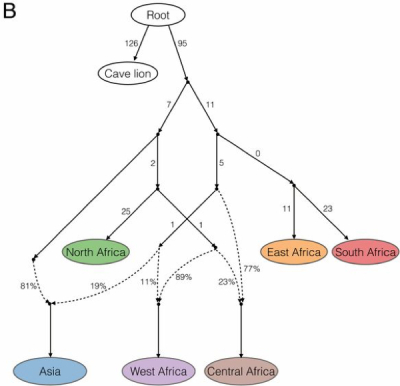
    The whole genome studies verified the inference from earlier mtDNA studies that the cave lions were a genetic "outgroup" of modern lions.  The two lineages of modern lions that diverged ~70,000 years ago comprised a "northern" lineage of lions from Asia, North Africa and West Africa, and a second "southern" lineage from Central, East and South Africa.  But unlike earlier mtDNA results, the genomic analyses showed that Central African lions were closely related to southern rather than northern African lions.  These authors' results also supported a closer but geographically incongruous relationship between North African lions with Asiatic lions rather than West African lions (which the authors say is "not unusual" in the cat family.
    Image
    Fig. 3(B) from de Manuel et al., 2020.

    Using a series of different genetic analytical techniques, these authors report a consistent time of divergence between ancestral lion populations and modern lions of about 500,000 year ago; using derived allele statistics this estimate was found to be 470,000 y-ago (392,000 – 529,000), whereas using pseudodiploid genomes (from the X chromosome of a male specimen) and "the estimate[d] rates of coalescence between their ancestral populations," this estimate was found to be 495,00 y-ago (460,000 – 578,000), and using sequence divergence an estimate of 540,000 y-ago (which relied upon a mutation rate of 4.5 × 10⁻⁹ per generation, a population size of 55,000 individuals, and a "transition (A-G or C-T)/transversion (A/G-C/T) ratio of 1.9," resulting in 108,000 generations at a generation time of ~5 years).  The authors state, based on the different methods of estimating the divergence time, that "[g]iven the general congruence among our estimates, we conclude that the most likely split time between cave and modern lions is ca. 500,000 y ago,"  which they note is "remarkably consistent with the early Middle Pleistocene appearance of P. fossilis in the European fossil record."

    The paper next provides a genetic analysis of gene flow (i.e., interbreeding) between cave lions and modern lions in their overlapping range in southwestern Eurasia during the Pleistocene; their results showed no evidence of gene flow between the Siberian cave lion and modern lions.  In contrast, these researchers found evidence of interbreeding between Yukon cave lions and South African modern lions, which further analysis appeared to be an artifact of the differences in "depth of [genomic sequence] coverage between the Yukon and Siberian cave lions."  The authors conclude that "there is no robust evidence for gene flow between the cave lion populations represented by our two samples and any of the modern lion lineages tested" (which would be expected for divergent species).  The authors speculate that these results could be due to a lack of sympatry between cave and modern lions, or sexual selection due to the cave lion lacking the characteristic prominent mane exhibited by modern lions.

    The authors also report the results of principal component analyses on the modern lion specimens, which were consistent with the "distinctiveness" of the southern and northern African lion populations.  Repeating some of the comparative analyses performed between cave and modern lions, the authors report a divergence between these African lions of ~70,000 years (52,000-98,000 y-ago), which the authors consider to be consistent with earlier mtDNA-derived estimates and also reflect a "severe" population bottleneck in the northern Africa lineage occurring coincident with a sharp reduction in the population of this lineage at about the same time.  (Both cheetahs and humans have experienced such population bottlenecks in their evolutionary histories.)  These authors report that there is also evidence for genetic admixture between populations of African lions, particularly in Central African lion populations.  They describe the Central African lion population as a potential "melting pot" of lineages after their divergence ~70,000 year ago. Another anomalous result, evidence of close genetic relationships between southern African lions and Asiatic lions (e.g., with about 18.5% of Asiatic lions genetic ancestry arising from southern African lion populations), these authors postulate might have arisen from "migration corridors between Sub-Saharan African and the Near East may have existed in the past, for instance through the Nile basin in the early Holocene" and that such interbreeding with northern African lions and Asiatic lions having been prevented by "geographical barriers represented by the Atlas Mountains and the Sahara desert."

    Among modern lions, assessment of autosomal heterozygosity frequency and the prevalence of "runs of homozygosity" were "consistent with a population history of consecutive bottlenecks in the northern lineage as their ancestors migrated away from Sub-Saharan Africa and persisted in more isolated smaller populations," which the authors speculate might also have arisen from "sustained anthropogenic pressure" due to a possible correlation between these effects on lion populations of large human populations in the Indus Valley and Mesopotamia in Asia, and Egyptian, Greek and Roman empires in North Africa.  The capacity of these literally man-made effects on lion populations are also seen in a reduction in genetic diversity in southern African lion populations associated with European colonization during the 20th Century.

    Turning to the Indian lions, the authors report the greatest extent of population reduction and inbreeding in these lions (a 16-fold reduction in heterozygosity compared with modern southern African lions), with 90% of the Indian lion genomic DNA residing in ROHs.  Further analyses showed that Indian lions carry on average 12.7% more deleterious mutations in homozygosity, which results in a substantial genetic load and even more so should these mutations be recessive (i.e., individuals would carry both mutant copies of the gene).

    The authors conclude their paper with a section on "implications for conservation," including efforts to resuscitate extinct or nearly extinct populations a la Jurassic Park.  (The risks of this embodiment of "playing God" using genetic methodologies have been set forth in Beth Shapiro's book, How to Clone a Mammoth: The Science of De-extinction.)  These authors caution that "although conservation efforts are contributing to increasing population size after centuries of decline, their remarkable lack of genomic diversity suggests that they could be extremely susceptible to inbreeding depression and genetic erosion, as well as future pathogen outbreaks."

    While providing the first whole-genome sequencing comparison of several extinct and living lion species, the paper illustrates that significant additional work will be needed to sort out the interrelationships between these different forms of the King of Beasts.

    * Marc de Manuel, Ross Barnett, Marcela Sandoval-Velasco, Nobuyuki Yamaguchi, Filipe Garrett Vieira, M. Lisandra Zepeda Mendoza Shiping Liu, Michael D. Martin, Mikkel-Holger S. Sinding, Sarah S. T. Mak, Christian Carøe, Shanlin Liu, Chunxue Guo, Jiao Zheng, Grant Zazula, Gennady Baryshnikov, Eduardo Eizirik, Klaus-Peter Koepfli, Warren E. Johnson, Agostinho Antunes, Thomas Sicheritz-Ponten, Shyam Gopalakrishnan, Greger Larson, Huanming Yang, Stephen J. O'Brien, Anders J. Hansen, Guojie Zhang, Tomas Marques-Bonet, and M. Thomas P. Gilbert

    Institutions: PRBB, Barcelona, Spain; University of Copenhagen; University Malaysia Terengganu, 21030 Kuala Nerus, Terengganu, Malaysia; University of Birmingham; eBGI-Shenzhen, China; Norwegian University of Science and Technology; University of Chinese Academy of Sciences; Yukon Palaeontology Program Russian Academy of Sciences; Pontifícia Universidade Católica do Rio Grande do Sul (PUCRS), Brazil; INCT-EECBio), Brazil; Instituto Pró-Carnívoros, Brazil; Smithsonian Institution; Walter Reed Army Institute of Research; University of Porto, Portugal; qDepartment of Biology, Faculty of Sciences, University of Porto, 4169-007 Porto, Portugal; Asian Institute of Medicine, Science and Technology, Malaysia; University of Oxford, OX; James D. Watson Institute of Genome Science, Hangzhou, China; Information Technologies, Mechanics and Optics University, Wt. Petersburg, Russia; Nova Southeastern University, Ft. Lauderdale, FL;, University of Copenhagen, 1350 Copenhagen, Denmark; Kunming Institute of Zoology, Chinese Academy of Sciences,Kunming, China; The Barcelona Institute of Science and Technology; ICREA,  Barcelona, Spain; and Universitat Autònoma de Barcelona, Barcelona, Spain

    Image of Lion (Panthera leo) lying down in Namibia by Kevin Pluck, from the Wikimedia Commons under the Creative Commons Attribution 2.0 Generic license.


  • By Donald Zuhn

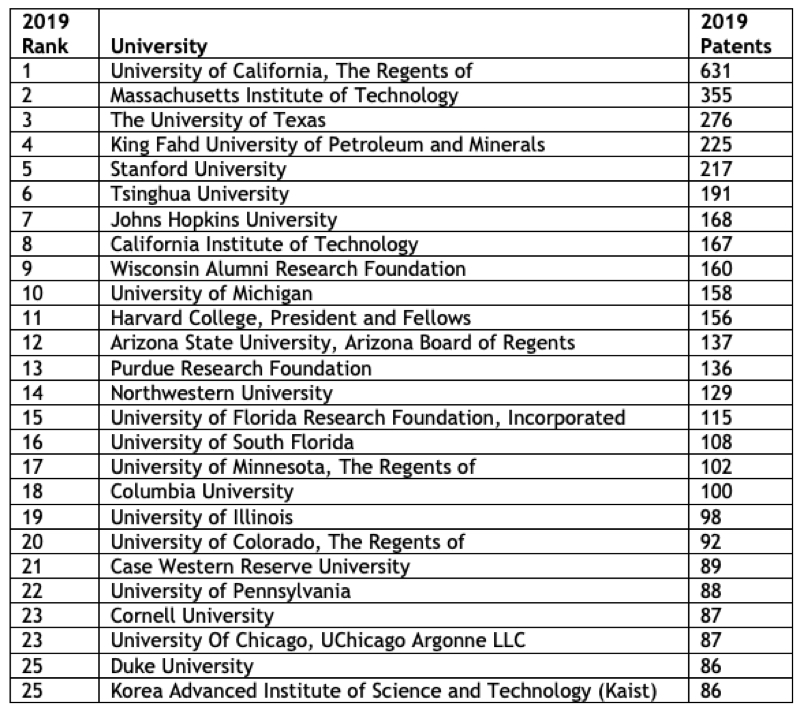
    CoverToday, the National Academy of Inventors (NAI) and the Intellectual Property Owners Association (IPO) published a list of the top 100 worldwide universities that received the most U.S. utility patents during the 2019 calendar year.  The NAI is a member organization comprising U.S. and international universities, and governmental and non-profit research institutions, with over 4,000 individual inventor members and Fellows spanning more than 250 institutions.  The organization was founded in 2010 to recognize and encourage inventors with patents issued from the U.S. Patent and Trademark Office, enhance the visibility of academic technology and innovation, encourage the disclosure of intellectual property, educate and mentor innovative students, and translate the inventions of its members to benefit society.  The joint effort by the NAI and IPO is based on data obtained from the U.S. Patent and Trademark Office.  For this report, the NAI and IPO defined a university as an institution that grants undergraduate-level degrees, and when a patent is assigned to one or more entities, credit was given to the first named entity.  The report indicates that the number of patents granted to a particular university does not necessarily indicate the value of a university's technology, the effectiveness of its research, or whether its patents will be successfully licensed and/or brought to market.  The top 25 universities on the NAI/IPO listing are as follows (click on table to expand):

    Table
    The complete list of 100 universities can be found here.

    For additional information regarding this and other related topics, please see:

    • "IPO & Harrity Analytics Release List of Top 300 Patent Holders for 2019," May 25, 2020
    • "IPO Releases List of Top 300 Patent Holders for 2018," August 7, 2019
    • "IPO Releases List of Top 300 Patent Holders for 2017," July 4, 2018
    • "Top 100 Universities Worldwide Granted U.S. Patents in 2016," June 15, 2017
    • "IPO Releases List of Top 300 Patent Holders for 2016," June 14, 2017
    • "NAI & IPO Release List of Top 100 Universities Receiving Patents in 2014," July 5, 2015
    • "IPO Releases List of Top 300 Patent Holders for 2014," July 1, 2015
    • "IPO Names Top 100 Patenting Universities," July 24, 2014
    • "IPO Releases List of Top 300 Patent Holders for 2013," July 7, 2014
    • "NAI & IPO Release List of Top 100 Universities Receiving Patents in 2012," January 7, 2014
    • "Brookings Paper Calls for Technology Transfer Model Based on University Start-ups," December 12, 2013
    • "IPO Releases List of Top 300 Patent Holders for 2012," June 24, 2013
    • "Another Look at IPO Top 300 and Life Sciences Top 53," June 11, 2012
    • "IPO Releases List of Top 300 Patent Holders for 2011," June 7, 2012
    • "IPO Releases List of Top 300 Patent Holders for 2010," June 30, 2011
    • "IPO Releases List of Top 300 Patent Holders for 2009," May 26, 2010
    • "IPO Releases List of Top 300 Patent Holders for 2008," May 14, 2009
    • "IPO Releases List of Top 300 Patent Holders," May 22, 2008
    • "IPO Posts List of Top 300 Patent Holders," April 20, 2007

  • By Donald Zuhn –-

    USPTO and JPO Issue Joint Message

    JPOYesterday, Director Andrei Iancu of the U.S. Patent and Trademark Office and Commissioner Akira Matsunaga of the Japan Patent Office issued a joint message to express the Offices' "most heartfelt sympathies to the victims of the novel coronavirus (COVID-19) and their families," and "hope that everyone affected recovers soon and that the spread of COVID-19 infection will end as soon as possible."  Noting that the pandemic has had a significant negative impact on the global economy, the two Offices also pointed out that the pandemic has served as a reminder of the importance of innovations that support our society.  The two Offices also reminded stakeholders of their "close cooperative relationship" to "establish[] various initiatives to support inventors worldwide."  The Offices conclude the joint message by expressing their belief that "we will be able to overcome this crisis by promoting and utilizing innovative technologies."


    USPTO to Allow Electronic Filing of PTE Applications

    USPTO SealIn an official notice issued last week, the U.S. Patent and Trademark Office announced that because it considered the effects of the COVID-19 pandemic to be an "extraordinary situation" within the meaning of 37 C.F.R. § 1.183, the Office would permit patentees to file initial Patent Term Extension applications that meet certain criteria via EFS-Web or Patent Center.  In particular, the official notice states that "the prohibition against filing initial patent term extension applications in accordance with 37 CFR 1.740 or 37 CFR 1.790 via the USPTO patent electronic filing systems is hereby waived until further notice."  The notice also states that "the requirements in 37 CFR 1.740(b) and 37 CFR 1.790(b) for two additional copies of the initial extension application are waived until further notice."  In order to be entitled to a filing date for an initial patent term extension application filed via EFS-Web or Patent Center, the notice sets forth the following requirements:

    1. An appropriate document description:
      a. "Patent Term Extension Application Under 35 USC 156" (Doc Code TERM.REQ) must be selected for an initial submission under 35 U.S.C. 156(d)(l) (governed by 37 CFR 1.740), or
      b. "PTE Interim Patent Extension filed" (Doc Code TERM.REQ.ITM) must be selected for an initial submission under 35 U.S.C. 156(d)(5) (governed by 37 CFR 1.790);
    2. An email address in the contact information to facilitate contact with the applicant's representative; and
      3. The applicable fee:
      a. the fee set forth in 37 CFR 1.20(j) for submission of an initial application for patent term extension under 37 CFR 1.740, or
    3. the fee set forth in 37 CFR 1.20(j) for submission of an initial application for interim patent term extension under 37 CFR 1.790.

    While the notice indicates that the waiver will be "effective only until the USPTO provides further notice," the Office also indicates that it is making efforts to allow for electronic filing of PTE applications on a permanent basis.


    USPTO Makes COVID-19 Statement Form Available

    In a Patent Alert e-mail distributed last month, the U.S. Patent and Trademark Office announced the release of a form to assist applicants with making the required statement of delay due to the COVID-19 pandemic (see "USPTO Announces Further Extension of Certain Patent Deadlines").  The Office noted that the "Statement of Delay Due to COVID-19 Outbreak" form (PTO/SB/449) is being released in response to requests from applicants for guidance on how best to make the required statement as well as to assist the Office in processing those requests.


    USPTO to Allow Electronic Filing of Plant Patent Applications

    In an official notice issue last month, the U.S. Patent and Trademark Office announced that because it considered the effects of the COVID-19 pandemic to be an "extraordinary situation" within the meaning of 37 C.F.R. § 1.183, the Office will temporarily permit the filing of plant patent applications and follow-on documents via the EFS-Web or Patent Center until further notice.  More details about the Office's temporary waiver can be found in the official notice.  However, as with the PTE application waiver described above, the Office indicates that it is making efforts to allow for electronic filing of plant patent applications on a permanent basis.