• By Kevin E. Noonan

    Bat ResearchAs the COVID-19 pandemic has disrupted life throughout the world this spring, bats have been a prominent feature in news stories and recriminations about how the pandemic started (and being blamed even more than happenings in China, although to be fair the effects of the pandemic, good and bad, have been more the consequence of how countries and their citizens and their leaders have reacted to the virus than merely the virus itself).  In view of the state of modern biology, it is not surprising that the bat genome is an interesting area of study, and this week an international team of researchers published results that shed light on bat biology and evolution (if not on their propensity to harbor viruses capable of such devastating effects on humans).

    The paper, entitled "Six reference-quality genomes reveal evolution of bat adaptations," was published in Nature.  As the authors explain, the paper provides "the first reference-quality genomic sequence of six bat species, specifically Rhinolophus ferrumequinumRousettus aegyptiacusPhyllostomus discolorMyotis myotisPipistrellus kuhlii, and Molossus molossus (only a few of the 1,400 known bat species, comprising 20% of all existing mammalian species).  This genomic information allowed these scientists to elucidate bat evolutionary antecedents, specifically their origin within the Scrotifera, a broad group that encompasses most placental mammals.  Not surprisingly, these studies also revealed positive selection for hearing-related genes, and selective loss of certain immunity-related genes, in particular ones (such as NF-κB regulators) related to inflammation.  There is a striking expansion of antiviral APOBEC3 genes the authors believe is related to the bat's exceptional immunity to viral infection.

    The researchers had a number of unique phenotypic traits exhibited by bats to explore for their genetic bases, including flight, echolocation, extreme longevity, and perhaps more relevant to their current notoriety, unique immunity.  Applying what they termed "state-of-the-art sequencing technologies and assembly algorithms," these scientists report that they were able to generate contiguous genomic sequences that were ~100-fold more contiguous than earlier attempts (and thus less prone to error) and at ~100% completeness.  From these data, the authors report they annotated between 19,122 and 21,303 protein-coding genes with an annotation quality higher than that obtained to date for dog, cat, horse, cow and pig, and surpassed (not surprisingly) only by mouse and human annotated genomic sequences.  The size of the bat genome determined using these analyses is approximately 2 gigabasepairs (Gb), which the researchers characterize as being smaller than for other placental mammals (which range from 2.5-3.5Gbp).  This disparity was found to be related to lower content of transposable elements in the bat genome, with there being extreme variability (in both type and number) of more recently inserted transposable elements compared with other mammals.

    Evolutionarily, the genomic sequence data is consistent with one of four clades that diverged in the late Cretaceous (100-66 million years ago, Mya), illustrated by this diagram (click to expand):
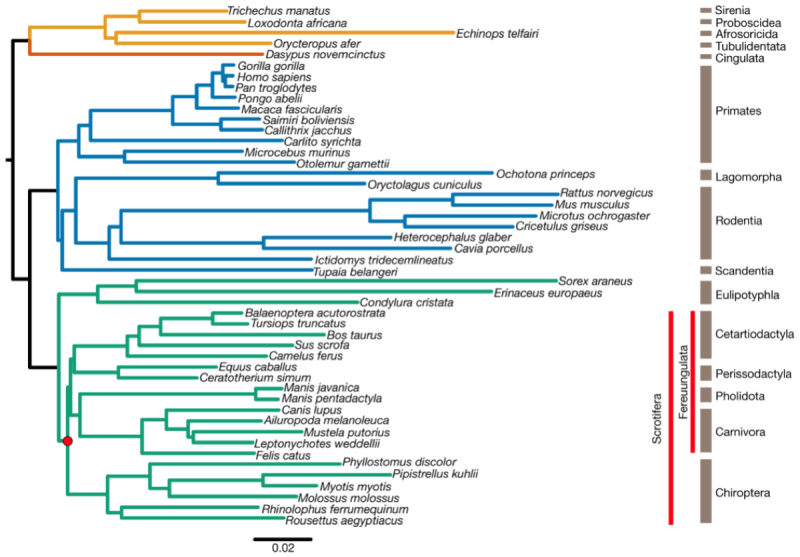
    Bat Genetic Tree(where green designates the Laurasitheria which contain the origins of bats; blue, Euarchontoglires; orange, Xenarthra; and yellow, Afrotheria).  These results arose from comparisons of 12,931 orthologous protein-coding genes and 10,857 orthologous conserved noncoding elements from genomes of 48 mammalian species.

    Having developed these phylogenetic relationships, the authors next turned to what they termed "the genomic basis of exceptional traits" that have arisen in bats.  These comparisons identified nine genes having undergone positive selection from ancestral species, including LRP2, TJP2, and SERPINB6 genes, all of which are involved, inter alia, in hearing.  Specifically, these genes are expressed in cochlea and, in humans are associated with deafness.  Interestingly, the LRP2 gene contains a sequence change that encodes an amino acid substitution (methionine) specific to bats capable of echolocation; bats that do not express this phenotype — such as pteropodid bats — have a different amino acid (threonine) encoded at this position.  Patterns of inheritance of microduplications in the TJP2 gene were interpreted by these scientists to mean that the echolocation-related mutations arose in bat ancestors but were lost in bats who do not exhibit this trait, providing an evolutionary answer to the question of whether echolocation had arisen multiple times independently in these bats.

    The comparative screening experiments also provided information on genes related to immunity.  These included "the B-cell-specific chemokine CXCL13, the asthma-associated NPSR1 and INAVA (a gene that is involved in intestinal barrier integrity and enhancing NF-κB signaling in macrophages).  Ten additional immunity-related genes identified in these studies included "IL17D and IL1B (which are involved in immune system regulation and NF-κB activation), and LCN2 and GP2 (which are involved in responses to pathogens)."  These genes showed the presence of "bat-specific" sequence variants that had undergone positive selection during bat evolution, supporting their role in the development of the pathogen-resistance phenotype seen in bats.  In addition to these bat-specific sequence variants, the paper reports ten genes lost or inactivated in bats that are expressed in non-bat members of the Laurasiatheria.  These include two genes, LRRC70 (known to "potentiates cellular responses to multiple cytokines and amplif[y] NF-κB activation mediated by bacterial lipopolysaccharides") and IL36G (that encodes a pro-inflammatory interleukin).

    Another group of immune-related genes are those that have been differentially amplified in bats; most relevant are genes in the APOBEC gene family which is expanded in bats at the APOBEC3 locus (which encodes "DNA- and RNA-editing enzymes that can be induced by interferon signaling and are implicated in restricting viral infection and transposon activity").  These genes were found as a "small" expansion in ancestral bat species and "multiple, lineage-specific expansions that involve up to 14 duplication events" in later-arising bat species.  Consistent with the evolution of pathogen (particularly viral) resistance in bats, the genomic analyses reported in this paper found evidence of prior viral infection in the form of endogenous viral elements (EVEs) in three predominant non-retroviral forms.  These genes encoded viral envelope (env) proteins similar to alpha retroviruses which had previously been thought to be confined to avian species.

    The paper also reports evolution-related changes in non-coding RNAs.  These results showed that "nearly all of the annotated noncoding RNA genes are shared across all six bat genomes . . . , and between bats and other mammals [for example, 95.8–97.4% are shared between bats and humans]."  Of the 286 known conserved miRNA gene families found in mammals, eleven were "significantly contracted" in bats and thirteen were lost.  For single-copy miRNA genes, one (known as miR-337-3p) had unique variation in bats related to binding specificity and was "pervasively expressed."  The researchers also reported finding 122-261 novel miRNAs, with twelve being shared in all six bat species interrogated (two of which were shown to be functional in regulating gene expression).

    The authors conclude by stating:

    Our conservative genome-wide screens investigating gene gain, loss and selection revealed novel candidate genes that are likely to contribute tolerance to viral infections among bats.  Consistent with this finding, we also found that bat genomes contain a high diversity of endogenized viruses.  We also uncovered genes involved in hearing that exhibit mutations specific to laryngeal-echolocating bats and ancestral patterns of selection.  . . .  Finally, we identified and experimentally validated miRNAs that are evolutionary novelties or that carry bat-specific changes in their seed sequence.  Changes in these important regulators of gene expression may have contributed to changes in developmental and behavioural processes in bats.

    And perhaps more importantly these researchers recognized that:

    These high-quality bat genomes, together with future genomes, will provide a rich resource to address the evolutionary history and genomic basis of bat adaptations and biology[].  These genomes enable a better understanding of the molecular mechanisms that underlie the exceptional immunity and longevity of bats, allowing us to identify and validate molecular targets that ultimately could be harnessed to alleviate human ageing and disease.  For example, we predict that our reference-quality bat genomes will be tools that are heavily relied upon in future studies focusing on how bats tolerate coronavirus infections.  This is of particular global relevance given the current pandemic of coronavirus disease 2019 (COVID-19), and ultimately may provide solutions to increase human survivability—thus providing a better outcome for this, and future, pandemics.

    * The researchers hie from the Max Planck Institute of Molecular Biology and Genetics, Institute of Systems Biology, and Institute of Physics, Dresden, DE; The Max Planck Institute for Psycholinguistics, NL; the School of Biology and Environmental Science, the Conway Institute of Biomolecular and Biomedical Science, and the Earth Institute, University College Dublin; the Australian National University, Canberra;  the Department of Biological Science, Texas Tech; the Department of Ecology and Evolution, and Consortium for Inter-disciplinary Environmental Research, SUNY Stony Brook; Department of Sciences, John jay College of Criminal Justice; Department of Biological Sciences, University of Bristol; Department of Biology, University of Konstanz; Smithsonian Tropical Research Institute, Panama City; ISEM, University of Montpellier; Zoological Institute and Museum, University of Greifswald; Department of Migration, Max Planck Institute of Animal Behavior, Radolfzell; Vertebrate Genomes Laboratory and the Laboratory of Neurogenetics of Language, The Rockefeller University; Howard Hughes Medical Institute, Chevy Chase, Maryland; Donders Institute for Brain, Cognition and Behavior, NL; and the Facility of Computer Science, Technical University, Dresden
  • Note:  The below is a sarcastic parody, in the spirit of our earlier sarcastic parodies.

    By Michael Borella

    Cover US 4 405 829WASHINGTON D.C., June 23, 1984.  In a unanimous decision, the Federal Circuit has ruled U.S. Patent No. 4,405,829 invalid under 35 U.S.C. § 101, finding the claimed invention directed to an abstract idea.  The '829 patent, assigned to the Massachusetts Institute of Technology (MIT), was the brainchild of three of its professors, Ronald Rivest, Adi Shamir, and Leonard Adleman.  Lauded in academic circles as one of the first viable public-key cryptosystems and duly granted by the U.S. Patent and Trademark Office, the Court nonetheless found that the patent lacked an inventive concept necessary for patentability.

    Soon after issuance, MIT sought to license the patent to various companies developing security software and hardware.  Speaking under condition of anonymity, in-house counsel at one of these companies said, "We knew that there was no way the courts would uphold this patent, so there was no reason to take it seriously."  A number of these potential licensees joined a declaratory judgment action, asking the U.S. District Court for the District of Massachusetts to find the claims of the patent ineligible.  The District Court did so, and MIT appealed to the Federal Circuit.

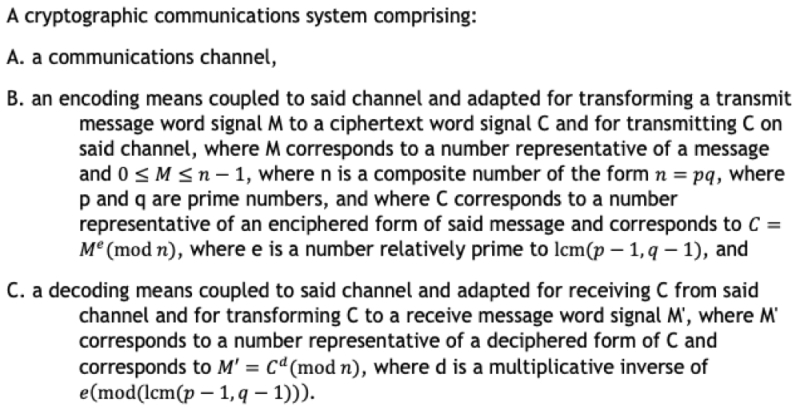
    Claim 1, which was agreed to be representative, recites:

    Claim 1

    The Court began its analysis "by first determining whether the claims at issue are directed to a patent-ineligible concept, such as law of nature, natural phenomena, or abstract idea."  This did not take long, as it noted that, "[t]he focus of the claims, as is plain from their terms, is on encoding a message into ciphertext using mathematical techniques and decoding the message from the ciphertext using complementary mathematical techniques — that is all abstract."

    MIT countered, arguing that the claimed invention was "revolutionary in nature."  It asserted that, prior to the '829 patent, encryption was largely based on symmetric keys.  Such systems involved using a key to encrypt a message to ciphertext, and the same key again to decrypt the ciphertext back into the message.  The disadvantage of such a system is that the symmetric key had to first be shared or distributed across an insecure medium in order to be effective.  The claimed invention, according to MIT, overcame this technical barrier by generating two mathematically inverse keys — a public key (e), and a private key (based on d, p, and q).  The security of the system relied on the intractability of factoring large prime numbers (p and q).  Further, MIT contended that the claimed cryptosystem would facilitate "many future innovations, such as electronic commerce, virtual private networks, security of stored data, and military communications."

    The Court was not convinced, stating that "even if the techniques claimed are groundbreaking, innovative, or brilliant, that is not enough for eligibility — a claim for a new abstract idea is still an abstract idea."  Notably, the Court found that "the subject matter is nothing but a series of mathematical calculations based on selected information."  Moreover, the Court was skeptical about the potential of the claimed cryptosystem, relying on statements made by the challengers' expert indicating that "it would be dozens of years before computers were powerful enough to carry out the claimed exponentiations a reasonable time frame."

    Finding the claim directed to an abstract idea, the Court moved on to determining whether the remaining elements of the claim constitute an inventive concept.  Such a concept needs to be "sufficient to transform the claimed abstract idea into a patent eligible application."  Here, the Court found that all additional elements, such as the encoding means, decoding means, and communications channel, "merely invoke well-understood, routine, conventional components and activity to apply the abstract idea identified previously."  Indeed, the Court noted that the encoding means and decoding means were "functionality claimed at a high level of generality, thus failing to limit the claim to a particular embodiment of this abstract idea."  Particularly, "nothing in the claims, understood in light of the specification, requires anything other than an off-the-shelf, conventional computer, or components thereof."

    MIT attempted to establish that its technique was unconventional, but the Court rapidly shot down that notion.  It held that "the mathematical principles that MIT refers to may indeed be innovative, but they are also abstract," and "one cannot argue that a concept held abstract under part one of the analysis is inventive under part two."  Additionally, the Court observed that "the allegedly unconventional technique did no more than apply longstanding, well-understood mathematical operations — multiplication, exponentiation, and modulus, for example."

    Thus, the claims lack an inventive concept and fail the § 101 test.  The Court summed up by stating, "[a]n inventor who makes an advance such as this one cannot obtain patent protection for the advance itself and must seek protection outside of patent law, such as in the law of trade secrets."

  • By Michael Borella

    Introduction

    Federal Circuit SealPacket Intelligence sued NetScout in the Eastern District of Texas, alleging infringement of U.S. Patent Nos. 6,665,725, 6,839,751, and 6,954,789.  The District Court ruled that all three patents were valid under 35 U.S.C. §§ 101 and 102, and infringed.  The § 101 dispute was tried at the bench.  NetScout appealed.

    The core technological aspects under dispute are described reasonably well in the '789 patent as follows:

    Some prior art packet monitors classify packets into connection flows.  The term "connection flow" is commonly used to describe all the packets involved with a single connection.  A conversational flow, on the other hand, is the sequence of packets that are exchanged in any direction as a result of an activity—for instance, the running of an application on a server as requested by a client.  It is desirable to be able to identify and classify conversational flows rather than only connection flows.  The reason for this is that some conversational flows involve more than one connection, and some even involve more than one exchange of packets between a client and server.

    A hypothetical example of this might be that a packet monitor examining packets only on the granularity of TCP connection flows (defined by a 5-tuple of source and destination IP address, source and destination port, and protocol) might not be able to identify two TCP connection flows involving in the same transaction as being related to one another as members of a conversational flow.  Notably, the '789 patent has a June 1999 priority date, a time frame in which this type of packet monitor typically was only able to identify flows based on static filters.  Today's packet monitors largely have the ability to dynamically identify multiple related flows.

    Claim 19 of the '789 patent was agreed upon to be representative, and recites:

    19.  A packet monitor for examining packets passing through a connection point on a computer network, each packet conforming to one or more protocols, the monitor comprising:
        (a) a packet acquisition device coupled to the connection point and configured to receive packets passing through the connection point;
        (b) an input buffer memory coupled to and configured to accept a packet from the packet acquisition device;
        (c) a parser subsystem coupled to the input buffer memory and including a slicer, the parsing subsystem configured to extract selected portions of the accepted packet and to output a parser record containing the selected portions;
        (d) a memory for storing a database comprising none or more flow-entries for previously encountered conversational flows, each flow-entry identified by identifying information stored in the flow-entry;
        (e) a lookup engine coupled to the output of the parser subsystem and to the flow-entry memory and configured to lookup whether the particular packet whose parser record is output by the parser subsystem has a matching flow-entry, the looking up using at least some of the selected packet portions and determining if the packet is of an existing flow; and
        (f) a flow insertion engine coupled to the flow-entry memory and to the lookup engine and configured to create a flow-entry in the flow-entry database, the flow-entry including identifying information for future packets to be identified with the new flow-entry, the lookup engine configured such that if the packet is of an existing flow, the monitor classifies the packet as belonging to the found existing flow; and if the packet is of a new flow, the flow insertion engine stores a new flow-entry for the new flow in the flow-entry database, including identifying information for future packets to be identified with the new flow-entry,
        wherein the operation of the parser subsystem de-pends on one or more of the protocols to which the packet conforms.

    We will discuss the Court's § 101 analysis of this claim.

    In Alice Corp. v. CLS Bank Int'l, the Supreme Court set forth a two-part test to determine whether claims are directed to patent-eligible subject matter under § 101.  One must first decide whether the claim at hand involves a judicially-excluded law of nature, a natural phenomenon, or an abstract idea.  If so, then one must further decide whether any element or combination of elements in the claim is sufficient to ensure that the claim amounts to significantly more than the judicial exclusion.  But elements or combinations of elements that are well-understood, routine, and conventional will not lift the claim over the § 101 hurdle.  While this inquiry is generally carried out as a matter of law, factual issues can come into play when determining whether something is well-understood, routine, and conventional.

    Notably, procedure for the proper application of this test with the abstract idea exception has been inconsistently defined and is confusing in practice.  A potentially more workable definition of patent eligibility is that a claim is directed to an abstract idea if all of its elements are either non-specific, address a non-technical problem, or known in the art.  Thus, a claim is more likely to survive a § 101 challenge if one or more elements thereof have three qualities:  specificity, a technical problem that they solve, and some degree of novelty.

    The Majority Opinion

    Judge Lourie wrote for the majority, which was he and Judge Hughes.  The majority provided an overview of the District Court's § 101 analysis, of note being that the District Court made a series of factual findings with respect to the claimed invention versus the prior art and based its holding of eligibility on those findings.

    In any event, the majority framed its opinion by stating that "[i]n our eligibility analysis, we consider the claim as a whole and read it in light of the specification."  The majority cited to a number of previous Federal Circuit decisions relating to the patent-eligibility of computer-implemented and networking inventions.  In this, the majority emphasized that the inquiry often turns on "whether the focus of the claims is on a specific asserted improvement in computer capabilities or, instead, on a process that qualifies as an 'abstract idea' for which computers are invoked merely as a tool."

    With the § 101 framework in place, the majority agreed with the District Court that claim 19 was not directed to an abstract idea.  Particularly, "claim 19 purports to meet a challenge unique to computer networks, identifying disjointed connection flows in a network environment" and provides "detail how this is achieved in several steps."

    Moreover, "[t]he asserted patents' specifications make clear that the claimed invention presented a technological solution to a technological problem."  They "explain that known network monitors were unable to identify disjointed connection flows to each other, and the focus of the claims is a specific improvement in computer technology: a more granular, nuanced, and useful classification of network traffic."

    NetScout argued that Two-Way Media Ltd. v. Comcast Cable Commc'ns, LLC mandates limiting the Alice part one analysis to the specification's concrete embodiments.  But the majority observed that Two-Way Media stands for the notion that the claims, "not the specification, must include an inventive concept" under Alice part two.  Since the majority concluded that claim 19 was not abstract under part one, it did not have to reach part two.

    Accordingly, the claimed invention was found to be patent-eligible.

    Judge Reyna's Dissent

    Judge Reyna wrote in dissent because, in his view, "the claims are directed to the abstract idea of identifying data packets as belonging to conversational flows rather than discrete connection flows."  Judge Reyna stressed that "the asserted advance over the prior art is the classification of data packets according to the flow of data associated with given activities rather than potentially disjointed exchanges transmitted over individual connections."  And, he found this distinction to be "conceptual, not technological, in the absence of specific means by which that classification is achieved."

    The crux of the disagreement between Judge Reyna and the majority is that Judge Reyna limited his § 101 inquiry to the language of the claim, while the majority looked to the specification.  Judge Reyna noted that claim 19 recites "only a general method of sorting data packets according to any flow, not a specific means of sorting packets by conversational flow," and that "the claim does not recite how the individual packets are actually identified as belonging to a conversational flow beyond the functional requirement that identifying information is used."

    Judge Reyna admitted that the specification provides the necessary detail, but "[n]one of these processes or components are recited in claim 19, and the claim elements have not been construed as limited to the structures and processes disclosed in the embodiments."  Thus, "the components and operations actually recited in the claims do not provide the specificity required to transform a claim from one claiming only a result to one claiming a way of achieving it."  Without this detail, Judge Reyna believes that the invention is drawn to information processing "falling within the realm of abstract ideas."

    Conclusion

    The majority found claim 19 to be a reasonably specific technical invention that provided an advance over the prior art.  Judge Reyna disputed this finding because he views the claim as being non-specific in terms of its technical character, thereby making any such improvement to be too abstract for patenting.  The case turned on a disagreement in fundamental principle — when and how should one read the technical aspects of a specification into the broader language of the claims, if at all?  Until this question is answered, the appropriate level of detail to place into claims will remain an open issue.

    Packet Intelligence LLC v. NetScout Systems, Inc. (Fed. Cir. 2020)
    Panel: Circuit Judges Lourie, Reyna, and Hughes
    Opinion by Circuit Judge Lourie; opinion concurring in part and dissenting in part by Circuit Judge Reyna

  • By Kevin E. Noonan

    Supreme Court Building #1Arthrex recently filed a(nother) certiorari petition with the Supreme Court, this time in Arthrex, Inc. v. Smith & Nephew, Inc., which has also been the subject of petitions from the U.S. government and Smith & Nephew.  (This is the later-decided case between the parties, and has as its hallmark the Federal Circuit's decision that Administrative Patent Judges (APJs) at the Patent Trial and Appeal Board, or PTAB, were improperly appointed under the Appointments Clause because they are principal officers requiring Presidential appointment and Senate approval).

    The Questions Presented are:

    1.  Whether the court of appeals' severance remedy is consistent with congressional intent, where Congress has long considered tenure protections essential to secure the independence and impartiality of administrative judges.

    2.  Whether the court of appeals correctly held that the elimination of APJ tenure protections was sufficient to render APJs inferior officers, even though their decisions still are not reviewable by any principal executive officer.

    The genesis of the questions Arthrex petitions the Court to review, according to its petition, is "Congress's decision to grant administrative patent judges ("APJs") final authority to revoke previously issued patents" wherein there is "[n]o superior officer in the Executive Branch can review their decisions."  These characteristics are those of principal officers, Arthrex argues, and the Federal Circuit was correct in so deciding.  Where the Federal Circuit erred, in Arthrex's view, was in not leaving it to Congress to remedy the situation but rather by imposing a judicial fix:  it "eliminated the tenure protections that shield APJs from politics and improper influence."  "That remedy," Arthrex contends, "not only contravenes congressional intent, but fails to cure the Appointments Clause violation."  This is because the inter partes review procedures enacted in the Leahy-Smith America Invents Act (AIA) were intended to be "adjudicative and fair," and this intent would be thwarted if as a consequence of the Federal Circuit's decision APJs could be removed "for policy reasons, political reasons, or no reason at all."  And Arthrex argues that the remedy does not cure the constitutional infirmity, because APJs remain principal officers to the extent that "they still have the power to issue final decisions on behalf of the agency without any possibility of review by a principal officer."  This cannot be what Congress intended (i.e., where "the fate of patents rests with subordinate officers issuing final decisions while trying to please their superiors and preserve their jobs"), Arthrex argues in view of the importance ("the backbone") of intellectual property to the American economy.

    After a brief history of APJs (originally, "examiners-in-chief"), including their status as principal officers from 1861 until 1975 (when Congress changed the law) and a synopsis of their powers and duties, the petition asserts that it was only in 1980 (when Congress created "an administrative scheme" that was ex parte reexamination) that the PTAB's predecessor, the Board of Patent Appeals and Interference, was permitted to invalidate a duly-granted patent.  (Technically, the BPAI was not created until 1984 when Congress merged the Board of Appeal with the Board of Interferences.)  The petition makes the distinction that in enacting IPRs, Congress created (intentionally) the first adjudicative "scheme" as opposed to the earlier "examinational" proceedings.

    Following an explanation of the proceedings below (both before the PTAB and the Federal Circuit), the petition makes its substantive arguments for the Court to grant the petition.  First, Arthrex argues that severability, as the Federal Circuit fashioned it in its remedy, is deserving of the Court's review because the tenure protections of the statute that would be severed have evinced Congressional intent to ensure impartial adjudications in review of administrative agency actions.  The Federal Circuit rewrote the statute in a way that would "give it an effect altogether different from that sought by the measure viewed as a whole" which is improper, citing Murphy v. Nat'l Collegiate Athletic Ass'n, 138 S. Ct. 1461, 1482 (2018).  This required the Federal Circuit to conclude that "Congress was more concerned about providing a potent new mechanism for canceling patents than about the impartiality of the adjudicative process through which those property rights may be revoked."  But this is a decision for Congress not the courts, Arthrex argues.  In addition, as a consequence of reduced impartiality and independence, the integrity of the IPR regime will be compromised.  This concern has historical antecedents, including Ramspeck v. Fed. Trial Exam'rs Conference, 345 U.S. 128, 130, 132 & n.2 (1953), and several reports from committees looking into the situation, including Report of the Special Committee on Administrative Law, 61 Ann. Rep. A.B.A. 720, 723 (1936); Administrative Management in the Government of the United States 37 (1937); Attorney General's Comm. on Admin. Procedure, Final Report 46 (1941); Administrative Procedure: Hearings Before the H. Comm. on the Judiciary, 79th Cong. 81 (June 21, 1945), under circumstances where administrators were dependent for their "day-to-day" employment.  Arthrex argues that Congress heeded these concerns by enacting the Administrative Procedures Act in 1946 which established the civil service protections the Federal Circuit severed in its decision below, codified as 5 U.S.C. § 7521(a); this interpretation was supported by portions of the legislative history quoted by Arthrex in its petition.

    Arthrex's argument isn't based solely on Congressional intent; the petition argues that there are "significant due process concerns at stake" requiring the parties to be afforded a "fair trial in a fair tribunal," citing Withrow v. Larkin, 421 U.S. 35, 46 (1975).  APJs' neutrality is threatened by removing these civil service protections Arthrex argues because "it permits superiors to exert subtle yet powerful influence over adjudications without the accountability that comes from a transparent review process."  These concerns are particularly relevant to the administrative adjudications provided by the Leahy-Smith America Invents Act because of the drastic change those proceedings occasioned on U.S. patent law.  An important requirement for the type of adjudications Congress intended (mimicking civil litigation) requires a "disinterested decisionmaker," Arthrex argues.

    For all these reasons Arthrex asserts that the Federal Circuit's decision "fundamentally distorted" the IPR regime because it "discarded a safeguard Congress has long considered imperative for agency adjudicators" and which is "indispensable to make the trial-like proceedings Congress created in the AIA actually fair." The petition cites in support dissents from denial of rehearing en banc from several of the Federal Circuit judges (including Judges Dyk and Hughes) and cites similar concerns from Members of Congress.  There is also a risk that courts reviewing the decisions from other agencies having ALJs appointed under the same constitutionally flawed procedure will mimic the Federal Circuit and thus put neutrality in agency adjudications at risk in 27 different agencies and 2,000 ALJs, as well as 10,000 adjudicators who are not ALJs.  All of which are reasons for the Court to grant certiorari, Arthrex argues, because "[a]bsent review, other courts could follow the same path, imperiling the fairness of administrative proceedings across the government."

    Turning to jurisprudential principles the petition argues that the Federal Circuit's severance provisions "def[y] settled principles," because courts are unable to produce by severance a statute giving it effects "altogether different from [those] sought by the measure viewed as a whole" (i.e., as Congress enacted it), citing Murphy.  The Federal Circuit panel used as its basis for severance of APJ protections that Congress would have intended to have "a Board whose members are removable at will rather than no Board at all" due to the importance of the IPR proceedings enacted under the AIA.  The flaw in that reasoning, according to Arthrex, is that "Congress was trying to improve patent review—not mow down patents by any means necessary" (although there have been occasions that reasonable patent practitioners might have questioned that conclusion).  Arthrex concludes that Congress "plainly intended" APJs to have "the tenure protections it has long considered essential to independent and impartial adjudication" at least in view of the "billions of dollars of intellectual property" that their decisions can affect.

    The other source of error Arthrex asserts in its petition is an eminently practical one:  "[i]t does not fix the problem" which is that because "there is still no principal executive officer who can review APJ decisions" APJs themselves are principal officers.  This portion of the petition disputes the Federal Circuit's application of the Edmond v. U.S. decision which Arthrex argues established under parallel facts and circumstances that Coast Guard Court of Criminal Appeals judges were inferior officers.  520 U.S. 651 (1997).  Similarly, in Free Enterprise Fund v. Public Company Accounting Oversight Board, 561 U.S. 477 (2010), the Court itself relied on review vel non of decisions to find that members of the Board were inferior officers.  Justice Alito raised "serious questions under the Appointments Clause" for railroad arbitrators in Department of Transportation v. Association of American Railroads, 575 U.S. 43 (2015).  Arthrex further argues that in cases (including Freytag v. Commissioner, 501 U.S. 868 (1991), and Lucia v. SEC, 138 S. Ct. 2044 (2018)) where the Court found ALJs to be inferior officers their decisions were reviewable by a principal officer.

    This distinction is important because "a hallmark of principal officer status" is being able to speak for the United States without review by a superior.  Arthrex finds this tradition existing "from the earliest days of the Republic" and is a tradition extending from those antecedents in patent law (back to the original Patent Act, Act of Apr. 10, 1790, ch. 7, §1, 1 Stat. 109, 109-110).  The primacy of principal officers is "a cornerstone of the modern administrative state" Arthrex contends, reflecting "long-continued policy of Congress [to] jealously confine[] the power of final decision in matters of substantial importance to a few principal administrative officers" (citing inter alia the APA, codified at 5 U.S.C. § 557(b)).  Arthrex characterizes the authority of APJs to render decisions appealable only to Article III courts (specifically, the Federal Circuit and the Supreme Court) as being a "sharp departure from precedent and tradition" unless APJs are principal officers.

    Finally, Arthrex argues that the Federal Circuit exceeded its jurisprudential bounds by not leaving it to Congress to amend the statute, and that it promotes "inertia" by providing its own remedy as imperfect as Arthrex argues it is.  Congress, after all, "is far better positioned to determine how best to revise the statute" because it "can edit a statute as it sees fit."  It can also "weigh competing policy concerns," employ a broader perspective regarding the "full impact" of any statutory revisions, "select from a range of historically grounded remedies that are not available to the courts," or even abandon inter partes review entirely, citing the STRONGER Patents Act of 2019, H.R. 3666, 116th Cong. (July 10, 2019) (thus providing a provocative but not entirely unrealistic closing to the petition).

  • By Michael Borella

    Federal Circuit SealElectronic Communication Technologies (ECT) sued ShoppersChoice in the Southern District of Florida for allegedly infringing claim 11 of U.S. Patent No. 9,373,261.  The claim recites:

    11.  An automated notification system, comprising:
        one or more transceivers designed to communicate data;
        one or more memories;
        one or more processors; and
        computer program code stored in the one or more memories and executed by the one or more processors, the computer program code comprising:
            code that enables a first party associated with a personal communication device (PCD) to input or select authentication information for use in connection with a subsequent notification communication session involving advance notice of a delivery or pickup of a good or service at a stop location by a mobile thing (MT);
            code that causes storage of the authentication information;
            code that monitors location or travel information in connection with the MT;
            code that causes initiation of the notification communication session to the PCD with the one or more transceivers, in advance of arrival of the MT at the stop location, based at least in part upon the location or travel information associated with the MT;
            code that, during the notification communication session, provides the authentication information to the PCD that indicates to the first party that the notification communication session was initiated by an authorized source; and
            code that, during the notification communication session, enables the first party to select whether or not to engage in a communication session with a second party having access to particulars of the pickup or delivery.

    ShoppersChoice moved that the claim was invalid under 35 U.S.C. § 101, and the District Court granted this judgment on the pleadings.  ECT appealed.

    In Alice Corp. v. CLS Bank Int'l, the Supreme Court set forth a two-part test to determine whether claims are directed to patent-eligible subject matter under § 101.  One must first decide whether the claim at hand involves a judicially-excluded law of nature, a natural phenomenon, or an abstract idea.  If so, then one must further decide whether any element or combination of elements in the claim is sufficient to ensure that the claim amounts to significantly more than the judicial exclusion.  But elements or combinations of elements that are well-understood, routine, and conventional will not lift the claim over the § 101 hurdle.  While this inquiry is generally carried out as a matter of law, factual issues can come into play when determining whether something is well-understood, routine, and conventional.

    Notably, procedure for the proper application of this test with the abstract idea exception has been inconsistently defined and is confusing in practice.  A potentially more workable definition of patent eligibility is that a claim is directed to an abstract idea if all of its elements are either non-specific, address a non-technical problem, or known in the art.  Thus, a claim is more likely to survive a § 101 challenge if it has three qualities:  specificity, a technical problem that it solves, and some degree of novelty.

    Applying part one of Alice, the Court rapidly determined that the claim is directed to the abstract idea of "providing advance notification of the pickup or delivery of a mobile thing."  Particularly, the Court agreed with the District Court judge that "business practices designed to advise customers of the status of delivery of their goods have existed at least for several decades, if not longer."  And as we know from Alice, claims to longstanding business practices are given a dim view under § 101.

    ECT argued that the claimed invention incorporated security enhancements, such as authentication of the notification communication session.  But the Court found these features to be claimed, and described in the specification, at so high a level that they could be virtually anything.  Therefore, they did not render the claim any less abstract.  Furthermore, "the process of recording authentication information . . . and including that information in a subsequent communication with the customer is abstract not only because it is a longstanding commercial practice, but also because it amounts to nothing more than gathering, storing, and transmitting information."

    ECT also argued that its procedural openness and success at the USPTO should be factored into the § 101 inquiry.  ECT noted that the application "sailed through" the USPTO with "complete and total transparency."  Moreover, ECT requested that the USPTO reconfirm its findings of patentability under § 101 after receiving a notice of allowance, which the USPTO did.  Nonetheless, it should be surprising to absolutely nobody that the Federal Circuit does not put much weight on what the USPTO thinks about § 101 in any given matter.  The Court wrote:

    These specific details relating to the procedure of prosecution before the USPTO bear no relationship to the subject matter to which claim 11 is directed and do not negate the fact that claim 11 is directed to longstanding business practices.  Nor do ECT's purported diligence and good faith during patent prosecution before the USPTO in any way shield the patent's claims from Article III review for patent eligibility.

    Accordingly, the Court found the claim abstract and moved on to step two of Alice.  Here, it found that claim 11 did not pass muster "[b]ecause [it] is specified at a high level of generality, is specified in functional terms, and merely invokes well-understood, routine, conventional components and activity to apply the abstract idea identified previously."

    ECT made an interesting argument, stating that in another § 101 case, the Court "held a far shorter, far less enabled claim valid."  The Court shot down this comparison, stating that "patent eligibility turns on the content of the claims, not merely on the number of words recited in the claims."  The Court went on to observe that "just because a patent claim is enabled does not mean that the claim is patent eligible—subject matter eligibility and enablement are separate inquiries, irrespective of any overlap between the two."

    So the Court seems to be affirming that there is — or at least can be — some commonality between the § 101 and § 112(a) inquiries.  But this commonality is not fleshed out any further.  For that matter, the Court's earlier statements also imply overlap between the analyses of § 101 and § 112(f), but again we are left to guess as to the extent and implications of any such overlap.

    Finally, ECT argued that the District Court should have construed the claims before rendering a § 101 decision.  But ECT did not identify any terms needing construction, so the Court dismissed this notion and held that claim 11 does not meet the requirements of § 101.

    Electronic Communication Technologies, LLC v. ShoppersChoice.com, LLC (Fed. Cir. 2020)
    Panel: Chief Judge Prost and Circuit Judges Dyk and Wallach
    Opinion by Circuit Judge Wallach

  • By Kevin E. Noonan

    Supreme Court Building #2Arthrex recently filed a certiorari petition with the Supreme Court in Arthrex v. Smith & Nephew Inc. (a case related to Arthrex, Inc. v. Smith & Nephew, Inc., which has also the subject of petitions from the U.S. government and Smith & Nephew).

    The Questions Presented are:

    1.  Whether the retroactive application of inter partes review to patents that were applied for before the America Invents Act violates the Fifth Amendment.

    2.  Whether a court of appeals can invoke forfeiture principles to refuse to address a constitutional claim in a pending appeal despite an intervening change in law.

    The latter of these Questions were also presented in the U.S. government's and Smith & Nephew's petitions; the former is unique to Arthrex and addresses a question the Court has been unwilling to address directly.  Although it is reasonable to assume that the Court will not respond in the affirmative this question does address one of the grounds of appealing a Patent Trial and Appeal Board decision left open by the Supreme Court's decision in Oil States Energy Serv. LLC v. Greene's Energy Grp. LLC.  Arthrex notes that the Court is already considering a petition on this issue in Celgene Corp. v. Peter, but this case differs because Celgene had both applied for and been granted its patent prior to enactment of the Leahy-Smith America Invents Act in 2011.  Arthrex asks the Court to consolidate these cases to decide whether invalidating a patent arises to a Fifth Amendment taking in each factual context.

    The forfeiture issue arises in this petition because Arthrex is asking the Court to review this Federal Circuit decision that did not consider its constitutionality challenge under the Appointments Clause because Arthrex had not raised the issue before the Patent Trial and Appeal Board.  This raises the question according to Arthrex of "[w]hether a court may refuse to address constitutional claims on forfeiture grounds despite an intervening change in law," which the petition characterizes as "another important and recurring issue."

    But the focus of the petition is Arthrex's contention that applying inter partes review retroactively to patents filed or granted prior to enactment of the AIA constitutes an unconstitutional taking in violation of the Fifth Amendment.  In support of this argument, Arthrex cites the effect of the IPR regime:

    Hundreds of inter partes reviews are filed each year, and more than 60% challenge patents issued before the America Invents Act.  Around 15% more challenge patents like Arthrex's for which the application was filed before the statute's enactment but granted afterward.  Innovators like Arthrex disclosed their inventions to the public in reliance on the patent regime that prevailed at the time. Revoking patents through a new and far more lethal mechanism is a classic bait and switch that violates basic Fifth Amendment norms against retroactivity.

    These facts establish that the question of the constitutionality of IPRs are "an important and recurring issue" and Arthrex notes several other cases have recently raised unconstitutionality claims, including Genentech, Inc. v. Hospira, Inc., OSI Pharm. LLV v. Apotex Inc., Enzo Life Sciences, Inc. v. Becton Dickinson & Co., and Collabo Innovations, Inc. v. Sony Corp., as well as Celgene.  This issue "will affect thousands of cases for years to come" Arthrex contends, illustrating the point by noting that "[m]ore than 10,400 petitions for inter partes review have been filed since the proceedings began in September 2012." And in view of the timing of patent term and inter partes review, it is not a surprise according to Arthrex that this is the case.  Arthrex estimates that nearly one in seven patents challenged in inter partes review proceedings are those like the Arthrex patent at issue that were filed before but granted after enactment of the AIA.

    Turning to the distinctions between IPRs and prior reexamination statutes, Arthrex emphasizes the "fundamental" differences wherein "[i]nter partes review is far more potent than its predecessors," such as the requirement in prior reexamination regimes that a challenger show a "substantial new question of patentability," citing 35 U.S.C. § 303(a) (emphasis in petition), in contrast to the "more likely than not" standard that at least one patented claim is unpatentable for IPRs.  (In fairness, this circumstance is what Congress clearly intended, rightly or wrongly.)  Importantly, the petition notes that prior reexamination regimes permitted the patentee to amend claims to retain patentable claim scope, whereas the PTAB implemented the IPR provisions of the AIA to make any such opportunity infrequent if not entirely ephemeral.

    The petition also asks the Court to consider that IPRs negatively affect the fundamental choice each inventor faces to "keep [the] invention secret and reap its fruits indefinitely," Bonita Boats, Inc. v. Thunder Craft Boats, Inc., or choose to apply for a patent that "enabl[es] others to 'practice [the invention] and profit from its use."  This bargain is disrupted by "[a] legal system where Congress can change the rules after an inventor has already made that choice casts a pall over others facing the same decision."  The petition provides the Court with a real world perspective:  "[c]ompanies invest hundreds of billions of dollars each year creating new technologies," citing a Congressional study, which is particularly costly in medicine-related fields according to Arthrex's petition.  The cost imposed by IPRs amounts to loss of 2/3rds of the value of patents pre-AIA Arthrex contends.

    The petition supports its assertion that the Federal Circuit erred by citing precedent that stands for the proposition that "the presumption against retroactive legislation is deeply rooted in [the Court's] jurisprudence, and embodies a legal doctrine centuries older than our Republic," Landgraf v. USI Film Prod., and "[e]lementary considerations of fairness" counsel that "settled expectations should not be lightly disrupted."  These concerns are particularly important in property rights, Arthrex argues, as "matters in which predictability and stability are of prime importance."  The petition cites Lynch v. Mathis, Cherokee Nation v. Leavitt, Perry v. U.S., and Lynch v. U.S. in support of this proposition generally, as well as McClurg v. Kingsland and Richmond Screw Anchor Co. v. U.S. with regard to patents.  Contrary to recent Supreme Court pronouncements (Oil States), the petition argues that patents are property rights and entitled to these constitutional protections, relying on Fla. Prepaid Postsecondary Educ. Expense Bd. V. Coll. Sav. Bank, Ex parte Wood (1824), and 35 U.S.C. § 261.

    But according to Arthrex, the AIA breaks the bargain with an inventor because it "dramatically expands the opportunities for attaching a patent and thus diminishes the value of the rights conferred."  The petition notes the significantly higher burden imposed by the clear-and-convincing quantum of evidence needed to invalidate a patent in district court (that difference being one of the principal motivations for enacting IPRs in the first place).  And the petition notes the troublingly frequent fulfillment of the potential for the PTAB and district courts to come to different conclusions regarding validity.  Arthrex asserts that the practical difference between prior reexamination regimes and IPRs is that the "fatality" rate of patents changed from one in three to two in three with at least concomitant reduction in patent value.

    Finally, the petition argues the Federal Circuit erred in basing its decision in part on the fact here that Arthrex's patent granted after AIA enactment because the proper assessment of retroactivity is when a party acted, which in this case Arthrex argues was when they decided to disclose the invention and put protection at risk (essentially arguing a reliance interest).

    Addressing the issue of whether this case is an appropriate vehicle for the Court's consideration of the issues, Arthrex argues that while even on its own it would be the different procedural postures between this case and Celgene gives the Court the opportunity, should they consolidate the cases, to decide the retroactivity questions for patents that granted before or after enactment of the AIA.

    The petition then sets forth Arthrex's argument regarding whether the Court should review the Federal Circuit's holding that its Appointments Clause decision should apply to all pending appeals.  This portion of the petition recapitulates Arthrex's arguments on appeal and in its certiorari petition (discussed in a forthcoming post).  In brief, Arthrex argues that the Federal Circuit correctly recognized the constitutional infirmity in how PTAB APJs are appointed.  In addition to arguing that the Federal Circuit had fashioned an improper remedy (severing the removal provisions in the statute from being applied to APJs), Arthrex argues that the Court should consider the issue here because how to apply the earlier decision to pending appeals constitutes an "important and recurring issue" needing the Court to resolve.  In this regard, the petition cites later Federal Circuit decisions that refused to apply the Arthrex holding (and remanding to the PTAB for renewed IPR before properly appointed APJs), see Customedia Techs. Inc. v. Dish Network Corp.; Bos. Sci. Neuromodulation Corp. v. Nevro Corp.; Ciena Corp. v. Oyster Optics LLC; and Sanofi-Aventis Deutschland GmbH v. Mylan Pharmaceuticals Inc.

    Forfeiture, the Federal Circuit's holding in these cases, is error according to Arthrex because it is contrary to Supreme Court precedent that an intervening change in the law should nullify the consequences of failing to bring a ground of appeal in the first instance at trial (or here, before the PTAB).  This cited precedent includes Curtis Publi'g Co. v. Butts; Hormel v. Helvering; and Joseph v. U.S. as well as cases where the Court has permitted consideration of an unbrought constitutional challenge without an intervening change in the law, including Nguyen v. U.S.; Freytag; and Glidden Co. v. Zdanok.

    The petition concludes with the suggestion that the Court in the alternative postpone a decision on certiorari grant in this case until certiorari petitions are filed in the Customedia and Sanofi cases, or such petitions in the later Arthrex' case.

  • By Kevin E. Noonan

    Supreme Court Building #3Last fall, the Federal Circuit decided in Arthrex, Inc. v. Smith & Nephew, Inc. that Administrative Patent Judges (APJs) serving on the Patent Trial and Appeal Board (PTAB) were principal officers and thus had been improperly appointed under the Appointments Clause, and accordingly vacated a PTAB determination in an inter partes review proceeding and remanded for consideration by a panel of properly appointed APJs (see "Federal Circuit Holds APJs Are Principal Officers").  Thereafter, in Polaris Innovations Ltd. v. Kingston Technology Co., the Federal Circuit relied on its Arthrex decision to vacate and remand a PTAB determination in an IPR.  One significant difference in the procedural posture of these cases is that in Arthrex the constitutional issue was raised for the first time on appeal, where in Polaris the patentee had raised the issue before the PTAB in the first instance.  The U.S. Government has now petitioned the Supreme Court for certiorari to review, and overturn, the Federal Circuit's decision, supported by a brief by the Solicitor General.

    The Questions Presented in the petition are two:

    1.  Whether, for purposes of the Appointments Clause, U.S. Const. Art. II, § 2, Cl. 2, administrative patent judges of the U.S. Patent and Trademark Office are principal officers who must be appointed by the President with the Senate's advice and consent, or "inferior Officers" whose appointment Congress has permissibly vested in a department head.

    2.  Whether the court of appeals erred by adjudicating an Appointments Clause challenge brought by a litigant that had not presented the challenge to the agency.

    The first question is substantive, the second procedural; this stratagem gives the Court a way to dispense with the case by holding that the CAFC improperly considered the issue in the first place should the Court otherwise not be inclined to decide the separation-of-powers question in these instances.

    The government's brief in support of its petition asserts that the Supreme Court should review the Federal Circuit's decision because it invalidates an act of Congress and erred in reaching its conclusion.  The brief sets forth the players:

    • the Director, who is a principal officer appointed by the President and confirmed by the Senate, can be dismissed at will by the President.  35 U.S.C. 3(a)(1);
    • the PTAB, an "administrative tribunal within the USPTO.  35 U.S.C. 6"; and
    • Administrative Patent Judges (APJs), who are "persons of competent legal knowledge and scientific ability who are appointed by the Secretary [of Commerce], in consultation with the Director."

    Important for the decision below, the Solicitor General reminds the Court that APJs, like most civil servants, can only be removed for "cause," specifically "only for such cause as will promote the efficiency of the service," 5 U.S.C. 7513(a).

    The brief makes the case in the Background section that the Director "controls" ("direct and supervise") APJs.  For example, "[t]he Director also has plenary authority to decide which Board members will hear each case, and he may alter a panel's composition at any time," citing 35 U.S.C. 6(c).  The Director also has plenary power to decide what PTAB decisions are (or are not) precedential (i.e., the Director has to agree).  Further powers wielded by the Director is "unreviewable discretion to institute, refuse to institute, or de-institute particular [inter partes] reviews," citing 35 U.S.C. 314(a) and (d); and Thryv, Inc. v. Click-to-Call Techs., LP, 140 S. Ct. 1367, 1373-75 (2020).

    In Arthrex, as the Solicitor General explains, the Federal Circuit considered the issue because "the case "implicates the important structural interests and separation of powers concerns protected by the Appointments Clause," and that "[t]imely resolution [wa]s critical to providing certainty to rights holders and competitors alike."

    The appellate court recognized that, under Edmond v. United States, 520 U.S. 651 (1997), inferior officers are "officers whose work is directed and supervised at some level by others who were appointed by Presidential nomination with the advice and consent of the Senate."  The petition sets forth the three Edmond factors used by the Federal Circuit to render its decision (review authority, supervisory authority, and removal authority), noting the first supported the view that APJs were principle officers and the second supported the converse view while the third supported principal officer status.  And the brief notes the remedy:  "sever[ing] the application of Title 5's [efficiency-of-the service] removal restrictions" to administrative patent judges."

    In Polaris, the Federal Circuit applied the rule in Arthrex; in Polaris the Appointments Clause challenge was timely made.  Here the Solicitor General's brief noted the internal dissention at the Federal Circuit in considering the decision, which was followed by a fractured opinion issued in the denial of rehearing en banc, which rendered "five separate opinions, joined by a total of eight judges."

    The government presents several arguments supporting the certiorari grant.  First, there is the significance of the consequences.  The brief argues that, as a general rule a court invalidating a statute is "the gravest and most delicate duty that this Court is called upon to perform," citing Rostker v. Goldberg, 453 U.S. 57, 64 (1981), quoting Blodgett v. Holden, 275 U.S. 142, 148 (1927).  This significance is compounded here because the decision is one that affects "more than 200 agency adjudicators, in an agency that administers intellectual-property rights affecting vast swaths of the Nation's economy" according to the Solicitor General's brief.

    And the Solicitor General reminds the Court that "no other circuit is likely to issue a conflicting decision or to offer its own views on the Appointments clause" because of the unique exclusive jurisdiction the Federal Circuit exercises over patent law questions.  And as is frequently the case, the "sharply divided separate opinions" of the Federal Circuit on the question of en banc review is asserted in analogy to circuit court splits available in other areas of the law to signal a need to Supreme Court consideration (although this argument is not always persuasive; see "U.S. Supreme Court on Eligibility: Nothing to See Here, Move Along").

    On the merits, the government argues that the Federal Circuit erred because the government disagrees with the Federal Circuit's interpretation and application of the Edmond decision.  The government contends that Edmond directed that "a court should consider the cumulative effect of the supervisory mechanisms available to various superior officers" (emphasis in the brief).  The Solicitor General argues that PTAB judges are "directed and supervised" "at least to the same degree" as the judges whose appointment was at issue in Edmond.  The brief sets forth the authority exercised over PTAB judges by the Secretary of Commerce and the Director.  First, they are authorized to appoint and remove PTAB judges, their removal being subject to the same regulations as other civil servants which "generally permits removal for any legitimate reason with a connection to 'the work of the agency,'" citing Brown v. Department of the Navy, 229 F.3d 1356, 1358 (Fed. Cir. 2000).  In addition, the Director has "unfettered authority" to control the PTAB judges' activities regarding which cases they will adjudicate.

    Second, the statute gives the Director "broad authority" to establish policies binding on PTAB judges, the brief enumerating many of these powers, and emphasizing the "sole discretion" with which the Director can exercise these powers.

    Third, the brief argues that the Director's supervisory powers extend to the specific proceedings before the PTAB, including the "unilateral[, unreviewable] authority to decide whether to institute a proceeding."

    Consequently, the government argues:

    The work of a USPTO administrative patent judge thus is superintended by presidentially appointed, Senate-confirmed officers at virtually every step.  An administrative patent judge decides only those Board cases, if any, that the Director assigns him.  In deciding those cases, the judge must apply the patent laws in accordance with regulations, policies, and guidance the Director has issued, and with past decisions the Director has designated as precedential.  Once the Board issues its final written decision, that decision can be deemed precedential (or not) by the Director, countermanded prospectively by further guidance he issues, or both.  And any proceeding in which the judge participates may always be reheard de novo by a review panel whose members the Director also selects—a panel that typically includes the Director himself and two other particular senior Executive officials.

    The brief then sets forth the government's reasons why the Federal Circuit's reasoning for coming to a contrary conclusion was erroneous.  The first of these is the Court's failure to consider the "cumulative effect" of supervision and direction imposed on APJs by the Secretary and Director, and instead focusing on whether any of the three specific supervisory mechanisms (review, supervision, removal) were in place.  While acknowledging that these factors can be "relevant" to the inquiry the Solicitor General argues that it was error for the Court to consider these factors in isolation and "treat[] them as ends in themselves."  And the brief notes that the characteristics advanced in the government's arguments — the Director's "broad policy and supervisory authority" — were acknowledged by the Federal Circuit but overridden by a combination of the two other factors ("review" and "removal") considered by the Court.

    The government criticizes this "checklist" approach as being inconsistent with the Edmond admonition that the proper calculus is to determine "whether, when all of the existing control mechanisms are considered together, the officer's 'work is directed and supervised' by superiors to a sufficient degree."  In particular, the brief asserts that the inability to remove an APJ without cause (which the Federal Circuit considered in determining that a PTAB APJ is a principal officer) is an indirect means of "induc[ing]the subordinate to do the superior's will," which is much less significant when the superior has direct means to do so (e.g., by inter alia "establish[ing] binding substantive rules that administrative patent judges must follow and to choose which judges will apply them in every case").  The brief argues that the removal power here is just as robust as in Edmond, as is the ability of the Director to review PTAB decisions.

    The government synthesizes these arguments by stating that the Federal Circuit erred by "considering each mechanism of supervision and direction separately, and by discounting prerogatives that did not independently satisfy the panel's benchmarks, [thereby] overlook[ing] the ways that the various powers the Secretary and Director possess work together."

    The Federal Circuit's second error requiring Supreme Court review identified in the government's brief was its "willingness to excuse the patent owner's administrative forfeiture" by not raising its constitutional objection before the PTAB in the first instance.  In addition, the Solicitor General argues that the Federal Circuit erred by adopting a "categorical exception to ordinary rules of administrative exhaustion" in this case.

    The government begins its argument be enunciating the consequences of the Federal Circuit's decision, which permitted appellants to challenge PTAB decisions on Appointment Clause grounds without having raised the issue below, resulting in the Court vacating "more than 100 [PTAB] decisions."  This has "unwound the significant efforts of the agency and the litigants in the administrative proceedings—often spanning a year or longer—to determine the patentability of the challenged claims" and "[i]f allowed to stand, the Federal Circuit's forfeiture ruling in Arthrex will force the prevailing parties in many other cases to relitigate issues before newly constituted Board panels," leading to "duplicative proceedings."  The government reminds the Court that there is a public interest involved here, wherein "duplicative proceedings are unlikely to yield any meaningful public benefit, and many patent claims that the Board has found unpatentable will remain in force, creating uncertainty in numerous patent-reliant industries throughout the Nation's economy."

    The Solicitor General supports this argument by citing precedent to the effect that fairness to "those who are engaged in the tasks of administration" generally requires objections to be timely made before the administrative body; such administrative and judicial economy principles are not unique to the question before the Court.  The rule "protects administrative-agency authority" and "promotes efficiency," according to the brief.  This should have been dispositive before the Federal Circuit, according to the government, and the appellate court had previously applied the principle in this manner, e.g. in In re DBC, 545 F.3d 1373 (Fed. Cir. 2008), and Trading Techs. Int'l, Inc. v. IBG LLC, 771 Fed. Appx. 493 (2019) (per curiam).

    Moreover, the government argues that there are no exceptional circumstances here that justify the Federal Circuit straying from the proper application of this principle.  The Solicitor General rejects Arthrex's argument that Freytag v. Commissioner, 501 U.S. 868, 895 (1991), provides "broad discretion to excuse such forfeitures whenever separation-of-powers are raised" because the Freytag decision recognized the general rule and opined that it should only be the rare case where a Court should exercise this discretion.  But that decision did not establish a general rule that courts should excuse forfeiture in any case where a separation-of-powers question is raised, according to the brief.  Arthrex's second reason, also deficient in the government's view, is that raising the issue before the PTAB would have been "futile" because "the Board lacked authority to "correct[] the problem.'"  The Solicitor General asserts the Director's "unfettered discretion" to refuse to institute an IPR would have afforded "complete relief" if, in response to having raised the argument before the Board the Director refused to institute the proceeding.  And even absent this (which appears to be an impractical way to resolve a constitutional issue) the government argues that raising the issue below "might have facilitated subsequent judicial review of Arthrex's constitutional claim," citing Elgin v. Department of the Treasury, 567 U.S. 1, 16 (2012).

    The brief concludes by reminding the Court that these two cases present different issues (e.g., Polaris does not implicate the forfeiture issue, a decision on which regarding Arthrex could prevent the Court from reaching the separation-of-powers issue) and thus the Court should grant certiorari in both cases.

    Arthrex and Smith and Nephew also have both filed certiorari petitions, the former of which will be considered in a subsequent post and the latter of which has been considered here.

  • By Kevin E. Noonan

    Supreme Court Building #1While the Federal Circuit's decision last fall in Arthrex, Inc. v. Smith & Nephew, Inc. raised issues about the appointment of Administrative Patent Judges (APJs) serving on the Patent Trial and Appeal Board (PTAB), it should be remembered that it also wiped out a PTAB decision in favor of Smith & Nephew in the underlying inter partes review of Arthrex's U.S. Patent No. 9,179,907 on anticipation grounds (which, given the deferential nature of Federal Circuit review on factual issues, the challenger had every expectation the PTAB decision would be affirmed).  At the end of June, Smith & Nephew (S&N) had its opportunity to explain to the Supreme Court why the Federal Circuit was wrong and why the Court should grant certiorari and reverse (petition).

    The Question Presented is simple, direct, and dispositive:

    Whether administrative patent judges are "principal" or "inferior" Officers of the United States within the meaning of the Appointments Clause.

    Predictably, S&N argues that the Federal Circuit erred in deciding that Administrative Patent Judges (APJs) are "principal officers" needing Presidential appointment and confirmation by the Senate under the Appointments Clause, contending that the Court's precedents establish these requirements not to lie with regard to "first-line administrative adjudicators" (and relying on the Government's separate petition for support of this principle).  The basis:  such administrative adjudicators are 'directed and supervised at some level' by other Executive Officers" and hence are inferior officers, citing Edmond v. United States (the same case that the Federal Circuit held supported its conclusions to the contrary).  The petition recounts the policy (and constitutional structure) basis for the Appointments Clause, to "preserve public accountability relative to important Government assignments" (again, citing Edmond).  Inferior officers, on the other hand, do not require this level of scrutiny, because "administrative convenience . . . was deemed [by the Founders] to outweigh the benefits of the more cumbersome procedure" (Edmond).  The petition then orients the U.S. Patent and Trademark Office into the Executive Branch with regard to these considerations, noting that it is an administrative agency established by statute, 35 U.S.C. § 1(a), in the Department of Commerce and overseen by the Director who is also the Undersecretary of Commerce for Intellectual Property (and a principle officer).  The PTAB, for its part, is "an adjudicatory body within the PTO," citing Oil States Energy Servs., LLC v. Greene's Energy Grp., LLC and established by statute as well; 35 U.S.C. § 6(b).  APJs are appointed by the Secretary of Commerce, 35 U.S.C. § 3(b), and their compensation and tenure are determined by these officials as civil servants.  With regard to their procedural roles in the IPR process, the brief is careful to note the Director's "sole and unreviewable discretion whether to institute," citing Thryv, Inc. v. Click-To-Call Techs., LP.  The petition also characterizes the Director's role in designating APJ panels to hear the IPR and that the statute and regulations do not "limit the Director's authority to alter the panel's composition and size on his own initiative at any time" under 35 U.S.C. § 6(c), providing an extensive litany of how the Director has "direction and supervision" over the corps of APJs before, during, and after an IPR proceeding and including being able to render these decisions precedential (or not) or ordering rehearing (under circumstances that can result, for appropriate reasons, in overturning the original decision).

    With regard to the issue S&N hopes to bring before the Court, the petition sets forth the nature of the disputes between the parties, including District Court litigation where Arthrex prevailed and the IPR where S&N prevailed, and that Arthrex raised its constitutional challenge under the Appointments Clause for the first time on appeal.  The remainder of the introductory portion of the petition concerned the Federal Circuit's rationale in rendering the decision below and its suggested remedy.  S&N also includes (in the discussion of the case as well as provided in Appendices) opinions of several Federal Circuit judges (including Judges Hughes, Wallach, Dyk, and Newman) disagreeing with the panel majority's conclusions.

    The petition highlights the consequences by bringing to the Court's attention the Federal Circuit's vacating "more than 100" PTAB decisions and extension of these consequences to inter partes reexamination (VirnetX Inc. v. Cisco Sys., Inc.) and ex parte reexamination (In re JHO Intellectual Prop. Holdings, LLC, No. 19-2330, Dkt. 25 (Fed. Cir. June 18, 2020)).

    The Reasons for Granting the Petition section of the petition is where S&N makes its concise arguments for the Court to grant review.  The petition asserts that the Federal Circuit had "departed from this Court's long and unbroken line of Appointments Clause jurisprudence" in making its decision, citing Lucia v. SEC and Freytag v. Comm'r, and ruled contrary to the "[l]ong settled and established practice" of the co-equal branches is entitled to "great weight" in the Appointments Clause context," citing NLRB v. Noel Canning.  S&N's argument is a simple one (like the Government's argument in its petition):  S&N disagrees with the Federal Circuit's interpretation of the Edmond case.  Specifically, S&N argue that the "multipart test" applied to interpreting Edmond was error, as was the determination that being "not removable without cause" particularly relevant to the issue.  Citing Seila Law LLC v. Consumer Fin. Prot. Bureau, S&N argues that what determines whether an appointed official is a principal or inferior officer is simply whether that officer's work is "directed and supervised" by a superior officer (here, the Director and ultimately the Secretary of Commerce).  The Court's directives on what the term "directed and supervised" means, or what it means to have a superior has been straightforward ("he has a superior" under Edmonds) but this oversight "need not take any particular form, check any 'exclusive criterion' . . . , or even be 'plenary,'" citing Free Enter. Fund v. Pub. Co. Accounting Oversight BdIn view of the Court's penchant for considering cases before it in terms of what the Founder's understood or intended, the petition sets forth "Founding-era dictionary" definitions for "superior" and "inferior" with regard to the relationship between officers.  The petition argues against there being a "nebulous line" between superior and inferior officers so as to "preserve the balance between 'public accountability' and 'administrative convenience' struck by the Appointments Clause.  And that the Court's three decisions (Edmond, Freytag, and Lucia) were consistent with this regime.

    Returning to the statutory scheme, the petition then sets forth how APJ's are inferior officers "soup to nuts," citing that the Director:

    • provides "policy direction and management supervision" for APJs, 35 U.S.C. § 3(a)(2)(A);
    • controls whether to institute IPRs in the first place, id. § 314(a);
    • controls how many and which APJs serve on which panels, id. § 6(c);
    • provides "exemplary applications of patent laws to fact patterns" that are binding on APJs, Pet. App. 14a;
    • controls whether a panel's decision will be precedential, SOP 2 at 11–12;
    • controls whether a decision will be reheard by a Precedential Opinion Panel, SOP 2 at 4–5;
    • controls how many and which APJs rehear a case, 35 U.S.C. § 6(c); and
    • decides whether to dismiss an entire IPR proceeding rather than allow a panel's decision to become final, Pet. App. 131a–132a (Hughes, J., dissenting from the denial of rehearing en banc).

    The petition also applies these supervisory roles to the IPR context, including several that are not reviewable (initiation, reconsideration, termination).  The consequence of these controls, S&N argues, is that "'[t]he Director'—a principal Officer who is removable at will—'bears the political responsibility'" for the work APJs do," citing Saint Regis Mohawk Tribe v. Mylan Pharm. Inc.  (Somewhat amusingly, S&N cites one of the more vociferous commentators for "regularly tak[ing] the Director to task" for his decisions as an example of the "political accountability" intended under the Appointments Clause.)

    If the Director's control isn't enough, S&N contends that the Secretary of Commerce is another principal officer who exerts control over the APJs sufficient to render them inferior officers, providing in likewise all the tools at the Secretary's command to exert such control, for example "failure to follow instructions," citing Cobert v. Miller.

    The Federal Circuit failed to properly consider these indicia of supervision and direction, according to S&N, and instead applied the multipart test.  This was error, according to S&N, because the panel misapplied Supreme Court's Edmond precedent.  The petition analogizes the Director's level of control over APJs with that asserted by the Judge Advocate General over military judges in Edmond, contending that both superiors had the power to remove the respective judges under their control from their assignments and that the Federal Circuit erred in interpreting the removal power to apply to being able to discharge them from employment.

    And the petition characterizes the Federal Circuit as having "elevated form over substance in asking whether 'the Director [has] the power to single-handedly review, nullify or reverse' a Board decision," again analogizing the lack of finality by the adjudicators here and in Edmond ("APJs cannot, in any meaningful sense, speak the last word for the Executive Branch 'unless permitted to do so by other Executive officers,'" citing Edmond).  Of course, even the Director (and the Secretary) are subject to supervision by the Federal Circuit, where the Director has the right to be a party in any appeal.  35 U.S.C. § 143.

    S&N asserts another reason the Court should grant certiorari to review and correct the Federal Circuit's purported error:  the political branches have had a "uniform and longstanding view" that APJs are inferior officers.  The evidence for this proposition asserted by S&N includes that the statutory procedure for naming APJs contains no provisions for Presidential appointment or Senate confirmation, citing In re DBC for a judicial interpretation of 35 U.S.C. §§ 6(a),(d)).  Indeed, Congress was prompted to act by "an influential article" that contended APJs were not being appointed properly.  S&N asserts that the Federal Circuit panel improperly disregarded the "great weight" that should be given to "longstanding and settled practices" of co-equal governmental branches, citing NLRB v. Noel Canning and Fin. Oversight & Mgmt. Bd. for P.R. v. Aurelius Inv., LLCAgain, the petition (wisely) goes back in history to cite several cases where the Appointment Clause was interpreted so that "the political branches' chosen method of appointment in determining whether an official was an inferior Officer."

    The petition concludes with a section arguing that the Court should grant certiorari not merely because the Federal Circuit erred but because this case is "the ideal vehicle for deciding whether APJs are principal or inferior officers."  The reasons asserted by S&N include that even the Federal Circuit recognized that the the status of APJs is an "issue of exceptional importance" that has "wide-ranging effect on property rights and the nation's economy," about which the Government also agrees in their petition.  This also implicates the separation of powers, because the Federal Circuit's decision "usurped Congress's prerogative to vest the appointment of APJs . . . 'as they think proper.'"  The decision below has also interfered with the PTAB's implementation of the post-grant regime enacted by Congress in the Leahy-Smith America Invents Act, evidenced by the "more than 100 [IPR] decisions" vacated by the Federal Circuit since the Arthrex decision last fall, as well as the extension of the disqualification of APJs in other proceedings including inter partes reexamination and ex parte reexamination.  This will result in "a tidal wave of new Appointment Clause challenges" to the PTAB's competency, with the attendant disruption in the Board's business (not to mention, but they do, that similar challenges could arise in other administrative agencies where rights are adjudicated by ALJs).  In addition, the issues are focused in this case to the principal/inferior officer distinction and have been extensively briefed and argued below by the parties and the government, with several Federal Circuit judges providing their sharply divided opinions on the issue.

    Finally, the petition acknowledges the forfeiture issue contained in the government's petition and provides its reasoning why this issue is another reason for the Court to grant certiorari (and notes that it will write more fulsomely in response to the other petitions submitted to the Court in this case.

    Such other petitions, including one by Arthrex, will be discussed in future posts.

  • CalendarJuly 16, 2020 – "Trade Secret Misappropriation: When and How to Take Action" (Fitch Even) – 12:00 pm to 1:00 pm (ET)

    August 5-6, 2020 – Advanced Summit on Life Sciences Patents Conference (American Conference Institute)

  • Fitch EvenFitch Even will be offering a webinar entitled "Trade Secret Misappropriation: When and How to Take Action" on July 16, 2020 from 12:00 pm to 1:00 pm (ET).  Joseph F. Marinelli and Thomas A. James of Fitch Even will explore the factors that must be considered when bringing a trade secret action, covering these topics and more:

    • Pre-suit diligence and conduct
    • Filing considerations related to jurisdiction and venue (state court, federal court, ITC)
    • Other causes of action to consider
    • Available relief
    ª Protecting trade secrets during litigation

    While there is no cost to participate in the program, advance registration is required.  Those interested in attending the webinar can register here.