• By Michael Borella —

    2025-06-09 ImageIn June 2014, the U.S. Supreme Court handed down Alice Corp. v. CLS Bank Int'l, establishing a now-infamous two-step, judicially-imposed test for patent subject-matter eligibility that narrowed the broad statutory eligibility principles set forth in 35 U.S.C. § 101.  Under Alice, one must first determine whether a patent claim is directed to an ineligible concept such as an abstract idea, a law of nature, or a natural phenomenon.  If so, the second step requires further determination of whether the claim as an ordered combination amounts to significantly more than just the ineligible concept.  In theory, this framework was meant to prevent the sweeping preemption of fields of technology that ostensibly should remain in the public domain.  In practice, however, the Alice test has proven exceedingly difficult to apply consistently, especially for software inventions.  Despite software having a concrete manifestation on physical media and being used to change the state of tangible devices, it often gets lumped into the abstract idea category even when claimed so narrowly that it can only preempt a specific use case.

    The disarray is such that even older precedents that were once shining examples of eligibility have been thrown into doubt.  The Supreme Court's own 1981 Diamond v. Diehr decision, which upheld the eligibility of a patent on a computer-implemented rubber curing process, was reaffirmed as good law in Alice.  Yet, the Alice test as currently applied could easily be used to argue that Diehr's claims are actually ineligible.[1]  This uncertainty has real-world consequences, raising the risk and cost for small and mid-sized companies seeking to protect their innovations.

    If Alice set the stage, the U.S. Court of Appeals for the Federal Circuit — the court that hears all patent appeals from district courts and the United States Patent and Trademark Office (USPTO) — has written the chapters that followed.  The last decade has seen the Federal Circuit dramatically narrow the scope of patent-eligible software, decision by decision.  First, many business methods were declared ineligible, then more and more software inventions implemented on a general-purpose computer, then even software on any platform, and eventually some non-software innovations got swept up as well.

    This tightening chokehold is reflected in the Federal Circuit's own track record.  In 2024, for example, the Federal Circuit decided 22 patent cases on substantive grounds of § 101 and found the claims eligible in only one.[2]  In other words, a staggering 95.5% effective invalidity rate of patents on appeal.  For patent owners, the Federal Circuit has become an abattoir for software patents, with only the rarest of claims surviving.

    On the front lines of patent eligibility, the USPTO has tried to bring some stability to the chaos.  The USPTO periodically issues guidance to help examiners (and applicants) navigate the morass of § 101 case law.  A notable effort was the January 2019 Revised Patent Subject Matter Eligibility Guidance, which categorized abstract ideas into three buckets (mathematical concepts, methods of organizing human activity, and mental processes) and instructed examiners to consider a claim to recite an abstract idea only if it falls into one of those recognized categories.  The 2019 guidance also introduced the notion of considering whether a claim involving an abstract idea integrates it into a practical application.  If the claimed invention is applied in a specific manner that improves technology or another field, it might be deemed patent-eligible at step one despite involving an abstract idea.  This gave applicants new arguments to overcome rejections by pointing to technological benefits in their inventions.

    By many accounts, the 2019 guidance somewhat reined in the wild inconsistency of examiner decisions and led to a modest increase in software patent allowances . . . for a while.[3]  However, unpredictability still rules the USPTO's application of Alice, especially across different examiner art units.  Some examiners (particularly in business-method oriented units) continue to issue near-automatic § 101 rejections, while others in computer hardware, software, and communications art units might be more receptive if the applicant articulates a clear technical improvement.  Appeals to the Patent Trial and Appeal Board (PTAB) are often an uphill battle — recent statistics show the PTAB affirms examiners' § 101 rejections about 90% of the time.[4]  In effect, unless you can fit your claim into the mold of a past case found eligible or an example from USPTO guidance, the safer bet is that the PTAB will say "no patent for you."

    The subjective nature of Alice leaves room for reasonable minds to differ.  And they do.  The experience of practicing before the USPTO can feel like trying to shoot at a moving target.  Even after the 2019 guidance, applicants faced divergent outcomes on similar inventions.  Examiners have significant discretion in characterizing what a claim is "directed to" at step one and what counts as "conventional" at step two.  Thus, a savvy applicant must preemptively stack the deck in their favor through careful drafting (more on that below).

    In late 2023 and 2024, the USPTO began grappling with how emerging technologies like artificial intelligence (AI) fit into the eligibility framework.  Under a mandate from former President Biden's 2023 Executive Order on AI, the USPTO issued an Updated Subject Matter Eligibility Guidance in July 2024 focusing on AI-related inventions.  Many had hoped this update — the first in almost five years — would address some of the widely voiced concerns about the unpredictability of examining AI and software inventions. Unfortunately, the 2024 Guidance dashed those hopes.[5]

    The update largely restated generic eligibility principles and added only a few AI-specific examples.  Even worse, the guidance arguably doubles down on a hardline approach suggesting that advances in AI and uses of AI are likely ineligible unless they are implemented in specific hardware circuitry or cause a significant change to the state of an ancillary system.  In other words, merely improving an AI algorithm in software might not satisfy the USPTO's idea of a practical application unless you tie it to a particular machine or a real-world effect, even if that improvement saves massive amounts of compute and storage capacity on the algorithm's host computer.

    The Supreme Court, for its part, has repeatedly declined to hear new patent eligibility cases that might clarify the doctrine.  This includes denying certiorari in 2022's American Axle case, which many hoped would address the Federal Circuit's overly aggressive application of the law of nature exception and maybe soften Alice's impact.  In Congress, a bipartisan group of legislators has been pushing for reform.  Senators Thom Tillis and Chris Coons, among others, recently re-introduced the Patent Eligibility Restoration Act (PERA) to rewrite § 101 and roll back some of the Alice-era exclusions.  But this is not the first time that a version of PERA has been introduced, and the patent community is waiting for the bill to get much closer to being a law before giving it their full attention.

    Thus, 2025 can be characterized as largely status quo in terms of patent eligibility.  Stakeholders are still watching the Supreme Court and Capitol Hill for rays of hope, perhaps a sense that someone, somewhere is going to pull the eligibility doctrine back to solid constitutional ground.  But there is no reason to believe that meaningful change will take place this year.

    Given this challenging landscape, what can attorneys, applicants, and patentees do to improve their odds of surviving a § 101 challenge?  While no strategy is foolproof (indeed, even the most meticulous drafting cannot guarantee eligibility under an uncertain test), there are techniques that can tip the scales at least a modest amount.  Patent practitioners over the last decade have essentially reverse-engineered the patterns of decisions to develop a playbook for software patents.  Below are some best practices as a mix of drafting tips and prosecution strategies to help prevent or overcome a § 101 challenge.

    1.  Focus on a specific technical improvement: Frame the invention as a solution to a technical problem, not a business.  Put differently, the claimed invention should improve the operation or performance of machines rather than that of businesses or people.  In the specification, clearly articulate the technological improvement or advantage the software provides.  For example, does it make a computer run faster, use memory more efficiently, use less network capacity, or operate under reduced power requirements?  Does it improve features fundamental and specific to computer technology, such as network security, data compression, parallel processing, or overall availability?  The Federal Circuit has emphasized that software claims directed to an improvement in computer functionality are not abstract.  Make sure the claims explicitly recite the features that form this improvement, and that the specification describes how those features solve a specific technical challenge.  In short, tell a story of innovation in real-world technology rather than casting the invention of an automation of a business process or human task.  In fact, try to avoid emphasizing or even mentioning any business process or human task at all.

    2.  Avoid outcome-driven claim language: Draft concrete, step-by-step claims that explain how the invention achieves its results.  Purely functional or result-oriented claims (e.g., "determining a classification for the data using machine learning") are red flags.  Instead, include the specific mechanisms or steps that carry out the improvement.  If your invention uses an algorithm, spell out key steps of that algorithm rather than claiming just the end result.  If it processes data, indicate how the data is processed in a new way.  Broad and generic claims are especially vulnerable under § 101, so consider adding technical limitations.  For instance, instead of "generating a network map," you might claim a specific step like "iteratively constructing a network map based on real-time telemetry data received from network nodes."  This helps tie the idea to concrete procedures or components.

    3.  Recite hardware or real-world effects (when possible): One way to show a claim is not abstract is to root it in a physical context or device.  If the software interacts with new or specialized hardware, include those details.  Even if it's running on a generic computer, mention any sensors, controllers, or other devices that are part of the system and used by the invention. Similarly, if the software produces a tangible real-world result (e.g., controlling an industrial process, adjusting a camera's settings, or providing a specific type of medical treatment), emphasize that.  Simply saying "by a computer" or "on the internet" is unlikely to help. But describing, for example, how a specific AI algorithm embedded in a medical imaging device yields clearer images for diagnosis will make the invention more concrete.

    4.  Highlight any non-conventional techniques: Under Alice step two (the inventive concept analysis), claims that merely use routine or well-known computer functions won't cut it.  If your invention uses an algorithm or data processing technique that is not conventional, or combines steps in a unique way, call that out in the specification.  The goal is to create a factual basis that, if someone later alleges that the claimed invention involves just standard computing, you can rebut that by pointing to your disclosure.  After the Federal Circuit's 2018 Berkheimer decision and ensuing USPTO memos, examiners are supposed to provide evidence when they claim something is well-understood, routine, or conventional.  While this policy is not always followed strictly, it arms you with an argument:  if you have described why your solution is innovative at a technical level, you can insist that an examiner (or court) acknowledge those concrete details rather than ignoring them.

    5.  Include a statement of technical improvement in the specification: In the unpredictable world of software patents, the specification is your lifeline.  Use it to explicitly teach why the invention is technologically significant.  Don't assume the benefit is obvious.  Include an explanation of the technical problem (e.g., "existing media distribution systems could not handle real-time network changes without significant adaptation delay, which led to failures in live streaming or broadcasting") and how your invention overcomes it ("the claimed embodiments provide a solution by incorporating an iterative machine learning model that dynamically updates a representation of the network in real-time, something not achievable with prior manual or static methods").  The statement of technical benefit can take various forms, but it should include descriptions of at least:  (i) the technical deficiencies in previous systems, (ii) the how the claimed invention overcomes these technical deficiencies, (iii) as many of the claimed invention's technical advantages as you can come up with (e.g., "by reducing the number of database accesses by an order of magnitude, these embodiments use less computational, network, and power capacity than conventional techniques.").  Finally, leave the door open for other technical improvements potentially flowing from the claimed invention as well as the possibility that this invention could be used to solve other technical problems not explicitly discussed in the specification.

    6.  Reinforce the technical improvement at every opportunity in the specification: Even a general statement of technical improvement might not be enough.  As you describe and specify the invention, consider enhancing each and every feature with a sentence or two describing its technical improvement.  The goal is to repeatedly hit the reader over the head with technical improvements, as well as to give you a number of locations in the specification to point to during prosecution or litigation that support the patent eligibility of the claims.  One example might be, "The system pre-allocates memory blocks in a deterministic schedule based on static task profiling, avoiding dynamic memory access during execution.  This eliminates runtime memory fragmentation and latency spikes in real-time systems, improving timing predictability and reliability and thus providing a concrete enhancement in computer memory management."  Another example might be, "The scheduler dynamically assigns processor cores and their clock rates based on predicted energy consumption models for application tasks derived from historical sensor and usage data.  Doing so reduces power consumption without user-perceivable performance degradation, directly improving hardware resource management in mobile computing."

    7.  Include performance results or data demonstrating an improvement: Benchmarking data, latency reductions, improved throughput, or lower resource usage can help substantiate that the invention provides a technical benefit.  However, applicants must exercise caution — if your claims recite an abstract idea, examiners and courts may construe performance gains as improvements to abstract idea itself rather than to the underlying computing technology.  To mitigate this risk, the specification should clearly tie the performance benefits to specific technical features — such as arrangements of software modules, hardware interactions, or architectural changes, rather than to general functional outcomes.

    8.  Add narrower embodiments that include more hardware or specific steps: In case the broad version of the claims hits an eligibility roadblock, these more focused embodiments might survive.  For example, reciting specific hardware components such as a sensor, display controller, or network interface can help anchor the claim in concrete technology rather than abstract functionality.  Similarly, adding detailed steps, like preprocessing data in a defined format, performing a particular type of signal transformation, or using a designated memory allocation strategy, can demonstrate that the invention is not merely a result-oriented abstraction.  These narrower embodiments provide fallback positions during prosecution or litigation and can help show that the claimed invention improves the operation of a particular machine or system.  In some cases, it may be beneficial to include at least one very narrow claim directed to the precise implementation over which protection is sought.  This forces the examiner to engage with a concrete technical contribution of the invention rather than dismissing all possible implementations as highly general abstract ideas.  Even if such a claim has limited commercial value on its own, it can serve as a foothold for establishing eligibility and opening dialogue during prosecution.

    9.  Be aware of USPTO examples and precedents: It can be helpful to draft claims that are comparable to ones that have been deemed eligible in the past.  The USPTO's examples (from 2019 and the 2024 update) provide model claims that the USPTO purports to be eligible.  If the invention is technologically similar to one of these examples, consider using language from the example in your specification.  Nonetheless, some examiners are skeptical of this USPTO guidance, as it does not have the authority of Federal Circuit case law.

    10.  Don't over-rely on Enfish and McRo: While these Federal Circuit cases are still good law and provide useful guidance for arguing that software-based claims can be eligible when they improve the functioning of a computer itself, they represent relatively rare wins in a legal landscape that has grown more skeptical of software patents.  Subsequent decisions have narrowed their reach, often distinguishing them on factual grounds or finding that later claims failed to recite comparable specificity.  Courts now expect a more rigorous showing that the invention solves a technological problem in a non-generic way, preferably with supporting disclosures in the specification that demonstrate how the claimed advance is achieved and why it matters from a technical perspective.  When drafting claims and a specification, do not assume that any similarities to the claims of Enfish or McRo will be given much weight by an examiner.

    11.  Always interview the examiner when you are dealing with a § 101 rejection during prosecution: Examiner interpretation of subject matter eligibility varies widely, and what one examiner considers a clearly abstract idea, another might view as a technological improvement.  These differences are often shaped by the examiner's background, personal approach to the Alice framework, and the prevailing norms of their art unit.  Different examiners and art units can have dramatically different § 101 rejection rates even within the same technical center.  An interview gives you the opportunity to understand how the examiner is construing the claims, what part of the specification they find compelling (if any), and whether they are open to particular claim amendments or additional details that could overcome the rejection.

    It bears repeating that even following all these best practices is not a guarantee.  The legal standard for patent eligibility remains, to put it mildly, a work in progress.  By heeding these lessons, however, particularly the careful tailoring of claims and the emphasis on detailed technical improvements in the specification, practitioners can significantly improve their chances of securing and defending software patents in this hostile environment.

    [1] https://www.patentdocs.org/2021/04/could-alice-be-used-to-invalidate-diehr-of-course-it-could.html.

    [2] https://www.patentdocs.org/2025/05/the-narrow-pathway-to-patent-eligibility-in-the-federal-circuit.html.

    [3] Numerous attorneys report anecdotally that the rate of § 101 rejections in 2025 has increased over that of previous years.

    [4] https://www.patentdocs.org/2024/08/91-that-is-the-rate-at-which-the-ptab-affirms-examiner-section-101-rejections.html.

    [5] https://www.patentdocs.org/2024/07/uspto-publishes-updated-subject-matter-eligibility-guidance-focusing-on-ai.html.

  • By Kevin E. Noonan —

    United Therapeutics Corp. (UTC) and Liquidia Technologies Inc. have been battling for close to a decade over their respective inhaled formulations of treprostinil (UTC's Tyvaso®, Liquidia's Yutrepia™) for treatment of pulmonary hypertension and their dispute is not yet over, both parties filing suits asserting patents against one another.

    Image 1Treprostinil

    In their extensive litigation, UTC has asserted claims in U.S. Patent No. 9,593,066 as well as U.S. Patent No. 10,716,793.  The District Court held that the asserted claims of the '066 patent were invalid for anticipation or were not infringed, a decision affirmed in all respects by the Federal Circuit, and that the asserted claims in the '793 patent were infringed and were not invalid (see "United Therapeutics Corp. v. Liquidia Technologies, Inc. (Fed. Cir. 2023)".  In an inter partes review proceeding, the Patent Trial and Appeal Board held that the challenged claims of the '793 patent (which the District Court held were infringed) were invalid for obviousness, a decision also affirmed by the Federal Circuit (see "United Therapeutics Corp. v. Liquidia Technologies, Inc. (Fed. Cir. 2024)).

    In the more recent cases, UTC asserted (in the Middle District of North Carolina, 1:25CV368, before Judge Thomas Schroeder, complaint filed on May 9, 2025) claims of U.S. Patent No. 11,357,782 (issued June 14, 2022, which expires May 14, 2027) for methods of treating pulmonary hypertension using dry powder formulations; claim 1 is representative:

    1.  A method of treating pulmonary hypertension comprising:
        providing an inhalation device for treating pulmonary hypertension in a human suffering from pulmonary hypertension comprising a powder formulation of treprostinil or a pharmaceutically acceptable salt thereof and a dry powder inhaler configured to administer single event dose of the powder formulation comprising treprostinil or a pharmaceutically acceptable salt thereof,
        wherein the single event dose comprises at least 15 micrograms to 90 micrograms of treprostinil or a pharmaceutically acceptable salt thereof delivered in 1 to 3 breaths,
        wherein the dry powder inhaler is configured to administer the entire single event dose in less than 5 minutes with at least 5 micrograms of treprostinil or a pharmaceutically acceptable salt thereof being inhaled per breath through coordinated actuation of the dry powder inhaler with each breath, and
        administering to a human suffering from pulmonary hypertension with the dry powder inhaler the single event dose comprising at least 15 micrograms to 90 micrograms of treprostinil or a pharmaceutically acceptable salt thereof in 1 to 3 breaths,
        wherein the human administers the entire single event dose with the dry powder inhaler in less than 5 minutes by inhaling at least 5 micrograms of treprostinil or a pharmaceutically acceptable salt thereof per breath by coordinating one actuation of the dry powder inhaler for each separate breath, and
        wherein administration of an additional single event dose in the same manner occurs at least 3 hours later.

    An important distinction is that UTC's product, encompassed by the limitations of the '782 patent is a new formulation of UTC's Tyvaso® product called Tyvaso DPI®, which obtained FDA approval in 2022 and (according to UTC's complaint) "is the first marketed dry powder formulation of treprostinil in the United States."  Liquidia's accused product, Yutrepiaä, is also a dry powder formulation of treprostinil approved by FDA on August 19, 2024.  However, this approval came with the caveat that Liquidia's product would not get final approval until UTC's 3-year regulatory exclusivity expired on May 23, 2025, which approval was granted when that deadline recently passed (although Liquidia has not yet put its Yutrepiaä product on the market).

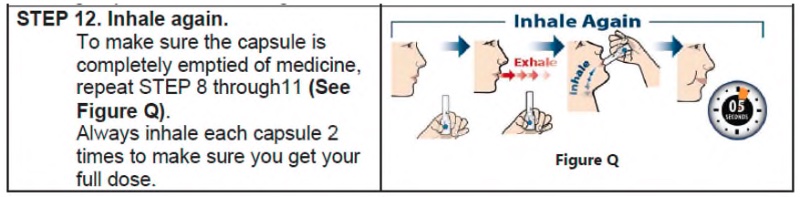
    UTC alleges that practicing Yutrepia's label will literally infringe claim 1 of the '782 patent, as well as claims 2, 3, 8.  UTC's complaint, filed May 9, 2025 asks for a declaratory judgment of inducing infringement under 35 U.S.C. § 271(b) and contributory infringement under 35 U.S.C. § 271(c) based on Liquidia's current failure to launch their product.  UTC's allegations are based on "Liquidia's unauthorized development, manufacturing, commercial marketing, distribution, offers for sale, sales and/or use of Yutrepia™ (treprostinil) inhalation powder for the treatment of pulmonary hypertension ("PH")," based on "tentative approval" of Liquidia's Yutrepiaä product.  UTC's allegations are illustrated by this cartoon included in the complaint:

    Image 2
    Liquidia asserts non-infringement based on UTC's claims requiring coordination between actuation of the dry powder in the inhaler and inhalation by the patient, which is not required by the Yutrepia's device/method.  Liquidia further asserts invalidity based on the PTAB's invalidation of the '793 patent based on timing (the Final Written Decision of the IPR in the '793 patent was issued "only weeks after" allowance of the '782 patent), and that a related UTC application (US 2022-0323459 A1) was rejected for obviousness based on the reasoning in the FWD in the '793 IPR.

    In a separate litigation, UTC filed suit under the Hatch-Waxman Act in the District of Delaware against Liquidia's earlier Yutrepiaä product when Liquidia amended its NDA (NDA No. 213005, filed under § 505(b)(2)) for this drug to include a new indication, pulmonary hypertension associated with interstitial lung disease ("PH-ILD").  Initially UTC asserted the '793 patent (later invalidated by the PTAB in inter partes review; see above) and U.S. Patent No. 11,826,327, claim 1 being representative:

    1.  A method of improving exercise capacity in a patient having pulmonary hypertension associated with interstitial lung disease [i.e., PH-ILD], comprising administering by inhalation to the patient having pulmonary hypertension associated with interstitial lung disease an effective amount of at least 15 micrograms up to a maximum tolerated dose of treprostinil or a pharmaceutically acceptable salt thereof in a single administration event that comprises at least 6 micrograms per breath.

    Relevant to proceedings in the Middle District of North Carolina case (see below), UTC's motion for preliminary injunction to prevent Liquidia from marketing its Yutrepiaä product was denied in that case.  This case is set for trial this month.

    In another dispute in inter partes review, the PTAB invalidated UTC's challenged claims in U.S. Patent No. 9,604,901, with claim 1 being a representative claim:

    A pharmaceutical batch consisting of treprostinil or a salt thereof and impurities resulting from (a) alkylating a benzindene triol, (b) hydrolyzing the product of step (a) to form a solution comprising treprostinil, (c) contacting the solution comprising treprostinil from step (b) with a base to form a salt of treprostinil, (d) isolating the salt of treprostinil, and (e) optionally reacting the salt of treprostinil with an acid to form treprostinil, and wherein the pharmaceutical batch contains at least 2.9 g of treprostinil or its salt.

    This decision was affirmed by the Federal Circuit (see "United Therapeutics Corp. v. Liquidia Technologies Inc. (Fed. Cir. 2024)").

    For its part Liquidia sued UTC for infringement of its U.S. Patent No. 10,898,494, which patent issued January 26, 2021 and expires May 5, 2037 and recites representative claim 1:

    1.  A method for treating a patient, comprising:
        administration of a dry powder composition comprising
        from about 100 micrograms to about 300 micrograms treprostinil or a pharmaceutically acceptable salt thereof to a patient
        by inhalation using a dry powder inhaler over one to four breaths to treat pulmonary hypertension.

    Liquidia's complaint mirrors UTC's complaint but is limited to inducement and/or contributory infringement (the patient being the literal infringer by using the inhaler as prescribed).  Liquidia interprets UTC's treatment regimen containing on its label to direct patients to administer 112 micrograms (mcg) or 128 mcg at each treatment session for 4 sessions per day, which falls within the scope of UTC's asserted claims.

    The most recent activity in these litigations was the District Court's denial in its North Carolina action of UTC's motions for a temporary restraining order and preliminary injunction.  In denying these motions, the District Court held that UTC failed to satisfy the requirement for a showing of a likelihood of success on the merits and that Liquidia's Yutrepiaä product market entry would cause irreparable harm.  The basis for UTC's failure to satisfy the "likelihood of success" requirement focused on whether the asserted claims were invalid for obviousness.  As explained in the opinion, in the preliminary injunction context the burden on the accused infringer is to raise the invalidity issue "that [the patentee] cannot show 'lacks substantial merit,'" citing BlephEx, LLC v. Myco Indus., Inc., 24 F.4th 1391, 1399 (Fed. Cir. 2022).  But, the District Court cautioned, "[t]he burden of presenting a substantial question of invalidity at this stage is lower than what is required to prove invalidity at trial," under Entegris, Inc. v. Pall Corp., 490 F.3d 1340, 1351 (Fed. Cir. 2007), and other authority.  Here, Liquidia's basis for asserting invalidity was the PTAB's IPR decision that the '793 patent was invalid for obviousness (a decision that issued after the Examiner allowed the application leading to the '782 patent).  Liquidia's position is that the disparate decisions create a contradiction, insofar as the '793 invalidation was based on the same prior art as the '782 allowance (a representative claim from each patent shown side-by-side below):

    Table 1
    The Examiner for the application that resulted in the '782 patent reasoned that "a person of ordinary skill in the art would be unable to 'predict the dose, the number of breaths, and the timing of taking the drug' based on the relevant prior art," a conclusion not reached by the PTAB Board in invalidating the '793 patent (specifically the dose range, 15-90 micrograms, and delivery in "one to three" breaths).  Liquidia's invalidity argument was supported, they contended, by rejection of claims in UTC's U.S. Patent Application No. 17/745,333 for obviousness made after the PTAB's decision invalidating the '793 patent became available.  UTC's attempts to distinguish the limitations recited in these claims and the disclosure in the specification were unavailing in attempting to convince the District Court that Liquidia's obviousness arguments were unsupported by the evidence; the District Court supported its decision regarding such arguments by UTC's failure to convince the Examiner during prosecution of the '333 application using similar arguments, the comparison of the three sets of claims shown in this table:

    Table 2(It being clear that claim 1 of the '782 patent is recited with significantly more specificity (i.e., limitations) than the claims of either the '793 patent or the '333 application; nevertheless these distinctions were not persuasive before the District Court.)  And in the denial of UTC's preliminary injunction motion, Judge Schroeder rejected arguments based on any differences in effect regarding the '793 and '782 claims being method of treatment claims and the '333 application claims being directed to pharmaceutical compositions, saying that "[i]f it is not the case that what constitutes an obvious inference from the prior art with respect to a pharmaceutical product is obvious as to a method of treatment, UTC has not persuasively made that case."

    Turning to the "irreparable harm" prong of the requirements for a preliminary amendment, the District Court also found a lack of persuasiveness from UTC.  Rather, the Court was persuaded in part by UTC's delay in bringing suit on the '782 patent (from June 2022 until May 9, 2025, for purportedly strategic reasons, as well as a six-month delay from the date when FDA established Liquidia's Yutrepiaä product label — the Court characterized this situation as involving "last-minute filing").  Also relevant was Liquidia's assertion that it was sufficiently "financially viable" to compensate UTC for any monetary losses it might incur after a Yutrepiaä product launch.  The Court further expressed doubts about the risk of price erosion argued by UTC, and UTC's cause was not aided by statements by UTC executives minimizing the risk of a Yutrepiaä product launch, in some instances to be less than 5% of their current revenues.

    In view of UTC's failures in establishing the first two prongs of the requirements for being granted a preliminary injunction, the District Court's relatively perfunctory analysis of the other two prongs (balance of the hardships and the public interest) did nothing to change the outcome, and the Court denied the injunction of these grounds.

    As a consequence of the District Court's decision, within days Liquidia announced that it was preparing for a full commercial launch of its Yutrepiaä product.  And UTC's third quarter 2024 projected annual revenues of $3 billion provided important incentives for further litigation over this market.

  • By Michael Borella —

    Background:  The oral argument of Bob v. Algorithm Savings & Loan (2014), p. 6:

    JUSTICE HÄAGEN-DAZS:  Imagine King Tut lounging outside his pyramid, surrounded by gold and bad financial instincts.  He's handing out chits left and right, "Good for one unit of gold, redeemable later."  He's got an abacus guy furiously moving beads to keep up.  Eventually, the abacus guy says, "Uh, dude, you've promised more gold than you actually have."  So Tut yells, "Stop!"  Crisis averted.  Or take my mother—she didn't need a computer.  Just one glance at my checkbook and she'd declare, "Hey, you've overdrawn. Stop!"  So now I ask you what, exactly, is less abstract about a computer saying "stop" instead of my mom or a Bronze Age accountant with a bead toy?

    Scene:  A quiet conference room at a law and technology symposium.  An experienced patent attorney with a degree in computer engineering sits across from retired U.S. Supreme Court Justice Häagen-Dazs.  They are discussing technology in the context of patent law.

    Justice Häagen-Dazs:  I've always been skeptical about software patents.  I recall, in Bob, we noted that using a computer to perform an abstract idea isn't enough.  After all, isn't a computer just a very fast abacus?

    Patent Attorney:  With respect, Justice Häagen-Dazs, I would argue that's a profound oversimplification.  An abacus is a passive mechanical tool.  It requires a human operator to interpret, manipulate, and extract meaning.  It doesn't process anything on its own.  A microprocessor, on the other hand, is an active, autonomous computing engine capable of executing millions of logic operations per second according to programmed instructions.  It doesn't just assist a person's calculation, it performs the calculation.

    Justice Häagen-Dazs:  But aren't both merely performing arithmetic?

    Patent Attorney:  The distinction lies in functional capacity and architecture.  A microprocessor implements a general-purpose model of computation, like a Turing machine.  It can simulate any algorithmic process, given enough time and memory.  In practice, an abacus has no such versatility.  It can't run an operating system, control a spacecraft, or manage a distributed database on its own or even with the assistance of a human.  It doesn't have conditional logic, memory registers, or instruction sets.  When patent law considers eligibility, this matters because we're not just talking about number crunching.  Computers are dynamic, programmable systems that change state and manage complex workflows.

    Justice Häagen-Dazs:  You mean my King Tut hypothetical from Bob was wrong?

    Patent Attorney:  Your analogies conflate what is being done with how it is being done.  Yes, the goal of preventing overspending is the same.  But the mechanism for achieving that goal in a computer is entirely different from a human using common sense or manually tallying numbers.  As a more tangible example, if the only known method of binding two pieces of wood together is a nail, then that should not prevent the inventor of the screw from obtaining a patent.

    Justice Häagen-Dazs:  But couldn't a human operating an abacus do anything a microprocessor could do?  Isn't it just a generic tool like a pen and paper or a handheld calculator?

    Patent Attorney:  No one has ever used an abacus to stream a video or encrypt HTTPS traffic, much less train a large language model — for good reason.  The analogy breaks down because an abacus can only be used to perform simple mathematical operations to solve small scale problems.  It would be absurd to contend that you could replace a modern graphical processor with even thousands of humans armed with abacuses.  The problems being solved and the solutions are fundamentally different.

    Justice Häagen-Dazs:  But the concern I had — and still have — is that merely implementing a longstanding human practice on a computer shouldn't suffice for patent eligibility.  Otherwise, we'd be monopolizing abstract ideas with trivial technological dressings.

    Patent Attorney:  The key question is whether the computer implementation is trivial.  If it merely automates a human practice using generic computing steps, such as storing, retrieving, and displaying, then forget about § 101 — it's not patentable as obvious.  But in many cases, the implementation is non-trivial in that the inventors aren't just using the computer as a faster pencil.  They are solving technical problems that arise only in the context of computer implementation.  Take for example a method of organizing human activity, say, a known manual accounting method.  If someone's claim is so broad that it covers that method, it's clearly unpatentable.  But if the same concept is implemented in a way that changes how the problem is solved because of the unique constraints or capabilities of the computing environment, and further the claim reflects this difference, then the computer is inseparable from this solution.  The notion of the abstract idea from Bob fails to reflect this fundamental fact.  Going back to a pre-Bob regime of patentability would not result in thousands of low-quality patents, especially if the USPTO properly applies the principles of obviousness, functional claiming, and definiteness from the patent statute.

    Justice Häagen-Dazs:  So in your view, the difference is not merely one of speed or convenience but of computational capability?

    Patent Attorney:  Precisely.  A microprocessor embodies a flexible, programmable platform capable of executing a vast range of machine-readable instructions.  It's not just an electronic abacus.  It is a fundamentally different class of tool.  Comparing it to an abacus is like comparing a steam engine to a horse.

    Justice Häagen-Dazs:  I see.  Perhaps I underestimated how much abstraction and logic can be embedded in hardware.  But I've been told over and over that there's something special happening under the hood in software patents, yet I can't see what's happening.  I'd rather err on the side of caution than risk giving twenty-year monopolies to ideas that should remain in the public domain.

    Patent Attorney:  Um, there's this thing called "discovery" where parties can produce evidence, such as source code, system architectures, and technical declarations from programmers, to show exactly what's happening "under the hood."  The courts don't have to guess.

    Justice Häagen-Dazs:  Yes, yes, I'm aware of discovery.  But even then, I see lines of code, flowcharts, declarations by experts with PhDs in computer science . . . and I still don't see a machine.  I see words.  Diagrams.  Assertions that something is "faster" or "more efficient."  To me, it's all just squiggly nonsense in a box labeled "processing unit."  It might as well be alchemy.

    Patent Attorney (getting visibly annoyed):  Justice Häagen-Dazs . . . Steve . . . a microprocessor is neither alchemy nor it is an abacus.  As my Gen Z kids like to tell me, this is what happens when you let old people make the important decisions . . . .

    Justice Häagen-Dazs (looking at a sundial strapped to his wrist):  Oh dear, is that the time?  I'm late for pickleball.  Toodles!

    Justice Häagen-Dazs stands up and hurries toward the exit, only to collide with an attendee entering the room.  The attendee's mobile phone (which happens to be running an investment app) slips from their hand and lands squarely on Justice Häagen-Dazs' foot.  He winces and curses the "abstract idea" that just fractured his toe and cost him six weeks of pickleball.

    End Scene

  • By Kevin E. Noonan —

    "Plus ça change, plus c'est la même chose," Jean-Baptiste Alphonse Karr (1849)

    Federal Trade Commission (FTC) SealIn the last years of the Biden Administration, the Federal Trade Commission issued a policy statement and sent letters to ten companies having Orange Book-listed patents claiming devices for administering drugs challenging the propriety of those listings and demanding that the companies delist these patents (see "FTC Announces Efforts to Police Pharmaceutical Companies' Patent Behavior" and "FTC Warns Pharma Companies It Means Business with Its Orange Book Listing Policy").  The changes during the past 100+ days of the Trump Presidency could hardly be more dramatic:  Chairwoman Lina Khan and two Commissioners appointed by Democratic Presidents are gone (voluntarily or by disputed Presidential fiat) and almost any Biden initiative has been challenged or reversed; indeed, with apologies to Justice Jackson it can fairly be said that "the only [Biden initiative] which is valid is one which this [President] has not been able to get [his] hands on."

    The FTC's crusade against Orange Book-listed device patents is the exception to this trend (proving that the perception that "drugs cost too much" and that patents are to blame is bipartisan, as is the seeming misunderstandings regarding the purported linkage between them).  The latest FTC action has been another spate of warning letters sent to Novartis, Mylan, Teva, Amphastar, and Covis (indicating that at least some of the previously threatened companies had earlier complied).

    One difference in this latest foray is the existence of the Federal Circuit affirmance of a district court order to delist, in Teva Pharms. Inc. v. Amneal Pharms. LLC, following the doctrinal grounds relied upon by the FTC in its former incarnation.  This should come as no surprise, because the FTC filed amicus briefs before both courts, and the district court opinion was unabashed in incorporating the arguments in the FTC's brief in support of its ruling and the legal reasoning supporting it.

    While the changes in philosophy between the two Administrations (and the composition of the FTC could not be more partisan), in practice the rhetoric in the letters are almost identical.  Each letter asserts that the recipient has an "ongoing obligation to ensure the propriety of its patent listings in the FDA's [Orange Book]," citing the earlier letters, all the letters expressly referenced the Federal Circuit decision in Teva v. Amneal, and in Teva's case not limiting the delisting demand to the patents at issue in that case.  The earlier public pronouncements are relegated to a footnote in these letters but were cited as a reminder nonetheless.  And all these letters were signed by Kelse Moen, Deputy Director, Bureau of Competition; Mr. Moen was appointed by FTC Chair Andrew Ferguson on February 18, 2025.

    The FTC has been enunciating these threats for almost two years, and while being conventionally active in pursuing judicial remedies as in Teva v. Amneal (and previously in the series of cases resulting in FTC v. Actavis) has not followed through on its demands.

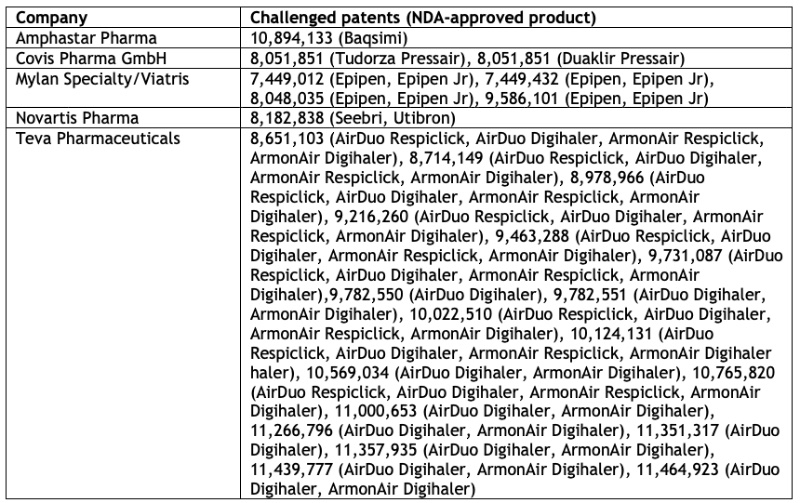
    The patents challenged by the FTC for each pharmaceutical company are as follows:
    Table

  • By Michael Borella —

    Love it or hate it, artificial intelligence (AI) has ushered the world to an inflection point.  The power of large language models (LLMs) is changing the structure of labor markets, education, informational gatekeeping, and governance.  It is still unclear whether these changes will lead to a utopian scenario in which all human needs are taken care of by machines or a neo-feudal hellscape in which a few ultra-wealthy technocrats cyber-rule over billions of platform-dependent serfs.  Or maybe we land somewhere in between.  Regardless of where it is ultimately headed, AI is the current big thing and on track to continue expanding.

    Given this, it is important (and even mildly entertaining until you get to the end of this article) to consider the weirdness of some AI-adjacent subcultures.  While the vast majority of individuals working in the AI space do not adhere to these philosophies and beliefs, a handful of notable and highly-influential technologists are either true believers or have been known to rely on these fringe philosophies.

    The rationalists are a loosely affiliated intellectual community focused on human reasoning, understanding cognitive biases, and anticipating long-term risks from advanced technologies such as AI.[1]  Many believe that artificial general intelligence (AGI) poses an existential risk unless it is aligned with human values.  This sounds fine, but some rationalists have taken this to an extreme degree, overlapping intellectually with longtermers, another esoteric niche that places the needs of future humans at or above the level of those of current humans.[2]

    This has led to some strange positions, often based on self-centered, post-hoc justifications.  Longtermers place an equal moral weight on the well-being of future humans and that of current humans.  Thus, they posit that there will be many more human beings in the future than there are now, and so a utilitarian and "rational" conclusion is to optimize for the needs of those of the future even if this causes some degree of suffering in those of the present.  Sometimes these lines of thinking are referred to as "effective altruism."

    Probably the most famous effective altruist is Sam Bankman-Fried, who justified enriching himself by making risky investments with other peoples' money as a way to improve the overall welfare of the world.[3]  Bankman-Fried was to eventually give it all away in massive acts of philanthropy.  In practice, this alleged mission did not work out so well, and Bankman-Fried was sentenced last year to 25 years in prison for fraud and conspiracy related to his operation of the FTX cryptocurrency exchange.

    Other well-known individuals in various rationalist circles subscribe to or are influenced by similar ideas, and have not (yet) been convicted of a crime.  Venture capitalist Marc Andreessen views rationalism and longtermism through a libertarian-accelerationist lens, viewing failure to adopt AI a greater danger than any of its existential risks.  In fact, Andreessen has provided a non-individualized list of "enemies" who purportedly stand in the way of AI growth.[4]  Andreessen's The Techno-Optimist Manifesto, a very long blog post espousing his beliefs, has a strangely messianic glow.  But no matter how you frame it, Andreessen is preaching for a low-regulation environment that would be good for Andreessen, allowing him to add multiples to the billions he already enjoys.

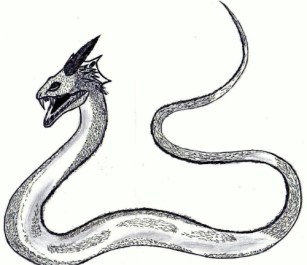
    BasiliscoBut Andreessen is not the only rationalist to flirt with religion.  An online community of rationalists had a major kerfuffle over the thought experiment called Roko's Basilisk.[5]  In short, it asks us to consider that a future super-intelligent AI might punish anyone who knew about it but didn't help bring it into existence.  In particular, the Basilisk would perform simulations of these people, the simulated copies subjected to extreme suffering, possibly for very long periods of time.[6]

    Of course, this is just a sophisticated variation of Pascal's Wager, a much older thought experiment about the existence of God.[7]  Nonetheless, online panic ensued, leading to moderators banning discussion of the Basilisk on their forum.  And it does not end there.  According to some reports, tech CEO and armchair efficiency expert Elon Musk met the singer Grimes (mother of 3 of his at least 14 children) due to Twitter discussions of the Basilisk.[8]

    And that is just the short list.  Arguments could be made that others have promoted controversial, ethically questionable, or arguably sociopathic ideas in the furtherance of AI (and often themselves at the same time).  These include OpenAI CEO Sam Altman (deemphasizing AI safety while using fear tactics to gain influence and power), investor Peter Theil (pushing for AI use in authoritarian contexts), and former Coinbase CEO Balaji Srinivasan (advocating for cloud-based governance and rule by techno-elites, with AI as a central tool).

    Some AI evangelists on the more careful side of things will attempt to rationalize their arguments by stating that AGI is an engine of abundance and the distribution of the excess wealth is a political rather than technological problem.[9]  Yet, it is rare in human history for a political system to distribute wealth equally or equitably, and we have many counter-examples of the exact opposite occurring.

    But let's end on an even darker note.  The Zizians are a small cult-like group that grew out of the rationalist movement.  They are currently believed to be involved in the deaths of six individuals in 2022 and 2025.[10]  To be clear, the Zizians are not mainstream rationalists.

    I personally know dozens of people working in the AI space and I have to admit that they are all pretty chill.  It would not be accurate or fair to lump the majority of AI users, developers, and advocates under the "weird" moniker.

    But the statements of a number of very powerful individuals, many of whom currently lead the AI community, have been more than just weird.  They are also troubling because they reveal a willingness to dismiss oversight, minimize risks, and speak in abstract, hyper-rational terms that often ignore real-world human suffering.  On the other hand, these are some of the same people who brought us aggressive online ads, social media, meme coins, and surveillance capitalism.  So their vision of the future, however well-funded and covered in altruistic gloss, deserves critical scrutiny rather than blind trust.

    [1] https://en.wikipedia.org/wiki/Rationalist_community.

    [2] https://en.wikipedia.org/wiki/Longtermism.

    [3] https://www.newyorker.com/news/annals-of-inquiry/sam-bankman-fried-effective-altruism-and-the-question-of-complicity.

    [4] Someone powerful making lists of enemies has never gone wrong.  Nope.  Not once.

    [5] https://en.wikipedia.org/wiki/Roko%27s_basilisk.

    [6] Ironically, the rationalists, many of whom claim to be atheists, appear to have recreated a version of the Christian hell.

    [7] https://en.wikipedia.org/wiki/Pascal%27s_wager.

    [8] https://www.vice.com/en/article/what-is-rokos-basilisk-elon-musk-grimes/.

    [9] See, e.g., https://www.aei.org/articles/the-age-of-agi-the-upsides-and-challenges-of-superintelligence/.

    [10] https://en.wikipedia.org/wiki/Zizians.

    Image of Basilisco, desenho de Rodrigo Ferrarezi by Rodrigo Ferrarezi, from the Wikimedia Commons under the Creative Commons Attribution 3.0 Unported license.

  • By Michael Borella —

    Federal Circuit SealThe last 11 years have taught us much about the Federal Circuit; namely, that a majority of the judges simply do not seem to appreciate software.  Given the statements that several have made in opinions, one might be able to go as far as saying that some of these judges appear to fundamentally misunderstand how software is developed and works in practice.

    Like creeping autocracy, those of us subject to their rule have watched the gradual erosion of what types of inventions are eligible for patenting under 35 U.S.C. § 101.  Initially, business methods were found largely ineligible, then software executable on a general purpose computer, then software executable on any platform, and then non-software inventions as well.  The consequences of the subjectivity the Court has engendered include a highly unpredictable examination process at the U.S. Patent and Trademark Office and that the validity of any invention under § 101 can be challenged with a straight face.

    The vast majority of those in the patent legal community are aware of this slow-moving coup, and their reactions vary from disapproving frowns to recoiling in shock.  The few voices in favor of the status quo include non-practitioners from academia and those who financially benefit from things remaining the way they are.  The piecemeal nature of this death by 1000 cuts results in absurd rulings occurring before the legal community is generally aware that the velociraptors were testing the fences.  And by then, mechanisms for reversing course are compromised.

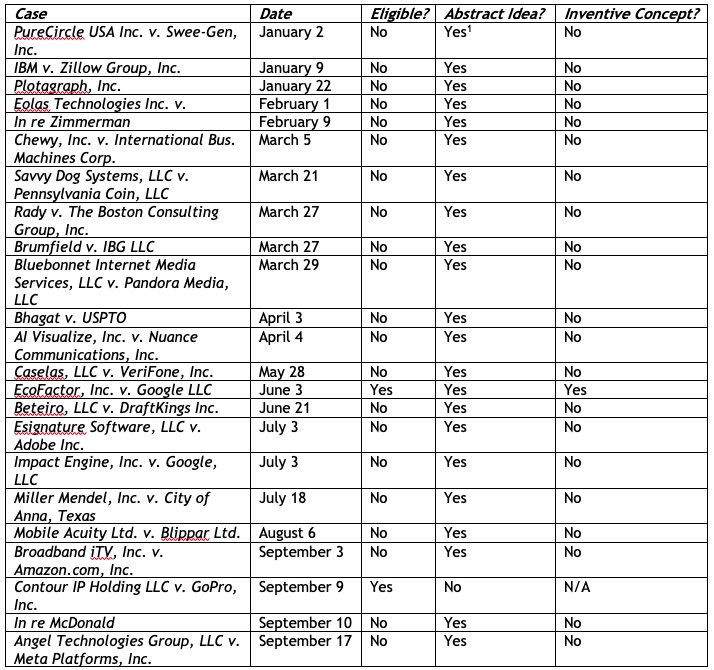
    To put some numbers to the situation, we considered all substantive § 101 decisions that came down from the Federal Circuit in 2024.

    Table
    We considered 23 cases, of which only 2 involve claims that were found eligible.  Thus, the Federal Circuit determined that claims were not eligible an astounding 91.3% of the time.  To be fair, one of the cases in which claims remained eligible — EcoFactor, Inc. v. Google LLC — was decided on procedural grounds.  Thus its inclusion in this list is for purposes of completeness.  Recalculating with this case removed results in a 95.5% invalidity rate.

    The fact that the Federal Circuit is a brutal venue for patentees with § 101 challenges should come as no surprise.  The Court has been willing to view the exceptions of Alice v. CLS Bank Int'l expansively for years.  Despite the Supreme Court's warning to "tread carefully in construing this exclusionary principle lest it swallow all of patent law," said law is now curled up like the mythical ouroborous worm.

    Put in context, between 2021 and 2023, the USPTO's Patent Trial and Appeal Board (PTAB) affirmed examiner's § 101 decisions about 90% of the time.  Thus, the appeals process for § 101 offers scant hope that patents survive.

    But it is instructive to take a deeper dive into the one case where the Federal Circuit substantively reviewed the claims and found them eligible.  Claim 11 of Contour IP Holding LLC v. GoPro, Inc. recites:

    11.  A portable, point of view digital video camera, comprising:
        a lens;
        an image sensor configured to capture light propagating through the lens and representing a scene, and produce real time video image data of the scene;
        a wireless connection protocol device configured to send real time image content by wireless transmission directly to and receive control signals or data signals by wireless transmission directly from a personal portable computing device executing     an application; and
        a camera processor configured to:
            receive the video image data directly or indirectly from the image sensor, generate from the video image data a first image data stream and a second image data stream, wherein the second image data stream is a higher quality than the first image data stream,
            cause the wireless connection protocol device to send the first image data stream directly to the personal portable computing device for display on a display of the personal portable computing device, wherein the personal portable computing device generates the control signals for the video camera, and wherein the control signals comprise at least one of         a frame alignment, multi-camera synchronization, remote file access, and a resolution setting, and at least one of a lighting setting, a color setting, and an audio setting,
            receive the control signals from the personal portable computing device, and
            adjust one or more settings of the video camera based at least in part on at least a portion of the control signals received from the personal portable computing device.

    Here, the Court found that "when read as a whole, claim 11 is directed to a specific means that improves the relevant technology . . . an improved POV camera through its combination of claim limitations and requirement that the claimed POV camera processor be configured to record low- and high-quality data streams in parallel, followed by the low-quality data stream's wireless transfer to a remote device."  According to the Court, "[t]he claims thus require specific, technological means—parallel data stream recording with the low-quality recording wirelessly transferred to a remote device—that in turn provide a technological improvement to the real time viewing capabilities of a POV camera's recordings on a remote device."

    Notably, the District Court construed the claim term "generate" to require parallel recording of video streams.  Apparently, this led the Federal Circuit to find that the claim language was sufficiently specific.  The Court also looked to the specification to find that it "discloses improving POV camera technology through specific means of generating high- and low-quality video streams in parallel and transferring a low-quality video stream to a remote device, and the claims reflect this improvement."

    Accordingly, the claim is not directed to an abstract idea, and the Court did not need to opine on whether it included an inventive concept.

    Ultimately, this decision remains frustrating, as it does not clearly delineate what level of detail is required for a software-based claim to be patent eligible.  The claim certainly had a few factors going for it, including that it was reasonably narrow, directed to a physical device, benefited from a claim construction that invoked a technical improvement, and that the claim’s technical improvement was described as such in the specification.  A sampling of the other cases in the above table finds that the majority involve claims that are directed to business methods operating on general purpose computers, include eligibility arguments not supported by the claim language, omit describing the alleged technical improvement in the specification, and/or exhibit claim language that is outcome oriented.

    These distinctions reinforce what has become the norm in modern patent drafting — submit claims that are not overly broad or vague, explicitly recite a technical improvement not believed to be in the prior art, and describe how the technical improvement solves a technical problem.  Even by doing all of this, a determination of patent eligibility is not guaranteed in the presence of such an uncertain test, but it may push the odds in the applicant's favor.

  • By Kevin E. Noonan —

    Federal Circuit SealOnly a few days after the one-year anniversary of hearing oral argument, the Federal Circuit handed down its decision in Regents of the University of California v. Broad Institute, Inc. on Monday.  The opinion reviewed the Patent Trial and Appeal Board's decision in Interference No. 106,115 between Senior Party the Broad Institute, Harvard University, and MIT (collectively, "Broad") and against Junior Party the University of California/Berkeley, the University of Vienna, and Emmanuelle Charpentier (collectively "CVC" before the PTAB, here, "Regents") over CRISPR (clustered regularly interspaced short palindromic repeats) technology for gene editing.

    To briefly recap, the '115 interference was the second interference between these parties after Interference No. 106,048 was dismissed for there being no interference-in-fact; see "PTAB Decides CRISPR Interference in Favor of Broad Institute — Their Reasoning" and affirmed by the Federal Circuit in Regents of the Univ. of Cal. v. Broad Inst., Inc., 903 F.3d 1286 (Fed. Cir. 2018).  The '115 interference was provoked by Regents to overcome the basis for the decision in the '048 Interference; specifically Regents filed additional continuation applications reciting eukaryotic embodiments of CRISPR technology, reading directly on eukaryotic CRISPR claims in Broad's granted patents.  The PTAB awarded priority to Broad in this interference based, inter alia, on Broad convincing the Board that putative failures by Regents in reducing to practice their conception indicated that Regents' conception was incomplete or defective and Broad's conception thus occurred before Regents'.  The specifics of this reasoning is set forth in the Board's decision (see "PTAB Grants Priority for Eukaryotic CRISPR to Broad in Interference No. 106,115") and the parties arguments and grounds for appeal set forth in their briefs (see "CVC Files Appeal Brief in Interference No. 106,115"; "CVC Files Response and Reply Brief in Interference No. 106,115 Appeal"; "Broad Files Reply Brief in Interference No. 106,115 Cross-Appeal").

    The Federal Circuit's opinion recites much of the factual and procedural background contained in these briefs and the history of the '115 interference (including the Board's decisions on the parties' Preliminary Motions; see "PTAB Decides Parties' Motions in CRISPR Interference"), but the opinion is significant for its decision that the Board erred as a matter of law on the priority question.  It is interesting to note that the panel is careful to describe in their explication what each party claims to be the case regarding their conception and reduction to practice of the claimed eukaryotic CRISPR embodiments.

    The opinion, by Judge Reyna joined by Judges Hughes and Cunningham, affirmed in part, vacated in part, and remanded, in consideration of these grounds of appeal.  Regents based its appeal on the Board's priority determination and that its earliest provisional applications (P1, filed May 2012 and P2, filed October 2012) failed to satisfy the written description requirement and thus Broad was designated Senior Party.  For Broad, its appeal was based on the Board's claim construction regarding the scope of the term "guide RNA" as being limited to single guide RNA species wherein the crRNA and tracerRNA components of the CRISPR-Cas9 complex were covalently linked, usually by a short spacer nucleic acid (a species of which, termed Chimera A, was the basis for Regents' earliest date of conception).

    The opinion begins with Regents' disputed date of conception and the completeness thereof.  The panel held that the basis for the Board's determination that Regents' conception was defective was legal error, because it "require[ed] Regents' scientists to know that their invention would work."  This amounted to a conflation of the "distinct legal standards for conception and reduction to practice."  Reciting established law, the opinion asserts "[t]here are three stages to the inventive process: (1) conception, (2) reasonable diligence, and (3) reduction to practice," citing Mahurkar v. C.R. Bard, Inc., 79 F.3d 1572, 1577 (Fed. Cir. 1996).  Under Burroughs Wellcome Co. v. Barr Lab'ys, Inc., 40 F.3d 1223, 1228 (Fed. Cir. 1994), the panel states that "an inventor need not know that his invention will work for conception to be complete" because, inter alia, "[k]nowledge that the invention will work, 'necessarily, can rest only on an actual reduction to practice,'" citing Applegate v. Scherer, 332 F.2d 571, 573 (CCPA 1964), and Univ. of Pittsburgh of Commonwealth Sys. of Higher Educ. v. Hedrick, 573 F.3d 1290, 1299 (Fed. Cir. 2009).  Based on this precedent, the Board having denied Regents the benefit of its earliest conception date based on uncertainty on its operability was error according to the Federal Circuit.  The panel further noted that the evidentiary basis for the Board's decision was "almost exclusively . . . Regents' scientists' statements expressing uncertainty about whether the experiments had succeeded and suggesting modifications to their CRISPR-Cas9 system" and thus to conclude that they did not have a "definite and permanent idea" on this basis was error.  The Board improperly applied the Burroughs standard, which defined "[f]actual uncertainty [which] is when '[the subsequent course of experimentation, especially experimental failures, reveal uncertainty that so undermines the specificity of the inventor's idea that it is not yet a definite and permanent reflection of the complete invention as it will be used in practice.'"  The Board's error was in depending on the Regents' scientists statements rather than determining whether those statements were accompanied by "modifications in their experiments that substantively changed their original idea."

    Another basis for Board error was the failure to determine whether Regents' conception (i.e., the "plan" for performing CRISPR gene editing in eukaryotic cells) was used successfully by Regents scientists themselves or any other groups, using only routine skill and routine techniques.  Put another way, the opinion asserts that the proper analysis is to determine "whether [Regents' scientists] had formed the idea of [the invention's] use for [its intended] purpose in sufficiently final form that only the exercise of ordinary skill remained to reduce it to practice" "without extensive research or experimentation" under Burroughs.  The experiences of third parties is relevant both for their failures (citing Amgen, Inc. v. Chugai Pharm. Co., 927 F.2d 1200, 1207 (Fed. Cir. 1991)) and successes (citing Brand v. Thomas, 96 F.2d 301, 303 (CCPA 1938)).  Also relevant, according to the opinion was the course of conduct of the "alleged inventor" with regard to whether she "contemplated the use of routine skill or methods at an asserted conception date, or used such routine skill or methods during subsequent, successful experimentation conducted by [her]."  The Board's failure to consider routine methods or skill in reducing the invention to practice, and instead "focusing almost entirely on Regents' scientists' statements about perceived experimental difficulties and doubts about success" was another source of Board error.  This error was illustrated by the Board deciding that it was not enough that the Regents' inventors had "conceived of the mechanics" of the invention but instead must have had an "operative invention" to have conceived.  In doing so, the panel found that the Board had misapplied the Court's Hitzeman v. Rutter precedent, which concerned an instance where there was a "bare hope" for a result that had "never before [been] achieved," 243 F.3d 1345, 1358–59 (Fed. Cir. 2001).  The proper distinction in this case was that the claim limitations were not directed to a result but rather to whether CRISPR functions in a eukaryotic cell, according to the opinion.  Failing (refusing, according to the panel) to consider "whether a person of ordinary skill could have achieved the function of editing eukaryotic DNA" was error by the Board.  The proper standard is there being "more than a 'general hope,' but less than knowing with certainty that the invention would work" according to the opinion.

    The Court also held that the Board erred by failing to consider Regents' evidence of the success of others in using their conception to successfully reduce eukaryotic CRISPR to practice.  By focusing on the purported difficulties encountered by Regents' scientists in reducing the invention to practice the Board legally erred in not considering whether Regents' scientists "described routine methods or skill at the asserted conception dates and used those methods or that skill to achieve purported successes during subsequent experimentation."  The Board erred by assuming that the purported difficulties in reduction to practice indicated that the invention required undue experimentation to be carried out, according to the opinion.

    The opinion sets out its conclusions as to the scope and extent of the Board's error in its priority determination:

    In sum, the Board erred by failing to consider routine methods or skill, focusing almost entirely on Regents' scientists' perceived experimental difficulties and related statements of doubt.  We thus vacate the Board's decision on conception and remand for the Board to decide on conception under the proper application of the legal framework.  On remand, the later party to reduce to practice will have the opportunity to show, under a conception date established by the correct standard, either (1) it was "the first to conceive of the invention and that it exercised reasonable diligence in later reducing that invention to practice," Cooper v. Goldfarb, 154 F.3d 1321, 1327 (Fed. Cir. 1998), or (2) it had "prior conception of the claimed subject matter and communication of the conception to the adverse claimant."  Price v. Symsek, 988 F.2d 1187, 1190 (Fed. Cir. 1993).

    The opinion then turned to Regents' appeal of the Board's decision in Preliminary Motions that Regents' earlier priority documents did not satisfy the written description requirement for determination of which party was entitled to be designated as the Senior Party.  The panel determined that the Board properly applied the rubrics regarding whether the P1 or P2 disclosures satisfied the requirement based on the complexity and unpredictability of the invention as understood by one having ordinary skill in the art. While acknowledging that working examples or description of an actual reduction to practice are not required under Ariad Pharms., Inc. v. Eli Lilly & Co., 598 F.3d 1336, 1351 (Fed. Cir. 2010) (en banc), the panel also asserted that the determination depends on how the ordinarily skilled worker would understand what was described within "the four corners of the specification."  The Board here "properly tailored its analysis to the specific facts of this case, rather than applying a one-size-fits-all approach."  The Federal Circuit also rejected Regents' argument that the Board's decision violated the provisions of the Administrative Procedures Act for failing to consider disclosure that would have supported possession of the invention.  The Court saw no indication that the Board had improperly relied upon or only considered evidence of one route of practicing the invention (using expression vectors) and not others (microinjection) and thus upheld the Board's written description determination.

    Turning to Broad's appeal on claim construction grounds regarding the term "guide RNA," the panel held that the appeal is moot, because the Board made its determinations in denying Broad's Preliminary Motions on "independently sufficient grounds . . . unrelated to claim construction."  Under these circumstances, "the relief sought would not have an impact on the legal interests of the parties" and thus the appeal is moot.

    The decision was entirely in Regents' favor with regard to priority and amounts to almost a mandate in Regents' favor on remand.  The opinion criticized, found legal error, and vacated every basis upon which the PTAB panel awarded priority to Broad.  Of course, as a consequence the question of what group of inventors were the first to invent and thus are entitled to patents on eukaryotic versions of CRISPR remains undecided, with all the investment and licensing uncertainty that these circumstances create.  And it is unlikely that investors, licensees, or the public will have a definitive answer on this issue any earlier than one or two years from now.

    Regents of the University of California v. Broad Institute, Inc. (Fed. Cir. 2025)
    Panel: Circuit Judges Reyna, Hughes, and Cunningham
    Opinion By Circuit Judge Reyna

  • By Andrew Velzen —

    PocketPairI have previously written extensively on the ongoing legal battle between Nintendo / The Pokémon Company (referred to herein collectively as simply "Nintendo") and PocketPair over PocketPair's popular video game Palworld.[1]  This past week, PocketPair published a blog post addressing some of the recent and upcoming in-game changes.[2]  The PocketPair blog post is worth analyzing vis-a-vis Nintendo's recently filed U.S. patent applications.

    Before jumping into the meat of PocketPair's blog post, though, let's check in with the status of Nintendo's developing U.S. patent portfolio related to this case.  As I discussed in one of my previous posts, Nintendo has filed three patent applications that, on their face, are seemingly meant to target Palworld.[3]  To remain consistent with the nomenclature I have used previously, I will continue to refer to these three U.S. patent applications as:  U.S. App. No. 18/652,874 ("US-App-3"), U.S. App. No. 18/652,883 ("US-App-4"), and U.S. Pat. App. No. 18/776,729 ("US-App-5").  As I previously noted, two of these applications (US-App-3 and US-App-5) have both issued as U.S. patents (US-App-3 issued in December 2024 and US-App-5 issued in February 2025).

    There has also been additional activity in US-App-4 since my last post.  On December 4, 2024, a final Office Action issued in US-App-4 in which the Examiner rejected the pending claims as obvious under 35 U.S.C. § 103, but indicated one of the dependent claims (claim 22) as allowable.  On March 4, 2025, Nintendo filed a response with the U.S. Patent and Trademark Office (USPTO).  In the response, rather than accepting the allowable subject matter of claim 22, Nintendo responded by:  (i) submitting a further amendment that slightly narrowed the independent claims and (ii) arguing that the prior art did not render the claims obvious.  The patent examiner at the USPTO was persuaded by this response and issued a Notice of Allowance for US-App-4 on April 4, 2025.  Nintendo now has until July 7, 2025 to pay the issue fee, which would result in an issued U.S. Patent.[4]  To summarize, Nintendo now has two patents and will likely soon have a third, as well.

    Turning to PocketPair's blog post, PocketPair communicated three important things:  (1) that PocketPair "continue[s] to dispute these [patent infringement] claims and assert the invalidity of the patents in question"; (2) that PocketPair's v0.3.11 patch to Palworld (which "removed the ability to summon Pals by throwing Pal Spheres and instead changed it to a static summon next to the player" and implemented several changes to "other game mechanics") was "indeed a result of the ongoing litigation"; and (3) that PocketPair's upcoming v0.5.5 patch to Palworld (which will change "gliding" such that it is "performed using a glider rather than with Pals") represents "yet another compromise" in order to "prevent further disruptions to the development of Palworld."

    While the only currently pending litigation is in Japan (i.e., there is no counterpart patent infringement litigation currently pending in the U.S.), the U.S. patent applications described above are sister applications to the presently asserted Japanese patents and cover similar game mechanics.  Further, to my knowledge, the version of Palworld presently playable in Japan is identical to the version of Palworld playable in the U.S.  Hence, any changes made to Palworld to avoid Japanese patent infringement may also assist with (e.g., be done with the purpose of) avoiding U.S. patent infringement.

    On their face, the changes described in item (2) and (3) above from PocketPair's blog post do seem to relate directly to the claims issued (or allowed) in US-App-3, US-App-4, and US-App-5.  For example, the claims of the issued patents corresponding to US-App-3 and US-App-5, respectively, cover (i) "catching a field character" with a "catching item" and then later the "field character" fighting a "fighting character" and (ii) "catching a first virtual character" with a "virtual object" and then later launching the "virtual object" and displaying the "first virtual character" fighting a "second virtual character."[5]  Thus, the changes to Palworld in patch v0.3.11 could certainly assist in avoiding infringement of US-App-3 and US-App-5.  Likewise, the changes to Palworld in patch v0.5.5 could assist in avoiding infringement of US-App-4 (assuming US-App-4 ultimately issue as a patent), since the claims of US-App-4 relate to "causing [a] player character to board an air boarding object."[6]

    It is important to note, however, that PocketPair's modification of game mechanics is not an admission of infringement of the U.S. patents.  This is especially true when coupled with PocketPair's statement from the blog post that PocketPair "continue[s] to dispute" the patent infringement claims.  Further, while modification of game mechanics is not an admission of infringement, neither does it insulate PocketPair from liability for any previously committed acts of patent infringement.  Instead, PocketPair may simply be taking steps to mitigate risk moving forward.

    For example, should it ultimately be determined that PocketPair committed patent infringement in the U.S., multiple remedies could be applied.[7]

    A first type of remedy could include assessing damages against PocketPair in the form of a reasonable royalty.  A reasonable royalty depends on both a "royalty rate" (e.g., the monetary value per unit of infringing product sold that is attributable to the infringing feature) and a "royalty base" (e.g., the number of units of infringing product sold).  The shorter the amount of time that an infringing product is for sale, the less the so-called "royalty base."  For example, any copies of Palworld sold after any infringing feature has been removed from the game could not be included in the "royalty base" (since those copies were not infringing).  Hence, PocketPair could be amending the features to protect against a higher monetary judgment should it ultimately lose a patent infringement case.

    A second type of remedy could include an injunction.  PocketPair may be enjoined (i.e., judicially forbidden) from selling products in the future that include infringing features.  Thus, to prevent future software development / game design time being committed to removing infringing features, PocketPair may simply be proactively removing allegedly infringing features now.  Likewise, removal of such features upfront may both:  (i) preemptively adjust player expectations regarding those features and related features being included in-game; and (ii) prevent additional game features that rely on the underlying infringing features from being developed in the interim (i.e., between now and any infringement judgment).

    Appropriately thirdly, PocketPair may avoid treble damages in the U.S. by removing the features in question now (i.e., upon becoming aware of the U.S. patents in question).  According to 35 U.S.C. § 284, when there is a finding of patent infringement, "the court may increase the damages up to three times the amount found or assessed."  Treble damages are traditionally rendered as a result of the defendant's willful infringement (e.g., the defendant performing one or more actions that the defendant knows would be covered by a claim of a valid patent of which the defendant was aware).  Due to the presently ongoing legal battles (both in Japan and in the U.S.), PocketPair has almost assuredly been made aware of the two issued U.S. Patents (and allowed US-App-4).  For example, PocketPair may have received one or more threatening letters from Nintendo indicating that Nintendo believes PocketPair to be infringing Nintendo's U.S. patents (e.g., along with copies of the U.S. Patents in question).  This puts PocketPair on notice and, if PocketPair continues to infringe Nintendo's patents thereafter (without any other protections in place, such as a non-infringement opinion), should Nintendo ultimately prevail in a U.S. lawsuit, PocketPair could be on the hook for three times the amount for any infringing acts committed after being put on notice.

    As a result, it is very plausible that PocketPair maintains its innocence in terms of patent infringement liability, but for at least the three remedy-related reasons above, has decided to remove the features in question anyway.  This is speculation, but in addition to mitigating risk for the reasons above, PocketPair may also be changing in-game elements based directly on ongoing negotiations with Nintendo.  It is likely that settlement negotiations have at least been floated between the two parties (if not actively ongoing).  Further, part of those settlement negotiations would likely include PocketPair's agreement to remove certain game features from Palworld.  Thus, by removing the features from the game currently (and by issuing a public blog post about it), PocketPair may be negotiating in good faith with Nintendo.

    What happens from here on out will likely be based on PocketPair's appetite for a legal battle.  Nintendo is arguably in a relatively strong negotiating position at the moment, as it has already filed suit in Japan and has obtained two (likely soon-to-be three) related patents in the U.S.  Additionally, PocketPair has had immense success over the last year with Palworld.  It may be more of a risk than PocketPair is comfortable with to stake some of that success in a multinational litigation against Nintendo.  In other words, depending on the terms of a negotiated agreement, it may be safer for PocketPair to simply capitulate to Nintendo's requests (e.g., remove certain features from Palworld and pay Nintendo some amount of money), rather than fight the charges of infringement.[8]

    Should PocketPair desire to take this fight further, though, there are certainly avenues in the U.S. that could be pursued.  For example, PocketPair could haul Nintendo's U.S. patents back into the USPTO in an Inter Partes Review (IPR) proceeding or a Post Grant Review (PGR) proceeding in an attempt to invalidate the patents, as described in my previous pieces.

    Since its outset, this has been an interesting case to follow, with aspects touching on many different areas of intellectual property law.  Given the size of the parties involved (and the relative success of their respective games), I think the entire gaming industry is watching to see how it plays out.  Regardless of the outcome, this legal battle clearly highlights that patents remain an effective tool in the gaming space, even if their use has fallen out of vogue somewhat post-Alice.[9]

    [1] See https://www.patentdocs.org/2024/04/palworld-friend-or-foe.html; https://www.gamesindustry.biz/nintendos-patents-were-designed-to-take-on-palworld; https://www.mbhb.com/intelligence/snippets/what-the-pokemon-companys-patent-applications-are-evolving/.

    [2] https://www.pocketpair.jp/news/20250508.

    [3] https://www.gamesindustry.biz/nintendos-patents-were-designed-to-take-on-palworld; https://www.mbhb.com/intelligence/snippets/what-the-pokemon-companys-patent-applications-are-evolving/.

    [4] It is somewhat of an interesting side note that Nintendo has yet to pay the issue fee in US-App-4 (as of May 10, 2025).  Whereas in both US-App-3 and US-App-5, Nintendo paid the issue fee a week or two after getting a Notice of Allowance, in US-App-4, it has been over a month since the Notice of Allowance was issued and Nintendo has yet to pay the fee.

    [5] U.S. Pat. Nos. 11,179,111 and 12,220,638.

    [6] U.S. Pat. App. Pub. No. 2024/0286040.

    [7] See, e.g., 35 U.S.C. § 284.

    [8] Worth noting, should PocketPair and Nintendo come to terms on a settlement regarding the Japanese patent infringement suit, such a settlement agreement would most likely be written to avoid any patent litigation in the U.S., as well.  Said differently, if PocketPair agrees to a settlement with Nintendo, PocketPair would presumably be globally insulated against future litigation over related patents.

    [9] Alice Corp. v. CLS Bank Int'l, 573 U.S. 208 (2014).

  • By Kevin E. Noonan —

    Federal Circuit SealOnly a few days after the one-year anniversary of hearing oral argument, the Federal Circuit handed down its decision in Regents of the University of California v. Broad Institute, Inc.  In short — and to be explicated more fully in a coming post — the decision was completely in the Regents' favor (except for the panel affirming the Patent Trial and Appeal Board's decision on Preliminary Motion denying Regents the benefit of the priority date of two earlier-filed provisional applications on written description grounds).  The opinion, by Judge Reyna joined by Judges Hughes and Cunningham, criticized, found legal error, and vacated every basis upon which the PTAB panel awarded priority to Broad.  The Federal Circuit also found moot Broad's cross-appeal seeking to have the language of the Count regarding "guide RNA" to encompass both single- and dual-guide embodiments.  The case was remanded to the PTAB, instructing the Board "to reconsider the issue of conception in a manner consistent with this opinion."

    Of course, as a consequence the question of what group of inventors were the first to invent and thus are entitled to patents on eukaryotic versions of CRISPR remains undecided, with all the investment and licensing uncertainty that these circumstances create.  And it is unlikely that investors, licensees, or the public will have a definitive answer on this issue any earlier than one or two years from now.

  • Steam Controller Litigation Makes Another Appearance before Federal Circuit

    By Andrew Velzen —

    Introduction

    On April 23, 2025, the Federal Circuit rendered an opinion in Valve Corp. v. Ironburg Inventions Ltd. surrounding U.S. Patent No. 9,289,688 (the '688 patent").  This marks the second time that the Federal Circuit has weighed in on this patent (the Federal Circuit has also issued an opinion in a related case between the same two litigants over U.S. Patent No. 8,641,525).  A proper discussion of the opinion, and of valuable takeaways therefrom, requires a review of the somewhat convoluted procedural history surrounding the litigation.

    Ironburg Inventions Ltd. ("Ironburg") is the intellectual property (IP) holding company for the renowned video gaming controller manufacturer SCUF Gaming.  According to SCUF:

    SCUF was founded in 2011 with one goal in mind: to create a better way to play so gamers can reach their fullest potential.  Our approach took one simple idea that ended up creating a whole new category of pro-performance products, that quite literally changed the game.

    (SCUF was acquired by Corsair in 2019, but still exists as a standalone brand widely recognized in the gaming industry).  SCUF is well-known for developing third-party controllers for Xbox, PlayStation, etc. over the previous decade that include added paddles on the backside, giving the player additional inputs.  For reference, an example of a SCUF PS4 controller is shown below (the paddles are the elements labeled with "SCUFIMPACT"):
    Image 1
    Procedural History

    The '688 patent (owned by Ironburg) issued on March 22, 2016 and is entitled "Games Controller."  Claim 1 of the '688 patent recites the following:

    1.  A games controller comprising:
        a case; and
        a plurality of controls located on a front end and a top of the case;
        the case being shaped to be held in both hands of a user such that the user's thumbs are positioned to operate controls located on the top of the case and the user's index fingers are positioned to operate controls located on the front end of the case; wherein
        the games controller further comprises at least one first additional control located on a back of the case in a position operable by a middle, ring or little finger of the user, the first additional control comprising a first elongate member displaceable by the user to activate a control function, wherein the first elongate member comprises a first surface disposed proximate an outer surface of the case and the first elongate member comprises a second surface opposing the first surface, the second surface being configured and arranged to be non-parallel with a portion of the outer surface of the back of the case to which the first elongate member is mounted. [emphasis added]

    As an example, Figure 5 of the '688 patent illustrates claim 1 above:

    Image 2
    The '688 patent clearly relates to some of the core innovations of SCUF controllers (namely, the paddles).

    On December 3, 2015, Ironburg filed suit in the Northern District of Georgia against Valve (a gaming industry giant, most widely recognized for its digital storefront, Steam) alleging infringement of U.S. Patent Nos. 8,641,525 and 9,089,770 based on Valve's Steam Controller (discontinued in 2019):

    Image 3

    Ironburg amended the complaint in the N.D. Georgia on May 16, 2016 to also allege infringement of the '688 patent.  In response, on February 7, 2017, Valve filed a petition for an Inter Partes Review ("IPR") with the Patent Trial and Appeal Board (PTAB) at the U.S. Patent and Trademark Office (USPTO) seeking to invalidate claims of the '688 patent.  The IPR was instituted over multiple claims of the '688 patent on grounds of unpatentability under 35 U.S.C. §§ 102(a)(1) and 103 over multiple references.  The challenges to the claims of the '688 patent addressed in the IPR are summarized below:

    Table 1In the final written decision of the IPR, the PTAB found that Uy anticipated many, but not all, of the claims of the '688 patent upon which IPR was instituted.  In particular, the PTAB found that Uy failed to anticipate claims 3, 26, and 29.  Further, the PTAB also concluded in the final written decision that Butler failed to anticipate claims of the '688 patent and that Burns could not be used as anticipatory prior art (since Valve allegedly failed to demonstrate that Burns adequately constituted a prior art printed publication).  As a result, in addition to claims 3, 26, and 29, claims 18, 19, and 21 were thus adjudicated in the final written decision as unanticipated by and non-obvious over the art cited by Valve.

    Thereafter, both Valve and Ironburg appealed to the Federal Circuit.  In particular, Valve appealed the PTAB's decision regarding Burns not constituting a prior art printed publication (and that determination's bearing on the unpatentability of dependent claims 18, 19, 21, 26, and 29) and Ironburg appealed the PTAB's decision that claim 1 was anticipated by Uy.

    In its first decision on appeal ("Valve I"), the Federal Circuit:  (1) affirmed the PTAB's determination that claim 1 was anticipated by Uy and (2) vacated the PTAB's determination that Burns did not constitute prior art (note — the argument regarding Burns properly or not properly constituting prior art almost exclusively centered on evidentiary rules of authentication, and does not warrant discussion here).  Based on these determinations, the case was then remanded to the PTAB to determine whether dependent claims 18, 19, 21, 26, and 29 were unpatentable (e.g., obvious) in light of the Burns reference.

    On remand, the PTAB issued an additional final written decision as to claims 18, 19, 21, 26, and 29.  In the additional final written decision, the PTAB determined that Valve failed to demonstrate that any of claims 18, 19, 21, 26, or 29 were anticipated or obvious (even when considering Burns).  In doing so, the PTAB indicated that "because all the claims to be addressed on remand depend directly from claim 1, . . . claim 1 is the only independent claim at issue."  The PTAB then found that claims 18, 19, 21, 26, and 29 were not demonstrated to be unpatentable by Valve based on the PTAB's determination that the combination of Burns and LaCelle did not render claim 1 unpatentable (and, therefore, could not render any of the dependent claims that depend on claim 1 obvious).  This determination was based on a purported lack of motivation to combine Burns and LaCelle.  Notably, the PTAB failed to address any of the specific claim features of claims 18, 19, 21, 26, and 29.

    Based on the above, Valve again appealed to the Federal Circuit.  Hence, at long last, we arrive at the present Federal Circuit decision ("Valve II").  In Valve II, the Federal Circuit addressed two major questions.  First, the court reviewed whether the PTAB acted improperly by reviewing the patentability of claim 1.  Second, the court also reviewed the PTAB's determination regarding a lack of motivation to combine Burns and LaCelle.  While it took some windup to get here, I think both of these issues are interesting and merit discussion.

    Regarding the PTAB's Review of the Patentability of Claim 1:

    In the first final written decision, the PTAB had found claim 1 to be anticipated by Uy and also found that Burns did not constitute proper prior art that merited consideration.  However, in remanding the case, the Federal Circuit explicitly instructed the PTAB that Burns was proper prior art that needed to be considered.  Hence, the question on remand for the PTAB was:  where do you start regarding claim 1 when analyzing dependent claims 18, 19, 21, 26, and 29?

    A first option would be to start from square one, but include the Burns reference in the analysis.  This would involve determining whether Burns, alone, anticipates claim 1 and, if Burns does not, whether LaCelle or Knight (provided by Valve in the original petition), in combination with Burns, render claim 1 obvious.  After evaluating claim 1, the PTAB could then start from Burns alone or a combination of Burns with LaCelle or Knight (depending on which of the dependent claims in question is being analyzed), and determine whether (i) Burns or (ii) LaCelle or Knight reads on the additional features of the dependent claims in question (assuming there exists a sufficient motivation to combine LaCelle and Knight with Burns).

    Option two would be to simply start directly from the Federal Circuit's conclusion; namely, that claim 1 is unpatentable (i.e., anticipated or obvious over at least some combination of the cited references).  Thereafter, the PTAB would only need to identify whether any of the dependent claims in question included features that rendered them patentably distinct from claim 1.

    The PTAB followed option one on remand.  If you read the PTAB's remand decision, it is clear that the administrative patent judges were under the misapprehension that the Federal Circuit in Valve I merely "reversed [the PTAB's prior] determination that Burns was not prior art."  As such, the PTAB reviewed the evidence and concluded that, even when Burns is properly included in the full "Winslow's tableau" of prior art, there are no references that can be combined with Burns to arrive at claim 1.  Because of this, in the PTAB's view, none of dependent claims 18, 19, 21, 26, and 29 could possibly be anticipated or obvious even with the inclusion of Burns (since they depend from claim 1, which is itself unanticipated by and non-obvious over all combinations including Burns).

    The Federal Circuit clearly thinks that this choice was incorrect.  Here in Valve II, the Federal Circuit indicates that Valve I represented much more than just a decision about what the proper realm of prior art was.  Instead, the court makes clear that the decision in Valve I "affirmed that claim 1 was unpatentable, and . . . required that the Board treat the patentability of claim 1 as no longer 'at issue'."  In saying as much, the Federal Circuit referenced issue preclusion doctrine and invoked the mandate rule sua sponte (though, notably, the concurrence in Valve II questions the wisdom in doing so).

    Per Valve II, and according to the mandate rule, the PTAB should have understood that unpatentability issues were:  "locked in on remand" (citing Atlanta Gas Light Co. v. Bennett Regul. Guards, Inc., 33 F.4th 1348, 1355 (Fed. Cir. 2022)) and foreclosed from being reconsidered (citing Amado v. Microsoft Corp., 517 F.3d 1353, 1364 (Fed. Cir. 2008)).  As such, it should have been an impossibility that dependent claims 18, 19, 21, 26, and 29 were unpatentable solely based on their dependence on claim 1, as claim 1 was already adjudicated unpatentable.

    Given the above, the PTAB should have followed option two described above.  In particular, the PTAB should simply have reviewed the added claim elements in the contested dependent claims and determined whether Burns, LaCelle, or Knight: (i) taught said additional element(s); and (ii) can be combined with one another.

    Regarding the PTAB's Determination Regarding a Lack of Motivation to Combine Burns and LaCelle:

    Probably the most important takeaway from Valve II, though, lies in the Federal Circuit's discussion of the PTAB's alleged lack of motivation to combine Burns and LaCelle.

    As noted above, according to the Federal Circuit, the PTAB improperly disregarded the mandate rule.  In doing so, the PTAB discussed the alleged lack of motivation to combine Burns and LaCelle.  However, even if the mandate rule had been properly applied by the PTAB, full consideration of claims 18, 19, 21, 26, and 29 would have required an analysis of whether Burns and LaCelle are properly combinable.  Thus, the Federal Circuit separately discussed the issue of combinability.

    According to the Federal Circuit in Valve II, the PTAB's determination of a lack of motivation to combine was "not supported by substantial evidence."  In its evaluation on remand, the PTAB determined that the technology involved was simple and that the level of ordinary skill in the art was "relatively low and did not require a college education."

    In the IPR, Valve pointed to LaCelle for the structure of a curved back control, arguing that this would serve to motivate a person of ordinary skill in the art to combine LaCelle with Burns.  In disregarding this argument, the Federal Circuit felt that the PTAB failed to address three main factual issues.  First, the Federal Circuit indicated that the PTAB failed to address the contention that LaCelle discloses controls on the back of a controller similar to Burns.  Second, the Federal Circuit felt that the PTAB did not acknowledge evidence of LaCelle's disclosure of features that are curved.  And third, the PTAB failed to give proper weight to Valve's expert's testimony regarding the predictable nature of the combination of the Burns and LaCelle.  Notably, the PTAB had refrained from considering some of the evidence related to the third factual issue on procedural grounds (as some of the evidence was submitted by Valve in a supplemental reply).  The Federal Circuit indicated that the additional evidence did not offer new theories of unpatentability and was therefore proper / should have been considered.

    At the end of the day, for the two primary reasons above, the Federal Circuit remanded the case back to the PTAB again for further consideration of claims 18, 19, 21, 26, and 29 in light of the Burns and LaCelle references.

    Takeaways

    There is obviously a lot going on here, both procedurally and substantively, both at the PTAB and at the Federal Circuit (not to mention the initial District Court proceedings and the litigation of related patents).  If I had to summarize the important points from this additional decision (Valve II), though, I would boil them down to the following:

    (1) Federal Circuit decisions regarding patentability in light of prior art are subject to the mandate rule and to the issue preclusion doctrine.  By definition, decisions regarding patentability made at the Federal Circuit level cannot be relitigated at the PTAB thereafter.  It goes a bit further than this statement, though.  Put succinctly, the PTAB (and litigants before the PTAB) should not render any decisions (or present any arguments) regarding dependent claims that modify the patentability analysis of an independent claim previously adjudicated unpatentable by the Federal Circuit.  In the present example, in Valve II, the Federal Circuit spent significant time discussing why the PTAB's analysis of claim 1 vis-a-vis Burns and LaCelle was inappropriate given the opinion rendered in Valve I.

    (2) The hurdle when it comes to demonstrating a motivation to combine under 35 U.S.C. § 103 remains relatively minimal.  This is particularly so when one or more of the following are true (and especially when all are true):  (i) the level of ordinary skill in the art is low; (ii) the pieces of art are from the same field; and (iii) experts testify to the predictability of the results of combining the art.  In the present case, both Burns and LaCelle relate to features on the backside of game controllers.  It does not necessarily matter what the intended use of the features are, especially since the features can be readily understood by a person with little technical ability.  This was further reinforced by the testimony of Valve's expert indicating that the results of combining the curvature in LaCelle with the back paddles of Burns would lead to a predictable result.

    (3) A picture is worth a thousand words.  Lastly, and this is my own viewpoint rather than anything explicitly stated in Valve II, sometimes it can be difficult to overcome viewpoints developed at first glance based on what seems to be relatively straightforward intuition.  For example, even if the PTAB's analysis on remand had been proper and/or Valve's reasoning regarding motivation to combine were unpersuasive, there still remains the hurdle of viewing two (or more) pieces of prior art side-by-side and concluding that someone of ordinary skill in the art would not understand how to combine them.

    This case is just another example of the age-old allure of hindsight bias.  This bias is particularly pronounced when looking at two drawings that seem very visually similar (and thus appear, on their face, to be readily combinable).  When reviewing the dependent claims in question, as well as the rest of this case, the Federal Circuit was confronted with the following two drawings from Burns and LaCelle.  It would arguably require some fairly impressive mental gymnastics to convince yourself that a person of ordinary skill in the art could not combine the curvature of LaCelle (top) with the paddles of Burns (bottom):

    Image 4

    Conclusion

    Based on a cursory review of the dependent claims in question, a cursory review of the Burns and LaCelle references, and the extended discussion in Valve II, I would be surprised if the remaining dependent claims are not found unpatentable on remand.  Regardless of how it ends, though, Ironburg's efforts in obtaining these patents were not in vain, even if all remaining claims of the '688 patent are invalidated on second remand to the PTAB.

    Back in 2021, Ironburg's infringement suit based on U.S. Patent No. 8,641,525 went to trial in the Western District of Washington (transferred from the Northern District of Georgia).  This resulted in a jury award of about $4M against Valve.  This result, coupled with the licensing deal that Ironburg purportedly had with Microsoft for $6M, demonstrates the value of the patents in question.

    Valve Corp. v. Ironburg Inventions Ltd. (Fed. Cir. 2025)
    Nonprecedential disposition
    Panel: Circuit Judges Lourie, Dyk, and Prost
    Opinion by Circuit Judge Dyk; opinion concurring in the result by Circuit Judge Prost