• By Kevin E. Noonan -

    Judge Newman_1As posted in July, the Special Committee of the Federal Circuit voted unanimously to maintain the suspension imposed on Judge Pauline Newman (see "Judge Newman Suspended for One Year by Federal Circuit") for another year.  On Friday, September 6th, the Judicial Council of the Court unanimously agreed to maintain the suspension.

    The Order was succinct:  per curiam, the Council declared that:

    Judge Newman shall not be permitted to hear or participate in any cases, at the panel or en banc level, for a period of one year beginning with the issuance of this Order, subject to consideration of renewal if Judge Newman's refusal to cooperate continues after that time and to consideration of modification or rescission if justified by an end of the refusal to cooperate.

    In a footnote, the Order notes that "[t]he Council sees no need for oral argument in this matter" but permitted Judge Newman's counsel to file a brief.  In this brief, filed August 14th, counsel made seven assertions:

    I. THE COMMITTEE IGNORED AND/OR IMPROPERLY DISCOUNTED JUDGE NEWMAN'S EVIDENCE OF CONTINUED FITNESS-

    A. SUPREME COURT'S DECISION IN RUDISILL IS HIGHLY RELEVANT

    B. JUDGE NEWMAN'S PARTICIPATION AT CONFERENCES IS HIGHLY RELEVANT

    C. THE COMMITTEE IMPROPERLY (AND PREEMPTIVELY) DISCOUNTED THE OPINIONS OF JUDGE NEWMAN'S OWN DOCTORS

    II. THE COMMITTEE IGNORED TROUBLING ACTIONS BY THE CHIEF JUDGE THAT FURTHER UNDERMINE CONFIDENCE IN THE FAIRNESS OF THE INVESTIGATION

    III. REFUSAL TO SIT FOR AN INTERVIEW CANNOT SUBJECT JUDGE NEWMAN TO SANCTIONS

    IV. COMMITTEE'S INSISTENCE THAT "COURT STAFF DESERVE TO WORK IN AN ENVIRONMENT FREE FROM ABUSE OR ANGER" IS IRRELEVANT TO WHETHER MENTAL HEALTH TESTING IS NEEDED

    V. COMMITTEE'S RECOMMENDATION IS NOT A SANCTION, BUT AN ATTEMPT TO COERCE COMPLIANCE

    VI. THE ONGOING LITIGATION PROVIDES SUFFICIENT REASON TO DECLINE THE COMMITTEE'S REQUESTS

    VII. NO FURTHER SANCTIONS ARE WARRANTED.

    A great deal of this argument has been made and rejected by the Special Committee (or the Judicial Counsel itself) before.  The brief notes that Judge Newman's suspension is the longest in U.S. judicial history and asserts that it is entirely unprecedented (emphasis in brief).  Reiterating a consistent theme in Judge Newman's earlier arguments the brief asserts that "Congress did not intend judiciary's self-policing mechanism to become an end-run around the constitutionally prescribed procedures for removing an Article III judge."  It demands that "[t]he Judicial Council should either bring this matter to a close or, if it believes that Judge Newman's behavior constitutes severe misconduct, refer Judge Newman for impeachment," consistent with the Judge's constitutional grounds for opposing the actions of the Special Committee and Judicial Council of the Court.

    The rhetoric has increased in temperature in this brief, accusing the Special Committee's Report and Recommendation (adopted by the Judicial Council) as having an "anti-Judge Newman bent," that "the Committee is playing with a stacked deck" regarding their rejection of Judge Newman's doctors' opinions', terming the proceedings a "stealth impeachment" and accusing the Special Council of "obfuscation, double-speak, and outright illegality."  "[T]he 'my way or the highway' approach and the bullying tactics will not work," the brief strongly asserts.

    The brief acknowledges the stark reality of Judge Newman's advanced age:  "While it is uncertain whether or not Judge Newman lives long enough to see herself vindicated, what is certain is that these proceedings will leave an indelible stain on the Federal Circuit and its misguided leadership."

    On the purported merits, the brief notes that "the Committee has now recommended continuing an already-unprecedented sanction for no legitimate reason" and what is demanded, neurological and psychological testing, no matter its outcome, "would not change the fundamental fact: absent impeachment, whether or not to leave the bench is a decision reserved exclusively to Judge Newman (or Congress) and not to her colleagues."

    According to the brief, Judge Newman's justification for her position of simple non-compliance with the Special Committee's demands is "the history of factual misstatements, misleading claims, legal errors, and overall hostility and antagonism" from the Special Committee (and thus her colleagues).

    Regarding Rudisill, the brief asserts that the Supreme Court's reversal of the Federal Circuit and adoption of the rationales in Judge Newman's dissenting opinion stands as evidence that "Judge Newman is not only 'aware' of the issues present in cases [contrary to the Special Committee's allegations] but is able to resolve them better than many of her colleagues."  And as for allegations that the Judge has gotten slower in writing opinions, the brief asserts that "in balancing speed and minimizing the risk of error, Judge Newman values the latter over the former," citing Justice Scalia's dissent in Pauley v. BethEnergy Mines, Inc., 501 U.S. 680, 716 (1991), that "[a]ny adjudication of claims necessarily involves a tradeoff between the speed and the accuracy of adjudication."

    For the first time, Judge Newman trains her rhetoric squarely at the Chief Judge, stating that "[t]o [do anything but bring these proceedings to an end and withdraw the suspension] is to allow any chief judge to make whatever accusations she may choose to make, launch an investigative process based on those accusations (whether they be true or not), hope to uncover something during that process, and then perpetually expand the investigation and the demands associated with it."  Indeed, one subsection of the brief is directed to allegations of "troubling actions" by that Judge as "further undermin[ing] confidence in the fairness of the accusation."

    With regard to the Committee's dismissal of Judge Newman's own physicians' medical opinions on her competence, the brief states that "[i]n order for that concern [that Judge Newman is seriously impaired but her doctors have not recognized it] to have any validity, one would have to believe that Judge Newman's mental health exhibits Dr. Jekyll and Mr. Hyde qualities, i.e., that she is perfectly stable, courteous, even-keeled, and in control of her memory everywhere, except in and around 717 Madison Place, NW, thus preventing anyone outside the courthouse who interacts with her from perceiving her alleged "paranoia," "agitation," and "confusion" (opining that "[n]o rational person can or would believe that such a state of affairs exists").

    The brief turns the tables on the Special Committee's allegations of Judge Newman's anger and unpleasant reactions to allegations against her by staff members, citing Katherine A. DeCelles et al., Anger Damns the Innocent, 32 Psych. Sci. 1214, 1214 (2021), for the principle that "anger is an invalid cue of guilt and is instead a valid cue of innocence; accused individuals . . . were angrier when they are falsely relative to accurately accused"; after all, according to the brief, "[i]t is highly likely that any other member of the Judicial Council would also be angry if accused by colleagues of incompetence."

    In Judge Newman's view, the terms of the sanction establish that it is meant to coerce compliance and thus is outside the scope of the Disability Act and the Rules, which do not "give either the Special Committee or the Judicial Council coercive powers."  And these attempts at coercion would be unavailing in any case, the brief asserting that "[i]t should be abundantly clear by now—more than 18 months into these unwarranted proceedings—that Judge Newman 'will steadfastly refuse to yield to the coercion of' suspension, meaning the Committee and the Judicial Council has to move on."  In this regard, the brief asserts (for other reasons) that "[t]he Disability Act (to the extent it is constitutional), permits the Council to suspend Judge Newman only 'on a temporary basis for a time certain,' not until 'compliance' is achieved" under 28 U.S.C. § 354(a)(2)(A)(i), citing McBryde v. Comm. to Rev. Cir. Council Conduct & Disability Ords. of Jud. Conf. of U.S., 264 F.3d 52, 67 n.5 (D.C. Cir. 2001), and Hastings v. Jud. Conf. of U.S., 770 F.2d 1093, 1108 (D.C. Cir. 1985), as contrary precedent.

    And again referencing the Judge's age, the brief asserts that "[i]t appears that the only reason the Committee is undaunted by the obvious collision between its chosen tack and the statutory and constitutional limits is its bet that, given Judge Newman's age, nature will take its course before her suspension runs into double digits."

    As has been the tenor of all of Judge Newman's arguments, it is clear that neither Judge Newman nor her colleagues on the Federal Circuit are willing to back down or come to a reasonable compromise.  The history of these contretemps suggest that one way of avoiding them (and the risk of the "indelible stain" on the Court Judge Newman attributes to the Committee's behavior) would be for Congress to mandate that investigation of future allegations of incapacity not be made by judges sitting on the same court as the Judge being investigated.  Judge Newman asked for such transfer and her request was denied (with predictable results over the course of the last year).  Such a mandate would avoid the appearance of the Special Committee or Judicial Council being prosecutor, judge, and jury on the matter and might avoid the perhaps inevitable interplay of personalities that has arisen during the course of these proceedings.

    In many ways nothing has changed; the Judicial Council has merely taken the procedural step of adopting the Special Committee's recommendation to continue Judge Newman's suspension from participating in the Federal Circuit's business for another year.  But without having to read between the lines it is abundantly clear that in many ways things have gotten worse and will continue to do so unless and until this matter is resolved.
  • By Kevin E. Noonan –

    Federal Circuit SealIn Natera Inc. v. NeoGenomics Laboratories, Inc. the Federal Circuit affirmed the District Court's grant of a preliminary injunction against NeoGenomics in patent infringement litigation involving Natera's U.S. Patent Nos. 11,519,035 and 11,530,454 directed to methods for amplifying targeted genetic material and methods for detecting variations in genetic material indicative for diseases and disorders, respectively.

    Claim 1 of the '035 is representative and recites:

    1.  A method for amplifying and sequencing DNA, comprising:
        tagging isolated cell free DNA with one or more universal tail adaptors to generate tagged products, wherein the isolated cell-free DNA is isolated from a blood sample collected from a subject who is not a pregnant women;
        amplifying the tagged products one or more times to generate final amplification products, wherein one of the amplification steps comprises targeted amplification of a plurality of single nucleotide polymorphism (SNP) loci in a single reaction volume, wherein one of the amplifying steps introduces a barcode and one or more sequencing tags; and
        sequencing the plurality of SNP loci on the cell free DNA by conducting massively parallel sequencing on the final amplification products, wherein the plurality of SNP loci comprises 25-2,000 loci associated with cancer.

    The opinion explains that cell-free DNA (cfDNA) fragments are found in human blood and that a subset of these fragments are derived from tumor cells (termed ctDNA); detection of these latter species can provide a way to detect relapse in cancer patients as "molecular residual disease."  These fragments were detected using Natera's Signatera product, and in its infringement suit Natera accused NeoGenomics of infringing by selling its competing RaDaR product.  Both products "identify ctDNA within the bloodstream to assess the efficacy of cancer treatment and the risk of cancer recurrence" (i.e., "they are designed from a patient's genetic information based on a tissue biopsy of the patient's tumor").

    The District Court granted Natera's motion for preliminary injunction because it held that Natera satisfied the four-prong test, specifically 1) there being a likelihood of success on the merits (infringement of at least one asserted claim of the '035 patent); 2) irreparable harm to Natera caused by NeoGenomics' infringement; 3) that the injunction would be in the public's interest; and 4) that the balance of the hardships were in Natera's favor.  The details of the injunction not only prohibited NeoGenomics from making, using, selling or offering to sell its competing RaDaR product, but also from "promoting, advertising, marketing, servicing, distributing, or supplying the RaDaR assay to allegedly induce infringement"; the injunction exempted patients already using RaDaR as well as "finalized or in-process research projects, studies, and clinical trials."  The District Court granted NeoGenomics' motions to permit three not-yet-initiated clinical testing contracts to proceed (despite testing of samples not having yet begun but for which third parties had designed the experiments and testing protocols using RaDaR), based on the public interest in this research and the negative effect that the injunction could have on these third parties.  The Court also permitted NeoGenomics to test patient samples it had received but not yet tested at the time of the injunction.  Finally, the District Court permitted NeoGenomics to use its RaDaR product in three "negotiation-stage" research contracts (but that had finalized protocols and approvals) because enforcing the injunction under these circumstances would cause "delay and hardship."  On the other hand, the Court did not permit another potential contract to go forward because the evidence for this contract was "only a conclusory statement that the sponsoring organization had done significant work designing the study." NeoGenomics appealed.

    The Federal Circuit affirmed in an opinion by Chief Judge Moore, joined by Judges Taranto and Chen, expressly assessing three of the four prongs of the test in turn (the opinion does not address the "balance of the hardships" prong).  With regard to the likelihood of success on the merits for infringement of at least one asserted claim of the '035 patent, the opinion sets out the evidence for the likelihood that Natera would prevail on the question of infringement, and separately the likelihood that NeoGenomics would be unable to establish invalidity.  On the infringement question, NeoGenomics argued that the District Court erred by not engaging in explicit claim construction, but the Federal Circuit rejected this argument, noting that "[a] district court has no obligation to definitively construe claims at the preliminary injunction stage," citing Sofamor Danek Grp., Inc. v. DePuy-Motech, Inc., 74 F.3d 1216, 1221 (Fed. Cir. 1996) (while certainly a decision directed to the preliminary injunction standard Sofamor it is also curiously one handed down by the Court a few months before the Supreme Court rendered its decision in Markman v. Westview, which decision altered the claim construction landscape considerably).  Here, the parties did not present a claim construction dispute to the District Court and for its part NeoGenomics did not raise the issue despite having several opportunities to do so ("in its opposition brief before the district court, at the technology tutorial, or at the preliminary injunction hearing," only finally doing so in its motion to stay the injunction).  The Federal Circuit did not disagree with the District Court's construction nor that NeoGenomics' RaDaR product infringed the expressly recited steps of claim 1 of the '035 patent.  The Court also distinguished the facts in Amgen Inc. v. Sandoz Inc., 923 F.3d 1023 (Fed. Cir. 2019), asserted by NeoGenomics as being analogous and, as in that case, non-infringing, the Court finding no clear error in the district court's determination thereof.

    On the invalidity question, the opinion rejected NeoGenomics' argument that the District Court applied an incorrect legal standard regarding their obviousness contentions, and that "mere vulnerability" to invalidation is enough to defeat a preliminary injunction motion, citing Amazon.com, Inc. v. Barnesandnoble.com, Inc., 239 F.3d 1343, 1358–59 (Fed. Cir. 2001).  While the Court recognized that an accused infringer "need not make out a case of actual invalidity" under Amazon the proper standard is to show a "substantial question" of invalidity, and "[t]he relevant inquiry is therefore whether the patentee has shown it is more likely than not to prevail over an invalidity challenge."  On the merits, NeoGenomics argued that the '035 patent claims were obvious over a poster presented by Fiona Kaper and colleagues and reproduced in the 2010 PROC. OF THE 101ST ANN. MEETING OF THE AM. ASS'N FOR CANCER RES. entitled "Parallel Preparation of Targeted Resequencing Libraries From 480 Genomic Regions Using Multiplex PCR on the Access Array System," which disclosed "a system for tagging, amplifying, and adding barcodes to DNA locations of interest" termed the "Fluidigm Access Array."  The opinion finds no error in the District Court's decision based in large part by the Court's assessment that NeoGenomics' assertions were "little more than conclusory argument with no meaningful supporting documentation" set forth in [only] "four paragraphs." Citing KSR Int'l Co. v. Teleflex Inc., 550 U.S. 398, 418–19 (2007), the Federal Circuit asserted that "[i]t is not sufficient to merely allege that the individual elements of the claimed invention were each known in the prior art," and that "NeoGenomics failed to articulate a reason why a skilled artisan would have been motivated to use the Fluidigm Access Array system with cfDNA for cancer detection as claimed by the '035 patent."  The Court further held that the District Court did not commit clear error in rejecting NeoGenomics' allegations of sufficient motivation to combine the Fluidigm Access Array system with cfDNA and a reasonable expectation of success thereof in the face of Natera's "significant evidence of obstacles to using cfDNA in the present setting that would have been known to a skilled artisan."  Nor was NeoGenomics persuasive in arguing that the District Court erred in assessing the obstacles raised by Natera based on being able to amplify and sequence ctDNA "with precision" because the '035 patent claims contained no such precision requirement. The Federal Circuit held that while "[u]nclaimed factors relevant to the feasibility of creating a useful claimed invention can impact the motivation to combine analysis," citing Auris Health, Inc. v. Intuitive Surgical Operations, Inc., 32 F.4th 1154, 1159 (Fed. Cir. 2022), here the District Court did not abuse its discretion in deciding against NeoGenomics on whether a skilled worker would have expected the method to be practiced with some level of "precision."

    Turning to the issue of irreparable harm, the Court opined that the standard is whether Natera could show a "causal nexus" between infringement and the harm alleged, citing Luminara Worldwide, LLC v. Liown Elecs. Co., 814 F.3d 1343, 1352 (Fed. Cir. 2016).  Such evidence can include "head-to-head" competition and "lost market share" and can arise where the injury alleged is not quantifiable (the old bromide being "no adequate remedy at law").  Natera's evidence of direct competition between the parties in a "two-player" market meant to the Court that "any growth experienced by NeoGenomics would therefore result in lost sales to Natera" which was sufficient to satisfy the standard for irreparable harm.  The Federal Circuit rejected NeoGenomics' argument that the District Court had misinterpreted Presidio Components, Inc. v. American Technical Ceramics Corp., 702 F.3d 1351 (Fed. Cir. 2012), to create a per se standard for competition in the two-player market situation.  According to the opinion, the District Court assessed the circumstances, including the potential for "biopharmaceutical partnerships, business relationships, clinical opportunities, and market share" to be lost by Natera because of competition from NeoGenomics if permitted to continue to compete (recognizing that in Presidio, as here, the patentee was unwilling to grant a license to the accused infringer).  Other factors considered by the Court were the necessity for cancer patients of "continuity of care" which would inhibit patients using a different diagnostic test once NeoGenomics' test was used instead of Natera's test (resulting in loss of current sales plus loss of repeat business/future sales).  Regarding another NeoGenomics' argument the Federal Circuit rejected the aspect of both the Signatura and RaDaR tests as being tumor-informed testing, which was not a claimed limitation of the '035 patent, based upon Natera's evidence that the method claimed in the '035 patent was "critical to overcoming challenges associated with successfully amplifying and sequencing cfDNA in the claimed ctDNA context" and "would be impossible to achieve without practicing the particular methods claimed in the '035 patent."  Finally the Court rejected NeoGenomics' argument that Natera delaying in bringing suit, based on its involvement with other infringement cases and Natera having brought suit within days of NeoGenomics obtaining regulatory approval (Medicare coverage) and or months of NeoGenomics achieving commercial availability.

    Regarding the public interest, the Court noted that the District Court considered evidence that Natera's Signatura and NeoGenomics' RaDaR products were approved for use with patients having the same cancer diagnoses and that Natera had commercial capacity to satisfy any increased demand caused by imposition of the injunction.  The Federal Circuit noted that the District Court had carved out sales to existing patients or those involved in "ongoing clinical trials or research projects."  The Federal Circuit also rejected NeoGenomics' claims that the public was harmed because their RaDaR product was superior to Natera's Signatura product in the face of controverting evidence from Natura.  Nor was the Court convinced by testimony of NeoGenomics' expert that their product was superior for certain specific cancers, finding that "the [expert's] letter provides no scientific basis for its broad and conclusory assertions" nor does it "point to any evidence that RaDaR is effective for more types of cancers than Signatera" (while on the contrary Natera provided evidence that its product was approved for all the cancer indications that the RaDaR product was approved for).  And while NeoGenomics provided testimony from a "key opinion leader" as well as market reports and other evidence of its RaDaR product being superior to Natera's Signatura product, none of this evidence was sufficient to convince the panel that the District Court had erred regarding the public interest prong of the preliminary injunction standard.

    Finally, the opinion does not set forth its review of the District Court's consideration of the  balance of the hardships (or equities, as termed in the opinion) being in Natera's favor, merely stating that "[w]e have considered NeoGenomics' remaining arguments and find them unpersuasive."

    Natera, Inc. v. NeoGenomics Laboratories, Inc. (Fed. Cir. 2024)
    Panel: Chief Judge Moore and Circuit Judges Taranto and Chen
    Opinion by Chief Judge Moore

  • By Joshua Rich

    District Court for the Northern District of CaliforniaIn the lawsuit brought against them for using visual artists' work to teach their large language model, and producing near-identical copies in response to prompts, Stability AI, Midjourney, DeviantArt, and Runway AI moved to dismiss almost all of the claims asserted against them.  Those claims include copyright infringement, violations of the Digital Millenium Copyright Act ("DMCA"), unjust enrichment, violation of the Lanham Act for false endorsement and trade dress infringement, and, against DeviantArt alone, breach of contract.  Judge Orrick of the U.S. District Court for the Northern District of California, although seemingly skeptical of the merits of some of the other claims, dismissed only the DMCA and breach of contract claims with prejudice and the unjust enrichment claims without prejudice and with leave to amend.  Thus, the sprawling, heavily litigated case will go forward based on many different theories for recovery (including quite a few novel ones).

    The case began when visual artists Sarah Andersen, Kelly McKernan, and Karla Ortiz[1] sued Stability AI, Midjourney, and DeviantArt on various claims arising out of the creation and use of the Stable Diffusion large language model.  Allegedly, Stability AI developed Stable Diffusion and trained it through the use of LAION ("Large-Scale Artificial Intelligence Open Network") datasets that include the plaintiffs' artwork.  Each of the defendants has then allegedly employed Stable Diffusion as the engine for the AI engine for its proprietary artwork-producing product, including in creating images "in the style" of the plaintiffs' art (some of which are nearly identical copies of existing works).  The plaintiffs asserted claims against all three defendants for copyright infringement (both direct and inducement), violations of the DMCA, violation of the right of publicity, unfair competition, and declaratory relief, as well as breach of contract claims against DeviantArt.

    All three of the initial defendants separately filed motions to dismiss the original Complaint, but raised similar arguments.  As it turned out, Kelly McKernan and Karla Ortiz had not registered any of their copyrights, so they had to concede that they could not assert such claims.  The court also narrowed Sarah Anderson's copyright claims to those that she had registered, but allowed those to go forward.  However, the court had ruled that the factual pleadings for inducement of copyright infringement were too conclusory to support the claim, so dismissed those with leave to file an amended complaint with more factual basis.  The same was true for the claims based on the DMCA, right to publicity, unfair competition, and breach of contract; Judge Orrick explained at length how the original Complaint had too little factual explanation for a defendant to identify whether there was a plausible cause of action stated in any of the claims, but allowed the plaintiffs to replead their allegations with more factual support so as to identify such claims.

    Rather than merely adding more factual averments in support of the claims they already pled, the plaintiffs fundamentally changed the pleadings.  They added seven more named plaintiffs and a new defendant, Runway AI, who they accuse of developing Stable Diffusion with Stability AI.  They also changed the asserted causes of action, dropping some (right of publicity and declaratory relief) and adding others (violation of the Lanham Act).  The ten named plaintiffs then averred additional facts in support of the claims, albeit not in all of the ways Judge Orrick identified the claims to be deficient.

    Once again, each of the defendants moved to dismiss the claims asserted against them.[2]  While most of the arguments overlapped, there were some differences based on the claims asserted against each defendant and their factual circumstances.  Ultimately, based on the defendants' motions to dismiss, Judge Orrick dismissed the DMCA and breach of contract claims with prejudice and the unjust enrichment claims without prejudice and with leave to amend.

    The first argument raised by Stability AI and DeviantArt was that adding more plaintiffs and new claims was not what Judge Orrick gave leave to do.  Judge Orrick acknowledged that to be true and, while leave to amend is freely given, noted that the proper course of action would have been to request leave to add the new plaintiffs and claims.  But after rapping the plaintiffs' knuckles for not doing so, he found that he would have granted leave for those changes had he been asked and allowed the new plaintiffs and claims to proceed.

    Substantively, Midjourney raised an argument that bridged all of the copyright claims — that certain plaintiffs' copyright registrations were insufficient to support the claims of infringement.  Namely, two plaintiffs (Sarah Anderson and Julia Kaye) registered some their works as part of compilations and plaintiff Gerald Brom registered some of his works as text rather than artwork.  But every plaintiff had at least one visual work (that is, a work of visual art) registered and asserted.  Midjourney also argued that the plaintiffs had not identified all of the copyright registrations that were being asserted.  But the Federal system requires only notice of plausible claims, not identification of all supporting facts.  Therefore, Midjourney's arguments were not a basis for dismissing any claim (although any copyright not properly registered cannot be the basis for a claim of infringement).

    Only one party, DeviantArt, argued that the First Amended Complaint completely failed to make out a claim for direct copyright infringement against it.  It did not train the Stable Diffusion model and the plaintiffs had failed to identify facts sufficient to tie it to any infringement in the original Complaint.  However, to do so it required the court to rely on a review of academic articles cited but not incorporated in the First Amended Complaint to determine the plausibility of the plaintiffs' allegations.  That is simply asking too much of the court to demand a deep dive into the technology, far beyond the face of the First Amended Complaint, to determine the veracity of the allegations.  Similarly, DeviantArt asked the court to find that use of the plaintiffs' works in Stable Diffusion was fair use.  Those fact-based arguments are suited for a motion to dismiss, not a motion for summary judgment.

    Although it did not contest that the plaintiffs had stated a claim for direct infringement through teaching the Stable Diffusion tool, Runway AI argued that certain theories of direct infringement related to Stable Diffusion 1.5 (namely that the model itself, after training, was an infringing copy of plaintiffs' works or that distributing Stable Diffusion 1.5 violated the plaintiffs' distribution rights) failed to state a claim.  Since there was no dispute that at least one theory of direct infringement (that training Stable Diffusion on the plaintiffs' works infringed their copyrights) stated a claim, the court had no need to address other theories.  However, it noted that proof of the theories was based on what facts could be proven, which is improper to resolve on a motion to dismiss.

    All of the defendants argued that the claims for inducing copyright infringement were deficient.  Two theories of induced infringement were advanced.  First, as alleged against Stability AI and Runway AI, the Stable Diffusion models themselves were infringing works and their distribution (such as to Midjourney and DeviantArt) constitutes infringement.  The defendants argued that was just a direct infringement claim repackaged under a different theory.  Judge Orrick found, however, that the plaintiffs were entitled to plead the two forms of infringement in the alternative and to determine how Stable Diffusion works and is implemented by users.  Any potential overlap can be resolved later, after discovery.

    Second, the defendants argued that the plaintiffs failed to aver facts that would support a claim that that are encouraging others to use Stable Diffusion to create infringing outputs.  The plaintiffs had identified a statement by Stability AI's CEO indicating that Stable Diffusion could "recreate" any of the images on which it had been taught,[3] as well as articles by academics and others identifying the fact that training images could sometimes be reproduced as outputs.  Those facts took the case out of the VCR paradigm of Sony Corp. of America v. Universal City Studios, Inc., 464 U.S. 417 (1984), under which the marketing of a product that could be easily used to infringe copyrights — but also capable of substantial noninfringing use — would not create a presumed intent to cause infringement.  That is, here, there was actual evidence that the marketing of Stable Diffusion was being done with the knowledge that it would likely facilitate infringement by others.  Thus, Judge Orrick found that the plaintiffs had averred facts sufficient to go forward with a claim for inducement of copyright infringement.

    Under the DMCA, the plaintiffs brought two different claims.  Under § 1202(a), they asserted that the defendants were falsely alleging that they owned the copyrights in the plaintiffs' copyrighted works by claiming copyright in the Stability Diffusion large language model.  The defendants countered by arguing that a claim of copyright in the Stable Diffusion large language model was not a claim of copyright "in connection with" any works produced by the large language model and that there was no allegation that they knowingly provided false copyright management information ("CMI") with the intent to induce copyright infringement.  Under § 1202(b)(1), they argued the defendants intentionally removed or altered CMI.  Judge Orrick found neither claim plausible.  He found a viewer would not read the copyright license governing the Stable Diffusion model to necessarily apply to works produced by the model.  And, consistent with earlier precedent in the same district,[4] he found none of the defendants "removed" or "altered" any CMI, they just did not affix CMI to AI-generated works nearly identical to existing works.  Because the newly-generated works are not truly identical to the works used to train the model, he found § 1202(b)(1) did not require ensuring the CMI was on the works.  Thus, Judge Orrick dismissed all of the DMCA claims with prejudice.

    The defendants next moved to dismiss the plaintiffs' unjust enrichment because, they argued, the claims are preempted by the Copyright Act.  To survive preemption, a state law cause of action (like unjust enrichment) must have some additional element that makes the protected rights qualitatively different from copyright rights.  As the claims were pled, there was little dispute that the unjust enrichment claims did not include any extra elements beyond copyright infringement.  Instead, the plaintiffs argued in briefing that the defendants were profiting off of the plaintiffs' reputations by mimicking their works based on prompts using the artists' names.  While that theory might not be preempted, because it did not appear in the First Amended Complaint the parties did not have a fair opportunity to address it.  Accordingly, Judge Orrick dismissed the unjust enrichment claim with leave to replead in a Second Amended Complaint, if the plaintiffs chose to do so.

    Midjourney argued that the Lanham Act claim asserted by five of the plaintiffs, claiming that Midjourney falsely claimed that the artists had endorsed its product by Midjourney's CEO including them on a list of artists on the Discord platform that its tool could mimic and the company itself included user-created works incorporating the artists' names in its showcase.  Midjourney argued that the plaintiffs failed to show falsity, relying on portions of a Discord thread not relied upon by the plaintiffs and requesting judicial notice of the evidence.  That type of disputable evidence is exactly what judicial notice is not intended to permit.  But more fundamentally, the fact that there is disputed evidence shows that dismissal is not appropriate; that argument is better presented at the summary judgment stage.  Midjourney makes two other arguments that suffer the same deficiencies: that invocation of the plaintiffs' names to identify their styles have no artistic relevance to the underlying works and that it cannot be liable for vicarious trade dress infringement because the plaintiffs have not identified all of the hallmarks of their works.  Again, these are factual arguments not resolvable as a matter of law, the standard at the motion to dismiss phase.

    DeviantArt also moved to dismiss the breach of contract claim asserted against it.  Essentially, the plaintiffs argued that the contractual provision between them indicating that it did not claim copyright in any of the artists' works was breached when DeviantArt incorporated Stable Diffusion into its own AI tool.  Just as he had done before, however, Judge Orrick rejected the argument that DeviantArt had breached that provision, even if third parties (whether Stability AI and Runway AI in teaching Stable Diffusion or end users in using DeviantArt's tool) were potentially infringing.  DeviantArt itself had not exceeded the scope of its limited license by them doing so.  The plaintiffs further argued that DeviantArt had breached an implied covenant of good faith and fair dealing, but could not tie it to a specific contractual provision that was frustrated by DeviantArt's conduct.  The breach of contract claims were therefore dismissed with prejudice.

    The motions to dismiss were notable for being supported by requests from Runway AI and Midjourney (and DeviantArt, albeit informally) for the court to take judicial notice of briefing from other cases and academic articles mentioned in the First Amended Complaint.  Judicial notice of pleadings is proper only to prove they exist and were filed, not to incorporate the arguments made in them.  But that is exactly what the defendants were trying to do — supplement their arguments with those made in the briefing and articles.  Judge Orrick therefore refused to take judicial notice of the requested documents.

    All in all, the proceedings on the motions to dismiss reveal quite a bit about the case.  First, current statutory law and precedent is poorly fitted for the resolution of disputes over ownership of AI-generated non-textual creative works.  The plaintiffs here have struggled to identify the appropriate claims to assert and the defendants have struggled to find good defenses to undercut them.  Second, both plaintiffs and defendants will be throwing every argument they can at the other side, regardless of the strength of the argument, hoping the court will leverage it in their favor.  Finally, Judge Orrick has made it clear that the critical inflection point in the case will be summary judgment, at which point it should be clear to everyone how he will rule on the merits.

    [1] The lawsuit is brought as a putative class action, but there were only three named plaintiffs in the original Complaint.  There are six different classes identified in the First Amended Complaint based on relief sought (injunctive relief or damages) and which dataset class members' works are found in.  Given that class certification requires questions or law or fact common to the class(es) and the representative parties having claims typical of the class(es), the number of different subclasses is a bad omen for class certification.  See Fed. R. Civ. P. 23(a).

    [2] Other than DeviantArt, none of the defendants moved to dismiss the direct copyright infringement claims.

    [3] Runway AI tried argue that Stability AI’s CEO’s remarks pointed a finger only at Stability AI, but since the two worked together on Stable Diffusion and there was other evidence of intent, Judge Orrick rejected that argument.

    [4] Doe 1 v. GitHub, Inc., No. 22-CV-06823-JST, 2024 WL 235217 (N.D. Cal. Jan. 22, 2024) (Tigar, J.).  Judge Orrick noted that other districts have found that large language models have and obligation to maintain the original creators' CMI on nearly identical works.

  • By Joshua Rich

    NDTX_SealOn August 20, 2024, Judge Ada E. Brown of the U.S. District Court for the Northern District of Texas issued an order granting summary judgment to the plaintiffs in Ryan LLC v. Federal Trade Commission, a lawsuit challenging the legality of the FTC's Final Rule prohibiting non-compete agreements.  Judge Brown found that the Final Rule both exceeded the FTC's statutory authority and was arbitrary and capricious because it "is unreasonably overbroad without a reasonable explanation."  Her decision is the Federal courts' first final decision on the Final Rule, but it conflicts with a Pennsylvania decision on preliminary injunction proceedings, issued just last month.  Thus, we haven't seen the last decision on the FTC's non-compete rule.

    On April 23, 2024, the FTC issued its Final Rule prohibiting non-compete agreements, which would take effect 120 days later, on September 4, 2024.[1]  The Final Rule prohibited new non-compete agreements entered into after the effective date and freed employees other than "senior executives" from existing non-compete agreements.  The same day the Final Rule was issued, however, Ryan LLC (a tax services firm with its headquarters in Dallas, Texas) sued the FTC, seeking to prevent the Final Rule from ever going into effect.  Ryan was later joined by a number of intervenors, including the U.S. Chamber of Commerce and the Business Roundtable.  Ryan's lawsuit was based on the Administrative Procedure Act ("APA") and argued: (1) the FTC exceeded its statutory authority by issuing the Final Rule, (2) the FTC's Final Rule was an unconstitutional usurpation of Congressional power, and (3) the Final Rule was arbitrary and capricious.

    District Court for the Eastern District of PennsylvaniaThe plaintiffs (both Ryan and the intervenors) filed a motion for preliminary injunction in June, and Judge Brown granted the preliminary injunction on July 3, 2024, enjoining the FTC from implementing the Final Rule against the plaintiffs and staying the effective date of the Final Rule.  But the injunction applied only with regard to the named plaintiffs, not to all parties.  Then, less than three weeks later, Judge Kelley B. Hodge of the U.S. District Court for the Eastern District of Pennsylvania entered an order in ATS Tree Services, LLC v. FTC denying a motion for preliminary injunction against the enforcement of the Final Rule.  There was therefore some question whether Judge Brown might reconsider her stance.

    She did not, and instead granted summary judgment to the plaintiffs, finding that the Final Rule violated the APA and "shall not be enforced or otherwise take effect on September 4, 2024, or thereafter."  Her review started with the text, structure, and history of enforcement under the FTC Act.  Section 5 of the FTC Act empowers the FTC to "prevent persons, partnerships, or corporations . . . from using unfair methods of competition in or affecting commerce and unfair or deceptive acts or practices in or affecting commerce."[2]  Section 6 of the Act then provides the Commission the power to make rules and regulations to carry out the purposes of § 5.[3]  Further, § 18 provides the FTC the power to promulgate "interpretive rules and general statements of policy with respect to unfair or deceptive acts or practices in or affecting commerce."[4]  In the context of the FTC Act, however, Judge Brown found that those rulemaking provisions allow making only interpretive or procedural, not substantive, rules with regard to unfair methods of competition.  She further found that the lack of statutory sanction provisions for violation of rules and the FTC's practice under the Act (promulgating no substantive unfair competition rules for more than the past 50 years and instead enforcing its mandate judicially) confirm her interpretation of the rulemaking provisions of the FTC Act.  Thus, Judge Brown found the enforcement mechanism of the FTC Act allows only adjudicative, not rule-based, enforcement.  As a result, any substantive rulemaking with regard to unfair competition, including the Final Rule would exceed the FTC's statutory authority.

    Judge Brown also found the Final Rule to be arbitrary and capricious, despite the FTC's consideration of over 26,000 comments and over 500 pages of explanation of why the Final Rule was adopted.  In one of the first applications of the Supreme Court's Loper Bright case,[5] which overturned Chevron deference, Judge Brown independently considered both the support provided by the underlying studies and comments and whether the remedies adopted by the Final Rule were properly scoped.  She found neither to be the case.  First, quoting the standard established by the Supreme Court, she found, "The Rule imposes a one-size-fits-all approach with no end date, which fails to establish a 'rational connection between the facts found and the choice made.'"[6]  Second, she found that the record did not support the Final Rule because no state has enacted a non-compete rule as broad as the Final Rule,[7] and the FTC failed to explain why a less broad prohibition would be insufficient to satisfy the needs of the public.  Thus, considering the evidence essentially de novo, Judge Brown found the Final Rule to be unsupported by the record.

    Notably, Judge Brown did not rule on the constitutional arguments raised by the plaintiffs.  It is not clear if she did so under the Last Resort Rule (under which courts avoid resolving constitutional questions if there is some other ground sufficient to support the court's decision) or some other reason.  But those questions still lurk in the background, and may be resuscitated if an appellate court overturns Judge Brown's decision.

    In addition to a possible direct appeal from the decision in the Ryan case, the FTC is continuing to litigate the Final Rule in the ATS Tree Services case.  Since the ATS Tree Services case is pending in the Third Circuit, seen as less conservative than the Fifth Circuit in which an appeal of the Ryan case would lie, the FTC may prefer that forum for appellate review.  However, wherever an appeal is heard, it is not unlikely the case ends up before the Supreme Court, which would have an opportunity not only to drive a stake deeper into the heart of Chevron deference by clarifying (and narrowing) the scope of the FTC Act, but also to narrow deference to agencies on the basis for their decisions.  Judge Brown limited the FTC's arguments against her ruling that the Final Rule was arbitrary and capricious to those set forth in the Final Rule, but allowed the plaintiffs to introduce additional evidence to rebut the factual record set forth therein.  As a result, under the analytical framework applied here, the FTC is fighting with one hand tied behind its back.

    The Ryan District Court's decision will not be the final word on the FTC's non-compete rule, but it creates a difficult hill for the government to climb.  Indeed, under the reasoning set forth, the FTC cannot adopt any substantive rule to diminish unfair competition — regardless of whether it is tied to restrictive covenants or otherwise.  But even if the FTC can adopt substantive competition rules on other topics, it appears the eight years of work and thousands of comments from the public on non-compete agreements may be all for naught.

    [1] For a discussion of the FTC rule, including the possibility that it would be struck down by the courts, see https://www.patentdocs.org/2024/04/ftc-bans-non-compete-agreements.html.

    [2] 15 U.S.C. § 45(a)(2).

    [3] 15 U.S.C. § 46(g).

    [4] 15 U.S.C. § 57a.

    [5] Loper Bright Enters. v. Raimondo, 144 S. Ct. 2244 (2024).

    [6] Quoting Motor Vehicle Mfrs. Ass'n of U.S., Inc. v. State Farm Mut. Auto. Ins. Co., 463 U.S. 29, 43, 103 S. Ct. 2856, 2867, 77 L. Ed. 2d 443 (1983) (quoting Burlington Truck Lines, Inc. v. United States, 371 U.S. 156, 168, 83 S. Ct. 239, 246, 9 L. Ed. 2d 207 (1962)).

    [7] As a practical matter, California's ban on non-compete agreements between employers and employees is as broad as the FTC Final Rule.  But Judge Brown relies on her preliminary injunction opinion rather than performing a state-by-state analysis here.

  • By Joshua Rich

    ABAFollowing in the footsteps of the U.S. Patent and Trademark Office[1] and the state bars of California,[2] Florida,[3] New Jersey,[4] New York,[5] and Pennsylvania,[6] the American Bar Association has weighed in on attorney's ethical use of Generative AI (GAI) tools with a formal ethics opinion entitled "Generative Artificial Intelligence Tools."[7]  The ABA opinion highlights many of the same ethical rules as the previous guidance, opinions, and reports, but from a different perspective.  As a result, it identifies issues and proposes ethical requirements slightly different from others.  And while the ABA's suggested steps for discharging ethical obligations are not binding on any attorney, the concerns are universal and the suggested steps likely to be persuasive if complications arise.

    Unlike the other guidance, the ABA formal opinion is limited to ethical considerations arising out of generative AI.  The ABA recognizes that lawyers are already using AI in many contexts, ranging from legal research to technology-assisted document review to contract analytics.  There are ethical issues that arise in those other contexts, but they are different from those that relate to GAI.  Further, the opinion recognizes that the guidance would need to be updated as technology develops, "anticipat[ing] that [the ABA] Committee and state and local bar association ethics committees will likely offer updated guidance on professional conduct issues relevant to specific GAI tools as they develop."[8]

    The ABA opinion starts where the Model Rules do, with the duty of competence.[9]  There are three ways that the use of GAI implicates the duty of competence:  knowing the GAI tools available to be used, understanding the capabilities and liabilities of any GAI tool the lawyer chooses to use, and ensuring that use of the GAI tool does not return inaccurate information.

    On the first issue, knowledge of available GAI tools, the opinion counsels that:

    [E]ven in the absence of an expectation for lawyers to use GAI tools as a matter of course, lawyers should become aware of the GAI tools relevant to their work so that they can make an informed decision, as a matter of professional judgment, whether to avail themselves of these tools or to conduct their work by other means. . . .  Ultimately, any informed decision about whether to employ a GAI tool must consider the client's interests and objectives.[10]

    That is, lawyers cannot remain competent by simply ignore the possible use of GAI tools; they must learn whether such a tool is reasonably necessary for their client's work.

    Once lawyers decide to use a GAI tool, they must understand the tool well enough to be able to explain it to clients, to allow them to make an informed decision whether the tool should be used for their project.

    This means that lawyers should either acquire a reasonable understanding of the benefits and risks of the GAI tools that they employ in their practices or draw on the expertise of others who can provide guidance about the relevant GAI tool's capabilities and limitations.  This is not a static undertaking.  Given the fast-paced evolution of GAI tools, technological competence presupposes that lawyers remain vigilant about the tools' benefits and risks.  Although there is no single right way to keep up with GAI developments, lawyers should consider reading about GAI tools targeted at the legal profession, attending relevant continuing legal education programs, and, as noted above, consulting others who are proficient in GAI technology.[11]

    For most lawyers, this means they will have to continually ensure they understand the benefits and risks of not only the technology they are currently using, but also updates and new tools.  GAI tools will therefore add to the educational burden borne by lawyers.

    Finally, the ABA's opinion highlights one of the most notorious risks of using a GAI tool, providing inaccurate responses such as "hallucinations" that would lead to incorrect legal advice or made up citations submitted to courts.  The formal opinion asserts that lawyers must engage in "an appropriate degree of independent verification or review of [the] output," with the level of review dependent on the tool and task being performed.[12]  For submission to a court or critical advice, careful review of every citation and statement would be in order;[13] for basic letters or other less important work, less effort might be needed.

    The opinion next addresses the duty of confidentiality, perhaps the most acute concern for most lawyers in using GAI tools.  All of the previous guidance identifies the risk of submitting a client's confidential information in prompts, which may run afoul of a lawyer's duty to avoid disclosure of such information.  That is, client information included in a GAL tool prompt is put in the hands of the GAI tool model, and may be used to teach the model and get disclosed to others.  But the opinion emphasizes another ethical risk unique to law firms: potential disclosure or use within the firm of one client's information for the benefit of another.  The opinion identifies considerations that lawyers must consider in both situations, as well as how to discharge the related ethical duties.

    As a general matter, a lawyer must first determine if client information will be adequately protected from disclosure.  "In considering whether information relating to any representation is adequately protected, lawyers must assess the likelihood of disclosure and unauthorized access, the sensitivity of the information, the difficulty of implementing safeguards, and the extent to which safeguards negatively impact the lawyer's ability to represent the client."[14]  Those considerations intersect with the duty of competence, as a lawyer must understand the GAI tool and associated issues to evaluate those considerations.

    The novel concern addressed in the opinion is intra-firm disclosure of client confidences through the use of a GAI tool.  The opinion sees no way to avoid such disclosure (as long as the firm uses the tool on more than one client's projects) and, instead, suggests that lawyers obtain informed consent for such potential disclosure from clients:

    [A GAI tool] may disclose information relating to the representation to persons in the firm (1) who either are prohibited from access to said information because of an ethical wall or (2) who could inadvertently use the information from one client to help another client, not understanding that the lawyer is revealing client confidences.  Accordingly, because many of today's self-learning GAI tools are designed so that their output could lead directly or indirectly to the disclosure of information relating to the representation of a client, a client's informed consent is required prior to inputting information relating to the representation into such a GAI tool.[15]

    Of course, if client confidences are segregated within a GAI tool, the risk of disclosure dissipates; using the tool in that way, however, severely limits the benefits of the tool.  More likely, the lawyer will have to obtain the client's informed consent to a potential disclosure through use of the GAI tool.  In either circumstance, however, under the duty to reasonably consult with the client, "clients would need to be informed in advance, and to give informed consent, if the lawyer proposes to input information relating to the representation into the GAI tool."[16]

    For the consent to be informed, the client must have the lawyer's best judgment about why the GAI tool is being used, the extent of and specific information about the risk, including particulars about the kinds of client information that will be disclosed, the ways in which others might use the information against the client's interests, and a clear explanation of the GAI tool's benefits to the representation.  Part of informed consent requires the lawyer to explain the extent of the risk that later users or beneficiaries of the GAI tool will have access to information relating to the representation.  To obtain informed consent when using a GAI tool, merely adding general, boiler-plate provisions to engagement letters purporting to authorize the lawyer to use GAI is not sufficient.[17]

    In order to provide the fulsome explanation necessary to obtain informed consent, a lawyer will have become educated about the specific GAI tool, at least in terms of the legal obligations related to access to information:

    As a baseline, all lawyers should read and understand the Terms of Use, privacy policy, and related contractual terms and policies of any GAI tool they use to learn who has access to the information that the lawyer inputs into the tool or consult with a colleague or external expert who has read and analyzed those terms and policies.  Lawyers may need to consult with IT professionals or cyber security experts to fully understand these terms and policies as well as the manner in which GAI tools utilize information.[18]

    This required self-education is not unlike that which a lawyer must undertake in other situations where they entrust data to supervised personnel or third parties.  They must also establish clear policies for permissible use of GAI and take reasonable steps to ensure compliance with those policies (and all professional obligations) by subordinate lawyers, other firm personnel, and third parties.[19]

    Finally, the opinion raises potential effects that GAI tools may have on the reasonableness of fees charged.  Lawyers charging an hourly rate must bill only their actual time worked; they cannot "value bill" for the efficiency realized through use of a GAI tool.  Even if the lawyer charges a flat fee, if the use of a GAI tool avoids all or nearly all work, the fee may be unreasonable.  And charging the client for the use of a GAI tool may not be ethical.  "To the extent a particular tool or service functions similarly to equipping and maintaining a legal practice, a lawyer should consider its cost to be overhead and not charge the client for its cost absent a contrary disclosure to the client in advance."[20]  And a lawyer cannot charge for all of the education needed to learn about the GAI tool and other issues necessary to obtain informed consent from the client.

    In short, the ABA formal opinion points out the many potential ethical pitfalls that arise out of the use of a GAI tool.  But the opinion also provides some guidance on how to avoid those pitfalls.  As tools develop and become better integrated into law firm practice, the requirements set forth in the opinion should become less burdensome and easier to meet.

    [1] "Guidance on Use of Artificial Intelligence-Based Tools in Practice Before the United States Patent and Trademark Office," 89 Fed. Reg. 25,609 (Apr. 11, 2024).  An outstanding discussion of the PTO's Guidance is available at https://www.patentdocs.org/2024/04/the-usptos-guidance-on-use-of-ai-based-tools-in-practice.html.

    [2] State Bar of Cal. Standing Comm. On Prof'l Resp. & Conduct, "Practical Guidance for the Use of Generative Artificial Intelligence in the Practice of Law" (2023), available at https://www.calbar.ca.gov/Portals/0/documents/ethics/Generative-AI-Practical-Guidance.pdf.

    [3] Fla. State Bar Ass'n, Prof'l Ethics Comm., Op. 24-1 (Jan. 19, 2024), available at https://www.floridabar.org/etopinions/opinion-24-1/.

    [4] NJ S. Ct. Comm. on AI & the Cts., "Preliminary Guidelines on New Jersey Lawyers' Use of Artificial Intelligence" (Jan. 24, 2024), available at https://www.njcourts.gov/sites/default/files/notices/2024/01/n240125a.pdf?cb=aac0e368.

    [5] NY State Bar Ass'n Task Force on Artificial Intelligence, "Report and Recommendations of the New York State Bar Association Task Force on Artificial Intelligence" (Apr. 6, 2024), available at https://nysba.org/app/uploads/2022/03/2024-April-Report-and-Recommendations-of-the-Task-Force-on-Artificial-Intelligence.pdf .

    [6] Pa. State Bar Ass'n Comm. on Legal Ethics & Prof'l Resp. & Philadelphia Bar Ass'n Prof'l Guidance Comm., Joint Formal Op. 2024-200 "Ethical Issues Regarding the Use of Artificial Intelligence," (May 22, 2024), available at https://www.pabar.org/Members/catalogs/Ethics%20Opinions/Formal/Joint%20Formal%20Opinion%202024-200.pdf.

    [7] Am. Bar Ass'n Standing Comm. on Ethics & Prof'l Resp., "Generative Artificial Intelligence Tools" Formal Op. 512 (July 29, 2024), available at https://www.americanbar.org/content/dam/aba/administrative/professional_responsibility/ethics-opinions/aba-formal-opinion-512.pdf.

    [8] ABA Formal Op. 512, p. 2.

    [9] See Model Rules R. 1.1.

    [10] ABA Formal Op. 512, p. 5.

    [11] ABA Formal Op. 512, p. 3.

    [12] ABA Formal Op. 512, p. 4.

    [13] As the opinion points out, submission of information to a tribunal that has been provided by a GAI tool also implicates Model Rules 3.1, 3.3, and 8.4(c).  ABA Model Op. 512, p. 9-10.  The same duties would apply with regard to submissions to the USPTO.

    [14] ABA Formal Op. 512, p. 6.

    [15] ABA Formal Op. 512, p. 7.

    [16] ABA Formal Op 512, p. 8 (citing Model Rules of Prof'l Conduct R. 1.4).  Even if no client information will be inputted, the client must be informed that a GAI tool is used if it asks.

    [17] ABA Formal Op. 512, p. 7.

    [18] ABA Formal Op. 512, p. 7.

    [19] ABA Formal Op. 512, p. 10-11 (citing Model Rules of Prof'l Conduct R. 5.1, 5.3).

    [20] ABA Formal Op. 512, p. 13.

  • By Kevin E. Noonan –

    Federal Circuit SealZealous advocacy is a hallmark of adversarial proceedings, whether in district court or before the USPTO, where the opportunities for such advocacy have multiplied with the establishment by the Leahy-Smith America Invents Act of inter partes review or IPRs (and to a lesser extent post-grant review or PGRs).  But sometimes such advocacy can morph into overzealousness and an example of this form of advocacy arose in an IPR between United Therapeutics Corp. v. Liquidia Technologies Inc. decided in a recent decision by the Federal Circuit.

    There was extensive (ANDA) litigation between the parties over inhaled formulations of treprostinil (UTC's Tyvaso®, Liquidia's Yutrepia™) for treating pulmonary hypertension, wherein UTC asserted claims in U.S. Patent No. 9,593,066 as well as U.S. Patent No. 10,716,793.  The District Court held that the asserted claims of the '066 patent were invalid for anticipation or were not infringed, a decision affirmed in all respects by the Federal Circuit, and that the asserted claims in the '793 patent were infringed and were not invalid; see "United Therapeutics Corp. v. Liquidia Technologies, Inc. (Fed. Cir. 2023)".  In an inter partes review proceeding, the Patent Trial and Appeal Board held that the challenged claims of the '793 patent (which the District Court held were infringed) were invalid for obviousness, a decision also affirmed by the Federal Circuit; see "United Therapeutics Corp. v. Liquidia Technologies, Inc. (Fed. Cir. 2024)".

    In the matter at hand, Liquidia challenged in a separate IPR UTC's claims in U.S. Patent No. 9,604,901 for obviousness of a method of making treprostinil; claim 1 is representative:

    A pharmaceutical batch consisting of treprostinil or a salt thereof and impurities resulting from (a) alkylating a benzindene triol, (b) hydrolyzing the product of step (a) to form a solution comprising treprostinil, (c) contacting the solution comprising treprostinil from step (b) with a base to form a salt of treprostinil, (d) isolating the salt of treprostinil, and (e) optionally reacting the salt of treprostinil with an acid to form treprostinil, and wherein the pharmaceutical batch contains at least 2.9 g of treprostinil or its salt.

    Liquidia submitted an expert declaration in support of its IPR petition that did not contain the conventional recognition that the declaration testimony was made under oath and the penalties for perjury that would arise for false swearing.  UTC timely objected to the declaration and moved to exclude on 35 U.S.C. § 25 and 37 C.F.R. § 42.2 grounds; Liquidia attempted (unsuccessfully) to cured by submitting a substitute declaration having the necessary language but this submission was held to be untimely by the PTAB and insufficient because it contained no evidence in substantive response to UTC's objection.  However, and importantly, UTC deposed Liquidia's expert prior to filing its Patent Owner response, where the deponent affirmed his duty to provide "truthful and accurate testimony."  At oral argument, Liquidia explained that the deficiencies in the declaration were inadvertent and an accidental deletion of the language during drafting, was not intentional, and argued that UTC was not prejudiced due to its exercised ability to depose the expert before filing its Owner's statement and oral argument.  During oral argument, UTC's representative conceded that "he would be 'hard pressed to sit here and say, you know, that we suffered a specific cognizable prejudice.'"  The PTAB filed a Final Written Decision (FWD) that some but not all of the challenged claims were invalid, relying in some part on Liquidia's expert declaration.  The Board considered this evidence despite its deficiencies because UTC had not been prejudiced, in its view, because UTC had had the opportunity to depose the expert.  This appeal followed.

    The Federal Circuit affirmed in a decision by Judge Stoll joined by Judges Hughes and Cunningham.  The panel affirmed the PTAB's reliance and consideration on Liquidia's expert declaration based on compliance with the Administrative Procedures Act (APA).  Specifically, the Court held that the Board's decision was not "arbitrary, capricious, an abuse of discretion, or otherwise not in accordance with law" under 5 U.S.C. § 706, citing In re Sullivan, 362 F.3d 1324, 1326 (Fed. Cir. 2004).  Nor was the decision an abuse of discretion (defined as a decision that is "(1) is clearly unreasonable, arbitrary, or fanciful; (2) is based on an erroneous conclusion of law; (3) rests on [a] clearly erroneous fact finding; or (4) involves a record that contains no evidence on which the Board could rationally base its decision) under Intelligent Bio-Sys., Inc. v. Illumina Cambridge Ltd., 821 F.3d 1359, 1367 (Fed. Cir. 2016) (quoting Bilstad v. Wakalopulos, 386 F.3d 1116, 1121 (Fed. Cir. 2004)).  While acknowledging the aptness of UTC's assertions regarding the statutory and regulatory standards for declarations and affidavits to be sworn under oath, the purpose for the rule is "to provide a guarantee of truthfulness where, as here, the testimonial evidence is in paper form," reciting Former Emps. of Barry Callebaut v. Chao, 357 F.3d 1377, 1383 (Fed. Cir. 2004), and is not burdensome ("easy to satisfy").  The opinion notes that UTC "made a strategic decision" to "rigorously" depose Liquidia's expert and established under oath that "there were no issues concerning the truthfulness of the opinions" therein.  The Court found "no harmful error" in the Board's reliance on the witness's testimony in rendering its FWD under these circumstances, and in the absence of an error "that was genuinely harmful or prejudicial" had no basis for finding the Board had abused its discretion, citing Swagway, LLC v. Int'l Trade Comm'n, 934 F.3d 1332, 1343 (Fed. Cir. 2019), for the opportunity for the Board and the Court to recognize harmless error under the APA.  On the merits the opinion notes that "UTC responded to Dr. Winkler's opinions in its Preliminary Response, Patent Owner Response, Sur-Reply, and its own expert's declaration" and thus had had "a full and fair opportunity to litigate Dr. Winkler's sworn opinions and suffered no prejudice."  "At bottom, under the facts here, substance beats form" the panel pithily summarized its opinion on UTC's arguments challenging the PTAB's decision (the panel relying on the parties' judgment in not having this decision used to "create a perverse incentive for a party to not depose a declarant who failed to include an oath or declaration with her affidavit").

    The opinion also affirmed the PTAB's obviousness determination based on that determination being supported by substantial evidence provided by the cited prior art and Liquidia's expert.  The opinion also rejected UTC's argument that the PTAB's finding of obviousness was contrary to the Court's limitations of reliance on "common sense" in obviousness determinations enunciated in Arendi S.A.R.L. v. Apple Inc., 832 F.3d 1355 (Fed. Cir. 2016), because the Board had relied on "more than common sense" in the form of "reasoned analysis and evidentiary support."

    United Therapeutics Corp. v. Liquidia Technologies Inc. (Fed. Cir. 2024)
    Nonprecedential disposition
    Panel: Circuit Judges Hughes, Stoll, and Cunningham
    Opinion by Circuit Judge Stoll

  • By Michael Borella, Mackenna Dunn*, and Garrett "Jake" Lee** —

    USPTO SealOver the last two years, we have studied the examiner affirmance rates of the Patent Trial and Appeal Board (PTAB) for § 101 rejections.  The PTAB is the administrative court of the U.S. Patent and Trademark Office (USPTO) that handles applicant appeals of examiner rejections, as well as inter partes reviews (IPRs) and post-grant reviews (PGRs).  Our analyses of 2021 and 2022 data were less than good news for applicants, with the PTAB affirming examiner § 101 rejections 87.1% and 88.4% of the time, respectively.

    Given that the PTAB's overall affirmance rate is about 58%,[1] the extreme difficulty of winning a § 101 dispute at the PTAB is shocking.  While some might contend that this is a natural process through which the PTAB weeds out weak inventions, it is actually because § 101 jurisprudence has evolved into a hot mess.  The Supreme Court's decision in Alice Corp. v. CLS Bank Int'l set forth a notoriously vague test, the Federal Circuit followed this with conflicting case law, and the PTAB does not even follow the USPTO's own 101 examination guidance.  This has opened the door to arbitrary and conclusory reasoning often winning the day.

    As a result, there have been a number of absurd outcomes, such as the ITC finding a diamond-encrusted drill bit to be an abstract idea and the Federal Circuit coming to the same conclusion about a camera phone.  Furthermore, prosecution of software applications before the USPTO has become highly examiner-dependent rather than being based primarily on the actual claim language at issue.  In other words, we are living in a timeline in which something went terribly wrong over the last two decades.

    In any event, the examiner affirmance rates for 2023 provide little hope for applicants.  As noted in the title, it is 91% — an increase from its already high numbers in 2021 and 2022.

    To gather the underlying data, we adopted an approach that was virtually identical to that of last year. From the PTAB's search interface, we specified the following criteria:  decision dates between January 1, 2023 and December 31, 2023, a proceeding type of "appeal", a decision type of "decision", and an issue type of "101".  These search results were filtered to focus only on decisions in which the applicant appealed an examiner's Alice-based § 101 rejection and the PTAB ruled on this basis of appeal.[2]  In other words, we excluded cases in which: (i) the appeal was not of a § 101 issue but the PTAB set forth a new grounds of rejection based on § 101, and (ii) the appeal was of a § 101 issue but the PTAB did not decide the case on § 101 grounds (e.g., the examiner withdrew the § 101 rejections after the appeal was filed).

    This took the 633 decisions returned by the search engine down to 495 substantive § 101 decisions.[3]  Compared to 2022, the 2023 overall numbers are quite similar.  There were 634 decisions and 482 substantive § 101 decisions in 2022.

    Figure 1

    Figure 1

    Figure 1 shows these overall results broken down by technical center (TC) from which the appeals originated.[4]  While the affirmance rate per TC is all over the map, the outliers are TCs 3600 and 3700 which are both over 95%.  This should surprise no one as so-called "business method" inventions are routed to these TCs.  When considered together, the vast majority (over 76%) of all appeals are out of TCs 3600 and 3700, demonstrating how frequently examiners in those TCs issue § 101 rejections.

    The affirmance rate for TC2100 (computing technologies) has ticked up from last year, jumping to over 85% from 80%.  This demonstrates that current § 101 practice is having a deleterious impact on software patenting in general and not just software-implemented business methods.  Also, the number of appeals out of TC2100 has increased from 45 to 70, suggesting that examiners in this TC have been issuing more § 101 rejections starting in late 2021.  The affirmance rate for TC1600 is also fairly high, likely due to a number of notoriously tough examiners in the bioinformatics art units.

    There are too few data points in any of the other TCs to draw any conclusions.  But these results do suggest that a software invention is likely to receive a more favorable examination in TC2100 than TCs 3600 or 3700, and that TCs 2400 and 2600 may be the most favorable TCs for software examination.

    Figure 2

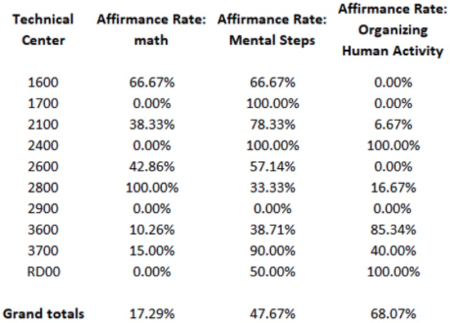
    Figure 2

    Next we considered the type of abstract idea used in the examiners' § 101 rejections.  For the abstract idea exception to patentable subject matter, the three main categories are mathematics, mental processes, and methods of organizing human activity.  In other words, a claim is deemed ineligible for patenting if it is directed to mathematics, a mental process, or a method of organizing human activity without significantly more.  Unfortunately, these categories are ill-defined.

    As shown in Figure 2, of all substantive affirmances of § 101 rejections by the PTAB, 17% were based on mathematics, 48% on mental processes, and 68% on methods of organizing human activity.  The reason that these three numbers do not sum to 100% is because some examiners and PTAB panels concluded that claims were directed to more than one of the categories (some were placed in all three).  Not surprisingly, mental steps was the most prevalent category for TC2100 (likely due to the fact that this category has been interpreted to be broadly applicable to software inventions by the Federal Circuit).  Likewise, the high rate of organizing human activity categorizations in TC3600 was expected due to most business methods being conducive to placement therein.

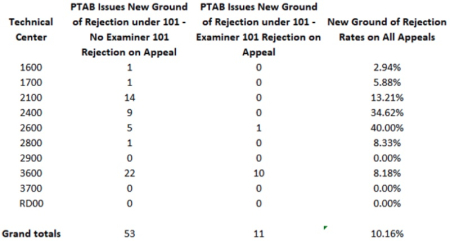
    Finally, we looked into situations where the PTAB provided new grounds of rejection based on § 101 (as noted above, most of these decisions were omitted from the analysis leading to Figures 1 and 2).  This is a troublesome thought for many applicants considering whether to appeal a § 102 or 103 rejection.  The PTAB is permitted to reverse the examiner on those grounds but set forth a new § 101 rejection, even if the examiner found the claims eligible under § 101 and the issue was not a subject of the appeal.

    Figure 3

    Figure 3

    The results are shown in Figure 3.  The overall likelihood of receiving a new ground of rejection under § 101 is only 10%.  But it is slightly higher for TC2100 and slightly lower for TC3600.  This is probably because examiners in TC2100 tend to give fewer § 101 rejections while examiners in TC3600 already give § 101 rejections very frequently.  While the numbers for TCs 2400 and 2600 may be too small to be significant, they appear to confirm the supposition that examiners in those TCs give relatively fewer § 101 rejections.

    Notably, most of these new grounds of rejection were given for applications where the examiner did not provide a § 101 rejection that was ultimately the subject of the appeal.  The results indicate that the concern of receiving a new § 101 rejection from the PTAB in this situation is not unfounded, though it does not happen frequently.

    Summing all of this up, the 2023 data is further confirmation that appealing a § 101 rejection to the PTAB is a highly risky endeavor and likely to result in an affirmance.  Further, appealing any non-101 rejection to the PTAB could result in the PTAB issuing its own § 101 rejection. Thus, continuing to work with an examiner to find allowable subject matter is the recommended course of action, even if the examiner is difficult.  Of course, some examiners — such as those with very low allowance rates — are unlikely to consider any amendment to be allowable, and therefore an appeal may be justified.  Moreover, the 2023 data also confirms that the use of TC steering tools should be part of every practitioner's workflow.  These tools use analytics to predict the TC to which a patent application is likely to be routed, and with them it is easier to prepare applications that are more likely to avoid applicant-hostile TCs 3600 and 3700.

    * Mackenna Dunn is a summer clerk with MBHB who is attending Chicago-Kent College of Law. Mackenna graduated from the University of Rhode Island with a Bachelor of Science degree in Biomedical/Medical Engineering.

    ** Garrett "Jake" Lee is a summer clerk with MBHB who is attending George Washington University.  Jake graduated from George Mason University with a Masters in Applied and Engineering Physics.

    [1] From the USPTO's appeal statistics for its fiscal year 2023.  This number jumps to around 67% if affirmances-in-part are considered.

    [2] To simplify the analysis, we considered a decision to be an "affirmance" of the examiner's § 101 rejection if the PTAB held at least one claim invalid under § 101.

    [3] Many of the 633 decisions were of rejections on other grounds (e.g., §§ 102 or 103).  We did not consider anything but the § 101 determinations.  But we omitted decisions with § 101 rejections based on laws of nature or natural phenomena, non-statutory double patenting, utility, and claims that did not fall into one of the four statutory categories (which accounted for only a handful of the decisions).

    [4] RD00 is a new, experimental TC that supposedly is an attempt to make examination more efficient and consistent.

  • By Kevin E. Noonan –

    Federal Circuit SealThe Federal Circuit once again had an opportunity to opine on the extent of behavior by a generic drugmaker who opts to accept a "section viii carve-out" in its FDA approval (resulting in a so-called "skinny label) on liability for inducing infringement in Amarin Pharma, Inc. v. Hikma Pharmaceuticals USA Inc.

    The case arose over Amarin's Vascepa® (icosapent ethyl) drug product, an omega-3 fatty acid from fish oil, for treatment of severe hypertriglyceridemia (blood triglyceride levels at least 500 mg/dL; normal range is less than 150 mg/dL) (the "SH indication").  Amarin also later received approval for a second indication, reducing cardiovascular disease risk (wherein the second approval removed a Limitation of Use in this regard on the original label) (the "CV indication").  Hikma filed its ANDA against the first approved Vascepa® product; upon Amarin receiving its second FDA approval Hikma filed a section viii statement to carve-out the CV indication under 21 U.S.C. § 355(j)(2)(A)(viii) (the so-called "skinny label").  FDA approved Hikma's skinny label ANDA in 2020 not containing the CV Limitation of Use on the label.

    Thereafter, in a series of press releases, Hikma asserted its product as a "generic version of Amarin's Vascepa®."  In a particular press release, Hikma claimed its two-month U.S. sales to be $1.1 billion, a figure for all uses of its product, with up to 75% of these sales being for the putatively carved-out CV (off-label) indication (albeit there being other press releases emphasizing the limitation of FDA approval to the SH indication).  And on Hikma's website, while asserting an AB rating for its product (generic approval for all indications on the label), the website also said "Hikma's generic version is indicated for fewer than all approved indications of the Reference Listed Drug."

    In the ensuing litigation (this case), Amarin sued Hikma for inducement of infringement under 35 U.S.C. § 271(b) of Orange Book listed U.S. Patent Nos. 9,700,537 and 10,568,861 (for claim 1 of the '527 patent and claim 1 and 2 of the '861 patent):

    '537 patent:

    1.  A method of reducing occurrence of a cardiovascular event in a hypercholesterolemia patient consisting of:
        identifying a patient having triglycerides (TG) of at least 150 mg/DL and HDL-C of less than 40 mg/dL in a blood sample taken from the patient as a risk factor of a cardiovascular event, wherein the patient has not previously had a cardiovascular event, and administering ethyl icosapentate in combination with a 3-hydroxy3-methylglutaryl coenzyme A reductase inhibitor,
        wherein said 3-hydroxyl-3-methylglutaryl coenzyme A reductase inhibitor is administered to the patient at least one of before, during and after administering the ethyl icosapentate; and wherein the 3-hydroxy-3-methylglutaryl coenzyme A reductase inhibitor is selected from the group consisting of pravastatin, lovastatin, simvastatin, fluvastatin, atorvastatin, pitavastatin, rosuvastatin, and salts thereof, and
        wherein daily dose of the 3-hydroxy-3-methylglutaryl coenzyme A reductase inhibitor are 5 to 60 mg for pravastatin, 2.5 to 60 mg for simvastatin, 10 to 180 mg for fluvastatin sodium, 5 to 120 mg for atorvastatin calcium hydrate, 0.5 to 12 mg for pitavastatin calcium, 1.25 to 60 mg for rosuvastatin calcium, 5 to 160 mg for lovastatin, and 0.075 to 0.9 mg for cerivastatin sodium.

    '861 patent:

    1.  A method of reducing risk of cardiovascular death in a subject with established cardiovascular disease, the method comprising administering to said subject about 4 g of ethyl icosapentate per day for a period effective to reduce risk of cardiovascular death in the subject.

    2.  The method of claim 1, wherein the subject has a fasting baseline triglyceride level of about 135 mg/dL to about 500 mg/dL and a fasting baseline LDL-C level of about 40 mg/dL to about 100 mg/dL.

    In its complaint, Amarin asserted Hikma's press releases, website content, and product label as evidence of "specific intent to actively encourage physicians to directly infringe the asserted patents by prescribing its generic icosapent ethyl product for the off-label CV indication, an indication for which Hikma did not get FDA approval."

    The District Court granted Hikma's motion to dismiss under Fed. R. Civ. Pro. 12(b)(6) for failure to state a claim in Amarin's complaint alleging inducement of infringement, based on its determination that the complaint failed to allege facts that Hikma had taken "affirmative steps" to induce infringement (a decision contrary to the recommendation of the magistrate judge to whom the district court judge referred the motion).  The District Court judge cited the cautionary language in Hikma's label regarding side effects as "hardly instruction or encouragement" for the alleged off-label use and that removal of the CV Limitation of Use from Hikma's label would not have been persuasive that its product had been "shown to reduce cardiovascular risk" and thus to have "encourage[d] its use for that purpose."  The distinction relied upon by the District Court was that "'merely describing an infringing [treatment] mode is not the same as recommending, encouraging, or promoting an infringing use,'" quoting, with alterations, Takeda Pharms. U.S.A., Inc. v. W.-Ward Pharm. Corp., 785 F.3d 625, 631 (Fed Cir. 2015).  With regard to Hikma's press releases and other public statements, the District Court considered that while they "may be relevant to Hikma's intent to induce infringement" (emphasis in opinion), they were not evidence of "an inducing act" constituting a separate element for inducement under § 271(b). The website evidence was deemed insufficient because it did not "rise to the level of encouraging, recommending, or promoting taking Hikma's generic for the reduction of CV risk," comparing GlaxoSmithKline LLC v. Teva Pharms. USA, Inc., 7 F.4th 1320, 1336 (Fed. Cir. 2021) (per curiam) ("GSK"), with Grunenthal GmbH v. Alkem Lab'ys Ltd., 919 F.3d 1333, 1339 (Fed. Cir. 2019).

    The Federal Circuit reversed in an opinion by Judge Lourie, joined by Chief Judge Moore and District Court Judge Albright (W.D. Tx), sitting by designation.  The opinion begins by emphasizing that the matter below was not an ANDA case under 35 U.S.C. § 271(e)(2)(A), wherein the alleged infringement does not involve an infringing act other than filing the ANDA (what the opinion denotes as a "hypothetical" act of infringement, based on what would arise if the ANDA applicant received FDA approval and marketed the allegedly infringing generic drug).  The panel also asserted that this is not a typical "skinny label" case under section viii wherein the plaintiff asserts the generic label isn't "skinny enough" and wherein "the label alone induces infringement," relying on H. Lundbeck A/S v. Lupin Ltd., 87 F.4th 1361, 1370 (Fed. Cir. 2023), and HZNP Meds. LLC v. Actavis Lab'ys UT, Inc., 940 F.3d 680, 699 (Fed. Cir. 2019).  The basis for Amarin's assertions, in the Federal Circuit's view, is the combination of the skinny label and Hikma's "public statements and marketing" of its approved generic product (which the opinion states makes this "nothing more than a run-of-the-mill induced infringement case," a characterization perhaps motivated by the contretemps arising in its decisions in GSK, see "GlaxoSmithKline LLC v. Teva Pharmaceuticals USA (Fed Cir. 2020)" and "GlaxoSmithKline LLC v. Teva Pharmaceuticals USA (Fed. Cir. 2022)", and Hikma's assertions of the consequences that would arise if the Federal Circuit reversed, see below).  In such a case, the standard the Court applied was "whether the totality of the allegations, taken as true, plausibly plead that Hikma induced infringement" (emphasis in opinion) that would provide "substantial evidence to support a jury verdict of induced infringement."

    The panel noted that the case has come before them in a "nascent" stage, without the benefit of discovery or as an appeal of denial of a preliminary injunction motion or an appeal of a summary judgment motion or post-trial motion (citing several of the Court's earlier precedent on skinny label cases having those attributes).  As a consequence, the Court stated it is responsible here for "reviewing allegations, not findings, for plausibility, not probability" under Bell Atl. Corp. v. Twombly, 550 U.S. 544, 556 (2007)(emphasis in opinion).

    Turning to the evidence relied upon by the District Court in granting Hikma's motion, the opinion states as being "undisputed" that there has been direct infringement by doctors and other healthcare providers in prescribing Hikma's alleged infringing product for off-label use (the CV indication) and that Hikma had "the requisite intent and knowledge to induce that infringement" as found by the District Court.  This leads the Court to determining whether Hikma "actively" induced healthcare providers' direct infringement.  At least due to the analytical basis for reviewing motions to dismiss ("[a]ccepting all well-pleaded facts as true and drawing all reasonable inferences in Amarin's favor"), the opinion finds that it did.  However, the panel discarded any implication that Hikma's label (the "Indications & Usage" section) provides "implied or express instruction to prescribe the drug for the CV indication."

    The panel instead turned to the parties' contentions.  First, Amarin's complaint alleged that other portions of Hikma's label (specifically, "the clinical studies section, which describes statin-treated patients with the same cardiovascular event history and lipid levels covered by the asserted patents") would teach physicians that the product could be prescribed for treating cardiovascular risk (because, inter alia, the patient populations for the SH and CV indications overlap).  Moreover Amarin contended that while FDA approved removal of the CV Limitation of Use regarding CV indications from their label it did not do so for Hikma's label.  Hikma's removal of the CV Limitation of Use regarding CV indications as well as including warnings of potential cardiovascular side effects from its drug, Amarin contended, communicated to physicians that its generic drug could be used off-label for the CV indication.

    Hikma for its part argued that Amarin was asserting a requirement (and infringement liability for the absence thereof) for language discouraging infringement contrary to law, relying on Takeda Pharms. U.S.A., Inc. v. W.-Ward Pharm. Corp., 785 F.3d 625, 631 (Fed Cir. 2015).  Hikma attempted to take refuge (as has arisen in other skinny label disputes) on FDA's requirement that the label for generic copies of branded approved drugs be "the same as the labeling approved for the listed drug" under 21 U.S.C. § 355(j)(2)(A)(v).  Also, Hikma argued that its silence regarding its product's effects on risk of cardiovascular complications "cannot plausibly instruct infringement."  Finally, Hikma argued that it is "implausible" and "borderline frivolous" to contend (as Amarin does) that information related to clinical studies and attendant warnings about side effects would encourage a physician to prescribe their drug.

    The Federal Circuit conceded that Hikma's label does not "recommend[], encourag[e], or promot[e] an infringing use" as a matter of law as found by the District Court.  But (agreeing with the magistrate judge) the Court (and Amarin) did not rely on the label alone.  Rather, it is the combination (emphasis in opinion) of the label and Hikma's "public statements and marketing materials" that render the District Court's grant of Hikma's motion to dismiss to be in error.  Specifically, the Court considered that while the "AB rating" description on Hikma's website may be broad enough to encompass both infringing and non-infringing uses (and thus not support a finding of inducement liability) their press releases consistently characterized their drug as being a "generic equivalent to Vascepa®" and cite the SH indication limitation as being only a part of their approved indication.  These implications were supported by reports on sales figures resulting in large (75%) part from off-label use for CV indications.  "Those allegations, taken together with those relating to Hikma's label, at least plausibly state a claim for induced infringement," the Court held.

    Importantly, these allegations by Amarin regarding Hikma's inducement liability are, according to the opinion, "question[s] of fact—not law" and therefore are "not proper for resolution on a motion to dismiss."  The panel asserted they "[we]re unpersuaded" by Hikma's arguments that, because these facts are not in dispute the District Court was correct in deciding to grant Hikma's motion to dismiss on legal grounds.  And the opinion distinguishes earlier cases where inducement was decided as a matter of law on the procedural posture of one such case, wherein HZNP was decided ("critically") on summary judgment and was solely based on the contents of the label; the parties access to discovery placing this case (motion to dismiss) on a different footing, insofar as Amarin was entitled to having all factual considerations and inferences in its favor (finding Amarin's contentions on how Hikma's statements and representations could "plausibly" suggest to a physician that its drug was effective the CV indications).  The panel also refused to interpret Hikma's representations regarding its AB rating for the drug as being sufficient to insulate it from inducing infringement liability.

    The opinion also rejects Hikma's assertions that reversing the district court would be contrary to the Court's decision in GSK, distinguishing that decision on the basis of procedural differences (a motion to dismiss here with a post-trial judgment as a matter of law there) as well as substantive distinctions (there, the label itself taught an infringing use and hence "it was reasonable for the jury to find that the generic manufacturer's marketing of its product as an "AB rated generic equivalent" encouraged physicians to prescribe the drug for the infringing use instructed by the label"), which is not the case here.  Here, Amarin was entitled to have all its allegations accepted as true in the context of a motion to dismiss, including their allegations that "Hikma did much more than call its product a 'generic version' of Vascepa" in the face of evidence of Hikma's other activities.

    The opinion disdainfully rejects Hikma's "inflated characterizations" regarding the dire consequences for section viii carve-outs should the Court rule (as it does) against them.  The opinion states its decision is "limited to the allegations before us" and "guided by the standard of review appropriate for this stage of proceedings," while pledging fealty to the "careful balance struck by the Hatch-Waxman Act regarding section viii carve-outs."  The Court cautioned generic drugmakers that "clarity and consistency in a generic manufacturer's communications regarding a drug marketed under a skinny label may be essential in avoiding liability for induced infringement," which was not found here.

    This case is remanded to the District Court where, absent settlement (unlikely in view of Hikma's $1 billion + annual sales) the Federal Circuit will likely have the opportunity to rule on the substantive questions regarding skinny label inducement raised by these circumstances.

    Amarin Pharma, Inc. v. Hikma Pharmaceuticals USA Inc. (Fed. Cir. 2024)
    Panel: Chief Judge Moore, Circuit Judge Lourie, and District Judge Albright (sitting by designation)
    Opinion by Circuit Judge Lourie

  • By Michael Borella and Joshua Rich

    Senate SealAfter floating a discussion draft last fall, a bipartisan group of Senators formally introduced the Nurture Originals, Foster Art, and Keep Entertainment Safe Act of 2024 ("the NO FAKES Act" or "the Act") on July 31, 2024.  The Act is remarkable not only because its sponsors span the ideological spectrum — the Act was introduced by Senators Coons, Blackburn, Klobuchar, and Tillis — but also because it has received the backing of groups such as the Motion Picture Association, the Recording Industry Association of America, the Independent Film & Television Alliance, as well as the Screen Actors Guild-American Federation of Television and Radio Artists (SAG-AFTRA) and major artist representation agencies.[1]  In a Congress that is more often than not too polarized to actually legislate, the bipartisan nature and widespread support for the Act may indicate that it has a fighting chance of becoming a law.

    To date, any regulation of the use of individual's names, images, or likenesses has been governed by copyright law, the Lanham Act, or state statutes and common law.  Those laws have generally been sufficient to protect individuals' rights, but there is a mounting concern that generative AI replications fall through the cracks of existing law.  For example, the song "Heart On My Sleeve" — purportedly a collaboration between musicians Drake and The Weeknd — went viral last year on social media and streaming platforms.[2]  Earlier this year, OpenAI quickly shuttered a digital voice assistant that sounded remarkably similar to actress Scarlett Johansson.[3]  A recent lawsuit alleges that an AI company used deceptive practices to obtain samples from voice actors, which were later used to produce content that was not actually spoken by the actors.[4]  Even more recently, voice actors and motion capture artists in the video game industry voted to strike over potentially exploitative uses of their images and likenesses by AI.[5]  More generally, the public is slowly becoming aware of menacing uses of "deepfakes" — highly-realistic, AI-enabled audio, image, or video representations of individuals appearing to be saying or doing something they never actually did.

    The NO FAKES Act is an attempt to cure those deficiencies by providing civil remedies that protect people against misuse of their images and voices.  In particular, the Act creates a federal cause of action through which actors, artists, creators, and other individuals can seek relief for certain types of uses of their digital replicas.  A digital replica is defined by the Act as "a newly-created, computer-generated highly realistic electronic representation that is readily identifiable as the voice or visual likeness of an individual."  Critically, the digital replica must be:

    embodied in a sound recording, image, audiovisual work, including an audio-visual work that does not have any accompanying sounds, or transmission (i) in which the actual individual did not actually perform or appear; or (ii) that is a version of a sound recording, image, or audiovisual work in which the actual individual did perform or appear, in which the fundamental character of the performance or appearance has been materially altered.

    Of course, the NO FAKES Act creates liability only for unauthorized use of the digital replica; it therefore includes provisions related to identifying the holders of rights (that is, the individual or "any other person that has acquired, through a license, inheritance, or otherwise, the right to authorize the use of such voice or visual likeness in a digital replica").

    The Act's foundation is the precept that "each individual or right holder shall have the right to authorize the use of the voice or visual likeness of the individual in a digital replica."  The right is "(I) a property right; (II) not assignable during the life of the individual; and (III) licensable, in whole or in part, exclusively or non-exclusively, by the right holder."  This right continues past the death of the individual whose voice or visual likeness is at issue, with it becoming transferrable to heirs or assignable to other parties.  One who acquires a postmortem right in this fashion must periodically (first every ten years but after that every five years) demonstrate public use of the voice or visual likeness in order to prevent the right from expiring.  Regardless of public use and renewals, the right will expire 70 years after the death of the individual, aligning the expiration with expiration of rights under the Copyright Act.

    Although the right of publicity is most analogous to privacy or trademark rights, the NO FAKES Act aligns more closely with other federal laws, including the Copyright Act and the Communications Decency Act (CDA), rather than the Lanham Act.  The Act also leverages the existing administrative framework established by the Copyright Act, instructing the Copyright Office to set forth a procedure for a rights holder to carry out the renewals and to maintain an online directory of current post-mortem digital replication rights and a directory of representatives of websites and other potential hosts of media incorporating digital replicas (which allows protections analogous to Section 230 of the CDA).

    The Act creates a civil cause of action that can be brought based on: "(A) The production of a digital replica without consent of the applicable right holder[, or] (B) The publication, reproduction, display, distribution, transmission of, or otherwise making available to the public, a digital replica without consent of the applicable right holder."  Like the Copyright Act (but unlike the Lanham Act), the liability requires that a person engaging in either activity must have actual knowledge of their unauthorized use of a digital replica or has willfully avoided having such knowledge.  Also like the Copyright Act but unlike the Lanham Act, a three-year statute of limitations applies starting from the date when "the party seeking to bring the civil action discovered, or with due diligence should have discovered, the applicable violation."

    The remedies also align most closely to copyright law, allowing a plaintiff to receive statutory damages or actual damages (including both the harm to the individual and disgorgement of the defendant's profits).  Specifically, the remedies available are the greater of: (a) $5,000 per work embodying the applicable unauthorized digital replica, $5,000 per violation by an entity that is an online service, and $25,000 per work embodying the applicable unauthorized digital replica by an entity that is not an online service, or (b) "any actual damages suffered by the injured party as a result of the activity, plus any profits from the unauthorized use that are attributable to such use and are not taken into account in computing the actual damages."  The Act makes it clear that a plaintiff can seek injunctive or other equitable relief, and that punitive damages in the case of willful violations can include attorney's fees.

    Analogous to fair use defenses in copyright law, the Act carves out certain exclusions to ensure that the Act does not conflict with the First Amendment.  For example, the NO FAKES Act does not protect against the use a digital replica (even without authorization) in bona fide news accounts, documentary, historical, or biographical uses, or commentary, criticism, scholarship, satire, or parody. Further exclusions include de minimis uses as well as advertising or commercial uses in conjunction with any of the aforementioned exceptions.  However, the Act makes it clear that the exclusions do not apply — that is, it creates an exclusion to the exclusions — "where the applicable digital replica is used to depict sexually explicit conduct."

    Likely in order to attain support of AI, tech, and media companies, the Act sets forth a number of safe harbors similar to the Communications Decency Act.  For products and services capable of producing digital replicas, there is no secondary liability unless those products and services are designed primarily to produce unauthorized digital replicas with limited commercial purpose beyond that.[6]  For online services, referring or linking to an unauthorized digital replica also does not incur liability.  As a quid pro quo, online services hosting user uploaded material have a takedown obligation upon receiving notice of violations of the Act.  That is, they will not be liable for violating any rights if the online service:

    (i) removes, or disables access to, all instances of the material (or an activity using the material) that is claimed to be an unauthorized digital replica as soon as is technically and practically feasible for that online service; and

    (ii) having done so, takes reasonable steps to promptly notify the third-party that provided the material that the online service has removed or disabled access to the material.

    However, these safe harbors are not available unless the online service designates, with the Copyright Office, an agent to receive notice of such violations.  The designation must include at least the name, address, telephone number, and email address of the agent.  The Copyright Office must maintain an online public registry of such agents.

    All of those provisions are generally not very contentious.  There is controversy, however, over whether the state law causes of action should be preempted and the balance between clarity and uniformity of the law and allowing States to provide greater protection.[7]  The Act explicitly preempts any state laws that protect "an individual's voice and visual likeness rights in connection with a digital replica, as defined in this Act, in an expressive work."  But there are exceptions to this preemption including pre-existing state laws (defined as "statutes or common law in existence as of January 2, 2025, regarding a digital replica"), state laws "regulating a digital replica depicting sexually explicit conduct," or "causes of action under State statutes or common law for the manufacturing, importing, offering to the public, providing, making available, or otherwise distributing a product or service capable of producing 1 or more digital replicas."  In other words, state right of publicity and privacy laws protecting image and likeness rights in general would not be preempted but any specifically addressing the protection of digital replicas would be nullified if enacted after January 2, 2025.

    The NO FAKES Act appears to be necessary because tech companies producing generative AI tools or providing them as services seem unwilling or unable to effectively self-regulate how they exploit the labors of others to train their models.  Copyright law is unlikely to provide sufficient protection for the training of a generative AI model with the voices and visual likenesses of performing artists, even if those works are copyrighted.  Further, it is not clear how similar the output of such models needs to be when compared to the original work for there to be copyright infringement.

    If passed, the NO FAKES Act will plug a significant part of this gap.  How a generative AI model is trained, or even if generative AI is used at all, does not matter.  The digital replica need only be "computer-generated" and "readily identifiable as the voice or visual likeness of an individual."  In doing so, the Act would be the first federal law in the U.S. that protects publicity rights.

    Deepfakes, by their very nature, undermine public trust and can cause significant harm by distorting perceptions of reality and spreading misinformation.  The appeal of this legislation lies in its commitment to limit the malicious misuse of technology, yet allowing authorized uses.  However, while the bill has garnered bipartisan support, it will require a concerted effort and extensive backing in both the Senate and the House to pass into law, not to mention the support and signature of the president (whoever that might be if and when the Act is passed by Congress).

    Even if the NO FAKES Act is enacted, there remains a question as to whether it is constitutional.[8]  Unlike patents and copyrights, Article I of the Constitution provides no explicit basis for a federal right of privacy or publicity.  Rather, the cause of action created by the Act is limited to violations that affect interstate commerce or use means of facilities of interstate commerce, tying the Act to the commerce clause.  But there remains a tension with the Act's express statement that it is establishing a new property right in name, image, or likeness.  So, ultimately, the courts may have the last word on whether constitutionality should be judged based on the nature of the right or the scope of the remedy.

    [1] https://www.coons.senate.gov/news/press-releases/senators-coons-blackburn-klobuchar-tillis-introduce-bill-to-protect-individuals-voices-and-likenesses-from-ai-generated-replicas.  Notably absent from this list are Microsoft, Alphabet, Meta, xAI (affiliated with Twitter/X), Apple, and several other AI tech players.

    [2] https://en.wikipedia.org/wiki/Heart_on_My_Sleeve_(Ghostwriter977_song).

    [3] https://www.patentdocs.org/2024/05/black-widow-versus-openai-and-what-it-means-for-singers-and-voice-actors.html.

    [4] https://www.cbsnews.com/news/two-voice-actors-sue-ai-company-lovo/.

    [5] https://www.mbhb.com/intelligence/snippets/interplay-between-image-and-likeness-rights-and-ai-central-to-gaming-actor-strike-and-newly-proposed-legislation/.

    [6] This provision was likely included to protect the developers of generative AI large language models, such as OpenAI, Microsoft, and Google.

    [7] For example, at an August 5, 2024 USPTO "Public roundtable on AI protections for use of an individual's name, image, and likeness," the representative of the Motion Picture Association spoke in favor of complete preemption and was immediately followed by the representative of the Recording Industry of America who spoke against preemption.

    [8] This issue was raised by one of the speakers during the virtual portion of the USPTO roundtable, but it came too late for most other speakers to comment.

  • By Kevin E. Noonan –

    Washington - Capitol #5
    U.S. Senator Chris Coons (D-DE), along with Sen. Thom Tillis (R-NC), have been the motivating force for patent reform for almost a decade, primarily in their efforts to roll back legislative efforts and judicial decisions having negative effects on U.S. innovation and the patent system (see "Senator Coons And Co-Sponsors Introduce the PREVAIL Act"; "Senators Tillis and Coons Once More Attempt to Fix Patent Eligibility"; "Senate Bill Proposed to Provide Subject Matter Eligibility Solution"; "Senate Subcommittee on Intellectual Property Holds Hearings on Proposed Revisions to 35 U.S.C. § 101"; "Congress Releases Framework for Section 101 Reform").  Yesterday, Sen. Coons and Sen. Tom Cotton (R-AR) introduced the Realizing Engineering, Science, and Technology Opportunities by Restoring Exclusive (RESTORE) Patent Rights Act of 2024 in yet another such effort, this time to restore the presumption that a patentee who has prevailed against an infringer at trial is entitled to an injunction (subject to equitable principles and a demonstrated negative effect on the public interest).  Representatives Nathaniel Moran (R-TX1) and Madeleine Dean (D-PA4), joined by co-sponsors Hank Johnson (D-GA4), Deborah Ross (D-NC2), and Chip Roy (R-TX24) introduced a companion bill in the House of Representatives.

    The bill, entitled the "Realizing Engineering, Science, and Technology Opportunities by Restoring Exclusive Patent Rights Act of 2024," contains but two substantive sections.  Sec. 2 sets forth Findings, including that:

    (1) Securing effective and reliable patent protection for new technologies is critical to maintaining the competitive advantage of the United States in the global innovation economy;

    (2) The Constitution of the United States empowers Congress to grant inventors the "exclusive Right" to their inventions in order to "promote the Progress of Science and the useful Arts";

    (3) The right to prevent others from making, using, offering to sell, selling, or importing a patented invention without authority from the inventor is the core of the patent right, ensuring that an inventor enjoys, for a limited time, the sole benefit of the inventor's invention or discovery;

    (4) Congress and the courts of the United States have long secured the constitutionally protected patent right through the traditional equitable remedy of an injunction;

    (5) Given the irreparable harm that is caused by multiple acts of infringement or willful infringement of a patent, courts historically presumed that an injunction should be granted to prevent such acts, with a burden on defendants to rebut such presumption with standard equitable defenses;

    (6) Recently, courts have ended the approach described in paragraph (5), which contradicts the traditional, historical practice governing the equitable remedy described in that paragraph; [and]

    (7) Eliminating the traditional, historical equitable practice of applying a rebuttable presumption of injunctive relief in the case of continuing acts of infringement or willful infringement of a patent has-

    (A) substantially reduced the ability of patent owners to obtain injunctions to stop continuing or willful infringement of patents; and

    (B) created incentives for large, multinational companies to commit predatory acts of infringement, especially with respect to patents owned by undercapitalized entities, such as individual inventors, institutions of higher education, startups, and small or medium-sized enterprises.

    The remedy, set forth in Section 3, proposes to amend Title 35, Section 283 of U.S. Code to provide a rebuttable presumption:

    (b) REBUTTABLE PRESUMPTION.-If, in a case under this title, the court enters a final judgment finding infringement of a right secured by patent, the patent owner shall be entitled to a rebuttable presumption that the court should grant a permanent injunction with respect to that infringing conduct.

    If enacted, this provision would return patent litigation to status quo ante from the Supreme Court's decision in eBay v. MercExchange, where the Court removed the traditional presumption of the injunction right in the first wave of its now two-decade crusade to reestablish its primacy in patent law after a generation of the Federal Circuit decisions "quietly (and sometimes not so quietly) walking away from Supreme Court decisions the appellate court found inter alia contrary to it Congressional mandate to harmonize patent law" (and that stemmed from various periods in the Court's history where the Justices were more or less "friendly" towards the exclusivities awarded to patentees; see, e.g., Justice Jackson's adage that "the only valid patent is one which this Court has not been able to get its hands on."  Jungerson v. Ostby & Barton Co., 335 U.S. 560, 572 (1949) (Jackson, J., dissenting).

    It is unlikely that this effort will get much traction before the 118th Congress adjourns this fall, and its prospects will depend at least on the outcome of the November elections.  But as many commentators (see, e.g., Mossoff, 2021, The Injunction Function: How and Why Court's Secure Property Rights in Patents, 96 Notre Dame L. Rev. 1581) have argued, and the Findings reflect, the absence of a presumption of an injunction has emboldened "efficient infringers," usually economic Goliaths, from infringement against patent-holding Davids on the basis that even if adjudged to infringe the penalty will be a royalty that may be less costly to satisfy than what a license would have cost them for respecting patent rights in the first place.  It has often been the case that these Davids (Gates, Jobs, Amgen, Genentech, as well as university technology transfer) have been the engines of innovation for over forty years, and bringing back balance to these competing interests is likely to benefit American innovation and the economy.  Stay tuned.