• By Kevin E. Noonan

    Federal Circuit SealStipulating to infringement after a contrary claim construction is a conventional stratagem for a losing party to have a final judgment that can be challenged before the Federal Circuit.  The risk of course, is that if the Court finds the district court's construction to be correct, the stipulation precludes appellate challenge of the infringement judgment.  Defendant Maia Pharmaceuticals suffered those consequences recently in Bracco Diagnostics Inc. v. Maia Pharmaceuticals, Inc.

    The case arose as ANDA litigation over Maia's generic sincalide product, that Bracco asserted infringed Orange Book-listed U.S. Patent No. 6,803,046 concerning its Kinevac® product.  This product is a synthetic peptide hormone used to stimulate gallbladder contraction, pancreatic secretion, and "accelerate the transit of a barium meal through the small bowel."  The '046 claims encompass drug formulations "purer than prior art formulations, and have fewer degradants and more consistent potency" than prior art forms, achieved according to the specification "through addition of excipients such as buffers, surfactants/solubilizers, and surfactants."  Claim 1 is representative of the asserted claims:

    1.  A stabilized, physiologically acceptable formulation of sincalide comprising:
        (a) an effective amount of sincalide,
        (b) at least one stabilizer,
        (c) a surfactant/solubilizer,
        (d) a chelator,
        (e) a bulking agent/tonicity adjuster, and
        (f) a buffer.

    [Wherein the italicized limitations were relevant to the District Court's claim construction and this appeal.]

    Maia's products contain amino acids in addition to the synthetic peptide hormone, which Bracco contended satisfy the "buffer," "surfactant" and/or "solubilizer" limitations recited in the claims.  The issue thus resolved as whether these claim limitations encompassed amino acids.  One aspect of the District Court's construction was that dependent claims recited Markush groups for these limitations that contained amino acids for each.  Another aspect was that the specification recited particular definitions of these terms that encompassed amino acids within their scope.  These characteristics of the specification formed the basis for the District Court's construction of the terms "buffer," "surfactant," and "solubilizer" to include amino acids (among in each instance many other species).  Following claim construction, Maia stipulated infringement of certain claims and dismissal of all other claims and defenses without prejudice, and the District Court entered judgment against defendant; this appeal followed.

    The Federal Circuit affirmed in an opinion by Judge Lourie, joined by Judges Clevenger and Chen.  The issue for the panel was whether the District Court erred in including amino acids within the generically claimed limitations for buffers, solubilizer, and surfactants, concluding that it had not.  (The panel also reviewed and affirmed how the District Court construed "the backslash between surfactant/solubilizer to mean "and" or "or," and erroneously included "may" in its definition of surfactant.)

    The Court started, consistent with Phillips v. AWH Corp., 415 F.3d 1303 (Fed. Cir. 2005) (en banc), with the language of the claims.  The opinion notes that the use of Markush language in the dependent claims removes the responsibility (or the option) for construction by the Court, due to the closed nature of this claim form (a cautionary tale with regard to using Markush claims).  With regard to the term "buffer" in the independent claims, the Court rejected Maia's contention that the claim should be construed with regard to its function in the claimed formulation, and that the District Court had improperly imported limitations from the specification into the claims (a perennial problem in claim construction (see "Claim Construction at the Federal Circuit: A District Court Judge's View").  Maia supported this argument, ultimately to no avail, on the grounds that many amino acids have no buffering capacity, and that to the extent an amino acid comprising its sincalide formulation is not a buffer its infringement stipulation should not preclude its ability to litigate infringement (i.e., it should not be construed as an admission).  The Federal Circuit agreed that the District Court's construction was technically in error regarding the difference in various amino acids in buffering capacity, but also agreed with Bracco that the error was harmless.  And with regard to whether the stipulation should be given effect as an admission of infringement, the panel was clear:

    The key language of its stipulation reads as follows: "Under the Court's construction of the disputed claim terms of the '046 patent, . . . Maia's 505(b)(2) NDA Product would literally infringe the 36 claims. ". . . That stipulation forecloses the argument for noninfringement.

    To rule otherwise, according to the opinion, would be to "reinterpret the [district] court's construction to mean" what Maia now contends it should have meant (which of course the Federal Circuit refused to do).  The panel similarly refused Maia's other arguments (claim inoperability for inoperativeness), and affirmed without recourse to remand, citing SUFI Network Servs., inc. v. United States, 755 F.3d 1305, 1312 (Fed. Cir. 2014), and Shinyei Corp. of Am. v. United States, 524 F.3d 1274, 1284 n.3 (Fed. Cir. 2008).

    Maia made substantially the same arguments with regard to the surfactant/solubilizer limitation(s), with the same effect on the Federal Circuit.  Once again, the panel considered the District Court erred in its claim construction, but held that the error was harmless because "inclusion of the list of exemplary surfactant/solubilizer agents, while technically incorrect, is essentially correct in its functional definition." And once again:

    When Maia stipulated to infringement under the court's claim construction, it stipulated to infringing every limitation of the claims, not just to having amino acids. Having entered into a stipulation, Maia is bound by it [emphasis in opinion].

    Regarding the District Court's consideration of the "/" between surfactant and solubilizer to mean "and" or "or" rather than that surfactants falling within the scope of the claims were also solubilizers, the panel agreed with Bracco's argument that this was an attempt to improperly read a limitation from the specification into the claims.  (To be fair, the patentee's repeated use of "/" in the specification for species having both surfactant and solubilizer properties could just as readily been seen to be construing the claims in light of the specification and how this convention was used by the patentee.)  But to the panel the use of "/" in the specification was "ambiguous" and other claim language could be construed to describe sincalide formulations not to have surfactants at all.

    Regarding construction of the term "surfactant," Maia argued error for including "an excipient that may reduce the interfacial tension" (emphasis in opinion), and argued that the District Court should have used the plain and ordinary meaning of the term, wherein the compound "must" reduce interfacial tension.  Maia also cited portions of the specification supporting (in its view) this construction.  The panel expressly rejected Maia's argument that "may" rendered the term ambiguous, saying "'may,' standing alone, presents some ambiguity.  However, the plain and ordinary meaning of "may" within the context of this specification is properly understood as indicating an inherent measure of likelihood or possibility.  It is not used by a person of skill to describe an event that has no likelihood of occurring."  In addition, the Federal Circuit expressly rejected Maia's argument that the specification requires that a surfactant "must" reduce interfacial tension, saying "none of Maia's references indicates that the patentee intended to limit the claim scope in the manner that it asserts" and "[w]e have repeatedly 'cautioned against limiting the claimed invention to preferred embodiments or specific examples in the specification,' where, like here, the patentee has not made a clear disavowal of the claim scope," citing Imaginal Systematic, LLC v. Leggett & Platt, Inc., 805 F.3d 1102, 1109–10 (Fed. Cir. 2015).  Finally, the opinion states that the District Court's construction was supported by extrinsic evidence (expert testimony), which can properly be used to support a construction consistent with the intrinsic evidence.

    Bracco Diagnostics Inc. v. Maia Pharmaceuticals, Inc. (Fed. Cir. 2020)
    Panel: Circuit Judges Lourie, Clevenger, and Chen
    Opinion by Circuit Judge Lourie

  • By Kevin E. Noonan

    The transcendental conundrum in patent law in these times is how to overcome the misinterpretation of the Supreme Court's decisions on patent eligibility law by district courts and the Federal Circuit.  That these courts cannot overcome the precedential tangle they have created is firmly established by the Court's own decisions; Judge Moore in Athena Diagnostics, Inc. v. Mayo Collaborative Services, LLC stated the obvious when she said in her dissent:

    My colleagues' refusal deflates the Amici's hopeful suggestion that our precedent leaves the eligibility of a diagnostic claim in front of the Federal Circuit "uncertain."  It is no longer uncertain.  Since Mayo, every diagnostic claim to come before this court has been held ineligible.  While we believe that such claims should be eligible for patent protection, the majority of this court has definitively concluded that the Supreme Court prevents us from so holding.  No need to waste resources with additional en banc requests.

    And in response, the Supreme Court has eschewed any and every opportunity to revisit their twisted precedent denying certiorari in over 50 cases (see "U.S. Supreme Court on Eligibility: Nothing to See Here, Move Along").

    Part of the problem is that it has been maddeningly difficult to define not what patent eligibility is (you cannot go wrong with "anything under the sun made by man") but rather what it is not.  In the high technology class of inventions, this has come down to deciding without defining what an abstract idea is and when its abstractness prevents patent eligibility; see, e.g., "Stupid §101 Tricks").  (The other, related type of ineligible subject matter are business method patents, the exclusion of which is almost categorical (see "Bilski v. Kappos, Alice Corp. Pty. Ltd. v. CLS Bank Int'l"; "CyberSource Corp. v. Retail Decisions, Inc."); this has the benefit is requiring little interpretation and hence maximal certainty regarding what is ineligible.)

    But the ineligibility of the latest iGadget, while sometimes tragic, is not as existentially problematic as the havoc that these precedents have wreaked on life sciences patenting.  For both diagnostic methods and to a slightly lesser extent natural products, the philosophically lost proscriptions by the Court, bolstered by plain illogic in district court (see "Ariosa Diagnostics, Inc. v. Sequenom, Inc.") and Federal Circuit (see "Federal Circuit Denies Rehearing en banc in Ariosa v. Sequenom") decisions, has rendered pursuit of patent protection for these inventions to be relegated to the ranks of the foolhardy.  The effect on investment and hence progress and innovation has been as expected; perhaps the only silver lining from the SARS-Cov-2 epidemic has been that in the frantic and desperate struggle for both diagnostics and vaccines the usual market forces have been collapsed by government investment (which is not usually a recipe for economic success).

    But if policymakers cannot find a path to resolve the political differences that have prevented a legislative solution to the patent eligibility issue (see "The Zombie Apocalypse of Patent Eligibility Reform and a Possible Escape Route"), perhaps it is because the various stakeholders have not been able to arrive at a consensus over what should and should not be eligible (besides interest groups like the ACLU shouting "hands off my DNA"; see "ACLU (Predictably) Opposes Patent Subject Matter Eligibility Proposal").  This situation suggests it might be better to start with examples of what should be patent eligible (or at least something that would focus the basis for opposition to eligibility) and walk backwards to the point where various stakeholder groups could raise objections that might define the metes and bounds of why certain inventions have or should be deemed unprotectable under patent law.

    For diagnostic methods, it might be best to start with that most tangible of subject matter classes, a machine (see "American Axle v. Neapco Holdings" and "Ex parte Itagaki and Nishihara" perhaps to the contrary).  In this example, the claimed invention would be a machine configured to perform a diagnostic assay on a biological sample, wherein the machine provides a diagnosis based on detecting the presence of a naturally occurring biomarker in the sample.  The specifications on the machine can be limited so that each embodiment of the machine is calibrated to perform only specific diagnostic assays on specific samples to detect specific biomarkers that are specific for only a specific disease or class of diseases.  As so limited, should this machine be patent-eligible?  Why or why not?  And in making these determinations of course the patent eligibility of other diagnostic machines, from the MRI to the EKG to the stethoscope should guide the eligibility decision.

    If this machine passes the eligibility test, the next-level question could be whether the processes used by the machine (e.g., the chemistry) is patent-eligible, and does eligibility depend on whether these assays are novel?  What is the significance of whether they are adapted to detecting the biological phenomenon informative for the diagnosis?  And what if they are specifically adapted (along with all the specificities considered above regarding patent eligibility for the machine) to use with the machine?

    Another consideration is whether these processes need to be performed by the machine or whether they could be performed outside the machine itself?  Would eligibility of the diagnostic assay depend on claim infringement requiring use of the machine, i.e., producing the "inputs" from the biological sample cannot be interpreted unless evaluated by the machine?

    And does the complexity of the biomarker inputs make a difference, i.e., should it matter if the machine evaluates the input information using a computer, for example?  Does it matter if the inputs are so complex they can only be understood using a computer?

    The answers to these questions can then be used to evaluate the distinction(s) between these features/characteristics of these different embodiments of the invention that vitiate patent-eligibility.  In other words, where do we draw the line?

    For natural products, the issue may be less complex, based on the distinction drawn by the Court in Myriad that "mere" isolation of genomic DNA rendered that DNA ineligible for patenting, and that conversion of naturally occurring messenger RNA (mRNA) to complementary DNA (cDNA) involved sufficient human intervention to render cDNA patent-eligible.  But as a general rule, this distinction with other natural products is not satisfactory for at least two reasons.  First, it flies in the face of established practice that "mere" isolation could pass the patent eligibility test.  And second, because natural products in their natural state are not usually useful, their utility arising from isolation (and purification, and concentration) and use in applications for which they are not used in nature (the canonical example being the anticancer drug taxol which, while intrinsically having anticancer properties does not exhibit this capability naturally because trees don't get cancer).

    The issue may be as simple as recognizing (as District Court Judge Sweet did in his opinion invalidating Myriad's claims) that DNA is sui generis, the "physical embodiment of genetic information."  "Mere" isolation of DNA was (perhaps) less relevant because the function of the DNA was unchanged by its isolation; before this statement enrages biotechnologists it should be recalled that all the ways that isolated DNA has been used remain patent-eligible (incorporated into vectors, introduced into heterologous cells, producing valuable biological molecules, etc.).  For almost every other natural product, however, its utility is not found in nature, so perhaps that transformation, produced by human intellect, should be enough to render most important "natural" products, converted most unnaturally, to be patent eligible.  After all, a claim to "Penicillin" per se has never been patent-eligible because it reads on penicillin as it exists in nature, and a claim to "a pharmaceutical composition comprising penicillin [at a useful dose and formulated for pharmaceutical use]" has always been (and still is) patent eligible.  What is uncertain today is whether a claim to "an isolated/purified preparation of penicillin [having a specific utility, claimed or disclosed in the specification]" is patent eligible, and the outcome of this thought experiment on this subject matter is to determine why or why not?

    It may only be by "walking backwards" from exemplars of these different technologies that must be patent-eligible to the point where that eligibility can be called into question that some insight may be gained as to why some subject matter (or embodiments thereof) are patent-eligible sheep and others patent-ineligible goats.  Almost a decade of letting courts try to come to these distinctions in their case law has failed to arrive at any clarity, Blackstone be damned; maybe it's enough to make the case for a more analytical approach to recognize that the result can't be any worse.

  • By Kevin E. Noonan

    The Fountain of Youth — an enduring aspiration, particularly as the ravages of age reduce human faculties prior to leading inexorably to death.  Reduction in sight is the human faculty that can have the greatest effect on quality of life in the aged — a faculty that begins to decline in the 4th or 5th decade of life and doesn't get better (when it does) without medical intervention.

    But what if there were a way to rejuvenate sight?  That prospect is the tantalizing suggestion in a paper published on December 2nd entitled "Reprogramming to recover youthful epigenetic information and restore vision," Nature 588: 124-29*.  The basis of the report is the recognition that many of the age-related effects on vision are an example of gene expression differences associated with epigenetic changes in chromosomal DNA.  Epigenetics is a phenomenon of gene structure and expression involving small differences in nucleotide bases, typically methylation of cytosine residues at specific (CpG) sites.  These changes have been studied in normal development, where gene expression changes arise as different cell types properly differentiate and act as a molecular "clock" reflecting age.  The ability to turn back cellular time has been demonstrated by the development of induced pluripotent stem cells (iPSCs), wherein terminally differentiated somatic cells (typically fibroblasts) can be turned into pluripotent cells.  Pluripotent cells are capable of differentiating into cells of each embryonic germinal layer (ectoderm, mesoderm, endoderm), and iPSCs can be produced by expressing four specific genes: OCT4, SOX2, KLF4 and MYC.  All of these genes encode transcription factors capable of affecting (and effecting) developmentally relevant gene expression.  Consequent to this "de-differentiation" occasioned by expression of these genes is a "resetting" of the epigenetic patterns associated with development.  In this paper the researchers hypothesized that resetting these epigenetic patterns could also rejuvenate neuroretinal cells to reinvigorate and overcome the ocular nerve damages by glaucoma in an animal model.

    Because one of these genes (MYC) is also associated with cancer development (i.e., it is an oncogene) the researchers developed an inducible expression construct that expressed only the  OCT4, SOX2, and KLF4 members of the quartet (OSK).  (This decision was also informed by the experience of other researchers that continuous expression of all four genes in animal models resulted in teratomas or was fatal within days of introduction.)  Their system used a polycistronic (i.e., all the genes in one linear array) construct of all three genes regulated by a tetracycline response element (TRE) promoter in a adeno-associated viral vector.  This construct was tested by introduction into fibroblasts from aged (20 month old) mice and gene expression related to aging (i.e., that showed differential expression with age) was evaluated.  These studies showed that OSK expression for 5 days resulted in a "youthful" mRNA expression pattern in these genes (without any effect on the terminal differentiation state of the fibroblasts).

    The TRE promoter enabled selection for or against expression of the OSK gene cassette; as the authors explain "[t]he TRE promoter can be activated either by reverse tetracycline-controlled transactivator (rtTA) in the presence of the tetracycline derivative doxycycline (DOX) ('Tet-On') or by tetracycline-controlled transactivator (tTA) in the absence of DOX ('Tet-Off')."  Simply put, the presence of absence of DOX in the animal's drinking water determined whether the expression cassette is "on" or "off," as illustrated in this figure:

    2020-12-14 Panel (a)
    Long-term (10-18 months) expression of this cassette was achieved in both young (5 months-old) and aged mice with no tumorigenesis or other negative side effects being observed.

    To test the ability of induced OSK expression to rejuvenate optical nerve cells the researchers examined retinal ganglion cells (RGC, which project axons away from the retina informing the optic nerve) in an optic nerve crush injury model (which mimics the effects of optic nerve injury due to inter alia glaucoma).  The construct was delivered by injection into the vitreous humor and resulted in about 37% of the RGCs taking up and expressing the OSK genes in response to DOX administration.  A separate cohort of mice were administered versions of the construct where DOX inhibited OSK expression.  In these experiments, "the greatest extent of axon regeneration and RGC survival occurred when all three genes were delivered and expressed as a polycistron within the same AAV particle" according to the researchers.  In contrast, inhibition of OSK expression in the "Tet-Off" mice showed no axonal growth.  Moreover, delivery of the OSK genes individually in separate viral vectors or in pairs also did not show axonal growth, indicating the need for these genes to be expressed together in proper relative amounts provided by the polycistronic construct.  The researchers also found OSK expression induced expression of Stat3, a gene know to encourage regeneration.  These results were obtained in using 12-month-old mice as well as 1- and 3-month-old mice, which indicated, as the authors note, that "ageing does not greatly diminish the ability of OSK transcription factors to induce axon regeneration."  Increased axonal growth from RGCs was found even after crush injury, an effect found with no other treatment modalities.

    The researchers then determined whether these reinvigorated RGCs showed changes in DNA methylation patterns.  In the absence of DOX-induced OSK expression injury in this model caused an "accelerated" aging pattern, whereas in the presence of DOX-induced OSK expression counteracted this effect according to the results reported in this paper.  Interestingly, this preservation of a "youthful" pattern of DNA methylation was found to be enriched at genes "associated with light detection and synaptic transmission."  Having shown this association the researchers then investigated whether axonal regeneration required youthful changes in DNA methylation.  These experiments were performed by reducing expression of genes that caused DNA demethylation in RGCs (and whose expression was known to be increased in cells expressing OSK) and detecting that axonal regeneration did not occur in these mice even in the presence of DOX-induced OSK expression.

    Whether these effects of OSK expression would also be seen in human neurons was investigated using differentiated human neurons in vitro.  Neurons harboring an OSK-encoding construct were treated with vincristine (a drug that occasions axon injury) and DOX-induced OSK expression was shown to "counteract[] axonal loss and the advancement of DNA methylation age," showing a 15-fold greater area of proliferation in OSK-expressing cells than control vincristine-treated neural cells.  These cells also showed the demethylation-dependent characteristics that were shown in RGCs in the mouse optic nerve crush injury model.

    The most clinically significant result disclosed in this paper involved the effect of OSK expression in a glaucoma model in vivo.  Intraocular pressure was increased to pathological levels by injecting microbeads unilaterally into the anterior chamber of mouse eye for 21 days.  At 4 weeks, after these animals showed correspondingly unilateral decreases in axonal density and the number of RGCs present in the treated eye.  The viral vector encoding inducible OSK expression thereafter was introduced by intravitreal injection followed by DOX-induced OSK expression for 4 weeks.  Compared with control (introduction of saline or viral vectors not encoding OSK into the microbead-treated eyes) the OSK vector-treated eyes showed "restored axon density equivalent to that in the non-glaucomatous eyes, with no evidence of RGC proliferation."  These mice also showed a reversal of vision loss caused by the glaucomatous injury.  Together these results indicated that OSK expression could be a therapy for glaucoma in humans.

    Finally, the paper reports efforts to determine whether OSK expression could improve age-related (as opposed to injury- or pathology-related) vision problems.  In these experiments, 3-and 11-month-old mice were treated by intravitreal injection of DOX-inducible OSK encoding constructs and OSK expression induced for 4 weeks.  Twelve-month-old mice showed age-related visual acuity and RGS electrical activity diminution which was reversed by DOX-induced OSK expression.  However, these phenotypic changes were not observed to be associated with an increased number of RGCs or axon density, which prompted these researchers to hypothesize that the effect were dependent on changes in gene expression ("transcriptomic changes" as these were termed in the paper).  RGCs from treated or untreated 12-month-old mice were isolated and compared with RGCs from 5-month-old mice and expression of 464 genes were found to be altered: expression of almost all (90%) of these genes were found to be restored to youthful levels in OSK-expressing RGCs.  The participation of DNA methylation changes in aged RGCs in producing a youthful pattern of gene expression was further assessed and validated using artificial intelligence/machine learning approaches.

    The results reported in this paper suggest therapeutic interventions that could improve vision in the aged human population even in the absence of vision-impairing pathologies such as glaucoma.  Although cautious to mention that "we do not wish to imply that DNA methylation is the only epigenetic mark involved in this process" and "[i]t is likely to involve other transcription factors and epigenetic modifications," the authors are not blind to the implication that:

    [W]e show that it is possible to safely reverse the age of a complex tissue and restore its biological function in vivo.  Using the eye as a model system, we present evidence that the ectopic expression of OSK transcription factors safely induces in vivo epigenetic restoration of aged CNS neurons, without causing a loss of cell identity or pluripotency.  Instead, OSK promotes a youthful epigenetic signature and gene-expression pattern that causes the neurons to function as though they were young again.  The requirement for active demethylation in this process supports the idea that changes in DNA methylation patterns are involved in the ageing process and its functional reversal.

    * By researchers from Harvard Medical School, Yale University School of Medicine, Massachusetts General Hospital, UCLA Geffen School of Medicine, and The University of New South Wales Medical School.

  • By Kevin E. Noonan

    Over the past decade, genetic archeology has revealed two branches of the human family tree, one known since the 19th Century (the Neanderthals) and the other more recently discovered (the Denisovans, an Asian relative of the Neanderthal population).  These populations evolved without genetic intermingling with Homo sapiens sapiens for about 500,000 years, which resulted in the accumulation of genetic variants specific for these populations.  But the migration of modern human populations out of Africa and throughout the world resulted in interbreeding between humans and Neanderthals or Denisovans about 60,00-40,000 years ago, and as a result there are genetic sequences inherited from them in modern human DNA that can be distinguished on the basis of these population-specific genetic alterations (see, e.g., Inherited Neanderthal Gene Encodes Genetic Risk for COVID-19).

    Recent work* has found a cluster of genetic alterations ultimately inherited by modern humans from Neanderthals in a paper entitled "A Neanderthal Sodium Channel Increases Pain Sensitivity in Present-Day Humans," published in Cell Current Biology 30: P3465-69.  These alterations were found in a Neanderthal version of a gene, the SCN9A gene, that encodes Nav1.7 voltage-gated sodium ion channel involved in nerve transmission in peripheral nerves and implicated in pain sensation.  In modern humans, mutations in this gene causing a "loss of function" phenotype (inactivation of this gene) are associated with pain insensitivity and anosmia, while "gain of function" mutations  (increased activity) are associated with idiopathic small-fiber neuropathy and increased sensitivity to pain.

    The Neanderthal-specific alleles reported in this paper contained three amino acid variants (M932L, V991L, and D1908G) compared with the gene found in modern humans; alleles containing all three of these variant amino acids are not found in any living primate other than humans (see below).  These researchers performed a series of experiments to determine the physiological effects of these variants assessed alone, in pairs, and in the presence of all three variant amino acids.  These experiments involved synthesizing messenger RNAs (mRNAs) corresponding to each species of variant and introducing them into Xenopus laevis oocytes (which provided a more easily manipulated experimental platform for establish the effects) and then human cells.  The oocyte experiments, which involved co-expression with a human gene encoding a protein (termed the "β3 subunit") that forms a functional complex with Nav1.7 protein, evaluated the electrophysiological function of the channel and showed a shift compared to the human gene product indicating increased sensitivity.  Physiologically, the channel having the Neanderthal variants remained "open" for a longer time and, the researchers wrote, "is expected to lower the threshold for the generation of an action potential" (i.e., activate the physiological mediator of nerve activity that can be perceived as pain).

    When tested individually and in combinations (M932L+V991L, V991L+D1908G, M932L+D1908G, and M932L, V991L, and D1908G), none of the single amino acid variant-containing species showed any differential effect on function.  When tested in pairs, two of the variants (M932L+D1908G and M932L+V991L) also showed no effect.  However the third combination (V991L+D1908G) showed the same type of shift detected in the triple variant.  When these amino acids were mapped to the protein (shown below) the V991L and D1908G residues were found on the intracellular portion of the protein while the M932L residue was found extracellularly, perhaps indicating a need for an interaction prevented by the intervening cell membrane for the M932L variant.  The D1908G variant (but not the other two) is also found in Denisovan DNA and can be inherited homozygously; as the authors speculate, "[t]his suggests that the D1908G substitution occurred in the common ancestor of Neanderthals and Denisovans but that it may have had a functional effect only in Neanderthals, where also the V991L substitution occurred."

    2020-12-13 Panel B
    Similar experiments were performed using human embryonic kidney cells, where similar results were obtained for these variant Nav1.7 protein species.

    The authors next reported the results of their investigations of whether any of these variants are found in DNA from present-day humans, examining 2,535 genomes in the 1000 Genomes database.  None of these variants were found in DNA from African or European populations, but the M932L and V991L variants were found in Asian and American populations at low frequencies (0.9-7.8% and 0.5-23.8%, respectively) but in a pattern indicting co-inheritance (termed "linkage disequilibrium").  The D1908G variant was also detected in these populations, at frequencies of 0-17.1% in Asia and 0.5-52.9% in America; where present this variant is in linkage disequilibrium with the M932L and V991L variants.

    These researchers also tested whether these variants were inherited from a common ancestor to Neanderthals, Denisovans, and modern humans or whether they arose in ancient Neanderthal and Denisovan populations and were introduced later by cross-breeding with Homo sapiens sapiens.  The genetic signal providing the assay was the size of the genetic element in which these variants are found, which were expected to be larger if the introduction was more recent than a common ancestor because the "genetic reshuffling" caused by meiotic recombination would not have had as long a time to disrupt co-inheritance.  Indeed this was the found to be the case, when a comparison was made between DNA fragments from Yoruba individuals and ones from Neanderthal and Denisovan samples containing alleles likely to have been co-inherited.  The researchers found one ~26 kilobasepair (kb) fragment containing the M932L and V991L variants and another ~110 kb fragment containing the D1908G variant whose inheritance patterns were consistent with later introgression of these variants from interbreeding between the different populations.

    The M932L and V991L variants have also been associated in modern populations with increased sensitivity to pain, and small-fiber neuropathy, consistent with the experimental results reported in this paper.  A survey of 362,944 unrelated "individuals of British ancestry" revealed  none that while were homozygous for the three variants, 1,327 (0.4%) carried an allele bearing all three variants in heterozygous form.  And their genetic makeup correlated to their responses to questions about their sensitivity to pain, which was that they "had experienced one or more forms of pain more often than non-carriers."  However, there were no individuals in this dataset having both V991L and D1908G variants.  And while gender was not a factor, age seemed to be, with "an approximately linear and positive correlation with reported pain between the ages of 40 and 70."

    The authors conclude with reasoned speculation on the significance of their findings:

    [G]iven the electrophysiological effects of the [amino acid] substitutions, nociception, i.e., the input to the central nervous system from peripheral nerves in response to harmful or potentially harmful stimuli, is likely to have been higher in Neanderthals than in modern humans.  The translation of such input into the conscious perception of pain is modulated both at the level of the spinal cord and the brain.  Thus, it is not possible to conclude that Neanderthals necessarily experienced more pain than modern humans do.  Yet the input from Neanderthal peripheral nerve endings would have allowed Neanderthals to be more sensitive to stimuli, as suggested by the observations in present-day people heterozygous for the Neanderthal Nav1.7 variant.

    *H. Zeberg, M. Dannemann, K. Sahlholm, K. Tsuo, T. Maricic, V. Wiebe, W. Hevers, H. Robinson, J. Kelso, and S. Pääbo

  • By Kevin E. Noonan

    Cancer of the appendix is a very rare form of cancer, having an incidence of 0.12 per 1,000,000 person-years (Siegel et al., 2020, Cancer statistics 2020 70:7-30).  Incidence is rising (by 232% from 2000-2016 in the U.S.) without a known etiological basis, particularly in individuals less than 50 years old, and accordingly it has become more than a curiosity as a target for cancer research.  Treatment (perhaps not surprisingly) involves surgical removal of the appendix, but typically is detected after metastatic disease has spread to other areas of the patient's body.

    A recent publication in the New England Journal of Medicine, entitled "Spectrum of Somatic Cancer Gene Variations Among Adults With Appendiceal Cancer by Age at Disease Onset," by a research group from Vanderbilt, has identified an interesting pattern of genetic variants that may become a basis for differential diagnosis and screening.  The study encompassed 385 patients diagnosed with appendiceal cancer, and found that patients diagnosed at less than 50 years of age showed a "unique somatic variant patterns in PIK3CAGNASSMAD3, and TSC2" compared with patients diagnosed when they were older.  One of these markers (GNAS) has previously been associated with overall survival rates (Ang et al., 2018, JCO Precis. Oncol. 2:1-18).

    The demographics of the patients in the study were 49% men and about 28% "early onset" patients (age less than 50 at diagnosis).  About 80% of the study participants were non-Hispanic whites, with African Americans comprising a larger proportion of early-onset patients (9 of 109 vs. 11 of 276).  The somatic variants characteristic of early-onset patients showed "significantly higher odds of presenting with nonsilent variations in PIK3CASMAD3, and TSC2 (where by "nonsilent" is meant to include "missense, frameshift, nonframeshift, splicing, and nonsense variations that resulted in a change in the primary amino acid sequence of the proteins encoded by these genes).  On the other hand, these patients had a 60% decreased odds of having GNAS nonsilent variations compared with patients with late-onset disease.  GNAS was also investigated to show a 65% decrease in the odds of variations than late-onset cases in mucinous adenocarcinomas of the appendix (40.5% of study participants) and a 72% decrease in the odds of variation in late-onset nonmucinous appendiceal adenocarcinomas (these being different types of appendiceal cancer present in 44.4%); the remainder had appendiceal cancers of different histological antecedents.  Other genes showing variation in appendiceal cancers included KRAS (51.4%); TP53 (27.2%); APC; KMT2D; SOX9; and ATM (although none of these variants showed age-of-onset correlations.  And certain of these variants showed frequencies in early-onset patients that were mutually exclusive (i.e., variants were found in only one member of the pair); these included GNAS and TP53; SOX9 and KRAS; and SOX9 and TP53.  These relationships and the types of variants considered in this study are shown in the following Figure:

    2020-12-10 Image
    Of these genes, somatic variants of GNAS, "a heterotrimeric G protein α subunit that activates adenylyl cyclase downstream of activated G protein–coupled receptors in response to hormones and a plethora of extracellular signals," has been detected in a variety of other gastrointestinal tumor types, including pancreas, stomach and colorectum.  PIK3CA "encodes the p110 catalytic subunit of phosphatidylinositol-3-kinase (PI3K), among the key kinases in PI3K/AKT and the mammalian target of rapamycin (mTOR) (PI3K/AKT/mTOR) signaling."  It is a commonly altered gene in numerous cancers, including colorectal cancer and stomach cancer.  The gross statistics of variant frequency detected in this study were consistent with earlier results, but this study elucidated an age-related difference in PIK3CA somatic variation unappreciated in any earlier study.  The authors also note that a PIK3CA inhibitor — alpelisib — has been approved for the treatment of certain advanced breast cancers, suggesting a stratagem for treatment in early-onset appendiceal cancers.

    The clinical significance of the other two variants — TSC2 and SMAD3 — are murkier.  TSC2 "is a target of RAS/ERK signaling" wherein phosphorylation of the TSC2 gene product can suppress its tumor-suppressive activity (a molecular characteristic thought to be relevant to oncogenicity and shorter disease-free survival in colon carcinomas).  SMAD genes are "key mediators of transforming growth factor β (TGF-β) signals that, on inactivation, enhance tumor growth" but are infrequently associated with overall appendiceal cancers.

    After acknowledging certain limitations with the tumor sources used in the study (having to do with information on "cancer stage, metastasis sites, pseudomyxoma peritonei, or tumor grade," for example), the authors conclude with the following statement:

    These findings demonstrate that [appendiceal cancers, AC] diagnosed among young individuals harbor a distinct molecular phenotype compared with late-onset ACs and yield clinical actionability in future studies that should aim to elucidate distinct molecular phenotypes and mechanisms of early-onset AC and to develop and test personalized therapeutic modalities tailored to young patients diagnosed with AC.

  • By Kevin E. Noonan

    EPOEarlier this year, and almost one year to the day (January 17, 2019) that the Opposition Division (OD) of the European Patent Office revoked in its entirety European Patent No. EP 2771468, the Technical Board of Appeal affirmed the revocation (after suggesting it would refer some of the Broad's questions and challenges to the OD's decision to the Enlarged Board of Appeal).  A little more than ten months later, the written decision of the Board was published by the European Patent Office, offering cold comfort but at least some detailed explanation for the Proprietors The Broad Institute, MIT, and Harvard College.

    To recap, this patent was opposed by Novozymes A/S, CRISPR Therapeutics GG, and several strawmen.  Representative claims revoked by the OD and affirmed by the Board are as follows:

    1.  A non-naturally occurring or engineered composition comprising:
        a Clustered Regularly Interspersed Short Palindromic Repeats (CRISPR)-CRISPR associated (Cas) (CRISPR-Cas) system chimeric RNA (chiRNA) polynucleotide sequence, wherein the polynucleotide sequence comprises
            (a) a guide sequence of between 10 – 30 nucleotides in length, capable of hybridizing to a target sequence in a eukaryotic cell,
            (b) a tracr mate sequence, and
            (c) a tracrRNA sequence
        wherein (a), (b) and (c) are arranged in a 5' to 3' orientation,
        wherein when transcribed, the tracr mate sequence hybridizes to the tracrRNA sequence and the guide sequence directs sequence-specific binding of a CRISPR complex to the target sequence,
        wherein the CRISPR complex comprises a Type II Cas9 protein complexed with (1) the guide sequence that is hybridized to the target sequence, and (2) the tracr mate sequence that is hybridized to the tracrRNA sequence,
        wherein the tracrRNA sequence is 50 or more nucleotides in length.

    2.  A Clustered Regularly Interspersed Short Palindromic Repeats (CRISPR)-CRISPR associated (Cas) (CRISPR-Cas) vector system comprising one or more vectors comprising
        I.  a first regulatory element operably linked to a nucleotide sequence encoding a CRISPR-Cas system chimeric RNA (chiRNA) polynucleotide sequence as defined in claim 1, and
        II.  a second regulatory element operably linked to a nucleotide sequence encoding a Type II Cas9 protein comprising one or more nuclear localization sequences, of sufficient strength to drive accumulation of said Cas9 protein in a detectable amount in the nucleus of a eukaryotic cell;
    wherein components I and II are located on the same or different vectors of the system.

    12.  Use of the composition of claim 1, or the vector system of claim 2 or any claim dependent thereon for genome engineering, provided that said use is not a method for treatment of the human or animal body by surgery or therapy, and provided that said use is not a process for modifying the germline genetic identity of human beings.

    17.  Use of the composition of claim 1, or the vector system of claim 2 or any claim dependent thereon, in the production of a non-human transgenic animal or transgenic plant.

    The OD had issued its formal opinion on March 26th, which was consistent with a preliminary opinion prior to summoning Proprietor Broad Institute and the opponents to oral hearing.  While this opinion found defects in certain substantive matters (such as claims 1, 2, 14, and 15 not satisfying Article 123(2) EPC), the majority of the claims were found to lack novelty (claims 1-6 and 9-17) or inventive step (claims 7 and 8) as a consequence of the OD's decision that EP 2771468 was not entitled to its priority claim.

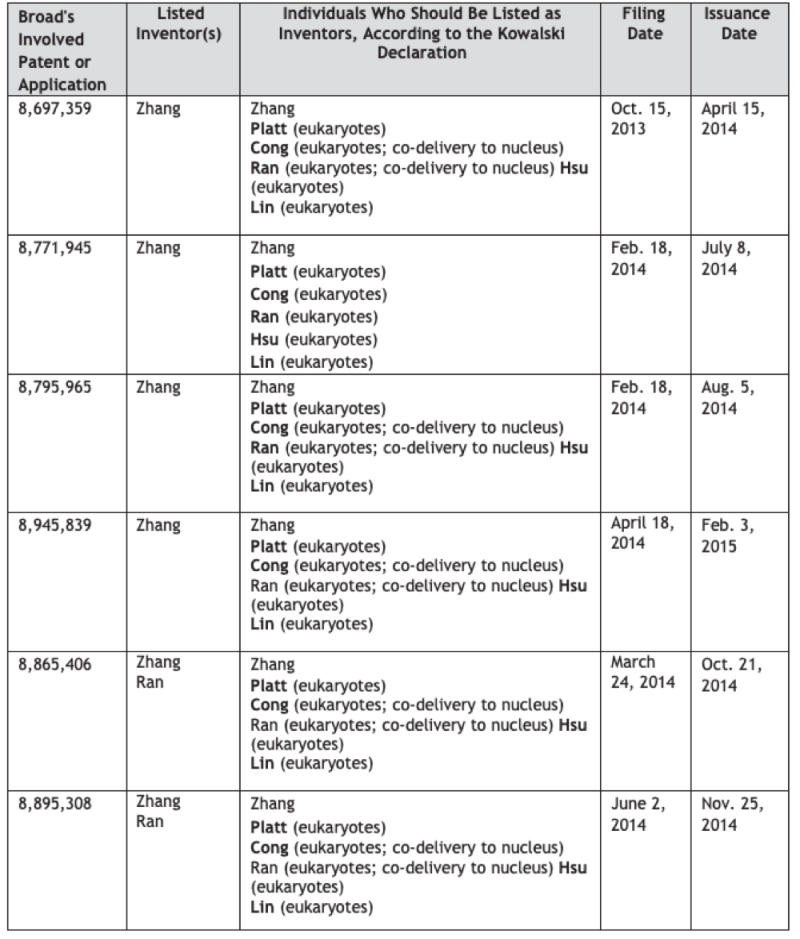
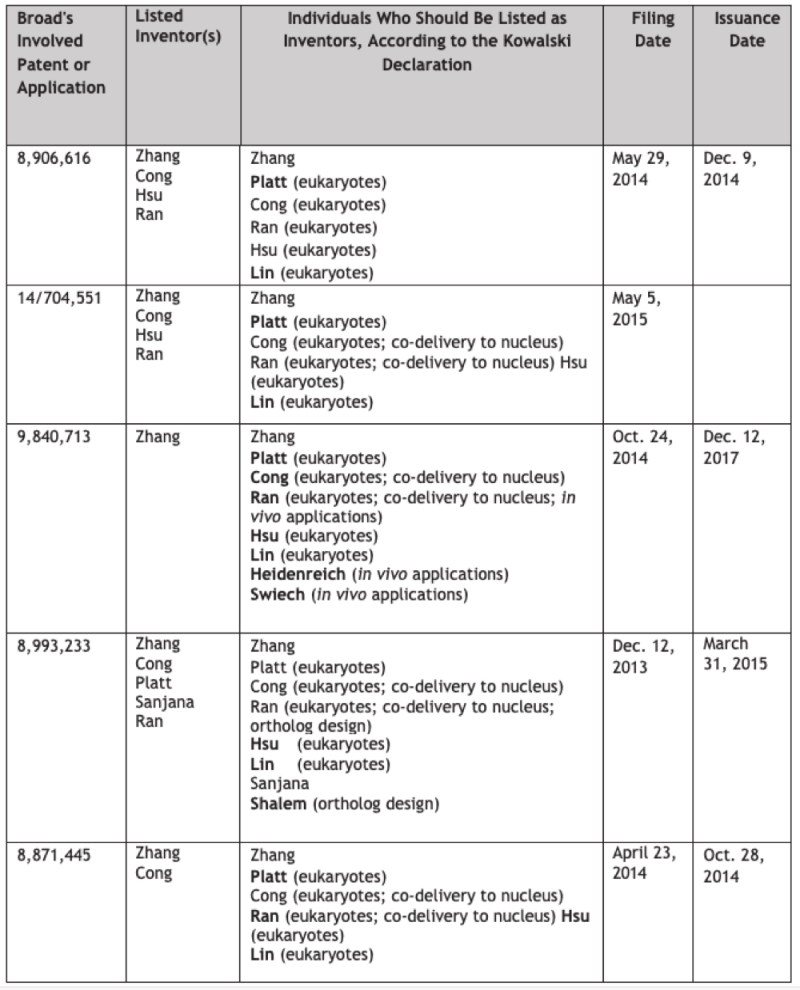
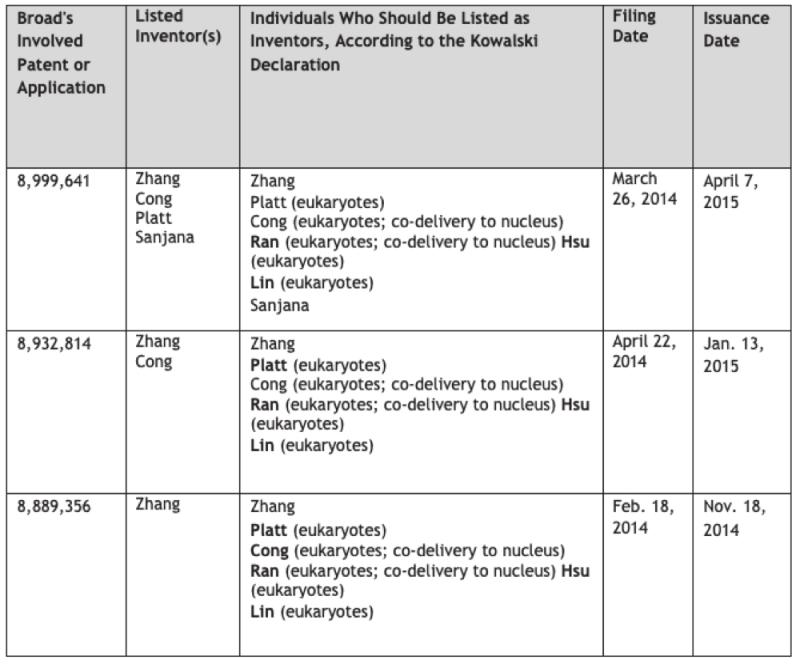
    The priority issue was raised based on the earliest two provisional applications (U.S. Provisional Application Nos. 61/736,527 and 61/748,427), as well as U.S. Provisional Application Nos. 61/791,409 and 61/835,931, which named Luciano Marraffini as an inventor, and which were owned by Rockefeller University.  The priority documents and their named inventors are as follows:

    • U.S. 61/736,527 (P1) named Zhang, Cong, Hsu, Ran, Habib, Cox, Lin and Maraffini as inventors
    • U.S. 61/748,427 (P2) named Zhang, Cong, Hsu, Ran, Habib, Cox, Lin and Maraffini as inventors
    • U.S. 61/758,468 named Zhang, Cong, Hsu, and Ran as inventors
    • U.S. 61/769,046 named Zhang, Cong, Hsu, and Ran as inventors
    • U.S. 61/791,409 (P5) named Zhang, Cong, Hsu, Ran, Habib, Cox, Lin and Maraffini, Bikard and Jian as inventors
    • U.S. 61/802,174 named Zhang, Cong, Hsu, Ran, and Platt as inventors
    • U.S. 61/806,375 named Zhang, Cong, Hsu, Ran, and Platt as inventors
    • U.S. 61/814,263 named Zhang, Cong, Hsu, Ran, and Platt as inventors
    • U.S. 61/819,803 named Zhang, Cong, Hsu, Ran, and Platt as inventors
    • U.S. 61/828,130 named Zhang, Cong, Hsu, Ran, and Platt as inventors
    • U.S. 61/835,931 (P11) named Zhang, Cong, Hsu, Ran, Cox, Lin, Maraffini, Platt, Santjana, Bikard and Jian as inventors
    • U.S. 61/836,127 named Zhang, Cong, Hsu, and Ran as inventors

    In Europe, under Article 87 EPC and Paragraph IV of the Paris Convention, priority to an earlier-filed application can be validly claimed by the prior applicant or by her successor in interest.  In either case, the applicant must be someone having the right to claim priority.  In the U.S., these provisional applications were filed in the name of the inventor and the EPO requires that there be an assignment of the invention on or before a European or PCT application is filed.  (Of course, a PCT application can always be filed naming the inventors as applicants.)  In this case, proper application of the applicable rules required both the named applicants (The Broad Institute, MIT and Harvard College) and Rockefeller to have been named as applicants when the application was filed.

    But Rockefeller was not named as an applicant.  Accordingly, the OD determined that the named Proprietors could not validly claim priority to provisional applications P1, P2, P5, and P11; the third provisional application thus provided the earliest effective filing date, and by the filing date of that application there had published prior art that invalidated the granted claims.  In this regard, the formal opinion followed the earlier preliminary opinion in stating that "[i]n both the EPC and the Paris convention systems the decisive fact for a valid claim of priority is the status of applicant, rather than the substantial requirement . . . to the subject matter of the first application" (emphasis in opinion).  The OD determined that "neither the requirement of the applicant's identity nor the proof of a valid success in title [had] been fulfilled" for the claimed invention, and stressed that these were requirements to promote legal certainty that would protect third parties' interests, and that these requirements were not subject to the national law of the priority document.  Nor, according to the preliminary opinion, could the granted European patent properly claim priority to U.S. 61/758,468 because that document failed to disclose the length of the guide sequence as claimed.

    On appeal, the Board set forth the following as the issue before them:

    "A and B are applicants for the priority application.  A alone is the applicant for the subsequent application.  Is a priority claim valid even without any assignment of priority right from B to A?"

    The appellants say that the answer is "yes" and the respondents that the answer is "no".

    The Broad made arguments regarding three questions, none of which were persuasive:

    1) Should entitlement to priority be assessed by the EPO?

    2) How is the expression "any person" in Article 87(1) EPC to be interpreted?

    3) Does national law (in this case US law) govern the determination of "any person" who has "duly filed" in Article 87(1) EPC?

    And the remedy Appellants requested (and the Board denied) was as follows:

    1.  The decision of the Opposition Division dated 26 March 2018 be set aside.
    2.  …
    3.  Entitlement to priority of the Patent to P1, P2, P5 and P11 is acknowledged as validly claimed.
    4.  Questions are referred to the Enlarged Board of Appeal if the Board is minded not to decide that entitlement to priority of the Patent to P1, P2, P5 and P11 was validly claimed, as set out at pages 70-72 of the grounds of appeal;
    5.  ….
    6.  The case is remitted to the Opposition Division for further prosecution if the Board decides that entitlement to priority of the Patent to P1, P2, P5 and P11 was validly claimed;
    7.  ….
    8.  In case the Board decides not to remit the case to the Opposition Division, to reject the oppositions and maintain the Patent as granted or, alternatively, in the form of any of Auxiliary Requests 1-64.

    (where grounds 2, 5, and 7 were not pursued in this appeal).

    With regard to Question 1, the Board characterized the Proprietor's (Broad's) position to be that for a property right devolving from national law the EPO should leave priority challenges to the national courts of each country in which rights are pursued by the Proprietor.  This would be consistent with Article 60(3) EPC, wherein the EPO does not adjudicate patent ownership disputes.  This argument comes down to matters of jurisdiction and competence according to the Board, which the Proprietor contended were adequately policed by Article 88 EPC and Rules 52 and 53 EPC.  The "same invention" requirement is sufficient to ensure legal certainty for third parties according to the Proprietor's argument.  And this principle would be applied to technical deficiencies in a priority claim, something the Proprietor argues is within their area of expertise.  Finally, this would not be a challenge that could be raised in opposition proceedings.

    The Board understood that the Proprietor contended in these arguments that the EPO should not consider the portion of Article 87(1) relating to "any person" and set forth the Article to illustrate their decision to the contrary:

    Article 87 Priority right

    (1) Any person who has duly filed, in or for (a) any State party to the Paris Convention for the Protection of Industrial Property or (b) any Member of the World Trade Organization, an application for a patent, a utility model or a utility certificate, or his successor in title, shall enjoy, for the purpose of filing a European patent application in respect of the same invention, a right of priority during a period of twelve months from the date of filing of the first application.

    (2) Every filing that is equivalent to a regular national filing under the national law of the State where it was made or under bilateral or multilateral agreements, including this Convention, shall be recognised as giving rise to a right of priority.

    (3) A regular national filing shall mean any filing that is sufficient to establish the date on which the application was filed, whatever the outcome of the application may be.

    (The Board noted that this Article has the identical wording as Article 4A of the Paris Convention).

    The Board distilled the requirements of this Article as requiring proper identification by an Applicant of "who," "where," "what," and "when" an invention was made.  Clearly, "who" is the only question before the Board in this appeal.

    The Board held Proprietor's position to be directly contrary to the requirements of Article 87(1), saying that "Article 87(1) EPC does not require that the 'any person' who has filed the patent application is actually legally entitled to do so, merely that they have done so."  The EPO's assessment is thus not of substantive ownership but of the formality of whether the proper who has actually filed the application.  And the Board did not find a proper analogy in Enlarged Board of Appeal Decision G 3/92 regarding the adequacy of fulfilling Article 60(3) requirements with regard to the requirements of Article 87(1).

    The Board agreed with Proprietor that failure to satisfy these formalities requirements as Proprietor has been determined not to can result in loss of rights, but responded by reminding the Proprietor that "EPC sets out many formal requirements for obtaining a patent, relating to such things as payment of fees, time limits for carrying out certain actions etc." and "[t]he loss of a patent or a patent application due to failure to fulfil such formalities is a feature of the EPC system."  That is certainly what happened here, but the opinion states that "[i]t is not for the Board to repair such errors, omissions or deliberate choices of a party."

    Further, the opinion states that "[t]he Board can see no basis in Article 88 EPC and Rules 52 and 53 EPC for disregarding the 'any person' requirement of Article 87 EPC," [because] "none of these provisions relieve the EPO from the obligation to formally assess who has performed the act of filing the patent application as required by Article 87(1) EPC."

    The opinion then turned to the relevance of successors in title, which the Proprietor argued is inconsistently applied but the Board stated is "merely a supporting argument for the appellants' view that a substantive legal assessment of the right to a priority claim should not be carried out."  And the Board noted that "the issue of successorship in title is not an issue in this case and therefore the appellants' arguments on this point are irrelevant for deciding this case."  Nor was the Board persuaded by the Proprietor's arguments regarding Article 54(3) EPC because "[t]he EPO does not perform a substantial assessment of the legal entitlement to claim priority, but only a formal assessment of who has performed the act of filing the patent application."

    Regarding Question 1, the Board thus held that "the Board concludes that the instances of the EPO are empowered and obliged to assess the validity of a priority right claim as required by Article 87(1) EPC."

    Turning to Question 2 regarding how the term "any person" in Article 87(1) should be interpreted, the opinion rejected the Proprietor's view that this term should be interpreted to mean that any of a number of applicants having a valid priority claim can file on behalf all of them and that the EPO's contrary requirement that all applicants be properly named on filing is in contravention of the Paris convention.  The Proprietor made semantic/textual arguments (that the use of "any person" does not mean "all," as well as others), and argument that the Paris Convention governs how ambiguous terms must be interpreted "in light of their object and purpose" which is to "assist the applicant in obtaining international protection for his invention" (something that interpretation of Article 87(1) does not achieve, inter alia, by imposing additional priority requirements).  The Proprietor further argued that national court decisions support their position that how the EPO is applying Article 87(1) was in error, and that there has never been a clear examination of this application on the merits (summarizing this aspect of the Proprietor's argument as contending "[i]t was irrelevant whether a practice was well-established.  If it was wrong, it was always possible to change such a practice . . .").  Finally, the Proprietor contended that the EPO's interpretation and application of Article 87(1) was intended to prevent multiple proceedings by individual applicants, that could lead to multiple patents.

    The Board agreed that the interpretation of "any person" in Article 87(1) EPC was based on Article 4A of the Paris Convention as interpreted using principles set forth in the Vienna Convention, specifically Article 31(1):

    A treaty shall be interpreted in good faith in accordance with the ordinary meaning to be given to the terms of the treaty in their context and in the light of its object and purpose.

    Under this rubric, the Board agreed with respondents that the term "any person" is "restrictive in meaning and requires strict identity of the applicants."  However, the Board also admitted that "the ordinary meaning of this term in all the language versions is ambiguous" and thus turned to the "object and purpose" of the Paris Convention upon which this requirement is based (this linguistic genealogy being undisputed between the parties).  For this determination the Board turned to Technical Board of Appeal Decision T 0015/01 (cited by the Proprietor) to be to "assist the applicant in obtaining international protection for his invention" (remembering that the Proprietor cited this language from this decision to illustrate that the EPO's interpretation was contravening this purpose, at least in this case).  In the Board's view, on the contrary, the question was rather "who is the 'applicant' whose interests are being safeguarded" under these objects and purposes.  Turning to the introductory hypothetical, the Board noted that:

    So if A and B file the first patent application together, the appellants' interpretation of "any person" would allow A alone to file and own another patent application in another country claiming the same invention without involving B.  This could of course result from an agreement between A and B, it could however equally result from more sinister circumstances, such as A trying to deprive B of its rights to a patent in another country.  This second scenario can hardly be thought of as one that the law should seek to protect, and neither safeguards the interests of all of the patent applicants, nor assists the applicants in obtaining international protection.

    This cannot be the object and purpose of the Paris Convention as understood by the Board.

    The Board took something of a detour in this section of the opinion in considering the Proprietor's argument that the EPO's application of the priority rule at issue in these proceedings is in violation of the European Convention on Human Rights.  But the detour was not extensive or time-consuming; the Board asserted that it found the argument "circular: it assumes that the established EPO interpretation of the Paris Convention is wrong, without bringing any supplementary arguments as to why this is the case, and then concludes that, being wrong, the European Convention on Human Rights is violated."

    With regard to proper interpretation of Article 87(1) the opinion states that its consideration of the language, object, and purpose of the Paris Convention was not dispositive either (although the opinion attests that the Board finds respondents arguments to be more persuasive).  And the Board readily admitted that there is no informative case law on the question (the opinion distinguishing the UK and Swiss cases cited by the Proprietor as supporting their position on the proper interpretation of the Article on the basis that these cases involved successorship in title).

    In such an instance, the Board asserted that "[u]sers of the international patent system are thus faced with an established practice, the continued application of which can be seen as an aspect of legal certainty.  In general, the bar for overturning long established case law and practice should be a high one because of the disruptive effects a change may have."

    The opinion also addressed what can be considered an equitable principle at play here that made them disinclined to soften the applicant identity requirements:

    The Board notes that in the present case it does not appear to have been a mistake of inadvertence that one of the applicants for the Priority Application was excluded from the Subsequent Application, but rather a deliberate choice of the appellants.  Moreover, a formal requirement cannot be merely disregarded or ignored if, as the consequence of its non-compliance, it results in the revocation of the patent.  It is not appropriate to "soften" any requirement – be it formal or substantive – for patenting on the sole basis that its non-compliance may result in the revocation of a patent.

    The Board set forth its conclusion on Question 2 by stating

    The ordinary meaning of the term "any person" in Article 87(1) EPC is ambiguous [due, inter alia, to differences in the languages of the underlying treaties].  The "all applicants" approach is certainly a plausible interpretation of this term from the ordinary meaning perspective and appears to be the one consistently applied by several member states of the EPC, over the last hundred years. . . .  The bar to overturning long established case law and practice should be very high because of the disruptive effects a change may have.  The continuation of such long standing and rationally based practices can be considered as an aspect of legal certainty.  In the light of these considerations the Board finds that the words "any person" in Article 87(1) EPC require that all applicants for the priority application, or their successors in title, are applicants for the subsequent application.

    The final question was whether national law (in this case, U.S. law) should govern the meaning of the term "any person" in Article 87(1).  In particular, this interpretation is apt for answering the question why one inventor was "left off" the application and their assignee not identified as a co-applicant (which in this case was that the (U.S.) attorneys had determined that the omitted inventor was not an inventor as the application was filed.

    But this situation raised the issue of how the EPO could determine proper inventorship in EP applications claiming priority, as this one does, to U.S. provisional applications that "do not need claims; . . . are never examined;  . . . never proceed to grant; [whose] sole purpose is to obtain a filing date; . . . may contain multiple inventions; [and] need not name (an) inventor(s) or applicant(s)."

    The Board responded to this situation by stating that the U.S, as a signatory to the Paris Convention, is bound by its terms, including Article 4A with regard to who falls under the description as "any person" as discussed by the Board in this case.  And the Proprietor's arguments regarding the relevance of the "special characteristics" of U.S. provisional applications were not relevant to the Board's decision here.  

    The Board rendered its decision, that the OD decision is affirmed and that priority has not been validly claimed for the P1, P2, P5, and P11 references.

    The Board made one more decision in its opinion, regarding the Proprietor's request that the Board refer a question to the Enlarged Board of Appeal.  Specifically, the Board stated that it believed it has been able to answer the questions raised "beyond doubt" and that no referral was necessary.

  • By Kevin E. Noonan

    Federal Circuit SealTrial courts tend to get more than the benefit of the doubt when their decisions are viewed under the "abuse of discretion" standard, and juries similarly are affirmed unless there isn't substantial evidence supporting their verdicts.  Both these rubrics, which extend more generally to cases involving disputes outside patent law, were used by the Federal Circuit to affirm both the finding of infringement and a hefty ($89,712,069) damages calculation in Vectura Ltd. v. GlaxoSmithKline LLC.

    The case arose involving Vectura's patented components for pulmonary administration for dry-powder inhalers, the components claimed in U.S. Patent No. 8,303,991.  Vectura asserted Claim 3, dependent on independent claim 1 as further limited to magnesium stearate as the "additive material" against GSK in the litigation:

    1.  Composite active particles for use in a pharmaceutical composition for pulmonary administration, each composite active particle comprising a particle of active material and particulate additive material on the surface of that particle of active material, wherein the composite active particles have a mass median aerodynamic diameter of not more than 10 μm, and wherein the additive material promotes the dispersion of the composite active particles upon actuation of a delivery device.

    (wherein the District Court's construction of the italicized limitations was at issue on appeal).

    Vectura asserted this claim against three GSK accused infringing articles:

    • Breo, which comprises two blisters, one containing a mixture of vilanterol, lactose, and magnesium stearate and the second containing a mixture of fluticasone and lactose, but not magnesium stearate.

    • Anoro, which comprises two blisters, one containing a mixture of vilanterol, lactose, and magnesium stearate and the second containing a mixture of umeclidinium, lactose, and magnesium stearate.

    • Incruse, which comprises only one blister, containing a mixture of umeclidinium, lactose, and magnesium stearate.

    GSK's method of preparing its accused infringing articles was relevant to Vectura's infringement accusations:

    GSK first mixes the lactose excipient with magnesium stearate in the absence of the active ingredient.  That step yields lactose particles that are discontinuously coated with magnesium stearate.  After a de-lumping step, GSK then mixes the lactose particles with the active ingredient.  In that step, small particles of the active ingredient are deposited onto the larger lactose particles, which are already coated with small particles of magnesium stearate.

    The District Court construed two terms of Claim 3:

    [T]he court construed the phrase "promotes the dispersion of the composite active particles" (the dispersion limitation) to mean "wherein a composition that contains one or more composite active particles has increased dispersion of the active material upon activating a delivery device for inhalation into the lungs by a patient, as compared to the same composition wherein unmodified active particles are substituted for the composite active particles.

    The court construed the term "composite active particles."  GSK's proposed construction of that term included a process limitation requiring that the composite active particles be "formed by milling . . . using sufficient energy and duration to ensure sufficient break-up of agglomerates of both constituents, dispersal, and even distribution of additive over the active particles."  The district court rejected GSK's proposed construction, holding that the term "composite active particles" does not include a process limitation.  The court construed the term to mean "[a] single particulate entit[y/ies] made up of a particle of active material to which one or more particles of additive material are fixed such that the active and additive particles do not separate in the airstream."

    The District Court found a "distinction without a difference" under this claim construction of GSK's process of mixing the active ingredient with magnesium stearate in the presence of lactose instead of in its absence.  The jury found that this claim was infringed and not invalid, and GSK appealed the District Court's denial of motions for judgment as a matter of law on infringement and damages.  This appeal followed (and did not involve the District Court's judgment that the claims were not invalid).

    The Federal Circuit affirmed, in an opinion by Judge Bryson, joined by Chief Judge Prost and Judge Wallach.  GSK raised four issues on appeal:

    • First, that the district court should have granted JMOL on infringement because "Vectura failed to present substantial evidence that the accused inhalers use additive material that "promotes the dispersion" of the active material," or in the alternative granted GSK a new trial.

    • Second, that the district court should have granted JMOL on claim construction, wherein "the district court's construction of the term "composite active particles" was erroneous, requiring a new trial on infringement."

    • Third, for a new trial on damages because of flaws in Vectura's expert's calculations.

    • Finally, for a new trial on damages due to prejudicial arguments made to the jury regarding GSK sales made by Vectura's damages expert and counsel.

    The Federal Circuit opinion set forth for the reader's convenience the standards of its review:  substantial evidence for jury verdicts, citing Personalized User Model, LLP v. Google Inc., 797 F.3d 1341, 1345 (Fed. Cir. 2015); and abuse of discretion for its new trial motion, citing Union Carbide Chems. & Plastics Tech. Corp. v. Shell Oil Co., 308 F.3d 1167, 1182 (Fed. Cir. 2002).

    GSK argued that under the District Court's construction it was not disputed between the parties that Vectura had the burden to show "the use of magnesium stearate in the accused inhalers improves the dispersion of the active ingredient compared to identical products in which only the lactose excipient is coated with magnesium stearate."  GSK argued the District Court erred in denying its motion for JMOL on this issue because in its view the jury based its decision that Vectura had satisfied its burden on an allegedly flawed scientific test.  The asserted flaws had to do with whether the lactose alone was covered with magnesium stearate vs. coating the drug-containing particles and the lactose (wherein the latter composition was dispersed better in the lungs).  The Federal Circuit found GSK's argument was deficient because this test was not the only basis for the jury's determination.  The District Court found in denying JMOL that Vectura relied on aspects other than the flawed study and that there was "ample other evidence" the jury could have relied upon other than the putatively flawed study.  This included evidence that a magnesium stearate coating "helps overcome the tendency of the particles to stick together and therefore increases the dispersion of the particles in the lungs" and test results wherein GSK's accused infringing products showed the particles "were consistently associated with magnesium stearate."  The District Court also held that the jury was entitled to rely on GSK documentary evidence regarding satisfaction of the dispersal limitation in Claim 3.  Thus, according to the panel, the totality of the evidence developed below was sufficient to satisfy the substantial evidence standard for affirming the jury's verdict of infringement.

    GSK's second argument on appeal was that proper construction of the claim limitation "composite active particles" required that these particles be produced by a "high-energy milling" process (which GSK argued does not describe their process).  According to GSK, the '991 specification discloses high-energy milling, and disclosure of this process was used during prosecution of the '991 patent to overcome a prior art reference.  Thus, according to GSK, a correct construction of the "composite active particles" requires the particles (and drugs made from those particles) to be made using a "high-energy milling" process.

    On the merits, the Federal Circuit considered "this case [to] fall[] between two prior cases from this court: Continental Circuits LLC v. Intel Corp., 915 F.3d 788 (Fed. Cir. 2019), and Andersen Corp. v. Fiber Composites, LLC, 474 F.3d 1361 (Fed. Cir. 2007)."  In the Continental Circuits case, the Federal Circuit had refused to import a process limitation into an apparatus claim, whereas in the Anderson case, the Court had construed an apparatus claim to encompass a process limitation.  From these cases the panel enunciated a standard, wherein "process steps can be treated as part of the product claim if the patentee has made clear that the process steps are an essential part of the claimed invention."  As a practical matter, the opinion states this standard another way, saying the Court looks to "language of requirement, not preference."  Here, from the Federal Circuit's assessment of the '991 patent specification the Court reached the conclusion that the disclosure in the specification was more similar to the circumstance in the Continental Circuits case, where the specification set forth a preference but not a requirement for the process step (citing several instances in the specification supporting this view).  And with regard to the prosecution history, the opinion states the Court rejected GSK's argument because the distinction GSK raised to overcome the asserted prior art reference was directed at another aspect of the method for making the claimed composition.

    With regard to damages, the Federal Circuit considered the parties' prior licensing history, wherein Vectura had previously granted GSK a nonexclusive license that had expired in 2016.  This license had had a "tiered structure" ("a royalty of 3% on its first 300 million British pounds in sales, 2% on sales between 300 million and 500 million pounds, and no additional royalties on sales above 500 million pounds") that Vectura's expert used as a "comparable license" in reaching her damages conclusions.  Significantly, however, the expert did not include the cap of no additional royalties after 500 million pounds, based on "changed circumstances."  In contrast. GSK's royalty rate was much lower (only 0.0187%).

    GSK argued that Vectura's analysis was flawed because it used the "entire market value" approach rather than distinguishing the non-infringing components of the accused infringing articles.  The Court considered the damages theories to relate to "a rather unusual circumstance," because the choice is usually between where "an entire-market-value royalty base is appropriate only when the patented feature creates the basis for customer demand or substantially creates the value of the component parts, and apportionment is required when an entire-market-value royalty base is inappropriate," citing Virnetx, Inc. v. Cisco Sys., Inc., 767 F.3d 1308, 1326 (Fed. Cir. 2014).  Here, however, the Court thought that any such apportionment is contained ("built-in") in the earlier license so re-apportionment was unnecessary.  The panel opined that the District Court properly credited Vectura's expert's testimony regarding the comparability of her damages calculations as a reasonable royalty and the terms of the earlier license.  And with regard to the lack of a royalty cap, the Court held that "[i]t was . . . permissible for the jury to credit Ms. Schenk's testimony and to award damages without applying a royalty cap."

    GSK's other grounds for a new trial based on damages was that Vectura's damages expert and counsel mentioned the total sales of GSK's products and that this was prejudicial.  The District Court had found some of these references to be improper but in total that they were not so prejudicial as to warrant a new trial.  Asserting that "[o]n the issue of the impact of improper conduct at trial, the views of the judge who supervised the trial proceedings are entitled to considerable weight,"  Fineman v. Armstrong World Indus., Inc., 980 F.2d 171 (3d Cir. 1992), the Federal Circuit found these disclosures not to be sufficiently prejudicial for it to find the District Court's denial of JMOL to be an abuse of discretion.

    Vectura Ltd. v. GlaxoSmithKline LLC (Fed. Cir. 2020)
    Panel: Chief Judge Prost and Circuit Judges Bryson and Wallach
    Opinion by Circuit Judge Bryson

  • By Michael Borella

    Federal Circuit SealOne would think that inventions relating to computer game software would easily meet the requirements for patent eligibility, as these inventions fundamentally involve technological processes and require computer implementation.  But that is not always the case.  Under current interpretations of the eligibility standard, not only does the language of the actual claims matter, so does the context of the invention.

    Gree was issued U.S. Patent No. 9,597,594, and it was timely challenged in a Post Grant Review (PGR) by Supercell.  The challenger is a mobile game development company, responsible for the widely-popular Clash of Clans and related apps.  The Patent Trial and Appeal Board (PTAB) of the U.S. Patent and Trademark Office (USPTO) ultimately found the majority of the claims under review to be ineligible for patenting under 35 U.S.C. § 101.  Gree appealed.

    Claim 1 of the '594 patent, which is representative, recites:

    A method for controlling a computer that is provided with a storage unit configured to store game contents arranged within a game space, first positions of the game contents within the game space, and a template defining second positions of one or more of the game contents, and that progresses a game by arranging the game contents within the game space based on a command by a player, the method comprising:
        when the template is applied to a predetermined area within the game space based on the command by the player, moving, by the computer, the game contents arranged at the first positions within the game space to the second positions of the game contents defined by the template within the predetermined area.

    The invention described as being applicable to how a user controls city-building games, "in which a player builds a city within a virtual space (hereinafter referred to as 'game space') provided in the game program in a computer."  These virtual cities include "arrangements of game contents, i.e., items such as protective walls, buildings,  . . . soldiers, weapons, etc."

    The problem being solved is related to managing game contents in large cities.  According to the specification, "it is very complicated for a player to change positions, types, levels, etc., of individual items in the cities."  As a consequence, users who play the game for some time find it increasingly necessary to micromanage these resources.

    The claimed invention overcomes these drawbacks by "creating a template defining positions of one or more game contents and subsequently applying the template to a predetermined area within the game space."  Doing so causes the computer to "move[] the game contents arranged within the game space to the positions of the game contents defined by the template."  Particularly, when "the numbers of game contents of each type defined by the template match the numbers of game contents of each type in the game space to which the template is to be applied[, this causes] all game contents arranged within the game space [to be] moved to positions of game contents as defined by the template."  Put another way, a single pre-defined operation can be used to replace a potentially large number of user interface interactions.

    Other claimed embodiments include handling mismatches between "the numbers of game contents of each type defined by the template and the numbers of game contents of each type in the game space to which the template is to be applied."  When the number of game contents is larger, "those with the smallest moving distance (e.g., Manhattan distance) to positions defined by the template may be moved to the positions of game contents as defined by the template."  Conversely, when the number of game contents is smaller, "all game contents . . . may be moved to positions of game contents defined by the template, to which the moving distance is the smallest, with positions on which no game contents are arranged among the positions of game contents defined by the template."

    In Alice Corp. v. CLS Bank Int'l, the Supreme Court set forth a two-part test to determine whether claims are directed to patent-eligible subject matter under § 101.  One must first decide whether the claim at hand involves a judicially-excluded law of nature, a natural phenomenon, or an abstract idea.  If so, then one must further decide whether any element or combination of elements in the claim is sufficient to ensure that the claim amounts to significantly more than the judicial exclusion.  But elements or combinations of elements that are well-understood, routine, and conventional will not lift the claim over the § 101 hurdle.  While this inquiry is generally carried out as a matter of law, factual issues can come into play when determining whether something is well-understood, routine, and conventional.

    Recently, the Federal Circuit provided a major clue as to how to think about patent eligibility in practice.  In Dropbox Inc. v. Synchronoss Techs. Inc. the Court wrote that "an inventive concept exists when a claim recites a specific, discrete implementation of the abstract idea where the particular arrangement of elements is a technical improvement over the prior art."  This suggests that in order for a claim that is otherwise directed to an abstract idea to be successful under § 101, it should have three qualities: specificity, a technical solution that it provides, and some degree of novelty.  More particularly, there should be a nexus between these three factors — specificity, technical character, and novelty should appear in the same claim element or at least be explicitly linked in some fashion in the recitation of the claim.

    The outcome of the PGR trial was that claims 1, 8, and 10-20 of the '594 patent were found to fail the eligibility test.  On review, the Federal Circuit agreed with the PTAB that, under part one of Alice, all claims are "directed to the abstract idea of creating and applying a template of positions of one or more game contents."  The Court further agreed with the PTAB that "certain claims of the '594 patent are broad enough to cover simply implementing the long-standing and conventional game of correspondence chess using chess templates on a computer."[1]

    Gree attempted to argue that the claims involved an improved graphical user interface.  But the Court rapidly dismissed this effort because only one of the claims specifically recited such features and did so at a high level.

    Finding the claims directed to an abstract idea, the Court turned to part two of Alice.  There, it found that almost all of the claims — claim 1 included — lacked an inventive concept.  In particular, the computer hardware limitations "merely invoke generic computer components performing their standard functions to limit the use of the abstract idea itself to the technological environment of a game space on a computer."  Further, the Court indicated that "claims 1, 8, and 10–20 are so broad that they encompass automation of . . . well-understood, routine, conventional activity."

    In contrast, the Court found that claims 5-7, directed to the mismatched template scenarios, did include significantly more than the abstract idea itself.  These claims recite:

    5.  The method according to claim 1, wherein when the number of game contents arranged within the game space is smaller than the number of game contents for which the second positions are defined by the template, the computer moves the game contents arranged at the first positions within the game space to the second positions of the game contents defined by the template to which the moving distance is the smallest.

    6.  The method according to claim 5, wherein out of the second positions of the game contents defined by the template, the computer displays positions on which no game contents are arranged and the game contents, in a discernible condition.

    7.  The method according to claim 1, wherein when the number of game contents arranged within the game space is larger than the number of game contents for which the second position[s] are defined by the template, the computer moves the game contents arranged at the first positions within the game space for which the moving distance to the second positions of the game contents defined by the template is the smallest, to the positions.

    Unlike the other claims, claims 5-7 recite "specific steps for applying templates in mismatched template scenarios, these claims require something more than automating correspondence chess."  Further, "Supercell has not shown that conventional correspondence chess template application included any technique—let alone the specifically claimed technique—for applying a template in the claimed mismatched template scenarios."

    In summary, the Court concluded that claims 1-4, and 8-20 were ineligible and that claims 5-7 were eligible.  Putting this into the Dropbox framework described above, the ineligible claims were non-specific and overlapped with known features from the prior art.  In contrast, the eligible claims were drawn toward specific features that were not known to be in the prior art.  The Court never explicitly addressed whether the claims had sufficient technical character, but seeing as it found some claims eligible, it appears that was the case.

    But before finishing its opinion, the Court made an interesting criticism of PTAB's § 101 analysis that may be helpful for practitioners.  The Court observed that:

    The Board also determined that under the Alice framework, Petitioner only needed to account for each claim limitation under either a formulation of the concept a claim is 'directed to' or under Alice step two.  To the extent that the Board meant that a proper § 101 analysis may consider some claim limitations only at Alice step one and others only at Alice step two, we do not agree with its reading of Supreme Court precedent.  Instead, both steps of the Alice inquiry require that the claims be considered in their entirety.

    Thus, the propensity for the PTAB and USPTO Examiners — and frankly other Federal Circuit panels — to analyze claim elements under the auspices of either Alice part one only or part two only, is incorrect.

    [1] As described in the opinion, in correspondence chess, "a first player fills out a post card with information that represents the current state of the board and makes an indication on the post card of the first player's intended move and mails the post card to a second player who, having already set up a chess board, moves a piece on the board in accordance with the instruction on the post card."  The template in correspondence chess would be the move as indicated on the post card.

    Gree, Inc. v. Supercell Oy (Fed. Cir. 2020)
    Panel: Circuit Judges Lourie, Hughes, and Stoll
    Opinion by Circuit Judge Stoll

  • By Kevin E. Noonan

    Federal Circuit SealInterferences were rendered unnecessary with the passage of the Leahy-Smith America Invents Act in 2011, but they linger in disputes between patents and applications claiming priority to applications filed before the change to a "first-inventor-to-file" system.  The Federal Circuit recently upheld the Patent Trial and Appeal Board's priority determination in Chevron U.S.A. Inc. v. University of Wyoming Research Corp. in a decision based on the Board's construction of an undisputedly dispositive term.

    U.S. Interference No. 106,064 was declared between the University of Wyoming Research Corp. (over involved U.S. Patent No. 8,367,425 and Chevron U.S.A.'s Application No. 12/883,814).  The Count in the interference (which defines the interfering subject matter) was defined in the alternative as Claim 1 of the '814 application:

    1.  A method for determining asphaltene stability in a hydrocarbon-containing material having solvated asphaltenes therein, the method comprising the steps of:
        (a) precipitating an amount of the asphaltenes from a liquid sample of the hydrocarbon-containing material with an alkane mobile phase solvent in a column;
        (b) dissolving a first amount and a second amount of the precipitated asphaltenes by gradually and continuously changing the alkane mobile phase solvent to a final mobile phase solvent having a solubility parameter at least 1 MPa0.5 higher than the alkane mobile phase solvent;
        (c) monitoring the concentration of eluted fractions from the column;
        (d) creating a solubility profile of the dissolved asphaltenes in the hydrocarbon-containing material; and
        (e) determining one or more asphaltene stability parameters of the hydrocarbon-containing material.

    or

    Claim 5 of the '425 patent:

    5.  A method for determining asphaltene stability in a hydrocarbon-containing material having solvated asphaltenes therein comprising the steps of:
        (a) intentionally precipitating an amount of the asphaltenes from a liquid sample of the hydrocarbon-containing material with an alkane mobile phase solvent in a column that has a substantially chemically inert stationary phase established therein, wherein the substantially chemically inert stationary phase is substantially chemically inert relative to the precipitated asphaltenes;
        (b) dissolving a first amount and a second amount of the precipitated asphaltenes by changing the alkane mobile phase solvent to a final mobile phase solvent having a solubility parameter that is higher than the alkane mobile phase solvent;
        (c) monitoring the concentration of eluted fractions from the column;
        (d) creating a solubility profile of the dissolved asphaltenes in the hydrocarbon-containing material; and
        (e) determining one or more asphaltene stability parameters of the hydrocarbon-containing material;
        wherein said step of dissolving comprises the step of dissolving by gradually and continuously changing the alkane mobile phase solvent to a final mobile phase solvent having a solubility parameter that is at least 1 MPa0.5 higher than the alkane mobile phase solvent.

    Wyoming copied this claim to provoke the interference.  Wyoming was designated as the Junior Party in the interference as declared, the Board recognizing their earliest priority date as September 23, 2011 (the filing date of U.S. Application No. 13/243,782, now U.S. Patent No. 8,273,581) and Chevron as Senior Party, having the benefit priority to U.S. Provisional Application Nos. 61/242,280, filed 14 September 2009 and 61/312,765, filed 11 March 2010).  However, in its Decision on Motions, the Board granted Wyoming benefit of priority to U.S. Provisional Application 60/711,599 (filed Aug. 25, 2005), and U.S. Application No. 11/510,491 (filed Aug. 25, 2006), and declared Wyoming the Senior Party.  Chevron filed a Priority Statement establishing its earliest conception date (supported by evidence of diligence from conception to its earliest filing date) of March 1, 2009.  Accordingly, the Board held that Chevron was unable to establish its date of invention to be earlier than Wyoming's earliest priority date (the '599 application filing date) and entered judgment in favor of Wyoming.  This appeal followed.

    The Federal Circuit affirmed, in an opinion by Judge Schall joined by Judge Lourie; Judge Newman filed a dissenting opinion.  The basis of Chevron's appeal was that the Board had erred in determining that Wyoming was entitled to its earliest filing date based on an erroneous claim construction.  Specifically, Chevron contended that the Board had misconstrued the limitation "gradually and continuously changing the alkane mobile phase solvent to a final mobile phase solvent" to mean "the alkane mobile phase solvent is incrementally removed from the column over a period of time by continuously adding a final mobile phase solvent" (for the meaning of "gradually") and "without interruption" for the term "continuously."  Chevron urged that this limitation should be construed to mean "the amount of alkane mobile phase solvent fed into the column is incrementally decreased from 100% to 0% over a period of time without interruption while the amount of final mobile phase solvent fed into the column is incrementally increased from 0% to 100% over the same period of time," as Chevron had argued before the Board.  (Neither party disputed the construction given by the Board to the term "continuously.")  The panel recognized that the appeal concerned that "one, narrow issue" of claim construction, because there was no dispute that "Wyoming's '425 patent and the priority applications have written description support for the limitation under the Board's construction, but that they lack such support under the construction urged by Chevron."  Accordingly if the Board properly construed this term, Chevron was not entitled to priority for the Count.

    The Federal Circuit majority (as had the Board) based its decision affirming the Board on express disclosure in the '814 specification regarding the term "gradually":

    The term gradually as used herein shall be understood to mean that the alkane mobile phase solvent is incrementally removed from the column over a period of time by continuously adding a final mobile phase solvent having a solubility parameter at least 1 MPa0.5 higher than the alkane mobile phase solvent to the column.

    (And because the Board thus relied on intrinsic evidence, it did not consider the testimony of either of the parties' expert witnesses and the Court's review was de novo.)  On this basis, the Board (giving the limitation its broadest reasonable interpretation) held that the term "gradually and continuously changing" referred to the change of solvents in the column rather than at the inlet of the column (neglecting the physical reality that the introduction of the continuously changing solvent occurs, as it must, at the inlet, then proceeding through the column as chromatography continues).  Chevron for its part argued (before the Board and here) that the '814 specification contained several instances wherein the solvent change was described as occurring at the column inlet.  And Wyoming countered that these citations were directed to disclosure reciting where the solvent was gradually and continuously added not where the solvent was gradually and continuously changed.

    The panel majority agreed that the Board had properly construed the dispositive limitation under the broadest reasonable construction standard, particularly in view of the express definition of the term "gradually" in the '814 application specification.  The Court also found reliance to be supported by other disclosure in the specification in adjacent paragraphs.  The majority rejected Chevron's legal argument that the Board decision was contrary to the Federal Circuit's precedent from In re Suitco Surface, Inc., 603 F.3d 1255 (Fed. Cir. 2010), stating that unlike in that case here, the Board's construction was not "unreasonably broad" and was supported by express disclosure.  Because the majority found that the Board's construction was consistent with express disclosure and its own precedent regarding proper use of disclosure from the specification in construction under the broadest reasonable construction standard, the Federal Circuit affirmed the Board's priority determination in Wyoming's favor.

    Judge Newman dissented.  In the Judge's view, "[t]he Wyoming specification does not describe and does not support the claims copied from Chevron.  In its chain of applications Wyoming describes and claims a different method."  Thus the proper outcome would have been a determination that there was no interference in fact, particularly because the priority benefit accorded to Wyoming precludes Chevron's disclosure from being prior art to Wyoming's claims.  The Judge expressly disagrees with the majority's lack of consideration of the standard of the Court's "uniform precedent that requires that the interference count is construed in light of the application from which it arose; that is, Haemonetics Corp. v. Baxter Healthcare Corp., 607 F.3d 776, 781 (Fed. Cir. 2010) and Bicon, Inc. v. Straumann Co., 441 F.3d 945, 951 (Fed. Cir. 2006)."  As a consequence, in Judge Newman's view, the majority was able to ignore dispositive differences between the inventions claimed in the parties applications, namely that "Wyoming's method differed [from the claimed Chevron method] in that Wyoming required an abrupt and discontinuous solvent change" yet nevertheless granted priority to Wyoming.  These differences (or the consequences thereof) were for Judge Newman illustrated in each of the parties disclosures:

    Wyoming:

    WyomingChevron:

    Chevron
    And the Board understood these differences:

    The underlying facts in this situation are, for the most part, not in dispute.  [Wyoming's] example utilizes abrupt solvent input changes . . . , while [Chevron's] examples use solvent changes that are less so.

    Because "[w]hen claims are copied to provoke an interference, the copied claims are [to be] construed in light of the application from which the claims are copies" the Judge opines, citing Agilent Techs., Inc. v. Affymetrix, Inc., 567 F.3d 1366, 1375 (Fed. Cir. 2009).

    In addition, in light of these differences, Judge Newman believes that "Wyoming proved neither conception nor reduction to practice of the Count" (which is a function of the parties' priority status regarding Wyoming being declared the Senior Party and thus not having this burden).  But both the law and PTAB rules (specifically 37 C.F.R. § 41.202) contain that requirement which was not complied with here.  Seeing this as threshold issue, Judge Newman would have dissolved the interference and permitted both parties to have patents claiming their distinct inventions.

    Chevron U.S.A. Inc. v. University of Wyoming Research Corp. (Fed. Cir. 2020)
    Panel: Circuit Judges Newman, Lourie, and Schall
    Opinion by Circuit Judge Schall; dissenting opinion by Circuit Judge Newman

  • By Kevin E. Noonan

    Federal Circuit SealIt has long been understood that claim construction can, and frequently is, dispositive in patent litigation.  This truism was the basis for the Federal Circuit affirming the District Court's decision against a generic drug producer in its recent decision in Par Pharmaceutical, Inc. v. Hospira, Inc.  And the case being decided on whether Hospira's formulation described in its ANDA would constructively infringe Par's patented formulation, the clear error standard of view also had a part to play in the outcome.

    These issues arose in ANDA litigation, wherein Plaintiffs asserted U.S. Patent Nos. 9,119,876 and 9,925,657 against Hospira over Par's Adrenalin® product (epinephrine) and methods for administering the drug (by injection).  Hospira asserted non-infringement and invalidity as defenses (the District Court ruled against Hospira on the latter and they were not on appeal).  The Par patents were directed to formulations that overcame deficiencies in prior art epinephrine formulations, principally short shelf life due to three different routes of degradation (oxidation, racemization, and sulfonation).  Claim 1 of the '876 patent is representative:

    A composition comprising:
        in the range of about 0.5 to 1.5 mg/mL of epinephrine and/or salts thereof,
        in the range of about 6 to 8 mg/mL of a tonicity regulating agent,
        in the range of about 2.8 to 3.8 mg/mL of a pH raising agent,
        in the range of about 0.1 to 1.1 mg/mL of an antioxidant,
        in the range of about 0.001 to 0.010 mL/mL of a pH lowering agent, and
        in the range of about 0.01 to 0.4 mg/mL of a transition metal complexing agent,
        wherein the antioxidant comprises sodium bisulfite and/or sodium metabisulfite.

    (where boldface type is used in the opinion to designate limitations relevant to Hospira's appeal).  After defining these limitations, the opinion set forth the District Court's construction of the word "about" as it was used for each limitation.  Specifically, the parties agreed that this term be given its plain and ordinary meaning, i.e., "approximately"; significantly for the Federal Circuit in this appeal, Hospira did not assert a contrary construction.

    The parties proffered expert testimony regarding the three limitations emphasized above.  Par's expert testified that the tonicity range — 6-8 mg/mL — could be satisfied for the court's infringement determination by 9 mg/mL sodium chloride (Hospira's concentration, although concentrations as low a 8.55 mg/mL were also used) because it would suffice for the intended purpose, i.e., "maintain[ing] the integrity of living cells following the injection of epinephrine into the bloodstream."  Hospira's expert only disputed his counterpart with regard to whether the skilled artisan would consider 9 mg/mL to fall within the range of "about" 6-8 mg/mL.

    For the transition metal complexing limitation, the District Court relied on evidence that citric acid was a known chelating agent, and that the amount of elemental impurities (metals) was represented by Hospira in its ANDA as being within international standards (specifically, the ICH Q3D guidelines).  The correspondence between this standard and the concentration of metal chelating agent recited in the claim was attested by Par's expert to fall within the claimed range.  Hospira's expert again did not contest Par's expert in general but did testify that the upper limit of the ICH Q3D guidelines were an inappropriate standard for the District Court to apply.  Rather, in his view the proper amount should be derived from Hospira's test batches, which he opined would require a much lower amount of citric acid as a chelator.

    The parties contested the concentration of the pH lowering agent, Hospira's ANDA specifying citric acid as a buffer (with its sodium citrate salt), which together are considered in the art to be pH raising (whereas it was undisputed that citric acid by itself is a pH lowering agent).  According to Par's expert, subtracting the amount of citric acid in Hospira's formulation left sufficient citric acid to fall within the range of Par's claimed pH lowering agent, "even while those same citric-acid molecules would be part of the buffer system (citric acid combined with sodium citrate) that would serve as a pH raising agent."  (Despite the apparent paradox it is helpful to remember that infringement is a question of fact and the Federal Circuit reviews factual determinations by the District Court in a bench trial for clear error.)  Hospira's expert disagreed with Par's expert, testifying (reasonably, on its face) that the citric acid molecules in the formulation should not be considered as both pH-lowering and pH raising components of the formulation.  Nevertheless, the District Court ruled in Par's favor, that Hospira's formulation would infringe Par's patent claims.  This appeal followed.

    The Federal Circuit affirmed, in an opinion by Judge Taranto, joined by Judges Dyk and Stoll.  Hospira addressed on appeal the District Court's determinations for each of the three limitations at issue.  The Federal Circuit in its opinion first affirmed the District Court's finding that Hospira's 9 mg/mL sodium chloride concentration in its formulation fell literally within Par's claim limitation of "about" 6-8 mg/mL.  The panel noted that when the term "about" is used, it "avoids a strict numerical boundary to the specified parameter," citing Cohesive Techs. v. Water Corp., 543 F.3d 1351 (Fed. Cir. 2008), relying on Pall Corp. v. Micron Separations, Inc., 66 F.3d 1211, 1217 (Fed. Cir. 1995).  The extent to which a claimed numerical range can extend outside that range when modified by "about" in a claim is limited to what the skilled worker would "reasonably consider" the claim would encompass according to the opinion, citing Monsanto Tech. LLC v. E.I. DuPont de Nemours & Co., 878 F.3d 1336, 1342 (Fed. Cir. 2018).  In cases like these, where no party argues for a narrower claim construction, the determination is governed by the Cohesive standard.  The elements of this standard include whether the accused infringing formulation differs from the claimed range by a "modest amount" (Conopco, Inc. v. May Dep't Stores Co., 46 F.3d 1556, 1562 (Fed. Cir. 1994)), and how critical the claimed range is to the purpose of the limitation (not the invention) itself.  Although recognizing the contribution of claim construction to a Court's decisions on this question, the Federal Circuit stated that "it is a question of technologic fact whether the accused device meets a reasonable meaning of 'about' in the particular circumstances," citing Modine Manufacturing Co. v. U.S. Int'l Trade Comm'n, 75 F.3d 1545, 1554 (Fed. Cir. 1996).  Here, the panel opined that the District Court had properly applied its precedent as set forth herein, and that its basis for the decision was dependent on expert testimony.  The District Court found Par's expert to be more persuasive than Hospira's, particularly to the extent that it was dependent on "the technological facts, the importance of the purpose of the limitation, and the limitation's noncriticality."  In contrast, the District Court found that Hospira's expert "did not provide a meaningful analysis of the technologic context or the function of the claimed amount of tonicity regulating agent."  On these facts the panel found no clear error.

    With regard to the transition metal complexing agent limitation, the Federal Circuit rejected Hospira's argument that the District Court should have focused on its proposed generic formulation rather than on what was set forth in its ANDA.  The panel found that the District Court correctly considered citric acid to be a transition metal complexing agent as recited in the claim, which was consistent with the expert testimony from both parties.  The opinion rejected Hospira's argument that it did not intend citric acid to function as a chelating agent, in light of testimony that citric acid actually does act as a chelating agent.  The standard for finding infringement in ANDA litigation under 35 U.S.C. § 271(e)(2) is what is described in the ANDA (the filing of which is, as the Court noted, the constructive act of infringement), citing Sunovion Pharm., Inc. v. Teva Pharm., USA, Inc., 731 F.3d 1271, 1279 (Fed. Cir. 2013).  And Hospira's reliance on the ICH Q3D standard for its ANDA supported the District Court's finding, not at least because this citation was added to the ANDA after the FDA requested "alternative information" in this regard.  The ANDA not being silent on this question the Federal Circuit held that the District Court had sufficient evidence for finding that Hospira's formulation literally corresponded to this limitation.

    Finally, with respect to pH-affecting properties of citric acid and buffers made therefrom, the Federal Circuit affirmed based on Hospira not having preserved a claim-construction argument on this issue.  Moreover, the Federal Circuit understood that the (identical) specifications of the '876 and '657 patents, in the panel's view "at least strongly suggest[ed] the opposite."  Because it had not challenged claim construction on this (or any other) point, the Federal Circuit held that the District Court had not clearly erred in concluding that Hospira's formulation infringed the claims as construed (which, inter alia, depended on the disclosures in the specification), and affirmed.

    Par Pharmaceutical, Inc. v. Hospira, Inc. (Fed. Cir. 2020)
    Panel: Circuit Judges Dyk, Taranto, and Stoll
    Opinion by Circuit Judge Taranto