• By Michael Borella

    Federal Circuit SealOne of the more frustrating aspects of current patent-eligibility law is that it lends itself all too easily to mischief.  In particular, given that the eligibility test under 35 U.S.C. § 101 as interpreted by the courts is poorly-defined, conclusory reasoning frequently rears its ugly head.  Such reasoning is sometimes found in § 101 rejections of claims by examiners of the U.S. Patent and Trademark Office.  The more egregious of these rejections involve little actual analysis, no actual analysis, the ignoring of claim elements, the ignoring of stated improvements of the claimed invention, and attempts to minimize case law favorable to patentees by limiting the scope of those decisions to their facts.  But district courts are not immune to jumping to conclusions either.

    Realtime LLC brought an action in the District of Delaware alleging that multiple parties infringed claims of U.S. Patents 7,415,530, 8,717,203, 9,054,728, 9,116,908, and 9,667,751.  The defendants moved the District Court to dismiss, contending that the patents are ineligible (among other grounds).  Immediately after oral argument, the District Court declared all 159 claims of the five patents ineligible without a formal written opinion.  The only memorialization of the judge's reasoning is a five-page transcript.  Realtime asked the District Court for leave to amend its complaint, but the judge refused.  He admitted that "reasonable people can disagree" on the eligibility of the asserted claims, but nonetheless stated "I think you can take your issues up with the Federal Circuit, and if I'm wrong, I'm wrong."  Realtime appealed.

    In Alice Corp. v. CLS Bank Int'l, the Supreme Court set forth a two-part test to determine whether claims are directed to patent-eligible subject matter under § 101.  One must first decide whether the claim at hand involves a judicially-excluded law of nature, a natural phenomenon, or an abstract idea.  If so, then one must further decide whether any element or combination of elements in the claim is sufficient to ensure that the claim amounts to significantly more than the judicial exclusion.  But elements or combinations of elements that are well-understood, routine, and conventional will not lift the claim over the § 101 hurdle.  While this inquiry is generally carried out as a matter of law, factual issues can come into play when determining whether something is well-understood, routine, and conventional.

    As characterized by the Federal Circuit, the claimed inventions relate to "improving data storage and retrieval bandwidth utilizing lossless data compression and decompression."  The patents describe "certain drawbacks found in prior art systems, including that they did not adequately account for hardware limitations."  The inventions "overcome these limitations by, for example, selecting encoding techniques based upon their ability to effectively encode different types of input data."  As an example, claim 25 of the '751 patent recites:

    A system for compressing data comprising:
        a data server implemented on one or more processors and one or more memory systems and configured to:
            analyze content of a data block to identify a parameter, attribute, or value of the data block that excludes analysis based solely on reading a descriptor;
            select an encoder associated with the identified parameter, attribute, or value;
    compress data in the data block with the selected encoder to produce a compressed data block,     wherein the compression utilizes a state machine; and
    store the compressed data block;
        wherein the time of the compressing the data block and the storing the compressed data block is less than the time of storing the data block in uncompressed form.

    Of note is that these patents and their family members had survived previous § 101 challenges.  Particularly, "Magistrate Judge John D. Love of the Eastern District of Texas considered the patent eligibility of the '728, '530, and '908 patents, as well as the eligibility of members of the '203 and '751 patents' families, in two separate cases."  In these cases, Judge Love found the claims patent-eligible under both parts of the Alice test, and his findings were adopted by other judges in the Eastern District of Texas and the District of Massachusetts.

    Writing for a unanimous panel, Judge O'Malley began by discussing the de novo standard of review that is used by the Federal Circuit when reviewing § 101 decisions.  She noted that "we remain a court of appeal not a court of original jurisdiction," and that "[d]istrict courts have an obligation to provide us with a reviewable decision, commensurate with the issues before it."  This standard "does not justify resolving a complex legal issue without an opinion or reasoned analysis."

    Based on this understanding, the Court held that the record on appeal was insufficient for review.  It pointed to four errors made by the District Court.

    First, the oral transcript did not clearly set forth the District Court's rationale for its decision.  To that point, "the district court repeatedly inquired whether claim limitations were novel" and "later expressed a view that the claimed invention of the '751 patent was 'obvious'—but not in the patent sense, 'like it's common sense.'"  Judge O'Malley admitted that novelty and non-obviousness "are not wholly divorced from some aspects of the § 101 inquiry," but that "they are rarely issues appropriate for resolution on the pleadings."  She went on to state that these concepts are not relevant under part one of Alice, and that the District Court's subjective common sense is not relevant to the § 101 test.  Further, there was no evidence in the record that "the district court considered the claims as a whole or, for that matter, seriously considered any claims beyond claim 25 of the '751 patent."

    Second, the District Court failed to tie its description of the inventions to any representative claim and then apply the "directed to" analysis of Alice to that understanding of the claimed invention.  Judge O'Malley also questioned the District Court's high-level summary of the inventions ("choosing a compression method based on the data type").  She stated that this characterization "seems to miss that the claims expressly achieve this result in certain ways, involving examining data blocks and not relying just on a descriptor."  Moreover, "the district court improperly equated the presence of an abstract idea with a conclusion that the claims are directed to such an idea."

    Third, the District Court failed to address why it disagreed with the other judges that had previously found the claims eligible.  Judge O'Malley elucidated the type of analysis that she was expecting:

    This is not to say that those judges were necessarily correct in their assessment of this issue nor that the court was bound by those conclusions.  We mean only to say that, when deciding the motions to dismiss in this case, the court should have, at a minimum, provided a considered explanation as to why those judges were wrong.  This could have been done expressly; the court could have cited the earlier cases and distinguished them.  Or the analysis could have been implied; the court could have analyzed the arguments for eligibility in such a way that the reasons for the differing conclusions are apparent.  Here, however, rather than take either approach, the court recited a series of legal conclusions and § 101 cases, without analysis.

    Fourth, prior to and during oral argument, Realtime cited cases that purportedly would support its position that the claims were eligible (Visual Memory LLC v. Nvidia Corp., Enfish, LLC v. Microsoft Corp., and DDR Holdings, LLC v. Hotels.com).  But the District Court did not even mention these cases in its analysis.  As stated by Judge O'Malley, "there are often very fine lines between those cases and between what is patent eligible and what is not," and "[a] detailed analysis of those cases and the record before the district court is often needed if we are to appropriately assess the court's resolution of a § 101 challenge."

    For all of these reasons, the Federal Circuit remanded the case back to the District Court for further proceedings.  In short, Judge O'Malley's position is best captured in a statement made at the beginning of the opinion:

    [D]istrict courts might be tempted to opt for an effective coin toss rather than a reasoned analysis when faced with a challenge under § 101.  This is especially so where the abstract idea exception is invoked.  But the system is not supposed to work that way.  The parties are entitled to more and the Court of Appeals needs more.

    Realtime Data LLC v. Reduxio Systems, Inc. (Fed. Cir. 2020)
    Panel: Circuit Judges Newman, O'Malley, and Taranto
    Opinion by Circuit Judge O'Malley; concurring opinion by Circuit Judge Taranto

  • Federal Circuit Refuses to Issue Stay in Mandate Pending Certiorari Decision

    By Kevin E. Noonan

    Federal Circuit SealOne of the most interesting (albeit troubling) decisions by the Federal Circuit in the past year or so was its decisions, by a panel and then in denying review en banc, in American Axle & Manufacturing, Inc. v. Neapco Holdings LLC.  In addition to expanding (beyond recognition) the capacity for courts to invalidate patents on lack of subject matter eligibility grounds, the case illustrated the fractured nature of the Court on this question (with the judges being equally divided on the rehearing en banc petition).  Another aspect was a pair of strong dissents by Judge Moore, at both stages, where she expressed her view that the Court had embarked on a course that resembles "enablement on steroids" and "turns the [Section 101] gatekeeper into a barricade."

    On Friday, the Court denied American Axle's motion to stay issuance of the Court's mandate while awaiting the Supreme Court's decision on its petition for certiorari.  The Court's order cited the standard, under Federal Rule of Appellate Procedure 41(d)(1), that such a motion be granted only if "the petition would present a substantial question and that there is good cause for a stay."  More specifically, an appellant must show:

    (1) a reasonable probability that four Justices will consider the issue sufficiently meritorious to grant certiorari; (2) a fair prospect that a majority of the Court will vote to reverse the judgment below; and (3) a likelihood that irreparable harm will result from the denial of a stay. In close cases the Circuit Justice or the Court will balance the equities and weigh the relative harms to the applicant and to the respondent [citing Hollingsworth v. Perry, 558 U.S. 183, 190 (2010)].

    Here, the original panel — Judges Dyk, Moore, and Taranto — denied the motion on the grounds that American Axle had not shown the required irreparable harm.  Certain claims having been held unpatentable (more properly, not patent eligible), the Order notes that there is nothing left for the District Court to do in response to the mandate.  For the remaining claims, remanded for further proceedings, the Court rejected American Axle's argument that further proceedings according to their mandate would have the parties incur "[s]ignificant burdens and expenses" as a consequence.  But "[c]ontinued litigation . . . cannot be irreparable injury," citing Renegotiation Bd. v. Bannercraft Clothing Co., 415 U.S. 1, 24 (1974) ("Mere litigation expense, even substantial and unrecoupable cost, does not constitute irreparable injury"); Commonwealth Oil Refin. Co. v. Lummus Co., 82 S. Ct. 348, 349 (1961); (Harlan, J., in chambers) (denying motion for stay of the mandate where the only Nara v. Frank, 494 F.3d 1132, 1133 (3d Cir. 2007); and United States v. Microsoft Corp., No. 00-5212, 2001 WL 931170, at *1 (D.C. Cir. Aug. 17, 2001).

    It would be understandable for a patent practitioner reading this to believe the Court's Order was unremarkable and the denial routine.  That understanding is disturbed if not shattered by Judge Moore's concurring opinion.  The Judge writes "to elaborate on how [the three-prong test adopted by . . . sister circuits and several individual Justices and relied on by the Court] apply [to this case]" (although agreeing that American Axle has not satisfied the irreparable harm prong of the test).

    The Judge notes that the Supreme Court grants certiorari "to provide lower courts with much-needed guidance, ensure adherence to our precedents, and resolve a Circuit split."  But what we have here, in Judge Moore's opinion, "is worse than a circuit split—it is a court bitterly divided."  She says the Court is "at a loss as to how to uniformly apply § 101," as illustrated by their unanimous (albeit ultimately fruitless) plea for the Supreme Court to grant certiorari in Athena Diagnostics v. Mayo Collaborative Services. Paradoxically, she writes, while "[t]here is very little about which all twelve of us are unanimous, especially when it comes to § 101.  We were unanimous in our unprecedented plea for guidance."  This case, on the other hand, is not "progeny" of Mayo Collaborative Services v. Prometheus Laboratories, Inc. or Alice Corp. v. CLS Bank Int'l.  Rather, "[i]t is our own dramatic expansion of a judicial exception to § 101" according to Judge Moore.  While the Court has "struggled to consistently apply the judicially created exceptions to this broad statutory grant of eligibility," it has "slowly creating a panel dependent body of law and destroyed] the ability of American businesses to invest with predictability."  And this case is a model of [their] divide" on the issue.  The Judge then repeats in brief her concerns raised in her dissents from the panel opinion and the denial of rehearing en banc:

    In a divided panel here, we struggled to marry these concepts into an administrable distinction between eligible and ineligible claims.  The majority concluded as a matter of law that claims to a manufacturing process are not eligible for patent protection because they are directed to a law of nature even though no law of nature appears in the claims, the patent, or the prosecution history. Under the majority's new "Nothing More" test, claims are ineligible when they merely make use of a natural law.  We have strayed too far from the text of the statute.

    For these reasons the Judge believes there is "a reasonable probability certiorari will be granted."

    Judge Moore's concurrence then continues to draw the distinctions she believes are relevant between this case and prior Supreme Court subject matter eligibility precedent, saying that the claims at issue in this case "are not directed to a business method, internet or financial method" nor diagnostic method claims. Instead, the decision in this case "is a patent killing judicial exception of our own creation," one that "broadens the judicial exceptions in a way that threatens to swallow the whole of the statute."  Her opinion notes the Supreme Court's penchant for applying a correction when the Federal Circuit has "defied precedent or strayed from our mandate by claiming de novo dominion over factual issues," citing inter alia, Teva Pharm. USA, Inc. v. Sandoz, Inc., 574 U.S. 318, 324–27 (2015); KSR Int'l Co. v. Teleflex Inc., 550 U.S. 398, 407 (2007).  And, according to Judge Moore, the Court "repeats this mistake again" in this case.  The Court applied the law de novo in the face of contrary expert testimony and a complete lack of a single mention of the putative "natural law" (Hooke's law) in claims, specification or prosecution history, she states.  The significance:  "[t]his is simply not our role as appellate judges" she writes.  And procedurally Judge Moore believes that the Court's remand has usurped the District Court's discretion regarding whether to consider a new defense which will result in both the court and the parties being "forced to undertake significant, expensive and burdensome process addressing this new defense."

    None of these burdens amount to irreparable harm and accordingly Judge Moore concurred with the decision to deny American Axle's motion to stay.  But in a broad judicial hint, her concurrence concludes by saying:

    It bears noting, however, that although we have not stayed our mandate, the district court retains "the power to stay proceedings" as to claim 1 and the dependent claims, which "is incidental to the power inherent in every court to control the disposition of the causes on its docket with economy of time and effort for itself, for counsel, and for litigants" [citing Landis v. N. Am. Co., 299 U.S. 248, 254 (1936)].

    American Axle & Manufacturing, Inc. v. Neapco Holdings LLC (Fed. Cir. 2020)
    Panel: Circuit Judges Dyk, Moore, and Taranto
    Order by Circuit Judge Dyk; concurring opinion by Circuit Judge Moore

  • By Kevin E. Noonan

    Federal Circuit SealAt least some of the judges on the Federal Circuit have been reported to have voiced some frustration regarding the number of appeals of decisions by the Patent Trial and Appeal Board that are on the Court's docket, particularly Board decisions in inter partes review.  There being little evidence that this trend will not continue, the Court recently rendered its decision of Board decisions in two related appeals, in St. Jude Medical, LLC v. Snyders Heart Valve LLC.

    The matter arose in two inter partes review proceedings, wherein St. Jude challenged the claims of U.S. Patent No. 6,540,782, directed to an artificial heart valve and systems for introducing the valve.  More specifically, the '782 patent discloses and claims an artificial heart valve that can be administered using a catheter (thereby forgoing open heart surgery) and can be placed without removing the patient's damaged valve.  The opinion asserts that the claimed artificial valve has three components: "a valve element, a frame, and a band."  System claims for introducing the valve recite components for installing the artificial valve comprising "a holder, a manipulator, and an ejector."  Claim 1 of the '782 patent is representative of the artificial heart valve claims at issue:

    1.  An artificial valve for repairing a damaged heart valve having a plurality of cusps separating an upstream region from a downstream region, said artificial valve comprising:
        a flexibly resilient frame sized and shaped for insertion in a position between the upstream region and the downstream region, the frame having a plurality of peripheral anchors for anchoring the frame in the position between the upstream and the downstream region and a central portion located between the plurality of peripheral anchors;
        a band attached to the frame limiting spacing between adjacent anchors of said plurality of peripheral anchors; and
        a flexible valve element attached to the central portion of the frame and adjacent the band, said valve element being substantially free of connections to the frame except at the central portion of the frame and adjacent the band, said valve element having an upstream side facing said upstream region when the frame is anchored in the position between the upstream region and the downstream region and a downstream side opposite the upstream side facing said downstream region when the frame is anchored in the position between the upstream region and the downstream region, said valve element moving in response to a difference between fluid pressure in said upstream region and fluid pressure in said downstream region between an open position in which the element permits downstream flow between said upstream region and said downstream region and a closed position in which the element blocks flow reversal from said downstream region to said upstream region, wherein the valve element moves to the open position when fluid pressure in said upstream region is greater than fluid pressure in said downstream region to permit downstream flow from said upstream region to said downstream region and the valve element moves to the closed position when fluid pressure in said downstream region is greater than fluid pressure in said upstream region to prevent flow reversal from said downstream region to said upstream region. (relevant claim limitations in italics).

    The relevant recitations regarding the system for installing the valve in independent claim recites:

    an instrument including

    a holder having a hollow interior sized for holding the artificial valve when the frame is in the collapsed configuration;

    an elongate manipulator attached to the holder for manipulating the holder into position between the upstream region and the downstream region; and

    an ejector mounted in the hollow interior of the holder for ejecting the artificial heart valve from the hollow interior of the holder into position between the upstream region and the downstream region.

    (relevant claim limitations in italics).

    The Board instituted both IPRs  In IPR-105, St. Jude asserted that the challenged claims (1, 2, 4–8, 10–13, 17–19, 21, 22, and 25–30) were unpatentable as anticipated by U.S. Patent No. 5,957,949 to Leonhardt or obvious over a combination of the '949 patent and the combination of U.S. Patent No. 4,339,831 to Johnson and U.S. Patent No. 5,413,599 to Imachi.  In IPR-106, St. Jude asserted that claims 1, 2, 6, and 28 were anticipated by U.S. Patent No. 5,855,601 to Bessler or obvious or a combination the '601 patent with the '831 and '599 patents.  (Another patent, to Anderson, asserted against the '782 patent in the IPR-105 proceeding was not considered in the Federal Circuit's opinion.)

    The primary reference asserted in the IPR-105 proceeding, the '949 patent, taught artificial valves implanted by catheter into the heart or esophagus.  Its relevant components are "a biological valve, a valve stent, and graft material," the latter component comprising "'thin-walled biocompatible, flexible and expandable, low-porosity woven fabric' [that] is 'arranged to surround [the] stent.'"  The primary reference asserted in the IPR-106 proceeding, the '601 patent, disclosed an artificial heart valve that could be "compressed or expanded, and the installed unit include[d] a rigid stent member and a flexible valve member with a cuff portion."  Secondary references, the '831 patent, disclosed an artificial heart valve with a "durable and flexible membrane," and the '599 patent taught a medical valve apparatus that the opinion characterized as "not [being] the subject of substantial discussion" in the Federal Circuit's opinion.

    In the IPR-105 proceeding, the Board held that St. Jude had not established that the challenged claims were anticipated by the '949 patent nor obvious over the combination of the '949 patent taken in light of the '831 patent and the '599 patent.  In the IPR-106 proceeding, the Board held that St. Jude had established that challenged claims 1, 2, 6, and 8 were anticipated by the '601 patent but rejected St. Jude's anticipation arguments with regard to claim 28 and their arguments for all claims regarding obviousness.  Specifically, the opinion identified the dispositive issue as the Board's construction of the claim element "band," as "a structure generally in the shape of a closed strip or ring," which the opinion characterized as "slightly broadening" St Jude's construction from "circular" to "closed."  Under its construction the Board held that St. Jude had not proven that the '949 patent disclosed a band because (according to St. Jude) in the '949 patent disclosure the band "covered the entire length of the frame, like a sleeve" and was accordingly not a "strip" or a "ring."  The Board held that St. Jude thus failed to bear its burden of showing anticipation by a preponderance of the evidence.  Each party filed their appeal on the issues decided against them by the Board.

    In an opinion by Judge Taranto, joined by Judges Newman and O'Malley, the Federal Circuit affirmed the Board's decision in IPR-105 and reversed the decision that Bessler anticipated the '782 patent claims in IPR-106.  The Court also affirmed the Board's decision that the challenged claims in both IPRs were not obvious over the combination of asserted prior art.  The opinion identified the sole issue on appeal in IPR-105 to be the Board's claim construction of the term "band."  St Jude's construction of a "circular" band excluded, for example, oval shapes, and that the band disclosed in the '949 patent extended over the entire structure that was not claimed in the challenged '782 patent claims.  Moreover, the panel stated that the Board's conclusions were consistent with elements of its claim construction that St. Jude had either asserted or acquiesced to and specifically rejected St. Jude's argument on appeal referencing a dictionary definition for the word "band."  Nor, according to the panel, were these limitations disclosed in the specification of the '782 patent.  The opinion stated that "[t]he more fundamental problem with St. Jude's basis for its argument, however, is that it simply does not address the terms 'strip' and 'ring' [as components of the band] which St. Jude itself proposed and now accepts as the defining terms of the claim construction."  Under these circumstances the Court stated that "[t]he adopted claim construction governs" and under that construction the '949 patent does not anticipate the '782 patent's challenged claims.

    Both parties appealed the Board's decision in IPR-106, Snyders on the grounds that the '601 patent anticipated claims 1, 2, 6, and 8 of the '782 patent and St. Jude on the ground that claim 28 of the '782 patent was not anticipated by the '601 patent.  Snyders argued that the Board had made three errors of claim construction, but the Federal Circuit's decision found that one of these was in error and was sufficient for the panel to reverse the Board's anticipation determination.  The construed term was "how the frame is sized and shaped," which Snyders argued was incorrect because "it covers frames sized and shaped for installation with the native valve removed, rather than only with the troubled native valve remaining in place."  With regard to this limitation the Board found that "'[t]he claim language does not require the frame be sized and shaped for insertion into a damaged heart valve,' but 'only that the frame is sized and shaped for insertion in a position between the upstream region and the downstream region.'"  This was error in the panel's view because the Board did not consider the further disclosure in the '601 patent that the native valve was required to be replaced, which the challenged '782 patent claims expressly did not require.  The panel opinion found support for the argument that structural features of the claimed artificial valve was consistent with this lack of a requirement for native valve removal in the plain meaning of the claim language, as well as express disclosure to that effect in the '782 specification.  Specifically, the specification disclosed that "the frame is sized and shaped for insertion between the plurality of cusps C of the damaged heart valve in a position between an upstream region and a downstream region" (emphasis in opinion).  The significance for the Court was that this language indicated that the term "sized and shaped" "is not meant to refer only to placement in a position between the upstream and downstream regions, but also to fitting between the cusps of the intact native valve."  This interpretation is consistent, according to the opinion, with further disclosure in the '782 specification of the benefit of not needing to remove the native heart valve as an improvement over the prior art and in particular the deficiencies in the '601 patent in this regard.  Because the '601 patent does not meet the "size and shape" limitation as construed by the Federal Circuit, the panel reversed the Board's determination that the '782 patent claims were invalid for anticipation.

    Turning to St. Jude's grounds for appeal, the panel first addressed the argument that the Board had erred in not finding the '601 patent anticipated claim 28, directed to a system for inserting the claimed heart valve.  The panel rejected St. Jude's argument (related to whether the '601 patent disclosed the "manipulator" recited in claim 28 of the '782 patent) because "[c]laim 28 contains exactly the same 'sized and shaped' limitation for the valve as does claim 1, requiring a valve meeting that limitation (among others) in combination with an instrument used to install the valve."  Accordingly, claim 28 is not anticipated by the '601 patent for the same reason the Court held that claims 1, 2, 6, and 8 of the '782 patent were not, and affirmed the Board's decision on that basis.  The Court also rejected St. Jude's argument that the Board erred in not finding claims 1, 2, 6, 8, and 28 of the '782 patent invalid for obviousness over the asserted art.  The Court's basis for this decision was that the grounds for the Board's decision were a factual determination regarding "whether a skilled artisan would be motivated to make the proposed combination to arrive at the claimed invention."  And the panel held that St. Jude had not satisfied its burden to show that the Board did not have substantial evidence supporting its decision.  Because the Federal Circuit must give deference to factual determinations of the Board, unless an appellant can show a lack of substantial evidence, the Court affirmed the Board's decision that the cited references did not render obvious the challenged claims of the '782 patent.

    The Court gave costs to Snyders.

    St. Jude Medical, LLC v. Snyders Heart Valve LLC (Fed. Cir. 2020)
    Panel: Circuit Judges Newman, O'Malley, and Taranto
    Opinion by Circuit Judge Taranto

  • By Kevin E. Noonan

    Perception by the five human senses (sight, hearing, taste, smell, and touch) varies significantly between individuals and populations.  Some use these differences to their advantage, such as sommeliers capable of detecting exquisite shadings in wines (or even the difference between the taste of Coke and Pepsi; see Malcolm Gladwell's Blink).  Taste and smell are closely correlated, and the genetic bases of these differences and interdependencies have the potential to provide insights on how these differences can be accounted for, to better understand the genetic bases of perception itself.

    Recently, an international* team of researchers published a paper entitled "Sequence Variants in TAAR5 and Other Loci Affect Human Odor Perception and Naming," Current Biology 30: 1-11, that shed some light on these genetic questions.  Olfactory receptors (OR) in humans, as in most mammals, are encoded by genes having high DNA sequence diversity.  These genes (termed "canonical olfactory genes") are supplemented by genes involved in olfaction of amines termed trace amine-associated receptors (TAAR), a family of G-protein coupled receptors.  But OR genes have been reduced during primate evolution; in humans, most of these genes are inactive pseudogenes, wherein out of 855 genes in this group only about 400 encode functional genes involved in olfaction.  As a consequence, each individual has "a highly personalized set of functional ORs."  The question posed by these researchers was "[h]ow does genetic sequence diversity in this unusual class of genes translate to perception and behavior?"

    The study was performed with 9,122 Icelanders, first to establish phenotype and then to correlate phenotype with genetic variants.  In their phenotypic assessments, a challenged cohort of almost 10,000 Icelanders were tested for perception of five different smells: licorice; cinnamon; fish; lemon; and menthol.  Participants ranged in age from 18-96 years old; the mean age was 55.3 years and 44% were men.  Each participant was asked to identify the smell and then provide "pleasantness" and intensity ratings for each.  Consistent with common experience perception of intensity decreased with age, but the fish odor was consistently the least pleasant.

    Armed with this phenotypic data, the researchers then used whole genome sequencing from 28,075 individuals to interrogate 36.5 million sequence variants.  These researchers report that they found sequence variants in three loci that correspond to phenotypic differences in olfaction.  The first was a low frequency (2.2%) missense variant of the TAAR5 gene (pSer95P) associated with reduced intensity olfaction of (although increased aversion to) "fishy" smells (primarily triethylamine based).  Perhaps not paradoxically, these individuals rated the fish smells less unpleasant that individuals not bearing this variant allele; indeed, some of these individuals exhibited anosmia regarding the smell of fish.  Protein modeling predicted that this amino acid sequence variant would be expected to interfere with protein function (not surprising for a change that incorporates a Proline residue); the position of this change is shown in the figure:

    2020-10-20 Imagedescribed in the paper as follows: "Ser95Pro in helix II is highlighted in green.  The adjacent amino acid Arg94, which is known to be important for TAAR5 ligand interaction, is purple.  The conserved proline Pro89, highlighted in blue, induces a bend below in the helix."

    Wider genetic analysis showed this variant allele to be present at a frequency of 1.7% in Swedes, 0.8% in Southern Europeans, and 0.2% in Africans.  The significance and uniqueness of this TAAR5 variant was shown in comparison with seven other coding variants in the gene (all of which were present in the Icelandic population at >10-fold lower frequencies) wherein none of these variants affected perception of fish smell intensity.  The study was replicated with 2,204 Icelanders and found the same associations in this population.

    Variants in two canonical olfaction genes were found associated with licorice (trans anethole): OR6C70 (pLys233Asn, having an allele frequency of 23%) and OR6C68 (pPhe110Ile and pArg309Leu), which are part of about 300 correlated sequence variants found in OR genes on chromosome 12.  The OR6C70 variant was associated with perception of increased  intensity for the smell of licorice (and pleasantness ratings) as well as reduced intensity perception for lemon aromas.  These variants are also differentially distributed among human populations, occurring in 19% in Europeans, 52% in Africans, and 57% in East Asians.

    The third variant reported by these researchers was an intergenic variant on chromosome 11 (arising at a frequency of 32%) that was associated with identifying cinnamon (trans-cinnamaldehyde) as well as a reduced perception of lemon aroma intensity.  Two additional intergenic variants were also detected at this locus, at frequencies of 32% in Europeans, 43% in Africans, and 49% in East Asians.

    Compared with earlier genome-wide association studies only one previously detected variant (within an OR gene cluster on chromosome 11) correlated with any of the phenotypes (increased pleasantness for lemon aroma) tested in this study.

    The authors speculate regarding the significance of these results to explain selection against sensitivity to fish smells in an Icelandic culture dependent on fish and without traditional means (besides freezing) for preservation.  They also discuss the difficulty humans have with naming smells (which has led to speculation that the sense of smell is "muted" in humans compared with other animals), and consider whether this difficulty stems from deficiencies in "brain circuitry" in the piriform cortex and elsewhere in the brain.  They state that "[i]t could be that the effects on odor naming are mediated by sensory perception, i.e., increased or reduced sensitivity. However, we cannot rule out that variation in OR receptors results in altered neuronal connectivity, leading to the observed differences in naming."

    The authors conclude their study by noting:

    Altogether, our results provide a unique window into the effects of sequence diversity on human olfaction.  An individual's personalized OR repertoire gives rise to myriad differences in perception and behavior, including olfactory language, which we are only beginning to understand.  Using a genome-wide approach, we show that variation in the non-canonical OR gene TAAR5 influences human odor responses.  Variants in the two canonical OR loci discovered here are associated with increased odor intensity and naming, in contrast to the general view that greater tolerance for mutations in the human OR repertoire—as witnessed by greater sequence diversity—leads to reduced olfactory ability.  When coupled with evidence for geographical differences in allele frequencies, this raises the possibility that the portion of the extensive sequence diversity found in human OR genes that affects our sense of smell is still being honed by natural selection.

    *deCODE Genetics, Rejkjavik; University of Iceland; and University of Gothenburg, SE

  • By Kevin E. Noonan

    One of the hallmarks of the current coronavirus pandemic, caused by SARS-Cov-2, is its zoonotic origins.  The virus is thought to have risen in bats and "jumped" to humans, and despite conspiracy theories of intentional human engineering (reminiscent of Soviet-backed propaganda in Africa in the 1980's that HIV/AIDS was produced in a laboratory in the U.S. as a way to reduce the African population) such transfer of disease-causing microorganisms from animals to humans is not so rare.  Influenza, for example, is a virus that infects humans, fowl (chickens and ducks) and pigs, and due to the segmented nature of the influenza virus RNA genome passage through these species (with concomitant "shuffling" of genes for variants of the neuraminidase and hemagglutinin) results each year or so in a virus to which the human immune system is naïve, even for previously infected individuals.

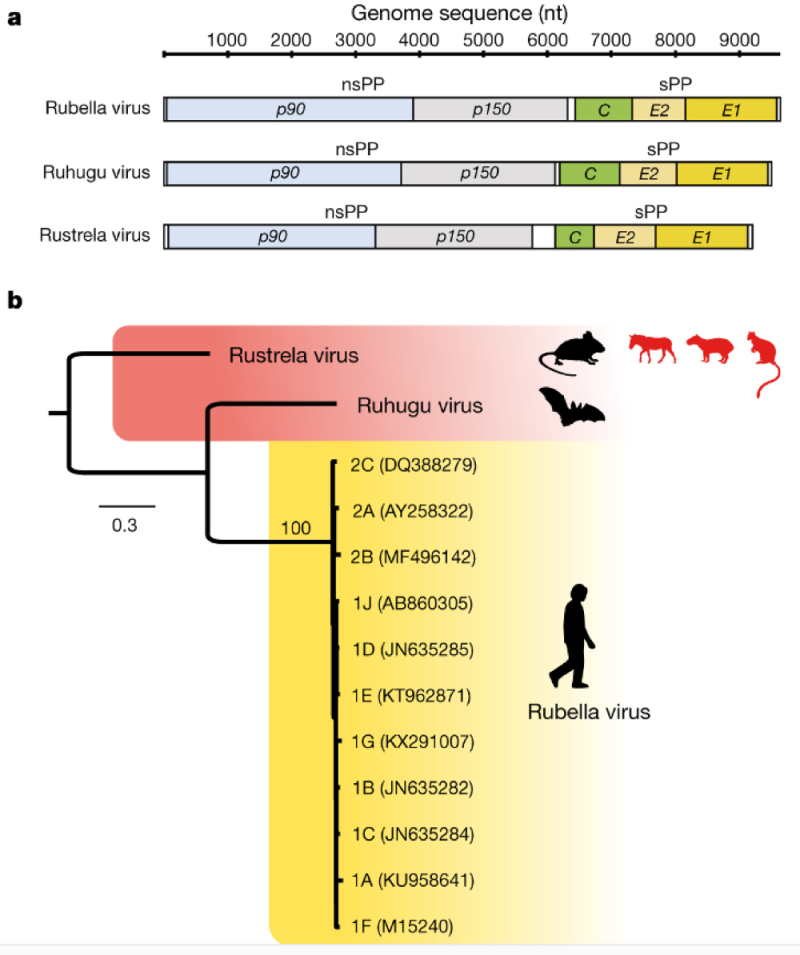
    Recently, an international* team of researchers reported in Nature their finding of viruses related to the Rubella virus (RuV) in a paper entitled "Relatives of rubella virus in diverse mammals," Nature 586: 424-28 (October 7, 2020).  One, named the ruhugu virus (RuhV), was found in "apparently healthy cyclops leaf-nosed bats (Hipposideros cyclops).  The other, a less closely related virus named the rustrela virus (RusV), is endemic in wild yellow-necked field mice (Apodemus flavicollis) in Germany.  This latter virus was also found by these researchers to cause acute encephalitis in placental and marsupial mammals (a donkey, Equus asinus; a capybara, Hydrochoeris hydrochaeris; and a kangaroo, Dendrolagus bennettianus) at a German zoo.

    Genetic analyses showed clear homology of the genetic structure of these viruses, and the evolutionary relationships between them and the rubella virus that causes disease in humans.  The E1 protein of the RuV virus is described as "a receptor-binding, class-II fusion protein, contain[ing] an immune-reactive region (amino acid residue positions 202–283) with immunodominant T cell epitopes and four linear, neutralizing B cell epitopes (NT1–NT4)."  These researchers report that the E1 protein of the RusV and RuhV viruses share this structure and epitope mapping confirms the activity of neutralizing antibodies that block trimerization of this protein, which is necessary for virus fusion with host cell membrane.  Consistent with evolutionary divergence between RuV/RusV and RuhV are two non-conservative amino acid differences in one of the E1 protein fusion loops, disclosed as P134A and T135A.  Nevertheless, these researchers report "regions of marked conservation and stabilizing selection" in certain regions of the viral genomes, consistent with their putative evolutionary relationships.

    While the authors are appropriately cautious in stating that "[t]he implication that RuhV or RusV are zoonotic agents is currently speculative," they also note that "bats and rodents possess biological attributes that predispose them to hosting many zoonotic viruses" and that RusV can infect both placental and marsupial mammals and cause neurological disease that resemble the severe encephalitis cause in infected human infants.

    These observations are also relevant, the authors note, to efforts to eliminate rubella in infection (particularly congenital infections) in humans in the near future.  The possibility of future zoonotic transfer of these related viral species is a prospect that could influence the likelihood of realistically removing this class of viruses from human pathogens, and may in the interim provide a pathway for developing animal models for infection with these viruses.

    Image

    * University of Wisconsin-Madison, WI; Uniformed Services University of the Health Sciences, Bethesda, MD; Leidos, Reston, VA; Fort Detrick, Frederick, MD; Friedrich-Loeffler-Institut, Greifswald-Insel Riems, DE; Food Safety and Fisheries, Rostock, DE

  • By James Lovsin

    Supreme Court SealToday, the Supreme Court granted petitions for a writ of certiorari to review the Federal Circuit's decision in Arthrex, Inc. v. Smith & Nephew, Inc., in which the court of appeals held how administrative patent judges were appointed to the Patent Trial and Appeal Board ("PTAB") violated the Appointments Clause of the Constitution (Art. II, sec. 2, cl. 2).  To prospectively remedy that violation, the court severed a portion of the America Invents Act restricting the way APJs can be removed, and vacated and remanded the PTAB's judgment for a new hearing.  The Federal Circuit denied rehearing, with four judges dissenting.

    The Supreme Court has granted certiorari on two questions that the government argued were common questions across the petitions filed by the petitioner (Smith & Nephew), patent owner (Arthrex), and government:

    1.  Whether, for purposes of the Appointments Clause, U.S. Const. Art. II, § 2, Cl. 2, administrative patent judges of the U.S. Patent and Trademark Office are principal officers who must be appointed by the President with the Senate's advice and consent, or "inferior Officers" whose appointment Congress has permissibly vested in a department head.

    2.  Whether, if administrative patent judges are principal officers, the court of appeals properly cured any Appointments Clause defect in the current statutory scheme prospectively by severing the application of 5 U.S.C. 7513(a) to those judges.

    Notably, the Supreme Court did not grant cert. on the government's third common question, which involved waiver/forfeiture of an appointments clause challenge.  Of course, the Court would not have granted cert. if the Justices thought the appointments issue was waived.

    Merits briefing from Smith & Nephew, Arthrex, and the government will begin on the two granted questions.  There will likely be many briefs from amici.  The Supreme Court has scheduled one hour of oral argument divided between Smith & Nephew, Arthrex, and the government.  A decision in the case is likely expected no later than June 2021.

    Arthrex presents yet another constitutional challenge to the PTAB.  Two years ago, the Supreme Court upheld the constitutionality of IPR proceedings in Oil States v. Greene, holding that IPRs did not violate Article III or the Seventh Amendment.  Justice Gorsuch and Chief Justice Roberts dissented in Oil States and it will be interesting to see if they are persuaded by the appointment clause challenge in this case.  The Justices' views in Supreme Court cases involving judicial review of PTAB rulings (Thryv, SAS, and Cuozzo) may also be worth considering here.  For example, Justice Alito, Justice Sotomayor, and Justice Gorsuch have supported strong judicial review in these cases.

    The Supreme Court's decision in Arthrex could affect pending and future PTAB proceedings.  There are, for example, around 40 PTAB cases in which the Federal Circuit remanded to the PTAB for a new hearing in light of Arthrex.  The government filed a consolidated cert. petition on these cases.  And for its part, the PTO has stayed Arthrex remands until the Supreme Court resolves Arthrex.  These cases will likely sit until after the Supreme Court's decision in Arthrex.

    If the Supreme Court answers the first granted question, yes, APJs are principles officers, the Court will likely address the second granted question, the remedy for the violation.  Some Federal Circuit judges and commentators have argued that the Federal Circuit's remands were unnecessary because judicial severance of the America Invents Act is both prospective and retroactive.  Bedgear v. Fredman Bros (Judges Dyk and Newman concurring opinion); A. Michaels, Arthrex Remands: Treat or Trick? Patently-O (July 19, 2020).  The retroactivity issue was not significantly addressed, if at all, at the cert. stage.  It will be interesting to see if retroactivity is briefed and considered by the Court in the context of the second question.

    If the Supreme Court concludes that Congress needs to remedy how PTAB judges are appointed with legislation, the Court could stay the effect of its ruling.  This would give Congress time to enact such legislation.  The House Subcommittee on Courts, Intellectual Property, and the Internet held a hearing on the appointment of PTAB judges in November 2019.  However, the appointment of PTAB judges may be a low priority for Congress in 2021.

    MBHB will monitor developments in Arthrex.  In the meantime, litigants should carefully consider the potential impact of the Supreme Court's decision in Arthrex on their PTAB proceedings.

  • By Kevin E. Noonan

    Court of Appeals - 3d Cir. SealThe Federal Trade Commission carried out an (in)famous crusade against reverse payment (more provocatively, "pay for delay") settlements in ANDA litigation for almost a decade before eventually having the Supreme Court see things their way (to some extent) in FTC v Actavis.  The Commission has not lost its enthusiasm for such interventions in drug patenting matters but without (so far) overwhelming success.  This pattern is illustrated in the Third Circuit's recent decision in Federal Trade Commission v. AbbVie Inc.

    The Commission's interest arose over Androgel, which the opinion characterizes as a "blockbuster testosterone replacement therapy that generated billions of dollars in sales," the latter characteristic no doubt playing a large part in attracting the FTC's investigation.  The Commission brought suit against AbbVie and related companies under 15 U.S.C. § 53(b) (Section 13(b) of the Federal Trade Commission Act), which provides FTC jurisdiction over false advertisements with provisions for injunctions and restraining orders:

    Power of Commission; jurisdiction of courts

    Whenever the Commission has reason to believe—

    (1) that any person, partnership, or corporation is engaged in, or is about to engage in, the dissemination or the causing of the dissemination of any advertisement in violation of section 52 of this title, and

    (2) that the enjoining thereof pending the issuance of a complaint by the Commission under section 45 of this title, and until such complaint is dismissed by the Commission or set aside by the court on review, or the order of the Commission to cease and desist made thereon has become final within the meaning of section 45 of this title, would be to the interest of the public,

    the Commission by any of its attorneys designated by it for such purpose may bring suit in a district court of the United States or in the United States court of any Territory, to enjoin the dissemination or the causing of the dissemination of such advertisement. Upon proper showing a temporary injunction or restraining order shall be granted without bond. Any suit may be brought where such person, partnership, or corporation resides or transacts business, or wherever venue is proper under section 1391 of title 28. In addition, the court may, if the court determines that the interests of justice require that any other person, partnership, or corporation should be a party in such suit, cause such other person, partnership, or corporation to be added as a party without regard to whether venue is otherwise proper in the district in which the suit is brought. In any suit under this section, process may be served on any person, partnership, or corporation wherever it may be found.

    The basis of the allegations were that defendants filed "sham" patent infringement suits (which seems to be the allegation the FTC makes against any patent infringement or ANDA lawsuit brought by a drug company) against generic drug companies, followed by entering into an "anticompetitive reverse-payment agreement" with one such company (Teva Pharmaceuticals).  (Indeed, Perrigo Co., one of the generic competitors, made that allegation before the District Court.)

    The various parties settled, concomitant with payments from Abbott/AbbVie for "avoided litigation expenses" (a category sanctioned by the Supreme Court's Actavis opinion) and an agreement of a date certain, prior to patent expiration, when the generic competitor could market its Androgel generic drug.  In Teva's case, the Androgel settlement was paired with settlement over another generic drug (brand name TriCor) which permitted Teva to take advantage of a 180-day exclusivity period as first filer, with Abbott being the supplier and being entitled to "the costs of production, an additional percentage of that cost, and a royalty."  (This agreement formed the basis for FTC's allegation of an illegal reverse payment.)

    FTC's complaint recited two counts:

    • Count 1 (Monopolization): that AbbVie and Besins willfully maintained a monopoly through a course of anticompetitive conduct, including sham patent litigation against Teva and Perrigo.

    • Count 2 (Restraint of Trade): that AbbVie restrained trade by entering into an anticompetitive reverse payment agreement with Teva.

    As explained by the Third Circuit, the District Court dismissed FTC's complaint as to the reverse payment liability theory but permitted the case to move forward on the sham patent allegation.  Thereafter, the District Court held for FTC on both prongs of the sham litigation theory (i.e., that AbbVie had monopoly power in the relevant market and the sham litigation was willfully acquired or maintained by that litigation) and entered judgment requiring AbbVie (and co-defendant Besins) to disgorge $448 million in "ill-gotten profits" but declined to enter an injunction.  This appeal (by FTC, AbbVie and Besins) followed.

    The Third Circuit held that the District Court erred in rejecting the reverse-payment theory and concluding that litigation against Teva was a sham.  The District Court did not err, according to the Third Circuit, in concluding that litigation against another generic company, Perrigo, was a sham, that defendants had monopoly power in the relevant market, or in denying FTC's request for an injunction.  The Court also held that the FTC had overstepped its authority in seeking disgorgement, because Section 13(b) of the FTC Act contained no provision authorizing this remedy, thus forestalling any remedy against defendants unless the district court found antitrust liability on the reverse payment theory on remand.

    With regard to the reverse payment allegation, the Court set forth its understanding of the fact pattern supporting such an allegation:

    "Company A sues Company B for patent infringement.  The two companies settle under terms that require (1) Company B, the claimed infringer, not to produce the patented product until the patent's term expires, and (2) Company A, the patentee, to pay B many millions of dollars" citing Actavis.

    The Court's basis of finding anticompetitive behavior under these circumstances was that "Company B might have prevailed by proving Company A's patent invalid.  Even if the patent were valid, Company B might prevail by showing it did not infringe.  In either case, generic drugs would have entered the market before Company A's patent was set to expire, and consumers would have benefited from lower drug prices."

    The lack of a bright line set forth in Actavis by the Supreme Court (which also involved Androgel) was the basis for the Court's reversing and remanding the District Court's grant of defendants' motion to dismiss.  And the opinion asserted that the Third Circuit's decision here was consistent with other cases decide by the Court, including King Drug Co. of Florence, Inc. v. SmithKline Beecham Corp., 791 F.3d 388 (3d Cir. 2015) (no authorized generic), In re Wellbutrin XL Antitrust Litig. Indirect Purchaser Class, 868 F.3d 132 (3d Cir. 2017), and In re Lipitor Antitrust Litig., 868 F.3d 231 (3d Cir. 2017) (settling a related claim for much less than it was objectively worth on one drug and a "no authorized generic" agreement on another).  From these cases the Third Circuit recognized two principles set forth in this opinion:

    • First, a reverse payment's legality depends mainly on its economic substance, not its form.

    • The second principle . . . is that the law of pleading applies to reverse-payment theories. [Specifically, i]f a plaintiff plausibly alleges that an agreement's anticompetitive effects outweigh its procompetitive virtues, the district court must accept that allegation and allow the plaintiff to take discovery.

    The Third Circuit's application of these principles led it to reverse the District Court's dismissal of FTC's reverse payment theory in their complaint, because "FTC plausibly alleged an anticompetitive reverse payment."  Although filing the putatively sham lawsuits engaged the 30-month delay in FDA approval provided by the Hatch-Waxman Act, FTC alleged the AbbVie and Besins were fearful that Teva would prevail and thus "turned to other ways to preserve their monopoly."  Under the terms of this agreement, the Third Circuit held that the "payment" to Teva (specifically, being permitted to bring its TriCor generic on the market) was "plausibly 'large'" due to inter alia its 180-day exclusivity as first filer.  (As it turns out, according to the opinion, Teva's actual sales were much higher than predicted and "far exceed[ed] the litigation costs that [any of the parties] saved by settling"; this analysis adds not a little hindsight to a determination that is usually grounded in the parties' expectations in determining whether there was antitrust intention in the agreement).  These agreements were also "plausibly 'unjustified," in the Third Circuit's view, on the basis that FTC alleged the TriCor arrangement "'cannot be explained as an independent business deal from Abbott's perspective'" (presuming that FTC has any basis for determining Abbott's perspective).  Thereafter the opinion cites a litany of such putatively "highly unusual" aspects of the agreements.  Finally, the opinion asserts that "it is plausible that the anticompetitive effects of AbbVie's settlement with Teva outweighed any procompetitive virtues of the TriCor deal" (which is a calculation FTC is entitled to assert as part of an antitrust allegation), citing similar considerations in its King Drug opinion.  The Third Circuit critiqued the District Court's grounds for finding that FTC had not plead an antitrust violation, finding it wanting at least as being inconsistent with King Drug in limiting its determination to the absence of a large cash payment from AbbVie/Besins to Teva.  And the Third Circuit found the District Court's lack of consideration of the supply arrangement between Teva and AbbVie/Besins for antitrust purposes to be inconsistent with its Lipitor decision, if only because a proper determination of such an agreement's compliance with antitrust principles requires "'factual assessments, economic calculations, and expert analysis that are inappropriate at the pleading stage.'"  The opinion was also critical of the District Court finding that the agreement was procompetitive as a matter of law, but the Third Circuit was careful not to come to any decision on whether the District Court had "correctly concluded the TriCor deal was procompetitive," leaving the question of where the balance will be struck on pro- and anticompetitive effects of these agreements to be decided on remand.

    The basis of the Third Circuit's decisions that AbbVie's assertion of its patents in ANDA litigation was (Perrigo) or was not (Teva) a sham were grounded in the Noerr-Pennington doctrine (i.e., that antitrust liability was not raised when a party petitioned the government for redress), recognizing the standard for exceptions to this immunity.  Specifically, the opinion noted that the Supreme Court has recognized two prongs for determining an exception:

    First, the lawsuit must be objectively baseless in the sense that no reasonable litigant could realistically expect success on the merits.  If an objective litigant could conclude that the suit is reasonably calculated to elicit a favorable outcome, the suit is immunized under Noerr, and an antitrust claim premised on the sham exception must fail.  Only if challenged litigation is objectively meritless may a court examine the litigant's subjective motivation.  Under this second part of our definition of sham, the court should focus on whether the baseless lawsuit conceals an attempt to interfere directly with the business relationships of a competitor through the use of the governmental process—as opposed to the outcome of that process—as an anticompetitive weapon.  This two-tiered process requires the plaintiff to disprove the challenged lawsuit's legal viability before the court will entertain evidence of the suit's economic viability (emphasis in opinion.)

    The Court noted that the statutory nature of an ANDA litigation mitigates against a determination that a litigation is a sham (although the 30-month stay mitigates in a generic company's favor as being "a collateral injury" as an "anticompetitive weapon" an NDA holder can use regardless of whether there is a good faith basis that the generic drug infringes any Orange Book-listed patent).  Regarding the District Court's basis for deciding the Teva litigation was not objectively baseless, the opinion found that it was not objectively baseless for AbbVie to assert infringement under the doctrine of equivalents based on the amendment's "tangential relationship" to prosecution history estoppel with regard to the penetration enhancers specified by AbbVie/Besins' patents and Teva's accused infringing formulation.

    On the other hand, this tangential relationship rationale did not convince the Third Circuit in the Perrigo litigation, because there "[n]o reasonable litigant in AbbVie and Besins's position would believe it had a chance of winning on these arguments."  The opinion rejected AbbVie/Besins's argument that the voluntary nature of the amendment avoids prosecution history estoppel, correctly noting that the Federal Circuit has rejected the argument that voluntary amendments have any less effect in supporting the estoppel than involuntary ones (i.e., ones made for reasons of patentability), citing Festo Corp. v. Shoketsu Kinzoku Kogyo Kabushiki Co., 344 F.3d 1359 (Fed. Cir. 2003).  Nor was it effective for AbbVie/Besins to argue that such amendments were made to expedite prosecution, citing Biogen, Inc. v. Berlex Labs., Inc., 318 F.3d 1132 (Fed. Cir. 2003) (and providing a cautionary tale for prosecutors who make such statements routinely, at least with regard to the estoppel-producing effects of such amendments).

    Having satisfied the objectively baseless prong of the sham litigation test, the opinion then reviewed whether AbbVie/Besins's suit met the subjective motivation prong.  In this regard the Third Circuit reviewed with approval the logical syllogism used by the District Court:

    (1) A lawsuit is objectively baseless if "no reasonable litigant could realistically expect success on the merits," . . . (2) and a litigant who files an objectively baseless lawsuit must have had some subjective motivation for suing; (3) but because the lawsuit was objectively baseless, the litigant's subjective motivation could not have been success on the merits, unless the litigant was unreasonable; (4) thus, a reasonable litigant's subjective motivation for filing an objectively baseless lawsuit must be something besides success on the merits.

    As applied to this case, the District Court:

    [F]irst held that AbbVie and Besins's lawsuits were objectively baseless.  It then reasoned that because AbbVie and Besins's decisionmakers were all very experienced patent attorneys who had reviewed Perrigo's paragraph IV notices and consulted outside counsel, they knew the lawsuits were baseless.  Finally, it reasoned that because the decisionmakers knew the lawsuits were baseless, they must have been motivated by something other than success on the merits.

    (although there appears to be a circularity in this reasoning that approaches the tautological).  The opinion also credited the Hatch-Waxman-mandated 30-month stay as being sufficient motivation to satisfy (under the right circumstances) the subjectively baseless prong of the test.

    The discussion in the opinion of monopoly power was unremarkable, in view of the interactions between the regulatory regime and the Orange Book patents listed in support of AbbVie/Besins's NDA ("a generic drug has significant capital, technical, regulatory, and legal barriers to overcome").  Also relevant was AbbVie's commercial behavior regarding price in the marketplace, specifically the ability to raise prices consistently despite the existence of cheaper (albeit somewhat less desirable) alternatives, i.e., injectable formulations.

    It was the Third Circuit's decision on remedies that was (for now) most significant, absolving (for now) AbbVie from disgorging almost $500 million as a penalty.  The error, according to the Third Circuit, was that the section of the FTC Act relied upon by the Commission in bringing suit does not give FTC the authority to order such disgorgement.  The Court based its decision on a review of the legal authority underlying FTC's enforcement capabilities and finding no indication that Congress gave FTC the authority under Section 13(b) it claims in this case.  And the wording of Section 13(b) was unambiguous to the Court in limiting FTC to seeking injunctive relief only in cases where an antitrust violation is imminent or ongoing, neither circumstance arising here.  While the opinion conceded that courts in sister circuits have permitted FTC to pursue and obtain disgorgement under Section 13(b) this court founds such outcomes not to be supported by the plain meaning of the statute nor an understanding of the operation of the Section in the context of the statute as a whole.

    Finally, the Third Circuit affirmed the District Court's denial of the injunctions sought by FTC as not being an abuse of discretion.  The standard for granting FTC an injunction relied upon by the Court is that "there is 'cognizable danger of recurrent violation, something more than the mere possibility which serves to keep the case alive,'" citing United States v. W.T. Grant Co., 345 U.S. 629, 633 (1953).  Those circumstances did not exist here given the nature of the underlying litigation, according to the Third Circuit.

    While the case is remanded, giving FTC another opportunity to obtain an injunction, and proceedings on remand will include trial on whether Counts 1 and 2, one judgment that survived appeal was the District Court's finding that AbbVie/Besins were liable for monopolization under Count 1 for bringing a sham litigation against Perrigo.  What penalty FTC can successfully extract from these defendants will be determined on remand and could form the basis for a settlement, especially should the possibility of a successful disgorgement request on grounds other than Section 13(b) be made by FTC.

    Federal Trade Commission v. AbbVie Inc. (3d Cir. 2020)
    Panel: Circuit Judges Hardiman, Porter, and Phipps
    Opinion by Circuit Judge Hardiman

  • By Michael Borella

    USPTO SealLast year, the U.S. Patent and Trademark Office (USPTO) issued a request for comments (RFC) on patenting artificial intelligence (AI) based inventions.  Topics of the RFC included AI's impact on inventorship and ownership, patent eligibility, disclosure, prior art, and the level of ordinary skill in the art.  The USPTO received 99 comments from a variety of stakeholders.  In parallel to that effort, the USPTO also released a second RFC related to the impact of AI on copyright, trademark, database protections, and trade secret law.  Stakeholders provided a similar number of comments.

    With this feedback in hand, the USPTO collated it into a 56-page report.  This article focuses on issues related to the drafting and prosecution of AI-related patent applications.  Readers are encouraged to read the rest of the report to obtain the USPTO's summary of the remaining issues.

    The report begins with a high level overview that can be expressed as three main points:

    1.  Most commenters agreed that AI-based inventions are a subset of computer-implemented software inventions, and thus the current framework for examining such inventions is suitable for examining AI-based inventions.  Still, some commenters exhibited concern that it may be difficult to meet the requirements of 35 U.S.C. § 112(a) for certain AI-based inventions.

    2.  Most commenters agreed that AI may lead to changes in how the standard of a person of ordinary skill in the art (POSITA) is interpreted.

    3.  There were some concerns that AI would lead to a proliferation of prior art making it difficult for examiners to conduct searches for relevant prior art.

    A brief list of issues of note follows.

    Definitions

    Interestingly, there was no clear consensus on what constitutes an AI-based invention.  Of the definitions provided, the one that seems to be the most helpful (in my subjective opinion) states that:

    AI inventions can be categorized (in no particular order) as follows:

    (a) inventions that embody an advance in the field of AI (e.g., a new neural network structure of an improved machine learning (ML) model or algorithm)

    (b) inventions that apply AI (to a field other than AI)

    (c) inventions that may be produced by AI itself.

    Patent Eligibility

    As noted, the consensus is that, as a special form of computer-implemented invention, AI-based inventions can be fairly evaluated under the current patent-eligibility of 35 U.S.C. § 101 as interpreted by the courts.  Some commenters indicated that AI-based inventions could be characterized as falling into the abstract idea subject matter exception, as a method of organizing human activity, a mental process, or a mathematical concept.  But to the extent that these inventions provide technological improvements and "amount to significantly more than the abstract idea," they would be found to pass through the § 101 filter.

    Indeed, this approach is consistent with the Supreme Court's refusal to draw a line between what is and is not eligible.  Each invention is to be considered on its own merits, and there are no "magic words" or drafting techniques that can be used to guarantee a claim is eligible.

    Written Description and Enablement

    While many commenters did not believe that AI-based inventions had any special written description requirements, one commenter stated that "AI inventions can be difficult to fully disclose because even though the input and output may be known by the inventor, the logic in between is in some respects unknown."  This is true, in the sense that a learning model can be viewed as a "black box" that receives input (e.g., words or images) and produces output (e.g., a classification).  One can view the constituent elements that make up the model (e.g., nodes, connections, and weights), but these elements can number in the millions.  As a consequence, they cannot be used to concisely characterize the invention, nor should they as the specific values of weights can be different each time the model is trained.

    Regarding enablement, the USPTO notes that "the amount of guidance or direction needed in the specification to enable the invention is inversely related to the amount of knowledge in the state of the art, as well as the predictability in the art."  But there is no clear understanding of the predictability of AI systems.  Some contain an inherent amount of intentional randomness that allow these systems to produce superior results when compared to more deterministic systems.  Others may be predictable if their training data and training technique is fixed.

    One possible way of addressing both of these concerns is to allow AI models that involve machine learning to meet the written description and enablement requirements with proper specification of how the models can be trained.  If, from the specification, a POSITA can glean enough knowledge to reasonably reproduce the training technique with their own data, the invention is likely to be well-described and enabled.

    Level of Ordinary Skill in the Art

    While the ubiquity of AI may impact the level of ordinary skill in the art, commenters seems to agree that the present legal framework is "adequate to determine the impact of AI-based tools in a given field."  As the level of skill in the art generally increases over time, use of AI-based tools would be just another way for the level of skill to rise, albeit at a potentially faster rate than what we have seen in the past.

    Prior Art Considerations

    While most commenters believed that there are no specific concerns regarding prior art and AI-based inventions, some indicated that AI itself may be used to generate massive amounts of prior art that would be challenging to thoroughly search.  Others pointed out that prior art unique to AI may eventually exist as AI systems evolve toward more general intelligence.  A key to these considerations would be proper examiner training.

    Data Protection

    A critical component of AI goes beyond the algorithms and models, and is embodied in the data sets that the algorithms use to train the models.  Currently, such data sets have relatively weak protection (mostly in the realm of trade secret law).  Some commenters would like to have provisions that allow incumbent companies to maintain proprietary rights over data sets that they have collected, while still allowing newcomers to use these data sets to train their own models.

    Examination

    There were suggestions that the USPTO coordinate with the world's other patent offices when considering its approach to AI-based inventions.  Of note was that the Japan Patent Office and Korean Intellectual Property Office have established specific and dedicated AI examination units.  Further, the Intellectual Property Office of Singapore has "reportedly created an expedited examination path for AI technologies."

  • CalendarOctober 13, 2020 – "An In-House Counsel’s Guide to Product Clearance: Best Practices in Freedoms-to-Operate, Landscaping and Opinions of Counsel" (McDonnell Boehnen Hulbert & Berghoff LLP) – 10:00 am to 11:15 am (CT)

    October 13, 2020 – "Preparing & Prosecuting Patents That Stand Up To Challenge" (LexisNexis IP and IPWatchdog) – 12:00 pm (ET)

    October 15, 2020 – "Myths of Litigated Patents" (LexisNexis IP and IPWatchdog) – 12:00 pm (ET)

    November 9-10, 2020 – Summit on Life Sciences IP Due Diligence (American Conference Institute) – virtual conference

  • ACIAmerican Conference Institute (ACI) will be holding its 4th Annual Summit on Life Sciences IP Due Diligence on November 9-10 as a VIRTUAL conference.

    The conference will begin with a Pre-Conference Primer at 8:00 am Monday, November 9th, entitled "Life Science Due Diligence 101 – Preparing Your Due Diligence Checklist and Managing the Process from Soup to Nuts."

    The conference will offer presentations on:

    • Evaluating COVID-19's Impact on Biopharma Deal Making and Valuation of IP Assets
    Conducting Due Diligence in the Age of "Six Feet Apart": Strategies for Performing a Robust Virtual/Remote IP Due Diligence Review
    Unique IP Due Diligence Considerations for Medical Devices, MedTech, and Artificial Intelligence
    Mitigating International Legal Risk: IP Due Diligence Considerations for Global Deals
     
    Assessing the Intricacies of Deal-Related IP Valuation
    An Interactive Interview with a Private Equity Expert and Venture Capitalist on the Ins and Outs of Securing Funding for Life Sciences Companies
    Understanding the Impact of New Developments at FDA on the IP Due Diligence Review Process
    "War Stories" on Due Diligence Gone Wrong: When Defective IP Due Diligence Wrecks the Deal
    Interactive Ethics Lab on Overcoming Common Challenges and Ethical Dilemmas in Life Sciences IP Due Diligence

    The conference will also offer an interactive case study focusing on "Avoiding Missteps When Conducting IP Due Diligence in Connection with Distressed Companies and Distressed Assets" and "Uncovering Red Flags in IP Ownership and Solving Conundrums Caused by Government Funding Initiatives on IP Rights and Evaluation."

    There will be a Post-Conference Workshop entitled "Freedom to Operate BootCamp: A Comprehensive Tactical Guide to Mastering the FTO Search" starting at 2:15 pm on November 10th.

    A complete brochure for this conference, including an agenda, detailed descriptions of conference sessions, list of speakers, and registration form can be obtained here.

    The registration fee is $1,795 (registered and paid by November 8th).  The Pre-Conference Primer is priced at $195 and the Post-Conference Workshop is $295; the registration fee for the combination of Virtual conference and workshop is $2,085.  Patent Docs readers are entitled to a 10% discount off of registration using discount code D10-657-657JX01.  Those interested in registering for the conference can do so here, by e-mailing CustomerService@AmericanConference.com, or by calling 1-888-224-2480.

    Patent Docs is a media partner of ACI's 4th Annual Summit on Life Sciences IP Due Diligence.