• By Kevin E. Noonan —

    ToolGenSenior Party ToolGen Inc. has filed a protective order in each of Interference Nos. 106,126 (naming as Junior Party the Broad Institute, Massachusetts Institute of Technology, and Harvard University) and 106,127 (naming as Junior Party University of California/Berkeley, University of Vienna, and Emmanuelle Charpentier, collectively "CVC") ('126 protective order and '127 protective order).  The protective orders, patterned after the one entered by the Board for CVC in Interference No. 106,115 as Junior Party, protect from public disclosure ToolGen's priority statement until such time (if ever) that either of these interferences enter the Priority Phase (likely to be late this year).

    Each Protective Order requires that confidential information be labeled "PROTECTIVE ORDER MATERIAL" and that disclosure be limited to the Parties (including, for CVC: Caribou Biosciences, Inc.; Intellia Therapeutics, Inc.; CRISPR Therapeutics AG; ERS Genomics Ltd.; TRACR Hematology Ltd., and Howard Hughes Medical Institute, and for Broad: The United States Government (National Institute of Health (NIH)); and Editas Medicine, Inc.), their in-house counsel and their representatives; expert witnesses, under the proviso that such an expert is not "a competitor to any party, or a consultant for, or employed by, such a competitor with respect to the subject matter of the proceeding; and 'other employees,'" which expressly include anyone not otherwise expressly set forth in the Order, provided that they sign an undertaking agreeing therein to keep confidential whatever they learn know about ToolGen's priority statements and the factual predicates thereof.  ToolGen can oppose such disclosure but bears the burden of showing why the Board should restrict any such individual from access.  Also encompassed in the Protective Order are Office personnel and their staff, all of which are burdened by the same confidentiality provisions.

    These confidentiality restrictions govern what efforts at maintaining confidentiality are required for all encompassed by the Order.  Also, any submissions for which confidentiality should be maintained under the Order should be filed/served in redacted and non-confidential versions, with any redacted version having filed therewith a Motion to Seal, justifying the grounds for seal under the protective order.  The documents will remain sealed unless, "upon motion of a party and after a hearing on the issue, or sua sponte, the Board determines that some or all of the redacted information does not qualify for confidential treatment."

    Each Protective Order contains a document entitled a "Standard Acknowledgment for Access to Protective Order Material" that anyone obtaining access to such materials shall be compelled to sign to get access.                                                                                                     

  • By Donald Zuhn —

    Leahy  PatrickIn a letter sent to President Joseph Biden at the end of March, Sen. Patrick Leahy (D-VT), Chairman of the Senate Subcommittee on Intellectual Property, and Sen. Thom Tillis (R-NC), Ranking Member of the Subcommittee on Intellectual Property, asked the President to "prioritize the appointment of intellectual property officials within the Executive Branch over the coming weeks."

    Tillis  ThomSenators Leahy (at right) and Tillis (at left) note that "[e]nsuring that the intellectual property of creative artists, inventors and small businesses is meaningfully protected" constitutes a top priority for them, and point out that IP-intensive industries account for 45 million jobs and more than 38 percent of U.S. GDP.  Recognizing the importance of IP to the Nation's culture and economy, the Senators ask the President to "move expeditiously to fill key Executive Branch positions that promote and protect intellectual property rights at home and abroad."  Among those key positions for the Senators are the Under Secretary of Commerce for Intellectual Property and Director of the U.S. Patent and Trademark Office, the Intellectual Property Enforcement Coordinator, and the Chief Innovation and Intellectual Property Negotiator within the Office of the U.S. Trade Representative.

    The Senators close their letter by indicating that "IP-intensive industries are poised to continue to be an engine for growth," especially in view of the damage to the economy caused by the coronavirus, and expressing their commitment to with the President and his Administration "to swiftly confirm qualified nominees for these critical positions."

    President Biden's selection for Secretary of Commerce, former Rhode Island Governor Gina Raimondo, was confirmed by the Senate on March 2, 2021.  The Administration has yet to nominate an Under Secretary of Commerce for Intellectual Property.

  • By Kevin E. Noonan —

    University of California-BerkleyLast December, Junior Party University of California/Berkeley, the University of Vienna, and Emmanuelle Charpentier (hereinafter, "CVC") filed its Substantive Motion No. 3 under 37 C.F.R. § 41.121(a)(1) asking for judgment of unpatentability for all claims in interference under 35 U.S.C. § 102(f) or (if post-AIA) 35 U.S.C. § 115(a) for "failure to name all inventors of the alleged invention" against Senior Party The Broad Institute, Massachusetts Institute of Technology, and Harvard University (hereinafter, "Broad") in Interference No. 106,115.  Recently, Broad filed its opposition to this motion.  At the time, Broad filed a responsive motion asking for leave to correct inventorship, and CVC recently filed its motion opposing Broad's attempt to effect a post hoc inventorship correction, the details of which are set forth herein.

    CVC begins its opposition brief by asserting that Broad has not established that it is entitled to this relief, as required under 37 C.F.R. § 41.121(b).  The basis of this argument comes first from the language of the statutes — 35 U.S.C. §§ 116 and 256 — permitting inventorship correction.  This language requires an applicant or patentee, respectively, provide proof of the facts surrounding the change and an identification of the inventors who should properly be named ("on application of all the parties and assignees, with proof of the facts and such other requirements as may be imposed").  Second, CVC argues that Broad did not provide consent for one of the individual — Shauiliang Lin — to be added as an inventor.  Third, CVC alleges that the motion is barred by laches and submitted in bad faith.  And finally, CVC argues that as a matter of jurisdiction the Director — not the Board — has sole authority to change inventorship and that there is no evidence that the Director has delegated this authority to the Board.

    CVC's first argument is a matter of applying the statutory requirements to Broad's motion.  CVC argues that Broad's motion is defective because the motion represents that all that is needed is to pay the appropriate fee and name the proper inventors.  This ignores the requirements set forth in the statutory language quoted above, according to CVC, citing Loken-Flack, LLC v. Novozymes Bioag, A/S, No. 105,996, 2015 BL 165619, *2-3 (P.T.A.B. May 27, 2015).  CVC asserts that Broad's motion is devoid of any evidence regarding the contribution the newly named individuals made to the claimed invention.  Because Broad as movant has the burden of showing it Is entitled to the relief requested under 37 C.F.R. § 41.121(b), CVC maintains that Broad needs to "explain how each (currently unidentified) person contributed to the conception of at least one claim of each of Broad's involved patents and application" and "provide evidence to support those assertions," citing Henkel Corp. v. Proctor & Gamble Co., No. 105,174, 2008 WL 5783337, at *20-25 (B.P.A.I. Mar. 28, 2008).  Moreover, CVC notes that Broad contends in its motion that it need not concede that inventorship is incorrect, which puts Broad in "the untenable position of, on the one hand, arguing that inventorship is correct and, on the other, having to affirmatively set forth why inventorship should be corrected," a situation of Broad's own making according to the brief.  And Broad's reliance on precedent is unavailing according to CVC because the circumstances here differ from those in that cited precedent.  CVC argues that while "Broad appears to believe that if CVC wins its motion on incorrect inventorship, then Broad automatically meets its burden to correct inventorship," this is an incorrect reading of the statute and precedent, due to "binding concessions" made with regard to statements presented to the European Patent Office under declaration in a related application.

    CVC's arguments regarding putative inventor Lin are straightforward, to the extent that the statute requires "all parties" to apply for the correction, citing Iowa State Univ. Research Found., Inc. v. Sperry Rand Corp., 444 F.2d 406, 410 (4th Cir. 1971), for the proposition that "when the Commissioner is asked to correct innocent errors of misjoinder or nonjoinder, all parties must apply for relief to comply with the requirements of the first and second paragraphs of § 256."  CVC further argues that the PTAB cannot waive this requirement, citing Chien Ming Huang v. Tzu Wei Chen Food Co., 849 F.2d 1458, 1460 (Fed. Cir. 1988).

    CVC's laches argument is based on the time — 8 years — between Broad's motion and when the "error" in inventorship arose (2013, when the Broad conducted "inventorship studies" on the patents in interference).  CVC asserts that the Board can impose laches as an equitable sanction under In re Stephen B. Bogese II, 303 F. 3d 1362 (Fed. Cir. 2002).  CVC also characterizes Broad's failure to correct inventorship in 2013 as "unreasonable behavior" supporting its resort to laches.  Broad's failure to effect the change in inventorship eight years ago that its motion seeks (improperly) from the PTAB now is the basis of CVC's bad faith allegation, alleging specifically that "to achieve a strategic advantage—and without any excuse—Broad ignored this knowledge" for the need to correct inventorship (although CVC does not set forth what "strategic advantage" Broad sought to achieve thereby).  CVC also disputes Broad's assertion that its intent is not at issue, stating that "[t]he intent of an interference party seeking a change of inventorship in the middle of the priority phase after submitting its priority brief is highly relevant" and "[g]iven the consequences such a change may have, the candor with which that change is solicited is paramount."  Directly seeking recourse to the duty of candor under 37 C.F.R. § 1.56, CVC asserts that:

    In the face of evidence that Broad intentionally misidentified the inventors of its involved patents and applications, as demonstrated by its own attorney's sworn declaration, and pursuant to the Federal Circuit's suggestion in Stark[v. Advanced Magnetics, Inc., 119 F.3d 1551, 1555 (Fed. Cir. 1997)], the PTAB should address whether there was bad faith in the original inventorship determination and deny Broad's motion.

    Finally, the brief asserts its jurisdictional argument that the Board is not competent to grant Broad's motion because that authority resides in the Director.  Citing Honeywell Int'l Inc. v. Arkema Inc., 939 F.3d 1345, 1349 (Fed. Cir. 2019) (which CVC concedes may be merely informative if not controlling), the brief argues that the proper procedural process would be for Broad to "(1) seek the Board's authorization to file a motion; (2) file the authorized motion, asking the Board to cede its exclusive jurisdiction to permit the Director's consideration of a certificate; and, (3) if the motion is granted, ask the Director to issue a certificate" (the Director then deciding whether to grant the certificate).Which of course Broad has not done.

    Broad has its opportunity to reply on April 19, 2021.

  • CalendarApril 14, 2021 – "Protecting Software Related to a Medical Device: A Case Law Review & Strategy" (Intellectual Property Owners Association) – 2:00 pm to 3:00 pm (ET).

    April 15, 2021 – "Patenting Antibody Pharmaceuticals at the EPO" (J A Kemp) – 2:30 to 3:30 pm BST (British Summer Time)

    April 15, 2021 – "Appellate Perspectives" (Federal Circuit Bar Association) – 1:00 to 2:00 pm (ET)

    April 16, 2020 – "Strategies for Federal Circuit, District Court, ITC, and PTAB" (UIC John Marshall Law School Center for Intellectual Property, Information & Privacy Law) – 7:40 am to 3:15 pm

    April 26-27, 2021 – Paragraph IV Disputes Conference (American Conference Institute)

  • Federal Circuit Bar Association_2The Federal Circuit Bar Association (FCBA) will be offering a remote program entitled "Appellate Perspectives" on April 15, 2021 from 1:00 to 2:00 pm (ET).  Nicholas Groombridge of Paul, Weiss, Rifkind, Wharton & Garrison LLP will moderate a panel consisting of Hon. Timothy Dyk, Circuit Judge, U.S. Court of Appeals for the Federal Circuit; Hon. Kathleen O'Malley, Circuit Judge, U.S. Court of Appeals for the Federal Circuit; Hon. Jimmie Reyna, Circuit Judge, U.S. Court of Appeals for the Federal Circuit; Hon. Klaus Bacher, Presiding Judge, 10th Civil Senate, Bundesgerichtshof (Germon Federal Court of Justice, FCJ); and Hon. Peter Meier-Beck, Presiding Judge, Antitrust Senate, Bundesgerichtshof (Germon Federal Court of Justice, FCJ).

    There is no registration fee for FCBA and EPLAW members and the registration for non-members is $75.  Additional information regarding the program can be found here.

  • IPO #2The Intellectual Property Owners Association (IPO) will offer a one-hour webinar entitled "Protecting Software Related to a Medical Device: A Case Law Review & Strategy" on April 14, 2021 from 2:00 pm to 3:00 pm (ET).  Christopher George of Hanley, Flight & Zimmerman, LLC; John Kind of Fenwick & West LLP; Jonathan Kwok of Hewlett Packard Enterprise; Ishir Mehta of Cantor Colburn LLP; and Ryan Phelan of Marshall, Gerstein & Borun LLP will review recent case law relating to software-related medical patents and provide strategy tips for preparing and prosecuting patent applications involving such technologies.

    The registration fee for the webinar is $150 for non-members or free for IPO members (government and academic rates are available upon request).  Those interested in registering for the webinar can do so here.

  • J A KempJ A Kemp will be offering a webinar entitled "Patenting Antibody Pharmaceuticals at the EPO" on April 15, 2021 from 2:30 to 3:30 pm BST (British Summer Time).  Vicki Allen and Andrew Bentham of J A Kemp will explore the basic principles of patenting of antibodies, and highlight recent trends in examination and strategies for drafting new cases and for addressing objections to existing applications.  The webinar will address the following topics:

    • Can broad antibody claims still be obtained?
    • Writing robust claims around specific antibody drug candidates
    • Inventive step when the target is known
    • What data to provide to support inventive step
    • USPTO and EPO practice: divergent or convergent?
    • Epitope/competition claims, combinations/cocktails, bispecifics and other non-traditional binder formats
    • Other routes to patentability

    Those wishing to register can do so here.

  • By Kevin E. Noonan —

    Rothschild's GiraffeThe giraffe is the tallest extant terrestrial animal, and its iconic long neck (6 feet) provides advantages for foraging for food and detecting predators on the veldt over long distances.  As a consequence, however, the giraffe has a blood pressure two-fold higher than other ruminant animals needed to bring blood to the brain that is so far away from the animal's heart.

    An earlier (2016) study of giraffe genome and genome of the related okapi (Okapia johnstoni) was not optimal, being restricted to 17,210 genes identified by comparison to cattle (Bos taurus) genome.  Last Wednesday, a team of Chinese and Norse scientists published a paper entitled "A towering genome: Experimentally validated adaptations to high blood pressure and extreme stature in the giraffe," in Science Advances.  In this paper, the authors described their work on Rothschild's giraffe (Giraffa camelopardalis rothschildi), which provided a higher "completeness" for this genome than previous studies.  The analysis provided the sequence of a 2.44 Gb assembly covering about 98% of giraffe genomic DNA.  Using comparisons with genomic DNA of cattle, goat, and okapi (with sperm whale as "outgroup"), the authors reported an assemblage of a putative common ancestor between giraffe and cattle; this resulted in a prediction of an evolutionary history of 4 chromosome fissions and 17 fusions that has resulted in the 15 haploid chromosome complement of modern giraffes (albeit admitting the need for further analysis to understand the significance of this result).

    In this chromosomal complement these researchers discerned 101 genes under positive selection and 359 undergoing "rapid evolution," related to growth and development, nervous and visual systems, circadian rhythm, and blood pressure regulation.  One gene in particular was the focus this research:  the giraffe fibroblast growth factor receptor-like protein 1 (FGFRL1) gene was found to have seven non-synonymous mutations affecting the FGF binding domain, the most in any genetic sequence comparison to other ruminant mammals.  This gene was known to be involved in bone mineral density and hypertension resistance (thought to permit blood flow to the heights the giraffe's neck requires).  To investigate the relevance of these mutations to giraffe physiology, the researchers used CRISPR-Cas9 to introduce these mutations into the mouse FGFRL1 gene.  The resulting phenotype in these mice was found to be resistant to treatment with a high blood pressure-inducing drug (angiotensin II) while showing no developmental changes in cardiac structure; wildtype mice showed "significantly increased blood pressure" as a result of drug treatment.  These genetically altered mice also displayed significantly higher bone density as adults, with skeletal hypoplasia immediately postnatally.  Otherwise no deleterious effects were noted in these mice.  Together these results suggested these mutations could be responsible, at least in part, for the giraffe's characteristic long-necked phenotype.

    This genetic research also detected differences in genes involving cardiac development, blood vessel characteristics and increased glomerular filtration rate in giraffe kidney, as well as genes involved in platelet function (including the phosphatidylinositol metabolism genes PIP4K2A, ISYNA1, MTMR3, CDS1, and INPP1) and ion transport related to cardiac contraction.

    With regard to genetic adaptation of sensory genes (important for an herbivorous ungulate subject to predation by, inter alia, lions), these researchers found differences in genes related to eye development, vision, hearing, and balance.  Like other ruminants, giraffes have only two opsin genes, suggesting the absence of trichromatic color vision.  Perhaps curiously, the giraffe genome has lost 53 olfactory-related genes compared with the opaki, due to segmental deletion of sets of genes spatially clustered in the opaki genome, which these researchers speculated was a sensory "tradeoff" with their increased visual acuity.

    Giraffes are known to have sleep durations among the lowest of all mammals.  Consistent with this phenotype circadian rhythm genes are altered in giraffes, particularly having a translation stop codon in the PER1 gene involved in circadian rhythm maintenance.

    These researchers conclude their paper saying:

    Overall, these results show that pleiotropy is a plausible mechanism for contributing to the suite of co-adaptations necessary in the evolution of the giraffe's towering stature.  However, because of the complexity of cardiovascular and sensory systems, more research on the functional consequences of giraffe-specific genetic variants is needed.

    * School of Ecology and Environment, Northwestern Polytechnical University, Xi'an, China; Department of Orthopaedics, Xijing Hospital, The Fourth Military Medical University, Xi'an, China; College of Animal Science and Technology, Jilin Agricultural University, Changchun, China. BGI-Qingdao, BGI-Shenzhen, Qingdao, China; Shaanxi Key Laboratory for Animal Conservation, College of Life Sciences, Xi'an, China; Jiaxing SynBioLab. Co. Ltd., Jiaxing, China;  Research Center of Traditional Chinese Medicine, The Affiliated Hospital to Changchun University of Chinese Medicine, Changchun, China; Center for Evolutionary Hologenomics, GLOBE Institute, University of Copenhagen, Øster Voldgade, Copenhagen, Denmark; Norwegian University of Science and Technology, University Museum, 7491 Trondheim, Norway; Section for Computational and RNA Biology, Department of Biology, University of Copenhagen, Copenhagen, Denmark; Center for Excellence in Animal Evolution and Genetics, Chinese Academy of Sciences, Kunming, China.

    Image of Rothschild's giraffe (Giraffa camelopardalis rothschildi) at Murchison Falls NP, UGANDA by Bernard DUPONT, from the Wikimedia Commons under the Creative Commons Attribution-ShareAlike 2.0 Generic license.

  • By Kevin E. Noonan —

    Last December, Junior Party University of California/Berkeley, the University of Vienna, and Emmanuelle Charpentier (hereinafter, "CVC") filed its Substantive Motion No. 3 under 37 C.F.R. § 41.121(a)(1) asking for judgment of unpatentability for all claims in interference under 35 U.S.C. § 102(f) or (if post-AIA) 35 U.S.C. § 115(a) for "failure to name all inventors of the alleged invention" against Senior Party The Broad Institute, Massachusetts Institute of Technology, and Harvard University (hereinafter, "Broad") in Interference No. 106,115.  In support of its motion, CVC argued that Broad deliberately misidentified the inventors on its involved patents and applications in the interference.  These allegations were based on differences between the named inventors in the patents- and applications-in-interference and the inventors named in a declaration by the Broad's patent attorney during a European opposition (EP 277146); it may be recalled that such irregularities involving a Rockefeller University inventor (Dr. Luciano Marraffini) not named in the European application were the basis for that patent to be invalidated (see "The CRISPR Chronicles — Broad Institute Wins One and Loses One").  Proper inventorship is important in the interference, inter alia, because the Board needs to know whose testimony can corroborate and whose needs to be corroborated under interference practice, where the uncorroborated testimony of an inventor is given no weight; see, Kolcraft Enters. v. Graco Children's Prods., Nos. 2018-1259, 2018-1260, 2019 U.S. App. LEXIS 19751 (Fed. Cir. July 2, 2019).

    Broad InstituteAt the time, Broad filed a responsive motion asking for leave to correct inventorship, which CVC has opposed; this opposition will be the subject of a future post.  On March 26th Broad filed a motion in opposition to CVC's motion for judgment based on misjoinder of inventorship, which is discussed here.

    Broad begins its opposition by asking the Board either to deny CVC's motion outright, or to grant the remedy requested in Broad's Contingent Responsive Motion No. 6 and permit correction of inventorship.  Rather than applying the proper test for inventorship, the Broad contends, CVC took "a shortcut" by arguing that a declaration by distinguished U.S. patent counsel Thomas Kowalski be considered dispositive on the issue of misjoinder.  This declaration set forth Mr. Kowalski's legal conclusions regarding inventorship of one of Broad's PCT applications, which was then submitted as evidence in an Opposition Proceeding against the counterpart granted European patent.  (Broad notes that "[t]he PCT applications that were the subject of that declaration are not involved in this interference.")  Broad then accused CVC of engaging in "a word search exercise, locating words in the PCT applications that match words in the involved claims" and asserting that the inventors of those claims are misjoined inventors of claims-in-interference here.  Broad argues that this effort is without support and should be denied on that basis.

    The brief then accuses CVC of creating a fanciful narrative that Broad intentionally omitted inventors in patents-in-interference "so that it could keep in reserve a greater pool of corroborators for this Interference," starting in 2013.  This requires the Board to believe that the Broad's focus at that time was "eight years into the future to some imagined interference where Broad would want to rely on certain individuals for corroboration to help establish priority," a narrative Broad characterizes as "far-fetched".

    Broad also objects to CVC's allegations that its prosecuting attorneys were guilty of inequitable conduct for participating in any such chicanery, terming this "rank speculation."  And Broad particularly objects to CVC's requested remedy, citing Federal Circuit precedent permitting 35 U.S.C § 256 and § 116 to be used as a "savings clause" for patents and applications, respectively, that name inventors incorrectly.

    On the law, Broad argues that CVC has not carried its burden of establishing misjoinder, its motion being "almost wholly . . . attorney argument."  The declaration of Scott Bailey, proffered in support of CVC's motion, is impermissible expert testimony on a question of law, which is squarely and only within the Board's purview.  Accordingly, Broad argues it should be given no weight.  In addition, Broad argues that Mr. Bailey is a scientist not a lawyer, doubly damning his opinions as being irrelevant to the adverse inventorship determination requested from the Board.  And Broad sets forth another litany, in this case of all the deficiencies in Mr. Bailey's declaration regarding the inventorship question.

    Another deficiency Broad alleges in CVC's motion is that CVC did not perform any ("zero") inventorship analysis; Broad argues that "the appropriate legal test for inventorship barely makes a cameo appearance in CVC's motion—if you blink you'd miss it" before setting forth its objections to CVC's inventorship arguments with particularity.  These include not construing the claims and not providing factual support for why certain individuals were not named as inventors in a "claim-by-claim, element-by-element comparison."  Rather, CVC improperly relied on Mr. Kowalski's declaration in the European Opposition which was not directed at the issues CVC used it to support, according to the brief.  Broad uses Mr. Bailey's complaint that performing this analysis would have been a "mammoth task" to argue that the remedy CVC requests — invalidating all of the involved claims in all of the involved patents — requires performance of this task no matter how "mammoth' it may be in scope.  Of course, Broad further argues that such a proper analysis assessment would have found no error (thus providing a reason why CVC didn't make the argument).

    The brief also notes that CVC "both relies upon and rejects Kowalski's inventorship analysis," calling this treatment "inconsistent" and providing specific examples.  The brief also argues that CVC does not provide support for its allegations that Mr. Kowalski's declaration should be considered conclusive, other than treating the declaration as a "judicial admission."  Which it is not, Broad argues, because it fails the definition that a judicial admission is a "formal statement[] of fact made in judicial proceedings that have the effect of deeming facts conclusively established, eliminating the need for proof," citing Barnes v. Owens-Corning Fiberglas Corp., 201 F.3d 815, 829 (6th Cir. 2000), as well as failing the definitional evidentiary tests used to establish a judicial admission.

    As a consequence, Broad argues, CVC did not satisfy its burden of establishing misjoinder of inventorship and its motion should be denied.

    Despite having addressed (and in their view rebutted) the substantive grounds of CVC's misjoinder arguments, Broad takes the time (and page numbers) to provide its rebuttal that it has intentionally omitted inventors for an improper purpose.  "CVC has not established and cannot establish,[ such an improper motive, and] CVC's attribution of an improper motive is unwarranted" according to the brief.

    Broad completes its arguments in opposition by asking the Board to permit correction of inventorship as the proper remedy should the Board be swayed by CVC's argument that correction is required.  Broad's brief argues that Egenera, Inc. v Cisco Sys., Inc., 972 F.3d 1367 (Fed. Cir. 2020), Is controlling and permits correction under the appropriate statutory provisions.

  • By Kevin E. Noonan —

    University of California-BerkleyIn its turn, Junior Party The University of California/Berkeley, the University of Vienna, and Emmanuelle Charpentier (collectively, "CVC") filed its motion in opposition to Senior Party The Broad Institute, Harvard University, and the Massachusetts Institute of Technology (collectively, "Broad") motion for priority in Interference No. 106,115.  CVC's motion challenges Broad's priority claim and the bases Broad set forth therein, rebutting Broad's legal arguments and mentioning more than once that Jennifer Doudna and Emmanuelle Charpentier received the 2020 Nobel Prize in Chemistry (and by implication that the Broad inventors had not).

    CVC's motion is based on two principles.  First, as supported by deposition testimony of Dr. Luciano Marraffini (compelled by the Board's grant of CVC's motion to require compliance), CVC argues that Broad inventor Zhang derived the invention claimed in the patents-in-interference from disclosure of CVC's conception from Dr. Marraffini.  Dr. Marraffini was in possession of CVC's invention because he was a confidential reviewer of the manuscript later published in Science as Jinek et al. (2012, "A Programmable Dual-RNA-Guided DNA Endonuclease in Adaptive Bacterial Immunity," Science 337: 816–21).  Dr. Marraffini also attended a CRISPR conference at Berkley on June 26, 2012 where the Doudna lab disclosed its CRISPR findings.  Indeed, the brief contains a comparison between what was disclosed at the meeting, what Dr. Marraffini disclosed to Dr. Zhang, and what Dr. Zhang communicated to his colleague Dr. Cong, first author on the paper published in the January 2013 issue of Science and containing Broad's disclosure of CRISPR practiced in eukaryotic cell:

    2021-04-06 Image 1
    CVC sets out testimony from Dr. Marraffini that he immediately communicated the key finding disclosed at that meeting by the Doudna/Charpentier group:  that CRISPR could be performed by single-guide RNA (sgRNA) comprising tracr and sequence-specific mature crRNA RNA fragments covalently linked in association with the Cas9 protein.  Prior to this discovery CVC relies on Dr. Marraffini's testimony that Dr. Zhang) understood that formation of functional CRISPR complexes required RNAse III cleavage of unprocessed tracr and crRNA.

    Second, CVC argues that once its seminal finding was made public, that CRISPR could be performed using sgRNA, no fewer than five labs ("Church (Harvard), Kim (ToolGen), Joung collaboration, and Chen (Sigma-Aldrich)"), including the Zhang lab, were able to perform eukaryotic CRISPR using routine, conventional laboratory methods, as evidenced by scientific papers from these labs published in Science in January 2013. Indeed, the brief argues that Dr. Zhang's alleged reduction to practice in June 2012, after receiving the information regarding sgRNA from Dr. Marraffini, is itself evidence of CVC's complete conception, because the information Dr. Marraffini communicated to Dr. Zhang came from Jennifer Doudna and Emmanuelle Charpentier.  The brief provides a convenient checklist of that disclosure:

    2021-04-06 Table 1
    CVC's derivation argument rests crucially on Dr. Marraffini's testimony.  As set forth in the brief, this deposition testimony established derivation of the Broad invention from CVC's inventors:

    Before he attended the 2012 CRISPR Conference, Marraffini had already reviewed CVC's draft Jinek 2012 manuscript as one of the peer-review referees for Science.  CVC submitted the draft Jinek 2012 manuscript to Science by June 8, 2012, just before the conference.  The draft Jinek 2012 manuscript revealed to Marraffini that processed tracrRNA, mature crRNA, and Cas9 are the necessary and sufficient components of the catalytic CRISPR-Cas9 DNA-cleavage complex, the design and use of a functional sgRNA CRISPR-Cas9 system, and also expressly stated that the sgRNA CRISPR-Cas9 system could be used for "genome editing in cells of the three kingdoms of life for biotechnological, biomedical and gene therapeutic purposes."

    Marraffini recalls that CVC's disclosure of tracrRNA as a necessary component in the catalytic DNA cleavage complex "as well [as] the development of the [sgRNA]" were "the most important findings that the team made" because, before CVC's breakthrough, no one knew that tracrRNA was an active component in the complex.  Before June 26, 2012, Zhang had no concept of a sgRNA CRISPR-Cas9 system of Count because he was unaware that tracrRNA was a necessary component of the catalytic CRISPR-Cas9 DNA-cleavage complex.  . . .  Prior to June 2012, the art taught that tracrRNA was merely an intermediate cofactor that RNase III and Cas9 needed for RNA processing to generate mature crRNA guides from long, unprocessed pre-crRNAs. Marraffini confirmed [this understanding in the art], testifying that tracrRNA was only "known . . . to be involved in the generation of guide RNAs."  Marraffini also testified that, before June 26, 2012, he and Zhang only discussed "the importance of tracr for what we knew at the time was generation of RNA guides," and that "the system, as we knew it, required RNase III to generate guides." [emphasis in brief]

    Marraffini explained further that he remembered this discovery as "the most important findings that the team made, the fact that the tracrRNA is required for cleavage of DNA, which was not known at the time.  And I thought that was a very important finding."  Marraffini's review [of the Jinek manuscript] showed that he understood the CVC inventors intended to use their sgRNA CRISPR-Cas9 system in eukaryotic cells: Being guided by the crRNA sequence, the dsDNA nuclease activity of Cas9 could be re-programmed to target essentially any sequence in any genome with a very high specificity.  Perhaps in one of the most exciting experiments of this work, Jinek et al. show that Cas9 can be 'loaded' with synthetic crRNAs that direct any chosen sequence in a plasmid.  As the authors indicate, this provides a new, invaluable tool for genome editing.  Marraffini's [contemporaneous] reviewer comments comport with his deposition testimony that CVC's sgRNA was "a fundamental advance that we could use in our project."  After reading the published version of Jinek 2012 in Science, Zhang similarly stated in a June 30, 2012 email to Marraffini that Jinek 2012 was "a great paper" and made Zhang feel that CVC was "moving in [the] direction" of eukaryotes because the abstract refers to "genome editing" and the paper tested eukaryotic target gene (GFP) sequences.

    Like the other attendees at the June 21 CRISPR Conference, Marraffini knew that he and his collaborator Zhang were now in a race to be the first to apply CVC's sgRNA CRISPR-Cas9 system for gene editing in eukaryotic cells and publish the results.  After returning from the conference, Marraffini promptly emailed Zhang on June 26,[2012], requesting a phone call to discuss "a couple of 1 presentations" he saw at the conference that were "important" to their project.  Marraffini clarified on cross-exam that the important presentation he had in mind for "gene editing of human cells" was indeed "the presentation by . . . Jinek and Chylinski about the single-guide RNA."  Zhang quickly responded to Marraffini's email, and the two immediately set up a phone call to discuss the CVC presentation.  On that call, he and Zhang discussed CVC's sgRNA CRISPR-Cas9 system and how CVC's sgRNA was a "fundamental advance that we could use in our project."  In particular, Marraffini testified that he "must have" told Zhang about the role of tracrRNA in the catalytic DNA-cleavage complex.  (Marraffini testifying that prior to June 26, his conversations with Zhang were "only about the importance of tracr for what we knew at the time was  generation of RNA guides.")  Marraffini also communicated to Zhang the intended purpose of using CVC's sgRNA CRISPR-Cas9 system in eukaryotic cells:

    Q:    So you . . . did you generally convey the view to Dr. Zhang that you thought the single-guide RNA would be an important tool for genome editing?

    A:    Yeah.  Yes, I — that's why I sent him the information, yes.

    When asked if he communicated to Zhang that CVC's sgRNA CRISPR-Cas9 system would be an important tool for genome editing in eukaryotes specifically, Marraffini stated unequivocally, "yes":

    Q :    [W]hen you first conveyed to Dr. Zhang the single — single-guide RNA system described in Jinek 2012, did you convey to him that you thought it would be an important tool for genome editing in eukaryotes specifically?

    A:    Yes.

    Marraffini also disclosed to Zhang that there was no need to employ the cumbersome RNA-processing system with which Zhang had been unsuccessfully tinkering.  After their June 26 phone conversation, Marraffini sent a follow-up email to Zhang, stating that he "checked" the Jinek 2012 draft manuscript and "[CVC] provide pre-processed crRNAs to the in vitro reaction, so there is no need for RNAse III . . . ."  Marraffini testified that until that time, "the system, as [he and Zhang] knew it, required RNase III to generate guides."  Indeed, prior to June 26, all of Zhang's CRISPR experiments were failed attempts to mimic pre-crRNA processing, evident from his repeated use of unprocessed crRNAs, unprocessed tracrRNA, and RNase III in the experiments When asked on cross-exam whether he had ever used pre-processed (mature) crRNA or processed tracrRNA in his experiments before June 26, Zhang testified that "I don't have a clear recollection if I have done any experiments [with mature crRNA]" and "I don't remember if I had done experiment there, with that [processed tracrRNA]."

    Zhang admits in his declaration that he obtained the sgRNA design from Marraffini, although he conspicuously omits the fact that the "chimeric RNA" Marraffini shared with him was CVC's sgRNA.  At deposition, however, Zhang conceded that the sgRNA structure indeed came from "the Doudna-Charpentier group."  Marraffini—who provides third party testimony that was unchallenged by Broad at deposition—testified that the sgRNA image in his June 26 email was a direct copy from the then-unpublished Jinek 2012 manuscript he had reviewed:

    Q:    Where did you get that particular image from, Doctor?

    A:    From the [Jinek 2012] manuscript.  But it was the same one that it was public from the conference.

    The sgRNA structure Marraffini sent to Zhang in his June 26 email is identical to the "chimera A" sgRNA structure [set forth above herein] Jinek and Chylinski presented on June 21, which is also identical to the sgRNA Zhang claims he "designed" on June 27, 2012 [all references to exhibits omitted].

    Based on this testimony, CVC argues that the evidence shows that Broad's inventors, and specifically Dr. Zhang, derived their claimed invention from the CVC inventors through Dr. Marraffini.  The brief further characterizes (turnabout being fair play) their own litany of purported "failures" by the Zhang lab, particularly with regard to the "fallback position" set forth in Broad's priority brief, that work performed prior to CVC's March 2012 conception date should be considered by the Board in making its priority determination.  This work, on alternative systems for gene editing (e.g., TALEN and ZFN), is not CRISPR, CVC argues, and without knowledge of CVC's sgRNA discovery the Broad inventors were pursuing (fruitlessly) more complicated versions of CRISPR that required, inter alia, RNAse III and unprocessed tracr and crRNA fragments.  Indeed, CVC argues that until Dr. Marraffini's disclosure of its invention to Dr. Zhang there was no recognition by the Broad inventors of the role and importance of tracr RNA.

    CVC sets out its own summary timeline of events by the parties, modifying the timeline presented in Broad's priority motion according to CVC's version of events as supported by the evidence set forth in this brief:
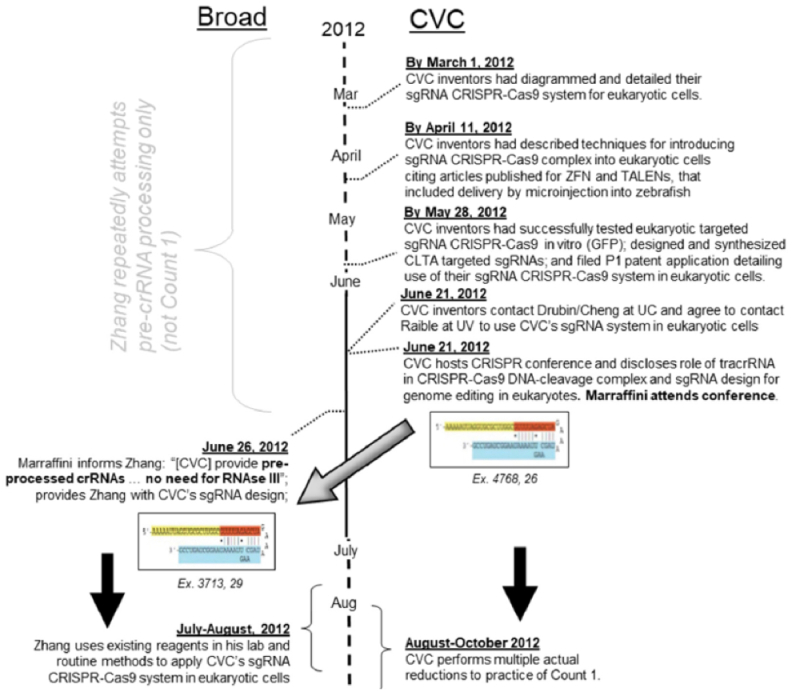
    2021-04-06 Image 2
    With regard to their purported incomplete conception argued by Broad, CVC argues that it had recognized and addressed each and every one of these putative deficiencies.  In addition, CVC argues that each of these "adaptations" required to practice CRISPR in eukaryotic cells "is not an invention, is not in the count, and is not required for reduction to practice," providing a mantra repeated for each of the various adaptations asserted by Broad:

    2021-04-06 Table 2
    (Missing, of course because it belongs properly in CVC's reply to Broad's opposition to their priority motion, is an explanation of the litany of CVC's failures recited in Broad's opposition.)

    Turning to Broad's evidence of actual reduction to practice, CVC makes the argument that the evidence is uncorroborated, because three of the witnesses (Sanjana, Cong, and Cox) set forth in this table are named as inventors, citing Chen v. Bouchard, 347 F.3d 1299, 1309 (Fed. Cir. 2003):

    2021-04-06 Table 3
    And the fourth, Kosuri, does not corroborate Dr. Zhang's testimony regarding ARTP, relying on vague ("this system") contemporaneous representations from Dr. Zhang and not having firsthand knowledge.

    The brief further alleges failure of proof, no contemporaneous inventor recognition, and failure of corroboration, for each of Broad's purported actual reductions to practice of eukaryotic CRISPR on July 20, July 28, July 31, and August, 2012, and further argues that because Broad did not establish the actual August date for this last instance of ARTP, the Board should consider it to be August 31, which is after CVC's August 9, 2012 asserted ARTP date.

    Broad's Reply brief to this opposition is due April 6, 2021.