
By Andrew Williams —
 The
The
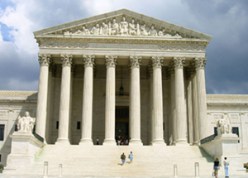
Supreme Court will hear oral arguments in Medtronic Inc. v. Boston Scientific Corp. on Tuesday, November 5,
2013. The sole issue to be determined is
whether the burden of proof shifts in a declaratory judgment action brought by
a licensee under MedImmune, such that the licensee has the burden to
prove that its products do not infringe the patent. The Federal Circuit had decided this issue in
the positive, thereby requiring Medtronic as the licensee to establish
non-infringement of the licensed patents. However, as we reported previously,
this case was unique because it arose out of provision in the license that
provided for a MedImmune-type
resolution more than 15-years before the Supreme Court decided that case. As a reminder, the parties (or their
predecessors-in-interest) had entered into a license agreement in 1991 covering
cardiac resynchronization therapy ("CRT") devices. The products that were the subject of this
case, however, were not marketed until 2004, and therefore (obviously) they
were not specifically identified in the license. The provision at issue in this case allowed
the patent holder to identify any new Medtronic products that it believed were
covered by its patents. If Medtronic
believed that theses identified products were not covered by the license, it
had the option to initiate a declaratory judgment action to challenge the non-infringement
and/or validity of the asserted patents.
Two
amicus curiae briefs focused on the
particular language of the license agreement, although in different ways. First, a collection of law professors
submitted a brief on behalf of Medtronic, the licensee, noting in part that the
burden on the patent holder was not "unfair" because the action was
contemplated by the agreement. Then,
Tessera Technologies Inc. ("Tessera") argued that the case should be
vacated and remanded because the license agreement did not, in fact, give rise
to federal jurisdiction in this case.
Legal
Scholars Amicus Curiae Brief
A
collection of law professors filed a brief in support of Medtronic, arguing
that the "purposes and policy concerns specific to the Declaratory
Judgment Act and Patent Act favor finding that the Federal Circuit's special
rule for licensee declaratory judgment actions is unnecessary and
inappropriate." The collection
described itself as "scholars of administrative law, civil procedure, or
intellectual property law who are interested in the efficient functioning of
the United States patent system in the service of the public interest."
To
argue that the Federal Circuit decision was contrary to public interest, the
collection of scholars began by explaining the importance of the DJ actions in
obtaining timely "rights" clearance. "A prime purpose of the federal Declaratory Judgment Act is to help
eliminate uncertainty by enabling parties threatened with legal liability to
obtain timely judicial determination of whether such liability applies." Therefore, imposing the burden on the
licensee in these litigations breaks the symmetry of the "mirror-image"
declaratory judgment versus enforcement actions. Importantly, this can lead to different
outcomes. The burden-of-proof
differential could cause the patent holder to "win" the DJ action,
even if it would have lost the mirror-image equivalent enforcement action. Even though this probability might be very
small, the scholarly collective pointed out that this relatively small
discrepancy would sit uneasily with Supreme Court precedent. In fact, the parties' persistence in this
case suggests that stakes are larger than they would appear. The ultimate impact could be that a licensee
may instead choose to repudiate a license, because there would have a better
chance (albeit slightly) of success without the shift of burdens.
The
consortium of scholars also argued that the burden should not shift to the
licensees because of the difficulty with proving the negative, especially in
patent cases. However, is this
necessarily true? For a patent holder to
successfully allege infringement, it must establish that all claim elements are
met by the accused product or method. However, an accused infringer can successfully defend such an allegation
by demonstrating that a single element is missing. Moreover, the scholars point out that
hundreds of claims could be at issue, and "[i]n principle, infringement of
each such claim might be separately asserted." Whereas this is true, often many of these
claims are dependent in nature, and therefore the number of independent claims
at issue can be significantly less. And,
if a licensee can find one element missing from an independent claim, it need
not concern itself with any of the claims that depend therefrom. The scholars also highlighted that there can
be multiple theories of infringement, which would somehow would prejudice
licensees. But, if a licensee was able
to establish an absence of literal infringement, would not the burden of proof
shift to the patent holder to allege the doctrine of equivalents, or some other
theory? While it is true that there may
be "well-appreciated difficulty in proving a negative," this truism
might not apply as readily to patent infringement cases.
The
scholarly collective also pointed out the practical consideration that such a
shift in the burden of proof would prove difficult with efficient and
predictable case management. Patent
litigations are apparently more time consuming than all federal cases except
death penalty Habeas Corpus cases, environmental matters, and civil RICO
cases. In fact, many district courts
have developed local patent rules or standing orders, which do not contemplate
the shift of burden in these cases. Until the lower courts can adjust, there will be "uncertainty,
controversy, and waste" if the Federal Circuit opinion is not overturned.
Finally,
this confederation of scholars looked to the particular license at issue in
this case. This is not the "typical"
MedImmune-type declaratory judgment
action, where without that previous Supreme Court case, the licensee needed to "bet
the farm" to bring the DJ action. Instead, in this case, the parties' agreement explicitly provided for
the bringing of such an action by the licensee. Therefore, the "fairness" concerns for the patent holder
expressed at the Federal Circuit are muted, because there was no surprise. In fact, the patent holder can be argued to
have disturbed the status quo, the argument goes, because they provided notice
to the licensee, Medtronic. Of course,
this logic can be extended further, because it was not the patent holder in
this case that introduced a new product that was covered by the license
(allegedly). In any event, the scholars
point out that neither party was disturbing the status quo, because they were
both merely acting "in accordance with their agreed regime for dispute
resolution."
Tessera
Technologies Inc. Amicus Curiae Brief
Tessera
described itself as "a leading provider of miniaturization technologies
for the electronics industry," and that as a frequent licensor, it has an
obvious interest in the burden of persuasion question at issue. In its amicus
curiae brief, Tessera began by looking at the license itself, noting that
the lower courts should not have had subject-matter jurisdiction over this case
in the first place. Because the license
included a "comprehensive contractual royalty dispute resolution
procedure," whereby the licensee was permitted to file a "nested"
DJ action, there was no chance that the licensee was going to abandon the
contract, and as such, a coercive patent infringement action by the licensor
cannot have been reasonably anticipated. Therefore, following the logic of the Gunn v. Minton Supreme Court case of last year, the Federal Circuit's
judgment should be vacated. Alternatively, Tessera argued that the case should be remanded to
determine if the question at issue was better determined as a matter of state
law.
According
to precedent, as articulated in Gunn v.
Minton, there are two ways in which federal question jurisdiction can be
invoked. The first is where "'federal
law creates the cause of action asserted.'" The second is where jurisdiction still lies, even
though the claim originated in state rather than federal law. These are a "'special and small category
of cases." Importantly, it is the
character of the threatened action, not the defense, the gives rise to
jurisdiction. In the present case, Tessera
asserted that it was imperative to look to the license, which gives rise to an
action that is unlike any other patent litigation — the licensee is allowed to
escrow its contested royalties with the goal of obtaining a complete refund
upon prevailing in the action; the licensee is not subject to any damages
(other than the royalty obligations), treble damages, or injunctive relief; and
the contract has claim preclusive effect, because if the patent holder does not
follow the specified procedures, no royalty will be owed even if the patent is
never litigated. Therefore, according to
Tessera, what is really being requested in this action is whether Medtronic's
products fall within the scope of the license agreement.
Tessera
then pointed out why the first type of federal question jurisdiction was
lacking. In reviewing the cases on the
issue, Tessera came to the conclusion "that identification of the
anticipated or threatened coercive claims in declaratory judgment actions
brought by patent licensees under an existing license turns on the 'totality of
the circumstances.'" Because the
only "threatened" action was contractual (assertion that the accused
device fell within the scope of the license), there was no chance that
Medtronic was going to repudiate the license. Instead, it was able to resolve the patent issue within the context of
the contract procedure — by filing the present action. As such, Medtronic's complaint was phrased in
the past and present continuous sense, with no mention of any fear of future
termination or patent infringement litigation. Consequently, no anticipated, impending, or threatened actions could
have given rise to the first type of federal question jurisdiction at the time.
Gunn v. Minton
provided the reasoning as to why the second type of jurisdiction was also
lacking. In that case, the Court
explained that "'federal jurisdiction over a state law claim will lie if a
federal issue is: (1) necessarily raised, (2) actually disputed, (3)
substantial, and (4) capable of resolution in federal court without disrupting
the federal-state balance approved by Congress.'" And, as in Gunn, the third and fourth factors are missing here. There would be no substantial impact on
federal system as a whole. Instead, the
preclusive effect would be limited to parties and patents. In fact, there is a similar "case-within-a-case"
sub-issue here that is also backward looking, because the patents in this case
have already expired. The fourth factor
is also not met, because state court have had the authority to hear patent
license disputes, and undoing this prerogative would certainly disrupt the
balance between the two. Because the District Court lacked jurisdiction, so did the Federal Circuit, and therefore
this case should be remanded with instructions to transfer to the Third Circuit
to see if any other federal subject-matter jurisdiction can be found.
Alternatively,
Tessera argued that the case should be vacated because the burden of persuasion
as to scope of a patent license is normally a state law matter. As a result, the case should be remanded to
determine if the parties contracted out this default rule. If they did not, the lower court should
determine on remand what burden state law provides in such a case.
This
is an interesting and compelling argument as to why the case should be vacated
and remanded. However, to reach this
conclusion, Tessera had to make several assumptions about Supreme Court
precedent, and how it would apply to the present facts. It will be interesting to hear any questions
to counsel directed at this jurisdictional issue. Unfortunately, the Court denied Tessera's
request to participate in the argument, but the tenor of the questions for the
counsel present should be telling.


Leave a comment