
By Andrew Williams —
 Just
Just
in time for Halloween, Senator Orrin Hatch (R-Utah) has introduced yet another
piece of legislation to combat the perceived "patent troll" problem. The Patent Litigation Integrity Act (S. 1612)
is aimed at shifting the reasonable fees and other expenses from the prevailing
party in patent litigations to the non-prevailing party, absent "substantially
justified" conduct, or other circumstances that would make it unjust. The proposed changes to 35 U.S.C. § 285 (Fees
and other expenses) are nearly identical to the comparable section of the
Goodlatte "Innovation Act," currently being discussed by the
House. The only significant difference
between the two amendments to § 285 is that the Senate bill specifies that "reasonable
fees and expenses" includes attorney fees. As a result, both the House and Senate now currently have bills pending
that would make the shifting of fees in patent litigation the default which can
only be overcome by showing that conduct was substantially justified. However, neither version provides guidance
explaining when such "justifications" rises to the level of "substantial."
Where
the House and Senate bills diverge is in on how to hold the parties accountable
for such fees, especially the plaintiff patent holders. Rep. Goodlatte's bill proposes making the
fees "recoverable against any interested party joined pursuant to section
299(d)." That section would allow
joinder of an interested party if "the party alleging infringement has no
substantial interest in the patent or patents at issue other than asserting
such patent claim in litigation." Therefore, not only must an "interested party" be identified,
it must be shown that the patent-asserting plaintiff has no other interest in
the patent (other than in asserting the patent). Sen. Hatch's bill takes a different tact,
providing for the potential discretionary bonding by "the party alleging
infringement." In this provision,
the court is given the express authority to order such a party to "post a
bond sufficient to ensure payment of the accused infringer's reasonable fees
and other expenses, including attorney fees." The provision goes on to highlight factors
that the court "shall consider" in determining whether such "a
bond requirement would be unreasonable or unnecessary." These include: (1) whether the bond will
burden the party alleging infringement to pursue unrelated activities; (2)
whether the party is an institution of higher learning or non-profit technology
transfer organization; (3) whether the party is a licensee of such an
institution or organization and conducts further development on the subject
matter; (4) whether the party is a named inventor or original assignee; (5)
whether the party practices the invention; (6) whether the party can prove they
have the ability to pay; and/or (7) whether the party will agree to pay the
shifted fees (and has the ability to do so).
 Two
Two
immediate observations come to mind. First, the bill introduced by Sen. Hatch (at left) treats the parties equally when it comes to fee
shifting, but it only provides for the bonding by the party asserting patent
infringement. It is clear that the goal
of this provision is to stop the "trolls," but it is also possible to
imagine an alleged infringer dragging out litigation in the face of evident willful
infringement in the hopes of deterring the patent holder with increased costs. On the other hand, the patent holder would
have the ability to request a preliminary injunction in such a case, especially
if the alleged infringer's case is so obviously without merit. The second observation is that this could set
up for a patent enforcement system that has two classes of patent-asserting
plaintiffs — those for whom there is no upfront cost to assert infringement,
and those for whom there is an "entry fee," which could run in the
millions of dollars. The point has been
made many times that there is an economic justification for non-practicing patent
asserting entities — for example, they can help innovators that do not have
sufficient resources of their own to capitalize on their inventions and they can
help provide liquidity to the intellectual property market. If such a "bond" provision is enacted,
it could have a chilling effect on the legitimate patent asserting entities,
which could have the unintended consequence of hindering innovation. Perhaps in anticipation of such criticism,
Sen. Hatch explained in a press release that "[f]ee shifting without the
option to seek a bond is like writing a check on an empty account, and that's
why it is important to include both in any legislation dealing with patent
trolls."
The
introduction of this bill also brings up two important questions. First, is there a problem with the current
fee-shifting section of § 285? According
to most commentators, there does appear to be. According to the June 4, 2013 New York Times Op-Ed piece, Chief Judge
Rader, Colleen Chien, and David Hricik pointed out that of the nearly 3,000
patent cases filed in 2011, only about 20 had fees shifted under § 285 (see "When NPR Podcasters Hit the Patent System"). That piece complained that federal judges
were not using fee-shifting provision with sufficient regularity to discourage "troll"-like
behavior. However, part of the problem
could lie in the standards established by the Federal Circuit to establish that
a case in exceptional. Along those
lines, earlier this month, the Supreme Court granted certiorari in two
cases dealing with the fee-shifting provision of § 285. In the first, Octane Fitness v. Icon Health and Fitness, the Court framed the
issue as:
[W]hether the Federal Circuit's promulgation of a rigid and exclusive two-part
test for determining whether a case is 'exceptional' under 35 U.S.C. § 285
improperly appropriates a district court's discretionary authority to award
attorney fees to prevailing accused infringers in contravention of statutory
intent and this Court's precedent, thereby raising the standard for accused
infringers (but not patentees) to recoup fees and encouraging patent plaintiffs
to bring spurious patent cases to cause competitive harm or coerce unwarranted
settlement from defendants.
The
framing of the question makes it appear that the Supreme Court is aware of the
perceived patent-troll problem, and perhaps is even aware of Chief Judge Radar's
opinion regarding the need to use § 285 more frequently. In the second case, Highmark Inc. v. Allcare Management Sys., Inc., the Court framed
the issue as:
Whether a district court's exceptional-case finding under 35 U.S.C. § 285
(which permits the court to award attorney's fees in exceptional cases), based
on its judgment that a suit is objectively baseless, is entitled to deference.
The
Federal Circuit has been reviewing such cases de novo, and it is perceived that this creates yet another hurdle
for the accused infringer to recoup their fees in such cases. In addition to these upcoming Supreme Court
cases and the proposed legislation, President Obama last June recommended a
series of legislative measures to curb the perceived troll problem, including
permitting "more discretion in awarding fees to prevailing parties in
patent cases . . . (similar to the legal standard that applies in copyright
infringement cases)." Therefore,
all three branches of government appear to believe that some change needs to be
made to § 285, at least as it is currently applied.
The
second question is whether this is the right time to make such a change. Rep. Conyers suggested yesterday in the
hearing of the House Committee on the Judiciary that this might not be the best
time to amend the fee-shifting statute, suggesting that it would be prudent to
wait and see what the Supreme Court says on the issue (see "House Judiciary Committee Holds Hearing on Innovation Act"). Moreover, Rep. Goodlatte's bill includes
provisions for heightened pleading standards. It is unclear what sort of traction such a provision will have, but it
appears that there is support for making a change beyond the notice pleading
that exists currently. However, if such
a provision were enacted, then requiring a patent holder to both plead with
very specific particularity and post a bond would seem
overkill and would most certainly swing the pendulum far in the other
direction. It would therefore seem to
make sense to postpone amending the fee-shifting statute, or at least hold off
on proposing particular changes at least until the pleadings-standard changes are
solidified.
Patent
Docs will continue to monitor and report on the activity of both the Goodlatte
and Hatch bills, as well as any other bill introduced to curb abusive patent
litigation. In the meantime, be on the
look-out tomorrow for any youngster in your neighborhood masquerading as patent
trolls, because they might try to shake you down for licensing fees, or at the
very least, some candy.
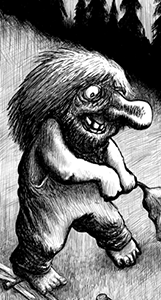
Graphic of troll (above) by JNL was modified (cropped) from a graphic available at the Wikipedia Commons, pursuant to the Free Art License. Any use of the modified graphic is subject to the same license.

 Patent Docs
Leave a reply to MRL Cancel reply