
By Donald Zuhn —
 Last week, the Generic
Pharmaceutical Association (GPhA) released a statement regarding a California
bill (SB-598)
that the GPhA asserted would "introduce[] burdensome provisions that could
raise costs and limit patient access to more affordable biosimilar medicines." The bill, introduced in February and now
before Governor Jerry Brown, would authorize a pharmacist to select a
biosimilar when filling a prescription order for a prescribed biological
product, provided that the prescriber did not personally indicate "Do not
substitute." The legislation would
also require that the substitution of a biosimilar be communicated to the
patient, and that the pharmacy notify the prescriber of the substitution or
enter the substitution into a patient record within five business days of the
selection.
The GPhA noted that a group
of more than thirty organizations, including CalPERS, AARP, California Pharmacists
Association, California Association of Health Plans, nine state labor unions, Kaiser
Permanente and some retail pharmacies, "oppose the burdensome notification
provisions in SB 598 and call upon Governor Brown to veto the legislation." The GPhA also noted that similar legislation
has been rejected in ten of the eighteen states where it has been considered and has only been passed with "significant amendments" in three states and with "Amgen
and Genentech-backed provisions intact in only one state (North Dakota)."
In opposing the California
bill, the GPhA points to a report from Express Scripts, which determined that the
potential 10-year saving to patients and payers in California from the
introduction of biosimilars on eleven biologics that are protected by U.S.
patents that have expired or will expire in the near future unless new patents
are granted would be approximately $27.6 billion. The report, entitled "Ten-Year Potential Savings from Biosimilars in California," and authored by Dr. Sharon
Glave Frazee, Dr. Susan Garavaglia, Jonah Houts, and Dr. Steve
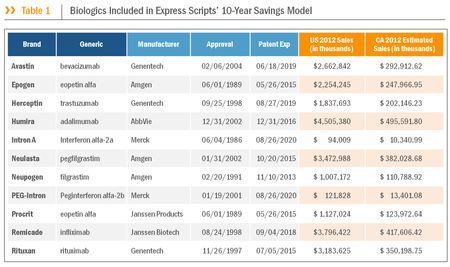
Miller, looked at eleven brand biologic drugs that were
considered to be good candidates for the introduction of biosimilars over the
next ten years. The eleven biologics are listed in Table 1 of
the report:
Noting that "[t]he
projected unrealized saving is significant," the report states that the
potential savings "warrant[] regulatory and legislative consideration at
both federal and state levels to improve the pathway for biosimilar evaluation
and reject industry requests to enact legislative barriers to interchangeable
biosimilar substitution."
The GPhA indicated that the
report "reinforces the importance of improving the pathway for biosimilar
evaluation and rejecting requests to enact legislative barriers to
interchangeable biosimilar substitution," and "bolsters the argument
that adding hurdles to the biosimilar pathway only can do harm to patients,
payers and the general public."


 Patent Docs
Leave a reply to Donald Zuhn Cancel reply