
By
Donald Zuhn —
On
August 23, in SkinMedica, Inc. v.
Histogen Inc., the Federal Circuit determined that the District Court for
the Southern District of California did not err in construing the phrase "culturing
. . . cells in three-dimensions" in the claims of U.S. Patent Nos.
6,372,494 and 7,118,746, and therefore affirmed the District Court's grant of
summary judgment of noninfringement to Defendants-Appellees Histogen, Inc.,
Histogen Aesthetics, and Gail Naughton ("Histogen").
 The
The
'494 and '746 patents, which are owned by Plaintiff-Appellant SkinMedica, Inc.,
relate to methods for producing pharmaceutical compositions containing novel
conditioned cell culture medium compositions and uses for such compositions. During prosecution of the '494 patent, the
claims were limited to pharmaceutical compositions comprising cell culture
medium conditioned by animal cells cultured in three-dimensions in order to
overcome an anticipation rejection based on a reference disclosing a pharmaceutical
composition comprising cell culture medium conditioned by animal cells grown in
two-dimensions. Claim 1 of
the '494 patent, which is representative, recites:
1. A
method of making a composition comprising:
(a)
culturing fibroblast cells in three-dimensions in a cell
culture medium sufficient to meet the nutritional needs required to grow the
cells in vitro until the cell culture medium contains a desired level of
extracellular products so that a conditioned medium is formed;
(b)
removing the conditioned medium from the cultured cells; and
(c)
combining the conditioned medium with a pharmaceutically acceptable carrier to
form the composition.
(emphasis
in opinion).
Prior
to issuance, the claims with the three-dimensional culturing limitation were
rejected as obvious in view of two references, one of which discloses a three-dimensional
skin culture system that uses a three-dimensional
matrix to culture a variety of cells. To
overcome this rejection, the inventors argued that "the conditioned medium
from cells cultured in three-dimensions has desirable properties not exhibited
by medium conditioned by cells cultured [in] two dimensions" and that the
references on which the obviousness rejection was based did not disclose that sustained
proliferation of the cells in culture is a result of factors or components of
the conditioned medium.
 In
In
2009, SkinMedica filed suit against Histogen for producing dermatological
products according to methods covered by the claims of the '494 and '746 patents. The District Court construed the phrase
"culturing . . . cells in three-dimensions" in the claims as meaning
"growing . . . cells in three dimensions (excluding growing in monolayers
or on microcarrier beads)." The District
Court reasoned that the inventors acted as their own lexicographers, defining
"culturing . . . cells in three-dimensions" away from its ordinary
meaning by consistently distinguishing beads from three-dimensional cultures in
the specification. Following the
District Court's construction, Histogen moved for summary judgment of
noninfringement, which the Court granted, finding that Histogen's process "uses
beads, [which] cannot infringe the disputed claim element as construed."
On
appeal, SkinMedica raised a single point of error, arguing that the District
Court erroneously excluded beads from the definition of "culturing . . .
cells in three-dimensions." In
finding that the District Court did not err in construing this phrase, Judge Prost, writing for
the majority, states that:
The specification clearly proves that the
patentees defined the three-dimensional culturing required by the claims to
exclude culturing with beads, because the patent expressly confines culturing
with beads to two-dimensional culturing.
Whether viewed as a matter of disclaimer or of lexicography, the result
is the same: the kind of
three-dimensional culturing protected by the patent excludes use of beads. Because the accused method employs beads, it
cannot infringe the patents in suit.
The majority opinion also states that:
In the written description, the patentees plainly and repeatedly distinguished
culturing with beads from culturing in three-dimensions. They expressly defined the use of beads as
culturing in two-dimensions. And they
avoided anticipatory prior art during prosecution by asserting that the
conditioned medium produced by two-dimensional cultures was inferior and
chemically distinct from the conditioned medium produced by three-dimensional
cultures.
Judge
Prost notes that the specification includes four relevant references to
"beads" in the specification (the parties agreed that a fifth
reference was not relevant), and indicated that "[i]n each and every one
of those four references, the patentees clearly distinguish culturing with
beads from culturing in three-dimensions."
The four references are as follows (with emphasis from the majority
opinion):
[1] Conditioned medium contains many of the original components of the medium,
as well as a variety of cellular metabolites and secreted proteins, including,
for example, biologically active growth factors, inflammatory mediators and
other extracellular proteins. Cell lines grown as a monolayer or on beads,
as opposed to cells grown in three-dimensions, lack the cell-cell and
cell-matrix interactions characteristic of whole tissue in vivo.
[2] Cell lines grown as a monolayer or on beads, as opposed to cells grown in
three-dimensions, lack the cell-cell and cell-matrix interactions
characteristic of whole tissue in vivo. Consequently,
such cells secrete a variety of cellular metabolites although they do not
necessarily secrete these metabolites and secreted proteins at levels that
approach physiological levels. Conventional conditioned cell culture
medium, medium cultured by cell-lines grown as a monolayer or on beads, is
usually discarded or occasionally used in culture manipulations such as
reducing cell densities.
[3] The present invention relates to novel compositions comprising any
conditioned defined or undefined medium, cultured using any eukaryotic cell type
or three-dimensional tissue construct and methods for using the
compositions. The cells are cultured in monolayer, beads (i.e., two-dimensions) or,
preferably, in three-dimensions.
[4] The cells may be cultured in any manner known in the art including in
monolayer, beads or in three-dimensions and by any means . . . .
With
respect to these references, Judge Prost indicates that the "reference[s]
to beads in the written description [can be read as] clear and unmistakable statement[s]
that bead cultures are not the three-dimensional cultures the inventors require
in their claimed methods." She also
notes that "[t]he inventors go to great lengths (in over twenty-five
columns of text in the specification) to explain dozens upon dozens of
different ways to culture cells in three-dimensions, yet do not mention beads
once in any of them." In summary,
Judge Prost states that:
[A]lthough the inventors never explicitly
redefined three-dimensional cultures to exclude the use of beads, their
implicit disclaimer of culturing with beads here was even "so clear that
it equates to an explicit one." Thorner [v. Sony Computer Entm’t Am. LLC], 669 F.3d at 1368. Without fail, each time the inventors
referenced culturing with beads in the specification, they unambiguously
distinguished that culture method from culturing in three-dimensions. Every time they included beads in a list of
methods for culturing cells, the inventors indicated that bead cultures were an
alternative to three-dimensional cultures (by using the disjunctive
"or") or distinct from three-dimensional cultures (by using the
disjunctive phrase "as opposed to").
. . . And the patentees expressly
defined culturing in beads as culturing cells in "two-dimensions,"
which excludes that method from the three-dimensional culturing required by the
claims.
Thus,
she concludes that "[i]t is therefore clear from the intrinsic record
that, although the inventors never explicitly redefined 'culturing . . . cells
in three-dimensions' to exclude the use beads, they affected a clear implicit
disclaimer of culturing with beads from the scope of their claimed invention."
Judge
Prost notes that SkinMedica asserted four reasons for not finding a disclaimer
of beads. With respect to SkinMedica's
first reason — that the patentees defined "three-dimensional
framework" broadly enough to encompass the use of beads — Judge Prost
indicates that this "theory misses the mark" because it would lead to
a conclusion that even a monolayer culture would qualify as three-dimensional. SkinMedica next argued that the Doyle
reference was incorporated by reference into the specification, and that this
reference "expressly discusses the use of beads to culture cells in three
dimensions." However, Judge Prost
disagreed, finding that the Doyle reference does not expressly discuss
culturing beads in three-dimensions.
SkinMedica
also argued that a different reference (the Seldon patent) "expressly acknowledges that
three-dimensional culturing with beads provides the same inherent advantages —
i.e., mimicking an in vivo environment — as other three-dimensional culturing." However, the majority opinion points out that
SkinMedica improperly relied on the Seldon patent because it raised this
reference for the first time in its reply brief. With respect to this reference, Judge Prost explains that:
SkinMedica crafts a nuanced theory about cell culturing with beads by simply
quoting a few short disjointed phrases from the lengthy reference. Yet it has provided no context for those quotes
or any reasoning for its conclusions past the quotes themselves. And because it waited until its reply brief
on appeal to first mention Seldon, neither the district court nor Histogen have
had an opportunity to fully discuss the importance of the disclosures in the
reference. . . . SkinMedica's tardiness has so shaded what light
Seldon may have shed on the relevant art here that we cannot fairly consider
it. We simply cannot decipher the import
of the reference without adequate context.
SkinMedica has waived its ability to rely on the reference for claim
construction purposes on appeal.
Finally,
with respect to SkinMedica's argument that the testimony of its expert
established that skilled practitioners understood that three-dimensional
culturing could be performed using beads, and that culturing using beads in
three-dimensions produces the same benefits over two-dimensional culturing that
the patents describe, Judge Prost responds that "[t]he first point from
Dr. Salomon's testimony . . . simply confirms an assumption we already made
during our analysis of the intrinsic record." As for the second point, she notes that
"Dr. Salomon's opinions are unhelpful to our analysis here," adding
that "[t]hey are conclusory and incomplete; they lack any substantive
explanation tied to the intrinsic record; and they appear to conflict with the
plain language of the written description."
Writing
in dissent, Chief Judge Rader argues that "the patentees
did not disavow the ordinary meaning of 'culturing . . . cells in three-dimensions'
to exclude the use of beads." He
notes that cells can be cultured on beads in either two- or three-dimensions,
providing graphic representations of each:
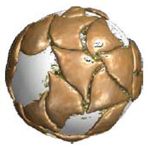
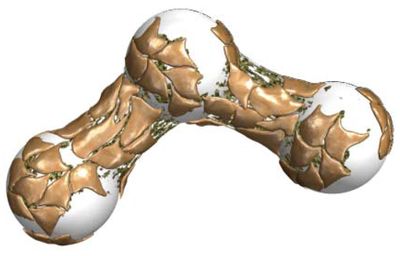
According
to the Chief Judge, the four references to beads in the specification discussed
by both the District Court and the majority opinion "do not amount to an unmistakable
and unambiguous disavowal." In
particular, he explains that "the patentees used the
disjunctive phrase 'as opposed to' to distinguish 'cells grown in
three-dimensions' from cells grown 'on beads' in two-dimensions," adding
that "[t]he phrase '[c]ell lines grown as a monolayer or on beads' can
reasonably be interpreted to mean cells cultured as a monolayer, or, as a
monolayer on beads."
Because
the four references in the specification "do not meet the exacting
standard imposed by this court's precedent [for an unmistakable and unambiguous
disavowal]," the Chief Judge states that he would find that the patentees
did not unmistakably and unambiguously disavow the ordinary meaning of "culturing
. . . cells in three-dimensions" to exclude the use of beads, and would
have therefore reversed the District Court's grant of summary judgment.
SkinMedica, Inc. v.
Histogen Inc.
(Fed. Cir. 2013)
Panel:
Chief Judge Rader and Circuit Judges Clevenger and Prost
Opinion
by Circuit Judge Prost; dissenting opinion by Chief Judge Rader

 Patent Docs
Leave a reply to Skeptical Cancel reply