
By
Andrew Williams —
 When
When
is it undue experimentation in practicing the full scope of a claim that contains
a genus of chemical compounds and a functional limitation of activity, when the
specification provides a method to assess the claimed functional activity (and
it can be routinely performed by one skilled in the art)? The Federal Circuit tackled this problem on
Wednesday in the Wyeth v. Abbott Laboratories
case, in which the Court affirmed a lower court's grant of summary judgment of
non-enablement. It was unclear from the
decision how many compounds were encompassed by this genus, but Abbott alleged
that there were tens of thousands, and Wyeth's expert appeared to acknowledge
that the number would be "significantly smaller" than "millions
of compounds." Nevertheless, it was
decisive to the Court that there were no suggestions in the patents at issue as
to which substitutions in the compound would be preferable, that there was no
guidance or predictions about any particular substitutions, and that the
unpredictability in the art would have required the testing of each compound to
see if it fell within the functional limitations of the claim. And, even though the Court acknowledged that undue
experimentation is a matter of degree, synthesizing and screening tens of
thousands of compounds qualified as "excessive" and therefore was
found to be undue. The only other hint
as to what amount of effort might or might not also qualify as "excessive"
was that the Court noted that "it would take technicians weeks to complete
each of these assays." Nevertheless, to affirm a grant of summary judgment with so many factual
issues to consider, not the least of which was whether one skilled in the art would
consider such experimentation to be undue, this was apparently not a close case
for the Court.
As
always, it is important to consider the claims at issue. The two patents were U.S. Patent Nos.
5,516,781 and 5,563,146, and claim 1 of the '781 patent is representative:
1. A method of treating restenosis
in a mammal resulting from said mammal undergoing a percutaneous transluminal
coronary angioplasty procedure which comprises administering an antirestenosis
effective amount of rapamycin to said mammal orally, parenterally,
intravascularly, intranasally, intrabronchially, transdermally, rectally, or
via a vascular stent impregnated with rapamycin.
The
technology at issue in this case was the use of balloon catheters to open
blocked arteries, where the balloons are guided to the site of accumulated
plaque and inflated to crush the plaque. However, such a procedure can cause injury to the arterial wall,
resulting in the thickening of the walls, in a process known as restenosis. Therefore, treating restenosis is essentially
a renarrowing of the artery. Rapamycin
can refer to a class of compounds, but the patent only refers to a single species
called sirolimus, which is naturally produced by a bacterium called Streptomyces hygroscopicus. Sirolimus is a macrocyclic triene ring, with
the following structure:
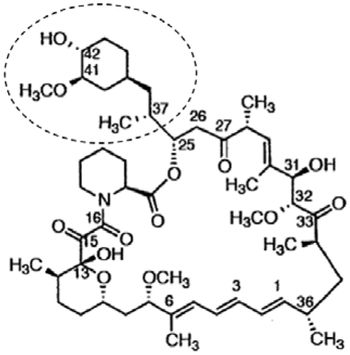
This
compound was known in the art, so the patents do not even contain this
structure, instead referring to a patent that discloses and claims rapamycin (although
again only the sirolimus compound). Nevertheless, even though the patents only refer to this one compound,
the District Court adopted Wyeth's broad construction of "a compound
containing a macrocyclic triene ring structure produced by Streptomyces hygroscopicus, having immunosuppressive and
anti-restenotic effects." Therefore, any substituent beyond the C-37 position (the dashed
circle) can be used to modify the structure and still fall within the scope of
this definition. Wyeth likely sought
such a construction because the defendants separately market stent products
that elute everolimus and zotarolimus, which have the same macrocyclic ring,
but different constituents at the C-42 position. The likely real problem that the Court had
with this case, therefore, was that it appeared as if Wyeth was trying to assert
its patents against currently used compounds that were not specifically taught
in the patent disclosure (which itself only mentioned one species).
 The
The
enablement question turned on the fact that not all species of the rapamycin
genus were immunosuppressive and anti-restenotic. Wyeth's expert did point out, however, that
one skilled in the art would know that you could not just add anything to
ring. If so, the number of possible
species would be in the millions, and might approach infinite. However, to have the claimed functional
effects, the compound would need to be permeable across cell membranes. This limits the practical size of compounds
to below 1,000-1,200 Daltons (for comparison, sirolimus is approximately 914
Daltons). Even though there was some
confusion at the oral hearing, the Court understood that this would limit the
number of compounds to the tens of thousands. More importantly, because the patents in suit did not disclose any other
species of this genus, there was no disclosure of which substituents would be
preferable, or any predictions as to which substituents would be active. The only teaching along these lines was the
inclusion of assays to determine immunosuppressive and anti-restenotic activity,
which the Court accepted would be routine for one skilled in the art. Nevertheless, even though routine, testing
tens of thousands of compounds would be excessive, and therefore the amount of
experimentation was found to be undue.
The
opinion was straightforward, and provides some guidance as to how many species
of a generic compound could cause undue experimentation if the disclosure
provides no guidance as to which substituents would fit the functional
limitation. However, what was not clear
from the opinion or the oral argument was whether one skilled in the art would
have considered such testing to be undue, or at least whether this question should
have been decided at trial. Also, it was
unclear just how many species of the tens of thousands were, in fact,
inoperative. It was suggested that only
around seven had been identified as active, but no mention was made of the
species that were found to be inactive. This could be because the Court believed this fact was irrelevant,
especially in view of the unpredictability in the art. However, it would be interesting to know
whether the decision would have been different if all known species were
active. And, if so, what if only half of
the species were active? The take home
lesson is if you are drafting and prosecuting such claims, provide as much
detail about the substituents as possible, and claim varying scopes of generic
structures. Of course, Wyeth was stuck
with its disclosure from 1992, and so they were between a rock and a hard place
(because the defendants were not selling the species that they disclosed).
The
really troubling aspect of this case came during oral argument, but did not
make it into the opinion. This issue related
to grant of summary judgment for lack of written description with regard to two
routes of administration, specifically transdermally and rectally. Apparently, the inventors testified that they
did not know how to administer the compound via these routes, and it was
unclear whether anyone else in the art knew at the time. Judge Moore, who wrote the opinion, questioned
from the bench whether the point of the written description requirement was to
demonstrate that the inventor possessed the invention. And, if the inventor admits to not possessing
a particular aspect of the invention, Judge Moore asked, can the specification
truly be described? She then carried
this line of thought to its logical, if not absurd, conclusion, that if a
synthetic chemist does not know how to administer drugs to patients, how can
they ever be entitled to method of treatment claims? She wondered if a formulator should also be
included in the inventive entity, especially considering the fact that in this
case both parties agreed that the definition of a person skilled in the art
would also include a formulator. Of
course, Wyeth's counsel cautioned against such draconian approach to
pharmaceutical patent claims. Nevertheless,
because the Court did not comment on the written description found in the
specification, it is unclear whether Judge Moore was simply musing, or whether
we can expect to see closer scrutiny of pharmaceutical method-of-treatment
claims from her (or the Court in general), especially if such claims contain
specific administration routes as limitations.
Wyeth v. Abbott Laboratories (Fed. Cir. 2013)
Panel: Circuit Judges Moore, Bryson, and Wallach
Opinion by Circuit Judge Moore


 Patent Docs
Leave a reply to Andrew Williams Cancel reply