
By Kevin E. Noonan —
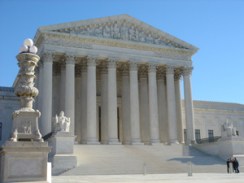 The Supreme Court ruled 5-3 today in favor of the
Federal Trade Commission in FTC v. Actavis,
Inc. Writing for the majority that
included Justices Kennedy, Ginsburg, Sotomayor and Kagan, Justice Breyer's
opinion reversed the decision of the Eleventh Circuit Court of Appeals
dismissing the FTC's complaint that a "reverse payment" settlement
agreement between an innovator drug maker and generic challengers in ANDA
litigation was anticompetitive and violated the antitrust laws. The Court refused to accept the FTC's position
that such agreements are presumptively unlawful, holding that lower courts
should apply an antitrust "rule of reason" analysis when evaluating
such agreements.
District Court for the Northern
District of Georgia
 The underlying litigation involved a reverse
payment settlement between NDA holder Solvay Pharmaceuticals and ANDA filers
Watson Pharmaceuticals and Paddock Pharmaceuticals. Watson and Paddock
filed separate ANDAs having Paragraph IV certifications that U.S. Patent No. 6,503,894
was invalid or unenforceable, and the patent holder timely filed suit pursuant
to 35 U.S.C. § 271(e)(2) in the U.S. District Court for the Northern
District of Georgia. However, the parties settled before the Court could
rule on defendants' summary judgment motions after a Markman hearing. The parties agreed that defendant generic
drug companies would "respect" the '894 patent, and that both were
entitled to launch in August 2015, five years before the '894 patent was
scheduled to expire. In addition, Watson and Paddock agreed that their
sales forces would promote Solvay's product until the agreed time for their own
product launch, and that Solvay would pay the parties (~$20-30 million to
Watson, ~$10 million to Par/Paddock) annually; in addition, Par/Paddock agreed
to supply the drug product to Solvay in a "backup capacity" for an
additional $2 million annually.
 The FTC investigated this settlement agreement,
pursuant to 21 U.S.C. § 355 note (2003), and alleged violations of Section 5a
of the Federal Trade Commission Act under 15 U.S.C. § 45(a)(1). The suit
was transferred from the Central District of California (in the Ninth Circuit,
which had not found these agreements lawful) to the Northern District of
Georgia (where the Eleventh Circuit had ruled these agreements to be lawful
absent "sham" litigation, in Valley
Drug Co. v. Geneva Pharmaceuticals, Inc., 344 F.3d 1294 (11th Cir.
2003), and Schering-Plough
Corp. v. Federal Trade Commission, 402 F.3d 1056 (11th Cir.
2005)). The District Court granted defendants' motion to dismiss pursuant
to Fed. R. Civ. Pro. 12(b)(6) (failure to state a claim). In doing so,
the District Court rejected the FTC's contentions in its complaint "(1)
that the settlement agreement between Solvay and Watson is an unfair method of
competition; (2) that the settlement agreement among Solvay, Paddock, and Par
is an unfair method of competition; and (3) that Solvay engaged in unfair
methods of competition by eliminating the threat of generic competition and
thereby monopolizing the market." The decision was based on earlier
11th Circuit precedent that reverse payments did not constitute anticompetitive
behavior "so long as the terms of the settlement remain within the scope
of the exclusionary potential of the patent, i.e., do not provide for
exclusion going beyond the patent's term or operate to exclude clearly
noninfringing products, regardless of whether consideration flowed to the
alleged infringer."
Court of Appeals for the Eleventh Circuit
The 11th Circuit affirmed. The opinion
focused on what it considered the economic realities (instead of the FTC's
economic theories), specifically that new drugs are produced in the U.S. under
the maxims "no risk, no reward" and "more risk, more reward,"
and that "no rational actor" (the economists' archetype) "would
take [the] risk" of investing more than "$1.3 billion" on a
potential drug where "[o]nly one of every 5,000 medicines tested . . . is
eventually approved for patient use" "without the prospect of a big
reward." Under this system, the Court recognized that the successful
drug maker who patents its drug will "usually[] recoup its investment and
make a profit, sometimes a super-sized one." The Court also noted
that "more money, more problems" is the result, with the profits "frequently
attract[ing] competitors in the form of generic drug manufacturers that
challenge or try to circumvent the pioneer's monopoly in the market."
The Court recognized the FTC's position to be that reverse payments are per
se anticompetitive as "unlawful restraints on trade" and hence
violations of Section 1 of the Sherman Act.
The Court stated that "[t]he lynchpin of the
FTC's complaint is its allegation that Solvay probably would have lost the
underlying patent infringement action" and that "Solvay was not
likely to prevail" in the patent litigation because "Watson and
Par/Paddock developed persuasive arguments and amassed substantial evidence
that their generic products did not infringe the ['894] patent and that the
patent was invalid and/or unenforceable" (emphasis in original). "The
difficulty," according to the Court, "is [in] deciding how to resolve
the tension between the pro-exclusivity tenets of patent law and the
pro-competition tenets of antitrust law," a difficulty that "is made
less difficult [] by [o]ur earlier decisions.'" While noting that
generally agreements between competitors that keep one competitor from the
market to the benefit of the other (and that increase costs to the public)
would be barred under the antitrust laws, reverse payment cases were "atypical
cases because 'one of the parties [owns] a patent'," citing Valley Drug.
This "makes all the difference" to the Court, because the patent
holder "has a lawful right to exclude others" from the
marketplace. Said another way, "[t]he anticompetitive effect is
already present" due to the existence of a patent," according to the
opinion, citing Schering Plough. Further citing Valley Drug,
the Court said that even subsequent invalidation of the patent would not render
the agreement unlawful, since its lawfulness must be considered at the time of
settlement, where the patentee "had the right to exclude others."
What counts is the "potential exclusionary power" of the patent at
the time of the reverse payment settlement, not its "actual exclusionary
power" unless a court had rendered a negative judgment of
invalidity or unenforceability prior to the settlement (an unlikely but not
impossible scenario). But the Court noted that the mere existence of a
patent did not give the parties to a reverse payment settlement carte
blanche; the settlement cannot "exclude[] more competition that the
patent has the potential to exclude." Such agreements remain "vulnerable
to antitrust attack" according to the opinion, and are subject to a "three-prong
analysis" that requires an evaluation of "(1) the scope of the
exclusionary potential of the patent; (2) the extent to which the agreements
exceed that scope; and (3) the resulting anticompetitive effects," citing Valley
Drug.
The Court then synthesized the rule from its
cases: "absent sham litigation or fraud in obtaining the patent, a
reverse payment settlement is immune from antitrust attack so long as its
anticompetitive effects fall within the scope of the exclusionary potential of
the patent." The Court assessed the FTC's allegations under this
standard, noting those allegations to be: (1) that Solvay was "unlikely
to prevail" in the underlying patent infringement litigation; (2) that
accordingly the patent has "no exclusionary potential"
(emphasis in original); and (3) if a patent has no exclusionary potential, the
reverse payment arrangement "necessarily" exceeds its "potential
exclusionary scope" and thus is tantamount to "'buying off' a serious
threat to competition." The FTC urged the Court, according to the
opinion, "to adopt 'a rule that an exclusion payment is unlawful if,
viewing the situation objectively as of the time of the settlement, it is more
likely than not that the patent would not have blocked generic entry earlier
than the agreed-upon entry date.'"
The Eleventh Circuit found the Commission's allegations to be unfounded
and affirmed the District Court's dismissal of the government's complaint.
Supreme Court
The FTC petitioned for certiorari, the Question
Presented being:
Federal competition law generally
prohibits an incumbent firm from agreeing to pay a potential competitor to stay
out of the market. See Palmer v. BRG of Ga., Inc., 498 U.S.
46, 49-50 (1990). This case concerns agreements between (1) the
manufacturer of a brandname drug on which the manufacturer assertedly holds a
patent, and (2) potential generic competitors who, in response to patent-infringement
litigation brought against them by the manufacturer, defended on the grounds
that their products would not infringe the patent and that the patent was
invalid. The patent litigation culminated in a settlement through which
the seller of the brand-name drug agreed to pay its would be generic
competitors tens of millions of dollars annually, and those competitors agreed
not to sell competing generic drugs for a number of years. Settlements
containing that combination of terms are commonly known as "reverse
payment" agreements. The question presented is as follows:
Whether reverse-payment agreements are per se lawful unless the underlying
patent litigation was a sham or the patent was obtained by fraud (as the court
below held), or instead are presumptively anticompetitive and unlawful (as the
Third Circuit has held).
In the majority opinion, Justice Breyer writes
that reverse payment settlement agreements can "sometimes violate the
antitrust laws," and thus that the District Court should not have
dismissed the case brought by the FTC. After discussing the Hatch-Waxman statutory scheme and the facts of the
case below, the opinion focuses on the risk to the consuming public posed by
such settlements in cases where the patent is invalid or not infringed. According to the majority, although they were willing to accept that the
agreement's "anticompetitive effects fall within the scope of the
exclusionary potential of the patent," this fact is not sufficient to "immunize
the agreement from antitrust scrutiny." The majority's concern is that while the holder of a valid patent may be
exempt from antitrust liability when enforcing the exclusionary right, ANDA
litigation involves an allegation that either the patent is invalid (in which
case the immunization is lost) or the generic product does not infringe (in
which case the patent cannot be enforced against the non-infringing generic
drug). Accordingly, such agreements "tend
to have significant adverse effects on competition." For this reason (as well as the majority's
antipathy to patenting in the medical area; see Mayo v. Prometheus and AMP v.
Myriad), the majority believes that "it would be incongruous to determine
antitrust legality by measuring the settlement's anticompetitive
effects solely against patent law policy, rather than by measuring them against
procompetitive antitrust policies as well." Support for this proposition (vigorously
disputed by the dissenting Justices; see
below) is found in Justice Breyer's opinion in several of the Court's
earlier cases, including United States v.
Line Material Co., 333 U. S. 287, 308 (1948) (retail price-setting between
patentees); United States v. United
States Gypsum Co., 333 U. S. 364, 390–391 (1948) (both cases from those
halcyon days where the only patents that were valid were those the Court had
not yet ruled upon); and Walker Process
Equipment, Inc. v. Food Machinery & Chemical Corp., 382 U. S. 172, 174
(1965) (incongruously, a case that established one of the grounds for finding
reverse payment settlement agreements unlawful, i.e., asserting a patent
obtained by "fraud on the Patent Office"). Consequently:
[R]ather than measure the length or amount
of a restriction solely against the length of the patent's term or its earning
potential, as the Court of Appeals apparently did here, this Court answered the
antitrust question by considering traditional antitrust factors such as likely
anticompetitive effects, redeeming virtues, market power, and potentially
offsetting legal considerations present in the circumstances, such as
here those related to patents.
The opinion also cites several earlier cases where
settlement agreements (not in the Hatch-Waxman context) were held to violate
the antitrust laws, including United
States v. Singer Mfg. Co., 374 U. S. 174 (1963) (where the issue was
collusion between three patentees to enforce the strongest patent against their
competitors); United States v. New
Wrinkle, Inc., 342 U. S. 371, 378 (1952) (more price fixing) and Standard Oil Co. (Indiana) v. United States,
283 U. S. 163 (1931) (patentees setting royalty rates). The question is whether any of these
situations is at all relevant to reverse payment settlement agreements is not
addressed in the opinion, which merely seems content to find cases where the
Court has in the past found that settlement "agreements are not outside the
scope of antitrust scrutiny (and does not consider whether the circumstances
surrounding this prior approbation is in any way related to the question before
the Court). Once again, these Justices
seem to be seeking some sort of "balance," not between too much or
too little patenting (as in Mayo) but
with regard to accommodating patent and
antitrust policies. Finally the Court
finds that the "procompetitive" purposes of the Hatch-Waxman Act are
consistent with having courts apply antitrust principles to reverse payment
settlement agreements in ANDA litigation.
Turning to the "general legal policy favoring
the settlement of disputes," Justice Breyer's opinion does not find sufficient
force in this policy to override the majority's concerns regarding
anticompetitive effects of reverse payment settlement agreements, even though the majority recognizes the Eleventh
Circuit's concern that "antitrust scrutiny of a reverse payment agreement
would require the parties to litigate the validity of the patent in order to
demonstrate what would have happened to competition in the absence of the
settlement," an outcome that "will prove time consuming, complex, and
expensive." In response to this
concern, the majority offer five "considerations" as its basis for
its holding that the FTC should be permitted to establish an antitrust
violation:
"First,
the specific restraint at issue has the 'potential for genuine adverse
effects on competition.'" The
payment in effect amounts to a purchase by the patentee of the exclusive right
to sell its product, a right it already claims but would lose if the patent
litigation were to continue and the patent were held invalid or not infringed
by the generic product.
The opinion also states this concern as "[t]he
patentee and the challenger gain; the consumer loses," citing academic
sources and amicus briefs for the proposition that "there are indications
that patentees sometimes pay a generic challenger a sum even larger than what
the generic would gain in profits if it won the paragraph IV litigation and
entered the market." Under these
circumstances, "a payment of this size [] may provide strong evidence that
the patentee seeks to induce the generic challenger to abandon its claim with a
share of its monopoly profits that would otherwise be lost in the competitive
market." And the majority
disparages the idea that entering into such an agreement would merely entice
other generic challengers to get in line to be bought off by the patentee,
based on the loss of the 180-day exclusivity for later ANDA filers and the
30-month delay in FDA approval raised by ANDA litigation against such a
subsequent filer. These considerations
convince the majority that, rather than producing an untenable situation where
the owner of a weak patent cannot possibly "buy [] off" all potential
competitors, the Hatch-Waxman regime in fact produces a critical generic
challenger, the first filer, who if successfully bought off by a reverse
payment settlement agreement will effectively chill future challenges by other
generic drug makers. As ingenious as
this possibility may be there is little empirical evidence that it has
ever occurred.
"Second,
these anticompetitive consequences will at least sometimes prove unjustified." The majority's concern is that a court cannot
tell without inquiry whether a particular reverse payment settlement agreement
is or is not "justified" under antitrust principles. "Where a
reverse payment reflects traditional settlement considerations, such as avoided
litigation costs or fair value for services, there is not the same concern that
a patentee is using its monopoly profits to avoid the risk of patent
invalidation or a finding of noninfringement. In such cases, the parties may
have provided for a reverse payment without having sought or brought about []
anticompetitive consequences."
This uncertainty is the basis for the majority to conclude that the District Court erred in dismissing the FTC's complaint, because by doing
so it denied the Commission the chance to establish whether or not there were
such justifications for the agreement.
"Third,
where a reverse payment threatens to work unjustified anticompetitive harm, the
patentee likely possesses the power to bring that harm about in practice." Once again the majority is concerned with the
size of the payment, which a court can use to be "a strong indicator of
[market] power."
"Fourth,
an antitrust action is likely to prove more feasible administratively than the
Eleventh Circuit believed." Here
the majority finds the Eleventh Circuit "throws the baby out with the
bathwater" by refusing to apply antitrust principles due to the
difficulties of litigating patent infringement and validity (when, of course,
the appellate court was merely recognizing that the impetus for these settlements
would disappear should the parties be required to litigate in an antitrust
context what they avoiding litigating in an ANDA context). According to the majority, "it is
normally not necessary to litigate patent validity to answer the antitrust
question" (except for sham litigation), because "[a]n unexplained
large reverse payment itself would normally suggest that the patentee has
serious doubts about the patent's survival" (indicating, to mix metaphors,
that the majority has "swallowed the FTC's Kool-Aid" regarding the
assumption that only patentees worried about non-infringement or invalidity will
enter into such agreements, a position refuted by the Eleventh Circuit and
others).
"Fifth,
the fact that a large, unjustified reverse payment risks antitrust liability
does not prevent litigating parties from settling their lawsuit." Here, the majority posits that the parties can
settle an ANDA dispute in "other ways, [] by allowing the generic
manufacturer to enter the patentee's market prior to the patent's expiration,
without the patentee paying the challenger to stay out prior to that point." Once again the majority return to the existence of a payment, saying that "the
basic antitrust question" comes down to the reasons for the payment (and,
of course, a court's determination of whether those reasons are valid).
The majority summarizes these considerations as
follows:
In sum, a reverse payment, where large and
unjustified, can bring with it the risk of significant anticompetitive effects;
one who makes such a payment may be unable to explain and to justify it; such a
firm or individual may well possess market power derived from the patent; a
court, by examining the size of the payment, may well be able to assess its
likely anticompetitive effects along with its potential justifications without
litigating the validity of the patent; and parties may well find ways to settle
patent disputes without the use of reverse payments. In our view, these
considerations, taken together, outweigh the single strong consideration — the
desirability of settlements — that led the Eleventh Circuit to provide
near-automatic antitrust immunity to reverse payment settlements.
Simply put, these concerns seem to amount to 1)
the size of the payment; 2) whether there are "legitimate justifications"
for the agreement; 3) whether the patentee has "market power"; 4) the
size of the reverse payment and whether it is "unexplained"; and 5)
if there are other ways to settle, why do the parties choose a reverse payment.
The FTC did not entirely win the day with the
majority, however; the majority rejected the Commission's suggestion that these
agreements should be presumptively unlawful and that the rule of reason be applied
using a "quick look" or other shortcut, which the majority noted was
permissible only in instances where "an
observer with even a rudimentary understanding of economics could conclude that
the arrangements in question would have an anticompetitive effect on customers
and markets," citing Justice Breyer's concurring-in-part and dissenting-in-part
opinion in California Dental Assn. v. FTC,
526 U. S., 756, 775 (1999). This
treatment is not justified for reverse payment settlement agreements according
to the majority, because "the likelihood of a reverse payment bringing
about anticompetitive effects depends upon its size, its scale in relation to
the payor's anticipated future litigation costs, its independence from other
services for which it might represent payment, and the lack of any other
convincing justification." Instead,
these Justices hold that the FTC must establish antitrust liability using a "rule
of reason" analysis, and in doing so, district courts can structure the
inquiry to avoid litigating patent validity, leaving it to these "lower"
courts to determine exactly how that may be accomplished.
The Chief Justice wrote the dissent, joined by
Justices Scalia and Thomas (Justice Alito recused himself from this case). Applying much of the same precedent, the
dissent comes to the opposite conclusion: the existence of a patent, properly
cabined within its proper scope, should be enough to justify a reverse payment
settlement of ANDA litigation. Instead of following "well-established" principles of patent law,
the dissent asserts that the majority would "use antitrust law's amorphous rule of reason to
inquire into the anticompetitive effects of such settlements." Besides finding no support in the patent law
or other statute, the dissent objects to the majority's ruling because it "will
discourage the settlement of patent litigation." Patent law "provides an exception to
antitrust law, and the scope of the patent — i.e., the rights conferred by the
patent — forms the zone within which the patent holder may operate without facing
antitrust liability. This should go
without saying," according to the Chief, "in part because we've said
it so many times," citing Walker
Process, Line Mineral, General Electric, Union Oil and Standard Oil. The only time a settlement violates antitrust
law in past Suoreme Court precdent is when the settlement goes beyond the boundaries of the patent grant say
the dissenters, citing Singer Mfg. Co.,
unless the patents are obtained by fraud (Walker
Process (again)) or the patentee engages in sham litigation, citing Professional Real Estate Investors,
Inc. v. Columbia Pictures Industries, Inc., 508 U. S. 49, 60–61 (1993). The dissenting opinion dissects the authority
cited by the majority and provides context or other statements from these cases
that contradicts or throws a different light on these decisions contrary to the
majority's views. And the history of the
application of antitrust law in the patent context is telling:
The majority is therefore right to suggest
that these "precedents make clear that patent-related settlement
agreements can sometimes violate the
antitrust laws." Ante, at 10 (emphasis added). The key word is sometimes. And those some times are spelled out in our precedents. Those cases have made
very clear that patent settlements — and for that matter, any agreements relating
to patents — are subject to antitrust scrutiny if they confer benefits beyond the
scope of the patent. This makes sense. A patent exempts its holder from the
antitrust laws only insofar as the holder operates within the scope of the
patent. When the holder steps outside the scope of the patent, he can no longer
use the patent as his defense. The majority points to no case where a patent settlement
was subject to antitrust scrutiny merely because the validity of the patent was
uncertain. Not one. It is remarkable, and surely worth something, that in the
123 years since the Sherman Act was passed, we have never let antitrust law
cross that Rubicon.
According to
the Chief, "settling a patent claim cannot
possibly impose unlawful anticompetitive harm if the patent holder is
acting within the scope of a valid patent and therefore permitted to do
precisely what the antitrust suit claims is unlawful" (emphasis in opinion). And thus the dissenting Justices contend that the majority's fancy that the
antitrust question can be answered without considering the validity of the
patent is unrealistic, and "depriving [the patentee] of such a defense — if
that's what the majority means to do — defeats the point of the patent, which is
to confer a lawful monopoly on its holder." And the dissent has little faith in the many
presumptions underlying the majority opinion, regarding the mechanics and
purpose of the Hatch-Waxman Act or how district courts will apply the Court's
decision ("Good luck to the district courts that must, when faced with a
patent settlement, weigh the 'likely anticompetitive effects, redeeming
virtues, market power, and potentially offsetting legal considerations present
in the circumstances.'") The
policy implications are bleak regarding benefits to the consumer:
The irony of all this is that the majority's
decision may very well discourage generics from challenging pharmaceutical
patents in the first place. Patent litigation is costly, time consuming, and
uncertain. . . . Generics "enter this risky terrain only after careful
analysis of the potential gains if they prevail and the potential exposure if
they lose." . . . Taking the prospect of settlements off the table — or limiting
settlements to an earlier entry date for the generic, which may still be many
years in the future — puts a damper on the generic's expected value going into
litigation, and decreases its incentive to sue in the first place. The majority
assures us, with no support, that everything will be okay because the parties
can settle by simply negotiating an earlier entry date for the generic drug
manufacturer, rather than settling with money. . . . But it's a matter of common
sense, confirmed by experience, that parties are more likely to settle when
they have a broader set of valuable things to trade. (citations omitted).
The Court's decision will likely end reverse
payment settlement agreements, making generic competition less likely. Unable to settle, innovator patentees will
litigate every case to conclusion, to avoid antitrust scrutiny involving the
same or similar infringement and validity questions better settled in ANDA
litigation. Coupled with the FTC's
position that transfer of "anything of value" from the branded drug maker
to a generic competitor should also merit antitrust scrutiny, there is now little
advantage for either party in an ANDA lawsuit to settle and thus incur greater costs
and risk that should deter rather than incentive generic challenges. This is not the likely consequence that the
majority envisioned but it is almost certaining the outcome that will result from this decision.
Federal Trade Commission v. Actavis, Inc. (2013)
Opinion
of the Court by Justice Breyer; dissenting opinion by Chief Justice Roberts


 Patent Docs
Leave a reply to EG Cancel reply