
By
Kevin E. Noonan —
 The
The
Obama Administration issued a Report earlier this month, entitled "Administration
Strategy on Mitigating the Theft of U.S. Trade Secrets," that sets forth
its efforts to prevent trade secret misappropriation. The Report involves the Departments
of Commerce, Defense, Homeland Security, Justice, State, Treasury, Director of
National Intelligence, and the Executive Office of the President, and the U.S.
Trade Representative (USTR) in the effort. The
Obama Administration, as evidenced by this document, recognizes the
contributions made to the economy by intellectual property, but also that some
of that creativity cannot be captured by traditional intellectual property
tools such as patents, copyrights, and trademarks. In this regard the Report cites increases in trade
secret theft and industrial espionage, citing The Office of the National
Counterintelligence Executive (ONCIX), "Foreign Spies Stealing US Economic
Secrets In Cyberspace", November 2011, at 1. These efforts at trade secret
misappropriation take the form of recruitment of former employees by foreign
corporation and governments as well as "cyber" attacks on "electronic
repositories" of trade secrets. All
these activities harm the U.S. economy and national security, according to the
preamble of the Report.
The
Administration enunciates a policy in protecting trade secrets to prevent
foreign corporations or governments "to gain an unfair economic edge"
from trade secret misappropriation. The Report
sets forth 5 "Strategy Action Items":
1. Focus Diplomatic Efforts to Protect Trade
Secrets Overseas
The
Report indicates that the Obama Administration intends to "continue to
apply sustained and coordinated diplomatic pressure" on other governments to
discourage trade secret theft. This will
be done by directing a "sustained, consistent and coordinated message from
all appropriate agencies to foreign governments" and by pressuring
governments to "take steps to strengthen their enforcement against trade
secret theft." Trade secret theft by
governments will be raised "at the most senior levels" of the
Administration, including officials from the "Departments of Commerce,
Defense, Justice, Homeland Security, State, Treasury and the U.S. Trade
Representative." This pressure will
be diplomatic, through representatives from the Department of State, as well as
through attempts at coalition building by representatives from the Department
of Commerce and the USTR. The
Administration will also implement trade secret protection protocols at U.S.
Embassies in countries "known to present high-risk conditions for trade
secret theft" particularly through their IPR Working Groups.
Under
this Action Item are included "Trade Policy Tools" directed towards "increase[ing]
international enforcement against trade secret theft to minimize unfair
competition against U.S. companies." These include:
• Deeper cooperation with trading partners
that share U.S. interests with the objective of promoting enhanced trade secret
and other intellectual property protection in ways that are consistent with
U.S. approaches and helpful in curbing trade in goods and services containing
stolen trade secrets;
• Targeting
weaknesses in trade secret protection through enhanced use of the annual
Special 301 process, including the Special 301 Report, action plans and
related tools to gather and, where appropriate, act upon information about the
adequacy and effectiveness of trade secret protection by U.S. trading partners;
• Seeking, through
USTR-led trade negotiations such as the Trans Pacific Partnership, new
provisions on trade secret protections requiring parties to make available
remedies similar to those provided for in U.S. law; and
• Continuing to
raise trade secret protections as a priority issue in all appropriate
bilateral, regional, and multilateral trade discussions and appropriate trade
and IP-related forums, including the Trade-Related Aspects of Intellectual
Property Rights Council and the Asia Pacific Economic Cooperation, informed by
interagency and stakeholder input regarding partners and issues of concern.
Also
included in this Action Item are efforts to increase international law
enforcement cooperation, international training and capacity-building, and
involvement of international organizations (the counterparts of the U.S.
Departments that sponsored this Report).
2. Promote Voluntary Best Practices by Private
Industry to Protect Trade Secrets
Some
of the responsibility for increased protections for trade secrets depend on
efforts by private companies. The
Administration contends that companies "need to consider whether their
approaches to protecting trade secrets keeps pace with technology and the
evolving techniques to acquire trade secrets enabled by technology." Under this Action Item, the Report commits the
Administration to "help facilitate efforts by organizations and companies
to develop industry led best practices to protect trade secrets," in an
effort led by the U.S. Intellectual Property Enforcement Coordinator
(IPEC). The Report, in a caveat that
could bring the whole effort to naught, qualifies the scope of such voluntary,
coordinated efforts by private companies, limits the scope of these practices
to those "consistent with [U.S] antitrust laws. Suggestions for such "best practices"
include:
• Research and development compartmentalization;
• Information security policies;
• Physical security policies; and
• Human Resources policies.
And
the Administration's efforts will be qualified by the statement that "it
should be emphasized that such guidelines are intended solely to offer
suggestions to assist businesses in safeguarding information they wish to keep
secret and are not designed to be a minimum standard of protection."
3. Enhance Domestic Law Enforcement Operations
These efforts are led by
the FBI, which in 2011 "increased the number of trade secret theft
investigations by 29 percent from 2010" as a result of the Attorney
General's Task Force on Intellectual Property. These efforts are a "top priority" at the Bureau, according to
the Report, with the FBI "expanding its efforts to fight computer
intrusions that involve the theft of trade secrets by individual, corporate,
and nationstate cyber hackers." This Action Item also notes that the Office of the Director of National
Intelligence is involved in coordinating the efforts of "the intelligence
community" in assisting private companies in resisting trade secret
theft. The Office of the National
Counterintelligence Executive (ONCIX) will share "threat warnings"
and increase awareness in the private sector using (unspecified) "counterintelligence
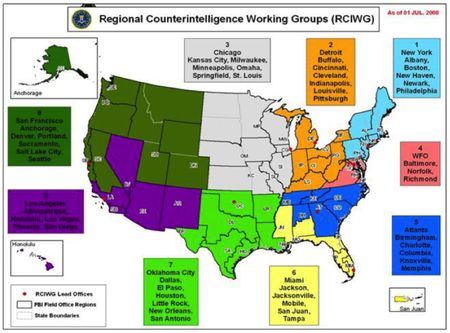
tradecraft procedures tailored to the private sector." The regional scope of these efforts are
illustrated in the following map:
Several
"national outreach organizations, including the Domestic Security Alliance
Council, the National Security Business Alliance Council, and InfraGard"
will also be involved with the FBI in "local, regional and national
efforts" intended to "reach a broad swath of companies in multiple
sectors such as information technology, communications, aeronautics,
engineering, energy, financial services, and consumer retail."
Enforcement
of U.S. trade secret laws will be facilitated through training by the FBI and the
DOJ of prosecutors and investigators, targeting "domestic law enforcement
officers, prosecutors, and international partners." The Department of Defense also has a role in
this effort, and "will collect, analyze and report on threat information
to cleared industries that support Department of Defense programs and the
missions of other U.S. government departments and agencies" and will "deliver
security training and education on counterintelligence."
4. Improve Domestic Legislation
The
Report cites several legislative initiatives, including:
• Public
Law112-236—The Theft of Trade Secrets Clarification Act of 2012 (S.
3642), closed a loophole in the
Economic Espionage Act that had allowed the theft of valuable trade secret
source code. This legislation was introduced by Senate Judiciary Chairman
Senator Patrick Leahy in response to the Second Circuit decision in United
States v. Aleynikov, 676 F.3d 71 (2d Cir. 2012), which overturned a verdict
that found that the defendant violated 18 U.S.C. § 1832(a) by stealing
proprietary computer code, a trade secret, from his employer. This legislation
was in line with the overall IPEC objective of protecting trade secrets from
misappropriation.
• Public Law 112-269—The
Foreign and Economic Espionage Penalty Enhancement Act of 2012 (H.R.
6029/S. 678),
bolstered criminal penalties for economic espionage and directed the Sentencing
commission to consider increasing offense levels for trade secret crimes. Its
passage is an important step in ensuring that penalties are commensurate with
the economic harm inflicted on trade secret owners. The passage of this
legislation could not have been achieved without the efforts of former House of
Representatives Judiciary Chairman Representative Lamar Smith and retired
Senator Herb Kohl.
5. Public Awareness and Stakeholder Outreach
The
report concludes by listing efforts by the Department of Commerce, the U.S.
Patent and Trademark Office and the FBI to increase public awareness of trade
secret theft. The Report also sets out
websites having additional information, including:
• Department of Commerce STOPfakes.gov IPR training module includes an
introduction to trade secrets (available here).
• Special 301 Report released by the U.S. Trade Representative summarizes
troubling trends involving trade secrets and forced technology transfer (available here).
• The Department of State (available here).
• DOJ National Security Division (available here).
• DOJ Criminal Division – Computer Crimes and Intellectual Property Section
(available here).
• FBI Counterintelligence Division (available here).
• National Intellectual Property Rights Coordination Center (available here).
• The Office of the National Counterintelligence Executive (available here).
• The Department of Defense – Defense Security Service (available here).
• Create.org study that includes recommendations for companies operating in
foreign countries to mitigate the risk of trade secret theft (available here).
• The World Intellectual Property Organization (WIPO) has more trade secret
information specifically designed for small and medium-sized enterprises
(available here).
Sprinkled
throughout the Report are specific instances of trade secret misappropriation,
limited (of course) to those instances detected or thwarted, including:
1. Theft of Ford Motor Company Trade
Secrets
In
April 2011, Yu Xiang Dong was sentenced to 70 months in federal prison for
theft of trade secrets and economic espionage. Yu was a former Ford Motor
Company employee who resigned to work at Beijing Automotive Company. He copied
4,000 Ford documents onto an external hard drive, which he took to China. Ford
valued the loss of the trade secrets at $50 million dollars.
2. Theft of DuPont Trade Secrets
Hong
Meng was a research chemist for DuPont. He was involved in researching Organic
Light Emitting Diodes (OLED). DuPont's OLED research efforts resulted in the
development of a breakthrough and proprietary chemical process for OLED
displays. Mr. Meng stole trade secret compounds and passed them to a Chinese
university. He was caught by the FBI and prosecuted by the U.S. Attorney's
Office for the District of Delaware and was sentenced to 14 months in federal
prison. DuPont valued the loss of the trade secrets at $400 million dollars.
3. Theft of General Motors Trade
Secrets
On
November 30, 2012, a Federal jury in Detroit found Shanshan Du, a former
General Motors (GM) engineer, and her husband, Yu Qin, both found guilty of
stealing GM trade secrets related to hybrid vehicle technology worth $40
million. Du and Qin tried to pass the trade secrets to Chinese automaker Chery
Automobile Company.
4. Theft of Cargill and Dow Chemical
Trade Secrets
In
October 2011, Kexue Huang, a former employee of both Cargill and Dow Chemical
passed trade secret information to a Chinese university that was developing
organic pesticides on behalf of China's government. Financial losses to both
companies from his criminal acts exceed $7 million. In December 2011, after
many months of hard work by FBI agents, CCIPS prosecutors and the U.S.
Attorneys' Offices in Indiana and Minnesota, Huang was sentenced to 87 months
in prison — the strongest sentence possible.
5. Theft of Valspar Trade Secrets
David
Yen Lee worked for Valspar, an Indiana paint company. He stole trade secrets
from Valspar and tried to pass them to Nippon Paint in China. Mr. Lee purchased
a plane ticket to China, but was caught by the FBI before he could leave the
U.S. On December 8, 2010, Mr. Lee was sentenced to 18 months in prison. Valspar
valued the trade secrets between $7 and $20 million.
6. Theft of Motorola Trade Secrets
In
November 2011, Customs and Border Protection officers at Chicago's O'Hare
Airport stopped Hanjuan Jin, a former Motorola software engineer, while she was
allegedly carrying 1,000 sensitive Motorola documents, $30,000 in cash, and a
oneway ticket to China. Jin was in the process of traveling to China to turn
over stolen trade secret information relating to mobile telecommunications to
Kai Sun News Technology Co., also known as SunKaisens, and to the Chinese
military.
7. Theft of Goldman Sachs Trade Secret
Goldman
Sachs spent $500 million dollars developing computer source code to support its
high frequency trading program. Sergey Aleynikov, a Goldman Sachs computer
programmer, resigned from his job to work for a competitor, and on his final
day of employment transferred this extremely valuable proprietary computer code
to an external computer server. Mr. Aleynikov had also transferred thousands of
proprietary computer code files to his home computers. Mr. Aleynikov was investigated
by the FBI and prosecuted by the U.S. Attorney's Office of the Southern
District of New York. He was sentenced to 97 months in Federal prison. In
February 2012, his conviction was overturned by the Second Circuit based on the
court's interpretation of the Economic Espionage Act. This loophole was fixed
when President Obama signed Public Law 112236 The Theft of Trade Secrets
Clarification Act of 2012 (S. 3642) on December 28, 2012.
The
Obama Administration's record on intellectual property policy is spotty at
best, including as it does the Department of Justice's benighted position of
the patent-eligibility of isolated human DNA and the laughable "magic
microscope," as well as comments as recently as last week illustrating
that the President has at best an uninformed opinion on intellectual property
issues (see video of comments). But the Report is replete with precatory
admonitions on the value of intellectual property, including statements by the
President that:
Our single
greatest asset is the innovation and the ingenuity and creativity of the
American people. It is essential to our prosperity and it will only become more
so in this century.
We cannot look back
years from now and wonder why we did nothing in the face of real threats to our
security and our economy.
The
proof of this particular pudding will be whether the Administration follows
through on the aims and goals set forth in the Report.


 Patent Docs
Leave a reply to Sovo Cancel reply