
Cats and the Federal Circuit
By Kevin E. Noonan
—
 Unlike dog breeds
that tend to be of ancient vintage (Labra-doodles and Yorkie-poos to the
contrary), many cat breeds are of relatively recent parentage. While there are many naturally occurring
breeds (such as Maine Coons and Norwegian Forest Cats), a surprising number of
cat breeds were developed in the last 50 years or so. The most recent (and perhaps most extreme)
are Savannahs, that are the result of breeding between a domestic short-haired
cat and a serval, a wild, undomesticated African cat. The Federal Circuit had the opportunity to
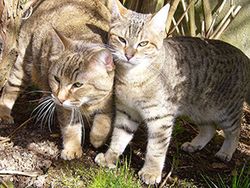
opine on whether another (relatively) recent cat breed, the Pixie-Bob (at right), was
patent-eligible subject matter or novel in an appeal from rejection on both
these grounds before the Patent Office. While the Court avoided the statutory subject matter question, it affirmed
rejection for lack of novelty for the remarkably named applicant, Frank Robert
Ditto.
Mr. Ditto claimed a
breed of cats produced by mating a bobcat, lynx or bobcat-lynx mix with a
domestic cat. The sole independent claim
is directed to "[a] domestic cat breed produced by breeding a purebred cat
produced by mating a Bobcat, Lynx, or Bobcat Lynx species with a domestic cat,"
with dependent claims reciting various phenotypic characteristics of the cats
(in most part relating to the cats' propensity to vocalize). As explained in the specification, the breed
has a unique combination of domesticated behaviors and "the spirit and
disposition of the wild" cat as well as other specific traits (including "a
variety of colors, have hind legs that are larger than their front legs, may
have spotted fur or a stump tail, and have 'sturdy muscular bodies.'"
The Board affirmed
the Examiner's rejection of §§ 101 and 102 grounds. The basis for the § 101 rejection was that the
breed was a "product of nature" that resulted from breedings that
occurred in the wild. The Board affirmed
this rejection insofar as the claims did not require any particular degree of
interbreeding and that naturally occurring cats could satisfy the limitations
recited in claim 1. With regard to the
§ 102 rejections, the Examiner cited two prior art references: a 1994 Seattle Times article by Green relating
to a Pixie-Bob produced by mating of a wild bobcat and a domestic cat (in a
family barn without human intervention); and a 1995 Bellingham Herald article by Porter describing the Pixie-Bob breed
and its introduction to The International Cat Association (TICA) as an "official"
cat breed. These references also
satisfied the limitations recited in claim 1 on similar grounds, i.e., that
there was no limitation as to the degree of breeding required and that "there
was no evidence . . . suggest[ing] any difference between the Pixie-Bob cat
[described in the cited prior art] and the claimed cats."
 The Federal Circuit
affirmed in a per curiam opinion
before Judges Dyk, Prost, and Reyna. Their
opinion did not address the § 101 rejection, finding sufficient evidence that
the claims were anticipated under § 102. According to the panel, the term "purebred" was properly given
its "broadest reasonable interpretation," particularly in view of the
lack of any particular definition in Inventor Ditto's specification. And the panel apparently relied on a
dictionary definition of "breed" as meaning "a distinctive group
of domestic animals differentiated from the wild type under the influence of
man and usu[ally] incapable of maintaining its distinctive qualities in nature,"
citing Webster's Third New International Dictionary of the English Language 274
(1993). Like the Board, the panel
rejected Inventor Ditto's argument that the Green and Porter references did not
describe a breeding that had achieved the desired level of domesticity
(particularly with reference to the TICA "SBT" breeding
standards). Tellingly, Inventor Ditto's
filing date (March 25, 1999) was after the date (May 1, 1998) when TICA accepted
the Pixie-Bob as a recognized breed. According to the panel, both the Green and Porter references disclosed
characteristics and features of the Pixie-Bob cats that are distinctive and
comprise the "desired effects" recited as a limitation in Inventor
Ditto's claims.
The panel's
decision finishes the patenting process for Inventor Ditto. However, the "product of nature"
rejection before the Office remains unscrutinized and intriguing (and,
truthfully and in full compliance with the Supreme Court's analytical protocol,
is based in part on the prior existence — i.e., on § 102 grounds — of the breeding
in nature). But the question can be
presented more starkly with the Savannah cat mentioned above. This cat is bred
solely with human intervention (there is no evidence that the African serval
ever mated in the wild with a domestic cat and certainly not with an American
domestic cat). In addition, males in the
F1 generation are sterile; indeed, it is not until the F4 generation that
fertile males are produced. This
required backcrossing into the domesticated cat stock in order to produce cats
that breed "true," i.e., that have both parents of the Savannah breed. All of these aspects evince the "hand of man" and represent
something that is the "product of human ingenuity 'having a distinctive
name, character [and] use,'" Chakrabarty
at 310, citing Hartranft v. Wiegmann, 121 U. S.
609, 121 U.
S. 615 (1887). Thus it is clear
under prevailing precedent that the Savannah cat should comprise
patent-eligible subject matter. Although
this question is beyond the scope of the question presented to the Supreme
Court in the Myriad case or in Mayo v. Prometheus, the question remains
whether this Court would find these "routine" and "conventional"
breeding methods to provide "enough" for the Savannah cat to be "more
than" a product of nature and become a patent-eligible product of man.
In re Ditto (Fed. Cir. 2012)
Panel: Circuit Judges Dyk, Prost, and Reyna
Opinion per curiam
Image of Pixie-bobs (above) by Angie 1900, from the Wikipedia Commons under the Creative Commons Attribution 3.0 Unported license.


 Patent Docs
Leave a reply to Curmudgeon Cancel reply