
By Kevin E. Noonan —
 The Federal Circuit rendered a fractured decision on Friday in Association for Molecular Pathology v. U.S. Patent and Trademark Office (the Myriad case), with a majority opinion by Judge Lourie, a concurring opinion by Judge Moore joining in certain parts of the "majority" opinion and in other parts concurring with the result, and a concurring-in-part and dissenting-in-part opinion by Judge Bryson (both judges writing separately to share their views of only a portion of the case, the question of subject matter eligibility under 35 U.S.C. § 101 for isolated DNA molecules) (see "Federal Circuit Issues Decision in AMP v. USPTO"). This post will discuss the majority opinion on the substantive issues: the patent-eligibility of the composition of matter claims (where the Court reversed the District Court's finding that "isolated DNA" was not patent-eligible under the "products of nature" "exception") and the method claims (where the Court affirmed the District Court on the diagnostic method claims under the Bilski "machine or transformation test") and reversed on the sole screening method claims (claim 20 of U.S. Patent No. 5,747,282). Future posts will discuss Judge Moore's and Judge Bryson's views on the composition of matter claims, as well as address the standing issue (where the Court affirmed the District Court's finding that the plaintiff's, albeit not all the plaintiffs, had standing under Supreme Court precedent, inter alia, MedImmune, Inc. v. Genentech, Inc.).
The opinion sets forth "representative claims" for the composition of matter, diagnostic method, and screening method claims; for the composition of matter claims, these were claims 1, 2, and 5 of U.S. Patent No. 5,747,282:
1. An isolated DNA coding for a BRCA1 polypeptide, said polypeptide having the amino acid sequence set forth in SEQ ID NO:2.
2. The isolated DNA of claim 1, wherein said DNA has the nucleotide sequence set forth in SEQ ID NO:1.
5. An isolated DNA having at least 15 nucleotides of the DNA of claim 1.
Claim 1 of U.S. Patent No. 5,710,001 and claim 1 of U.S. Patent No. 5,709,999 were cited in the opinion as representative of the "analyzing" or "comparing" claims:
1. A method for detecting a germline alteration in a BRCA1 gene, said alteration selected from the group consisting of the alterations set forth in Ta-bles 12A, 14, 18 or 19 in a human which comprises analyzing a sequence of a BRCA1 gene or BRCA1 RNA from a human sample or analyzing a se-quence of BRCA1 cDNA made from mRNA from said human sample with the proviso that said germline alteration is not a deletion of 4 nucleo-tides corresponding to base numbers 4184-4187 of SEQ ID NO:1.
'999 patent claim 1 (emphases added).
1. A method for screening a tumor sample from a human subject for a somatic alteration in a BRCA1 gene in said tumor which comprises [] comparing a first sequence selected from the group consisting of a BRCA1 gene from said tu-mor sample, BRCA1 RNA from said tumor sample and BRCA1 cDNA made from mRNA from said tumor sample with a second sequence selected from the group consisting of BRCA1 gene from a nontumor sample of said subject, BRCA1 RNA from said nontumor sample and BRCA1 cDNA made from mRNA from said nontumor sample, wherein a difference in the sequence of the BRCA1 gene, BRCA1 RNA or BRCA1 cDNA from said tumor sample from the sequence of the BRCA1 gene, BRCA1 RNA or BRCA1 cDNA from said nontumor sample indicates a somatic altera-tion in the BRCA1 gene in said tumor sample.
'001 patent claim 1 (emphasis added).
Finally, the opinion cited claim 20 of U.S. Patent No. 5,747,282 as the sole screening method claim:
20. A method for screening potential cancer therapeutics which comprises: growing a trans-formed eukaryotic host cell containing an altered BRCA1 gene causing cancer in the presence of a compound suspected of being a cancer therapeutic, growing said transformed eukaryotic host cell in the absence of said compound, determining the rate of growth of said host cell in the presence of said compound and the rate of growth of said host cell in the absence of said compound and comparing the growth rate of said host cells, wherein a slower rate of growth of said host cell in the presence of said compound is indicative of a cancer therapeutic.
After a brief recap of the factual background of the case, illustrated by a number of drawings representing the chemical structure of DNA:
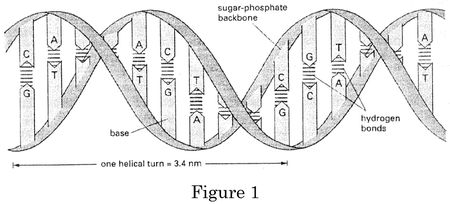
the processes of transcription and translation:

how DNA encodes individual amino acids in a protein:

and the structure of "naturally occurring" DNA in the human chromosome:

the Court addressed the District Court's decision on each of the different types of claimed subject matter in turn.
For the composition of matter claims, Judge Lourie's opinion (not surprisingly) focused on the chemical nature the isolated DNA molecule. The opinion sets out the competing positions of the parties, and mentions the government's "magic microscope" in determining that all the parties seem to agree that "isolated DNA" is a composition of matter (and, although unspoken, thus literally falls within one of the statutory definitions of patent-eligible subject matter). The issue for the Court therefore becomes whether isolated DNA falls within the scope of one of the exceptions to the "broadly construed" categories defined by § 101. The Court starts sets out Diamond v. Chakrabarty and Funk Bros. Seed Co. v. Kalo Inoculant Co. as controlling Supreme Court precedent, citing Chakrabarty for the dicta that "the relevant distinction for purposes of § 101 is . . . between products of nature . . . and human-made inventions." Chakrabarty, 447 U.S. at 313. The opinion recognizes the contrast presented between the genetically engineered bacteria in Chakrabarty and the naturally occurring bacteria in Funk Bros., a contrast the Federal Circuit sees the Supreme Court making in Chakrabarty. Notably, however, the opinion acknowledges that Funk Bros. was decided on the question of "obviousness" (or "invention" as formulated prior to codification of obviousness in the 1952 Patent Act under § 103) rather than subject matter eligibility under § 101. Curiously, the Court in footnote 6 declares that:
We note that [In re] Bergy is no longer binding law. Bergy was the companion case to Charkarbarty, and was vacated by the Supreme Court and remanded for dismissal as moot. Diamond v. Chakrabarty, 444 U.S. 1028 (1980).
While this is certainly one reading of the procedural outcome of the Bergy case, it runs contrary to the generally accepted idea that the Supreme Court in Chakrabarty affirmed (or at least did not disturb) the decision in Bergy that isolated bacteria producing lincomycin were patent-eligible. (Possibly the panel was attempting to distinguish its decision from any suggestion that this three-judge panel was overruling a CCPA decision, something only the en banc Federal Circuit can do.) In this same footnote the opinion distinguished other CCPA cases "cited by the parties and amici" because they "were not decided based on patent eligibility," including In re Bergstrom, 427 F.2d 1394, 1394 (CCPA 1970) ("the court held that pure prostaglandin compounds, PGE(2) and PGE(3), were improperly rejected as lacking novelty"); In re Kratz, 592 F.2d 1169, 1170 (CCPA 1979) ("the court held non-obviousness claims to synthetically produced, substantially pure 2-methyl-2-pentenoic acid ('2M2PA'), a chemical that gives strawberries their flavor"); In re King, 107 F.2d 618, 619 (CCPA 1939) ("holding claims to vitamin C invalid for lack of novelty, as '[a]ppellants were not the first to discover or produce [vitamin C] in its pure form'"); and In re Merz, 97 F.2d 599, 601 (CCPA 1938) ("holding claims to artificial ultramarine that contains non-floatable impurities invalid as not 'inventive,' and thus as obvious"). Elsewhere in the opinion, the majority also distinguishes some old "war horses" of "product of nature" jurisprudence:
Other Supreme Court decisions cited by the parties and amici were decided based on lack of novelty, not patentable subject matter. In American Wood-Paper Co. v. Fibre Disintegrating Co., the Court held the challenged patent "void for want of novelty in the manufacture patented," because the "[p]aper-pulp obtained from various vegetable substances was in common use before the original patent was granted . . . , and whatever may be said of their process for obtaining it, the product was in no sense new." 90 U.S. 566, 596 (1874). Similarly, in Cochrane v. Badische Anilin & Soda Fabrik, the Court held that a claim to artificial alizarine covered an old and well-known substance, the alizarine of madder, which could not be patented although made artificially for the first time. 111 U.S. 293, 311 (1884); see also id. at 308-09 ("It is very plain that the specification of the original patent, No. 95,465, states the invention to be a process for preparing alizarine, not as a new substance prepared for the first time, but as the substance already known as alizarine, to be prepared, however, by the new process, which process is to be the subject of the patent, and is the process of preparing the known product alizarine from anthracine." (emphases added).
The opinion sets forth what the majority sees as the Supreme Court test:
The distinction, therefore, between a product of nature and a human-made invention for purposes of § 101 turns on a change in the claimed composition's identity compared with what exists in nature. Specifically, the Supreme Court has drawn a line between compositions that, even if combined or altered in a manner not found in nature, have similar characteristics as in nature, and compositions that human intervention has given "markedly different," or "distinctive," characteristics. Id. Hartranft, 121 U.S. at 615; see also Am. Fruit Growers v. Brogdex Co., 283 U.S. 1, 11 (1931).
The opinion concludes that the claimed DNA molecules meet this test. This conclusion is based on the chemistry of isolated DNA:
It is undisputed that Myriad's claimed isolated DNAs exist in a distinctive chemical form — as distinctive chemical molecules — from DNAs in the human body, i.e., native DNA. Native DNA exists in the body as one of forty-six large, contiguous DNA molecules. Each DNA molecule is itself an integral part of a larger structural complex, a chromosome. In each chromosome, the DNA molecule is packaged around histone proteins into a structure called chromatin, which in turn is packaged into the chromosomal structure. See supra, Figure 3.
Isolated DNA, in contrast, is a free-standing portion of a native DNA molecule, frequently a single gene. Isolated DNA has been cleaved (i.e., had covalent bonds in its backbone chemically severed) or synthesized to consist of just a fraction of a naturally occurring DNA molecule. For example, the BRCA1 gene in its native state resides on chromosome 17, a DNA molecule of around eighty million nucleotides. Similarly, BRCA2 in its native state is located on chromosome 13, a DNA of approximately 114 million nucleotides. In contrast, isolated BRCA1 and BRCA2, with introns, each consists of just 80,000 or so nucleotides. And without introns, BRCA2 shrinks to just 10,200 or so nucleotides and BRCA1 to just around 5,500 nucleotides. Furthermore, claims 5 and 6 of the '282 patent cover isolated DNAs having as few as fifteen nucleotides of a BRCA sequence. Accordingly, BRCA1 and BRCA2 in their isolated state are not the same molecules as DNA as it exists in the body; human intervention in cleaving or synthesizing a portion of a native chromosomal DNA imparts on that isolated DNA a distinctive chemical identity from that possessed by native DNA.
These are structural arguments, focused on the differences in the chemical structure between the isolated DNA molecules recited in the claims of the patents-in-suit; while this focus is not surprising coming in a Federal Circuit opinion, one of the principle flaws in the District Court's opinion is to decide the case on a philosophical basis, rather than determining what was recited in the claims. In this regard, the Federal Circuit distinguished "isolated" from "purified," and in doing so distinguished these claims from the claims in In re Marden regarding ductile uranium and vanadium, and also from Parke-Davis & Co. v. H.K. Mulford Co., which found purified adrenaline to be patent-eligible because while the molecule was identical to the naturally occurring molecule its purification had converted it into "a new thing commercially and therapeutically." This chemical/structural distinction that forms the (legal) basis of the Court's opinion is that the claimed DNA is not, as it is "in nature, . . . covalently bonded to such other materials." "[A]n isolated DNA molecule is not a purified form of a natural material, but a distinct chemical entity. In fact, some forms of isolated DNA require no purification at all, because DNAs can be chemically synthesized directly as isolated molecules," according to the majority opinion.
The Court also rejects plaintiffs' argument, that isolated DNA is merely a "product of nature" because the isolated DNA shares its sequence with DNA in its native state in the chromosome, saying that this argument "looks not at whether isolated DNAs are markedly different — have a distinctive characteristic — from naturally occurring DNAs, as the Supreme Court has directed, but at one similarity: the information content contained in isolated and native DNAs' nucleotide sequence." This is the error that the District Court made, because "it is the distinctive nature of DNA molecules as isolated compositions of matter that determines their patent eligibility rather than their physiological use or benefit." The focus of this argument on uses is appropriate for deciding obviousness, not patent-eligibility, according to the opinion. "The claimed isolated DNA molecules are distinct from their natural existence as portions of larger entities, and their informational content is irrelevant to that fact."
In addition, the majority states that the District Court's opinion creates a new categorical rule of patent-ineligibility, something contrary to Supreme Court mandates, saying the high court "more than once cautioned that courts 'should not read into the patent laws limitations and conditions which the legislature has not expressed,'" citing Bilski, 130 S. Ct. at 3226 (quoting Diamond v. Diehr, 450 U.S. 175, 182 (1981)).
The opinion also (thankfully) rejects the "magic microscope" analysis by the government "as it misunderstands the difference between science and invention and fails to take into account the existence of molecules as separate chemical entities." Moreover:
The ability to visualize a DNA molecule through a microscope, or by any other means, when it is bonded to other genetic material, is worlds apart from possessing an isolated DNA molecule that is in hand and usable. It is the difference between knowledge of nature and reducing a portion of nature to concrete form, the latter activity being what the patent laws seek to encourage and protect.
Such an approach would "discourage innovation," because "[v]isualization does not cleave and isolate the particular DNA; that is the act of human invention."
The Court wisely rejects the "many thought-provoking hypotheticals" which "each . . . raise[] a complicated issue of patent eligibility" because these questions are "not before the court," taking to heart the maxim that "bad analogies make bad law." Put simply, "courts decide cases, they do not draft legal treatises." In this regard, the opinion mentions the litany of hypotheticals, including patenting "isolated chemical elements," "minerals found in the earth," "atomic particles," "organs," and "a leaf from a tree." "None of these examples, however, as far as we can discern, presents the case of a claim to a composition having a distinctive chemical identity from that of the native element, molecule, or structure," according to the Court, citing the lack of distinctiveness for each example. "Some may have a changed form, quality, or use when prepared in isolated or purified form, but we cannot tell on this record whether the changes are sufficiently distinctive to make the composition markedly different from the one that exists in nature. In contrast, a portion of a native DNA molecule — an isolated DNA — has a markedly different chemical nature from the native DNA. It is, therefore, patentable subject matter."
Finally, the opinion cites J.E.M. Ag Supply, Inc. v. Pioneer Hi-Bred International, Inc. for the principle enunciated by the Supreme Court that Congress needs to make these decisions, not the courts. In view of the reality that the PTO has been granting patents on isolated DNA molecules for 30 years, the opinion reminds us that "courts must be cautious before adopting changes that disrupt the settled expectations of the inventing community," Festo Corp. v. Shoketsu Kinzoku Kogyo Kabushiki Co., 535 U.S. 722, 739 (2002) (citing Warner-Jenkinson Co. v. Hilton Davis Chem. Co., 520 U.S. 17, 28 (1997); it is a principle administrations would be wide to adopt (or at least consider).
Turning to the method claims, the Court readily affirmed the District Court's finding that the "comparing" and "analyzing" claims (claim 1 of the '001 patent and claim 1 of the '999 patent) failed the machine-or-transformation test. Although the District Court decided this case before the Supreme Court's Bilski v. Kappos decision, the majority reached a decision on the merits because it reasoned that the parties had had sufficient opportunity to address the issues. The Court's decision was based on the language of the claims at issue, which do not recite affirmative steps for obtaining the sequence (and thus could be infringed "merely" by comparing or analyzing sequences). "This claim thus recites nothing more than the abstract mental steps necessary to compare two different nucleotide sequences: look at the first position in a first sequence; determine the nucleotide sequence at that first position; look at the first position in a second sequence; determine the nucleotide sequence at that first position; determine if the nucleotide at the first position in the first sequence and the first position in the second sequence are the same or different, wherein the latter indicates an alternation; and repeat for the next position."
Myriad argued (in order to "escape this result), that the claims should be read to contain "additional, transformative steps," including "the steps of (1) extracting DNA from a human sample, and (2) sequencing the BRCA DNA molecule, arguing that both steps necessarily precede the step of comparing nucleotide sequences." Not only were these steps not recited in the claims as affirmative limitations, the Court found that the specification required the term "sequence" to refer "more broadly to the linear sequence of nucleotide bases of a DNA molecule." In arriving at this conclusion, the Court distinguished these claims from the claims in Prometheus Labs., which the opinion states recite affirmative steps that are transformative. In contrast, Myriad's claims can be satisfied (i.e., infringed) by "mere inspection" alone, and thus encompass merely an abstract idea. Claim 20 of the '282 patent (the chemotherapeutic agent screening claim) was transformative, according to the Court, because it recited transformative steps ("growing said transformed eukaryotic host cell in the absence of said compound" and "determining the rate of growth of said host cell in the presence of said compound and the rate of growth of said host cell in the absence of said compound") in addition to the comparative step. As in Prometheus, the Court determined that the recitation of the transformative steps were sufficient to satisfy the machine-or-transformation test, and accordingly reversed the District Court's determination that claim 20 was patent-ineligible.
Association for Molecular Pathology v. U.S. Patent and Trademark Office (Fed. Cir. 2011)
Panel: Circuit Judges Lourie, Bryson, and Moore
Opinion for the court by Circuit Judge Lourie; opinion concurring in part by Circuit Judge Moore; opinion concurring in part and dissenting in part by Circuit Judge Bryson


 Patent Docs
Leave a reply to EDV Cancel reply