
By Kevin E. Noonan —
An anonymous correspondent writes:
48 hours ago, it looked like the Patent Reform Act was a done deal. Today, it's not at all that clear.
Tuesday afternoon, Harold Rogers (Chairman of the House Appropriations Committee) and Paul Ryan (Chairman of Budget) wrote a letter to Chairman Smith insisting on maintaining the power of these two committees to raid the Patent Office of its user fees. [See "Patent Reform News Briefs," June 7, 2011.] What isn't mentioned in the letter is that Chairman Rogers was one of the main architects of fee diversion in the early part of the decade.
Wednesday, four senior members of the Appropriations Committee reiterated their preference for fee diversion.
It can be expected that almost all stakeholders will come out in opposition to the bill if the appropriators get their way.
On Wednesday afternoon, in a debate between Robert Armitage (Eli Lilly) and Steven Miller (Proctor & Gamble) as proponents of the bill, against Pat Choate (an economist) and Jonathan S. Massey of Massey & Gail (a former Supreme Court clerk) in opposition to the bill, reports are that audience members came away with the realization that the bill raises real questions, that it may indeed be harmful to companies outside the Fortune 100, that the opponents of the bill have valid concerns, and that constitutionality of some provisions is certainly sufficiently questionable to create commercial uncertainty.
In a third letter, Rep. Adam Schiff [D-CA] joined other legislators that have expressed concerns with several provisions of the bill.
One knowledgeable source (who wished not to be identified) expressed the opinion at the end of the day Wednesday that the bill was no longer a "done deal," that its passage was truly an open question.
Phone calls that seemed hopeless a week ago could now be decisive — the fate of the bill turns on about 5000 phone calls to representatives.
 The letters in question raise legitimate questions. As noted in an earlier Patent Docs post, Representatives Harold Rogers (R-KY) and Paul Ryan (R-WI) object to provisions of the House "patent reform" bill (H.R. 1249) by citing Constitutional concerns (transferring appropriation authority from Congress to the Executive) and partisanship (characterizing this change as being contrary to "the new Republican majority's commitment to restraining spending, improving accountability and transparency, and reducing the nation's unparalleled deficits and debt" and saying that "it would be both irresponsible and unwise to allow the PTO to operate solely under the authority of bureaucrats and White House political appointees," conveniently forgetting that the Bush White House ended fee diversion from 2004-2008).
These sentiments were echoed (almost word-for-word) in a second letter from Rep. Rogers, joined by Representatives Frank Wolf (R-VA), Norman Dicks (D-WA), and Chaka Fattah (D-PA).
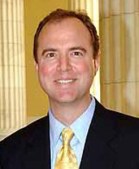 On the other hand, Rep. Adam Schiff (R-CA) (at left) writes to oppose the "First to File" system set forth in Section 2 of the bill. Rep. Schiff writes that this change will be "counterproductive" because it will hurt "the most creative inventors in our economy and lead to rushed patent filings." In support of this proposition, he notes that "[t]he driving force of innovation comes from small, agile firms that marshal creative energies in exciting and productive ways" and that "[i]t is precisely these small firms" that will be hurt by this change, in his opinion. Rep. Schiff cites the need for such small companies "to do additional market research, talk to venture capitalists or investors, develop their idea further and a myriad of other necessities" that the current system permits and a "first to file" regime will inhibit. He also ties the need for outside patent counsel to prepare applications that will ultimately be discarded as a misuse of resources that would otherwise be used for "hiring and actual act[s] of invention."
Artful lobbying and crafty politics (as well as a genuine belief that "patent reform" is necessary to address the backlog and other perceived weaknesses in the patent system) have gotten us to this moment. Whether sufficient political opposition can be mounted to prevent passage of H.R. 1249 is an open question, one that will only be answered if enough stakeholders who think the bill is fundamentally flawed exercise their franchise and let their Representative know. The time (once again) is now.


 Patent Docs
Leave a reply to staff Cancel reply