
By Kevin E. Noonan —
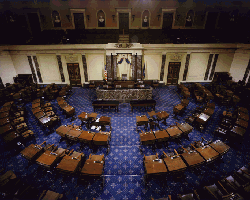 The Senate Judiciary Committee met today and passed S. 23, the Patent Reform Act of 2011, sending it to the Senate floor for consideration. The vote was 15 ayes, no nays, and on abstention (by Senator John Cornyn, R-TX). But prior to the vote, there were several (but fewer than expected) amendments presented and adopted, and several Senators who voiced their intention to bring amendments to the Senate floor and, if they were not included in the final bill, these Senators could not pledge their support.
Senator Jon Kyl (R-AZ) spoke extensively on changes in this bill from the Managers' Amendment to S. 515 passed by the committee in the last Congress. These changes, specifically to the post-grant review provisions of the bill, made it possible for him to support the measure, as he proposed it be amended. He voiced his "deep misgivings" about previous versions of the bill, and praised Committee Chairman Patrick Leahy (D-VT) for taking his suggestion and meeting with senior U.S. Patent and Trademark Office officials to address concerns that post-grant review would be difficult to implement and increase the backlog and patent application pendency. The bill as amended would have two differences from earlier versions that the Senator believes will be important: first, inter partes post-grant review would be conducted by the USPTO as an adjudicated proceeding, unlike the present system which is substantially similar to ex parte prosecution (albeit with third party requestor commentary). Senator Kyl called these proceedings "cumbersome" and "slow" and said that the system proposed in the bill would address these concerns by having each party present their evidence (and, presumably, rebuttal by patentee) to the Patent Office, which would then render a decision on whether the requestor had shown one or more claims to be invalid. The evidence would be limited to prior art printed publications and patents, and there would be no discovery (and, presumably, no evidence of on-sale activity or § 112 deficiencies). In addition, the threshold for granting review would be heightened from the present "substantial question of patentability" standard to a "reasonable likelihood of invalidity" standard, which the Senator hailed as being fair to patentees (by reducing or eliminating spurious or non-meritorious requests) and challengers (since there should be little justification for complaint if a requestor did not have sufficient evidence to satisfy a reasonable likelihood standard). The Senator contrasted this expected outcome with the present ex parte and inter partes re-examination regimes, where 95% of requests are granted, "many clearly unnecessary and some sought to gain advantage in litigation," which he characterized as a "gross waste of PTO resources." The Senator also noted that these provisions would provide incentives for challengers to "front-load" their evidence, enable the Patent Office to meet the one-year deadline for deciding post-grant review challenges, and to protect patentees from harassment by requests of dubious merit. Senator Kyl's amendment was unanimously approved by the committee by voice vote.
 Several Senators voiced concerns over business method patents, but while an amendment by Senators Charles Schumer (D-NY) and Kyl was not put to a vote, the sentiments of several of the committee members were strongly expressed. Senator Kyl called the Federal Circuit's State Street decision allowing business method patents a "serious error," something not permitted by other patent systems, and that has resulted in "thousands of invalid business method patents [that] remain on the books and [are] used to extract large sums of money from defendants." He supports the establishment of a temporary procedure for the PTO to invalidate these patents, to remove a "blight on the economy" more cheaply than by litigation. Senator Schumer said he would offer a business method patents provision on the Senate floor, calling business method patents a "plagu[e on] the financial sector," "anathema" to a patent system intended to protect technological innovation, and that business methods permit protection of "abstract and common concepts" because the nature of the financial services industry prevents the Patent Office from recognizing prior art (presumably because most businesses have traditionally kept such methods as trade secrets). He said that business method patents are litigated thirty times more frequently than all other patents, and that his amendment would let companies "targeted" by business method holders to go before the PTO and demonstrate the patent invalid over prior art, using an undescribed "efficient administrative proceeding." Senator Schumer also stated that he would not be able to support passage of the bill by the Senate if it did not contain some provisions for addressing business method patents. Senator Feinstein (D-CA) would go even further in her remarks, suggesting that the bill should simply ban business method patents altogether.
Senator Grassley (R-IA) proposed an amendment that passed on voice vote to ban methods for tax (avoidance) strategies. He noted that this problem came to his attention when several Certified Public Accountants were sued by a tax strategy patentee, and that his amendment was intended to protect taxpayer rights (i.e., the inalienable right to pay as little in taxes as possible legally). He said that such patents "encumber the use of the tax laws" by taxpayers, and can result in taxpayers having to pay a fee to a patentee for merely complying with the tax code, citing protection that would give private parties the "exclusive use" of loopholes in the tax code. "All taxpayers" should have equal access to tax strategies, in the absence of which the fairness of the system could be threatened, according to Senator Grassley. He specifically pointed out that his amendment would not ban software tools for preparing tax returns.
The committee also approved by voice vote "technical" amendments, and Senator Feinstein's "compromise" on willfulness, but did not vote on amendments to the "first-inventor-to-file" provisions or Senator Schumer's "generic drug" amendment. The committee also did not vote on Senator Tom Coburn's (R-OK) fee diversion amendment, which he will introduce during debate on the Senate floor. Senator Leahy gave Senator Coburn the floor for a (relatively) long discussion of his proposed amendment, which was supported by several other committee members. Senator Coburn asserted that there was a "contract with America" that patent fees were collected to pay for patent examination, and that "if an American pays a fee he should get what he pays for" and not for funding other aspects or parts of the government. He called intellectual property protection something that needs to be done in an expeditious and timely manner and produce "quality" patents, and that excess monies collected by the Patent Office should be used to provide additional services by the Office to examine and grant additional patents, rather than being diverted for other uses. He said he believed this was part of a bigger effort to adjust spending, debt, and the economy.
Senator Durbin (D-IL) raised a question that shed light not only on why Senator Coburn did not offer his amendment for consideration by the committee but also how legislators think about questions involving revenue. He asked who should be responsible for oversight on how PTO monies are spent, in view of the interests of the Appropriations Committee in federal revenue. Senator Coburn indicated that he believed the Judiciary Committee had that authority, although he backtracked slightly when Senator Durbin mentioned the Appropriations Committee staff dedicated to monitoring how monies were spent by various agencies. Senator Coburn countered that there is "not enough" oversight by Congress, although comments by other Senators indicated that this was not merely a "turf war" but a more fundamental question of how appropriation decisions are made (and perhaps the consequences of having other committees exert influence on these issues). Senator Coburn's comments on fee diversion were supported by Senators Grassley and Christopher Coons (D-DE) (the latter saying there is a "delicate relationship" between how the different Congressional committees could exercise oversight), and Senator Orrin Hatch (R-UT) called fee diversion "despicable" in supporting this amendment, also saying fee diversion was a "tax on innovation." Senator Cornyn called these provisions "central to the bill" which he predicted would have a "big impact on the country, on intellectual property rights and the economy."
The bill now moves to the Senate floor for eventual consideration. There has not yet been a patent reform bill introduced in the House of Representatives.


 Patent Docs
Leave a reply to anonymous Cancel reply