
By James DeGiulio —
 Genzyme's manufacturing problems with their $300,000 per year drug Fabrazyme have prompted patients who depend on the enzyme replacement drug to ask that Health and Human Services (HHS) Secretary Kathleen Sebelius exercise the government's "march-in rights" under the Bayh-Dole Act. The 1980 law empowers the federal agency funding the research, here the HHS, to abrogate Genzyme's U.S. Patent Nos. 5,356,804 and 5,560,757 on the drug, allowing other companies to fill the demand. The agency is empowered to provide licenses to other interested parties when the "health or safety needs" of the American people are not being "reasonably satisfied" by the patent holder or its exclusive licensee.
 Despite numerous petitions, no agency has ever exercised its "march-in" powers, and the NIH has repeatedly denied formal requests to march in, as they did with regard to CellPro and Norvir. However, this is the first time actual patients have alleged that a patent-holder isn't satisfying their needs. Unfortunately, even if the petition is granted, it is unclear which company would be equipped to take immediate advantage of an opportunity to produce Fabrazyme. One possibility could be UK-based Shire, who earlier this year applied to the FDA for market approval of Replegal, an enzyme-replacement drug similar to Fabrazyme. Shire had previously offered to supply Replegal drug free of charge to U.S. patients taking Fabrazyme, but this summer Shire announced it could no longer provide Replegal to new patients.
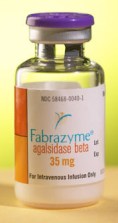 The petition was filed by a family prone to Fabry disease, a rare genetic disorder that interferes with fat metabolism. Patients with Fabry disease build up fats in body tissues, leading to kidney and heart failure, and usually death. The disease is also known to produce severe pain in the arms and legs, severe intestinal problems, profound fatigue and other maladies. About 1,500 patients with Fabry disease depend on Fabrazyme, which was approved in 2001.
Due to Genzyme's manufacturing issues, only 30 percent of the needed amount of Fabrazyme is available. Earlier this year, Genzyme discovered viral contamination in equipment used to produce Fabrazyme, and later discovered foreign particles in several lots of drug vials. As a result, the company has been fined $175 million by the FDA.
James DeGiulio has a doctorate in molecular biology and genetics from Northwestern University and is a graduate of Northwestern University School of Law. Dr. DeGiulio is a member of MBHB's 2010 associate class and he can be contacted at degiulio@mbhb.com.


 Patent Docs
Leave a reply to 6 Cancel reply