
By Kevin E. Noonan —
At least since William Shockley's crackpot racial
theories had their brief moment in the public discourse, it has been evident
that merely achieving a Nobel Prize is not a guarantee of Solomonic wisdom,
particularly outside the recipient's field of expertise. Or perhaps it is just a reflection of
the human reality that the fickle finger of genius touches even the most
brilliant of us serendipitously and cannot be counted as a birthright of any
constancy — strokes of genius perhaps being more like strokes of lightening than
we would care to admit.
This is particularly true of fields like economics,
where the complexities of the subject matter (and the difficulties is fashioning
meaningful "controls") frequently render conclusions that differ from
reality — if it were different, we could just transport the Fed to the
University of Chicago's economics department and be done with it. But all too often, economic predictions
and even analyses fall short, not due to anything other than the impossibility
of accuracy in describing these aspects of the world around us.
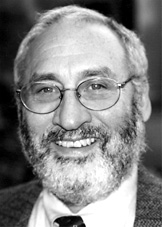 These characteristics of economic analysis come to
mind in considering Professor Joseph Stiglitz's (at right) op-ed piece in Friday's Wall Street Journal, purportedly making "The
Case Against Gene Patents." (The
Professor is joined by another Nobelist, John Sulston (below), chair of the Institute
for Science, Ethics and Innovation at the University of Manchester; his Nobel
was for medicine, awarded in 2002.) Professor Stiglitz, who is at Columbia University, won the Nobel Prize
in 2001 for his work on information assymetry. He was Chair of the President's Council of Economic Advisors
under President Clinton, and in
addition to the Nobel, has won the John Bates Clark Medal (1979) and is "one
of the most frequently-cited economists in the world" according to the
University of Connecticut's Department of Economics.
 And yet, Professor Stiglitz falls into the same
errors that far lesser pundits and polemicists have been prey to in the gene
patenting debate. Of course, the Professor was part of the
ACLU "team" that won a summary judgment verdict from a District Court
judge last month, so he is hardly unbiased on the issue. But he does make some idiosyncratic
errors that illustrate how far afield from reality the anti-gene patenting
folks are willing to go.
First, he states that "Myriad [has] had total control over the BRCA1 and BRCA2 genes since the
1990s. No other companies have been able to do research on the genes without
Myriad's permission." Partially true, with regard to companies — it should come as no surprise
that patents prevent competing commercial
activity. But this is hardly total
control, since extensive basic research has been done on these genes since
Myriad (and their licensor, the University of Utah) were granted the
patents. And there are extensive
commercial uses for the genetic information that could have been pursued by
companies without infringing. What
other companies have not been able to do is practice the patented invention.
He then states that genes "contain
the most fundamental information about humanity — information that should be
available to everyone." As
they are — the information is not patented. It has been a consistent theme of the ACLU and their friends
that Myriad has somehow hijacked an individual's genes, when the fact is that
gene patents do nothing of the sort.
 Speaking as an economist, Professor
Stiglitz then purports to introduce "a deeper understanding of the
economics and science of innovation" that, he says, "leads to exactly
the opposite conclusion" asserted by gene patent proponents, viz. that "private companies will
not engage in genetic research unless they have the economic incentives created
by the patent system." Unfortunately,
he then misconstrues the fundamental societal benefit conferred by the patent
system — not incentives to innovate, and not even incentives to commercialize,
but the requirements for disclosure that are fundamental to the patent
grant. Again misunderstanding the
difference between the patented article — an isolated nucleic acid encoding a
specific protein — and the information content comprising the sequence,
Professor Stiglitz asserts that patents "not only prevent the use of
knowledge in ways that would most benefit society, they may even impede
scientific progress." His
basis for this statement? "Every
scientific advance is built on those that came before it. There is still a
great deal to learn about our genes, particularly how they contribute to disease. Gene patents inhibit access to
the most basic information."
Once again, actually that is simply not
the case. Not only is there no
evidence to support the statement that gene patents have impeded genetic
research, there is copious evidence to the contrary — the almost 8,000 basic
scientific references that have been published since the Myriad patents at
issue in the ACLU lawsuit were granted. So the "patents impede scientific progress" argument does not
seem to have benefited from the Professor's deeper understanding of either
economics or science.
The next issue the Professor raises is
the potential "patent thicket" that might arise in an era of
personalized medicine when an individual's genetic information may be commonly
obtained, at least for genetic loci identified as being involved in the
etiology of common diseases. Here
he has a point, but it is a prospective one — that era is not yet upon us, for
one, and the types of claims invalidated by the District Court are not the ones
that will impact personalized medicine. The invalidated claims were, in large part, directed to the isolated
genes themselves. These claims
were targets because they had sufficient potential political impact — they
supported the "don't patent my genes" campaign mounted by the ACLU to
provide the background drumbeat of support from media and "grassroots"
outlets, they could be easily fashioned into a "message" with great
emotional impact, and they were the types of claims that are the bedrock of the
biotechnology industry.
However, it is unlikely that any of
these claims are infringed in performing the types of genetic testing either as
performed by Myriad for the BRCA1 and BRCA2 genes, or that would be implicated
in personalized medicine. That is
because these claims have the following structure (illustrated for BRCA1 but in
common with most other claims to isolated genes):
1. An isolated
DNA coding for a BRCA1 polypeptide, said polypeptide having the amino acid
sequence set forth in SEQ ID NO:2. [U.S. Patent No. 5,747,282]
In order to be infringed, this claim
requires that the full-length BRCA1 gene be isolated, and that it encode the
polypeptide identified by SEQ ID NO: 2. For personalized medicine, on the other hand, the identification of
disease-related polymorphisms in BRCA1 (or any other gene) will not require
isolation of the full-length gene. Instead, the polymorphic site will be identified, and only that fragment
of the gene will need to be interrogated. However this is done, it will not infringe a gene claim like claim 1 of
the '282 patent unless the entire, full-length gene is isolated. For economic if not scientific reasons,
this will simply not be done because it doesn't need to be.
The Professor argues that in the brave new
world of personalized medicine, "free sharing of information about genes will be vital to understanding the role of
these variations in human disease and other
traits" (emphasis added). That, of course, is the world we have
today, since the unpatentability of genetic information (and the patentability
of isolated genes) has resulted in a free-flow of information from universities
and governmental and non-governmental research institutes. In short, there is no incentive to
suppress this information, since the aspects that are patentable — isolated
genes — can be protected. Indeed,
in view of the disclosure requirements of U.S. patent law — specifically 35
U.S.C. § 112 — such full and complete disclosure is required (said disclosure
requirements not being an aspect, for example, of scientific research
papers). So as things now
stand (before the ACLU took up the anti-gene patenting torch), "the basic
data" of our genes is "freely available to everyone to interpret and
develop." What is not
permitted — during the temporary existence of a patent — is commercial activity
in competition with the patent holder or her licensee.
Of course, cost comes into the
equation, and the fact that some women are not able to afford the Myriad
test. But those costs are not
completely the consequence of the tests being patented, and any unavailability
of the tests is more the result of the lunacy of permitting insurance companies
instead of doctors to decide who does (and who does not) get needed care. The Professor asserts that "[p]atents
are also not necessary for ensuring that genetic tests come to market"
based on the representations of "[o]ther
labs" that they are prepared to provide the test for "a few hundred
dollars" rather than what Myriad charges. This is not surprising — these "other
labs" didn't have to incur the start-up costs and attract the investors at
a time when the success of Myriad's test was not assured. It is always easier to copy than to
innovate and commercialize, and the ex
post facto reasoning that these "other labs" can now provide
these tests more cheaply ignores the frank reality that the patent system
provides for that — these labs, and every other lab, will be able to enter the
marketplace unfettered by Myriad's patent rights when the patents expire,
sometime in 2014.
Professor Stiglitz saves some of the
best (or worst) flights of fancy until the end of the piece. The consequence of less private
investment in commercializing the fruits of genetic research by banning patents
would result in "a slight slowdown in private research expenditures,"
he says, which "can and should be made up for by an increase in public
expenditures." Governmental
control over the means for production was tried, famously and unsuccessfully,
in the 20th Century, and a non-existent limitation on genetic
information hardly justifies trying that experiment again, particularly in a
field like healthcare that is so important to everyone. The uproar over this administration's
healthcare initiative — which hardly substituted private with public control
over the healthcare system — should convince dispassionate observers that the "public option"
is not a viable one.
He also states that genes "are an
example of 'basic knowledge'" like mathematical theorems, again neglecting
the tangible/intangible, patent-eligible/ineligible distinction between genetic
information and isolated genes. He
compares patenting genes to patenting Alan Turing's "mathematical
insights," which if patented might have "greatly delayed" the
development of the modern computer according to the Professor. In this he neglects the unfortunate
facts that Turing's insights were made in the 1950's, while the personal
computer was developed in the 1970's – 80's. Moreover, even if patented, Turing's patents would have
expired 15-20 years before Steve Jobs and Bill Gates created the personal
computer revolution; an equally likely case might be made that patent protection would have provided the
incentive to commercialize the personal computer more rapidly by companies like
IBM and Xerox.
His conclusion shows how badly
Professor Stiglitz has assessed the reality of biotechnology innovation:
It's true that knowledge cannot be produced without cost,
but there is a proven alternative: government- and
foundation-supported research in universities and research laboratories.
For over a generation, this is
precisely what has happened: universities and research institutes have performed the basic scientific
research, and the potential to protect the practical applications of that
research through patenting have provided the incentives (and the economic
benefits to those universities and research institutes) for companies to commercialize
them. This partnership has
propelled the U.S. to the forefront of biomedicine, providing biologic drugs
and diagnostic methods for important and previously-intractable diseases. The industry has in some ways been a
victim of these successes: the
uninformed and willfully misinformed see these beneficial consequences and
misunderstand or misrepresent the critical importance of patenting in its
historical development. Professor
Stiglitz characterizes the District Court's decision as a "critical
achievement"; in ways only an economist can be, he is completely wrong,
and the evidence of the past 30 years provides ample evidence of that fact.


 Patent Docs

Leave a reply to Dan Feigelson Cancel reply