
By Kevin E. Noonan —
Fifteen hundred years ago everybody
knew the Earth was the center of the universe. Five hundred years ago,
everybody knew the Earth was flat, and fifteen minutes ago, you knew that
humans were alone on this planet. Imagine what you'll know tomorrow.Men in Black (1997)
 And in 2010, everybody knows that gene patenting is
a bad idea, at least if you define "everybody" as the editorial boards
of major metropolitan newspapers (and, of course the ACLU). Today, The Boston Globe took that brave stand in an editorial that proved they
know much less than that.
The conclusion is familiar, but the level of either
ignorance or misinformation is impressive. Here is a smattering:
Under US patent law, no one can
patent what occurs in nature.
Ah, no. Possibly correct if the sentence read ". . . what occurs in nature as it occurs in nature," but
certainly not correct as written. And a good thing, too, since the natural world is full of chemical
compounds (such as taxol) that are useful as medicines. An absolute ban on patenting chemicals
that occur in nature (in an purified state) would preclude protection for any
such medicine — a bad (and unnecessary) result, but one that would follow from
the kind of absolute ban The Globe
envisions.
And it isn't even good law. The closest Supreme Court case on
point, the Wood Paper Patent Cases
from the 19th Century, says (with regard to a claim for purified
cellulose):
Whether a slight difference in the degree of purity of an article produced by
several processes justifies denominating the products different manufactures,
so that different patents may be obtained for each, may well be doubted, and it is not necessary to decide.
Which says nothing about
a purified chemical (and the patent rolls abound which such patents). Providing a nice counterpoint is much
more recent, binding Supreme Court precedent that "anything under the sun
made by man" is patentable, for things that are "a
product of
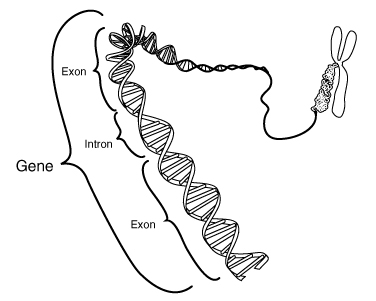
human ingenuity 'having a distinctive name, character [and] use'" (Diamond v. Chakrabarty). Isolated nucleic acid qualifies under this proper standard.
 It is also sad (albeit not surprising) that the
message that gene patents do not impede basic research hasn't penetrated — the
editorial states that "researchers who
discover what a specific gene does can retain the exclusive right to study it." Again, no, and that isn't
even a matter of opinion. Had the
esteemed editorial writers at The Globe
bothered to do their own basic research (something much less difficult than
scientific research), they would have realized that thousands of papers written
by hundreds of researchers other than the
scientists who patented the BRCA1 and BRCA2 genes have been published since the
late 1990's (the time when the patents at issue were granted). So the inventors named on those patents
(and their assignees and licensees, including Myriad Genetics) don't seem to
have exercised any exclusive rights with regard to such basic research. The Globe thinks that "[s]uch research
should be an open avenue of scientific inquiry," and apparently it is.
Then the editorial
strives for — and attains — complete unreality. Addressing the argument that gene patenting is necessary for
attracting investment and to insure a return on such investment, the writers
assert:
Yet even without gene patents, it's
hard to imagine that companies would not invest in the basic research that
leads them to tests and treatments that can be patented — and become
highly profitable — for devastating diseases.
It appears that no one
told The Globe's editorial board that
the ACLU has sued not only on claims to the genes, but to the genetic tests as well — the very tests The Globe agrees should be patentable. And insofar as those "treatments" The Globe endorses include the drugs — in this case, biologic drugs —
used in those treatments, gene patents are an important component of protecting
those drugs and making investment capital available for their commercialization.
Blissfully ignorant of
these realities, The Globe concludes
its editorial like this:
Eliminating these patents would attract
new researchers and sources of capital that could lead to treatments for many
diseases, including Alzheimer's and cancer. It would also encourage market
competition for tests and treatments based on gene sequences, saving money as
well as lives.
On the contrary,
without these patents there would be much less investment, and it is difficult
to see how there could be more basic research than is already being done. "Market competition" is fine,
but the concept can't be cherry-picked — the very market that promotes
competition can completely stifle progress by precluding the conditions
necessary to attract investment. That is the future The Globe
envisions, because its editorial writers blindly accept the wisdom of what
everybody knows.


 Patent Docs
Leave a reply to Dan Feigelson Cancel reply