
By
Donald Zuhn

ScienceFriday Last
week, National Public Radio's Science
Friday
, which is broadcast nationwide as part of NPR's Talk of the Nation, examined the issue of gene patenting.  The debate over gene patenting reignited
in May as a result of the Association for
Molecular Pathology v. United States Patent and Trademark Office
case, in
which a group of patients, physicians, academic researchers, and medical
societies filed suit against the U.S. Patent and Trademark Office and Myriad
Genetics, among others, over several patents claiming human BRCA1 and BRC2
genes and methods for detecting mutations in these genes to diagnose a
predisposition to breast and ovarian cancer (see Patent Docs reports here and
here).  Since then, two public
radio debates have focused on the issue.
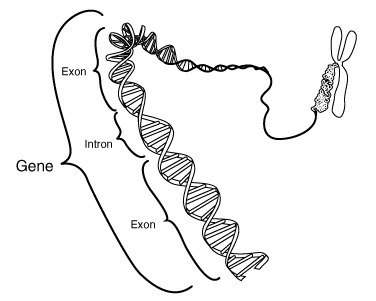
Gene In
June, Dr. Hans Sauer, the Associate General Counsel for Intellectual Property
for the Biotechnology Industry Organization (BIO); Joshua Sarnoff, Professor of
the Practice of Law at American University's Washington College of Law; and
Shobita Parthasarathy, Co-Director of the Science, Technology and Public Policy
Program at the Ford School of Public Policy at the University of Michigan
discussed the topic on WAMU, Washington, DC's leading public radio station (see "Gene Patenting Debate
Continues
").  And last August, Kevin Keenan,
Executive Director of the ACLU for San Diego and Imperial Counties; Stacey
Taylor, a partner at DLA Piper; and Dr. Leonard Deftos, Professor of Medicine
in Residence at the University of California, San Diego, and Adjunct Professor
of Law at California Western School of Law tackled the issue on San Diego's
KPBS "These Days" program (see
"Gene Patenting Debate Continues – Round Two").  This past Friday, Patent Docs author Dr. Kevin Noonan, a partner at McDonnell Boehnen
Hulbert & Berghoff, and Daniel Ravicher, the Executive Director of the
Public Patent Foundation (PUBPAT), which is serving as
co-counsel in the Association for
Molecular Pathology
case, squared off in a third debate
on the topic on NPR's Science Friday.

Flatow, Ira Science Friday
host Ira Flatow (at right) began the program by asking Mr. Ravicher why the lawsuit was
brought.  Mr. Ravicher replied that
the suit was "about whether or not the government has the right to grant
exclusive rights to one company over our genes" as well as the knowledge
of gene mutations that might relate to a predisposition for particular types of
diseases.  He added that the suit
was filed because Myriad Genetics, which co-owns the seven patents-in-suit, had
been asserting the patents in a way that "crack[s] down on anyone else
doing any research" and "anyone else doing . . . second opinion
testing."  After Mr. Flatow
noted that the PUBPAT website describes gene patent holders as having "the
right to prevent anyone from studying, testing, or even looking at a [patented]
gene," Mr. Ravicher declared that "there's absolutely conclusive
ownership of the gene by the patent holder."
Noonan, Kevin Mr.
Flatow then turned to Dr. Noonan (at left) for a response, asking whether he agreed with
Mr. Ravicher's assessment.  Dr.
Noonan conceded that Mr. Ravicher was "technically correct," but before
he could opine further, Mr. Flatow asked whether it was true that "people
aren't even able to look at the gene?"  Noting that "[t]he National Library of Medicine has a
list of most of the major scientific journals in the U.S. and abroad," Dr.
Noonan revealed that a search of the collection for BRCA references yielded
"almost 3,500 papers that have been published about these genes, some as
recent as last month."  (In
addition, a search of the NCBI PubMed database
yields 1,145 references containing "BRCA" in the title or abstract.)  In view of the NLM search results, Dr.
Noonan contended that "the idea that people are not doing scientific
research on these genes is just wrong," explaining that "[w]hat
people are not being [allowed] to do, and what some of the named plaintiffs in
this lawsuit are trying to do, is provide clinical testing."  According to Dr. Noonan, it was the
commercial use of the BRCA sequences, and not the research use of the
sequences, that was precluded.  Mr.
Ravicher, however, replied that he represented researchers at the University of
Pennsylvania, Emory University, and the University of California-Los Angeles, all
of whom had received "very nasty letters" from Myriad saying that
"[w]e know that you are doing things with these genes that relate to
breast and ovarian cancer, and you shall stop or pay us money."  He added that "BRCA analysis at
the University of Pennsylvania [had been] shut down because of Myriad's patent
assertion."

Returning
from a short break, Dr. Noonan noted that he was on the program to defend gene
patenting (and not necessarily Myriad), stating that "it would be a
mistake for the United States government — whether through the courts, through
Congress, or through the Patent Office — to not allow genes to be patented."  When asked why this would be a mistake,
he replied that "[b]esides being contrary to 200 years of natural products
patenting," a prohibition on gene patenting would adversely impact the disclosure
of gene sequences and investment in biotechnology.  Explaining that "in the biotechnology space, investment
is critical," Dr. Noonan noted that "[m]ost of the companies that do
this are small companies like Myriad, and unless there's some way for investors
— in something that's very high risk and [where] most of the products fail —
to get their investment back, you're not going to have investment."  As a result, "you don't have the
drugs and the diagnostics that the biotechnology industry has developed over
the past 25 years, and I think that we're in worse shape if we don't have them."

Ravicher, Dan In
response, Mr. Ravicher (at right) argued that "[t]here are valid reasons to have
patents on many things, but you can have patents on too many things, and
there's a line that's been drawn by the Supreme Court, and we fully believe
that these patents land on the wrong side of that line."  When pressed by Mr. Flatow to discuss
the impact of the lawsuit on investment, Mr. Ravicher noted that "patents
have both an incentivizing and a chilling effect," and analogized gene
patents with a patent on the law of gravity, stating that "the Supreme
Court has said that you can't patent some things [that] are basic laws of
nature because that would have such a dramatic, countervailing chilling effect
on everyone else — all 300 million other Americans and any research that they
might do on that subject — that granting a [patent] to that one party isn't
worthwhile."

Mr.
Flatow next asked Dr. Noonan whether he could patent a cure for cancer
discovered in the course of doing research on a patented gene.  After Mr. Flatow outlined a lengthy
hypothetical involving Bill Gates, Dr. Noonan observed that "we could spin
hypotheticals all day, but it gets down very much to what exactly is it that
you're doing."  Dr. Noonan
added that "if you isolate [a patented] gene and use it, then you would be
infringing," but "whether or not that would be something that you
would be sued for . . . would depend on the circumstances."  When Mr. Flatow asked whether a patent
holder could bring suit for "any arbitrary reason," Dr. Noonan
responded that Rule 11 of the Federal Rules of Civil Procedure precluded such a
suit, and "[y]ou have to have a good faith belief that somebody has
infringed your patent."  Mr.
Ravicher, however, noted that Rule 11 did not apply "to sending nasty
letters."  Explaining that a
lot of researchers were either universities that have "very skittish
university counsel offices" or small businesses that "could never
afford to defend themselves," Mr. Ravicher argued that "[m]erely the
threat of a lawsuit just through a letter, which doesn't have to meet Rule 11,
often chills conduct that most reasonable people would agree would never be
covered by a valid claim of any patent."

Turning
to the impact of the claim term "isolated," Mr. Ravicher argued that:

[M]ost reasonable people would agree
that if the patents were just on the BRCA genes, that would not be valid
because that exists in our body — the genes exist in our body.  It's that these patents say an
"isolated gene," and the Patent Office . . . said that . . . if you
isolated the gene, then that's patentable.  And we just think that's incorrect.  That's like saying I can go out into
nature, I can dig up some gold, I can isolate it from the mountain, and well
now I deserve a patent on gold, and that's just not the law.

(Mr.
Ravicher also contended that the decision to grant gene patents containing
claims reciting "isolated" sequences was related to the "very
pro-business, pro-patent Administration" under which authority the Office operated.)  With regard to the patentability of
natural products, Dr. Noonan countered that antibiotics made by bacteria and
the anti-cancer drug taxol, which is produced in the bark of the yew tree, were
both examples of patentable natural products.  As for the BRCA genes, he contended that:

(a) they're not identical to what's in
the chromosome, (b) they're not in the chromosome anymore, and (c) they are
much more converted [or] changed as the Supreme Court would say by the
"hand of man," than . . . taxol from the yew tree.  So if you're going to use the traditional
standards of what you have to do to change something that is found in nature to
make it patentable, these genes satisfy that criteria hands down.

Acknowledging
that "Kevin does an excellent job of presenting our opponent's point of
view," Mr. Ravicher noted that the plaintiffs in the BRCA case
nevertheless disagreed.  According
to Mr. Ravicher, "[a]ll those isolated natural product claims have never
been upheld by the Supreme Court, and we think they would be invalid under
binding precedent."

For
the last portion of the program, Mr. Flatow took calls from listeners.  The first caller stated that while she
couldn't "fault the company Myriad, because they are the holders of the patent
that was granted legally," and therefore she didn't "see any point in
any lawsuits against them," she appeared to favor Mr. Ravicher's argument
regarding the claim term "isolated," and thus saw "quite a bit
of validity in complaints or suits against the U.S. Patent Office."  Mr. Ravicher noted that he:

[W]ould disagree [with the caller] when she concedes that these patents are
legal.  There are many things done
under our previous Administration that were not legal.  Just because the Patent Office has
granted a patent doesn't mean it's actually valid.  In fact, about half of the patents granted by the Patent
Office and that are later litigated in court are found to be invalid.  They were wrongly granted by the Patent
Office.  That's because the Patent
Office has been created to be a pure patent-issuing Office under previous
Administrations.  Under the new
Administration, we expect that to change. 
So I would not concede that these patents are valid just because they
were granted.

Unfortunately,
Mr. Ravicher's attack on patent validity has some holes.  As an initial matter, Mr. Ravicher
provided no support for his assertion that "about half of the patents . .
. litigated in court are found to be invalid."  According to the Patstats.org,
however, in cases where patent validity was at issue, the patent holder
prevailed 59.8% of the time in 2008. 
Mr. Ravicher's comment about patent validity also glosses over the
motivation of accused infringers to invalidate asserted patents, as well as the
impact of recent Federal Circuit decisions (e.g.,
KSR International Co. v. Telflex Inc.)
on patents that were examined and granted years ago.  With respect to Mr. Ravicher's comment that the USPTO had
been "created to be a pure patent-issuing Office under previous
Administrations," one hopes that he was not referring to the most recent
Administration, as the Office's efforts to push through the claims and
continuations rules (among other rules packages) and "reject, reject,
reject" mantra contradict such a characterization.

Turning
to the cost of Myriad's test, Mr. Flatow asked Dr. Noonan whether there wasn't "something
ethically, morally wrong with not allowing someone to come up with a cheaper
test that potentially cancer patients can afford."  Dr. Noonan responded that he didn't
have "any evidence that Myriad is the most profitable company in the
country, or that what they're charging is excessive," adding that if
Myriad was "making money hand over fist and w[as] on Forbes' front cover as the most profitable biotechnology company,
maybe you'd have an argument." 
He argued that Myriad appeared to be charging an amount that merely "justified
the investment to [develop] the test in the first place."

The
second caller to the program admitted that she was "still a little unclear
on this isolating of the gene," and asked:

I have the gene, right?  It's in me?  So they've isolated it, but I have the gene, right?  So, why don't I have the patent on the
gene, or why can't I sue Myriad?

Agreeing
with the caller, Mr. Flatow exclaimed that Myriad was "using your
gene!" and asked Dr. Noonan for comment (while also accusing him of
"trying to make light" of the caller's question).  Dr. Noonan argued that he was not
making light of the question, and added that the caller's (and Mr. Flatow's) comment
was "the emotional crux of the ACLU
lawsuit."  He contended that:

[N]obody is going to knock on your
door, like Michael Crichton said in a New
York Times
editorial a few years ago, and give you a bill for using your
gene.  That's just — it's great —
it gets people all excited and all upset, but it's just — frankly, at the end
of the day, it's a lie.

The
third (and final) caller observed that "the recommendation typically for
women who test positive for the BRCA gene is to have a double mastectomy and
their ovaries removed, and it's troubling that you can do this and you can't
really get a second opinion," and noted that "[t]here's no other
company you can go to get this test done before you have this very radical life
changing surgery."  Dr. Noonan
replied that he had "spoken with some people at Myriad [who] say nobody
ever asked them for the second diagnosis," and therefore speculated that
"the second opinion option is one that may still be out there."  Mr. Ravicher, however, asserted that he
had "actually written a letter to Myriad on behalf of my client who has
already paid [for one test]," and that Myriad had "refused to grant
our client in this lawsuit the right to get a second opinion."  Dr. Noonan asked Mr. Ravicher whether
this letter had been sent to Myriad after the lawsuit was filed, and Mr.
Ravicher acknowledged that it had.

After
Mr. Ravicher suggested that an individual could get a second opinion outside
the U.S. "because these gene patents are not allowed in most other
countries in the world," Mr. Flatow compared such an option with the
dilemma facing women prior to Roe v. Wade.  Mr. Ravicher noted that he had "seen
another analogy, which was with respect to patents on human embryonic stem
cells in this country, which were granted [in the U.S.] but not granted in
other countries."  He
suggested that these patents had forced "many researchers . . . to move
their labs to foreign countries like Singapore because the [stem cell] patents
didn't exist there."  Exposing
the flaw in Mr. Ravicher's analogy, Dr. Noonan pointed out that "the
reason those labs moved offshore was the Bush Administration's restriction on
the cell lines," rather than the assertion of stem cell patents.

While
Mr. Flatow's guests found little common ground, they did agree on one thing at
the conclusion of the debate:  that
the case would likely be appealed to the Federal Circuit regardless of who wins
at the District Court level.

For additional information regarding this and other related topics, please see:
• "BRCA Patent Suit to Continue in Southern District of New York," November 2, 2009
• "Empirical
Research Fails to Support Gene Patenting Ban
," October 22, 2009

• "Gene
Patenting Debate Continues – Round Two
," August 4, 2009

• "The
Unwanted Consequences of Banning Gene Patenting
," June 16, 2009

• "Falsehoods,
Distortions and Outright Lies in the Gene Patenting Debate
," June 15, 2009

• "Gene
Patenting Debate Continues
," June 9, 2009

• "Association for Molecular Pathology v. U.S.
Patent and Trademark Office
," May 17, 2009

• "Court Report: Special Edition," May 13, 2009
• "Gene Patenting and
the Wisdom of Judge Lourie
," April 12, 2009

• "Science Article
Should Help Allay Gene Patenting Fears
," December 17, 2008

Posted in

29 responses to “Gene Patenting Debate Continues – Round Three”

  1. Bartmans Avatar

    Kudos to Dr. Noonan for doing a good job in a discussion which is very difficult and can become very nasty.

    Like

  2. EG Avatar
    EG

    According to Mr. Ravicher, “[a]ll those isolated natural product claims have never been upheld by the Supreme Court, and we think they would be invalid under binding precedent.”
    Don,
    I would frankly like to know what “binding precedent” Ravicher is referring to would render “isolated natural product claims” invalid. It must not include Chakrabarty v. Diamond or In re Bergy.
    I’m also not surprised that Ravicher doesn’t have his facts straight (witness the gaff on the number of patents invalidated). In my opinion, the ACLU complaint is a gross and deliberate distortion of what these patents cover (speaking of FRCP 11 issues, and I’m not alone in that view).
    It is entirely possible that Myriad hasn’t acted in the most diplomatic fashion, and may well have overreached on what these patents actually cover; if that’s true, the ACLU and others should address Myriad’s overreaching conduct without castigating the patent eligibility. But what the ACLU is appealing to here is not facts or the law, but instead “politically correct” hysteria based on bogus (and I do mean bogus) constitutional claims.

    Like

  3. Prior Art Avatar
    Prior Art

    Link to the program:
    http://www.sciencefriday.com/program/archives/200912112
    First, I’m shocked that I didn’t see the Dec 10 post warning us of this program as I check this site every day.
    Second, great job Kevin. Was this your first program?
    Third, I’m quite shocked at Ravicher’s naive statements regarding patents. Asserting patents grant the patentee a right to use, reference to law of gravity, using someone’s gene? He’s Associate Director of the Intellectual Property Law Program Benjamin N. Cardozo School of Law.
    Kevin, any analysis on the letter that Myriad has sent you?

    Like

  4. Avery Avatar
    Avery

    Thank you, Kevin, for being a public voice in favor of patents and for trying to correct the misinformation that is being flung about by the anti-patent crowd. Unfortunately it seems to be very much of an uphill battle, partly because the issues are complicated to explain but mostly I think because the anti-patent crowd doesn’t seem to have any qualms about exploiting the public’s ignorance as well as its fears. Thanks, though, for trying.

    Like

  5. EG Avatar
    EG

    Prior Art,
    Thanks for pointing out that Ravisher is Associate Director fo IP Law at the Cardozo School of Law. Wow, someone heading a law school IP program who hasn’t a clue what patent law/science basics are.
    I’ve also confirmed that Rivisher isn’t a registered patent attorney, although he appears have an undergraduate engineering degree (I don’t know if the C stands for Civil or Chemical). “Naive” is an understatement.

    Like

  6. CNS Avatar
    CNS

    With regard to patients’ desire for a “second opinion,” just what are they looking for another opinion on … that they should get a double mastectomy, or that they have the BRCA mutation to begin with? The first I can understand. However, the second, which is one of the issues here, isn’t even an opinion — it’s a fact. Either a patient has the BRCA mutation or they don’t — another lab’s test isn’t going to give them a different “opinion.”

    Like

  7. Kevin E. Noonan Avatar
    Kevin E. Noonan

    Dear CNS:
    That is exactly what they are saying – that a patient has the right to a test by another lab to provide the “second opinion.” Dan even mentioned that there were some reports that Myriad wasn’t using “the best methods,” but didn’t elaborate.
    On the one hand I agree with you, but keep in mind the rather dramatic intervention that a positive result entails – I can understand why a woman would want to be sure before undertaking such a life- and body-altering surgery.
    I would be interested to know if insurance routinely pays for such “second opinion” diagnostic tests for any other disease (or for breast cancer, for that matter).
    Thanks for the comment.

    Like

  8. Kevin E. Noonan Avatar
    Kevin E. Noonan

    All:
    Keep in mind that Dan is advocating his position with regard to this lawsuit, not expounding on patent law per se. He has been a civil and engaging counter to our arguments, and he has a defensible position, regardless of whether we agree with it or he had the time or opportunity to explicate it fully on the show.
    Also, remember that we avoid the ad hominem stuff here – not that I’m accusing anyone. Just want to keep our traditional tone.
    Thanks for the comments, and the kudos.

    Like

  9. Gary Johnston Avatar
    Gary Johnston

    Dear Patent Docs authors:
    Semantics, semantics, semantics. When people complain about “gene patents,” they are, whether they know it or not, almost never complaining about composition claims directed to cDNAs, but rather are almost always complaining about process claims directed to generically analyzing a gene (or part of a gene) for the presence/absence of a specific sequence that is correlated (to some degree or another) with a trait. In fact, a composition claim directed to a cDNA of a gene is, for all practical purposes, worthless in terms of preventing the analysis of that gene for the presence/absence of a specific sequence. You all know this, but you never acknowledge it. Instead, you attack the credibility of the Ravicher’s of the world by stating (correctly, I fully admit) that DNAs are nothing more than chemical compounds, and should be treated as such under the patent laws. It allows everyone to ignore (or forget about) the real issue, which is whether processes for “correlating” a biological marker to a trait or condition are or should be patent-eligible. This is the stuff that truly drives people crazy, and it SHOULD drive them crazy. Patents on such processes do not promote the progress of science or useful arts. Deep down, you know this. This is basic science stuff (causes, functions, correlations), and basic science will be done (and commercialized) regardless of patents. In fact, it very well could be done better!

    Like

  10. Kevin E. Noonan Avatar
    Kevin E. Noonan

    Dear Gary:
    You may well be right, but this has gone beyond talk – the complaint filed by the ACLU on behalf of the named plaintiffs is directed towards the claims to the genes themselves (see our post from this past May), and the ACLU’s campaign is directed to these claims expressly (“Do not patent my genes”).
    Unfortuntely, it isn’t just semantics anymore.
    As for the method claims, there you (and Dan) may have a point, although I can (and have) come up with a scenario where diagnostic tests could be developed for genes (correctly, a plurality of genes) in such as way that the test could be difficult if not possible to reverse engineer. Under these circumstances, it isn’t so much that diagnostic method patents promote progress, but that the alternative does the opposite- the absence of patent protection discourages disclosure and thwarts progress. And in the process, gives the company marketing the test a perpetual “monopoly.”
    Thanks for the comments.

    Like

  11. Saddlepack Maker Avatar
    Saddlepack Maker

    One of Mr.Ravicher’s points was that scientists at the University of Pennsylvania received “nasty” letters from Myriad. I find this interesting because the Regents of the University of Pennsylvania is a co-assignee of at least one of the patents asserted by the ACLU to be invalid. Mr. Ravicher fails to explain whether Myriad’s alleged request was an attempt to get the University of Pennsylvania to adhere to the terms of an agreement between Myriad and UPenn or whether Myriad is attempting to assert its rights under the patents.

    Like

  12. 6 Avatar

    Kev,
    The 2nd caller just didn’t understand that “isolated” meant that she didn’t have the gene in her body. She just didn’t get the claim properly construed. Your going off about the emotional thing was misplaced.
    However, she would be right in pointing out that the mechanism that companies have used to justify their patenting the gene (i.e. saying it is isolated) is hogwash and should have been taken out as such by the courts years ago. Everyone knows it, it is on its face apparent. It simply isn’t in the spirit of the patent laws what so ever and we see more and more of these types of limitations popping up every year even in other arts. The USSC will eventually set things proper. Whoa unto us until such a thing happens, and whoa unto those who stake their business on them not setting it right. Hopefully that is nobody.
    “Patents on such processes do not promote the progress of science or useful arts. Deep down, you know this. ”
    I have to give you an amen brother. I didn’t read your post until I typed the above portion.
    We see that nonsense popping up in other arts as well. So many inherent things used as limitations that they claim they’ve discovered about something that already existed in the prior art (or in your body). It’s time for a decision like In re King to take these people to pound town. Preferably delivered by Rader. “Ok, so you say you discovered this new thing about something old, fine, no patent”, “oh my bad, you were saying you ‘detected’ this new thing, fine, no patent”.
    And I do hope Rader gets this instant case when it gets up to a panel.
    Kev you did a good job arguing for your side, but I really think you should be on the other side. And I think if you were seeing clearly you would. It is one thing for us pointy headed ivory tower patent people to tell people that parts of living things (and seeds, don’t even get me started on monsanto) are patent eligable, it’s quite another to face the consequences of doing so. Especially when we all know good g od dmn well they probably aren’t eligable in the first instance. We can pretend that such things are a “product” within the meaning of the word in the statute, or even a composition of matter, within that term in the statute, but we know very good and well that the way the words were used in the statute were never intended to include things such as an isolated gene, an isolated piece of mined gold ore, an isolated piece of log cut from a tree, etc. etc. etc. We’re practically pretending to be ret arded in even thinking about stating otherwise.
    Just as an aside, I was recently made aware that it has recently become standard practice in the printer arts to claim a printer in combination with “novel” toner. That is like claiming a car in combination with it having gas in the tank where the formulation of the gas is the novel feature. The mixing of stat categories (car/printer is apparatus or product and the gas/toner is a composition of matter) and the bludgeoning of the fact that this phrase is used in the singular “any new and useful process, machine, manufacture, or composition of matter” is horrendous. We’re just more and more turning the system into a big joke. Every year. And the courts need to state in no uncertain terms: “enough already, get this sht under control or we will wreck your ‘industries’ that you build around these shinanigans”. KSR and Bilski are not powerful enough no matter the outcome of Bilski. The years of neglect need to be made up for.

    Like

  13. Kevin E. Noonan Avatar
    Kevin E. Noonan

    My dear 6:
    We have had this debate before, and it will be more efficient if I don’t reiterate it all again, but I’ll hit the highlights.
    What is claimed isn’t just “an isolated gene,” although I would argue that, to be intellectually consistent, banning genes because they are isolated on the grounds that they are natural products gets us into even more trouble. Most of the drugs that have been developed during the 20th Century were “natural products” – vitamins, hormones, antibiotics, steroids, the list goes on. If we are not able to patent genes, then we should not be patenting these either, and that would be tragic – tens of thousands of penicillins not developed because there is no patent protection (it took the 2d World War to develop penicillin – not a good model).
    So, one more time, if you go back to the “Lies” post from a few months ago, there is a graphic that shows that genes are not just isolated but are in fact changed in form to be something that never existed before. That is a cDNA copy of the gene – something only made by the hand of man. Contrast this with most of the other natural products, which are not changed much at all (simply separated from contaminants).
    Those who dismiss this argument focus on the wrong thing – that the information (at least the important information, the coding sequence) isn’t changed. But the information isn’t patented – in fact, the depository of gene sequences in the world’s patent offices contains millions of bases of information that anyone can use without liability to the patent owner. But the isolated gene, as a chemical, is new and, under controlling Supreme Court precedent, patent-eligible (being the product of the hand of man).
    I would note that most people aren’t stupid, and most arguments have pros and cons that can be argued – one of the things that is great about discussing these issues with Dan is we disagree fundamentally but we can have a reasoned debate that isn’t predicated on the assumption that either one of us is an idiot.
    And I would be careful about “wrecking” industries based on your (or my) concept of morality, what is right or more importantly, whether something is wrong. Look at the pros and cons – genes have been patented for 25 years, and have resulted in new diagnostics and therapeutics unknown and unattainable beforehand. These patents have supported investment in these industries and disclosure of a wealth of genetic information, both of which I believe are net benefits for society. Besides the thrill of having the PTO and the courts agree with you, what would be the benefit of having a ban on gene patenting?
    Thanks for the comment.

    Like

  14. David Koepsell Avatar

    Amen, 6.
    And Kevin, 6 is right… you’re a good guy, your moral stance ought to overcome your perceived debt to the industry.

    Like

  15. Donald Zuhn Avatar
    Donald Zuhn

    David:
    When 6 (or any “gene” patenting opponent) starts and ends the conversation with the claim term “isolated,” he conveniently ignores all of the other arguments that proponents have made in support of “gene” patenting. Instead of simplifying the issue so he can try to win the argument (and we all know how much 6 likes to win an argument), 6 should heed Kevin’s advice and read his June 15, 2009 post (the link to this post was provided at the end of the Science Friday post).
    Also, trying to win the argument by suggesting that Kevin (or any biotech patent practitioner) is biased because he represents biotech companies involved in “gene” patenting is akin to trying to win the argument by suggesting that an individual who lacks an advanced degree in molecular biology (or similar technical background), hasn’t prosecuted a patent application in his career, or isn’t a registered patent practitioner is unqualified to opine on the legal and scientific issues at the heart of the “gene” patenting debate. We haven’t gone there, and we would hope that opponents could focus on the issue rather than dwell on supposed and contrived biases that have no relevancy to the arguments being made.
    Don

    Like

  16. Noise above Law Avatar
    Noise above Law

    If ever there was a “slam-dunk” argument for something, it is when 6 and Dave K align on the opposite side.

    Like

  17. David Koepsell Avatar

    Jeez, I guess you’re right. Money and power never influence anyone’s notions of right or wrong.
    I’ve seen Kevin waver on this issue publicly, I’ve seen doubt in his eyes, and even heard him express it directly when discussing Myriad’s actions, I know he knows they should modify their behavior, and that behavior is enabled by what many of us feel is an erroneous and/or immoral application of the law.
    Now, your continued allegations about the ignorance of those who oppose you does nothing to undermine the essentially moral arguments underlying their position, just as our moral arguments do nothing to contradict your steadfast perception of the logic of your position. 6 is spot-on when outlines the distinction between the application and intention of the statutes.
    Anyway, happy holidays to all.
    -dk

    Like

  18. Kevin E. Noonan Avatar
    Kevin E. Noonan

    Now, now, now, David – let’s not mix apples and oranges.
    In all of our talks and postings, we have not taken a position on Myriad or its activities per se (although we have no reason to believe they have done anything wrong). Our point has always been about whether genes are patent-eligible, not whether patents on genes (or anything else) are always exercised properly. As I recall, the only caveats we have ever voiced is that we don’t represent Myriad or any other parties to the lawsuit, and we can’t speak for any issues other than whether genes are patent-eligible subject matter.
    And let’s be clear – I think it is immoral to advocate a position that (I believe) will encourage perpetual monopolies and hinder public disclosure. And I think that is a more defensible position than the “moral” arguments against gene patenting, which at the end of the day amount to a belief that “it’s just wrong.”
    The more difficult it is to protect intellectual property the more our services will be needed. So opposing gene patenting might be in our best financial interests, and in the best interests of corporate clients (while harming our university and small start-up clients).
    Finally, please keep in mind that money determines someone’s actions mainly when they don’t have any. And money isn’t the only motivator – careerism can be an even greater impetus to take a position that will get you noticed.
    Happy holidays to you too.

    Like

  19. 6 Avatar

    Kev before we continue would you mind telling me if indeed a cDNA is different structurally from the DNA it is based upon? And if it is, perhaps you would be good enough to tell me how specifically it is different structurally in brief fashion.
    I looked the Lies post over yet I can find no such discussion of this particular thing.

    Like

  20. Donald Zuhn Avatar
    Donald Zuhn

    6:
    Check out the fourth paragraph and the graphic that follows.
    Don

    Like

  21. 6 Avatar

    Don, the fourth paragraph mentions cDNA but the graphic that follows does not show a cDNA. It shows Gene DNA, primary RNA, mRNA and protein. From this am I supposed to infer that the cDNA is the exact same as the DNA except made in a lab?

    Like

  22. Donald Zuhn Avatar
    Donald Zuhn

    6:
    Good question. The graphic shows (a) how a gene is transcribed (converted into a primary transcript), (b) the primary transcript is spliced (converted into a mature transcript, or messenger RNA (mRNA)), and (c) the mRNA is translated (converted into a protein). Thus, the graphic shows how a gene is converted into a protein in a cell.
    A cDNA molecule is prepared from the mRNA in a test tube using the enzyme reverse transcriptase (an enzyme used by RNA viruses such as HIV). It is the cDNA sequence that is being claimed in a “gene” patent, as the cDNA sequence can be expressed recombinantly (i.e., used to produce a protein in a cell that but for the intervention of a researcher, would not exist in nature).
    Thus, the nucleic acid sequence that is being claimed (a) is “isolated” from the rest of the chromosome, (b) lacks introns (which can sometimes be quite large; in addition, alternative splicing presents the possibility that the same gene can be spliced to produce multiple, different mRNA transcripts), and (c) is produced from an mRNA molecule in a test tube using a non-human enzyme. The claimed cDNA molecule is therefore not present in the cell from which it is derived (probably a more accurate characterization than to simply call the claimed molecule “isolated”).
    Don

    Like

  23. 6 Avatar

    So basically Don what you’re saying is that the cDNA is not structurally the same as DNA because it is isolated, i.e. lacks the non-coding and regulatory elements found in genomic DNA. Basically this is just the long winded explanation of the “but it is isolated” argument. Stating that the “but it is isolated” actually means it is structurally different and made in a lab. Alright, that being assumed I’ll have more later.

    Like

  24. David Koepsell Avatar

    Kevin,
    Fair enough, but you have said that Myriad’s actions aren’t necessarily good PR… an understatement if I ever heard one. Moreover, the notion that there would be “permanent monopolies” due to secret-keeping is not at all realistic in light of the numerous scientific groups doing sequencing work who would, and do, in time discover useful genetic sequences (witness the Sanger Institute’s recent discovery of the SNPs involved in skin and lung cancers). Finally, there is no cDNA involved in the Myriad patent, in which claims 1 and 2 cover naturally-occurring mutations to naturally-occurring sequences.
    and, Secular Jew though I am, may I refer to 1 Timothy 6:10 regarding my personal attitude about money.
    all my best,
    David

    Like

  25. Kevin E. Noonan Avatar
    Kevin E. Noonan

    Dear David:
    And as a prolapsed Catholic, I refer to Shakespeare regarding citations to scripture:
    Shakespeare Merchant of Venice i. iii. 93
    All the best to you, as well.

    Like

  26. Kevin E. Noonan Avatar
    Kevin E. Noonan

    Dear 6:
    A little more background. The distinction is not only that a cDNA is isolated. First, the mRNA is single-stranded – it is not a double helix like DNA, it is just the coding strand, so it is 1/2 the molecule that the DNA is. Second, there are large chemical differences between DNA and RNA, including the use of different bases (uracil in RNA, thymine in DNA), and there being a ribose sugar in RNA versus a deoxyribose sugar in DNA. Ribose is much more sensitive to acidic conditions and also more labile – there are a lot of enzymes that destroy RNA and very few than attack DNA. Finally, compared with what is done to most “natural products” to isolated them (essentially, purifying them from contaminants), preparing cDNA is a complete chemical conversion.
    Two last points. First, a cDNA of a gene never existed until the inventor prepared it – it isn’t even like an antibiotic produced by a bacteria, which existed before it was purified and can be claimed only in its purified state. Second, the genetic information in the cDNA isn’t patented – claims to the cDNA do not preclude anyone from using the sequence information to interrogate a database of sequences for ones that are 80% identical (for example) or using the sequence for detecting a disease-associated mutation. And most of the gene claims require the full-length cDNA, not fragments.
    Hope this helps.

    Like

  27. Gena777 Avatar

    While I’m generally pro-IP, I must agree that patent law can have both an incentivizing and a chilling effect. Many of the ethical issues involved are quite apparent to us now, in part as a result of Myriad. Perhaps, however, there is a middle ground. For instance, it might be advisable to start seriously discussing patent pools as a potential (partial) solution, particularly when addressing treatments for life-threatening diseases. Of course, line-drawing can quickly become an issue with patent pools. I’d like to hear some of the pros and cons of this and similar proposals.
    http://www.GeneralPatent.com

    Like

  28. Kevin E. Noonan Avatar
    Kevin E. Noonan

    Dear Gena:
    We may ultimately need to consider something like this, as the number of traits associated with diseases increases and personalized medicine becomes more of a reality. With regard to Myriad, at least some of the patents expire between 2014 and 2015, so it is probably too late for that solution in this instance.
    Another possibility is having HHS, through NIH, work on regulations for licensing this type of technology. “March-in” rights under Bayh-Dole are also available. However, we should keep in mind that these types of regulations can be expected to have their own effects on investment, particularly if the tests in question must satisfy strict regulatory requirements or are otherwise costly to market.
    Thanks for the comment.

    Like

  29. saddlepack maker Avatar
    saddlepack maker

    I just got around to reading all of the comments and would like to add one more. The issue of bias struck me as odd. So, biotech patent attorneys are biased in their pro gene patent stands?!
    I haven’t heard anyone suggest that David K is biased – an ethicist taking an anti gene patent stance based on moral grounds while selling a book on the same subject.
    Interesting…

    Like

Leave a reply to Donald Zuhn Cancel reply