
By Kevin E. Noonan —
 Oral argument in Ariad
Pharmaceuticals, Inc. v. Eli Lilly & Co. was heard on
Monday before an en banc panel of the Federal Circuit. Counsel for Ariad (John M. Whealan),
Lilly (Charles E. Lipsey) and the U.S. Patent and Trademark Office (Mark R.
Freeman) argued before an active Court, with most questioning coming from Judges
Rader, Dyk, Lourie, Linn, Moore, and Newman. While active, the Court and counsel avoided the principal
question lurking under the question of whether there is a separate written description
requirement (one of the questions posed to the parties and amici by the Court). That question is what is
the standard for assessing patentability under circumstances when the mere
recitation of an invention — i.e., simply naming it — is insufficient to inform
the skilled worker of what the invention is, even if the disclosure as a whole
enables the skilled worker to make and use the invention.
 Mr. Lipsey, Lilly's counsel, began the argument, and
was almost immediately sidetracked by two questions from the Court. First, Judge Lourie asked whether written
description should be considered a question of law or fact. Mr. Lipsey answered that it always was
described as a question of fact, but had "come to be resolved like claim
construction," being determined from "the four corners of the
document." He said written
description was akin to the question of conception, citing Professor Liivak's amicus brief to the effect that the specification is the "corroboration of
conception." This colloquy
continued, with Judge Gajarsa suggesting that the written description issue could be
treated like obviousness, being a question of law with underlying facts, to
which Mr. Lipsey noted that this is how conception is assessed, so it would
provide a logical way to do it.
 At this point Chief Judge Michel (at right) asked whether there is
any evidence that there is a harm in considering the written description
requirement as a question of fact? And more importantly, whether there was any evidence that any cases
would have a decision changed if written description was considered a question of
law versus a question of fact? And
finally, he pointedly asked Mr. Lipsey whether, if it's a question of fact, "do
you lose?" When Mr Lipsey
answered "no," Judge Rader quickly asked, "Then why do you
care?" Lilly's counsel
quickly responded, "I don't, I was asked the question," prompting the
first of several outbursts of laughter from the gallery.
Chief Judge Michel also delayed counsel arriving at the
substantive portion of his argument by asking whether the District Court had
ruled on alternative jury instructions regarding the written description
issue. This portion of the
argument devolved quickly into specific questions of whether a timely objection
was made and alternative jury instruction proffered, and whether there was a charge
conference where the District Court considered the "proper" instruction. Mr. Lipsey replied that the jury
instruction permitted Ariad's claim to satisfy the written description
requirement if the claims recited NF-kB inhibitors functionally, while Lilly
insisted that the Federal Circuit's jurisprudence required there be some
disclosed structural correlation with function.
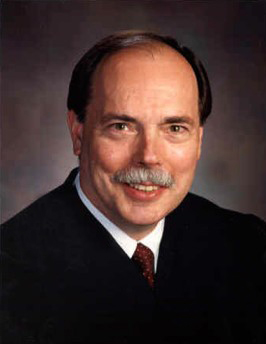 Judge Linn (at left) then asked, "if the original claims
are published, how can they fail the public notice test?" Mr. Lipsey responded that claims satisfy
the notice function as to what the
boundary of the invention is but do not describe the invention. The Court countered, asking "don't
the claims describe what the inventor considers to be his invention?" "They sometimes do, but they often
do not," according to Mr. Lipsey, reciting Judge Rich in a footnote in
the In re Vanco case. There, Judge Rich said, patent claims
describe the boundaries of the invention, like lot lines do with real property. But those boundaries do not describe
the land itself, or in this context, the invention according to Mr. Lipsey's
argument. Judge Lourie then applied
the question to genus/species claims, asking: "Isn't the question of
support that you possess a sufficient portion of the genus to be entitled to
the boundary?" Mr. Lipsey's
answer was that this is always the inquiry if you claim a genus, whether you
have sufficient support for a generic invention in the description, which can
be satisfied "in any one of a number of ways," reciting a sufficient
number of species or a generic description of a chemical compound as
examples. Judge Linn then asked: "Doesn't
the statute specify the way to do it, sufficiency is measured by enablement?" Mr. Lipsey responded that this is one thing the statute requires. The second thing the statute requires,
he argued, is that the thing claimed be something that the applicant invented — as shown by an objective analysis
of the four corners of the patent document. He maintained that this description of what the inventor had
invented had "always been required," citing O'Reilly, Schriber-Schroth,
In re Moore, and In re Ruschig.
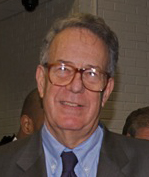 Judge Dyk (at right) asked: "In light of what Mr. Whealan
has conceded in his brief, what is the practical difference in Lilly's position
and Ariad's position?" (It
should be noted here that Ariad's reply brief seems to have hurt its position
somewhat, because some of the judges seem to believe that Ariad had "retreated" from the position it espoused in its opening brief.) Mr. Lipsey took this occasion to make
the strongest statement of Lilly's position, saying that "the question of
whether the specification describes what an inventor has invented is
fundamentally different than the question of what a hypothetical person of
ordinary skill (in possession of all that is known in the art) might without
undue experimentation be able to do." Judge Dyk pressed its question, asking: "But don't you
take Mr. Whealan to have conceded that the specification must provide a written
description as part of the enablement requriement?" Mr. Lipsey answered by both taking
advantage of this characterization by the Court yet distinguishing Lilly's
position from Ariad's. He said
that while Mr. Whealen "does concede that, but then he circularly says the
sufficiency of it is to be determined by enablement." This was the error in Ariad's
position, according to Mr. Lipsey, since "the case law is clear that if an
inventor has not originated the subject matter, has not invented it, as
reflected in the corroborated conception, the patent document, he is not
entitled to a patent on it, that is how our system is set up."
Mr. Lipsey continued in this vein, that the patent must
go to the "originator" and not to a third party who could build upon
what is contained in the patent specification. He cited Schriber-Schroth as making this "abundantly
clear," because the Supreme Court "accepted that people of ordinary
skill in the art would recognize that a flexible web could be used" with
the claimed invention, but that wasn't described in the patent. Judge Rader asked whether the case said
that the flexible-web embodiment of the invention in Schriber-Schroth had not been "described or identified"
(foreshadowing a distinction made later by Mr. Whealan). The reason for this distinction,
according to Judge Rader, was that applying the written description requirement
as advocated by Lilly would "turn claim construction into a validity
doctrine." (Mr. Lipsey later
expressly answered this question, saying that that was claimed in the Schriber–Schroth case "was not the
invention described, so it was a matter of description there.") The Judge
went on to say that "[c]laim construction is the most difficult area,
given the philosophical imprecision of language, we find that varies even from
panel to panel, yet now you are making that a validity doctrine, does that
trouble you at all?" Mr. Lipsey
responded that he "wasn't making anything anything," and that the
statute and a long history of court decisions supported his position. Judge Rader disagreed, asking
(repeatedly) for one example of a case where the written description
requirement was used outside the priority context. Mr. Lipsey responded that if there was a written description
requirement in the statute (and both the Court and Mr. Lipsey agreed that Ariad
had conceded that there was), "it has to apply to all claims in all
applications in all arts." In
response to repeated demands from Judge Rader for a case law example supporting
Lilly's position, Mr. Lipsey proferred In
re Sus and In re Moore without
further argument.
Mr. Lipsey was permitted to make the following
cogent statement of his argument:
The cases are clear, from O'Reilly to the present day, that there is a requirement separate and apart from what anyone else looking
might have been able to do it, that will limit what a patent applicant can
claim in his application, and that is that he must have demonstrated within the
four corners of the application as
it is read by one of skill in the art that this is something he invented, i.e.,
something he conceived, and because not all ideas are legally sufficient
conceptions, and indeed many of them are not, research plans, the germ of an
idea as in Genentech v, Novo Nordisk,
not all ideas are conceptions, and it's up to the court to look at what this
inventor actually invented what he is now claiming, and normally, I agree, in
99 out of a 100 cases, written description and enablement stand and fall
together, but they need not as Schriber–Schroth
indicates and it is now and has always been a validity defense and a validity
requirement.
He then turned to a further response to Judge Rader's
question of whether the written description requirement applies outside the
priority context, making reference to the language of § 120 of the
statute.
Section 120 of the statute tells you when you are
entitled to an earlier application filing date and it doesn't say that the
claim has to be presented in the earlier case. There is only one requirement,
it says it has to comply with Section 112, and if it does, you are entitled to
that date. And indeed, I believe
it has been conceded by Ariad that in that environment, the written description
analysis is performed all the time, and if that's the case it can only go on
under that statutory framework if it is a statutory requirement of Section 112,
and if you accept that, there is no principled reason why the written
description requirement does not apply to all claims in all applications at all
times in all arts, which is what
we contend.
(Judge Lourie helpfully asked, "isn't
it true that there is no limitation of 112 to the priority question?" to
which Mr. Lipsey answered: "Indeed, it does not.")
Judge Rader then asked: "Why did Judge Rich
create the written description requirement in Ruschig? Why did he say in Rasmussen that he was
applying it as it had been applied in priority questions? It was created for that purpose and he
moved it out of the 130 Section because he was uncomfortable with the narrow
interpretation of new matter? So
if it was created to be so narrow, how did it suddently get to be so broad?"
Mr. Lipsey replied that he begged to differ: "It [the written description
requirement] was not created in In re
Ruschig, it had been in existence a long time by the time of Ruschig and
was not an unusual rule." Responding to Judge Rader's challenge for "evidence that it had
been in existence a long time," Mr. Lipsey replied that "O'Reilly v. Morse said, you are trying
to claim something you didn't describe and haven't invented, you're out of
here, Schriber–Schroth said you are trying to claim something you didn't
describe." When Judge Rader
characterized these cases as "enablement cases," Mr. Lipsey replied
that "the word they used was described." Judge Rader then made his most direct statement of his
previously-asserted position on the question, saying that the Court in these
earlier cases used the word "described" "consistent with the
statutory requirement, because the description was so as to enable, so you can
use either term and be discussing the same thing." Mr. Lipsey asserted in response that "the
Schriber–Schroth case described the
thing changed that everyone would have known, and the only reason not to allow
the patentee to claim it is that it was not what he had described." Judge Rader countered that "Schriber–Schroth said that the patentee
must describe his invention so that others may construct and us it. They used description in its proper
enablement context, identification and enablement, the claim scope identifying
and the description enabling."
In his response, and final argument before his time
was up, Mr. Lipsey made Lilly's argument for the difference between Ariad (and
Judge Rader's) view, along with a suggestion that "overturning settled
expectations" was not the Court's proper role:
What gets left out is the fundamental requirement
of a U.S. patent that the person who applied for it invented what is being
claimed, and that is judged by reference to his own description of his
invention, the corroborated evidence of what he conceived, and if he didn't
invent it, he isn't entitled to a patent, whether anyone else could have done
it or not. And that's the
structure of our system, and if this is to be changed, this interpretation of
the statute has been in effect from 30, 40, 50, 100 years, and the Act has been
amended many times, and not once has it been suggested that it be changed, and we
suggest that the prudent thing, rather than upset settled expectations, it is
for Congress.
 The Court then heard from the Patent Office
representative, Mr. Freeman, who directly addressed Judge Rader's argument that
the early Supreme Court cases cited in support of a written description
requirement were enablement cases, saying: "We don't think there is any way
to read Schriber–Schroth, Permutit, or Moore as merely reflecting an enablement question," and then
proceeded to recite the Question Presented in Schriber–Schroth, asking whether the defendant could be held liable
wherein elements of the claimed combination were not described.
 Judge Moore (at right) asked whether any of Ariad's claims at
issue were originally-filed claims, and whether originally-filed claims could
fail the written description requirement. She also asked specifically whether there were cases outside the genus/species
situation in chemical cases where an originally-filed claim could fail the WD
requirement? Mr. Freeman answered
that, yes, claiming in purely functional terms, even as an original claim,
could fail the requirement, citing the Office's Written Description Guidelines "where
the specification describes how to make a compound but it is claimed by
function, having a scope to any compound having that function." He went on to say that fulfillment of
the written description requirement by originally-filed claims is presumed, and
cases where these claims failed to satisfy the written description requirement
should be "rare." He
said that the "fight over original claims is a fight over whether it is always
true that original claims describe themselves or if in the rare instance they
may not."
Judge Dyk asked whether there was "really a difference"
between what the Patent Office was saying and Ariad was saying (again, seeming
to adhere to the position espoused in Ariad's reply brief rather than its
principal brief) — "what are we arguing about," he asked. Mr. Freeman responded that this would
be "a great question for Mr. Whealan," provoking another round of
laughter. Responding to the
question, Mr. Freemand characterized Ariad's reply brief as being "baffling," and said that if all agree this means that when we
judge "whether a patent does A and B, we look only at B — we don't think
it consistent with the text [of the statute]. The statute does not say the description is required only
insofar as it enables."
Returning to the fray, Chief Judge Michel asked: "Why
does the PTO care? How many
applications are there that can't be rejected on other grounds?" and "I'm
not asking about history, I'm asking about impact?" Mr. Freeman responded that he didn't
know the precise numbers, "but number must be high — there are 400,000 applications
examined each year, and it has become increasing popular to claim inventions by
their functions or effect or to describe species and claim the genus." The written description requirement was
"one of the basic tools" the Office uses "to constrain these
claims and to make the patentee make clear to the public what the scope of the
invention is."
 Judge Rader countered that he didn't see any
evidence of the written description requirement being used in Office rejections
in the 300-400 cases that come to the Court each year — not a "a single
case." Although Mr. Freeman
began a substantive response — "You cannot assume away 400,000 cases, the
vast majority of the PTO's decisions are not litigated," Judge Newman
(at left) chimed in, quietly saying: "Let me help you" (and provoking another
round of laughter). Judge Newman
said:
When I started, chemistry was the hot area, and the
question of how many species you needed was assessed by the written
description requirement, and while many things have happened [since] . . . we
have come full circle, where there are generic concepts, this case is a good
example, and how one describes the genus depends on how much detail is
required. In some areas, description
and enablement are not co-extensive. And generally when it comes up in the Office it is resolved, so I agree
completely that it is quite rare to see those cases on appeal; they are not insoluble, it is much
easier to run some experiments than to appeal and come back a decade later. The
principle is importantly illustrated in this case, where the outcome may depend
on how we answer the questions.
Judge Lourie then threw Mr. Freeman a softball, asking: "Doesn't it occur that someone files a broad claim and exemplifies it with
very little, because it is all they have, and the PTO rejects on written
description?"
In answering "Yes" to this question, Mr. Freeman
used the Tronzo case as an
example. Judge Rader remained
unconvinced, asking: "Why isn't that covered in the vast majority of cases
by the doctrine of enabling throughout the scope of the claim?" While agreeing that this could be the
case, Mr. Freeman maintained that while it could be true in some cases, it is "not
always true that what isn't described isn't enabled," using In re DiLeone as an example.
To this, Judge Lourie said: "It's because they
are related, you have enabled other species but have not described it,"
and Mr. Freeman agreed as Judge Rader informed him that his time had expired.
 Mr. Whealan (after exchanging pleasantries with Chief Judge Michel)
was immediately directed to Judge Lourie's perception that there were significant
differences in the positions taken in Ariad's opening brief and its reply
brief. He was pointedly asked if
Ariad had "retreated," and parried this question with a clear
statement of Ariad's position:
What this Court has done is delinked the written
description of the invention from the rest of the words of the statute, and
what we are suggesting is that the description of the invention, and of how to
make and use it is measured by the following terms. Therefore it has to be clear, precise and exact, and it has
to enable. If this were not the
case, then Congress would have said that the written description of the invention
does not have to be clear, precise and exact terms, but the written description
of the manner of making and using it does. That makes no sense.
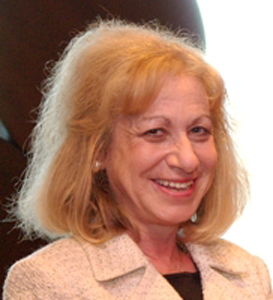 He then also announced that he was not going to use
"labels" (presumably, "written description" and "enablement"),
but was stopped from developing this theme by a question from Judge Prost (at left),
citing to that inconvenient reply brief — with reference to the statements in
the reply brief about the written description matching the inventor's
contribution: "Are you saying that there is no way that you can enforce
the written description requirement except by the enablement portion?" "Absolutely not," Mr. Whealan
replied. Ariad's position was that the Court had
delinked the written description and enablement requirements, leaving the Court
with no standard for assessing compliance with the written description
requirement. This led to the
development of the "possession" standard, which led to the
requirement to supply sequences and structure. "Possession does not exist in the statute," he
said, "and it doesn't exist in the case law."
The main portion of his argument was linked to the
Telephone cases and (to a lesser extent) to other early cases, where he
maintained that the evidence was that the inventor had not made the invention
and had not actually made all embodiments within the scope of the patent
claims, was permitted to claim broadly because he had enabled the skilled
worker to practice the invention. He said that the standard under the Court's jurisprudence had shifted
from whether the inventor put the public in possession of the invention to
whether the inventor was in possession of the invention, and ultimately to what
the inventor had actually done. He
said that Bell would have failed under the possession test used by the Court,
because Bell didn't get the invention to work, others did. Judge Dyk noted that Lilly was not
espousing that there has to be an actual reduction to practice, and Judge Linn asked what
was the difference between possession and identification? Mr. Whealan used a perpetual motion
machine as an example, where you could identify it but not enable it.
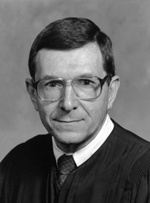 Judge Lourie (at right) then mentioned that almost all the amici, across all technologies and
sizes, and most of the major patent bar associations, all disagreed with Ariad's
position (at least the one taken in its principal brief). "What do they know that you don't?" he asked. When his initial
response ("people like invalidating patents for any reason") was shot
down by the bench, noting that the opinion was held "on both sides"
(presumably, companies like Microsoft that frequently criticize patents and
companies like Amgen that depend on patents), Mr. Whealan charged that Lilly
and amici had set up "a strawman," that Ariad was not suggesting that
the written description requirement be "read out" of the statute
(something that might come as a surprise to anyone who read Ariad's principal
brief and the grammatical parsing of the statutory language), but that the Court needed to enunciate the right standard. He also said that, in view of the vast sentiment against Ariad's
position (characterizing the amici as "noise"), Ariad could only
prevail if he were to convince the Court that ruling in Ariad's favor would not
"harm the system."
When he began his argument with regard to the
Supreme Court never having held, as
the Federal Circuit has done, that there are separate written description and
enablement requirements, he was interrupted by Judge Newman, who noted that
while there are not cases that have come before the Court, that is because of
the nature of the inventions in which the problem arises that they can be
enabled — "getting a gene out of a chromosome," which is "well
known" how to do — without being described. Mr. Whealan asserted in response that an applicant would not
get a patent under these circumstances, without supporting that statement with
any citation or other authority (perhaps erroneously believing that In re Kubin has foreclosed patentability
to gene claims).
He also maintained that "an original claim
defines itself," and that Lilly had changed this requirement because "under
Lilly you would have to show possession." In response to Judge Lourie's question concerning whether
the factfinder needs to believe a genus has been described, Mr. Whealan said
the Federal Circuit should "follow the Supreme Court" with regard to "whether
the description matched the inventor's contribution." He then contrasted the Telephone cases — where Bell was granted broad claims to his manner of transmitting voice over a
distance — to the Incandescent Light cases, where the broad claims were not
valid since most of the claimed "fibrous material" did not work
(prompting one of the judges to ask whether Mr. Whealan was arguing a utility
aspect to the question). Judge Dyk asked Mr. Whealan to describe the difference between "identifying"
and "describing" in view of his position that he would use the former
but not the latter term. Without
directly responding, Mr. Whealan argued that "putting the statute back
together" would lead the Court to applying the Telephone cases and that
precedent, which he characterized as Supreme Court teaching that a patentee
would not be limited to "how you did it" (i.e., practiced the
invention). If you had "changed
the way to do something, then [you are] entitled [to a patent,]" he said.
Judge Lourie then asked whether there were "a lot
of broad claims with little support that [have] to be rejected?" Mr. Whealan turned again to the Incandescent Light cases, to which Judge Lourie said: "That was 150 years ago, we're dealing
with today," and asked about the Gentry
Gallery case. The question
wasn't that the claim wasn't enabled, Mr. Whealan said, but that if you failed
to identify, you failed enablement. Judge Moore asked in this regard whether requiring that a claim be
enabled throughout its full scope would "satisfy this problem." Again pointedly reminding the Court
that he was "avoiding labels," Mr. Whealan agreed. Judge Moore then turned to the facts of
this case, and asked whether the other examples disclosed in Ariad's
specification would "work like decoy molecules." Mr. Whealan said the answer is no, but
that the patentee had identified the concept of preventing NF-kB from "hitting"
(actually, entering) the cell nucleus, and identified three ways to achieve
that goal. He then asserted that "others"
did just what the patentees had told them to do and "got it to work." He cited the "Michigan paper"
that the patentee had "told them what to do" and that they "just
did it with the exact sequences disclosed by the patentee." He characterized the inventors — "research
university people" — as "figuring
out the key thing to do," and that "the Michigan people wouldn't have
known to look at NF-kB."
Judge Moore then asked whether the Court should use
the principle of stare decisis to "leave
it alone?" Mr. Whealan
responded that since the Supreme Court had not "done the analysis,"
there was no stare decisis (nicely
disparaging the Federal Circuit's own precedent). He also noted the disagreements between the judges of the Federal
Circuit, and said that this case was a "progression of the Court's
jurisprudence" on the issue.
Judge Newman acknowledged that this case presented
questions that concerned "very fundamental aspects of policy based on
areas of technology — how far an applicant must go with a scientific concept
before the fundamental requirements of patentability will be met." She said it was "easy to
understand why this issue has not been before the Supreme Court," and that
in the earlier cases "the issues were much easier," mentioning that
in O'Reilly, "the Supreme Court
said of course you couldn't patent electromagnetism." Mr. Whealan countered that to the
people in the late 19th Century, the telephone was "revolutionary"
technology.
In his final remarks, Mr. Whealan restated Ariad's
position that "if you teach enough that someone could do it, that
satisfies it [the disclosure requirements of Section 112]." He said that "Ariad taught people
what to do and they did it."
In rebuttal, Mr. Lipsey dismissed Ariad's reliance
on the Telephone cases, saying that these cases "have nothing whatsoever
to do with written description," involving a "unique" claim set
reciting the apparatus "as herein described." He said that there was "no holding
that identification of a common principle entitles you to claim every way of
attaining it. The cases are legion
that what you are trying to do is claim the desired result, as in Morse and the ice
cutting case, those claims are improper."
He also dismissed the argument about the word "possession,"
saying that "Carnegie Mellon and
LizardTech makes clear that it is a
synonym for 'did he invent it?'"
Judge Dyk asked whether the issue was "the
difference between a research plan and an invention, and that the parties would
draw the line in different places?" Mr. Lipsey agreed, but said
that "the only way to get there is to do away with the statutory
requirement." The statute
defines what is required — did the inventor conceive the invention and reflect
that conception? He also agreed
with the final question posed by Judge Lourie, to the effect that "possession"
is a synonym for what an inventor invented and disclosed.
While there is little to be gained by speculating
on how the Court will rule based on the questioning from the bench, a remarkable
aspect of the argument is that neither party addressed four-squarely the issue
underlying the argument: how much
disclosure is required for inventions and in arts where merely naming something is
insufficient to describe it? There
are consequences (positive and negative) for patentees and the public under the Court's current written description jurisprudence, as evidenced by the
arguments from the amici involved, as
targets or enforcers of patents under the current interpretation of §
112. What the Court should
consider is whether or not these consequences are in sufficient balance, and
what the consequences would be if the Court significantly modified its
application of the written description requirement, thereby unsettling the
expectations that have arisen in the patenting community during the
development of the modern form of the written description requirement.
Patent Docs thanks Professor Oskar Liivak of Cornell Law School, who attended the oral argument and kindly provided identifications of a number of judges who asked questions during the hearing.


 Patent Docs
Leave a reply to Noise above Law Cancel reply