
Sometimes, Sins of Omission Are Not Inequitable
Conduct
By Kevin E. Noonan —
St. Thomas Aquinas recognized two types of
sin: those of omission and those
of commission. In patent law,
inequitable conduct comes closest to this concept of sin, where frequently the
accused behavior is the failure to submit to a patent examiner during
prosecution information that is material to patentability. However, mere failure to submit is not
enough; there must be some evidence of deceptive intent. Kingsdown Medical Consultants, Ltd. v.
Hollister Inc., 863 F.2d 867 (Fed. Cir. 1988) (en
banc). These principles were reaffirmed last Friday by
the Federal Circuit in AstraZeneca
Pharmaceuticals LP v. Teva Pharmaceuticals USA, Inc.

AstraZeneca sued Teva and Sandoz pursuant to 35
U.S.C. § 271(e)(2)(A) for filing ANDAs for a generic version of
Seroquel®, an antipsychotic agent. Each ANDA contained a Paragraph IV certification that AstraZeneca's U.S.
Patent No. 4,879,288 (the '288 patent), its Orange Book-listed patent for
Seroquel®, was invalid and/or not
infringed. The patent claims
quetiapine (the generic name for Seroquel®), an atypical antipsychotic having
the chemical structure:
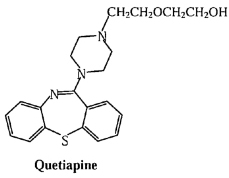
(An "atypical" antipsychotic agent is
characterized by what it does not do: it does not cause involuntary body movements such as "torsion
spasms, muscle spasms . . . dystonia's of the face neck or back with protrusion
of the tongue and tonic spasms of the limbs (dyskinesias).") The District Court granted summary
judgment that AstraZeneca was not guilty of inequitable conduct in obtaining
the '288 patent.
The Federal Circuit agreed, in an opinion by Judge
Newman, joined by Judges Rader and Prost. The material information asserted by Teva and Sandoz to have been
omitted by AstraZeneca concerned a number of quetiapine analogs, including the
following:

AstraZeneca submitted several prior art references
relating to these compounds, specifically a German-language publication
(Compound 210786), U.S. Patent No. 3,389,139 to Schmutz ("Schmutz
I"; Perlapine), U.S. Patent No. 3,539,573 to a second Schmutz reference ("Schmutz
II"; Compound 24028), and U.S. Patent No. 4,308,207 to Hunzikerr
(Fluperlapine).

The Examiner issued an obviousness rejection on
chemical structural obviousness grounds over the Schmutz II compound in view of
additional references, including U.S. Patent No. 4,097,597 to Horrom disclosing
the Horrom Compound, and another species from the Schmutz II reference, termed
Schmutz X by the parties.
AstraZeneca responded to the rejection with
argument regarding the unpredictability of "the critical physiological
property of atypicality," wherein the prior art did not provide a
rationale for choosing the substitutions resulting in quetiapine. These arguments proved unavailing, with
the Examiner demanding that AstraZeneca "provide proof that the prior art
compounds do not necessarily or inherently posses the characteristics of the
claimed compounds." Specifically, the Examiner required that AstraZeneca overcome his
structural obviousness rejection "by a side-to-side comparison with the
closest prior art compound(s)." The Examiner required this evidence for the Horrom compound and the
Schmutz X compound but none of the other compounds disclosed by AstraZeneca.
The patent applicant responded with a declaration
by one of the inventors, Dr. Migler, with data for each of the asserted
compounds. In his declaration, Dr.
Migler attested to the antipsychotic activity not of the Schmutz X compound but
a related compound termed Schmutz B:
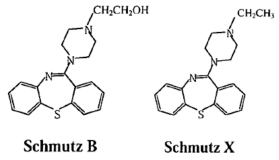
The reason for this substitution provided to the Examiner by AstraZeneca was that data for Schmutz X did not exist and "would
be very expensive to generate right now." The data Dr. Migler submitted with his declaration showed
that the antipsychotic behavior of these compounds was "typical." In addition, Dr. Miglar attested in his
declaration that another compound, termed "Schmutz A," showed no
antipsychotic behavior; this compound differed from the quetiapine compound in
having a chlorine atom substitution in the left benzene ring of the
heterocyclic structure and having a methyl group as a side chain.

Defendants argued at trial, and before the Federal
Circuit, that what AstraZeneca did not disclose to the Patent Office was
internal data showing atypical antipsychotic behavior for perlapine,
fluperlapine, Compound 21076, and Compound 24028, and that withholding this data
was "deliberately misleading." The essence of Defendants' argument, according to Judge Newman's
opinion, was that "AstraZeneca presented internal test data about similar
compounds that were typical while omitting internal test data about similar
compounds that were potentially atypical." This argument did not convince the District Court, which
ruled that AstraZeneca had disclosed the closest prior art and had addressed
the arguments and provided the evidence required by the Examiner.

Judge Newman's opinion noted that there was no
assertion that AstraZeneca withheld any "relevant" reference. The art AstraZeneca did cite (the
Hunzinger patent, for example) disclosed atypical antipsychotics including
fluperlapine, and any internal data possessed by AstraZeneca was thus
cumulative. The Federal Circuit rejected the Defendants' allegations that AstraZeneca made material misrepresentations during prosecution (such as it being "too expensive"
to provide data for the Schmutz X compound) as being without evidence, nor was
there evidence that, had AstraZeneca made and tested the Schmutz X compound,
material evidence would have been produced, said the Court. The Court said that the unpredictability of whether a
particular analog had atypical antipsychotic properties was "undisputed,"
and that "the record demonstrates that structural similarity is not a
predictor of whether antipsychotic behavior would be typical or atypical." The Court also assessed
whether the compounds having data regarding antipsychotic behavior that
AstraZeneca did not disclose were "equally close" in chemical
structure to the compounds whose data was disclosed and to quetiapine. In its analysis, the Court found that
substitution of the Schmutz B compound data for Compound 24028 data was not a
material representation, based on structural grounds (and despite evidence that
their antipsychotic behavior differed in ways that did not support AstraZeneca's
argument). The Court's analysis
rested on its assessment that AstraZeneca submitted data for the "structurally
closest" compounds, and the compounds asserted by the Examiner. The Court opined:
A reasonable examiner would not have
understood the Migler declaration as stating that no prior art product had the
atypical property shown by quitiapine, for it was known that other atypical
antipsychotics existed . . . . A reasonable examiner would understand AstraZeneca's
statements to refer to the closest prior art compounds, not all prior art
compounds.
Thus, according to the opinion, the evidence did
not support a finding that AstraZeneca misrepresented or omitted material
information, despite AstraZeneca's failure to disclose all its data for several
of these prior art compounds.
Similarly, the Court found that the Defendants did
not establish deceptive intent by clear and convincing evidence. Defendants' argument suffered because
it suggested that, due to the "high degree of materiality" it had shown
regarding the withheld information, "they therefore need a proportionally lesser showing of intent to
deceive to establish the requisite threshold level of intent." The Court was succinct in its
evaluation of this argument: "[t]hat
is incorrect," it said, and "[e]vidence of mistake or negligence,
even gross negligence, is not sufficient to support inequitable conduct . . .,"
citing Kingsdown Medical. A court must balance evidence of
materiality and deceptive intent, said the Federal Circuit, but only after threshold levels of materiality and deceptive intent have
been shown by clear and convincing evidence. The Defendants' evidence of deceptive intent was merely the
existence of the undisclosed data showing that some of the prior art compounds
had atypical antipsychotic behavior and AstraZeneca's failure to expressly
disclose this evidence to the Patent Office. Intent to withhold, however, is not the same as intent
to deceive, according to the Court, and "[i]ntent to deceive cannot be
inferred simply from the decision to withhold [information] where the reasons
given for withholding are plausible," citing Dayco Products Inc. v. Total Containment, Inc. In the absence of any evidence of
bad faith, the Court found AstraZeneca "presented plausible reasons for its
presentation of arguments and data during the prosecution" which did not
support a finding of deceptive intent.
Regardless of the soundness of the Federal Circuit's opinion,
the case illustrates how difficult making an inequitable conduct determination
can be. Even in situations where no affirmative sins of commission appear to have been committed, omissions that are sinful can be devilishly difficult to discern, and their
motivations even more so.
AstraZeneca Pharmaceuticals LP v. Teva
Pharmaceuticals USA, Inc. (Fed. Cir. 2009)
Panel:
Circuit Judges Newman, Rader, and Prost
Opinion by Circuit Judge Newman


Leave a Reply