
By
Donald Zuhn —
 Last
Last
month, the Milwaukee Journal Sentinel
published two articles documenting the current state of the U.S. patent system (see "The Milwaukee
Journal Sentinel Gets It Right about Patents"). The authors of those pieces, John
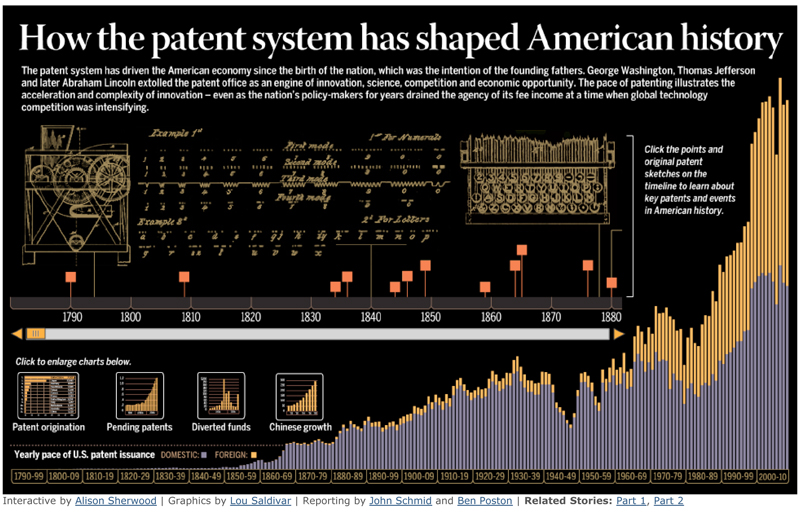
Schmid and Ben Poston, have now compiled an interactive graphic
that shows how the U.S. patent system has shaped American history and
innovation. The graphic contains a
number of elements, including a timeline of key patents and significant events
in American history, a comparison of domestic and foreign patents issued
between 1790 and 2009, and charts showing the top countries and states in which
U.S. patents originated, the number of pending applications between 1981 and
2009 and average application pendency between 1983 and 2008, fee diversion
between 1992 and 2004, and rapid growth of the Chinese patent system between
1999 and 2008.
Among the patents
making the Journal Sentinel's
timeline are the issuance in 1928 of U.S. Patent No. 1,680,818
to Harry Steenbock, the issuance in 1948 of U.S. Patent No. 2,442,141 to Andrew Moyer, and the issuance
in 1998 of U.S. Patent No. 5,843,780
to James Thomson. The '818 patent,
which is directed to an antirachitic product and
process (i.e., a process for
enhancing Vitamin D in "organic substances of dietary value"). Dr. Steenbock secured a Nobel
nomination in 1929 for the work leading to the '818 patent, and the success of
the patent helped launch the Wisconsin Alumni Research Foundation (WARF). The '141 patent is directed to a method
a producing penicillin, and the '780 patent is the first embryonic stem cells
patent. The timeline also includes
the Diamond v. Chakrabarty decision,
which the authors state spurred an "unprecedented growth in biotechnology,"
among its significant events.

 Patent Docs
Leave a reply to Gena777 Cancel reply