
By Kevin E. Noonan —
The "tyranny of the majority" has been the bane (or at least the peril) of representational democracy at least since Alexis de Tocqueville coined the term in 1835; more recently, Lani Guinier lost the nomination to be President Clinton's Assistant Attorney General for Civil Rights for her scholarly writings about proportional democracy as a remedy for that particular ill. And from 2002 until 2006, the Republican majority in the White House and both Houses of Congress (and, arguably, the Supreme Court) left opponents of the last administration's policies with few means to oppose them.
That tyranny was exhibited baldly today in the Executive Committee meeting of the Senate Judiciary Committee, compromising the gentility typically (or perhaps only purportedly) exhibited between members of that chamber. The subject matter of the committee's business this morning was, of course, "patent reform," specifically S. 515. One purpose of the meeting was to consider the "compromise" amendments that are part of the agreement between Chairman Patrick Leahy (D-VT), ranking member Senator Arlen Specter (R-PA), and Senator Diane Feinstein (D-CA), whose vocal displeasure with the bill as originally introduced led (at least in part) to some of the amendments considered today. The three amendments earlier circulated by this group were adopted by the committee; these included changes to the damages provisions, willfulness, interlocutory appeals, the best mode requirement and a pilot program for district courts concerning patent matters (Amendment GRA09451), joining amendments earlier adopted by the committee relating to royalty apportionment for universities and other federal grantees (Amendment GRA09400; adopted March 31, 2009), and amendments providing for "virtual" patent marking (Amendment GRA09350; adopted March 26, 2009).
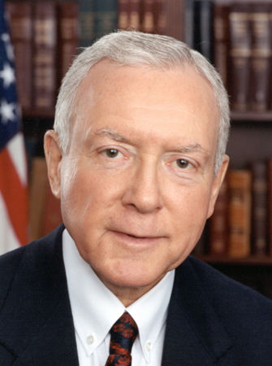
Perhaps more important were the amendments the committee did not adopt. These include amendments by Senator Jon Kyl (R-AZ) directed at making more stringent the standard for post-grant review (Amendment GRA09459), which was affirmatively defeated 4-13, and an amendment by Senator Tom Coburn (R-OK) relating to preventing by statute Congressional appropriators from diverting PTO user fees for other purposes (Amendment GRA09294), which was tabled on a 10-9 vote. However, these parliamentary setbacks paled in comparison to the strong reactions by Senators Orrin Hatch (R-UT) (at left) and Kyl (and to some extent, Senator Specter) at Chairman Leahy's evident determination to make certain that the bill was voted out of committee today. Indeed, after making a statement decrying the failure of the bill to address the real problems of the patent system, particularly inequitable conduct, Senator Hatch left the hearing room, despite Chairman Leahy's entreaties to remain so the Chairman could praise the Senator for his work on patent reform.
While Senators Leahy, Specter, and Feinstein applauded each other for reaching their compromise, and reported that various diverse stakeholders (including the Coalition for Patent Fairness, the Coalition for 21st Century Patent Reform, the AIPLA, PhRMA, and BIO) "strongly supported" the bill, Senator Kyl (most persistently) supported (weakly) by Senator Specter openly questioned the Chairman's insistence that the committee act on the bill today. Senator Kyl pointedly mentioned discrepancies between what the bill purportedly does or is intended to do, and what the language actually means, particularly with regard to willful infringement, which he says reinstates the subjective intent standard for the Federal Circuit's "objective recklessness" standard from the Seagate opinion.
Despite its seriousness, the mechanics of fulfilling the Chairman's purpose was rendered slightly ridiculous when it became necessary to frantically track down committee members to constitute a quorum. Once the committee had a quorum, the outcome was never in doubt — especially because Senator Leahy held the absent Democratic members' proxies and Senator Specter had the absent Republican members' proxies. On the final vote, only Senator Hatch (by proxy), Senator Kyl, Senator Feingold (by proxy), and Senator Coburn voted against reporting the bill, as amended, out of committee.
Now the bill is headed to the Senate floor. There is another venerable phrase in the American political lexicon — "the backroom deal" — and it seems certain that accusations of a backroom deal will be raised regarding the "compromise" hailed by its supporters on the committee. And it remains to be seen whether Chairman Leahy's high-handedness will backfire; as Senator Kyl pointedly remarked more than once, the Senate Majority Leader (Senator Reid, D-NV) may be less inclined to bring the bill to a vote, or even debate on the floor of the Senate, if there are serious objections to it. So once again, we all have the opportunity to exercise one of the great prerogatives of American citizenship: if you care about patent reform, write your Senator.


Leave a comment