
By Kevin Noonan —
Once again, the popular press, aided and abetted by
academics more interested in career advancement than the facts, have sounded
the clarion call against patenting genes (see "Gene Patenting in the News Again"). For anyone interested in a reasoned debate on an important topic, the
resulting articles are disheartening. For those interested in advancing progress and U.S. economic interests,
they are infuriating.

The latest jeremiad comes courtesy of Parade magazine, a
popular component of Sunday section in many local newspapers. It is helpful at the start to set out (and
refute) the many factual misstatements in the article:
• "A fifth of your genes belong to someone
else." Besides being contrary to the 13th amendment
(banning having a property right in a person), no patent in the U.S. (or anywhere
else) claims ownership of "your" genes. All U.S. patents require that compositions of
matter comprising "genes" are "isolated and purified." So no one is going to knock on your door and
ask for a royalty for using your genes.
• "No one should own a disease" — and
no one does. There have been patents on
isolated microorganisms, but this is not new: Louis Pasteur had patents on yeasts useful for wine and beer-making, and
before the genetics revolution of the last half century, the only way to make
useful antibiotics was to isolate the microorganism that happened to make the
drug.
• "Countries where they haven't patented genes have
better genetic testing." Correction: cheaper genetic testing, not better. Where did the genetic test come from? Not France, because they can't protect their genetic inventions in
France. The U.S. leads the world in
biotechnology and is responsible for most of the "better genetic testing"
that now exists. There are many reasons
why, but one important reason is that the companies that have developed those
tests could get the economic support needed to take a scientific discovery and
turn it into a useful test. This is so
because of patent protection. If France
can offer a cheaper test, it's because the French government permits companies
in France to use technology without paying for it. This is a good deal only if someone else is
paying for it; Dr. Andrews' comments are
a little like parents who don't get their children vaccinated, and then benefit
from the vaccination of all the other kids in the neighborhood.
• "Researchers are claiming they don't have to
report deaths from genetic studies, calling them 'trade secrets'" and "[s]ome companies are willing to put
people at risk to have an advantage." Unlikely to be true. But even if
it is, human testing is not within the purview of the patent system. The Food and Drug Administration controls
clinical trials, and human testing in a university setting is governed by
several levels of review boards enforced by Federal granting agency
oversight. The University of Illinois
hospitals lost all Federal funding several years ago because they hadn't
maintained proper records (i.e., paperwork); it is irresponsible to imply that people are dying without any evidence
that it is so.
• "You don't even have control over your own tissue
or blood once it's donated for research." The falsity of this statement is evidenced in the very next line of the
article: "What can the public do? Read consent forms at the hospital and doctor's office, and specify that you
don't want your blood or tissue used for patented genetic research." If you don't want your DNA to be used to
fight diseases, by all means refuse to consent. But then don't complain that your particular illness is an "orphan"
that no one is interested in.
• "Gene patenting is like someone owning the
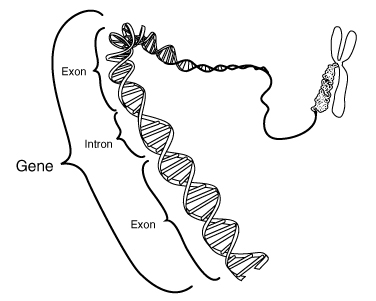
alphabet and charging you each time you speak." In reality, since gene patents are all
limited to isolated and purified DNA, the information contained in DNA is
freely available. No gene patent owner
can "charge" you for using the genetic sequence — which is the key to the scientific information contained in your genes
— in any way you wish. Paradoxically, the economic interest and
value produced in permitting companies to protect their investment in genetic
technology has had the consequence of producing the greatest increase in
biological knowledge in history. The
information generated on genes from humans, primates, mice, dogs, cats, horses,
cows, pigs and many other species, including both useful and harmful
microorganisms, is provided without charge to any researcher, capitalist or
homemaker having and interest and a computer. It is the equivalent of having publicly-accessible the blueprints of
every machine ever made.
The problem with the misinformation contained in these
articles is that they ignore important limitations imposed by the patent
system. As mentioned, individuals cannot
be patented. Human "body
parts" can't be, either, just like it is illegal to sell a kidney. (Ironically, in one of Dr. Andrews' books she
advocates people having a property right in their DNA. By that thinking, there is no legal
justification to prevent an individual from deciding to sell a kidney, since it
is his or her "property.") No
one owns your genes, or anyone else's.
Moreover, the patent right is finite — it
expires. That's one of the beauties of
the patent system, since it is a limited right, and one of those limitations is
time. Presently, a U.S. patent expires
20 years from its earliest filing date. For many of the earliest gene patents, that day is or soon will be
here. For the vast majority of gene
patents, expiration will occur by 2020. The biological reality is that, given the immense number of new genes
identified (and still being identified), and publication of the genetic
sequences of these genes in databases around the world, patent protection will
expire before we have determined the usefulness of most of human genes.
Just as in the generic drug debate, there is a balance to
be struck between rewarding companies and universities that expend vast amounts
of money, time and resources in discovering the genetic information necessary
to produce a genetic test, and the cost of those tests to the public. The answer is not to declare the underlying
technology off-limits to patent protection. That way leads to a real "tragedy of the commons" where no one
has the economic incentive to develop a test that can be stolen by a competitor
without compensation. There are many
ways to make testing available to those who cannot afford it; for those who can afford to pay, objections
to paying for such testing is a fancy variant of "free-riding" on the
time, efforts and accomplishments of others. (At least those Americans looking for cheaper genetic testing in France
can afford to support the airline industry in going there.)
There are many facets to the legal implications of the
revolution in genetics, including many included in the "Genetics Bill of
Rights." It does a disservice to
the civil libertarian aspects of the debate — freedom from discrimination,
freedom from prosecution, privacy rights over having yourself or your tissues
used in research — to conflate them with gene patenting. It is even more of a disservice to reasoned
debate on the topic to misstate the issues to make political or rhetorical
points, particularly when those misstatements are willful rather than
misinformed. Gene patenting is not a
scourge and does not impose undue burdens on the public. In fact, it is an important contributor to
results desired by all: better
technology to provide better prevention and treatment for human diseases. It is a shame that some will obscure the
facts to sell books or make headlines.


 Patent Docs
Leave a reply to bert Cancel reply