• IPO #2The Intellectual Property Owners Association (IPO) will offer a one-hour webinar entitled "Inequitable Conduct and the Duty of Disclosure" on May 20, 2021 from 12:00 pm to 1:00 pm (ET).  Gordon Arnold of Arnold & Saunders, LLP; Ron Derrington of Bracewell, LLP; Justin Hendrix of Collins Aerospace; and Luke McCammon of Finnegan, Henderson, Farabow, Garrett & Dunner, LLP will focus on the state of the law after GS Cleantech, the nuanced differences between the scope of the duty of disclosure between different Patent Office forums, and best practices and tips from the patent prosecutor's perspective.

    The registration fee for the webinar is $150 for non-members or free for IPO members (government and academic rates are available upon request).  Those interested in registering for the webinar can do so here.

  • By Kevin E. Noonan

    SARS-CoV-2In a time of a global pandemic, with antivaxxer and anti-science sentiments running rife, and when combinations of fear, distrust, and paranoia are rampant, it is easy for important results from basic science to become fodder inaccurately supporting the doomsday memes that abound.  This is the story of a scientific paper from two eminent scientists that, properly understood, explains a puzzling aspect of SARS-CoV-2 biology in COVID-19 patients:  why can viral genetic information be detected in some patients months after they have recovered from their illness, using sensitive testing (polymerase chain reaction, or PCR; for reference see CSI).  As it turns out, it is not evidence that SARS-CoV-2 is manmade, or that the various vaccines against the disease are toxic or disease-causing, or that (as Senator Rand Paul (R-TN) is (in)famous for charging) Dr. Anthony Fauci supported "gain-of-function" research in Wuhan China and then tried to cover it up.  There are plenty of websites having that content; here we will strive to stick to the facts.

    The paper, "Reverse-transcribed SARS-CoV-2 RNA can integrate into the genome of cultured human cells and can be expressed in patient-derived tissues," appeared in the Proceedings of the National Academy of Sciences USA this week, and was authored by Rudolf Jaenisch and Richard Young and their colleagues.  The purpose of the paper as stated therein is to resolve "[a]n issue of SARS-CoV-2 disease is that patients often remain positive for viral RNA as detected by PCR many weeks after the initial infection in the absence of evidence for viral replication," i.e., in the absence of producing live virus.  Their hypothesis:  perhaps enzymes produced in human cells, capable of converting RNA (like messenger RNA) to DNA, was introducing some portions of the SARS-CoV-2 RNA into the genome of infected cells.  This RNA would then be detected after the RNA was made as part of gene sequences surrounding the integration site.

    It should be appreciated in this regard that a great deal of human DNA, colloquially termed "junk" DNA, does not encode proteins or regulatory sequences (which is the function of the remainder of genomic DNA and was what earlier workers believed to be the totality of the genome).  This seemingly non-functional DNA is made up in significant part by the remnants of ancient retroviruses and retrotransposons, DNA elements "reverse transcribed" from RNA to DNA and inserted in the genome (perhaps randomly).  Some of these species form so-called repetitive elements; one of the most prevalent in human DNA (17%) named Long Interspersed Nuclear Element 1 (LINE1):

    Image
    These repeats, like their retrovirus and retrotransposon ancestors, can express a form of reverse transcriptase that can act on cellular RNA and result in reinsertion of the resulting DNA into the cellular chromosome (this is not an unknown phenomenon and is not necessarily associated with virus infection when it has been detected; see, Horie & Tomonaga, 2011, "Non-retroviral fossils in vertebrate genomes," Viruses 3, 1836–1848).  Importantly to this work, other RNA viruses and even cellular genes have been known to have portions of their RNA retroinserted into cellular genomic DNA after reverse transcription by endogenous cellularly encoded reverse transcriptases.

    Drs. Jaenisch and Moore first studied whether SARS-CoV-2 RNA could be reverse transcribed and reinserted into the genomic DNA from cultured human cells in a Petri dish; the cells they used are an established, immortal cell line known as HEK293T.  These cells arose from human embryonic kidney and differ from normal cells by not experiencing aging, senescence, and cell death after a limited lifespan.  They also contain DNA from a transforming adenovirus, having been made in 1973 and continuously grown (or "passaged") since then.  Their chromosomal complement is abnormal, having on average 64 chromosomes and multiple copies of some of them (e.g., 3 copies of the X chromosome and 4 copies of chromosomes 17 and 22).  In short, these are not normal cells but nevertheless have proven to be very useful for a variety of purposes in cell biology studies and biotechnology.

    In the COVID-19 studies reported in this recent paper, these scientists increased the likelihood of observing what they expected to be extremely rare events by introducing into recipient HEK293T cells a cloned copy of human LINE1 genetically engineered to express the endogenous reverse transcriptase (it will be appreciated that such cells do not occur naturally).  When assayed, using PCR detection or by genomic DNA sequencing methods, the largest SARS-CoV-2 derived DNA sequence was 1,632 basepairs (bp) encoding the protein (the nucleocapsid, NC) that acts as a "shell" for the viral RNA, in a genetic milieu that validated the hypothesis for LINE1-mediated reverse transcription and integration into the genome.  These studies also showed that portions of human genes called exons were preferential (76%) targets for integration, providing an explanation for why PCR treatment of cellular RNA could detect portions of SARS-CoV-2 RNA in otherwise virus-free individuals post-infection.  Similar results at lower frequencies were detected in HEK293T cells not having artificial LINE1-associated reverse transcriptase encoded by a genetically engineered LINE1 element.

    When the presence of chimeric human/SARS-CoV-2 RNAs were assessed in samples from infected individuals they were found at very low frequency — 0.004–0.14% of the total detected virus-related species, although they were found in multiple tissue types including lung, heart, and brain tissues.  Most of these detected sequences were from NC-encoding RNA, consistent with the HEK293T cell experiments.  That the SARS-CoV-2 RNA detected in human samples had been produced from integrated fragments of this RNA was supported by further findings that about 50% of these sample fragments had been produced by "negative-strand" (i.e., the complement in a double-stranded DNA) species that could only have come from such DNA (because the virus RNA is "positive stranded," i.e. the strand that contains the transcript in a form that can be directly translated into protein in the cell).

    These results explain the scientific conundrum of finding evidence of SARS-CoV-2 RNAs in individuals who had recovered from COVID-19 and showed neither symptoms nor the presence of SARS-CoV-2 virus in clinical samples.  It also suggested that continued expression of SARS-CoV-2 chimeric RNAs (and the proteins encoded thereby) might result in a persistence of immunity because the individual's immune system would continue to recognize them as antigenic and produce an immune response against the virus in the absence of later re-infection.

    These results show the ability of scientific inquiry to resolve unknown and unsuspected aspects of SARS-CoV-2 biology, unsurprising for a virus only recently identified and (if current etiological explanations hold) only recently having humans as a host (see "Evolution of SARS-CoV-2 from Bat to Human Pathogen").  But it is clear that what these results do not support is a conclusion that the mRNA vaccines (from Pfizer/BioNTech or Moderna) are in any way unsafe; after all, besides being the consequence of natural processes existing through geological time the exceedingly small frequency of these events is inconsistent with realistic worries about vaccination (considering the much more severe and frequent alternative outcome for those infected with the virus).  The advent of the first pandemic in over a century,  particularly coming after a little more than a century of medical and scientific achievements that "conquered" infectious diseases, is disquieting if not frightening.  But it is a mistake to let that fear inhibit use of the product of over a century of medical and scientific inquiry and successful intervention against infectious disease.  As Dan Rather was known to say, "Courage."

  • By Kevin E. Noonan

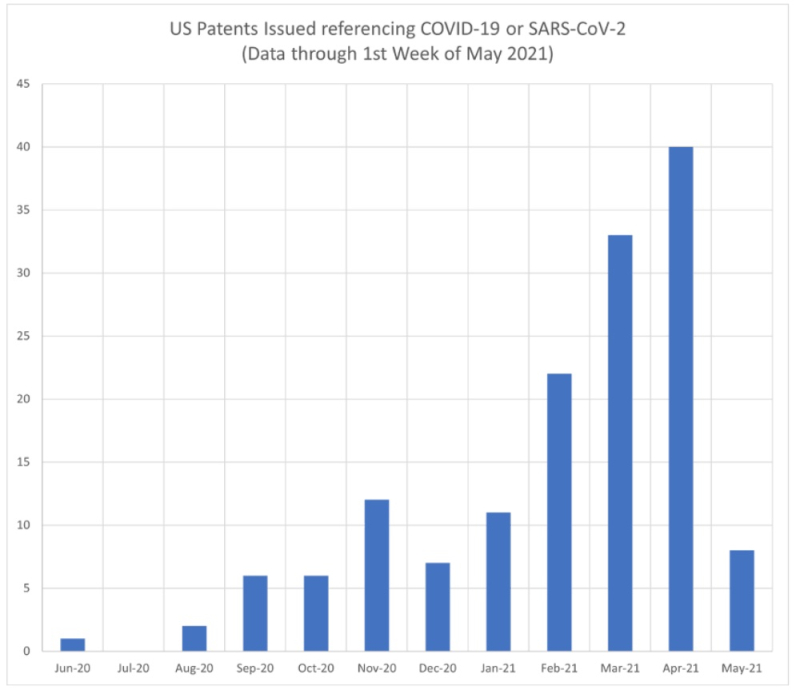
    Dennis Crouch, our colleague at Patently-O, tweeted last week that there have been 148 U.S. patents granted having disclosure related to (COVID-19 or SARS-CoV-2); see Search of U.S Patent and Trademark Office Patent Full-Text and Image Database and

    Histogram 1
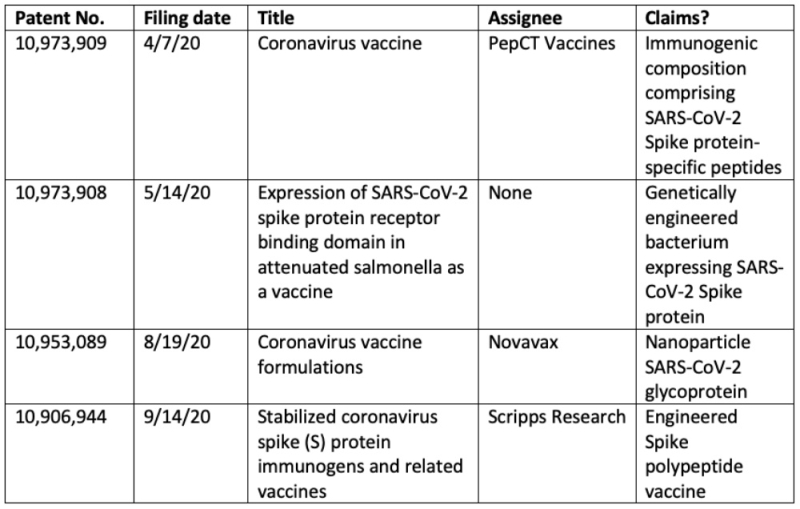
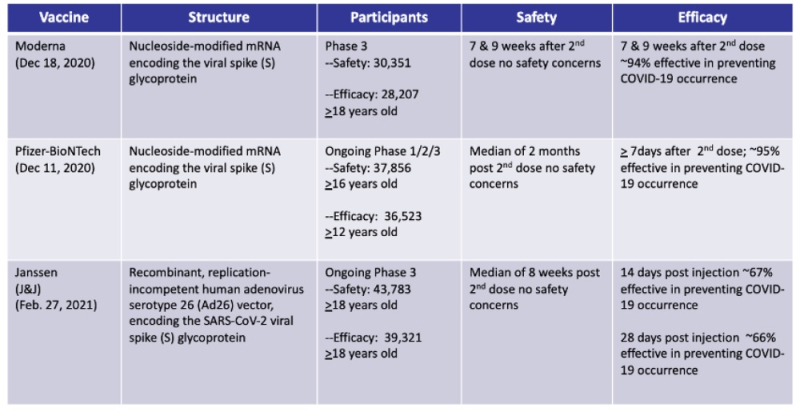
    With regard to issues involving the proposed WTO IP waiver (see "If the Devil of the WTO IP Waiver Is in the Details, What Are the Details?"), it may be instructive to inspect the relatively few (4) of these patents directed to COVID-19 specific vaccines (another 4 were directed to therapeutic antibodies).  These are set forth in this table:

    Table 1
    Of these, the only assignee associated with an actual, in-development SARS-CoV-2 vaccine is Novavax; however, the company has delayed its application for Emergency Use Authorization (EUA) from this month to sometime in the third quarter of this year (although maintaining that there is nothing troubling about the delay).

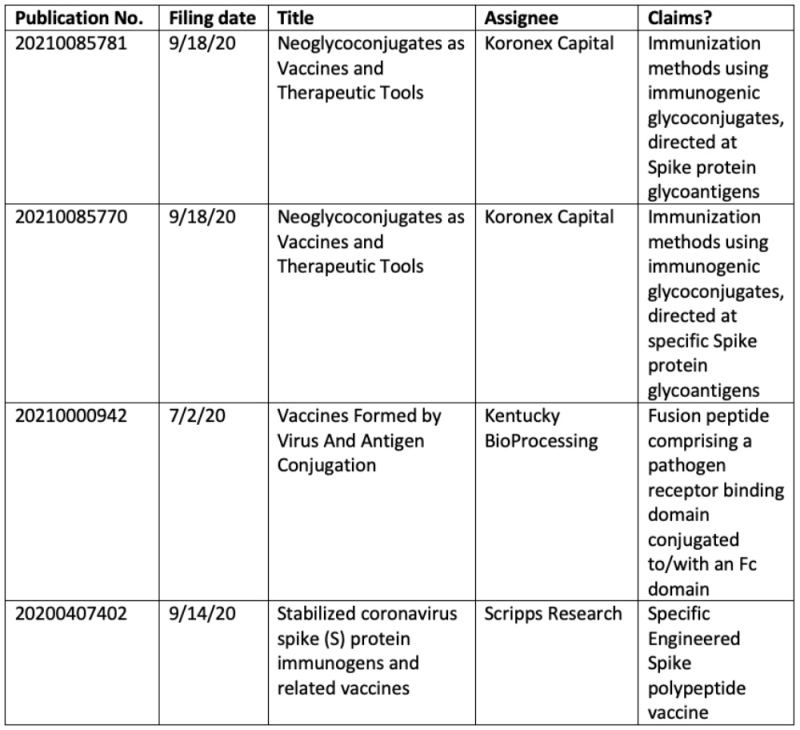
    In addition to these granted patents, there are 420 published applications that are found on the USPTO website when queried with (COVID-19 or SARS-CoV-2); the same pattern persists here, with only a small fraction being directed to vaccines or immunization methods:

    Table 2
    As with granted patents, the remainder of these pending applications are directed to detection methods, personal protective equipment, disease monitoring, and disinfectant preparations, as well as various pharmaceuticals and methods of treatment (not all of which are COVID-19 specific).

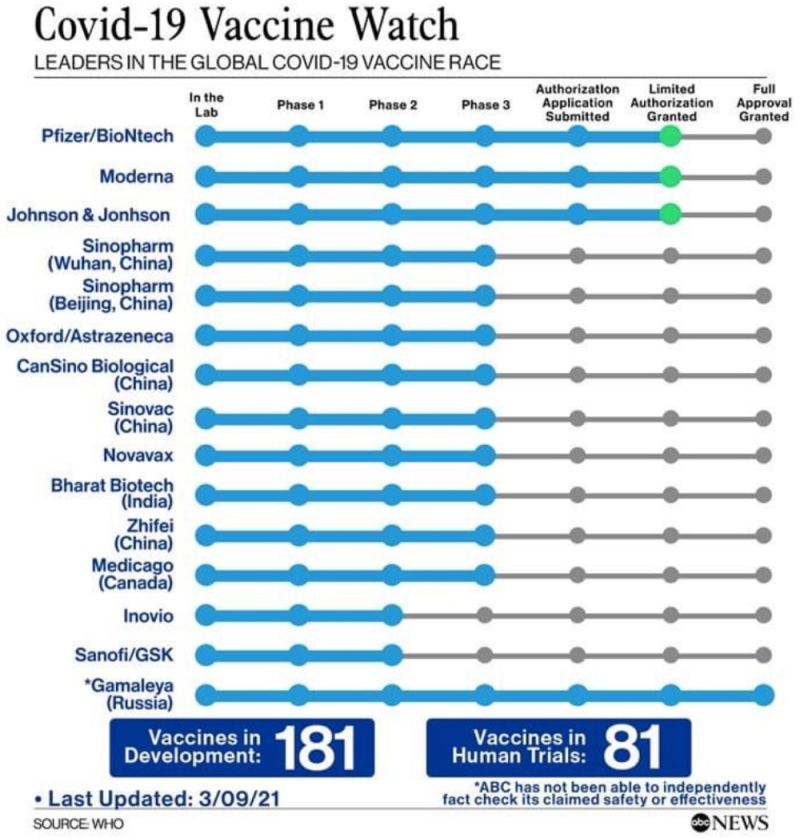
    This raises the question of whether the uproar over the proposed WTO waiver is "much ado about nothing" in view of the small number of granted patents and pending applications directed to COVID-19 vaccines.  A proper understanding of what is at stake involves considerations much more broadly shaped than these small number of patent properties.  For example, there are many other patented technologies involved in making any of the vaccines now available:

    Chart 1
    Table 3
    U.S. Food and Drug Administration EUA Information

    In addition, these vaccines are also produced using trade secrets that are undoubtedly not disclosed in these patents (see "Suspending IP Protection: A Bad Idea (That Won't Achieve Its Desired Goals").

    Most importantly, the cure is worse than the disease; as has been enunciated heretofore, the proposed IP waiver will do little if anything to solve the accessibility problem (see "Latest COVID Conundrum: Accessibility of Vaccines (When They Are Available)") but will almost certainly damage the very innovation system whose existence permitted these vaccines and others now in development to be produced on an accelerated timescale (see "The Road to Hell Is Paved with What Everybody Knows").

    The Biden administration has had the benefit of learned, reasoned calls (see "Pfizer CEO Pens Open Letter on COVID-19 Vaccine IP Waiver"; "BIO & IPO Issue Statements on Biden Administration's Support for Proposed WTO Waiver"; "Sen. Tillis Asks Biden Administration to Oppose WTO Waiver Proposal"; "IP Organizations Support Continued Opposition to Waiver Proposal") not to scramble willy-nilly down the rabbit hole enticingly proposed by those who may have good hearts but other with less than clear motives.  One of the nascent hallmarks of this administration (as compared with the last one) is an ability to recognize a blunder and correct it; after all, that is what political professionals who aspire to be statesmen are supposed to be able to do.  The negotiation period for any proposed WTO IP waiver gives this administration the opportunity to achieve the desired goal (global COVID-19 vaccination) without harming the global innovation system.  It is an opportunity the President and his administration should take.

  • By Donald Zuhn

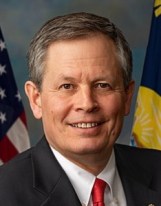
    Daines  SteveYesterday, Sen. Steve Daines (R-MT) wrote to President Joseph Biden to share his concerns regarding the Biden Administration's support for waiving intellectual property protections for COVID-19 vaccines and urge the President to reconsider his position on the proposed waiver.  In his letter, Sen. Daines (at right) asserted that "[s]uspending World Trade Organization (WTO) obligations to protect IP on COVID-19 vaccines would not only fail to significantly speed up vaccine distribution to the rest of the world, but it would set a dangerous precedent on IP protection at the international level and undermine American innovation."  Sen. Daines also argued that the proposed waiver would "provide[] for a technological windfall for adversaries such as China and Russia by giving away IP that has taken years of hard work and ingenuity by American scientists, not to mention billions in American investment, to perfect."

    Instead of a waiver, Sen. Daines suggested that the Administration should "prioritize fighting COVID-19 internationally by getting more shots in arms in countries who need them without transferring critical technologies and undermining our global leadership position."  He noted that as states decline additional doses of COVID-19 vaccines, "the U.S. should focus on increasing production and capacity to provide support for global vaccine supply and leading the world in vaccine manufacturing and distribution."  Sen. Daines concluded his letter by urging the Biden Administration to withdraw its support for waiving IP protections for COVID-19 vaccines and "terminate any plans to participate in negotiations at the WTO necessary to move this dangerous proposal forward."

  • By Donald Zuhn

    Bourla  AlbertOn Friday, Dr. Albert Bourla, the Chairman and Chief Executive Officer of Pfizer, sent an open letter to Pfizer employees regarding the U.S. Trade Representative's announcement last week that the Biden-Harris Administration would support waiving intellectual property protections for COVID-19 vaccines.  Dr. Bourla (at right) begins the letter by noting that the U.S. Trade Representative's announcement had "created some confusion" about whether Pfizer had "done enough to ensure fair and equitable distribution of our COVID-19 vaccine" and whether the proposed waiver was "going to bring solutions or create more problems."  The Pfizer CEO's letter sought to address these questions.

    With respect to the global distribution of Pfizer's COVID-19 vaccine, Dr. Bourla declared that the "[f]air and equitable distribution [of its vaccine] was our North Star from day one," noting that there were two conditions that had to be met in order to ensure that every country would have access to its vaccine: (1) a price that anyone can afford, and (2) reliable manufacturing of enough vaccine for all.

    PfizerWith regard to pricing, Dr. Bourla explained that Pfizer had decided in June 2020 to offer its vaccine through tiered pricing, where "wealthier nations would have to pay in the range of about the cost of a takeaway meal and would offer [the vaccine] to their citizens for free . . . middle-income countries were offered doses at roughly half that price and . . . low-income countries were offered doses at cost."  He also noted that "[m]any of the poorest communities will receive their doses through donation," stating that "[e]quity doesn't mean we give everyone the same.  Equity means we give more to those that need more."

    As for being able to manufacture "enough vaccine for all," Dr. Bourla acknowledged that while this second condition had been "much more challenging," the company was "getting there with remarkable speed."  Commending "the ingenuity and hard work of [Pfizer's] scientists, engineers and skilled workers," and pointing to "multibillion dollars of Pfizer investment," he noted that the company will provide more than 2.5 billion doses globally in 2021, and expected to provide 4 billion doses in 2022.  Dr. Bourla states that:

    These doses are not for the rich or poor, not for the north or south.  These are doses for ALL.  We have concluded agreements to supply 116 countries and we are currently in advanced negotiations with many more for a total of approximately 2.7 billion doses in 2021.  Upon finalization of all agreements, we expect that 40% of them, or more than 1 billion doses, will go to middle- and low-income countries in 2021.

    The Pfizer CEO acknowledges, however, that of the approximately 450 million doses that have been shipped to date, "the balance is more favorable to high income countries."  He explains that when Pfizer asked countries to place orders so the company could allocate doses, "the high-income countries reserved most of the doses."  He also explains that he "became personally concerned" with dose allocation and had "reached out to many heads of middle/low-income countries by letter, phone and even text to urge them to reserve doses because the supply was limited."  Unfortunately, most of these countries "decided to place orders with other vaccine makers either because mRNA technology was untested at that time or because they were offered local production options," and "other vaccine producers were not able to meet their supply commitments for varying technical reasons."  According to Dr. Bourla, Pfizer expects to be able to better supply its vaccine to middle- and low-income countries in the second half of 2021 and "to have virtually enough supply for all in 2022."

    Turning to the U.S. Trade Representative's announcement, Dr. Bourla writes that he recently had an opportunity to discuss distribution of the Pfizer vaccine with Ambassador Tai, and "explain why the suggested waiver of IP rights could only derail this progress."  His discussion with Ambassador Tai leads to the second question he raised at the start of his open letter — whether the proposed IP waiver was "going to bring solutions or create more problems."  And to this question, his answer is "categorically the latter."  Dr. Bourla explains that:

    When we created our vaccine there was no manufacturing production of any mRNA vaccine or medicine anywhere in the world.  We had to create manufacturing infrastructure from scratch.  With 172 years of quality manufacturing tradition, substantial deployment of capital, and more importantly, an army of highly skilled scientists, engineers and manufacturing workers, we developed in record time the most efficient manufacturing machine of a life-saving vaccine that the world has ever seen.  Currently, infrastructure is not the bottleneck for us manufacturing faster.  The restriction is the scarcity of highly specialized raw materials needed to produce our vaccine.  These 280 different materials or components are produced by many suppliers in 19 different countries.  Many of them needed our substantial support (technical and financial) to ramp up their production.  Right now, virtually every single gram of raw material produced is shipped immediately into our manufacturing facilities and is converted immediately and reliably to vaccines that are shipped immediately around the world (91 countries to date.)  The proposed waiver for COVID-19 vaccines, threatens to disrupt the flow of raw materials.  It will unleash a scramble for the critical inputs we require in order to make a safe and effective vaccine.  Entities with little or no experience in manufacturing vaccines are likely to chase the very raw materials we require to scale our production, putting the safety and security of all at risk.

    Aside from the manufacturing challenges, Dr. Bourla also suggests that "waiving of patent protection will disincentivize anyone else from taking a big risk."  He explains that Pfizer spent $2 billion before the company knew that it could successfully develop a vaccine because the company "understood what was at stake."  While acknowledging that "[t]he recent rhetoric will not discourage us from continuing investing in science," he is "not sure if the same is true for the thousands of small biotech innovators that are totally dependent on accessing capital from investors who invest only on the premise that their intellectual property will be protected."

    Dr. Bourla concludes his letter by stating that "[e]nding the pandemic and vaccinating the world is a massive, but achievable undertaking," and that Pfizer remains "fully focused on getting high-quality, safe and effective vaccines to patients all over the world as quickly as possible and to putting an end to this deadly pandemic."

    For additional information regarding this topic, please see:

    • "If the Devil of the WTO IP Waiver Is in the Details, What Are the Details?" May 9, 2021
    • "The Road to Hell Is Paved with What Everybody Knows," May 6, 2021
    • "BIO & IPO Issue Statements on Biden Administration's Support for Proposed WTO Waiver," May 6, 2021
    • "Biden Administration Supports Waiver of IP Protection for COVID-19 Vaccines," May 5, 2021
    • "Suspending IP Protection: A Bad Idea (That Won't Achieve Its Desired Goals)," April 26, 2021
    • "Sen. Tillis Asks Biden Administration to Oppose WTO Waiver Proposal," April 21, 2021
    • "IP Organizations Support Continued Opposition to Waiver Proposal," April 5, 2021
    • "Industry Coalition Supports Continued Efforts to Oppose Waiver Proposal," March 29, 2021
    • "BIO and PhRMA Urge Biden Administration to Oppose Proposed WTO TRIPS Waiver," March 11, 2021
    • "IPO Sends Letter on IP Law and Policy to President-Elect and Vice President-Elect," January 4, 2021


  • By Kevin E. Noonan

    WTO logoWhile the details of the WTO patent waiver have not been determined (or more properly negotiated), it is important to consider the structure of the international trade regime in which the waiver will operate and the consequences of any agreement defining exactly what will be waived.

    The GATT/TRIPS agreement is a treaty, which (of course) is an agreement between countries, and disputes and accommodations are between their governments.  The extent to which a private company's patent or other IP rights are protected under the terms of these agreements depends on actions of these governments in enforcing them on the company's behalf.  Thus, for protections like patents, a government can agree to "turn a blind eye" to infringement by companies in other countries (or other governments) by refusing to press the rightsholder's case before the WTO, to pressure the governments unilaterally (as in the Watch List and Special Watch List of the U.S. Trade Representative's Special 301 Report), or otherwise support a private company's private actions using an infringing country's legal system.  Such "passive" actions (i.e., refusing to enforce rights in violating or "scofflaw" countries) requires very little affirmative action by a government.  These are the types of de facto waivers that can be effective, for example, for patented drugs that can be produced by conventional drug production technology wherein description of an active pharmaceutical ingredient molecule.

    The details of COVID vaccine production have been set out in various news sources (see Neuberg et al., "Exploring the Supply Chain of the Pfizer/BioNTech and Moderna COVID-19 Vaccines"; Weiss et al., "A COVID-19 Vaccine Life Cycle: From DNA to Doses," USA Today, Feb. 7, 2021; King, "Why Manufacturing Covid Vaccine to at Scale Is Hard," Chemistry World, Mar. 23, 2021; Cott et al., "How Pfizer Makes Its Covid-19 Vaccine," New York Times, April 28, 2021).  But these are certainly not disclosed in the detail necessary for commercial production, and the complexities of production are illustrated in graphics from the Times article, wherein the DNA is prepared in Chesterfield, MO and shipped to Andover, MA for mRNA production; then the mRNA shipped back to Chesterfield or Kalamazoo, MI for packaging into the vaccine nanoparticles; and then sent back to Andover for testing before release.  While some of this complexity may be company-specific, it also represents the different technological requirements for preparing an effective vaccine.  It is unlikely that most of the countries in favor of the waiver (except India and South Africa) have the technological infrastructure for producing the vaccine.  And the company in India, the Serum Institute ("the largest vaccine maker in the world"), having the greatest likelihood of being able to reproduce the vaccine if the waiver is put in place recently was forced to "hand over its vaccines to the [Indian] government," according to an article in the New York Times (Schmall et al., "India and Its Vaccine Maker Stumble over Their Pandemic Promises," May 9, 2021).

    It is evident that, in the almost total absence of patents involved in COVID vaccine preparation, the disclosure needed to reproduce these vaccines (no matter how difficult that may be in practice) are protected by trade secrets.  If the WTO imposes this waiver, the question will be whether the U.S. will compel disclosure of trade secret owned by U.S. companies, or have disclosed them to the extent such secrets are part of regulatory filings.  Either action would constitute a "taking" under the Fifth Amendment ("Nor shall private property be taken for public use, without just compensation"); see Epstein et al., "The Fifth Amendment Takings Clause," Interactive Constitution: Common Interpretation.  Seemingly simple and straightforward, almost every word in the clause is open to interpretation, none perhaps as much as determining what "just compensation" entails.  It is likely that, should the government act peremptorily with regard to takings of trade secrets justified by any WTO waiver clause, the effect on trade secrets will carry the greatest consequences and be the cause of most controversy.  Indeed, the prospects arising therefrom are likely some of the biggest impediments towards effectuating any waiver in a manner that could have any chance of achieving the stated goal of facilitating COVID vaccine production.

    This prospect also raises the issue of how any such waiver will be implemented in the U.S. Treaties are not necessarily "self-executing" and need to become enforceable through an Act of Congress.  The distinguishing feature of such treaties are that "provisions in international agreements that would require the United States to exercise authority that the Constitution assigns to Congress exclusively must be deemed non-self-executing, and implementing legislation is required to give such provisions domestic legal effect."  See Mulligan, "International Law and Agreements: Their Effect upon U.S. Law," Congressional Research Service 7-5700, Sep. 19, 2018.  The necessity for Congress to act, although not having the heavy weight that entails approving treaties (i.e., a two-thirds majority vote in the Senate) nonetheless could be expected to face significant opposition should it be interpreted to permit the government to exercise a form of "eminent domain" over pharmaceutical companies' trade secrets.  In this regard such an act could readily be characterized as "forced technology transfer" and even IP theft, should, for example, such trade secrets be capable of use to weaponize rather than immunize against viral infections.

    The administration's public position raises the likelihood of an infringement on private property unprecedented in the U.S.  It also has implications for other aspects of foreign policy; for example, at least some of the trade secrets belong to BioNTech, a German company.  Germany has not agreed to the waiver, and should the U.S disclose BioNTech's trade secrets, no doubt Germany would have cause to seek redress against America.  This is but one of the possible legal consequences that the recent capitulation to the purported global "kumbaya" of the WTO waiver is likely to create.

    More complications will likely arise as the negotiations proceed.  Provided the Administration is properly advised and the waiver properly limited (e.g., to patents) these and other deleterious consequences may be avoided.  In view of the possibility of serious liability arising by improvident acquiescence to generally uninformed calls for a broad waiver, it might not be a bad idea for all those involved in innovation (universities, technology transfer offices, pharmaceutical companies, patent lawyers, and economists) counter these opinions with the facts and make their viewpoints known and voices heard.

  • CalendarMay 11, 2021 – "Skinny Labels, Enablement, Venue, and More: Recent Developments in Hatch-Waxman Litigation" (Federal Circuit Bar Association Patent Litigation Committee) – 1:00 to 2:00 pm (ET)

    May 12, 2021 – "Patenting Computer Simulations in Europe Following Enlarged Board Case G1/19" (Intellectual Property Owners Association) – 12:00 pm to 1:00 pm (ET)

    May 13, 2021 – "Asian and Pacific Islander Heritage Month" (Intellectual Property Owners Association Education Foundation & Asian IP Professionals Resource Group) – 5:00 pm to 6:00 pm (ET)

  • Federal Circuit Bar Association_2The Federal Circuit Bar Association (FCBA) Patent Litigation Committee will be offering a remote program entitled "Skinny Labels, Enablement, Venue, and More: Recent Developments in Hatch-Waxman Litigation" on May 11, 2021 from 1:00 to 2:00 pm (ET).  Coy Stull of Carlton Fields, P.A. will moderate a panel consisting of April Weisbruch of McDermott Will & Emery LLP, John Bateman of Parker Poe Adams & Bernstein LLP, and Christopher Bruno of McDermott Will & Emery LLP.  The panel will cover recent developments in the Hatch-Waxman and BPCIA litigation and legislation, in particular, the Federal Circuit decisions in Amgen Inc. v. Sanofi, GlaxoSmithKline LLC v. Teva Pharmaceuticals USA, Inc., Valeant Pharmaceuticals North America, LLC. v. Mylan Pharmaceuticals, Inc., as well as the Orange Book Transparency Act and the Purple Book Continuity Act.

    The webinar is complimentary for FCBA members and students, $50 for government/academic/retired attendees, and $175 for private practitioners.  Those interested in registering for the program, can do so here.

  • IPO #2The Intellectual Property Owners Association (IPO) will offer a one-hour webinar entitled "Patenting Computer Simulations in Europe Following Enlarged Board Case G1/19" on May 12, 2021 from 12:00 pm to 1:00 pm (ET).  Mike Jennings of AA Thornton; Tobias Kaufmann of Bardehle Pagenberg; Heli Pihlajamaa, Director Patent Law, European Patent Office (EPO); and James Signor of Leydig, Voit & Mayer, LTD. will address whether, following the Decision G 1/19 on Computer-implemented simulations by the Enlarged Board of Appeal (EBOA) of the European Patent Office, something has changed with respect to the assessment of patentability and inventiveness in Europe.  The panel will discuss the implications of the following:

    • For the purposes of assessing inventive step under this approach, a simulation can solve a technical problem producing a technical effect further to its implementation on the computer
    • The EBOA recognized in accordance with existing case law that features which could contribute to the technical character of a claim could be the use of technical inputs (e.g., measurements) or outputs (e.g., a control signal for controlling a machine), or specific adaptations to the computer or its operation
    • On the other hand, the EBOA stated that the simulation being based on underlying technical principles is by itself not sufficient to solve a technical problem
    • According to the decision, it is not necessary for there to be a direct link to physical reality, and the same standard applies even if the simulation is claimed as part of a design process

    The registration fee for the webinar is $150 for non-members or free for IPO members (government and academic rates are available upon request).  Those interested in registering for the webinar can do so here.

  • IPO #2The Intellectual Property Owners Association (IPO) Education Foundation, in collaboration with the Asian IP Professionals Resource Group, will offer a webinar in the Behind the IDEA series, entitled "Asian and Pacific Islander Heritage Month," May 13, 2021 from 5:00 pm to 6:00 pm (ET).  Swati Mohan of NASA, Patti Hoa of Apple, Jyoti Uppuluri of Facebook, and Vaishalli Udupa of Hewlett Packard Enterprise will discuss their roles and how they entered STEM and IP careers.

    There is no registration fee for the webinar.  However, those interested in attending the webinar should register here.