• By Kevin E. Noonan

    Federal Circuit SealIn Becton, Dickinson & Co. v. Baxter Corp. Englewood, the Federal Circuit overturned a decision by the Patent Trial and Appeal Board (PTAB) in an inter partes review that claims in the challenged patent were not invalid for obviousness.

    The patent at issue, U.S. Patent No. 8,554,579, is directed to telemedicine methods and particularly to methods for preparing patient-specific doses of pharmaceuticals.  Claim 8 was considered representative by the Court:

    8.  A system for preparing and managing patient-specific dose orders that have been entered into a first system, comprising:
                            . . .
        a dose preparation station for preparing a plurality of doses based on received dose orders, the dose preparation station being in bi-directional communication with the order processing server and
        having an interface for providing an operator with a protocol associated with each received drug order and specifying a set of drug preparation steps to fill the drug order, the dose preparation station including an interactive screen that includes prompts that can be highlighted by an operator to receive additional information relative to one particular step and includes areas for entering an input;
        . . . and wherein each of the steps must be verified as being properly completed before the operator can continue with the other steps of drug preparation process, the captured image displaying a result of a discrete isolated event performed in accordance with one drug preparation step, wherein verifying the steps includes reviewing all of the discrete images in the data record . . . .

    The claim terms at issue, both of which are recited in representative claim 8, are "highlighting" and various forms of the concept of "verification," as indicate in the claim as set forth above.  Becton, Dickinson asserted three prior art references in support of its IPR challenge sounding in obviousness:  U.S. Patent No. 8,374,887 ("Alexander"), U.S. Patent No. 6,581,798 ("Liff"), and U.S. Patent Publication No. 2005/0080651 ("Morrison").  The Board had found that the skilled artisan would have been motivated to combine the Alexander and Liff references, and even the combination of all the references.  Similarly, the Board found Baxter's evidence of secondary considerations to be weak, according to the Federal Circuit's opinion.  Nevertheless, the Board found that the Alexander reference, taken alone, did not render obvious the "verification" limitation, or that the combination of the references did not render obvious the "highlighting" limitation of the challenged '579 patent claims.

    The Federal Circuit reversed the Board's determinations, in an opinion written by Judge Dyk, joined by Judges Prost and Clevenger.  The panel first addressed the "verification" limitation.  According to the Court, the Board's application of its construction was not supported by substantial evidence.  Specifically, the Court held that the Board erred in concluding that the primary reference, Alexander, only disclosed that the remote pharmacist may verify but not that she must verify "each and every step before the operator is allowed to proceed."  The opinion states that in the panel's view "'may' does not mean 'occasionally,' but rather that one 'may' choose to systematically check each step."  This is significant because the Court found that in the context of the prior art Alexander specification "[t]here is no significant difference between that teaching of Alexander and the '579 patent's verification requirement, which the Board construed as requiring that 'the system will not allow the operator to proceed to the next step until the prior step has been verified.'"  The Court rejected Baxter's arguments to the contrary that unverified prescription filling was within the scope of the Alexander teaching (which argument was based on deposition testimony of Becton's expert), nor that use of the term "the system" in the Alexander process implicated a mechanical "hard stop" to the prescribing function, the Court stating that "[n]othing in the construction requires a mechanical stop as opposed to requiring authorization from a pharmacist to continue."  Accordingly, the panel held that the Board's determination to the contrary was not supported by substantial evidence.

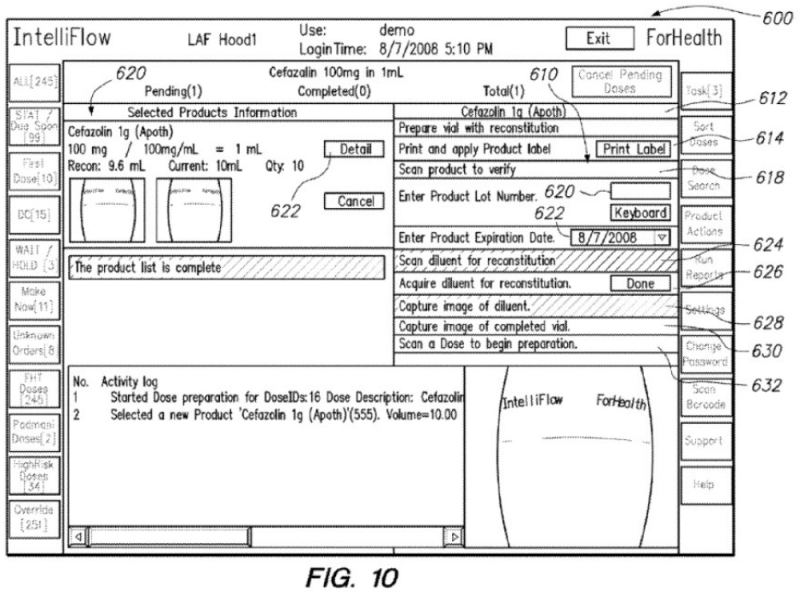
    With regard to the "highlighting" limitation the opinion notes that this limitation is tied to embodiments having "an interactive screen that includes prompts that can be highlighted by an operator to receive additional in-formation relative to one particular step," as illustrated by Figure 10 of the '579 patent:

    Image 1
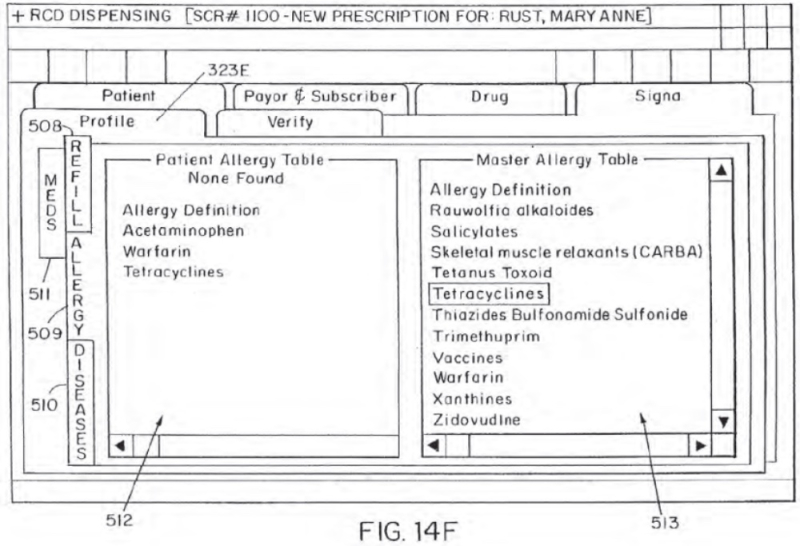
    The Court's understanding of the Board's construction of this term was that "the only missing element of this limitation [in the Alexander reference] is the ability to highlight prompts to receive more information concerning drug preparation steps."  And this feature was disclosed in the Liff reference in the panel's assessment (albeit in the physical rather than the virtual, computer realm; as stated in the opinion the system disclosed in the Liff reference comprises "a cabinet adapted to store a variety of prepackaged pharmaceuticals in a plurality of bins for filling patient prescriptions"; the Liff system was illustrated by Figure 14F of that patent:

    Image 2
    The Board had characterized its non-obviousness determination based on the highlighting limitation to be a "close case"; the Court disagreed.  To the panel, the Liff patent's teachings regarding highlighting for one purpose (i.e., patient characteristics) clearly would not have precluded the skilled worker from applying the highlighting function to another feature (e.g., information regarding the prescription order).  In the panel's view, their decision was predicated on the Supreme Court's teachings in KSR Int'l Co. v. Teleflex Inc., 550 U.S. 398, 416 (2007), that "[t]he combination of familiar elements according to known methods is likely to be obvious when it does no more than yield predictable results."  In addition, the panel relied on KRS for the principle that "[a] person of ordinary skill is also a person of ordinary creativity, not an automaton" with regard to the question of whether the "additional information that might be relevant" was limited to what the Liff reference expressly disclosed.

    In an interesting aside, the Court considered the issue of whether the Alexander reference was properly prior art under 35 U.S.C. § 102(e), because all claims in that patent were subsequently cancelled in an IPR.  Baxter argued that this eliminated the statutory requirement that the reference be "granted" and hence § 102(e) no longer applied.  The panel rejected that interpretation of the statute, saying that the Alexander reference satisfied the statutory terms because "the grant[] had occurred" and that the statute did not require the patent be currently valid to qualify as prior art.

    Finally, the panel addressed Baxter's secondary considerations evidence, agreeing with the Board that it was "weak" and did not rebut the prima facie case.

    The Court's invalidation outcome is rare with regard to an obviousness determination by the PTAB because it is equally rare that the Board does not amass sufficient evidence to be considered substantial and thus is not entitled to deference under Dickerson v. Zurko.  But where, as here, an IPR petitioner can demonstrate sufficient paucity of factual basis supporting the PTAB's non-obviousness determination, the outcome is unsurprising no matter how infrequent it may be in practice.

    Becton, Dickinson & Co. v. Baxter Corp. Englewood (Fed. Cir. 2021)
    Panel: Circuit Judges Prost, Clevenger, and Dyk
    Opinion by Circuit Judge Dyk

  • By Kevin E. Noonan

    Broad InstituteSenior Party The Broad Institute, Harvard University, and the Massachusetts Institute of Technology (collectively, "Broad") recently filed its reply to Junior Party The University of California/Berkeley, the University of Vienna, and Emmanuelle Charpentier (collectively, "CVC") opposition to its motion for priority in Interference No. 106,115.

    CVC's opposition raised two grounds for the PTAB to base a decision that CVC should prevail in the priority phase of the interference.  The first is that Broad inventor Zhang derived the invention claimed in the patents-in-interference from disclosure of CVC's conception from Dr. Marraffini.  Dr. Marraffini was in possession of CVC's invention because he was a confidential reviewer of the manuscript later published in Science as Jinek et al. (2012, "A Programmable Dual-RNA-Guided DNA Endonuclease in Adaptive Bacterial Immunity," Science 337: 816–21).  Dr. Marraffini also attended a CRISPR conference at Berkley on June 26, 2012 where the Doudna lab disclosed its CRISPR findings.  Indeed, CVC's opposition brief contained a comparison between what was disclosed at the meeting, what Dr. Marraffini disclosed to Dr. Zhang, and what Dr. Zhang communicated to his colleague Dr. Cong, first author on the paper published in the January 2013 issue of Science and containing Broad's disclosure of CRISPR practiced in eukaryotic cells:

    Image 1
    Second, CVC argued that once its seminal finding was made public, that CRISPR could be performed using sgRNA, no fewer than five labs ("Church (Harvard), Kim (ToolGen), Joung collaboration, and Chen (Sigma-Aldrich)"), including the Zhang lab, were able to perform eukaryotic CRISPR using routine, conventional laboratory methods, as evidenced by scientific papers from these labs published in Science in January 2013.  Indeed, CVC's opposition brief argued that Dr. Zhang's alleged reduction to practice in June 2012, after receiving the information regarding sgRNA from Dr. Marraffini, is itself evidence of CVC's complete conception, because the information Dr. Marraffini communicated to Dr. Zhang came from Jennifer Doudna and Emmanuelle Charpentier.

    Broad raises three flavors of argument against these allegations.  The first is procedural:  Broad argues that CVC's derivation arguments, arising for the first time in their opposition, are untimely and improper, because they needed to be raised in a substantive motion filed with Board permission under Bd. R. 121 and 37 C.F.R. § 41.208.  According to Broad, CVC was aware of these circumstances prior to deposing Dr. Marraffini and had the knowledge and opportunity to request the Board's permission to file a substantive motion at the appropriate time earlier in this interference.  Accepting these arguments now, according to Broad, is unduly prejudicial (it is unlikely any CVC argument would not be somewhat prejudicial to Broad) because it has deprived Broad the opportunity to submit its own opposition to these allegations complete with declaration testimony and the opportunity to depose CVC's declarants.  (This argument loses some of its rhetorical punch in view of the Board's granting Broad the opportunity to cross-examine Dr. Marraffini during CVC's deposition; see "PTAB Grants CVC Motion for Marraffini Deposition," but is certainly true for the other declarants.)

    Broad's second argument is entirely substantive:  Broad provides its rebuttal to CVC's allegations of derivation, relying heavily on citations to the evidentiary record (which presumably will not pose as challenging a task to evaluate as it does the casual observer); specifically, as an example, the brief provides this table showing Broad's possession of every aspect of eukaryotic CRISPR except the sgRNA embodiments prior to Dr. Marraffini's disclosure:

    Table 1
    The focus of much of these arguments is Broad's allegation that its lead inventor, Dr. Zhang, had successfully reduced eukaryotic embodiments of CRISPR using "dual RNA molecule" (i.e., the structural tracrRNA and the sequence-specific crRNA) versions in 2011 through early 2012, and that his immediate success in reducing to practice sgRNA embodiments (the subject of this interference) after Dr. Marraffini disclosed them was the consequence of those efforts, and not because CVC's inventors had complete conception of the invention falling within the scope of the interference Count:

    CVC claims Zhang surreptitiously took the entire invention from CVC through Marraffini.  But the truth is simpler and in no way nefarious: Zhang included a small, single adaptation that the CVC inventors chose to put into the public domain.  He was so far ahead of CVC with the work that mattered—creating a functioning eukaryotic CRISPR-Cas9 system—that he was able to reduce the chimeric RNA system to practice multiple times as memorialized in his complete, groundbreaking manuscript, all while CVC struggled and failed despite their multiple, highly experienced eukaryotic co-collaborators.

    In this regard, Broad's Reply continues its litany of reasons why it contends CVC's inventors failed to reduce eukaryotic CRISPR to practice to such an extent that the Board should conclude that their conception was incomplete until actually reducing such embodiments to practice at CVC's earliest priority date in this interference, January 23, 2013.  (This date is far after Broad's earliest claimed priority date, June 26, 2012, and its several actual reduction to practice dates in the month or two thereafter.)  Specifically, Broad argues (again) that mere disclosure of sgRNA embodiments of CRISPR-Cas9 is not enough for conception (discounting CVC's argument that once CVC showed activity of these constructs in vitro routine microinjection methods, which CVC showed were functional in zebrafish, were enough to provide complete conception).  These arguments weave a careful mixture of alleging that conception required that an inventor have a reasonable expectation of success for conception to be complete and an argument that the Board's decision that the Jinek reference (containing the experimental results that support CVC's reduction to practice) was insufficient to render Broad's invention obvious as decided by the Board in its final decision in the earlier interference between the parties (Interference No. 105,048) supports its allegations here that CVC's conception was incomplete at its earliest claimed conception date.  In this regard, Broad provides some inspiring rhetoric (e.g., "CVC is trying to wish away the forest of evidence by focusing on a single, irrelevant tree").  Also in this regard, Broad apparently has abandoned its earlier reliance on the principle of simultaneous conception and reduction to practice in its attack on CVC's conception ("simultaneous conception/reduction to practice is irrelevant on the facts"), seemingly being content to rely on evidence of CVC's purported failures of actual reduction to practice or statements supporting the uncertainty in achieving functional CRISPR in eukaryotic cells by CVC's inventors.

    Broad's third argument alleges that CVC's fact witnesses (Drs. Barrangou and Sontheimer) supporting their derivation arguments should be disregarded due to bias, because they are all involved with Intellia Therapeutics, a company commercializing eukaryotic CRISPR embodiments with Jennifer Doudna, one of CVC's lead inventors, and Dr. Marraffini, as well as their testimony being "inconsistent with the facts."

    In addition to these arguments, Broad addresses several less critical points raised in CVC's opposition, including whether the testimony of certain of their declarants should be disregarded because it is uncorroborated inventor testimony (as well as arguing that this testimony is unnecessary to establish Broad's actual reduction to practice).  Also, Broad argues that CVC's allegations that some of Broad's arguments raised in opposition to  CVC's conception are "lack[ing] candor" and "a sham" involve requirements asserted by the Board in its decision that there was no interference-in-fact in the '048 Interference (Broad taking the opportunity to accuse CVC of "fabricating a story inconsistent with the state of the art in 2012 and the prior decisions of the PTAB and Federal Circuit").  And Broad argues that CVC's opposition does not refute Dr. Zhang's conception or any evidence regarding their actual reductions to practice (this being the consequence, of course, of CVC's decision to assert its derivation argument, for which the relative ease of Broad's reduction to practice CVC argues is evidence of their own complete conception as conveyed by Dr. Marraffini to Dr. Zhang).  Included in these arguments are a rebuttal of CVC's argument that Dr. Zhang did not understand the need or function of tracrRNA, based on specific citations to the Broad's evidence, and Broad's assertion that far from being routine and conventional, "CVC itself identifies no less than 12 adaptations that Zhang made to his CRISPR-Cas9 system to overcome the numerous eukaryotic challenges" in achieving CRISPR functional in eukaryotic cells.

    Both parties have filed Motions to Exclude evidence that involve some of the testimony relied upon by the other party with regard to their priority positions, which will be the subject of future posts.

  • USPTO SealThe U.S. Patent and Trademark Office will be holding its next biotechnology/chemical/pharmaceutical (BCP) customer partnership meeting, as a virtual meeting, on June 15 and 16, 2021.  The agenda for the meeting is as follows:

    June 15, 2021

    • Welcoming and Opening Remarks (1:00 – 1:10 pm ET) — Daniel Sullivan and Gary Jones, Directors, and Renee Claytor, Director (Acting), TC1600, USPTO

    • COVID-19 Prioritization Examination Pilot and CARE Act Updates (1:10 – 2:00 pm) — Kery Fries, Senior Legal Advisor, Office of Patent Legal Administration (OPLA), USPTO

    • Application of Cooperative Patent Classification (CPC) to Search & Routing of Patent Applications (2:00 – 2:30 pm) — Fereydoun G. Sajjadi, SCE SPE, TC1600, USPTO

    • Interview Practice Review (2:30 – 2:50 pm) — Bethany Barham, SPE, TC1600, USPTO

    • Break (2:50 – 3:00 pm)

    • Precedential and Informative Decisions (3:00 – 3:30 pm) — Kalyan Deshpande, Lead Administrative Patent Judge, PTAB, USPTO

    • Appeals (3:30 – 4:00 pm) — Michael Cygan, Eric Jeschke, and Kristi Sawert, Administrative Patent Judges, PTAB, USPTO

    • Motions to Amend Practice in AIA Trials (4:00 – 4:00 pm) — Michelle Ankenbrand, Lead Administrative Patent Judge, PTAB, USPTO

    • Legal Experience and Advancement Program (LEAP) (4:30 – 5:00 pm) — Amanda Wieker, Administrative Patent Judge, PTAB, USPTO

    • Closing Remarks (5:00 – 5:05 pm) — Directors, TC1600, USPTO

    June 16, 2021

    • Welcoming and Opening Remarks (12:30 – 12:35 pm ET) — Daniel Sullivan and Gary Jones, Directors, and Renee Claytor, Director (Acting), TC1600, USPTO

    • TC Decided Petitions (12:35 – 1:00 pm) — Scarlett Goon, QAS, TC1600, USPTO

    • Rule 130 Declarations Practice under the American Invents Act (AIA) (1:00 – 2:30 pm) — Kathleen Fonda, Senior Legal Advisor, Office of Patent Legal Administration (OPLA), USPTO

    • Patent Stakeholder Support Division (SSD) – An Overview (2:30 – 2:50 pm) — Sudhanshu C. Pathak, Pro Se Assistance Program Coordinator, Office of Patent Experience, USPTO

    • Break (2:50 – 3:00 pm)

    • WIPO Standard ST.26 (for Sequence Listing) Introduction (3:00 – 4:30 pm) — Anne Gussow, QAS, TC1600, USPTO, and Mindy Brown SPE, TC1600, USPTO

    • Patent Electronic Business Center (4:30 – 5:00 pm) — Jeffery Wong, Project Manager, OPIM, USPTO, and Marcus Jackson, Team Lead, OPIM, USPTO

    • Closing Remarks (5:00 – 5:05 pm) – Directors, TC1600, USPTO

    Additional information regarding the BCP customer partnership meeting, including registration information for those wishing to attend the meeting or register for online participation, can be found here.  An agenda for the BCP customer partnership meeting can be found here.

  • HGF Limited and Knobbe Martens will be offering a webinar entitled "Developing Effective Patent Strategies for Personalized Medical Devices in Europe and the US" on June 9, 2021 at 11:00 am (ET).  Adam Hines of HGF, and Christy Lea and Sabing Lee of Knobbe Martens will explore considerations for implementing an effective strategy to secure patent protection for personalized medical devices, and to steer through a potentially crowded competitive landscape, with a particular focus on comparing the European and US jurisdictions.  The webinar will cover:

    • an overview of the growth in patent applications for personalized medical devices and examples of patent claims that can protect them;
    • considerations for drafting and prosecuting patent applications directed to personalized medical devices and how these approaches differ between Europe and the U.S.;
    • a case study examining litigation, in the U.S., of a patent portfolio with claims covering personalized medical devices and how defendants challenged patent validity.

    Those wishing to register can do so here.

  • Supreme Court Narrows Federal "Anti-Hacking" Law to Exclude Enforcement Against Those Who Use Otherwise Authorized Access for Improper Purpose

    By Joshua Rich

    Supreme Court Building #2There is a well-worn legal maxim that "hard cases make bad law."  In deciding Van Buren v. United States today, the Supreme Court was faced with the opposite problem: bad laws[i] make hard cases.  Specifically, in a 6-3 decision, the Court found that the Computer Fraud and Abuse Act ("CFAA") does not extend to an individual's accessing information over the internet for an improper purpose, so long as the individual would be entitled to access for a proper purpose.  There's no question that interpreting the opaquely-worded CFAA forced the Court to choose between two bad options, with a parade of horribles on both sides; it chose the option that clearly decriminalizes everyday behavior (but also would allow abusive use of access that individuals have solely for work purposes).

    The CFAA (codified at 18 U.S.C. § 1030) was enacted in 1986, based on a number of hacking incidents as well as — allegedly — Reagan White House viewings of the movie "War Games."  It was originally intended to deter hacking into government computers, financial institution networks, and other "protected computers."  For that reason, it established that a person commits a crime when he or she "intentionally accesses a computer without authorization or exceeds authorized access, and thereby obtains . . . information from any protected computer."  In that context, "the term 'exceeds authorized access' means to access a computer with authorization and to use such access to obtain or alter information in the computer that the accesser is not entitled so to obtain or alter."  And the term "protected computer" includes any computer "which is used in or affecting interstate or foreign commerce or communication, including a computer located outside the United States that is used in a manner that affects interstate or foreign commerce or communication of the United States."  With the advent of the internet and its expansion into every part of our lives, however, the portion of the law prohibiting exceeding access to protected computers has expanded the scope of the CFAA immensely.

    Against the backdrop of this broad law came Sergeant Nathan Van Buren and a set of facts seemingly out of Southern Gothic lore.  Sergeant Van Buren was a financially troubled officer in the Cumming, Georgia police department.  He (along with the rest of the department) had been warned to stay away from Andrew Albo, a local widower in his sixties with a penchant for much younger women, including prostitutes.  But instead of staying away, Van Buren befriended Mr. Albo during an arrest for providing alcohol to a minor and helped him "handle" disputes with young women.

    Seeing an opportunity for help with his financial woes, Van Buren told Albo — falsely — that he had substantial medical debts.  He then asked Albo for a loan.  But instead of appreciating Van Buren's position, Albo went to the county sheriff's department with recordings of the request and told them Sergeant Van Buren was shaking him down.  The FBI got involved and decided to run a sting operation.  First, it had Albo ask Van Buren for help running drugs, but the police sergeant refused.  Then, it had Albo ask for information about a female friend that Albo had allegedly met at a strip club (specifically, information regarding whether she was an undercover police officer).  Albo offered money in exchange for Van Buren accessing Georgia and national criminal databases to run the woman's license plates.  Van Buren accepted the money and ran the plates, then texted Albo when he had done so.  The FBI and Georgia Bureau of Investigation then swept in and arrested Van Buren, who admitted to all of the facts and agreed what he had done was wrong.

    The local U.S. Attorney charged Van Buren with honest services fraud and unauthorized access to the government databases in violation of the CFAA.  He was convicted on both counts, but the Court of Appeals reversed the honest services fraud verdict on the basis of improper jury instructions.  Van Buren then took the CFAA conviction to the Supreme Court.[ii]  Specifically, the Supreme Court considered whether a person who is authorized to access information on a computer for certain purposes violates the CFAA if he accesses that information for an improper purpose.

    The six-Justice majority, in an opinion written by Justice Barrett, decided that the CFAA would not extend so far.  The majority started with the text of the CFAA, and believed that the act was structured so that the two options for the offense (access with authorization or access exceeding the scope of authorization) would be parallel in a binary "gates-up-or-down inquiry."  That is, because the only question for the first part was whether the accesser had authorization or not, the second part should be limited to the question of whether the accesser had authorization to access that information in any circumstance or not.  In that sense, Justice Barrett used a physical analogy for the scope of authorization, describing the prohibition as relating to "particular areas of the computer – such as files, folders, or databases – to which their computer access does not extend."  In doing so, she rejected the government's assertion that the majority's interpretation would read the word "so" (in the phrase "entitled so to obtain or alter") from the statutory definition of "exceeds authorized access."  She indicated that the word "so" could be understood to distinguish the situation where an individual is not entitled to see the same information in non-computer-based means (such as, hypothetically, if a person were entitled to see a personnel file in hard copy by not electronically).

    The majority also relied on the history of the CFAA's enactment and a parade of horrible possible applications of the law to reject the government's reading that it covers access for an improper purpose.  The first version of the law that the CFAA replaced explicitly considered the purpose of access and the CFAA did not.  However, the legislative history (which neither the majority nor the dissent mentions) expressly stated that the change was not intended to be substantive.  In addition, the majority noted that the CFAA as read by the government could be understood to encompass everyday violations of terms of service, such as use of a work computer for personal reasons or embellishing online-dating profiles or using a pseudonym on Facebook.  For all of these reasons, the majority held that exceeding authorized access related to computer structures, not terms (or purposes) of access.

    Justice Thomas, writing in dissent and joined by Chief Justice Roberts and Justice Alito, disagreed with the outcome of the case primarily based on settled property law considerations.  He saw nothing more definitive about the majority's reading — any more of a "gates-up-or-down" approach — than if exceeding authorized access considered what the circumstances of authorization were.  In doing so, he analogized to property law, which generally protects against unlawful entry and unlawful use of property after entry.  And he saw nothing more reasonable in decriminalizing access in all circumstances if there is a single exception than prohibiting such access if an authority had explicitly said so.  For example, the majority's reading decriminalizes an IT administrator's actions in deleting every file on a computer minutes before resigning.  Thus, Justice Thomas noted, the majority's reading of the CFAA constitutes a substantial narrowing of the law.

    As a practical matter, the narrow reading of the CFAA shifts power from employers and the government to employees and website visitors.  The CFAA previously provided an arrow in the quiver of employers to discourage employees from misusing their access to information or misappropriating trade secrets (it was another criminal offense that could lead to an arrest before the employee disseminated the trade secrets beyond the doors of the company).  It also served as the primary basis for the federal government to charge employees who used IRS, Social Security, or law enforcement databases to stalk private citizens.  On the other hand, it also chilled some investigative reporting and whistleblowing because of violation of terms of service for websites.  Thus, every person who shops on their company computer or uses a fake e-mail address to avoid spam from a website can breathe a little easier.  And we can all hope that Congress will take the Court's decision as a reason to rewrite the CFAA and bring it into the internet age.

    Van Buren v. United States (2021)
    Opinion by Justice Barrett, joined by Justices Breyer, Sotomayor, Kagan, Gorsuch, and Kavanaugh; dissenting opinion by Justice Thomas, joined by Chief Justice Roberts and Justice Alito

    [i] Columbia University Law School professor Tim Wu called the CFAA the "worst law in technology" in a 2013 New Yorker article.

    [ii] See United States v. Van Buren, 940 F.3d 1192 (11th Cir. 2019).

  • By Kevin E. Noonan

    Federal Circuit SealLast week, the Federal Circuit affirmed imposition of an exclusion order under 19 U.S.C. § 1337 (Section 337 of the Tariff Act of 1930) by the Federal Trade Commission against 10X Genomyx (an intervenor in this appeal) over importation of patented microfluidic chips, in Bio-Rad Laboratories, Inc. v. International Trade Commission.  (10X Genomyx obtained a similar exclusion order against Bio-Rad in a case appealed last month; see "Bio-Rad Laboratories, Inc. v. Int'l. Trade Comm".)

    In this action, Bio-Rad filed a complaint against 10X Genomyx alleging that importation of certain microfluidics chips infringed claims of U.S. Patent Nos. 9,500,664, 9,636,682, and 9,649,635.  Representative claims set forth in the opinion are these:

    The '664 patent:

    1.  A system for forming a plurality of sample-containing droplets suspended in a back- ground fluid, comprising:
        a substrate having a bottom surface and a top surface;
        a sample well, a background fluid well, and a droplet well each having an upper region protruding from the top surface of the substrate;
        a network of channels formed in the bottom sur- face of the substrate and fluidically interconnecting the sample well, the background fluid well, and the droplet well; and
        a droplet generation region defined by the network of channels and configured to generate sample-containing droplets suspended in the background fluid;
        wherein the droplet generation region is de- fined by the intersection of a first channel, a second channel, and a third channel;
        wherein the first channel is configured to transport sample-containing fluid from the sample well to the droplet generation region, the second channel is configured to transport background fluid from the background fluid well to the droplet generation region, and the third channel is configured to transport sample-containing droplets from the droplet generation region to the droplet well; and
        wherein the substrate and the upper region of each well are injection molded as a single piece.

    The '682 patent:

    14.  A system for generating droplets, comprising:
        a device including a row of sample wells each configured to receive sample-containing fluid, a row of continuous-phase wells each configured to receive continuous-phase fluid, and a row of droplet wells, the device also including a corresponding channel network for each sample well, the channel network including a droplet-generation region and fluidically connecting the sample well to one of the continuous-phase wells and one of the droplet wells;
        a holder for the device;
        a gasket configured to be attached directly to the holder, such that the gasket extends over each sample well, each continuous-phase well, and each droplet well; and
        an instrument configured to
            (a) receive an assembly including the device, the holder, and the gasket,
            (b) engage the gasket with a manifold, and
            (c) apply positive pressure and/or negative pressure to the device via the manifold, such that sample-containing fluid flows from each sample well to the corresponding droplet-generation region, continuous-phase fluid flows from each continuous-phase well to the corresponding droplet-generation region, and sample-containing droplets flow from each droplet-generation region to the corresponding droplet well.

    The '635 patent:

    1.  A system to form and concentrate an emulsion, comprising:
        a device including a sample well configured to receive sample-containing fluid, a continuous-phase well configured to receive continuous-phase fluid, and a droplet well, the device also including a channel network having a first channel, a second channel, and third channel that meet one another in a droplet-generation region; and
        an instrument configured to operatively receive the device and to create
            (a)    a first pressure differential to drive sample- containing fluid from the sample well to the droplet-generation region via the first channel, continuous-phase fluid from the continuous-phase well to the droplet-generation region via the second channel, and sample-containing droplets from the droplet-generation region to the droplet well via the third channel, such that the droplet well collects an emulsion including sample- containing droplets disposed in continuous-phase fluid, and
            (b)    a second pressure differential to decrease a volume fraction of continuous-phase fluid in the emulsion, after the emulsion has been collected in the droplet well, by selectively driving continuous-phase fluid, relative to sample-containing droplets, from the droplet, from the droplet well via the third.

    (wherein the text in italics and boldface is the claim term at issue).

    The technology at issue was related to microfluidics chips for performing bioanalytic assays using small amounts of sample contained in microdroplets, defined in the opinion as "a contiguous amount of one type of fluid that is encapsulated within a different fluid," wherein "the inner fluid is aqueous or water-based, while the outer fluid is oil" in typical embodiments.  Generally, the sample is contained in the aqueous inner fluid.  An advantage of this arrangement was that each sample could be subject to chemical reactions in its own droplet (a "mini-test tube" according to the '664 patent) and that a larger number of chemical reactions can be performed in parallel.  Such reactions are performed on microchips as claimed in the patents-at-issue (the opinion noting that such microchips were known in the art at the priority dates of these patents).

    As set forth in the opinion, the named inventors of the asserted patents previously worked for a company (QuantaLife, Inc.) that was thereafter acquired by Bio-Rad.  These inventors had agreed in their employment contracts with QuantaLife to promptly assign to the company their rights to the provisional applications that matured into the three patents-in-suit, which they assigned to Bio-Rad after the acquisition.  These inventors later left Bio-Rad and formed 10X Genomics, where they developed the technology asserted by Bio-Rad to infringe the patents-in-suit.  Two embodiments of these chips were at issue in this case:

    • GEM Chips, having "input wells for three different materials—gel beads, sample, and oil—and one output well to collect droplets.  The microfluidic channels on the GEM Chips intersect each other such that the gel bead and sample fluid are mixed at a first intersection, the resulting mixture enters into a microfluidic channel referred to as a 'singulation channel,' and the mixture then mixes with the oil at a second intersection."

    • Chip GB, which 10X Genomyx utilizes "to generate droplets that are used to make the gel beads that are packaged with the GEM Chips and sold to customers.  The Chip GB contains one input well that holds an aqueous monomer solution, a second input well that holds oil, and channels from each of the wells that intersect each other to allow for the formation of droplets that are collected in a droplet well.  Over time, the monomers within each droplet polymerize, and the droplet becomes a gel bead."

    Responsive to Bio-Rad's complaint, an Administrative Law Judge (ALJ) granted summary determination that the doctrine of assignor estoppel precluded 10X Genomyx from challenging the validity of the asserted patents.  The ALJ then construed the claims with regard to the term "droplet-generation region" to mean "the intersection of (1) a sample-containing dispersed phase fluid inlet channel, (2) a continuous phase fluid inlet channel, and (3) a droplet outlet channel."  The parties agreed that the term "sample" meant "a compound, composition, and/or mixture of interest, from any suitable source(s)."

    Under this construction, the ALJ determined that 10X Genomyx's GEM Chips infringed the three patents, but that while the GB Chips infringed the claims of the '682 and '635 patents they did not infringe asserted claims 1 and 14 of the '664 patent because the monomer solution used with those chips was not a "sample" under the agreed-upon construction.  The Commission reviewed the ALJ's findings and adopted them, that the GEM chips infringed the three asserted patents (either literal, induced, or contributory infringement) but that the GB chips did not literally infringe the '644 patent.  The parties appealed each of the adverse determinations against them.

    The Federal Circuit affirmed, in an opinion by Judge Lourie, joined by Judges Newman and Dyk.  With regard to Bio-Rad's appeal, the panel addressed two assertions that the ALJ erred.  The first was that because the GB chips did not involve a sample they did not have structures corresponding to "a 'sample well,' a sample channel, sample-containing droplets, or the claimed 'droplet generation region.'"  Second, Bio-Rad argued that due to the structural nature of the elements of the claims (wells and channels), infringement could not depend on what was in those wells and channels.  The "sample" limitation was assessed based on the parties' agreed-upon definition (which was taken from the '664 specification), and the Federal Circuit found no error in the ALJ relying on witness testimony that what was encapsulated in 10X Genomyx's GB Chip was not a sample under the agreed-upon definition but rather was "an input for a reagent production process" (emphasis in opinion).  This determination was also consistent with distinctions made in the '664 specification regarding the differences between a sample ("something that the customer cares about and wants to analyze") and a reagent ("which 'are of no interest'").  And this interpretation was also consistent with exemplified samples ("blood and plasma, and research samples such as culturued [sic] cells or bacteria") and reagents, defined as ""a compount [sic], set of compounds, and/or composition that is combined with a sample in order to perform a particular test(s) on the sample")(emphasis in opinion).  Bio-Rad's challenge was on these definitions, which they argued imported unsupported additional limitations into the claim term and were based on faulty conclusions (such as the monomer being "of no interest" under circumstances where "10X care-fully designed the monomer solution with particular concentrations of ingredients to serve as a gel bead precursor solution").  The Court agreed with the Commission and 10X Genomyx that Bio-Rad's arguments in this regard were directed to the Commission's factual determinations, and that under the Administrative Procedures Act the Commission's factual determinations were entitled to deference and "substantial evidence" review (which Bio-Rad did not satisfactorily challenge).  In this regard, the opinion states that "[t]he compelling factor here is the distinction between 'samples' and 'reagents'" as set forth (and relied upon by the Commission) in the '644 patent specification.  And, in particular, the panel did not find that consideration of the term "of interest" in construing the meaning of the claims and applying that construction to 10X Genomyx's GB chips imported any untoward subjectivity to the analysis.

    Turning to Bio-Rad's second argument, the Federal Circuit considered this argument to "fail[]" for several substantive and procedural reasons.  The opinion states that it is "not clear" that Bio-Rad made this argument before the Commission, and accordingly should be precluded from presenting it on appeal in the first instance, citing Interactive Gift Express, Inc. v. CompuServe Inc., 256 F.3d 1323, 1346 (Fed. Cir. 2001).  Even if this procedural hurdle had been overcome, the panel asserted Bio-Rad would not prevail because its argument rested on "rewriting the claims in an oversimplified form and removing all limitations that differentiate the recited structures from each other."  The opinion illustrates this defect in Bio-Rad's argument by comparing the description of what is claimed in their brief with the actual claims, saying that the former "is not remotely close to what the claim says" it is.  "Inventors are masters of their claims, and the words they use to describe and claim their invention are decisive and binding," said the Court, and in the panel's view the '664 inventors did not claim their invention as broadly as it would need to have been claimed for Bio-Rad to prevail in its infringement argument here.  It was the inventors' decision "to characterize the wells and channels based on the material contained within them," according to the Court, and this choice cannot be "escaped" by recourse to the principle that "apparatus claims cover what a device is, not what a device does."  See Hewlett-Packard Co. v. Bausch & Lomb, Inc., 909 F.2d 1464, 1468 (Fed. Cir. 1990) (emphasis in original opinion).

    10X Genomyx's appeal challenged the Commission's determination that its GEM chips infringed the asserted claims of the three patents-in-suit.  The first of two challenges by 10X Genomyx was based on whether their GEM chips contained the "droplet-generating region" required by the claims.  10X Genomyx's other challenge was directed to whether the evidence supported the Commission's determination regarding indirect infringement.  The challenge regarding whether GEM chips comprised the "droplet-generating region" was on claim construction, where 10X Genomyx asserted this alternative construction of the term:

    [T]he intersection of the sample input channel that receives the dispersed phase fluid from the sample well, the oil input channel that receives the continuous-phase or background fluid from the oil well, and the droplet outlet channel that outputs to the droplet well, at which droplets are generated.

    Bio-Rad (and the Commission) countered that 10X Genomyx had waived this argument three times:  "first, by failing to propose it in the parties' Joint Claim Construction Chart; second, by failing to seek review by the Commission of the ALJ's waiver finding; and third, by failing in its principal brief to ask this court to overturn the ALJ's waiver finding."  The Court was not convinced, citing instances in the record (including that the construction proposed here was identical to 10X Genomyx's initial construction asserted before the ALJ and maintained before the Commission), and that this consistent assertion of its construction did not constitute waiver that would preclude 10X Genomyx from making its alternative claim construction argument on appeal.

    Nevertheless, on the merits, the panel found that the ALJ had correctly construed the term, based on the plain meaning of the claims and the specifications of the patents-in-suit.  The Court held that 10X Genomyx's proposed alternative construction would impermissibly impose requirements on the claimed invention not supported by the intrinsic evidence.  The Court also rejected 10X Genomyx's argument that the ALJ erred by applying the doctrine of assignor estoppel to preclude it from challenging construction based on the prior art, for the simple reason that the Court found evidence in the record that the ALJ had permitted these art-based challenges and that they had failed (which is not the same thing).  The opinion states that the ALJ had properly construed the claims using the intrinsic evidence under Phillips v. AWH Corp., 415 F.3d 1303, 1312–15 (Fed. Cir. 2005) (en banc), and the fact that prior art considerations did not make their way into the Commission's opinion (which the Court termed "less relevant arguments") did not indicate error.

    With regard to the Commission's finding of indirect infringement, the Federal Circuit recognized 10X Genomyx's argument to be a factual one (was there enough evidence presented to support the determination?) that is entitled to the substantial evidence standard of review.  The facts at issue revolved around whether 10X Genomyx had knowledge of the patents (on contrast with the priority applications, where such knowledge was not in doubt).  In finding that the Commission's determination was supported by substantial evidence, the opinion states that "10X's various arguments attempt to distract from the reality of this case: named inventors of the asserted patents sold their company and patent rights to Bio-Rad, worked for Bio-Rad for a short time, left Bio-Rad to start a new company, and launched new products that have been determined to infringe the patents they assigned to Bio-Rad."  In addition, the opinion states that 10X Genomyx's arguments "largely attack the ALJ's credibility determinations and weighing of the evidence" (which fails the substantial evidence challenge), particularly with regard to the ALJ's credibility determinations of the witnesses (including the named inventors).  And regarding the existence of non-infringing uses relevant to the Commission's contributory infringement determination, the Court rejected 10X Genomyx's assertion of "hypothetical" systems (which 10X Genomyx asserted were relevant due to the statutory language that an accused product be "suitable" for non-infringing use) as being contrary to precedent (for which the panel sets forth examples including Fujitsu Ltd. v. Netgear Inc., 620 F.3d 1321, 1330–31 (Fed. Cir. 2010), and Golden Blount, Inc. v. Robert H. Peterson Co., 438 F.3d 1354, 1363 (Fed. Cir. 2006).  In sum, because "[i]t is not within [the Court's] purview to reweigh the evidence or to question the ALJ's credibility determinations" the Court affirmed the Commission's infringement determinations against 10X Genomyx.

    Over the past six weeks, 10X Genomyx has obtained an exclusion order against Bio-Rad's importation of certain of their microfluidic chips over 10X Genomyx's patents and Bio-Rad in this case has obtained an exclusion order against 10X Genomyx's importation of certain of their microfluidic chips over Bio-Rad's patents.  The relationship and history between the companies argues against settlement, but under these circumstances settlement seems a sensible solution for both parties (depending of course on the relative market share and competitive positions of the parties excluded goods).

    Bio-Rad Laboratories, Inc. v. International Trade Comm. (Fed. Cir. 2021)
    Panel: Circuit Judges Newman, Lourie, and Dyk
    Opinion by Circuit Judge Lourie

  • By Kevin E. Noonan

    Broad InstituteLast month, Senior Party The Broad Institute, Massachusetts Institute of Technology, and Harvard University (hereinafter, "Broad") filed its reply to an opposition to Broad's motion to correct inventorship filed by Junior Party University of California/Berkeley, the University of Vienna, and Emmanuelle Charpentier (hereinafter, "CVC"), which was filed as a contingent motion in response to CVC's Substantive Motion No. 3 under 37 C.F.R. § 41.121(a)(1) asking for judgment of unpatentability for all claims in interference under 35 U.S.C. § 102(f) or (if post-AIA) 35 U.S.C. § 115(a) for "failure to name all inventors of the alleged invention" in Interference No. 106,115.

    CVC's opposition asserted that Broad has not established that it is entitled to this relief, as required under 37 C.F.R. § 41.121(b).  CVC also argued that Broad did not provide consent for one of the individuals — Shauiliang Lin — to be added as an inventor.  CVC further alleged that the motion is barred by laches and submitted in bad faith.  And finally, CVC asserted that as a matter of jurisdiction the Director — not the Board — has sole authority to change inventorship and that there is no evidence that the Director has delegated this authority to the Board.

    The Broad asserts that CVC's motion was a "classic straw man," in part because its motion was a contingent motion and thus would only be considered by the Board if CVC's Substantive Motion No. 3 was granted (and then and only then will Broad and CVC understand which inventors had not been properly named).  This procedural consideration, in Broad's view, makes "quick work" of CVC's argument that Broad had failed to identify the unnamed inventors and that its motion was untimely.  Broad also argues that CVC's other allegations (of bad faith and breach of the duty of candor) are not supported by any evidence and hence "should not detain the PTAB for long"; indeed, Broad characterizes these arguments as a "witch hunt [and] nothing more."

    As required by PTAB rules in an interference, Broad's reply methodically goes through CVC's opposition point by point in providing a rebuttal of the allegations therein.  Thus, Broad's argument explicates in detail the procedural deficiencies in castigating Broad for not identifying the unnamed inventors prior to the Board granting CVC's Substantive Motion No. 3 that there are any unnamed inventors to name.  Broad's position is that there are no such inventors.  Referencing the arguments Broad made in its Opposition to CVC's Substantive Motion No. 3 (see "Broad Files Motion Opposing CVC Motion for Misjoinder of Inventorship under 35 U.S.C. § 102(f)"), Broad states that if, despite its arguments therein, the Board grants the motion, then and only then will there be any unnamed inventors to name with regard to its contingent motion to amend inventorship.  And then and only then should the Board grant their motion, citing Egenera, Inc. v. Cisco Sys., Inc., 972 F.3d 1367, 1376 (Fed. Cir. 2020).  This is because in order for the Board to grant CVC's motion the Board would have to have concluded that there were unnamed inventors, for which Broad would be entitled to file its change of inventorship.  (The Catch-22 nature of this argument harkens to a similar quality in some of CVC's arguments regarding inventorship; see "CVC Files Reply to Broad's Opposition to CVC Motion for Misjoinder of Inventorship under 35 U.S.C. § 102(f)".)

    With regard to these arguments, Broad asserts that "CVC filed a half-baked motion to try to invalidate Broad's claims based on its allegation of missing inventors without providing any inventorship analysis or appropriate evidence" and "[i]f, despite those failings, the PTAB still finds there are missing inventors, then the relief requested in this contingent motion would be warranted based on the PTAB's finding an  identification of the individuals it deems should have been named as inventors."

    Broad uses similar arguments with regard to CVC's laches arguments, to the extent that it would only be after the Board granted CVC's Substantive Motion No. 3 that Broad was under an obligation to correct inventorship.  (While compelling as far as it goes, CVC's argument was rather different:  to the extent that Broad filed the PCT and EP applications that were the subject of a declaration on inventorship by their lawyer Thomas Kowalski, and that this inventorship differed from the inventors named in corresponding U.S. applications and patents claiming the same or substantially the same subject matter, the obligation to square these varying inventorship claims arose then, not only after the Board make its determination in this interference.)  More pertinent to Broad's argument is the focus of the unnamed inventor argument on a particular individual, Dr. Lin. Broad asserts precedent to the effect that laches does not arise when a putatively unnamed inventor moves to be added to an application or patent, including Advanced Cardiovascular Sys., Inc. v. Scimed Life Sys., Inc., 988 F.2d 1157 (Fed. Cir. 1993); Serdarevic v. Advanced Med. Optics, Inc., 532 F.3d 1352 (Fed. Cir. 2008); and Lismont v. Alexander Binzel Corp., 813 F.3d 998 (Fed. Cir. 2016).  Broad asserts no prior belief that there were any unnamed inventors in the patents-in-interference and thus no occasion for laches to arise with regard to inventorship questions.

    Broad characterizes CVC's allegations of bad faith as "irresponsible" and "reckless" (as opposed to the laches argument, which is "merely wrong").  Alluding to the BPAI's decision in Nevel v. Hoeller, Patent Int. No. 104,025, Paper No. 65 (B.P.A.I. May 10, 2000), where the Board chastised a party making similar accusations based on inventorship as "fishing expeditions" and "witch hunts" and stated that they would be "aggressively quelched," Broad focuses its argument on the seriousness of CVC's allegations and the deficiencies (in Broad's view) of CVC's evidence.  Its rhetoric rising to meet the seriousness of CVC's allegations, Broad argues:

    [CVC] has, at best, advanced a frivolous argument resulting in unnecessary briefing and increased costs for all.  Such behavior should not be condoned nor should it be overlooked.  Here the sword of equity should fall the other way.  See 37 C.F.R. § 42.12; see also Paper No. 2, Standing Order § 208.7 ("An allegation of inequitable conduct or fraud that fails to make out a facially sufficient case may result in sanctions or a referral to the Office of Enrollment and Discipline.").  It is past time for CVC's irresponsible allegations to stop.

    Broad's Reply then turns to CVC's procedural argument, that the Director and not the Board is empowered to correct inventorship.  Authority Broad cites in this regard include 37 C.F.R. § 1.48(i) and § 1.324(d), as well as other interference decisions such as Flamm v. Vinogradov, Patent Int. No. 104,807, Paper No. 20 (B.P.A.I. Dec. 11, 2002); Chai v. Frame, 10 U.S.P.Q.2d 1460, Patent Int. No. 101,432 (B.P.A.I. 1988); and Thomas v. Eicken, 219 U.S.P.Q. 900 (B.P.A.I 1983).  The brief distinguishes the authority cited by CVC in its opposition, Honeywell Int'l Inc. v. Arkema Inc., 939 F.3d 1345, 1349 (Fed. Cir. 2019), and resorts to both the C.F.R. and the M.P.E.P. for instances and circumstances where the Director can delegate her authority, including on an ad hoc basis.

    Finally, Broad asserts that lack of consent by Dr. Lin should not be a basis for the PTAB to deny Broad's contingent motion to correct inventorship.  According to Broad, Dr. Lin's consent is not "strictly necessary" (not citing any authority for this point itself, Broad relies on a purported failure by CVC to cite authority to the contrary).  The Broad shores up this lack of authority by relying on MPEP § 1481.02(I) that suggests than faced with refusal by an unnamed inventor to assent to being named a patent holder "may wish" to file a non-broadening reissue application, because the unnamed inventor's assent is not required in that situation.  The relatively thin reed of the "may wish" locution "indicates discretion when an inventor does not consent—not an absolute bar to correction" according to the Broad.  Broad's arguments on this issue in the brief conclude with a citation of CVC's authority, Honeywell Int'l Inc. v. Arkema Inc., 939 F.3d 1345, 1349 (Fed. Cir. 2019), for its holding that "it was an abuse of discretion for the PTAB to require Honeywell to show that the requirements to correct the priority chain of a patent had been met before authorizing Honeywell to file a motion for leave to petition the Director for a Certificate of Correction."

  • By Miao Li* —

    Chinese FlagThe 4th amendment to the Chinese Patent Law ("New CN Patent Law") will take effect on June 1, 2021.  This amendment represents a significant milestone in the evolution of the patent regulatory framework in China, given the unprecedented level of protection to which patent owners will become entitled.  A particularly notable change is the introduction of a drug patent linkage system in China, modeled on the U.S. Hatch Waxman Act.  The drug patent linkage system includes several key components, namely:  term extension eligibility for drug patents, a patent registration platform for approved drugs, and an early resolution mechanism for drug patent disputes.  This article aims to present a foundational understanding of each of these components.

    Patent Term Extension

    Art. 42 of the New CN Patent Law regulates patent term extension (PTE) and patent term adjustment (PTA), both referred to as "patent term compensation".  PTA compensates for the unreasonable delay of the CNIPA (China National Intellectual Property Administration) during prosecution and therefore applies to patents in any field.  By contrast, PTE is limited to drug patents, to remedy the loss of patent term due to regulatory review of new drugs.  Although such regulatory review of new drugs is conducted by NMPA (National Medical Products Administration) in China, PTE is granted by CNIPA upon the patentee's request.  PTE shall not exceed 5 years, and the total remaining patent term after drug approval shall not exceed 14 years.

    Moreover, Art. 85 of the Implementation Rules for the new Patent Law (Draft for comments) by CNIPA provides more details regarding the proposed plan for PTE eligibility.  Key provisions include:

    • Eligible patents shall relate to a chemical drug, biological drug, or traditional Chinese medicine ("TCM") approved by NMPA, or the manufacturing method or medical usage thereof (Art. 85/4).

    • The new drug product shall be a drug of new active ingredient approved for the first time by NMPA.  Particularly, in the case of TCM, the "new drug" definition is broadened to cover both innovative drugs and drugs with a new indication (Art. 85/4).

    • PTE = marketing approval date – patent filing date – 5 years (Art. 85/5).

    • One PTE per product per patent (Art. 85/7):

    — If one drug has multiple patents, only one extension request can be filed;
    — If one patent covers multiple drugs, only one extension on one drug can be filed;
    — Patent must not have been previously granted PTE;
    — Patent must have no less than 6 months before expiration;

    • The extension request must be filed within 3 months after drug approval.  The regulation has no retroactive effect, i.e., patents relating to new drugs approved before May 31, 2021 do not apply.

    • The protection scope of a patent during PTE is limited to the new drug and the indication approved on the drug by NMPA (Art. 85/6).

    Patent Registration Platform

    The patent linkage system is to require a patent registration platform where pharmaceutical companies disclose patents related to an approved drug to the public.  The purpose is to encourage and facilitate the early resolution of drug patent disputes, especially in the context of generic entries into the market.  Accordingly, NMPA built a patent registration platform for pharmaceutical companies to register patents relevant to marketed drugs.  The platform has recently opened for testing (https://zldj.cde.org.cn/home) and will launch on the effective date of the CN New Patent Law.

    This platform has been referred to as the "Chinese" Orange Book, but its scope is notably broader than the FDA Orange Book.  Pharmaceutical companies can register patents related to a chemical drug, biological drug, or TCM, whereas the FDA Orange Book is limited to chemical drugs.  For chemical drugs, applicants can register patents regarding an active ingredient, a formulation comprising the active ingredient, and medical usage.  For biological drugs, applicants can register sequence patents.  For TCMs, applicants can register patents regarding formulation, extract, and medical usage.  For previously approved drugs, companies can supplement relevant patent information after the platform launches.

    The above details are specified in the Implementation Measures for Early Resolution Mechanism in Drug Patent Disputes (Trial) (Draft for comments) ("Implementation Measures"), jointly issued by NMPA and CNIPA.  Also, the Supreme Court and CNIPA announced judicial provisions and administrative measures for early resolution mechanism for drug patent disputes, respectively.  The provisions and measures have made it mandatory for pharmaceutical companies to register relevant patents on the platform, otherwise, infringement/invalidity case filings before a court or CNIPA would be deemed inadmissible.

    Dispute Resolution Mechanism

    Art. 76 of the New CN Patent Law establishes an early resolution mechanism for drug patent disputes, which treats the drug marketing application by a generic applicant as a legalized infringement act, thereby allowing innovators to prevent the market entry of a generic drug or biosimilar during the drug approval process.  The mechanism stipulates both judicial and administrative jurisdictions for dispute resolution.  NMPA may suspend the marketing approval of the relevant drug based on the effective judgment of a court or the administrative adjudication of CNIPA.

    Further, an applicant seeking marketing approval for a generic drug will be required to submit a statement regarding each patent listed for the reference product.  The Implementation Measures provides in Art. 6 four types of patent statements.  The patent statements asserted by generics are also available on the Patent Registration Platform.  The four types of patent statements include:

    I.  No patent info;
    II.  The patent has expired or been invalidated;
    III.  The patent will expire on a certain date, and the applicant will not market the product until the expiry date;
    IV.  The patent is invalid or not infringed.

    A patentee or party of interest is afforded an opportunity to object to the patent statement and may file a lawsuit before a court (i.e., seeking a determination as to whether the drug for which marketing approval has been applied falls within the scope of the patent) or may initiate administrative proceedings before CNIPA.  Action must be taken within 45 days from when the application for drug approval is published by NMPA.  In the case of judicial proceedings, Beijing Intellectual Property Court has exclusive jurisdiction.

    The resolution mechanism and patent statements equally apply to all three types of drugs (chemical drug, biological drug, or TCM).  Nevertheless, there are special regulations regarding chemical drugs as stipulated in Implementation Measures.  Firstly, the judicial or administrative proceedings trigger an automatic stay of 9-month for the generic drug approval (Art. 8).  Secondly, the first generic company who successfully challenges the listed patents and receives the marketing approval will be granted a 12-month market exclusivity, during which NMPA will not grant another generic (Art. 11).  By contrast, for biosimilars and TCMs with the same name and prescription, NMPA determines marketing approval directly; and if there is patent infringement, a tentative approval will be granted.

    CN vs. US

    A comparison of relevant legal regulations between China (CN) and the United States (US) is helpful for formulating a better understanding.

    Table
    Finally, the New CN Patent Law has been regarded as being in compliance with the China‐US Phase 1 Trade Agreement made in 2020.  Nevertheless, it is worth considering the law amendments beyond just the scope of the Trade Agreement.  The amendments aim to balance the protection for innovative drugs and the need for generic entry and are in effect a proactive response to the fast development of the pharmaceutical industry in China during the past decade.

    * Ms. Li, who is a qualified Chinese patent attorney, is the Product Director at IPDataLab and also a consultant at Globe-Law Lawyers.  Previously, Ms. Li assumed the role of product management leader for a global patent search product at LexisNexis, and before that was a patent attorney at Procter & Gamble and ENN Group.  Ms. Li holds a Juris Master's degree from Peking University and a LL.M. degree from Munich Intellectual Property Law Center.

    This article was reprinted with permission from IPDataLab.

  • CalendarJune 3, 2021 – "Benchmarking & Selecting Right IP Valuation Models to Value the Patent Portfolio" (Ingenious e-Brain Solutions) – 12:00 pm EDT

    June 4, 2021 – Ethics in the Practice of IP Law (The Center for Intellectual Property, Information & Privacy Law at the University of Illinois Chicago School of Law) – 11:45 am to 3:45 pm

    June 7, 2021 – "Patentable Subject Matter and Written Description Requirements" (Spruson & Ferguson) – 4:00 pm (ET)

    June 22-22, 2021 – Summit on Biosimilars & Innovator Biologics: Legal, Regulatory, and Commercial Strategies for the Innovator and Biosimilars Marketplace (American Conference Institute)