• IPWatchdogIPWatchdog and Foresight and will be offering a webinar entitled "We Did It Our Way: Women IP Trailblazers Share Their Incredible Journeys" on July 13, 2021 at 2:00 pm (ET).  Gene Quinn of IPWatchdog, Inc. will moderate a panel consisting of Angela Grayson, Founder and Principal Member, PRECIPICE; Mary Jutten, CEO Traklight, Inc and Juetten Law, P.C.; Efrat Kasznik, Founder and Founder & President, Foresight Valuation Group, LLC; and Renée C. Quinn, Chief Operating Officer & Chief Financial Officer, IPWatchdog, Inc.  The panel will address questions such as what a "typical" career in IP entails and how women are faring as IP professionals.

    There is no registration fee for this webinar.  However, those interested in registering for the webinar, should do so here.

  • IPO #2The Intellectual Property Owners Association (IPO) will offer a one-hour webinar entitled "IP Case Law Mid-Year Review" on July 14, 2021 from 2:00 pm to 3:00 pm (ET).  Paul Berghoff of McDonnell Boehnen Hulbert Berghoff LLP, Greg Castanias of Jones Day, and Wendy Larson of Pirkey Barber PLLC will provide a roundup of this year's most significant intellectual property cases, review the most significant decisions as of June 30, and give a sneak peek at coming attractions.

    The registration fee for the webinar is $150 for non-members or free for IPO members (government and academic rates are available upon request).  Those interested in registering for the webinar can do so here.

  • By Kevin E. Noonan

    University of California-BerkleyOn May 20th, Junior Party the University of California, Berkeley; the University of Vienna; and Emmanuelle Charpentier (collectively, "CVC") filed its Substantive Preliminary Motion No. 3 in Interference No. 106,127 (which names ToolGen as Senior Party), asking the Patent Trial and Appeal Board to add claims in ToolGen's U.S. Patent No. 10,851,380* to this interference, pursuant to 37 C.F.R. §§ 41.121(a)(1)(i) and 41.208(a)(2) and Standing Order ¶ 208.3.2.

    Relevant to CVC's motion is the portion of the Count identical to Claim 85 of ToolGen's priority application, U.S. provisional application No. 14/685,510:

    An isolated mammalian cell comprising a Type II Clustered Regularly Interspaced Short Palindromic Repeats (CRISPR)/Cas system for site specific, cleavage of a double-stranded target nucleic acid sequence in the isolated mammalian cell, wherein the CRISPR/Cas system comprises:
        a)    a nucleic acid encoding a Cas9 polypeptide, wherein the Cas9 polypeptide comprises a nuclear localization signal and wherein said nucleic acid is codon-optimized for expression in mammalian cells, and
        b)    a chimeric guide RNA comprising a CRISPR RNA (crRNA) portion and a transactivating crRNA (tracrRNA) portion,
        wherein the target nucleic acid sequence comprises a first strand having a region complementary to the crRNA portion of the chimeric guide RNA and a second strand having a trinucleotide protospacer adjacent motif (PAM), and
        wherein the Cas9 polypeptide and the chimeric guide RNA form a Cas9/RNA complex in the isolated mammalian cell and mediate double stranded cleavage at the target sequence.

    CVC argues that the only difference between the language of the Count and the claims in the '380 patent is that those claims require the addition of two guanine residues ("GG") positioned before the crRNA portion of the sgRNA sequence.  CVC argues that these species of sgRNA (the fusion of crRNA and tracrRNA) recited in the '380 patent claims are a consequence of using the T7 phage RNA polymerase to produce sgRNA and that in vitro RNA production using T7 RNAP promoters was well-known in the art ("for decades"; emphasis in brief) at the priority date of the '380 patent; these arguments are supported by testimony from CVC's expert, Dr. Scott Bailey.

    This method of producing sgRNA and relevant prior art disclosing the use of T7 RNAP and promoters recognized by the polymerase are set forth in the brief as follows:
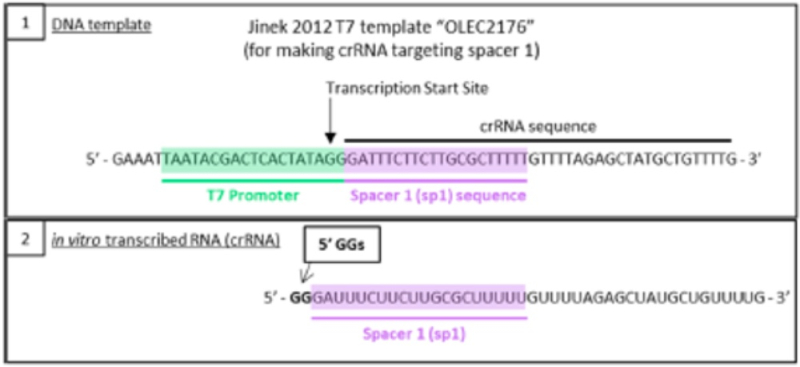
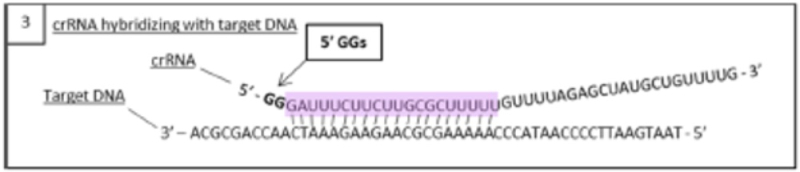
    Image 1 Image 2
    wherein the diagrams follow the source of the characteristic "extra" GG residues at the 5' end of crRNA and sgRNA produced thereby.  CVC also asserts a second reference, the Deltcheva reference, to illustrate the extent to which T7-catalyzed in vitro RNA production using a T7 promoter was well-known:
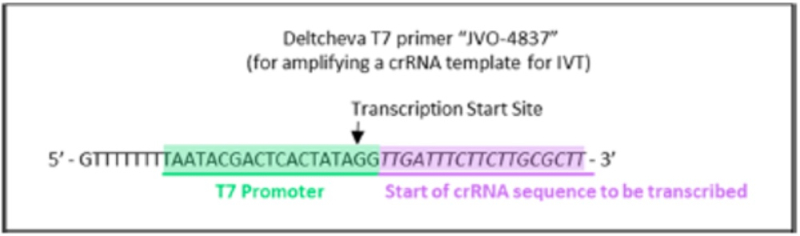
    Image 3
    CVC argues that the distinction of including two guanine residues in crRNA and sgRNA comprised thereof is not enough to distinguish the claims of the '380 patent from the Count in this interference (to which CVC argues these claims correspond) because "including a 5'-GG would have been obvious over Count 1 in view of [CVC's] Jinek 2012" reference as illustrated above, which reliance is permitted under Desjardins v Wax, Interference No. 105,915, Paper 127, 17-20 (P.T.A.B. Jan. 21, 2014).  Regarding motivation to combine the teachings of the Jinek reference in this regard with the more general teachings of producing an sgRNA for eukaryotic CRISPR, CVC argues that such motivation is supported by the method's "low cost, efficiency, and accuracy," and because "Jinek 2012 had already used the method to generate RNAs that effectively cleave eukaryotic DNA sequences (e.g., GFP) in CRISPR-Cas9 systems (i.e., ToolGen knew the method would be successful in eukaryotic CRISPR).  This success also would have provided the requisite reasonable expectation of success to complete a prima facie case of obviousness and hence for the '380 claims to properly be determined to correspond to the Count in this interference.

    The brief sets forth in detail comparison between the Count and claims of the '380 patent to set forth CVC's argument that those claims would have been obvious over the Count (considered as part of the prior art for this analysis; see N.V. Nutricia v. Mass. Inst. of Tech., Interference No. 106,096, Paper 80, 4 (P.T.A.B. Mar. 29, 2019)) in combination, inter alia, the Jinek 2012 reference (or any other reference teaching the use of the T7 promoter/ T7 RNA polymerase system for producing RNA including sgRNA in vitro.  CVC characterizes its argument by stating that those claims "the predictable use of prior art elements according to their established functions," citing  KSR Intern. Co. v. Teleflex Inc., 127 S.Ct. 1727, 1731 (2007); these arguments are supported by a detailed claim chart set out as Appendix 3 to CVC's brief (providing the comparison with the portion of the Count taken from ToolGen's application).  (Appendix 4 contains a similar claim chart from the portion of the  Count taken from claim 156 of the CVC's U.S. Application No. 15/981,807.)

    Turning to the basis for CVC's assertion of there being a reasonable expectation of success, CVC argues that:

    Expectation of success in eukaryotes would not be in doubt because "whether a CRISPR-Cas9 system would have been expected to work in a eukaryotic cell . . . is assumed under the framework of 37 C.F.R.  41.207(b)(2), wherein Count 1 is presumed to be prior art to the . . . claims," citing The Univ. of Calif. v. The Broad Inst., Inc., Interference No. 106,115, Paper 877, 66 (P.T.A.B. Sept. 10, 2020); 37 C.F.R. 41.207(b)(2).

    Having set forth the basis for the Board to find claim 1 obvious, the brief then sets forth CVC's obviousness analysis regarding claims 2-10 as having been obvious (and the brief is supplemented with Appendix showing those sites).

    The brief completes its obviousness assessment by asserting that there was no objective indicia that would contradict the prima facia case of obviousness supported by the facts and argument set forth above.  These include specifically the absence of any evidence of unexpected results (which ToolGen argued during prosecution of the '380 patent) in view of (for the purposes of this interference) ToolGen's half of the Count, which differs from the '380 claims only by the addition of the GG residues at the 5' end of the sgRNA as a consequence of producing that RNA species in vitro using T7 RNA polymerase and its cognate promoter.  CVC arrives at this conclusion because the claim corresponding to ToolGen's half of the interference Count (claim 85 of ToolGen's involved '510 application) was prosecuted to allowance, inter alia, by ToolGen's argument for unexpected results; as CVC asserts "there can be no  unexpectedly superior results when the closest prior art (i.e., Count 1) has the same results as the claimed method," citing Millennium Pharmaceuticals, Inc. v. Sandoz, Inc., 862 F.3d 1356, 1368 (Fed. Cir. 2017) (emphasis in brief).  In addition, CVC argues that here the prima facie case is sufficiently strong so as not to be rebutted by unexpected results, citing Ohio Willow Wood Co. v. Alps South, LLC, 735 F.3d 1333, 1344 (Fed. Cir. 2013) ("[W]here a claimed invention represents no more than the predictable use of prior art elements according to established functions, as here, evidence of secondary indicia are frequently deemed inadequate to establish  nonobviousness.").  Finally, merely discovering the effect of adding the GG residues at the 5' end of the sgRNA is not sufficient to overcome a prima facie obviousness case, based on Federal Circuit precedent that a "'previously-unknown, yet inherent, food-effect property' did not make the claims patentable because 'merely discovering and claiming a new benefit of an old process cannot render the process again patentable,'" citing In re Huai-Hung Kao, 639 F.3d 1057 (Fed. Cir. 2011).

    Finally, CVC's brief concludes with its argument that there is an interference-in-fact between CVC's involved claims in this interference and the '380 patent claims (illustrating the principle that once bitten is twice shy).  CVC argues here that the "two-way" test for interfering subject matter is met between at least one claim of the '380 patent and at least one of CVC's involved claims.  Specifically, the brief calls out claim 1 of the '380 patent and claim 156 of CVC's involved application No. 15/981,807:

    156.    A eukaryotic cell comprising a target DNA molecule and an engineered and/or non-naturally occurring Type II Clustered Regularly Interspaced Short Palindromic Repeats (CRISPR)-CRISPR associated (Cas) (CRISPR-Cas) system comprising
        a)    a Cas9 protein, or a nucleic acid comprising a nucleotide sequence encoding said Cas9 protein; and
        b)    a single molecule DNA-targeting RNA, or a nucleic acid comprising a nucleotide sequence encoding said single molecule DNA-targeting RNA;
    wherein the single molecule DNA-targeting RNA comprises:
            i)    a targeter-RNA that is capable of hybridizing with a target sequence in the target DNA molecule, and
            ii)    an activator-RNA that is capable of hybridizing with the targeter-RNA to form a double-stranded RNA duplex of a protein-binding segment,
            wherein the activator-RNA and the targeter-RNA are covalently linked to one another with intervening nucleotides; and
            wherein the single molecule DNA-targeting RNA is capable of forming a complex with the Cas9 protein, thereby targeting the Cas9 protein to the target DNA molecule,
    whereby said system is capable of cleaving or editing the target DNA molecule or modulating transcription of at least one gene encoded by the target DNA molecule.

    CVC identifies as "the only relevant differences" between this claim and claim 1 of ToolGen's '380 patent:

    • codon optimization of the Cas9 polynucleotide,
    • the NLS-tag on Cas9, and
    • including a 5'-GG on the guide RNA.

    Noting that claim 185 of CVC's '807 application recites use of the NLS tag, CVC argues that the skilled worker would have had a reasoned basis for including all of these features into a CRISPR-Cas9 system, under the rubric that a "combination of familiar elements according to known methods is likely to be obvious when it does no more than yield predictable results," citing KSR Intern. Co. v. Teleflex Inc., 127 S.Ct. 1727, 1731 (2007).  And, CVC maintains, the skilled worker would have had a reasonable expectation of success in achieving operative embodiments of CRISPR thereby, satisfying one prong of the two-way test.

    With regard to the other prong, CVC argues that claim 1 of ToolGen's '380 patent teaches all the elements of CVC's claim 156 in the order in which it is claimed, which is enough to satisfy the test for anticipation.

    Accordingly, CVC concludes, the Board should designate the claims of the '380 to correspond to Count 1, adding that "[t]here are no adequate alternative remedies because leaving the '380 patent out of this proceeding risks the inefficiency and expense of another interference proceeding involving CVC and ToolGen."

    * '830 Patent claims CVC asserts correspond to the Count in the '127 Interference:

    1.    A method of introducing a site-specific, double-stranded break at a target nucleic acid sequence in a eukaryotic cell, the method comprising introducing into the eukaryotic cell a Type II Clustered Regularly Interspaced Short Palindromic Repeats (CRISPR)/Cas system, wherein the CRISPR/Cas system comprises: a) a nucleic acid encoding a Cas9 polypeptide comprising a nuclear localization signal, wherein the nucleic acid is codon-optimized for expression in eukaryotic cells, and b) a guide RNA that hybridizes to the target nucleic acid, wherein the guide RNA is a chimeric guide RNA comprising a CRISPR RNA (crRNA) portion fused to a trans activating crRNA (tracrRNA) portion, wherein the guide RNA comprises two guanines at its 5' end, and there are no additional nucleic acid residues between the two guanines at the 5' end and the crRNA portion of the guide RNA; whereby a site-specific, double stranded break at the target nucleic acid sequence is introduced.

    2.    The method of claim 1, wherein the nuclear localization signal is located at the C terminus of the Cas9 polypeptide.

    3.    The method of claim 1, wherein the eukaryotic cell is a mammalian cell.

    4.    The method of claim 3, wherein the mammalian cell is a human cell.

    5.    The method of claim 1, wherein the nucleic acid encoding the Cas 9 polypeptide is codon-optimized for expression in mammalian cells.

    6.    The method of claim 1, wherein the target nucleic acid sequence is a genomic sequence located at its endogenous site in the genome of the eukaryotic cell.

    7.    The method of claim 1, wherein the nucleic acid encoding the Cas9 polypeptide is a vector.

    8.    The method of claim 1, wherein the Cas9 polypeptide is a Streptococcus pyogenes Cas9 polypeptide.

    9.    The method of claim 1, wherein the nucleic acid encoding the Cas9 polypeptide is introduced into the eukaryotic cell before introducing the guide RNA into the eukaryotic cell.

    10.    The method of claim 1, wherein the Cas9 polypeptide is a Streptococcus Cas9 polypeptide.

  • From our Foreign Correspondents —

    University of California-BerkleyWhile many patiently await developments in the pending U.S. interference proceedings relating to the CRISPR patents in the U.S., matters are progressing in Europe.  The Opposition Division (OD) of the European Patent Office (EPO) has just issued (on June 29, 2021) its written decision in the case of EP3241902, owned by the University of California/Berkeley, the University of Vienna, and Emmanuelle Charpentier (collectively termed "CVC").  While the headline decision of the OD to revoke the patent was delivered orally at the hearing on April 13, 2021, the OD has now provided its detailed reasoning behind the decision.

    Formally, EP3241902 was revoked for lack of inventive step.  However, pivotal in this decision was the finding by the OD that the patent was not entitled to priority from at least the first priority claim of May 25, 2012 (US 61/652,086; "P1").  In view of this, the inventors' own landmark publication from June 28, 2012 ("Jinek 2012") became prior art.

    Readers may recall that the Broad Institute's European patent EP2771468 was previously revoked for lack of novelty as a result of lack of priority entitlement.  However, the basis for that decision on priority was very different from the present case.  Broad's priority claim fell due to a formal defect in the priority claim (as a result of removal of an inventor at the PCT stage), meaning that the applicant for the patent was not the same entity (or successor in title) as the applicant for the priority application.

    In contrast, CVC's patent was denied priority for two more substantive reasons, relating to the content of P1 vis-à-vis the claims of the granted patent, namely:

    1)    P1 lacked a sufficient (enabling) disclosure to support the claims of the patent; and
    2)    P1 did not disclose the "same invention" as claimed in EP3241902.

    To give a little background, EP3241902 had various claims directed to "chimeric Cas9 proteins" and their uses.  In the "chimeric Cas9 proteins," a Cas9 enzyme with "reduced nuclease activity" is fused to a heterologous effector domain (e.g., transcriptional activator/repressor, methylase, etc.).  The Cas9 component is intended to act as a DNA-targeting protein, delivering the effector domain to a desired target site, somewhat akin to the use of TALEN and zinc finger nucleases well-known in the art.  Because EP3241902's earliest priority date of May 25, 2012 antedated Jinek 2012, a successful challenge of the priority claim was required in order to make Jinek 2012 available as prior art and, ultimately, to provide a basis for revocation.

    In the first preliminary opinion issued on February 13, 2020 along with a summons to oral proceedings, the OD initially considered that the patent was entitled to its earliest priority date, and therefore Jinek 2012 was not available as prior art.  In arriving at this preliminary view, the OD was persuaded by CVC's arguments that the sufficiency was evidenced by the fact that several research groups were able to carry out aspects of the claimed invention following on from the Jinek 2012 publication.

    In the run up to oral proceedings, which were cancelled due to COVID, the opponents filed further submissions focused heavily on the lack of an enabling disclosure in P1, and, moreover, that the disclosure in P1 was extremely limited compared to Jinek 2012.  Furthermore, the success of the research groups reported in the post-published articles was the result of significant research endeavor, building on the more extensive disclosure in Jinek 2012 than was found in the P1 specification.

    In view of these submissions, the OD issued a revised preliminary opinion on September 29, 2020, in which the OD reconsidered its position on the enablement in view of P1.  The OD provisionally concluded that the claimed invention was not plausible in view of P1 which, inter alia, did not disclose how to reduce nuclease activity of Cas9.  Because the disclosure in P1 did not render the claimed subject matter plausible, under EPO jurisprudence CVC could not rely on post-filing evidence to remedy the lack of enablement.  The OD deferred venturing an opinion on novelty or inventive step until entitlement to priority had been discussed fully at the oral proceedings rescheduled for April 12-14, 2021.

    The oral proceedings were scheduled to take place by videoconference over three days; this is atypically long for opposition hearings, reflecting the complexity of the case and number of parties (albeit fairly typical for the European CRISPR hearings).  However, by the end of the second day, the patent had been revoked in its entirety.  The minutes accompanying the decision reveal that the majority of the discussion centered around entitlement to priority.  The Main Request and 10 Auxiliary Requests (representing a series of "fallback" amended claim sets) filed by CVC were all found to lack entitlement to priority and were therefore obvious in view of a combination of the TALEN and zinc finger nuclease systems well-known from the art and the disclosure of Jinek 2012.

    Examining the decision further, there are two distinct strands to the findings of the OD on entitlement to priority:

    The first relates to the concept of Cas9 with "reduced nuclease activity".  While P1 mentioned in broad terms the concept of Cas9 with "reduced nuclease activity," there was no material disclosure in the P1 specification of how the skilled person might actually produce such a modified Cas9 without an undue burden.  OD found that the disclosure in P1 was vague and speculative regarding the regions of Cas9 conferring nuclease activity against a target DNA (later discovered to be the RuvC and HNH domains), and gave no meaningful guidance to the skilled person on how nuclease activity might be modified.  Moreover, the OD further found that the sole example in P1 was ill-suited to identify Cas9 variants with reduced nuclease activity.  There was considerable debate about the level of common general knowledge of the skilled person, and the extent to which this might supplement the disclosure of P1.  The OD did not arrive at a settled view on the common general knowledge, but it concluded that at best the skilled person would be able to produce a completely nuclease-inactive Cas9 (so-called "dead Cas9") without an undue burden.  The use of a dead Cas9 was also consistent with the TALEN and zinc finger nuclease systems known from the art, which do not have any intrinsic nuclease activity.  Thus, inasmuch as the claims related to reduced but not eliminated nuclease activity, they were not enabled by P1.

    Secondly, the OD considered whether Auxiliary Request 2, with claims limited to Cas9 with "substantially no nuclease activity", was entitled to priority from P1.  Priority was again denied but for a quite different reason.  The claimed subject matter was held not to relate to the "same invention" as disclosed in P1, as required under Art. 87 EPC.  The "same invention" requirement is assessed using the strict "direct and unambiguous" disclosure test favored by the EPO (see G 2/98).  Readers may have encountered essentially this same strict test in the more familiar context of assessing basis for amendments during EP prosecution.  In brief, the OD found that while the claims related to a modified but otherwise whole Cas9 protein linked to a heterologous domain, the disclosure in P1 was limited to a portion of Cas9 (i.e., not the whole protein) linked to a heterologous domain.  P1 disclosed in general terms various hypothetical embodiments of chimeric Cas9s comprising an "RNA-binding portion" derived from Cas9 linked to a heterologous domain, and in the OD's view this "RNA-binding portion" was always disclosed in P1 as a sub-portion of Cas9 (i.e., excluding the "activity portion" of Cas9).  This issue was compounded by the absence of any actual example of a chimeric Cas9 protein in P1.  While the "same invention" issue arose with respect to Auxiliary Request 2, it applied equally to all of the requests filed by CVC.

    CVC were given the opportunity to propose further amendments in an attempt to overcome the priority issues, but they failed to do so.  CVC have filed a notice of appeal against the decision, and the issuance of the written decision sets a four month deadline for them to file their complete grounds of appeal.

    Thus, another CRISPR patent has been revoked in EPO opposition proceedings because of priority issues.  While the Broad case drew attention to the strict formal requirements of priority at the EPO, the present case serves as a reminder of the particularly strict requirements of the EPO that the priority document discloses the "same invention" as the patent.  Regarding enablement, the EPO has a reputation for being comparatively patentee friendly, placing a correspondingly onerous burden on opponents to prove "serious doubts substantiated by verifiable facts," with any benefit of the doubt typically going to the patentee.  This can be a difficult challenge for opponents, but where a priority document is thin on experimental work and largely speculative, as seems to be the case here, priority can fall on this ground.

    EP3241902 is one of a number of patents in the name of CVC currently in the opposition and appeal process at the EPO.  EP2800811 (the parent of EP3241902), directed to Cas9 and single-guide RNA for DNA cleavage, was maintained in amended form by the OD and that decision is currently under appeal.  EP3401400 is directed to use of Cas9 in eukaryotes, and oral proceedings before the OD are scheduled to begin on November 29, 2021.  It is likely that the CRISPR patents will continue to face such challenges in view of the nature of the invention and its powerful and flexible applications in a number of commercially important areas of genetic modification.

  • By Kevin E. Noonan

    University of California-BerkleyOn May 20th, Junior Party the University of California, Berkeley; the University of Vienna; and Emmanuelle Charpentier (collectively, "CVC") filed its Substantive Preliminary Motion No. 2 in Interference No. 106,127 (which names ToolGen as Senior Party), asking the Patent Trial and Appeal Board to deny ToolGen benefit of priority to U.S. provisional application No. 16/717,324, filed October 23, 2012, pursuant to 37 C.F.R. §§ 41.121(a)(1)(ii) and 41.208(a)(3) and Standing Order ¶ 208.4.1.  The significance of the Board granting this motion would be that CVC would be Senior Party, with all the presumptions benefiting from Senior Party status.

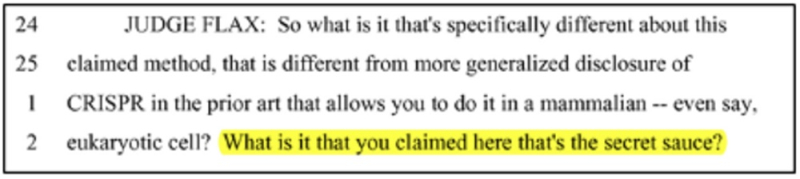
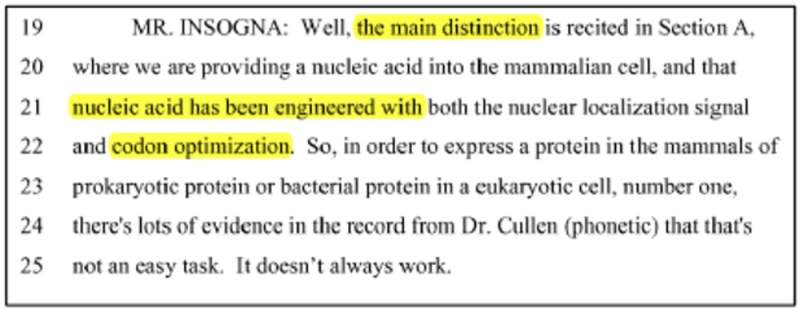
    CVC argues that the Board should deny ToolGen priority benefit to the '324 application based on party admissions because this provisional application does not disclose an operative embodiment falling within the scope of the interference Count.  Specifically, CVC argues that ToolGen in the prosecution of the '324 patent application leading to allowance (and declaration of this interference) had argued to the Patent Examiner (and PTAB) that "a codon-optimized Cas9 nucleic acid is required for CRISPR-Cas9 to function in eukaryotic cells" and that "a skilled artisan would have no idea what the outcome may be if one were to codon optimize a Cas9 nucleic acid."  This position was consistent with the prokaryotic source of Cas9, and the Board and Examiner relied upon these arguments to find allowable claims in the '324 application (now claims designated as corresponding to the Count in this interference), CVC asserts.  All such claims require use of a Cas9-encoding nucleic acid that is codon-optimized for expression in eukaryotic cells, and ToolGen added this limitation to the claims to overcome anticipation and obviousness rejections based on the prior art.  But ToolGen's '324 application does not disclose a codon-optimized Cas9 nucleic acid, according to CVC, nor by ToolGen's own argument would the skilled worker be able to discern such a nucleic acid with any reasonable basis for expecting such an embodiment could be produced using the disclosure in the '324 application.  Accordingly, CVC argues in its motion, ToolGen cannot in this interference renounce these arguments and rely on the priority date of the '324 patent to constitute a constructive reduction to practice for eukaryotic CRISPR-Cas9 embodiments falling within the scope of the interference Count.  Thus, according to CVC, the Board should deny ToolGen priority benefit to the '324 application (and redeclare the interference naming CVC as Senior Party).

    The brief is replete with examples from the '324 prosecution history (CVC characterizing these statements as "unambiguous" and "unequivocal"), including this colloquy from oral argument before the Board in an appeal during that prosecution:

    Image 1
    *  *  *Image 2
    and

    Image 3
    ToolGen even went so far as to represent to the Office that CRISPR-Cas9 would not function in eukaryotic cells without codon optimization, CVC argues.  In summary, CVC asserts ToolGen took the position:

    ToolGen's position during prosecution is clear and unmistakable: its invention required a codon-optimized Cas9 nucleic acid, codon-optimizing the Cas9 nucleic acid was unpredictable, and one would have "no idea" of the outcome of codon optimizing [emphasis in brief].

    and should not now be permitted to disavow it.  (And the fact that the Board instituted this interference having a Count comprising in the alternative a CVC claim that does not require a codon-optimized nucleic acid encoding Cas9 does not change the argument, CVC asserts.)

    CVC concedes that, in fact, codon optimization was known in the art as of the '324 application's filing date.  But ToolGen's admissions should preclude this fact from overcoming the estoppel-creating admissions, CVC tells the Board in their brief.  The legal basis for CVC's argument is based on judicial estoppel (citing Zedner v. United States, 547 U.S. 489 (2006)), and the effect of party admissions on positions taken in a later proceeding before the Board.  Citing Springs Window Fashions LP v. Novo Industries, L.P., 323 F.3d 989, 995 (Fed. Cir. 2003), CVC argues that "[t]he public notice function of a patent and its prosecution history requires that a patentee be held to what he declares during the prosecution of his patent" (emphasis in brief); accord, Louis v. Okada, 59 U.S.P.Q.2d 1073, 1075 (B.P.A.I. 2001) (precedential), wherein the Board denied a motion to amend the Count to "better align with [a party's] best proofs" because the party had relied on the element in question to overcome a prior art-based rejection.  In addition to Zedner, CVC cites New Hampshire v. Maine, 532 U.S. 742, 742 (2001), in support of the application of the "equitable doctrine of judicial estoppel" here, and Wilson v. Martin, 789 Fed. Appx. 861, 872 (Fed. Cir. 2019), for the Board having the authority to apply the doctrine.  CVC bases its argument on the inconsistency of a finding that there is any basis of support in the '324 for providing a constructive reduction to practice in this interference in the absence of disclosure of codon-optimized CAS9-encoding nucleic acid with ToolGen's consistent position to the contrary during prosecution (as evidenced by citations to the prosecution history throughout the brief).  And ToolGen would receive an unfair advantage should the Board rule to the contrary, CVC asserts (that advantage including ToolGen being Senior Party instead of CVC in this interference).

    One factual basis for CVC's argument is that while ToolGen's asserted codon optimization was necessary to produce a Cas9 protein functional in a eukaryotic cell, and the undisputed fact that codon optimization was known in the art at the '324 application's filing date, which embodiment of a codon-optimized nucleic acid encoding Cas9 was not disclosed therein, and not only did the '324 not provide any nucleic acid encoding Cas9 from any species other than its native one (S. pyogenes), the application did not even disclose a codon-optimization table (for a feature ToolGen argued was necessary to achieve operative eukaryotic CRISPR embodiments).  CVC also proffered expert testimony regarding the significance of these deficiencies, including the existence at the priority date of several codon-usage tables in the art having different frequencies for 12 of the 20 naturally occurring amino acids (and thus there being no consensus in the art as to which codons would be optimal for eukaryotic cell expression of Cas9).

    And the fact that ToolGen's specification purportedly shows successful reduction to practice of CRISPR-Cas9 mediated gene editing in eukaryotic cells does not cure the lack of written description of a codon-optimized Cas9 according to CVC, citing In re Alonso, 545 F.3d 1015, 1021 (Fed. Cir. 2008), for the principle that "[p]roof of a reduction to practice, absent an adequate description in the specification of what is reduced to practice, does not serve to describe or identify the invention for purposes of the written description requirement" (emphasis added).

    CVC is careful to argue that "of course" ToolGen's deficiencies in no way can be attributed to CVC, because CVC never argued the absolute need for codon optimization for nucleic acids encoding Cas9 for operable eukaryotic embodiments of CRISPR, nor did CVC argue that codon optimization was either essential nor unpredictable (indeed, CVC asserts its consistent argument that by May 2012 codon optimization was "a routine technique such that skilled artisans would have expected to express a functional Cas9 protein from a codon-optimized nucleic acid in eukaryotic cells").

    CVC asserts that these arguments are sufficient for the Board to deny priority benefit to ToolGen of the '324 application.

  • Supreme Court Retains Doctrine of Assignor Estoppel, But With Limits

    By Kevin E. Noonan and Joshua R. Rich

    Supreme Court Building #2Patent law is replete with arcane (and often judge-made) doctrines, such as the doctrine of equivalence and obviousness-type double patenting.  In addition, long having been considered a property right (Oil States to the recent contrary), patents have been bound to greater or lesser degrees with equitable considerations attendant on the transfer of property and proper limits thereof.  These two strands of patent law and jurisprudence converge in the doctrine of assignor estoppel, the question before the Court in Minerva Surgical, Inc. v. Hologic, Inc.  On Monday, a five-justice majority of the Supreme Court, reaffirmed the doctrine, while at the same time limiting its application.

    Simply put, assignor estoppel prohibits an inventor or other owner of rights in a patent from selling that patent to another party, then practicing the invention while attempting to avoid infringement liability by claiming the patent was invalid from the start.  The Minerva majority found that the doctrine was well-established in the law and thus was unwilling to abandon it.  However, consistent with the equitable nature of the doctrine, the Court limited the doctrine to those instances where the assignor could be fairly understood to have warranted (either expressly or implicitly) the validity of the claims ultimately issued.  Thus, in many circumstances — such as when an inventor assigns rights to a patent application that ultimately issues with significantly broader claims — the doctrine will not apply.

    In Minerva, the Court faced a clear example of one of the potential exceptions to the rule of assignor estoppel.  The inventor, Csaba Truckai, conceived a device with a moisture-permeable head that could treat abnormal uterine bleeding.  He filed a patent application that described that invention and assigned it to a company he formed.  After he sold the company (including the patent rights), he founded a second company, Minerva Surgical.  At Minerva, he developed a device with a moisture-impermeable head that could also treat abnormal uterine bleeding (the Court's opinion noting that Minerva's device worked in a different manner that the original device disclosed in the putatively infringed patent).  The successor-in-interest to Truckai's first company (Hologic), unhappy with his direct competition, filed a continuation of the original application and pursued claims that would encompass devices regardless of the permeability of the head despite the differences in the two inventions.  Those claims issued and the successor sued Minerva on that patent.  Minerva argued that those later-added claims lacked support in the written description of the application, but the trial court refused even to consider the argument based on the doctrine of assignor estoppel.  Denied the ability to assert invalidity as a defense, Minerva was found to infringe the broader claims.  On appeal, the Federal Circuit agreed with this application of the assignor estoppel doctrine.

    The Supreme Court majority, citing and discussing some of the precedent that established the doctrine of assignor estoppel, found that the doctrine was well established (both before and after the 1952 Patent Act) and that its application should be addressed as a matter of fairness.  If a party sells patent rights based on a representation that the claims are valid, it would be unfair to allow that assignor to come into court and argue that the claims are invalid.  And even if that representation is not explicit in the contract, the assertion of validity of the assigned patent may be implied because the inventors have represented to the Patent and Trademark Office in an oath and declaration that the application disclosed and claimed their invention.  Thus, the patent assignor — who would often be best positioned to compete with the assignee because of experience in the field — should in fairness not be able to raise invalidity as a defense to a patent infringement claim.  But it would similarly be unfair to assignors that had not made such a representation of validity of the claims asserted against them to be precluded from challenging validity.  An example that resonated with the majority was the case of an employee who prospectively assigns all inventions made in the workplace as part of an employment agreement; the employee could scarcely be held accountable regarding claims for a later-developed invention since the invention had not yet been conceived, let alone claimed.  It would also be the case when a patent application is assigned and the claims are later broadened to cover a scope not initially within the claims at the time of the assignment.

    The majority decision, written by Justice Kagan and joined by the Chief Justice and Justices Breyer, Sotomayor, and Kavanaugh, parsed as is the Court's wont the judicial history of the doctrine, which is of much less ancient provenance than other doctrines (a fact upon which Justice Barrett in part bases her dissent).  The principal case is Westinghouse Elec. & Mfg. Co. v. Formica Insulation Co., 266 U.S. 342, 349 (1924), where the Court opined that the doctrine of assignor estoppel was "well-settled" law.  But perhaps more important to the majority was the essential fairness as set forth above, the majority making the distinction that the equitable principles underlying the assignor estoppel doctrine were the stuff of "centuries-old fairness principles," tracing the roots of assignor estoppel in English law (Oldham v. Langmead (1789)) that "grew in favor throughout the 1800s as an aspect of fair dealing," as well as estoppel by deed in English real property law.  Its first appearance in U.S. law was in 1880, Faulks v. Kamp, 3 F. 898 (CC SDNY), and by 1893 was "so well established and generally accepted that citation of authority is useless," Griffith v. Shaw, 89 F. 313, 315 (CC SD Iowa 1893).  And Westinghouse, consistent with the rationale espoused in this precedent, "grounded assignor estoppel in a principle of fairness."

    But the Court also apprehended the circumstances, perhaps present here, where essential unfairness is just as important a consideration.  Such considerations have been present in the Court's application of doctrine in Westinghouse, according to the majority opinion, because the assignor should be allowed to argue how to construe the claims based on the prior art and, for example, obtain a construction narrow enough to avoid infringement.  (In a footnote, the Court acknowledges that while today the practice of the court construing claims limits the opportunity for an assignor to take refuge in this stratagem, the majority notes that "[t]he critical point for our purpose is that even while affirming the assignor estoppel doctrine, the Court made clear that it did not always bar assignors from effectively defending against infringement suits.")  The Westinghouse Court had "left for another day" a question that "most interested" them: "whether estoppel should operate differently if the assignment was not of a granted patent but of a patent application."  The distinction is that for an application the patent right is "inchoate" and not "certainly defined."

    The Court noted that the Federal Circuit, in addition to somewhat slavishly relying on the doctrine, also rejected consideration of Minerva's argument that Hologic had broadened the claims in its patent expressly to ensnare Minerva's device.  This was where the Federal Circuit erred, according to the majority, for not recognizing that "[t]he doctrine applies only when an inventor says one thing (explicitly or implicitly) in assigning a patent and the opposite in litigating against the patent's owner."  The majority announced that it rejected Minerva's call to abrogate the doctrine completely but had decided that the scope of the estoppel should be constrained.  The Court rejected Minerva's contention (persuasive to Justice Barrett) that the 1952 Patent Act abrogated the doctrine by including a provision that invalidity must be available as a defense in every case in 35 U.S.C. § 282(b) because like language was in the Patent Act when Westinghouse was decided.  In addition, such a statutory construction "would foreclose applying in patent cases a whole host of common-law preclusion doctrines" such as equitable estoppel, collateral estoppel, res judicata, and law of the case contrary, inter alia, to cases like SCA Hygiene Products Aktiebolag v. First Quality Baby Products, LLC, 137 S. Ct. 954 (2017).  Moreover this interpretation would be contrary to the principle that Congress "legislate[s] against a background of common-law adjudicatory principles," a proposition for which the majority cited Astoria Fed. Sav. & Loan Assn. v. Solimino, 501 U.S. 104, 108 (1991).  Thus, the majority opined that assignor estoppel was "such a background principle of patent adjudication" by 1952 that without an express, evident statutory purpose in the Patent Act, the Court was not persuaded by Minerva's argument.

    Nor did the majority believe that its decisions including Lear, Inc. v. Adkins, 395 U.S. 653 (1969), which eliminated licensee estoppel, and Justice Frankfurter's dissent in Scott Paper Co. v. Marcalus Mfg. Co., 326 U.S. 249, 264 (1945), limiting assignor estoppel, had "eviscerated any basis for assignor estoppel."  Rather, the opinion surmised that these decisions did nothing more than "police the doctrine's boundaries" (which is how the Court characterized its decision in this case).  In an amusing aside, the majority characterized the dissent as "worked-up" in its disagreements over the Court's decision in Scott Paper where in the majority's opinion the Court likewise refused to abrogate the assignor estoppel doctrine.  And Lear "gives Minerva still less to work with" the majority thought, being directed to licensee estoppel and reciting dicta that in the assignment context the "equities" are "far more compelling than those presented in the typical licensing arrangement."

    Finally, the Court ignored the clarion call that all of the patent law might be struck down to rid the innovation ecosystem of "bad" patents (and that this provided a sufficient incentive to abrogate the doctrine here).

    While hewing to the equitable application of assignor estoppel in certain instances, the majority believed that the doctrine requires limits.  The most significant of these limits is that it should be applied "only when its underlying principle of fair dealing comes into play."  And where "the assignor has made neither explicit nor implicit representations in conflict with an invalidity defense, then there is no unfairness in its assertion" and assignor estoppel should not apply.  The Court notes the common occurrence that an inventor assigns to an employer "future rights" in patents for later-developed inventions.  Here, it is the assignee that determines which inventions to patent, and thus the assignor can have no representations to make.  But most relevant to this case, the Court notes that the basis for a representation of validity can be diminished — if not abolished — by a change in patent claims, which can arise when an application not yet a granted patent is assigned (as characterized in Westinghouse, comprising an "inchoate" right").  The majority believed that this understanding of the limits of the proper application of the doctrine was the Court's concern in Westinghouse as it is here (appreciating that opinion to have "liberally dropped hints" to that effect).  Thus, the Court set out the rule that:

    Assuming that the new claims are materially broader than the old claims, the assignor did not warrant to the new claims' validity.  And if he made no such representation, then he can challenge the new claims in litigation: Because there is no inconsistency in his positions, there is no estoppel.  The limits of the assignor's estoppel go only so far as, and not beyond, what he represented in assigning the patent application.

    Here, because prior Federal Circuit precedent called for the blanket application of assignor estoppel, there was no record of whether application of the doctrine would be fair; the Federal Circuit's error was in not recognizing the boundaries that the majority enunciate here.  The Court therefore remanded the matter for further consideration on this point.

    Two groups of Justices dissented from the decision; Justice Barrett wrote for three Justices (herself and Justices Thomas and Gorsuch), while Justice Alito wrote for himself alone.

    Unlike the majority, Justice Barrett believed the doctrine was not so well-established that revision of the Patent Act in 1952 could be considered to have adopted (or at least not abrogated) the doctrine.  Justice Barrett's dissent dissected the Court's consideration of the doctrine prior to and after enactment of the 1952 Act and found no basis in the text of the Act for the majority's acceptance that assignor estoppel was so established that Congress could be presumed to have drafted the Act assuming the existence of assignor estoppel as an essential backdrop.  Thus, after coming to the conclusion that the doctrine was not well-established prior to the 1952 Act, Justice Barrett treated the question as one of statutory interpretation.  She found no discussion of assignor estoppel in the plain language of the statute and hence no reason to hold that it had survived the sweeping revisions of patent law enacted by the 1952 Act.

    Justice Alito wrote a separate dissent voicing his opinion that the Court should have considered explicitly whether the clearest precedent regarding the doctrine, Westinghouse v. Formica, should be expressly overruled (which would abrogate the doctrine).  Because neither the majority nor the primary dissent addressed that issue, he believed that the case should not have been considered by the Court at all.

    Minerva Surgical, Inc. v. Hologic, Inc. (2021)
    Opinion by Justice Kagan, joined by Chief Justice Roberts and Justices Breyer, Sotomayor, and Kavanaugh; dissenting opinion by Justice Alito; dissenting opinion by Justice Barrett, joined by  Justices Thomas and Gorsuch

  • By Kevin E. Noonan

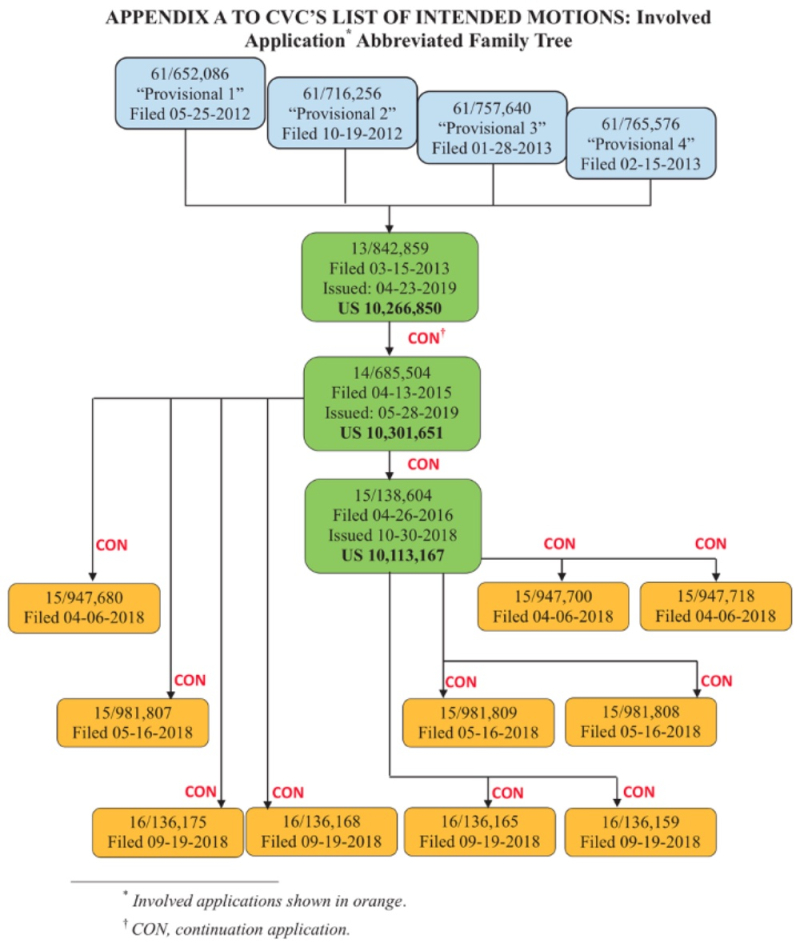
    On May 20th, Junior Party the University of California, Berkeley; the University of Vienna; and Emmanuelle Charpentier (collectively, "CVC") filed its Substantive Preliminary Motion No. 1 in Interference No. 106,127 (which names ToolGen as Senior Party), asking the Patent Trial and Appeal Board for benefit of priority to U.S. provisional application No. 61/652,086, filed May 25, 2012 ("P1"), U.S. Provisional Application No. 61/716,256, filed October 19, 2012, ("P2"), and U.S. Provisional Application No. 61/757,640, filed January 28, 2013 ("Provisional 3"), pursuant to 37 C.F.R. §§ 41.121(a)(1)(ii) and 41.208(a)(3) and Standing Order ¶ 208.4.1.  The relationships between the patents and applications in the '127 interference are set forth in this chart (filed in CVC's earlier preliminary motion in the '115 Interference):

    Image 1
    The significance of the Board granting this motion with regard to the P1 or P2 provisional applications would be that CVC would be Senior Party, with all the presumptions benefits of Senior Party status.

    CVC argues that its inventors invented eukaryotic cell CRISPR using a single-molecule guide RNA (sgRNA) that is described in each of the three provisional applications.  Once that breakthrough had been achieved, CVC argues that adapting CRISPR to eukaryotic cell environment would have been "pretty straightforward" (quoting Dr. Luciano Marraffini, who informed the Broad inventors of the sgRNA embodiment in June, 2012 (see "CVC Files Motion in Opposition to Broad Priority Motion").  CVC supports this assertion with contemporaneous consistent statements from Rodolphe Barrangou, Erik Sontheimer, Samuel Sternberg, and Dana Carroll, as well as Jennifer Doudna; by the existence of "existing platforms that had already been successfully used with the two incumbent systems: zinc-finger nucleases ("ZFNs") and transcription activator-like effector nucleases ("TALENs")"; and by the successful practice of CRISPR by several groups (including ToolGen) "[j]ust months after CVC presented this work and the absence in the reports from any of these groups of "any 'special' adaptations or conditions needed to achieve CRISPR gene editing in eukaryotic cells."  Citing extensively from the record in the '115 Interference, CVC asserts that "investigators from Broad copied CVC's system, applied well-known reagents, cell lines, and vectors, and simply followed the manufacturer's protocols to obtain the results that Broad published in 2013 ('Cong 2013')" and that "CVC itself employed expression vectors and techniques commonly used for ZFNs and TALENs to deliver the sgRNA CRISPR-Cas9 system into eukaryotic cells."

    CVC also addresses the PTAB's decision not to grant CVC's patents and applications in the '115 patent the benefit of priority to the P1 and P2 provisional applications sought here; the basis for that decision, according to CVC was that it was made "without the benefit of the now well-developed evidentiary record."  Specifically, CVC argues that "[t]he prior decision credited assertions that have been seriously undermined by evidence presented during the priority phase of the '115 interference."  That record is cured herein, CVC argues, because the motion "presents new evidence and highlights the specific description in P1 (all of which is carried over to P2) not addressed in the PTAB's prior decision on motions," the focus being on the P1 provisional application because an affirmative decision in this priority document would made CVC the Senior Party.  Part of that evidence is that the P1 provisional "contemplates and teaches that the sgRNA CRISPR-Cas9 system can be microinjected as a pre-assembled ribonucleoprotein ("RNP") complex into embryos, including fish cells ("E1"), which obviates the concerns alleged in the '115 interference" (emphasis in brief).  Why these aspects of the P1 disclosure are significant, CVC explains, is that the concerns raised by Broad regarding eukaryotic CRISPR embodiments ("RNA and protein expression, co-localization, and assembly") are avoided because the CRISPR-Cas9 complex is already formed in vitro prior to being microinjected into the embryo.  RNA degradation would also not have been a concern because it was known that sgRNA was protected from degradation in the complex by the Cas9 protein.  Nuclear localization, another putative concern, is avoided by direct microinjection into the nucleus, not would chromatin structure impede CRISPR gene editing activity in embryonic cell because eukaryotic DNA adopts an "open conformation" during cell division in embryos, according to CVC.  Finally, the skilled worker would not expect there to be toxicity of CRISPR complex in eukaryotic cells because, according to the brief, microinjection is known to be a "low toxicity" procedure.

    It should be noted that these arguments take advantage of the principle that reduction to practice requires only one embodiment falling within the scope of the claims and this argument does not address introduction of CRISPR-Cas9 components into non-embryonic eukaryotic cells.  Such embodiments are addressed in the separate argument CVC makes with regard to introduction of CRISPR-Cas9 components into human cells using expression vectors; CVC states that "the alleged concerns have been overstated in [this] context."  For example, CVC notes that P1 discloses use of Cas9 from Streptococcus pyogenes, which causes strep throat and thus "flourishes within the same temperature, pH, and ion concentration ranges as most mammalian cells."  Also disclosed in P1 is the use of nuclear localization signals to facilitate proper location within a eukaryotic cell.

    As to the significance of the Board's earlier decision in the '115 Interference, CVC argues that this decision is non-final (that Interference is on-going and the Board's decisions subject to appeal).  In addition, CVC argues that "[t]he PTAB's decision also gave undue weight to certain statements by Doudna, which were misinterpreted as expressing doubt about whether the system would work in eukaryotes."  Somewhat cleverly (because those statements have proven to be compelling before the Board both in the '115 Interference and the earlier Interference No. 106,048), CVC argues that they are not relevant evidence, because the extent to which CVC's priority applications disclose at least one operative embodiment within the scope of the Count "is an 'objective' assessment of what is disclosed within the 'four corners' of the specification, viewed "from the perspective of a person of ordinary skill in the art," citing Ariad Pharms., Inc. v. Eli Lilly and Co., 598 F.3d 1336, 1351 (Fed. Cir. 2010) (en banc).  To further provide the Board with evidence contrary to these statements, CVC submits a declaration by Inventor Doudna that places the statements in "proper" context.  And CVC provides authority for the proposition that an inventor's "acknowledgement of the complexities of the science does not negate the disclosure" in Frazer v. Schlegel, 498 F.3d 1283, 1288-89 (Fed. Cir. 2007), in which an inventor admitted a subjective lack of certainty regarding his invention that the Court held did not "negate or contradict" constructive reduction to practice.  Under these circumstances, CVC argues that the Board must "consider the merits anew" in deciding that CVC is entitled to priority benefit to the P1 and P2 provisional applications.

    The brief sets forth the "new evidence" presented in support of their motion:

    • First, the PTAB's decision on motions in the '115 interference did not address whether direct injection of a pre-assembled RNP complex into an embryo, as contemplated by P1, would trigger the same alleged concerns as embodiments relying on vector expression.

    • Second, the PTAB's decision on motions did not address description in P1 regarding: the analogous nature of ZFNs and TALENs; routine uses of nuclear localization signals and codon selection; and the inventors' appreciation of the dynamic nature of chromatin.

    • Third, the PTAB's decision on motions did not consider evidence that has since come to light that undermines the initial allegations by Broad that P1 fails to disclose necessary "special" instructions and adaptations for applying CRISPR-Cas9 in eukaryotic cells.

    • Fourth, Broad's arguments in the '115 interference relied on a misinterpretation of quotes by Doudna and Carroll.  Testimony from Doudna, Carroll, and others with first-hand knowledge (Marraffini, Sontheimer, Barrangou, Sternberg) is provided here, to inform what people in the field thought and the expectation that CRISPR-Cas9 would work in eukaryotes.

    The brief then applies each of these new items of evidence to the disclosure of the P1 and P2 provisional applications in making CVC's argument that both priority documents satisfy the disclosure requirements for CVC to be entitled to priority benefit.  This argument involves a comparison between eukaryotic CRISPR and successful microinjection of ZFNs and TALENS known in the prior art; that the skilled worker would have considered these systems to be the closest analogous systems to CRISPR-mediated gene editing in eukaryotic cells; that ToolGen itself had admitted the similarities between CRISPR-, ZFN-, and TALEN-mediated gene editing in eukaryotic cells; and that the other systems used by the Board as (negative) comparators in the '115 Interference (such as Group II introns, ribozymes, and riboswitches) were not apposite.

    Moreover, CVC asserts once again the evidence that, once sgRNA was disclosed by Doudna et al., several (six) groups used it to achieve successful CRISPR-mediated gene editing in eukaryotes.  The brief sets out relevant details of each of these groups' successes:  for Broad:

    Table 1 Table 2
    for ToolGen:

    Table 3
    for Harvard:

    Table 4
    and for Sigma:

    Table 5
    The brief also sets forth in detail the correspondence between the elements of the Count in the Interference and the disclosure in the P1 (and P2) references for each of these embodiments (E1, E2, and E3):

    Table 6
    wherein CVC asserts (as it did in the '115 Interference; see "Berkeley Files Substantive Motion No. 2 to be Accorded Benefit to Earlier Priority Application in Interference") the three embodiments CVC contends fall within the scope of the Count (designated E1 for introduction into fish embryos; E2 for introduction into human cells; and E3 for introduction into fruit fly cells) and that the P1 (and P2) provisional applications thus disclose constructive reduction to practice of CRISPR-Cas9 gene editing in eukaryotic cells.  CVC also sets forth examples of third parties using similar embodiments of their CRISPR technology published after the filing date (May 25, 2012) of the P1 provisional application:

    Table 7
    The brief also addresses the "concerns alleged in the '115 interference" and attempts to allay them for the Board, enumerating RNA degradation; co-localization of the components of the CRISPR-Cas9 complex; cellular conditions; nuclear localization; codon optimization; the effects of chromatin structure and toxicity, none of which are relevant, as CVC argues, for eukaryotic CRISPR-Cas9 embodiments using microinjection of in vitro assembled CRISPR-Cas9 complexes.

    Similar explication and explanation, particularly of the E2 embodiment introducing CRISPR-Cas9 into human cells using an expression vector are set forth in CVC's brief; in this regard the brief similarly addresses the "concerns" asserted against the P1 and P2 provisional applications in the '115 Interference, while at the same time discounting these concerns as "(i) . . . not [being] recited elements of the count and (ii) . . . not [being] required for practicing an embodiment within the scope of the count."  Much of these arguments rely on what the person of ordinary skill in the art would have understood at the time, such as using strong promoters to produce effective amounts of the sgRNA and Cas9 protein; using NLSs to increase nuclear localization likelihood; using S. pyogenes-derived Cas9 that purportedly "flourish" under eukaryotic cellular conditions; and that the P1 (and P2) disclosure recognize that chromatin structure is sufficiently "dynamic" for the CRISPR-Cas9 complex to gain access to portions of the genome targeted by the sgRNA for CRISPR-mediated gene editing to be achieved.

    CVC argues in the alternative that should the Board find wanting its disclosure evidence in the P1 provisional application, the P2 application contains additional disclosure that satisfies the requirements for constructive reduction to practice of at least one embodiment of the invention falling within the scope of the interference Count.

    In a separate section, prefaced by the assertion that it is "not required," CVC sets forth statements contemporaneous with the P1 and P2 provisional application filing dates that eukaryotic embodiments of CRISPR using sgRNA were expected to be operative in eukaryotic cells.  These statements were made, according to CVC, by Luciano Marraffini; Erik Sontheimer; Rodolphe Barrangou (wherein each of the foregoing were present and heard Jennifer Doudna's disclosure of sgRNA CRISPR embodiments at the Fifth Annual CRISPR Research Conference held at Berkeley in June of 2012); Dana Carroll, editor of a review article on CRISPR; Samuel Sternberg (a graduate student in the Doudna laboratory); and Jennifer Doudna herself (offering the "context" CVC intends to use to rebut Broad's negative interpretations of her statements regarding prospects for eukaryotic CRISPR embodiments).

    Finally, CVC sets out the continuous priority chain from the P1 provisional application through the applications and patents at issue in this interference, as set forth in the diagram above.

  • By Kevin E. Noonan

    In Interference No. 106,115 between Senior Party the Broad Institute (joined by Harvard University and MIT) and Junior Party the University of California, Berkeley; the University of Vienna; and Emmanuelle Charpentier (collectively, "CVC"), the Patent Trial and Appeal Board granted CVC's Preliminary Motion for benefit of priority to U.S. Provisional Application No. 61/757,640, filed January 28, 2013 ("Provisional 3"), pursuant to 37 C.F.R. §§ 41.121(a)(1)(ii) and 41.208(a)(3) and Standing Order ¶ 208.4.1.  In Interference No. 106,127, Senior Party ToolGen filed its Substantive Preliminary Motion No. 1 to deny CVC priority benefit to the '640 provisional application.

    The relationships between the patents and applications in the '127 interference are set forth in this chart (filed in CVC's earlier preliminary motion in the '115 Interference):

    Image 1
    ToolGen (stating that Broad did not substantively challenge CVC's assertion of this priority) challenges CVC's entitlement to priority benefit to the P3 provisional here on the grounds that it did not disclose "successful cleavage of DNA within eukaryotic cells, nor does it otherwise show a constructive reduction to practice of an embodiment within Count 1."

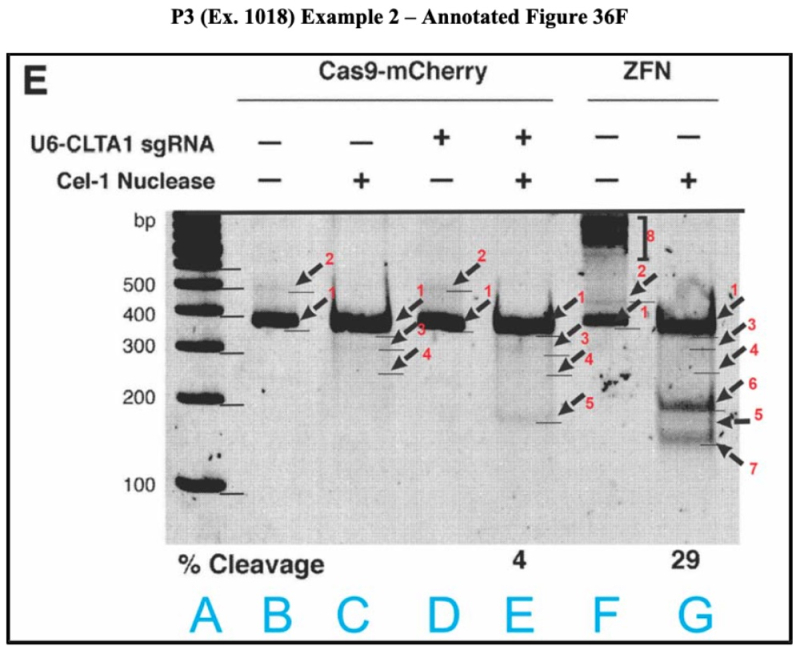
    ToolGen's argument depends on three assertions.  First, the brief identifies a single Example (Example 2) in the P3 provisional application directed towards purported eukaryotic cell embodiments of CRISPR gene editing (which, if it provided an adequate description of even a single enabled embodiment would be sufficient to satisfy the requirement for priority).  Second, ToolGen asserts that the Example (and Figures 38B and 36E related thereto) do not provide such an adequate description because "Figure 38B shows alleged cleavage bands at positions where there should be none and in some instances no bands where there should be bands."  Similarly, ToolGen asserts that Figure 36E "independently contains so many unexplained bands as to make it so shaky and unreliable that a [person of ordinary skill in the art or] POSA would not view it as showing possession of an embodiment within Count 1."  Taken together, ToolGen argues that "the Figures cannot be evidence that discloses successful cleavage to a POSA in eukaryotes, and the applicants' failure to sequence the resulting products further cements this conclusion."  Third, ToolGen argues that "applicants lysed the cells before DNA extraction such that they left the Cas9 protein active to cleave DNA outside of intact cells, as opposed to within the eukaryotic cell as required by Count 1" and "a POSA would understand that any cleavage shown in the gel results cannot confirm that cleavage occurred within eukaryotic cells."  Like U.S. provisional applications 61/652,086 ("P1") and 61/716,56 ("P2") (for which the Board refused to recognize priority for failure to disclose an adequate description of even a single enabled embodiment of CRISPR in a eukaryotic cell), ToolGen argues that the P3 provisional application is similarly deficient and the Board should deny CVC the accorded priority benefit.

    After setting forth the statutory requirements for a party to be accorded benefit of priority and discussing the level of ordinary skill in the art, ToolGen sets forth its analysis of the deficiencies in the P3 disclosure synopsized above. Supported by expert testimony (Dr. Turchi), ToolGen argues that a POSA at the time of the invention would not have considered the P3 disclosure to satisfy these requirements. Like Broad, ToolGen argues that "adapting the native prokaryotic CRISPR-Cas9 system to cleave DNA within eukaryotic cells was highly unpredictable." Like Broad before it ToolGen enumerates the many differences between the prokaryotic milieu where CRISPR was expressed natively and eukaryotic cells (the existence of the nucleus, packaging genomic DNA in chromatin, the intracellular components for gene expression in eukaryotic cells, and the resulting uncertainty ToolGen alleges arises as a consequence regarding whether the CRISPR-Cas9 system could be adapted for use in these cell types. (An uncertainty ToolGen notes that the Board acknowledged supported by the now infamous, improvident statements by CVC's inventors.)

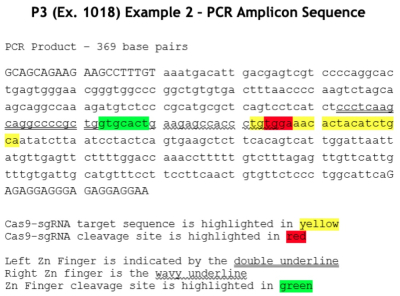
    Besides these somewhat theoretical obstacles (which, had CRISPR been readily reduced to practice would not have their current asserted significance), ToolGen critically reviews what it contends are deficiencies in the disclosure of Example 2 as illustrated by Figures 38B and 36E (as these deficiencies were attested to by ToolGen's expert witness).  This analysis was set out graphically to show the expected DNA fragments and sequences that the skilled worker would expect and need to observe to conclude successful CRISPR gene editing in the HEK293T human embryonic kidney cells used in the experiments disclosed in Example 2 of the P3 provisional application:
    Image 2
    The brief then sets out the bands produced by successful CRISPR according to ToolGen's expert:

    • A 369 bp PCR product band because not all of the DNA would have been cleaved.  Any larger bands would be unexpected because the PCR product should contain only 369 bp DNA fragments in all lanes.
    • Approximately 183 and 186 bp Cas9-sgRNA cleavage bands in the lanes with both Cas9 and sgRNA.
    • Approximately 162-169 and 200-207 bp ZFN cleavage bands in the ZFN positive control lane.

    Instead of these results, the brief (relying of ToolGen's expert) asserts that:

    If the Figure 38B and 36E gels showed successful DNA cleavage at the target site, a POSA would expect the data in the gels to be consistent with the above.  They are not.  Rather, Figure 38B contains bands that differ significantly from the bands that a POSA would expect if cleavage had been successful.  Figure 36E shows results inconsistent with Figure 38B, and also contains so many unexplained bands as to render the data unreliable—and a POSA would view it as insufficient to demonstrate possession [citations to exhibits omitted].

    The brief further sets forth an "annotated" version of Figure 38B to illustrate its purported deficiencies:

    Image 3
    ToolGen's expert's analysis is set forth in the brief as follows (citations to the exhibits omitted):

    The ~378 bp PCR band (band 1) is consistent with the predicted 369 bp full-length PCR band.  In contrast, the digestion product (band 2)—which the applicants claim is a CRISPR-Cas9 cleavage band—is not the expected size in any of the Cas9-sgRNA lanes (Lanes F, H, and I).  As Dr. Turchi explains, the supposed cleavage band in Figure 38B measures ~280 bp (band 2)—almost 100 bp longer than the expected ~185 bp.  There is no band at all in the expected ~185 bp range—which should have been identifiable at slightly below the 200 bp control ladder marker.  It is also irreconcilable with the sizes of the other bands.

    If the ~280 bp band (band 2) was a digestion band from the ~378 bp PCR band (band 1), there is an unaccounted for ~98 bp DNA fragment, making it unlikely that the ~280 bp band is an actual cleavage band.  Ex. 1410   88; F23.  There are also several unexpected bands—larger than the PCR band—of unknown origin that disappear upon digestion (bands 5 and 6).  Therefore, it is possible that the alleged cleavage band (band 2) comes from one of the larger, digestion sensitive bands and not the PCR band.

    Accordingly, because "applicants nowhere address the irregularities in Figure 38B or provide a POSA with any comfort that they possessed an embodiment within Count 1" and thus "a POSA at the time P3 was filed would find Figure 38B to be unreliable and would have disregarded it in its entirety."

    The brief then sets forth a similar analysis of the experimental results shown in Figure 36E.  The bands found in this Figure should be the same as those in Figure 38B, according to ToolGen's expert, but it does not.  One deficiency is the presence of additional bands; as stated in the brief, "[a]lmost every lane has more than one unexpected band, making it impossible to determine the origin of each digestion product band, which P3 does not attempt to explain."  As with Figure 38B, ToolGen's expert prepared an annotated version of this Figure:

    Image 4
    As explained by ToolGen's expert:

    The PCR band (band 1) measures ~352 bp, consistent with its expected size.  The applicants rely on a single ~173 bp band (band 5) in Lane E to indicate CRISPR10 Cas9 cleavage at the target site.  However, the alleged cleavage band (band 5) could just as easily be a digestion product of the unexpected ~477 bp band (band 2) in Lanes B, D, and F that disappear upon digestion in the Surveyor assay Lanes E and G.  This is fully consistent with the presence of an unexpected digestion band at ~297/312 bp (band 3) also in Lanes E and G, because the unexpected ~477 bp band (band 2) could have been digested into the ~173 and ~297/312 bp digestion product bands (bands 5 and 3, 4 respectively).  And there is yet another unexpected digestion product band at ~252 bp (band 4) in Lanes E and G, which could reflect the unexpected ~477 bp band (band 2) being digested into two equal DNA fragments.  These anomalies would leave the POSA unconvinced of the applicants' possession of an embodiment within Count 1.

    As Dr. Turchi notes, a digestion band is visible in Lane G—between the two ZFN cleavage bands—of similar size and intensity as the purported cleavage band (band 5) in Lane E.  This digestion band is significant because it would further lead a POSA to conclude that band 5 in Lane E is simply a digestion product of one of the larger unexpected band (band 2) in the undigested lanes (Lanes, B, D, and F), and not indicative of successful Cas9 cleavage at the target site.

    From this analysis ToolGen's expert opines that the evidence in Figure 36E is "inconclusive" and "riddled with anomalies and uncertainties" sufficiently inconsistent with CVC's assertion of successful practice of CRISPR-Cas9 in eukaryotic cells that these assertions would not be believed by a person of ordinary skill in the art.

    In view of the asserted poor quality of these experimental results, ToolGen further asserts that the skilled worker "next have performed sequencing on the PCR product to confirm and characterize any potential cleavage results."  Yet, as the brief notes, "no such work was reported in [the] P3 [provisional application]."

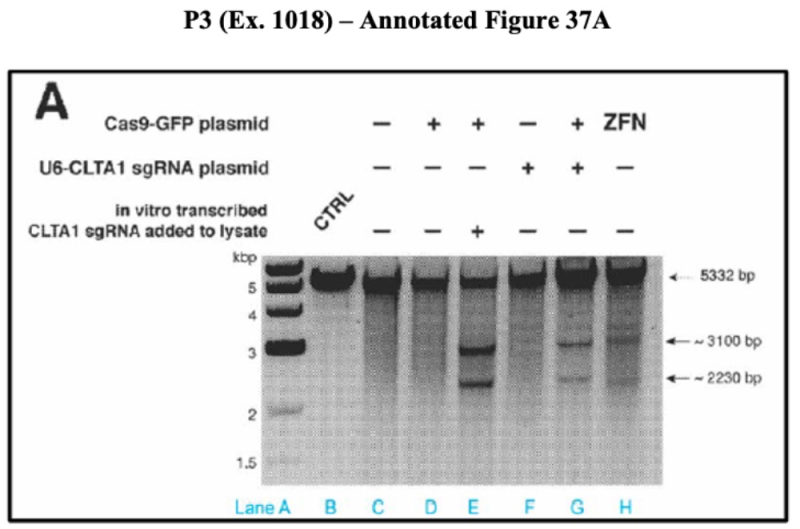
    As the final asserted defect in the evidentiary support for CVC's purported reduction to practice of CRISPR in eukaryotic cells, the brief then sets forth its argument that the way the cells were lysed after introduction of CRISPR-Cas9 could have permitted any observed cleavage to have occurred after lysis and thus fall outside the scope of the invention as defined by the Count.  This is illustrated in annotated Figure 37A:

    Image 5
    As set forth in the brief, "the presence of two bands indicates to a POSA that the plasmid was successfully cleaved extracellularly at the predicted Cas9-sgRNA target site and the donor plasmid restriction enzyme site" (emphasis added).  As a consequence, the brief goes on to say that "[t]he results shown in Figure 37A undermine any arguable cleavage results in Figures 38B and 36E because they show that extracellular cleavage occurred in cell lysates prepared using the same Cas9-preserving protocol that was used to prepare the cell lysate in Figure 38B and 36E [emphasis in the brief].  Because the applicants preserved the activity of Cas9 in the lysate, any alleged cleavage shown in Figures 38B or 36E could have occurred outside the cells, in the lysate."

    In addition, the relative cleavage efficiencies between the ZFN positive control and the purported CRISPR-Cas9 lanes further support the conclusion that such CRISPR-Cas9-mediated cleavage occurred in vitro in the lysis buffer and thus does not support reduction to practice of eukaryotic cell embodiments of CRISPR gene editing by CVC in the P3 provisional priority document.

    ToolGen thus asks the Board to rule that CVC is not entitled to the benefit of priority of the P3 provisional application.

  • CalendarJune 29, 2021 – "Proud Innovation — Learn from LGBTQ+ Innovators" (U.S. Patent and Trademark Office) – 1:00 to 3:30 pm (ET)

    June 30, 2021 – "Patentability of Simulations at the EPO" (J A Kemp) – 16:00 pm BST (GMT+1)

    June 30, 2021 – "Waiving IP Protections to Address COVID-19: The WTO Proposals and Ensuring Equitable Access to the Vaccines" (Intellectual Property Owners Association) – 12:00 pm to 1:00 pm (ET)

    June 30, 2021 – "The Better Part of Valor? Discretionary Institution in PTAB Proceedings" (Fitch Even) – 12:00 pm to 1:00 pm (ET)

    July 21-22, 2021 – Advanced Summit on Life Sciences Patents conference (American Conference Institute)

    July 27-28, 2021 – Practitioners' Think Tank on ITC Litigation and Enforcement conference (American Conference Institute)

    July 28-29, 2021 – Women Leaders in Life Sciences Law conference (American Conference Institute)

  • June-29-lgbtq-event-1500px
    The U.S. Patent and Trademark Office will host an online event entitled "Proud Innovation — Learn from LGBTQ+ Innovators" on June 29, 2021 from 1:00 to 3:30 pm (ET).  The event will consist of two panels:

    • Inspiring innovation: A discussion on creating change and building a legacy
    • Creating opportunities: A conversation about building networks and securing funding

    Those interested in attending the panel discussion can do so here.