• Federal Circuit Bar Association_2The Federal Circuit Bar Association (FCBA) will be offering a remote program entitled "Mediation Programs and Other Forms of Alternative Dispute Resolution" on September 28, 2021 from 3:00 pm to 4:00 pm (ET).  Rory Radding of Mauriel Kapouytian Woods LLP will moderate a panel consisting of Hon. Marian Blank Horn. Judge, U.S. Court of Federal Claims; Hon. Scott Boolick, Chief Judge, U.S. Patent and Trademark Office, Patent Trial and Appeal Board; Hon. Joel Alexander, Administrative Judge, Office of Regional Operations, U.S. Merit Systems Protection Board; and Kent Stevens, Independent Mediator, U.S. International Trade Commission Roster Mediator.  The panel will explore mediation and other alternative dispute resolution programs available in the various tribunals from which an appeal is taken to the U.S. Court of Appeals for the Federal Circuit.

    The webinar is complimentary for FCBA members and students, $50 for government/academic/retired attendees, and $175 for private practitioners.  Those interested in registering for the program, can do so here.

  • IPWatchdogIPWatchdog will be offering a webinar entitled "Patent Purgatory: How the USPTO Puts Patent Applications on Hold, and How One Inventor Is Fighting Back" on September 29, 2021 at 12:00 pm (ET).  Gene Quinn of IPWatchdog, Inc.; Andrew Grossman of BakerHostetler; Paul Kamenar, Senior Fellow of the Administrative Conference of the United States; and independent inventor Gilbert Hyatt will discuss Mr. Hyatt's experience with the U.S. Patent and Trademark Office, which sheds some light on the tools that the USPTO has at its disposal when it decides to take aim at an applicant.

    There is no registration fee for this webinar.  However, those interested in registering for the webinar, should do so here.

  • Biotechnology Innovation Organization (BIO)The Biotechnology Innovation Organization IP Counsels Committee will be offering the next installment of its webinar series on September 29, 2021 at 1:00 pm (EDT).  In the webinar, entitled "112 Enablement: What to Watch Out For," Michael Bunis of Choate Hall & Stewart LLP will moderate a panel consisting of Stephanie Schonewald of Choate Hall & Stewart LLP, Wendy Plotkin of Biogen, and Amy Bray of Adimab, LLC.  The panel will discuss Section 112, focusing on the enablement of functional language, review how this is playing out in district court litigation and in the PTAB, and also discuss potential prosecution strategies.  The panel discussion will also focus on recent enablement-related cases, including Amgen v. Sanofi and the cases that led to that landmark decision.

    The webinar is complimentary for BIO members and $99 for non-members.  Those interested in registering for the program, can do so here.

  • IIPLAThe International Intellectual Property Law Association (IIPLA) will be offering a live webinar on "IP Valuation" on September 29, 2021 from 10:00 am to 11:00 am (PST). David Wanetick of IncreMental Advantage will provide attendees with the skill set necessary to value patents.

    Those wishing to register for the webinar can do so here.

  • Federal Circuit Bar Association_2The Federal Circuit Bar Association (FCBA) will be offering a remote program entitled "How to Litigate in the Western District of Texas" on September 29, 2021 from 4:30 pm to 5:40 pm (ET).  Christian Hurt of Davis Firm P.C. will moderate a panel consisting of Hon. Alan D. Albright, District Judge, U.S. District Court for the Western District of Texas; Derek Gilliland of Sorey & Gilliland, LLP; and Janice Ta of Perkins Coie LLP.  The panel will discuss the litigation of patent disputes in the Western District of Texas, including important local rules and practice tips for litigators in Judge Albright's court.

    The webinar is complimentary for FCBA members, judges, and students, $75 for government/academic/retired attendees, $150 for small firm practitioners (fewer than 25 attorneys) and young lawyers (under the age of 35), and $300 for private practitioners.  Those interested in registering for the program, can do so here.

  • China_WebinarThe U.S. Patent and Trademark Office will offer a webinar entitled "China IP: Quarterly Legislation and Case Law Update" on September 30, 2021 from 1:00 pm to 2:00 pm (ET).  The webinar, which is the second of a planned series of quarterly updates, will cover the latest developments in intellectual property (IP) law in China.

    Those interested in registering for the webinar can do so here.

  • By Kevin E. Noonan

    ToolGenIn June, Senior Party ToolGen filed its Substantive Preliminary Motion No. 2 to deny Junior Party the University of California, Berkeley; the University of Vienna; and Emmanuelle Charpentier (collectively, "CVC") priority benefit to its U.S. Provisional Application No. 61/757,640, filed January 28, 2013 ("Provisional 3"), pursuant to 37 C.F.R. §§ 41.121(a)(1)(ii) and 41.208(a)(3) and Standing Order ¶ 208.4.1.  CVC filed its Opposition to this Motion.  On August 26th, ToolGen filed its Reply.

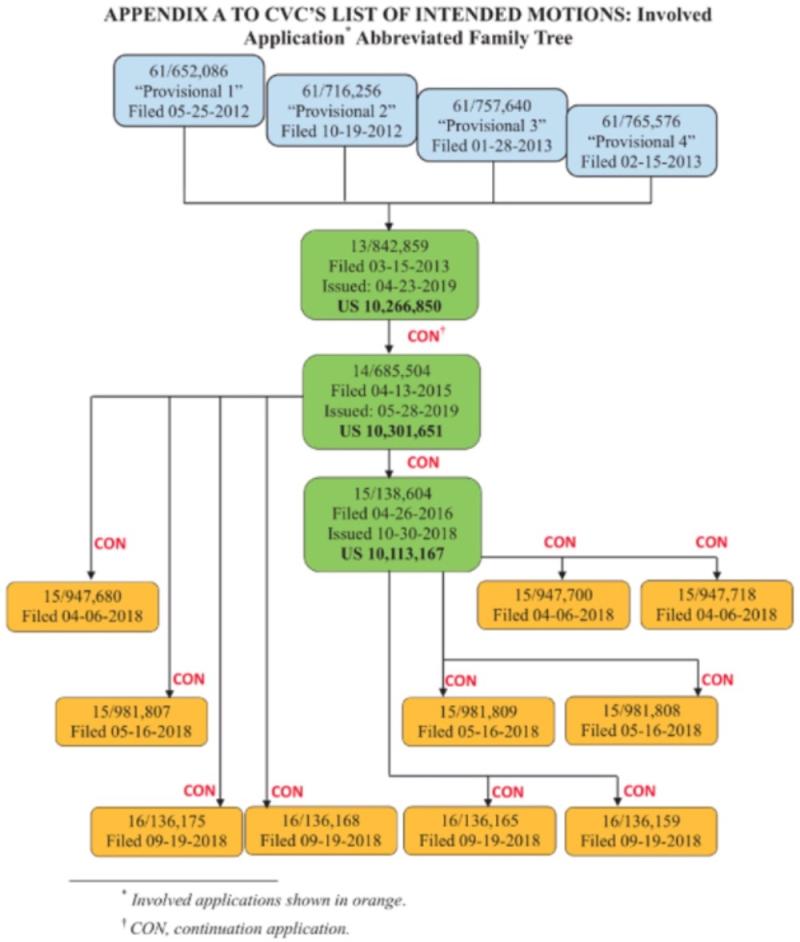
    The relationships between the patents and applications in the '127 interference are set forth in this chart (filed in CVC's earlier preliminary motion):

    Image
    In its Motion, ToolGen had challenged CVC's entitlement to priority benefit to the P3 provisional application on the basis that it did not disclose "successful cleavage of DNA within eukaryotic cells, nor does it otherwise show a constructive reduction to practice of an embodiment within Count 1."  ToolGen's argument depended on three assertions.  First, the brief identified a single Example (Example 2) in the P3 provisional application directed towards purported eukaryotic cell embodiments of CRISPR gene editing.  Second, ToolGen asserted that the Example (and Figures 38B and 36E related thereto) did not provide an adequate description because "Figure 38B shows alleged cleavage bands at positions where there should be none and in some instances no bands where there should be bands."  Similarly, ToolGen asserted that Figure 36E "independently contains so many unexplained bands as to make it so shaky and unreliable that a [person of ordinary skill in the art or] POSA would not view it as showing possession of an embodiment within Count 1."  Taken together, ToolGen argued that "the Figures cannot be evidence that discloses successful cleavage to a POSA in eukaryotes, and the applicants' failure to sequence the resulting products further cements this conclusion."  Third, ToolGen argued that "applicants lysed the cells before DNA extraction such that they left the Cas9 protein active to cleave DNA outside of intact cells, as opposed to within the eukaryotic cell as required by Count 1" and "a POSA would understand that any cleavage shown in the gel results cannot confirm that cleavage occurred within eukaryotic cells."  These allegations were supported by expert testimony (Dr. Turchi) to the effect that a POSA at the time of the invention would not have considered the P3 disclosure to satisfy the statutory requirements under 35 U.S.C. § 112.  ToolGen's position (echoing positions taken by Broad in Interference no. 106,115) was that "adapting the native prokaryotic CRISPR-Cas9 system to cleave DNA within eukaryotic cells was highly unpredictable" based on the many differences between the prokaryotic milieu where CRISPR was expressed natively and eukaryotic cells (the existence of the nucleus, packaging genomic DNA in chromatin, the intracellular components for gene expression in eukaryotic cells, and the resulting uncertainty ToolGen alleges arises as a consequence regarding whether the CRISPR-Cas9 system could be adapted for use in these cell types).  ToolGen's brief also contained a detailed explication of CVC's disclosure in its P3 provisional application, pointing out its purported deficiencies.

    CVC's Opposition made two counter arguments:  first, that ToolGen's critique failed to show that the '640 provisional application did not disclose a constructive reduction to practice; and second, that specifically Example 2 disclosed an actual reduction to practice supported by peer-reviewed approval in a related scientific paper.  In addition, CVC reminded the Board that it has already granted CVC benefit of priority to the '640 application three times (including its decision in the '115 interference, in declaring this interference, and in Interference No. 105,048).  With regard to the first opposition argument, CVC faulted ToolGen's expert for purportedly ignoring art (including Barrangou 2012, Science 2012, Mali 2013, and Cong 2013) that would have provided the proper context for judging the sufficiency of the '640 application's disclosure, and would have provided the skilled artisan with confirmation that "no special adaptations were needed to apply CRISPR-Cas9 in eukaryotic cells and that the routine methods and reagents that had been used previously to express RNA and other gene-editing nucleases had also been used to implement CVC's CRISPR-Cas9 system disclosed in P3" (a position CVC has consistently taken with regard to adapting CRISPR to eukaryotic cells).  CVC further argued that ToolGen's legal argument was defective, requiring actual reduction to practice (CVC stating that ToolGen's witness "admitted that the human cell embodiment described in Example 2 meets all the elements of Count 1" (emphasis in brief)).  CVC proffered its own expert (Dr. Doyon) testifying contrary to ToolGen's expert in support of its arguments.  And regarding the second argument, CVC countered ToolGen's litany of "alleged inconsistencies" in Example 2 of the '640 application with the acceptance of the scientific community of the patency of its evidence in the Jinek et al. 2013 reference, stating the conclusion in the art that "Jinek et al. demonstrate the capability of RNA-programmed Cas9 to introduce targeted double-strand breaks into human chromosomal DNA, thereby inducing site-specific genome editing reactions."  CVC also noted that ToolGen during prosecution of its patents-in-interference had represented to the U.S. PTO that "we and others have reported RNA-guided genome editing in human cells in January, 2013."  And CVC asserted that the '640 application discloses multiple examples of eukaryotic cell embodiments of CRISPR, in "a fish cell, human cell, and fruit fly cell" using microinjection or lipofection of CRISPR-Cas9 complexes produced in vitro.  CVC also provided its own explication of express disclosure in the Examples of its P3 priority document in support of it being entitled to the benefit of priority to its '640 provisional application.

    In its Reply, ToolGen accuses CVC of focusing the Board's attention on scientific references (Jinek et al. 2013, Mali 2013, and Cong 2013) rather than on the specification of the '640 application.  As in its Motion, ToolGen asserts arguments regarding the meaning of the experimental results set forth in CVC's '640 application and finds them wanting regarding establishment of a constructive reduction to practice of CRISPR in a eukaryotic cell.

    ToolGen first asserts that "P3 and Jinek 2013 are not interchangeable," insofar as the Jinek reference was published after the P3 filing date and has disclosure (including sequence disclosure) not found in the P3 specification.  The significance of this deficiency, ToolGen contends, is that their expert testified that such sequence information "is the exact data . . . a POSA would need to confirm cleavage in view of P3's disclosure."  This failure also negates CVC's reliance on later-published papers CVC contended verified the success that could be attributed to the eukaryotic CRISPR demonstration in Jinek according to ToolGen's brief.  (And even the sequencing information in the Jinek reference is suspect, ToolGen argues, because "the reported +65 nucleotide mutation is not human, but instead perfectly matches sequences in Wild Yak, Bighorn Sheep and Red Deer.")  And further, lest the Board consider this to be a "battle of the experts," ToolGen contends that CVC's expert 1) did not affirmatively testify that the disclosure of Jinek and the '640 application were equivalent (they "appear to correspond") and 2) the issue is whether the P3 specification satisfied the written description requirement, not what was disclosed in Jinek.

    ToolGen then rebuts CVC's argument in its Opposition that their expert did not consider the prior art, setting forth that expert's testimony that he had done so.  ToolGen also asserts that the legal analysis in its motion properly applied the statutory written description standard to these circumstances (specifically, by reviewing the totality of what was disclosed in the '640 specification).  ToolGen also denies CVC's assertion that these analyses required the '640 application to disclose a working example, and accused CVC of using a "pick-and-choose," "hindsight" reconstruction of their '640 specification comprising "pieced together disparate laundry lists" instead of addressing the deficiencies ToolGen asserts in Example 2 of that specification.  ToolGen acknowledges that P3 did contain a working example, but asserts that it was one that did not demonstrate successful CRISPR-mediated cleavage of DNA in a eukaryotic cell.

    The remainder of ToolGen's Reply sets forth in synopsis its arguments made in its Substantive Preliminary Motion, that 1) Example 2 in the '640 application did not meet all the elements of Count 1 (due to the deficiencies in the experimental evidence presented in that Example); 2) that the skilled artisan would recognize that the lysing method disclosed in the Example would permit cleavage to occur outside the cell (thus providing an artifactual explanation for whatever evidence of cleavage the Example provided); 3) that Figure 36E did not provide evidence of eukaryotic cell CRISPR due to the unexpected (and unexplained) bands in that Figure, which CVC's Opposition did not rebut or provide an alternative explanation for; and 4) that Figure 38B also contained unexpected and unexplained bands the existence of which called into question CVC's assertion that this experimental evidence established achievement of CRISPR-mediated DNA cleavage in a eukaryotic cell.

  • By Kevin E. Noonan

    On July 15th, Junior Party the University of California/Berkeley, the University of Vienna, and Emmanuelle Charpentier (collectively, "CVC") filed its opposition to Senior Party ToolGen's Substantive Motion No. 1 for benefit of priority to U.S. Provisional Application No. 61/837,481, filed June 20, 2013 ("P3" or "ToolGen P3"), or alternatively, International Application No. PCT/KR2013/009488, filed Oct. 23, 2013 ("PCT"), in Interference No. 106,127.  On August 27th ToolGen filed its Reply.

    In its Substantive Motion No. 1, ToolGen had set out graphically the relationship of these priority documents, including U.S. provisional application No. 61/717,324 ("P1") for which the Board had granted ToolGen priority upon institution:
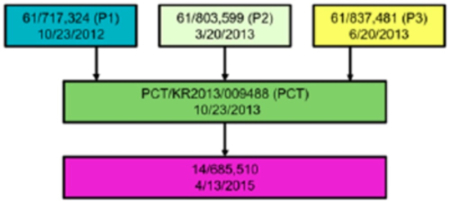
    Image 1
    The basis ToolGen asserted for its priority claim was satisfaction of the written description and enablement requirements under 35 U.S.C. § 112(a) with regard to two embodiments falling within the scope of the Interference Count.  ToolGen argued satisfaction of the alternative language of the Count that recites claim 18 (dependent on claim 15) of Broad's U.S. Patent No. 8,697,359, the brief annotating the limitation recited therein to facilitate identification of ToolGen's disclosure corresponding thereto:

    [1] An engineered, programmable, non-naturally occurring Type II CRISPR-Cas system comprising
    [2] a Cas9 protein and
    [3] at least one guide RNA that targets and hybridizes to a target sequence of a DNA molecule in a eukaryotic cell,
    [4] wherein the DNA molecule encodes and the eukaryotic cell expresses at least one gene product and
    [5] the Cas9 protein cleaves the DNA molecules,
    [6] whereby expression of the at least one gene product is altered; and,
    [7] wherein the Cas9 protein and the guide RNA do not naturally occur together;
    [8] wherein the guide RNAs comprise a guide sequence fused to a tracr sequence.

    The brief asserted Examples 3 and 4 of the P3 (PCT) priority document in support of its satisfaction arguments, noting that one such embodiment (designated 3-1) comprises a Foxn1-specific sgRNA and a Cas9 mRNA, while embodiment 3-2 comprises the same sgRNA and recombinant Cas9 protein.  And in each case, ToolGen argued the Examples illustrate CRISPR-mediated cleavage and editing of the target Foxn1 DNA in mouse embryos expressed in the resultant genetically engineered mice.  The CRISPR-Cas9 complex is illustrated in the brief by this drawing:

    Image 2
    wherein "target DNA [is] in the green box, DNA-targeting sequence of crRNA [is] in the blue box, crRNA:tracrRNA duplex linked together by a -GAAA- loop [is] in the red box, remaining tracrRNA portion shown with brown underline, Cas9 protein with label shown with purple underline depicted as a shaded oval, which is in complex with sgRNA and cleaves the target sequence in the target DNA."

    The brief also noted the portions of the P3 priority document showing that such CRISPR-Cas9 complexes successfully cleaved and edited the target Foxn1 DNA, which ToolGen argued provided extensive disclosure in the P3 priority document of "abundant working examples and considerable guidance to a [person of ordinary skill in the art] to make and use CRISPR/Cas9 in eukaryotic cells."  ToolGen also noted that the P3 priority document shares the same specification with U.S. Application No. 14/685,510, to which the Board has recognized ToolGen's entitlement to priority.

    CVC disagreed in its opposition brief.  CVC's argument tracked much of the argument made in CVC's Substantive Preliminary Motion No.2 that the Board deny ToolGen benefit of priority to it P1 provisional application (see "CVC Substantive Preliminary Motion No. 2 to Deny Priority Benefit").  In that argument, CVC maintained that the Board should deny ToolGen priority benefit to the P1application based on party admissions that the provisional application did not disclose an operative embodiment falling within the scope of the Interference Count.  Specifically, CVC argued that ToolGen in the prosecution of the P1 application leading to allowance (and declaration of this interference) had argued to the Patent Examiner (and PTAB) that "a codon-optimized Cas9 nucleic acid is required for CRISPR-Cas9 to function in eukaryotic cells" and that "a skilled artisan would have no idea what the outcome may be if one were to codon optimize a Cas9 nucleic acid" (and with the additional argument here that ToolGen's P3 and PCT applications do not disclose Cas9 embodiments comprising a nuclear localization signal, either, wherein both of these alterations CVC alleges ToolGen represented as the "secret sauce" before the Board during ex parte prosecution).  This position was consistent with the prokaryotic source of Cas9, and the Board and Examiner relied upon these arguments to find allowable claims that are now claims designated as corresponding to the Count in this interference, CVC asserts.  All such claims require use of a Cas9-encoding nucleic acid that is codon-optimized for expression in eukaryotic cells, and ToolGen added this limitation to claims-in-interference to overcome anticipation and obviousness rejections based on the prior art.  But neither of ToolGen's '481 provisional application nor its PCT application discloses a codon-optimized Cas9 nucleic acid, according to CVC, nor by ToolGen's own argument (unpredictability) would the skilled worker be able to discern such a nucleic acid with any reasonable basis for expecting such an embodiment could be produced using the disclosure in either the '481 provisional application or its PCT application.  Accordingly, CVC argues in its motion, ToolGen cannot in this interference renounce these arguments and rely on the priority date of the either the '481 provisional application or its PCT application to constitute a constructive reduction to practice for eukaryotic CRISPR-Cas9 embodiments falling within the scope of the interference Count.  And mere "generalized language" relating to these modifications are inadequate, CVC argues here, pursuant to University of Rochester v. G.D. Searle & Co., 358 F.3d 916, 923 (Fed. Cir. 2004).  Thus, according to CVC, the Board should deny ToolGen priority benefit to the '481 provisional application or its PCT application.

    CVC also took issue with ToolGen's alleged argument that its disclosure satisfies CVC's half of the count (which doesn't recite these modifications) saying "the issue is what embodiments ToolGen may rely on given that it unambiguously told the Patent Office that NLS addition and codon optimization are required and unpredictable."  And the disclosure of the P3 provisional and PCT application to which ToolGen seeks to claim priority benefit do not pass muster under this precedent according to CVC.

    Finally, CVC argued that "[p]rinciples of party admission and judicial estoppel preclude ToolGen from taking positions inconsistent with its prior assertions," citing Zedner v. United States, 547 U.S. 489 (2006), and Louis v. Okada, 59 U.S.P.Q.2d 1073, 1075 (B.P.A.I. 2001) (precedential).

    CVC then argued that these infirmities extended to ToolGen's P3 and PCT applications that were the subject to ToolGen's Substantive Motion No. 1.

    In its Reply, ToolGen addresses with particularity CVC's arguments raised in its Opposition.  The Reply begins by asserting that CVC argued against a strawman Motion ToolGen asserts it did not bring.  Specifically, ToolGen argues that its Motion No. 1, contingent on the Board granting CVC's Motion No. 1 to deny benefit to ToolGen's P1 application, was predicated on the P3 and PCT applications describing multiple embodiments that correspond to CVC's half of the Count (the Board declaring the interference based on a Count derived from claims in each Party's patents or applications-in-interference in the alternative, a demonstration of correspondence and support to either satisfying a demand for priority benefit.  According to ToolGen, CVC's arguments and expert testimony in support thereof do neither address nor rebut ToolGen's ground for asking the Board to recognize its priority claim with regard to the P3 or PCT applications.

    ToolGen reiterated its argument that P3 and PCT provide a constructive reduction to practice of embodiments falling within the scope of CVC's portion of the Count, which does not require NLS-tagged nor eukaryotic cell codon-optimized Cas9.  ToolGen's general objection to CVC's argument was that "CVC relies on contextual fragments of prosecution arguments, omits critical words from statements, stitches together disparate questions and answers, and misrepresents ToolGen's positions, and its expert Dr. Cullen's opinions, during prosecution, in order to craft a false narrative that ToolGen achieved patentability by focusing on codon optimization and NLSs, not the unpredictability in prokaryote-to-eukaryote translation," something ToolGen contends is "revisionist history."  CVC denies it ever asserted that there was a "secret sauce" (specifically, NLS-tagged or eukaryotic cell codon-optimized Cas9) ("never happened," according to the brief).  ToolGen takes the portions of the transcript of its arguments to the PTAB in ex parte prosecution to illustrate that "CVC's excerpted quote takes a question asked by Judge Flax and matches it with ToolGen's answer to a different question from a different Judge" (emphasis in brief).  ToolGen accuses CVC of "cherry picking" one (specifically, NLS-tagged or eukaryotic cell codon-optimized Cas9) out of six reasons it asserted as to why the skilled artisan would not have had a reasonable expectation of success in practicing CRISPR in eukaryotic cells, not that NLS-tagged or eukaryotic cell codon-optimized Cas9 was required to do so, in the context of non-obviousness without the disclosure of the application that matured into the P1 application.  In fact, ToolGen reminds the Board, it was the Examiner's focus on eukaryotic CRISPR embodiments requiring NLS-tagged or eukaryotic cell codon-optimized Cas9 that led to ToolGen's successful appeal in its application-in-interference.

    ToolGen further argues that CVC's prosecution history estoppel arguments are unsupported by the evidence in its prosecution history and also legally insufficient.  After making the distinction between the issue here (support in the P3 and PCT application for at least one embodiment falling within the scope of the count and the role of PHE in claim construction and infringement contexts and the inapplicability of the estoppel under the procedural issues before the Board in the interference), ToolGen then asserts is arguments that judicial estoppel as urged by CVC also does not apply.  ToolGen's reasoning is based on its earlier arguments regarding NLS-tagged or eukaryotic cell codon-optimized Cas9 that it never took the position CVC asserts it did during ex parte prosecution and thus judicial estoppel does not apply.

    Finally, turning to the substantive question of whether NLS-tagged or eukaryotic cell codon-optimized Cas9 was needed to show constructive reduction to practice of an embodiment of eukaryotic CRISPR falling within the scope of the interference Count, ToolGen argues that both the P3 and PCT applications satisfy this requirement because both NLS-tagging and eukaryotic cell codon-optimization were well known in the art at the time both these applications were filed, relying on Spectra–Physics, Inc. v. Coherent, Inc., for the rubric that "[a] patent need not teach, and preferably omits, what is well known in the art," 827 F.2d 1524, 1534 (Fed. Cir. 1987).  Nevertheless, ToolGen also asserts that in fact both the P3 and PCT applications expressly disclose examples of how each of these modifications are made to adapt CRISPR for the eukaryotic environment.  These include knowledge in the art regarding nucleic acids encoding the amino acid sequence of S. pyogenes Cas9, the existence and use of codon-optimization tables for achieving codon optimization in eukaryotic cells, and express reference in both the P3 and PCT applications of the protein/amino acid sequence of a specific NLS used (which ToolGen notes was first disclosed in the art in 1984).  ToolGen completes this portion of its argument by distinguishing the circumstances here before the Board and those in Univ. of Rochester v. G.D. Searle &Co., 358 F.3d 916, 929 (Fed Cir. 2004), where the specification of the asserted patents did not disclose support for the claims at issue.

  • By Kevin E. Noonan

    FDAThe U.S. Food and Drug Administration approved the first biosimilar drug for treating macular degeneration under the provisions of the Biologics Price Competition and Innovation Act (BPCIA, codified at 42 U.S.C. § 262) as part of the Affordable Care Act of 2010 (colloquially known as "Obamacare").  The drug is Byooviz (ranibizumab-nuna), a biosimilar to Genentech's Lucentis®, and like Lucentis® has been approved for treating several eye diseases and conditions.  Specifically, according to the FDA announcement, Byooviz is approved for "neovascular (wet) age-related macular degeneration (nAMD)[,] macular edema (fluid build-up) following retinal vein occlusion (blockage of veins in the retina) and myopic choroidal neovascularization, a vision-threatening complication of myopia (nearsightedness)."  In the announcement, Sarah Yim, M.D., director of the Office of Therapeutic Biologics and Biosimilars in the FDA's Center for Drug Evaluation and Research (CDER) was quoted as saying:

    Today's approval provides another treatment option for millions of people whose vision is impaired and is another step forward in our commitment to provide access to safe, effective and high-quality biological products.  Continuing to grow the number of biosimilar approvals is a key part of our efforts to provide greater access to treatment options for patients, increase competition and potentially lower costs.

    For those keeping score, this is the 31st biosimilar product approved by the FDA (and the last one, Semglee (insulin glargine-yfgn), was the first approved interchangeable product).  The details regarding these approved products are set forth in this table:

    Table
    It is certainly the case that the pace of these approvals is not what their proponents envisioned or expected, and that has led to some frustration (never a good thing when it is experienced by impatient policy makers; see, e.g., "A Solution in Search of a Problem").  Nevertheless, the pace of agency approvals is increasing, despite some slowdown due to the COVID-19 pandemic, and all signs indicate that it will increase (see, e.g., Biosimilars Council, New Analyses Point to Opportunities to Increase Savings from Biosimilar Adoption).  Which seems to be what everyone wants.

  • University of California-BerkleyBy Kevin E. Noonan

    On July 15th, Junior Party the University of California/Berkeley, the University of Vienna, and Emmanuelle Charpentier (collectively, "CVC") filed its Opposition to Senior Party ToolGen's Substantive Motion No. 1 for benefit of priority to U.S. Provisional Application No. 61/837,481, filed June 20, 2013 ("P3" or "ToolGen P3"), or alternatively, International Application No. PCT/KR2013/009488, filed Oct. 23, 2013 ("PCT"), in Interference No. 106,127.

    In its motion, ToolGen set out graphically the relationship of these priority documents, including U.S. provisional application No. 61/717,324 ("P1") for which the Board had granted ToolGen priority upon institution:

    Image 1
    The basis ToolGen asserted for its priority claim was satisfaction of the written description and enablement requirements under 35 U.S.C. § 112(a) with regard to two embodiments falling within the scope of the Interference Count.  ToolGen argued satisfaction of the alternative language of the Count that recites claim 18 (dependent on claim 15) of Broad's U.S. Patent No. 8,697,359, the brief annotating the limitation recited therein to facilitate identification of ToolGen's disclosure corresponding thereto:

    [1] An engineered, programmable, non-naturally occurring Type II CRISPR-Cas system comprising
    [2] a Cas9 protein and
    [3] at least one guide RNA that targets and hybridizes to a target sequence of a DNA molecule in a eukaryotic cell,
    [4] wherein the DNA molecule encodes and the eukaryotic cell expresses at least one gene product and
    [5] the Cas9 protein cleaves the DNA molecules,
    [6] whereby expression of the at least one gene product is altered; and,
    [7] wherein the Cas9 protein and the guide RNA do not naturally occur together;
    [8] wherein the guide RNAs comprise a guide sequence fused to a tracr sequence.

    The brief asserted Examples 3 and 4 of the P3 (PCT) priority document in support of its satisfaction arguments, noting that one such embodiment (designated 3-1) comprises a Foxn1-specific sgRNA and a Cas9 mRNA, while embodiment 3-2 comprises the same sgRNA and recombinant Cas9 protein.  And in each case, ToolGen argued the Examples illustrate CRISPR-mediated cleavage and editing of the target Foxn1 DNA in mouse embryos expressed in the resultant genetically engineered mice.  The CRISPR-Cas9 complex is illustrated in the brief by this drawing:

    Image 2
    wherein "target DNA [is] in the green box, DNA-targeting sequence of crRNA [is] in the blue box, crRNA:tracrRNA duplex linked together by a -GAAA- loop [is] in the red box, remaining tracrRNA portion shown with brown underline, Cas9 protein with label shown with purple underline depicted as a shaded oval, which is in complex with sgRNA and cleaves the target sequence in the target DNA."

    The brief also noted the portions of the P3 priority document showing that such CRISPR-Cas9 complexes successfully cleaved and edited the target Foxn1 DNA, which ToolGen argued provided extensive disclosure in the P3 priority document of "abundant working examples and considerable guidance to a [person of ordinary skill in the art] to make and use CRISPR/Cas9 in eukaryotic cells."  ToolGen also noted that the P3 priority document shares the same specification with U.S. Application No. 14/685,510, to which the Board has recognized ToolGen's entitlement to priority.

    CVC disagrees in its opposition brief.  CVC's argument tracks much of the argument made in CVC's Substantive Preliminary Motion No. 2 that the Board deny ToolGen benefit of priority to it P1 provisional application (see "CVC Substantive Preliminary Motion No. 2 to Deny Priority Benefit").  In that argument, CVC maintained that the Board should deny ToolGen priority benefit to the '324 application based on party admissions because this provisional application does not disclose an operative embodiment falling within the scope of the interference Count.  Specifically, CVC argued that ToolGen in the prosecution of the '324 patent application leading to allowance (and declaration of this interference) had argued to the Patent Examiner (and PTAB) that "a codon-optimized Cas9 nucleic acid is required for CRISPR-Cas9 to function in eukaryotic cells" and that "a skilled artisan would have no idea what the outcome may be if one were to codon optimize a Cas9 nucleic acid" (and with the additional argument here that ToolGen's P3 and PCT applications do not disclose Cas9 embodiments comprising a nuclear localization signal, either, wherein both of these alterations CVC alleges ToolGen represented as the "secret sauce" before the Board during ex parte prosecution).  This position was consistent with the prokaryotic source of Cas9, and the Board and Examiner relied upon these arguments to find allowable claims that are now claims designated as corresponding to the Count in this interference, CVC asserts.  All such claims require use of a Cas9-encoding nucleic acid that is codon-optimized for expression in eukaryotic cells, and ToolGen added this limitation to claims-in-interference to overcome anticipation and obviousness rejections based on the prior art.  But neither of ToolGen's '481 provisional application nor its PCT application discloses a codon-optimized Cas9 nucleic acid, according to CVC, nor by ToolGen's own argument (unpredictability) would the skilled worker be able to discern such a nucleic acid with any reasonable basis for expecting such an embodiment could be produced using the disclosure in either the '481 provisional application or its PCT application.  Accordingly, CVC argues in its motion, ToolGen cannot in this interference renounce these arguments and rely on the priority date of the either the '481 provisional application or its PCT application to constitute a constructive reduction to practice for eukaryotic CRISPR-Cas9 embodiments falling within the scope of the interference Count.  And mere "generalized language" relating to these modifications are inadequate, CVC argues here, pursuant to University of Rochester v. G.D. Searle & Co., 358 F.3d 916, 923 (Fed. Cir. 2004).  Thus, according to CVC, the Board should deny ToolGen priority benefit to the '481 provisional application or its PCT application.

    CVC also takes issue with ToolGen's alleged argument that its disclosure satisfies CVC's half of the count (which doesn't recite these modifications) saying "the issue is what embodiments ToolGen may rely on given that it unambiguously told the Patent Office that NLS addition and codon optimization are required and unpredictable."  And the disclosure of the P3 provisional and PCT application to which ToolGen seeks to claim priority benefit do not pass muster under this precedent according to CVC.

    Finally, CVC argues that "Principles of party admission and judicial estoppel preclude ToolGen from taking positions inconsistent with its prior assertions," citing Zedner v. United States, 547 U.S. 489 (2006), and Louis v. Okada, 59 U.S.P.Q.2d 1073, 1075 (B.P.A.I. 2001) (precedential).

    The brief then points out with particularity ToolGen's arguments in its motion, pursuant to PTAB procedural rules in interferences, in a "call and response" format and hies back to its argument and the structure thereof in CVC's own motion to deny ToolGen benefit of priority to its '428 provisional application.  These arguments are all tied to CVC's assertion that "ToolGen's motion fails to show that its P3 and PCT provide a [constructive reduction to practice] of CVC's half of the count because neither application describes an embodiment with an NLS-tagged and codon-optimized Cas9 consistent with its prosecution representations," based on the priority benefit requirements as set forth inter alia in Falkner v. Inglis, 448 F.3d 1357, 1362 (Fed. Cir. 2006), and 37 C.F.R. § 41.201.  CVC's arguments further sound in familiar written description precedent (University of Rochester v. G.D. Searle & Co; Ariad Pharm., Inc. v. Eli Lilly & Co., 598 F.3d 1336, 1351 (Fed. Cir. 2010) (en banc); In re Alonso, 545 F.3d 1015, 1021 (Fed. Cir. 2008)) as applied to the description contained in the specification of ToolGen's P3 and PCT applications.  Specifically, CVC's brief focuses on Embodiment 3-1 and Embodiment 3-2 cited by ToolGen in support of its motion for priority benefit, each of which comprise a codon-optimized Cas9 protein having an NLS tagged therewith.  In particular, CVC argues that the P3 provisional application has no disclosure of a codon-optimized Cas9 sequence and lacks a formal sequence listing pursuant to 37 C.F.R. § 1.821 (despite the specification making reference to "SEQ ID NO:2" as an amino acid sequence encoding Cas9).  Moreover, the absence of this disclosure was conceded by ToolGen's expert according to CVC.  In addition, CVC argues that:

    P3 lacks the following disclosures that a skilled artisan would otherwise need to understand that ToolGen possessed a Cas9 mRNA of the count: (1) the bacterial Cas9 species from which the Cas9 mRNA was derived, (2) whether the Cas9 mRNA was codon-optimized or encoded an NLS-tagged Cas9 protein, (3) which NLS, if any, was attached; or (4) which Cas9 mRNA sequence was injected into the mouse cells,

    and ToolGen's expert merely cobbled together "disparate statements from other portions of the specification" in an attempt to establish sufficiency of disclosure.  (Perhaps infelicitously, ToolGen relied on the same expert to support its arguments before the Board during ex parte examination.)  CVC further argues that at the time the invention was made there were many codon optimization tables known in the art and that they differed with regard to how a bacterial protein like Cas9 would be effectively codon-optimized for expression un eukaryotic cells (and CVC notes that P3 does not inform the skilled worker which table or program should be used).  CVC asserts similar arguments with regard to choice of NLS tags known in the art.  According to CVC both embodiments have these flaws fatal to satisfaction of the requirements for a constructive reduction to practice.

    CVC asserts similar deficiencies in the disclosure of ToolGen's PCT application; in both arguments CVC focuses on element [2] in ToolGen's explication of Claim 18 of Broad's '359 patent corresponding to one half of the Count.  CVC also asserts deficiencies in Embodiment 4 in ToolGen's PCT application while "purports to transfect an NLS tagged Cas9 protein complexed with a sgRNA into the protoplast cells of the Arabidopsis plant (CVC noting in a footnote that codon optimization was not relevant because Cas9 protein was microinjected into the cells).  Again relying on ToolGen's purported arguments in related patents, CVC argues that the disclosure of the PCT is deficient for not disclosing the identity of the Cas9 protein nor the NLS signal (out of the "dozens and dozens" that CVC asserts were known in the art), despite ToolGen disclosing "five Cas9 nucleic acid sequences and two Cas9 amino acid sequences in a sequence listing."  CVC bases this portion of its argument on deficiencies in the sequence listing with regard to identifying which sequences used in which disclosed embodiment, and in other instances identifying certain sequences for human cell experiments but not for use in mouse or plant cells, or for use in transfection but not microinjection experiments.

    The brief concludes with CVC's arguments regarding party admissions and judicial estoppel in view of ToolGen's purported arguments before the Board during ex parte prosecution.  Citing Springs Window Fashions LP v. Novo Indus., L.P., 323 F.3d 989, 995 (Fed. Cir. 2003), CVC argues that "[t]he public notice function of a patent and its prosecution history requires that a patentee be held to what he declares during the prosecution of his patent" (emphasis in brief) and were not "simply an inadvertent mistake by the prosecuting attorney" because these statements were "detailed, consistent, and repeated" and were "effected with reasonable clarity and deliberateness" by ToolGen.  And in an interference context CVC relies on the BPAI's decision in Louis v. Okada that ToolGen must be bound by its earlier averments.

    CVC further argues that judicial estoppel also prevents ToolGen from eschewing its earlier arguments, citing Zedner v. United States, New Hampshire v. Maine, 532 U.S. 742, 742 (2001); and Wilson v. Martin, 789 Fed. Appx. 861, 872 (Fed. Cir. 2019).  CVC relies on the rubric that what is prohibited is a party taking a position that is "clearly inconsistent" with an earlier position (although to be fair the bulk of CVC's arguments is that ToolGen's P3 and PCT applications are insufficient to support the arguments it made previously before the Board in ex parte examination).  But CVC contends that the clears inconsistency is that "ToolGen's motion, by relying on generic disclosures of Cas9 mRNA and protein in P3 and PCT, directly contradicts ToolGen's prosecution position that NLS addition and codon optimization are required, yet unpredictable, to get CRISPR-Cas9 to function in eukaryotic cells."  Permitting ToolGen to garner priority benefit under these circumstances would work an unfair advantage and, on a broader policy plane, "would encourage other parties to advocate one position during prosecution to initiate an interference and then advocate the opposite position to survive the interference."

    For all these reasons CVC asks the Board to deny ToolGen's Substantive Motion No. 1.