• CalendarOctober 5, 2021 – "Celebrate Hispanic Heritage Month" (Intellectual Property Owners Association Education Foundation) – 5:00 pm to 6:00 pm (ET).

    October 5-21, 2021 – Hatch-Waxman and BPCIA Virtual Proficiency Series (American Conference Institute)

    October 7, 2021 – "Green Technologies – Patenting Trends and Technology Development" (J A Kemp) – 16:00 BST (British Summer Time)

    October 8, 2021 – "International IP Practice" (Center for Intellectual Property, Information & Privacy Law at the University of Illinois Chicago School of Law, the World Intellectual Property Organization, and Kuhnen & Wacker) – 7:15 am to 3:15 pm (CDT) on 

    November 9-10, 2021 – Paragraph IV Disputes Conference (American Conference Institute) – 8:00 am until 6:00 pm (EST) on November 9 and 7:50 am until 5:15 pm (EST) on November 10, 2021

  • IPO #2The Intellectual Property Owners Association (IPO) Education Foundation will offer a webinar in the Behind the IDEA series to "Celebrate Hispanic Heritage Month," on October 5, 2021 from 5:00 pm to 6:00 pm (ET).  The webinar, which is sponsored by IBM, will highlight Hispanic professionals who will share how their culture has impacted their career in innovation, STEM, or IP.  Natalie Gonzales of Baker Botts will moderate a panel consisting of Victor Garcia of NVIDIA, Natalia Russi-Vigoya of IBM Corp., and Augusto Vega of IBM Corp.

    There is no registration fee for the webinar.  However, those interested in attending the webinar should register here.

  • J A KempJ A Kemp will be offering a webinar entitled "Green Technologies – Patenting Trends and Technology Development" on October 7, 2021 at 16:00 BST (British Summer Time).  Henry Hunt-Grubbe and Hermione Thompson of J A Kemp will look into the patenting trends in greentech, discuss examples of how technology developments have been made and patented, and discuss procedural aspects of greentech patenting.  The webinar will address the following topics:

    • An overview of what greentech is and patenting trends in greentech.
    • Discuss examples of challenges faced with greentech development.
    • Discuss examples of technology developments that have been made.
    • Discuss approaches to claiming green technologies and where fundamental inventions may lie.
    • Provide a summary of government incentives for patenting greentech in the main countries for patent filings.

    There is no registration fee for this webinar.  However, those interested in registering for the webinar, should do so here.

  • UIC LawThe Center for Intellectual Property, Information & Privacy Law at the University of Illinois Chicago School of Law, along with the World Intellectual Property Organization (WIPO) and Kuhnen & Wacker, will be holding a virtual seminar on "International IP Practice" from 7:15 am to 3:15 pm (CDT) on October 8, 2021.  The program will bring together speakers to provide instruction on the issues of contemporary significance covering patents, trademarks, and design rights, and will provide sessions on:

    • Key Developments in International Trademark & Design Law
    • Key Developments in International Patent & Trade Secret Law and Policy
    • Strategies for Patent Cooperation Treaty (PCT) Filings
    • Featured Presentation: Patents and Technology: Perspective, Truth, and Change — Lisa Jorgenson, Deputy Director-General, Patents & Technology, WIPO
    • Intersections in International IP Law, Policy, and Practice

    Additional information about the program, including an agenda and list of speakers, can be found here.  Those interested in registering for the conference online can do so here.  The registration fee is $125 (there is no registration fee for UIC students, faculty, adjunct professors, staff, IP Center advisory board members, and government attendees).  Patent Docs readers who register for the program will be entitled to a 20% discount off of the registration fee using the discount code patentdocs2021.

    Patent Docs is an Institutional Partner of the UIC School of Law IP Center.

  • By Kevin E. Noonan

    University of California-BerkleyOn June 11th, Junior Party the University of California, Berkeley; the University of Vienna; and Emmanuelle Charpentier (collectively, "CVC") filed its Responsive Preliminary Motion No. 1 in Interference No. 106,127 to be accorded benefit of priority to U.S. Patent Application No. 13/842,859, filed March 15, 2013, or in the alternative U.S. Patent Application No. 14/685,504, filed April 7, 2015, or U.S. Patent Application No. 15/138,604, filed April 26, 2016, pursuant to 37 C.F.R. §§ 41.121(a)(2) and 41.208(a)(3) and Standing Order ¶ 208.4.1.  CVC filed this motion contingent on the Board granting Senior Party ToolGen's Substantive Preliminary Motion No. 2 to deny CVC priority benefit to U.S. Provisional Application No. 16/757,640, filed January 28, 2013 ("P3").  On July 15th, Toolgen filed its Opposition, and on August 27th CVC filed its Reply.

    ToolGen's Substantive Preliminary Motion No. 2 challenged CVC's entitlement to priority benefit to the P3 provisional in this interference on the grounds that it did not disclose "successful cleavage of DNA within eukaryotic cells, nor does it otherwise show a constructive reduction to practice of an embodiment within Count 1."  In its Responsive Motion, CVC sought to establish its entitlement to later-filed applications, to retain its best priority position against ToolGen (CVC itself has filed its Preliminary Motion No. 2 to deny ToolGen of the priority benefit to its earliest application, U.S. Provisional Application No. 16/717,324, filed October 23, 2012).  In its Responsive Motion, CVC argued entitlement to the '859 application as a matter of law because it is the earliest application having an identical specification to CVC's applications-in-interference and CVC argues that it therefore is entitled to a presumption that this application provides a constructive reduction to practice thereby, citing Transco Prod. Inc. v. Performance Contracting, Inc., 38 F.3d 551, 556–57 (Fed. Cir. 1994).  CVC's alternative priority claims were based on the common specification shared by all these applications, comprising "a string of continuation applications [that] thus provide[s] the same disclosure as the involved applications."  CVC provided the following table of comparison evidence of what is disclosed in the specification of the '859 application with each element of the Count:

    Table
    Specifically, CVC argued that Examples 4, 5, and 7 set forth a constructive reduction to practice of an embodiment falling within the scope of the Interference Count.

    ToolGen disagreed, arguing in its Opposition that CVC failed to carry its burden of showing the constructive reduction to practice it alleged.  As an initial matter, ToolGen cited CVC's argument that the disclosure in the three non-provisional applications here has been continuously disclosed in earlier provisional applications (U.S. Provisional Application No. 61/652,086, filed May 25, 2012 ("P1"), U.S. Provisional Application No. 61/716,256, filed October 19, 2012, ("P2"), and U.S. Provisional Application No. 61/757,640, filed January 28, 2013 ("P3"), priority to which CVC asked the Board to accord benefit in its Substantive Preliminary Motion No. 1 (opposed by ToolGen separately).  ToolGen understandably repeated (in brief) its principal argument in that Opposition, that CVC had not shown that CRISPR-mediated DNA cleavage in eukaryotic cells would have been a matter of routine and predictable experimentation, based inter alia on the Board's decisions in Interference No 105,048 (and Federal Circuit affirmance thereof; Regents of Univ. of California v. Broad Inst., Inc., 903 F.3d 1286, 1291–92 (Fed. Cir. 2018)) and Interference No. 106,115 to the contrary.  And ToolGen, as it has done in its own Preliminary Motion No. 2 to deny priority benefit, argued that the Board erred in granted CVC priority benefit to its P3 provisional application (U.S. Provisional Application No. 61/757,640, filed January 28, 2013) in the '115 Interference because it did not consider ToolGen's arguments that CVC had not satisfied the constructive reduction to practice requirement for this provisional (again, briefly recounting their earlier arguments here).  ToolGen thus made its first argument on the backs of its earlier arguments with regard to the P1, P2, and P3 priority documents, because if CVC was not entitled to priority to them then the Board should not grant CVC priority benefit to the three non-provisional applications at issue here in the face of CVC's representations that the disclosure in Examples 4, 5, and 7 was the same in these non-provisional applications and the earlier-filed provisional applications.  ToolGen supported these arguments by applying them to each of these Examples to illustrate what it considered to be their flaws that precluded CVC from entitlement to priority benefit.

    CVC's Reply focuses on having the Board grant priority to the '859 application even if its claims for priority benefit to all the earlier applications have been denied.  The basis for this claim is that the '859 application contains disclosures regarding eukaryotic CRISPR embodiments that appear in all the other, later-filed applications in this interference and thus CVC is entitled to priority benefit under 35 U.S.C. § 120 and precedent, citing Transco Prods. 6 Inc. v. Performance Contracting, Inc., 38 F.3d 551, 556 (Fed. Cir. 1994).  CVC bootstraps ToolGen's failure to challenge specification support in later-filed applications (inter alia, its involved Application No. 15/981,807) as an admission that the disclosure in the '859 application is similarly sufficient, based on its assertion that the disclosures (at least with respect to Examples 4, 5, and 7) are the same, citing Dreyfus v. Lilienfeld, 49 F.2d 1062, 1064 (C.C.P.A. 1931), and Renz v. Jacob, 326 F.2d 792, 799 (C.C.P.A. 1964).

    On the merits, CVC sets forth its case regarding what is disclosed in the '859 application as the basis for its priority claim.  In doing so, CVC distinguishes the Board's basis for denying priority to earlier applications (specifically in the '048 and '115 Interferences) because it asserts that "the evidence supporting this motion involves additional disclosures, including at least the '859 application's Examples 4, 5, and 7, which were not at issue in the '048 or '115 interferences, as well as different expert testimony and a later state of the art, March 15, 2013—by which time numerous peer-reviewed publications had reported using sgRNA CRISPR-Cas9 in eukaryotic cells."  CVC characterizes ToolGen's arguments are requiring actual (as opposed to constructive) reduction to practice, which is generally not required, citing Falkner v. Inglis, 448 F.3d 1357, 1362 (Fed. Cir. 2006).  Regardless, CVC argues that ToolGen is wrong in asserting any deficiencies in its disclosure of eukaryotic CRISPR falling within the scope of Count 1, which errors it then explicates in its brief.

    Specifically, CVC argues that ToolGen is wrong at least with regard the human cell experiments set forth in Example 4 (and alleging that ToolGen's expert Dr. Tuchi agreed), enumerating the eight specific elements of the Count and where in the Example they were satisfied.  CVC's brief faults ToolGen for applying an incorrect legal theory, specifically that the '859 application would need to provide "definitive evidence that CRISPR-Cas9 modulates transcription of at least one gene encoded by the target DNA molecule in eukaryotic cells" (emphasis in brief).  CVC cites Faulkner and In re Borkowski, 422 F.2d 904, 908 (C.C.P.A. 1970), for the principle that there is no need to show specific working examples to satisfy constructive reduction to practice.  CVC's brief faults ToolGen's expert witness for a variety of blunders in his analyses and consideration of the prior art (including positions CVC contends are contradicted by the '859 application), and accordingly urges that his testimony be given no weight.  And CVC argues that reassertion of arguments regarding its P1-P3 provisional applications here against the '859 application are mere illustrations of the consistency of ToolGen's errors it makes in supporting its Opposition.

    The focus of the parties' arguments is at the nexus of where a constructive reduction to practice in an unpredictable art meets the requirement that a skilled artisan would recognize by that disclosure that an inventor has possession of the disclosed invention, described in such a way that a person of ordinary skill in the art would be able to practice a claim throughout its full scope without undue experimentation.  In an interference context these principles apply to an application receiving priority benefit adequately discloses at least one embodiment of an invention falling within the scope of the interference Count, which ultimately is what the Board will need to decide in determining the priority question regarding the '859 application.


  • By Kevin E. Noonan

    University of California-BerkleyOn May 20th, Junior Party the University of California, Berkeley; the University of Vienna; and Emmanuelle Charpentier (collectively, "CVC") filed its Substantive Preliminary Motion No. 1 in Interference No. 106,127 (which names ToolGen as Senior Party), asking the U.S. Patent and Trademark Office's Patent Trial and Appeal Board for benefit of priority to U.S. Provisional Application No. 61/652,086, filed May 25, 2012 ("P1"), U.S. Provisional Application No. 61/716,256, filed October 19, 2012, ("P2"), and U.S. Provisional Application No. 61/757,640, filed January 28, 2013 ("Provisional 3"), pursuant to 37 C.F.R. §§ 41.121(a)(1)(ii) and 41.208(a)(3) and Standing Order ¶ 208.4.1.  On July 15th, ToolGen filed its Opposition.  On August 27th, CVC filed its Reply.

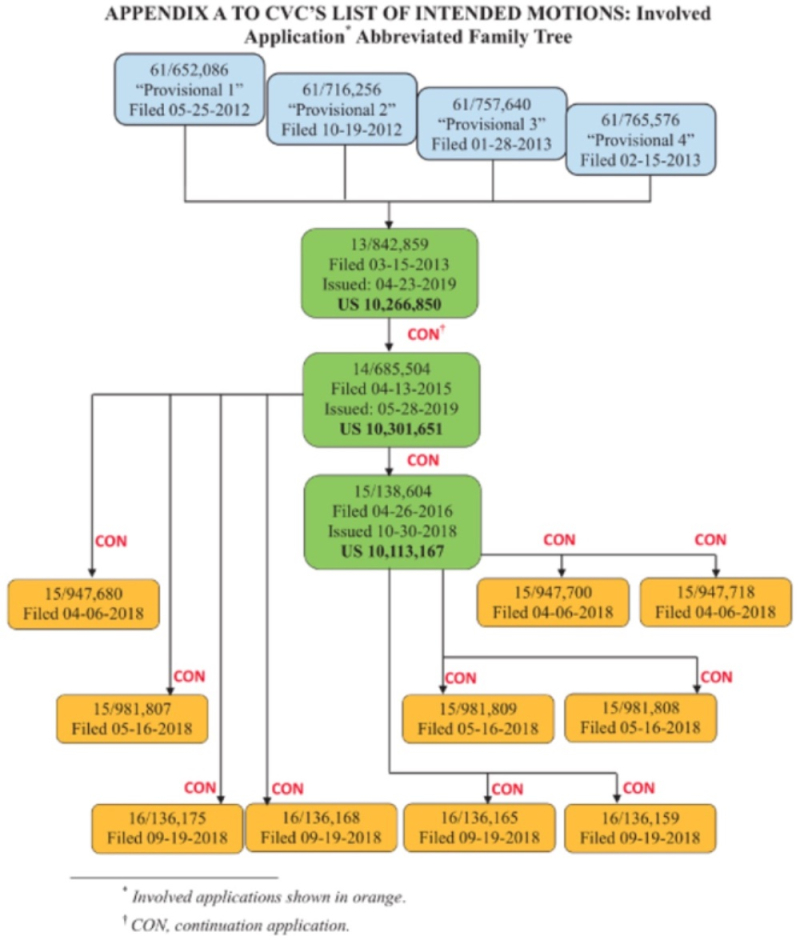
    The relationships between the patents and applications in the '127 interference are set forth in this chart (filed in CVC's earlier preliminary motion in the '115 Interference):

    Image
    The significance of the Board granting this motion with regard to the P1 or P2 provisional applications would be that CVC would be Senior Party, with all the presumptions benefiting Senior Party status.

    In its Preliminary Motion No. 1, CVC argued that its inventors invented eukaryotic cell CRISPR using a single-molecule guide RNA (sgRNA) that is described in each of the three provisional applications.  Once that breakthrough had been achieved, CVC argues that adapting CRISPR to the eukaryotic cell environment would have been "pretty straightforward" (quoting Dr. Luciano Marraffini, who informed the Broad inventors of the sgRNA embodiment in June, 2012 (see "CVC Files Motion in Opposition to Broad Priority Motion").  CVC supported this assertion with contemporaneous consistent statements from other scientists; by the existence of "platforms that had already been successfully used with the two incumbent systems: zinc-finger nucleases ("ZFNs") and transcription activator-like effector nucleases ("TALENs")"; and by the successful practice of CRISPR by several groups (including ToolGen) "[j]ust months after CVC presented this work" and the absence in the reports from any of these groups of "any 'special' adaptations or conditions needed to achieve CRISPR gene editing in eukaryotic cells."

    CVC also addressed the PTAB's decision not to grant CVC's patents and applications in the '115 patent the benefit of priority to the P1 and P2 provisional applications sought here; the basis for that decision, according to CVC was that it was made "without the benefit of the now well-developed evidentiary record," specifically, that "[t]he prior decision credited assertions that have been seriously undermined by evidence presented during the priority phase of the '115 interference."  Part of that evidence is that the P1 provisional "contemplates and teaches that the sgRNA CRISPR-Cas9 system can be microinjected as a pre-assembled ribonucleoprotein ("RNP") complex into embryos, including fish cells ("E1"), which obviates the concerns alleged in the '115 interference" (emphasis in brief).  In view of this evidence, concerns raised by Broad regarding eukaryotic CRISPR embodiments ("RNA and protein expression, co-localization, and assembly") are avoided because the CRISPR-Cas9 complex is already formed in vitro prior to being microinjected into the embryo.

    ToolGen based its opposition on three arguments.  First, ToolGen argued that (as a procedural matter) CVC failed to allege that either the P1 or P2 provisional application provide an enabling disclosure.  Second, ToolGen argued that the Board has already denied CVC benefit of priority to the P1 and P2 provisional applications in the '048 Interference (as part of its determination that there was no interference-in-fact) and the '115 Interference.  Third, ToolGen argued that CVC's arguments in support of its Preliminary Motion No. 1 do not cure the deficiencies of their arguments in earlier interferences and are just as unavailing.  Thus, ToolGen's first argument was procedural and its second and third argument went to the merits of CVC's disclosure (or lack of it) in these three provisional applications.

    In its Reply, CVC begins by asserting that there is no estoppel based on the Board's decisions in the '048 and '115 Interferences because 1) the issues were different in the '048 interference (no interference-on-fact based on non-obviousness), and 2) there has not been a final decision in the '115 interference.  According to CVC, "[t]he record supporting this motion is different, contains new evidence, and must be considered as a whole" and "[g]ranting this motion would not require overturning or contradicting any prior findings."  Moreover, "[i]t would violate the law and basic principles of equity and fairness to give preclusive effect here based on the record in the '048 proceeding" CVC asserts, citing Smith v. Bayer Corp., 564 U.S. 299, 312 n.9 (2011); and Fears v. Wilkie, 843 F. App'x 256, 261 (Fed. Cir. 2021) (quoting and applying Smith).  And finally, CVC quotes passages from the Federal Circuit's opinion emphasizing its express dependence on the record before the Court (which of course is not the record here).  With regard to the Board's decision in the '115 Interference, CVC emphasizes the provisional nature of the Board's decision as well as the great difference between priority benefit and priority of invention determinations, while noting that application of a preclusive effect of these decisions is discretionary.  CVC contends that the differing circumstances and addition evidence presented in this interference (specific to ToolGen) should turn the Board's discretion against applying preclusion against CVC here.

    On the substantive merits, CVC argues that the disclosure of P1, which is contained in P2 and P3, is sufficient to satisfy the requirements for reduction to practice of at least one embodiment falling within the scope of the Interference Count, in view of the high level of skill in the art, as evidenced by how quickly CVC's inventors and other groups (including Broad, ToolGen, and others) achieved CRISPR-mediated DNA cleavage in eukaryotic cells when sgRNA was disclosed (albeit the provisionals not having been disclosed).

    CVC repeats its argument that ToolGen errs in maintaining that "a constructive reduction to practice requires experiments, working examples, and optimization of the invention," which CVC properly argues (at least regarding the standard) it does not.  CVC also contends that ToolGen would require CVC's P1 application to "instruct a POSA how to overcome or rule out every hypothetical concern that ToolGen conjures up, as well as convey certainty of success," also (CVC contends, erroneously) it does not.  As CVC argues, its P1 application "describes how to make pre-assembled ribonucleoprotein complexes (RNPs) that function in vitro," as well as the well-known technique of microinjection, which would result in successful CRISPR gene editing activity in a eukaryotic cell (CVC dismissing the obstacles to successful eukaryotic CRISPR other than mere introduction into a eukaryotic cell that its opponents have urged).  Relying on what it now known (including "new evidence obtained during the priority phase of the '115 interference") CVC argues that these purported obstacles would not have precluded eukaryotic CRISPR (which while likely true does not address the issue of what the skilled worker would have understood the P1, P2, or P3 applications to have described and enabled with what was known at the time they were filed).  "[T]here is overwhelming contemporaneous evidence showing that a POSA would have expected sgRNA CRISPR-Cas9 to have activity in eukaryotes," CVC argues, and thus any discussion of "expectation of success" is inapposite.

    Specifically, CVC asserts that its P1 provisional application disclosed three eukaryotic CRISPR embodiments falling within the scope of the Interference Count: (i) as pre-assembled RNP complexes; (ii) as expression vectors encoding the system; or (iii) as RNA molecules encoding the system (citations omitted) in a fish cell (E1), a human cell(E2), and a fruit fly cell (E3).  The skill in the art was such, according to CVC, that this disclosure, founded on the use of sgRNA and associated specifics (like PAM sequences, preassembly of RNPs in vitro, the conventionality of microinjection techniques), was sufficient to satisfy the requirements of written description and enablement needed to establish the priority right.  (And CVC makes the argument that these teachings were "continuous and logically arranged" to rebut ToolGen's argument that they appeared "hundreds of paragraphs apart" in the P1 specification.)

    Finally, CVC addressed ToolGen's argument that the P1 (and P2 and P3) disclosures would not provide the skilled artisan with a reasonable expectation of success (which is not required according to their brief) by citing "contemporaneous evidence [that] overwhelmingly shows that those in the field expected sgRNA CRISPR-as9 to function in a eukaryotic cell environment.  This argument was based on evidence from other labs contemporaneous with the disclosure of the P1, P2, and P3 provisional applications and comparisons with zinc-finger nucleases (ZFNs) and TALEN sequences, catalytic RNA species such as Group II introns, ribozymes, and riboswitches (as well as T7 polymerase) and distinguishing CRISPR from each of them.

    In weighing the evidence and argument the parties set forth related to CVC's Substantive Preliminary Motion No. 1, the issue for the Board may be quite simple:  is CVC's development of the single molecule guide RNA (sgRNA) embodiment of CRISPR enough to support reduction to practice of eukaryotic CRISPR, or are the obstacles (asserted by Broad successfully in the '048 Interference and again in the '115 Interference and here by ToolGen) enough to deny CVC priority benefit to any priority document that does not expressly exemplify that CRISPR is capable of DNA cleavage in eukaryotic cells.

  • CalendarSeptember 27, 2021 – "Interplay Between FDA Law and Patent Law: Avoiding Indigestion After Belcher v. Hospira" (Schwegman Lundberg & Woessner) – 12:00 pm to 1:30 pm (CT)

    September 28, 2021 – "Inventorship and Assignment: Two Vital Concepts in Patent Law" (Schwegman Lundberg & Woessner) – 12:00 pm (CT)

    September 28, 2021 – "Mediation Programs and Other Forms of Alternative Dispute Resolution" (Federal Circuit Bar Association) – 3:00 pm to 4:00 pm (ET)

    September 29, 2021 – "Patent Purgatory: How the USPTO Puts Patent Applications on Hold, and How One Inventor Is Fighting Back" (IPWatchdog) – 12:00 pm (ET)

    September 29, 2021 – "112 Enablement: What to Watch Out For" (Biotechnology Innovation Organization IP Counsels Committee) – 1:00 pm (EDT)

    September 29, 2021 – "IP Valuation" (International Intellectual Property Law Association) – 10:00 am to 11:00 am (PST)

    September 29, 2021- "How to Litigate in the Western District of Texas" (Federal Circuit Bar Association) – 4:30 pm to 5:40 pm (ET)

    September 29-30, 2021 – FDA Boot Camp (American Conference Institute)

    September 30, 2021 – "China's New Patent Law: Explaining Substantial Changes Years in the Making" (IPWatchdog and AWA) – 10:00 am (ET)

    September 30, 2021 – "China IP: Quarterly Legislation and Case Law Update" (U.S. Patent and Trademark Office) – 1:00 pm to 2:00 pm (ET)

    October 5-21, 2021 – Hatch-Waxman and BPCIA Virtual Proficiency Series (American Conference Institute)

    November 9-10, 2021 – Paragraph IV Disputes Conference (American Conference Institute) – 8:00 am until 6:00 pm (EST) on November 9 and 7:50 am until 5:15 pm (EST) on November 10, 2021

  • IPWatchdogIPWatchdog and AWA and will be offering a webinar entitled "China's New Patent Law: Explaining Substantial Changes Years in the Making" on September 30, 2021 at 10:00 am (ET).  Xiaofan Chen of AWA Asia and Gene Quinn of IPWatchdog, Inc. will discuss China's new Patent Law — the first major update to the law since 2008, which entered into force on June 1, 2021, and which brings substantial changes, including the creation of a patent linkage system, introduces an open license system, improves protection for industrial designs as well as several new provisions directed towards pharmaceuticals, and strengthens patent enforcement.

    There is no registration fee for this webinar.  However, those interested in registering for the webinar, should do so here.

  • Schwegman Lundberg WoessnerSchwegman Lundberg & Woessner will be offering a webinar entitled "Interplay Between FDA Law and Patent Law: Avoiding Indigestion After Belcher v. Hospira" on September 27, 2021 from 12:00 pm to 1:30 pm (CT).  Suneel Arora, Timothy Christman, Lea Westman, and John Swart of Schwegman Lundberg & Woessner will discuss the Federal Circuit's decision in Belcher Pharmaceuticals, LLC v. Hospira, Inc., affirming a finding of unenforceability of a patent for inequitable conduct, inferring intent based in part on inconsistent representations that were made by the patentee to the U.S. Food & Drug Administration versus the U.S. Patent & Trademark Office.  The panel will also discuss other cases involving FDA/USPTO interplay, involving a range of considerations including patentability, duty of candor, infringement exemption under § 271(e)(1), and patent term extension for regulatory approval delay.

    While there is no cost to participate in the program, those interested in attending the webinar can register here.

  • Schwegman Lundberg WoessnerSchwegman Lundberg & Woessner will be offering a webinar entitled "Inventorship and Assignment: Two Vital Concepts in Patent Law" on September 28, 2021 starting at 12:00 pm (CT).  Douglas Portnow and Ryan Connell Schwegman Lundberg & Woessner will provide an overview of how inventorship is determined and why assignment is important, including hypotheticals for audience participation, and will also discuss some of the common errors and how to correct them.

    While there is no cost to participate in the program, those interested in attending the webinar can register here.