• Federal Circuit Bar Association_2The Federal Circuit Bar Association (FCBA) will be offering a remote program entitled "Patent Valuation: Crystallization or Ambiguity" on November 2, 2021 from 11:00 am to 12:00 pm (ET).  Andy Culbert of Perkins Coie LLP will moderate a panel consisting of Rakesh Michael of Uber, Blair Jacobs of McKool Smith, and Ute Kilger of Boehmert & Boehmert.

    The webinar is complimentary for FCBA and EPLAW members and $75 for non-members.  Those interested in registering for the program, can do so here.

  • J A KempJ A Kemp will be offering a webinar entitled "IP for Plants and Plant Protection Products in Europe and UK" on November 2, 2021 from 4:00 pm GMT.  Andrew Bentham and Chris Milton of J A Kemp will provide an update on legal developments and practical tips for practitioners active in the agri-tech sector.  The webinar will address the following topics:

    • Patenting plant protection products such as herbicides and pesticides.
    • A recent development concerning data to support inventive step at the EPO for plant protection products.
    • Other considerations when patenting plant protection products.
    • An update on supplementary protection certificates for plant protection products.
    • Regulatory data protection for plant protection products.
    • Patent-eligibility of plants and agricultural microbes under the European Patent Convention — latest case law and unanswered questions.
    • Plant variety rights in the EU and UK.
    • Brexit considerations.

    There is no registration fee for this webinar.  However, those interested in registering for the webinar, should do so here.

  • IPO #2The Intellectual Property Owners Association (IPO) will offer a one-hour webinar entitled "Strengthening Your Patent Portfolio to Resist AIA Post-Grant Attacks" on November 2, 2021 from 2:00 pm to 3:00 pm (ET).  Ashita Doshi of Thermo Fisher Scientific, Nichole Valeyko of Merck & Co., Ben Searle of HP Inc., and Todd Walters of Buchanan Ingersoll & Rooney PC will discuss strategies and practical tips for obtaining patent portfolios that survive post-grant attacks, including a discussion of the following topics:  PTAB statistics, application drafting, claim drafting strategies, prosecution strategies, obtaining a robust portfolio, and knowing when and where to assert your patents.

    The registration fee for the webinar is $150 for non-members or free for IPO members (government and academic rates are available upon request).  Those interested in registering for the webinar can do so here.

  • HGF Limited and Knobbe Martens will be offering a webinar entitled "Challenging Granted Patents: A Comparison between Europe and the US" on November 3, 2021 at 11:00 am (ET).  Adam Hines of HGF and Christy Lea and Sabing Lee of Knobbe Martens will compare and contrast mechanisms for challenging patents in both Europe and the U.S., and in particular, will focus on opposition proceedings before the European Patent Office (EPO) along with proceedings at the Patent Trial and Appeal Board (PTAB) in the U.S.  The panel will also provide practical tips on how to maximize the chance of success in each jurisdiction.  The webinar will cover:

    • An outline of the European opposition process and PTAB trials process in the U.S. generally, including inter partes review (IPR) and post-grant review (PGR)
    • Tactical considerations and approach prior to filing an opposition in Europe or a petition for IPR/PGR in the U.S.
    • Discussion of key differences between European and the U.S. invalidity proceedings
    • Practice updates from Europe, including the use of videoconferencing for oral proceedings and changes to the Rules of Procedure at the Boards of Appeal
    • Practice updates from the U.S., including discretionary denials and the many challenges to the NHK-Fintiv rule, which may block IPRs when co-pending litigation exists
    • Strategy considerations in deciding whether to challenge a U.S. patent versus a European patent

    Those wishing to register can do so here.

  • Federal Circuit Bar Association_2The Federal Circuit Bar Association (FCBA) will be offering a remote program entitled "Competition Law: Shifting Plates? Balance Between Competition and IP" on November 3, 2021 from 11:00 am to 12:00 pm (ET).  Sabine Age of Hoyng Rokh Monegier will moderate a panel consisting of Patrick Coyne of Finnegan, Henderson, Farabow, Garrett & Dunner LLP; Kevin Duan of Han Kun Law; Dina Kallay of Ericsson; Bill MacLeod of Kelley Drye & Warren LLP; and Barry Nigro of Fried, Frank, Harris, Shriver & Jacobson LLP.

    The webinar is complimentary for FCBA and EPLAW members and $75 for non-members.  Those interested in registering for the program, can do so here.

  • AIPLA #1The American Intellectual Property Law Association (AIPLA) will be offering a webinar entitled "Inequitable Conduct Lives!" on November 3, 2021 from 12:30 pm to 2:00 pm (ET).  William Covey of the U.S. Patent & Trademark Office, David Hricik of Mercer Law School, and Warren Woessner of Schwegman Lundberg & Woessner, P.A. will provide an overview of the ethical obligations of practice as well as the substantive law of inequitable conduct and related disciplinary matters, including several recent cases finding inequitable conduct despite the barriers created in 2011 by Therasense.  The panel will also provide practical procedures and practices to avoid creating a record that leads to inequitable conduct and for more compact prosecution.

    The registration fee for the program is $99 (AIPLA member rate).  Those interested in registering for the program, can do so here.

  • Federal Circuit Bar Association_2The Federal Circuit Bar Association (FCBA) will be offering a remote program entitled "Patent Subject Matter Globally: The US (Section 101) and Other Countries" on November 4, 2021 from 11:00 am to 12:00 pm (ET).  Michael P. Sandonato of Venable I Fitzpatrick will moderate a panel consisting of Paul Browning of Finnegan, Henderson, Farabow, Garrett & Dunner LLP; Nakajima Masaru of Seiwa Patent & Law; Jason Mueller-Neuhaus of Borden Ladner Gervais LLP; and Anne Schön of Hoffmann Eitle.

    The webinar is complimentary for FCBA and EPLAW members and $75 for non-members.  Those interested in registering for the program, can do so here.

  • By Kevin E. Noonan

    The advent of technology making feasible elucidation of whole genomic sequencing over the past 30 years has led to reports of many if not most important or interesting animal genomes (including the most celebrated results of the Human Genome Project) (see, e.g., "Nautilus pompilius Genome Determined"; "Giraffe Genome Reveals Relevant Adaptations"; "Avocado Genome Elucidated; Durum Wheat Genome Revealed"; "Rose Genome Reveals Its Exquisite Complexities"; "Silver Birch Genetics Explained"; "Genomic Sequence of Strawberry Determined"; "Koala Genome Sequenced"; "Tomato Genome Determined"; "Lowland Gorilla Genome Sequenced"), as well as important historical relationships newly appreciated (see, e.g., "Did Neanderthal DNA Persist in Modern Humans as a Defense against Xenobiotic Viruses?"; "Chicken Origins Established (But Philosophical Questions Remain)"; "Genetic Analyses of Sweet Potato Genome Sheds Light on Speciation and Global Dispersion Patterns"; "The Domestication History of Apples Revealed by Genomic Analysis"; "Evidence of Geographic Change in Central America from Genome Studies of Eciton Ant Species"; "Dolphin Genes Show Relationships between Large Brains and Energy Metabolism Similar to Humans and Elephants").

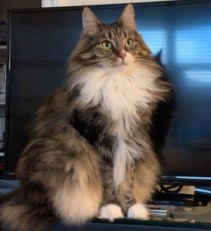
    CatBut what has become evident recently is that most of these genomes were in one way or another incomplete, due typically because there were regions of this or that genome that were resistant to accurate sequencing or come other biologic idiosyncrasy.  The most recent example of this reminder of the complexity of biological organisms is our old friend the domestic cat, which built (as most of the new studies do) on the earlier genomic elucidations.  In this case, the earlier study in question was published in 2014, when an international effort led by Stephen J. O'Brien at the Oceanographic Center, Nova Southeastern University, Ft. Lauderdale, Florida reported the complete genomic sequencing of the domestic cat, Felix catus.  The report, entitled "Annotated features of domestic cat – Felis catus genome," was published in GigaScience 2014, 3:13 (August 5, 2014) (see "Domestic Cat Genome Sequenced").  The study reported sequencing of a female Abyssinian cat named Cinnamon, a mixed-breed cat from Russian named Boris, and Sylvester, a wildcat ancestor of domestic cats.  The report showed that domestic cats have retained "a highly conserved ancestral mammal genome organization" in comparison with ancestral cats (see Driscoll et al., 2007, "The near eastern origin of cat domestication," Science 317: 519–23).  Both species, F. catus and Felix silvestris, have 38 chromosomes, 18 pairs of autosomes, and two pairs of dimorphic gender-determining chromosomes.  Details of the domestic cat genome structure included the presence of 217 loci of endogenous retrovirus-like elements (amounting to 55.7% of the entire genome, comprised of long interspersed elements (LINEs), short interspersed elements (SINEs), satellite DNA, retroviral long terminal repeats (LTRs) and "others"); 21,865 protein coding genes (open reading frames or ORFs), detected by comparison with eight mammalian genomes (from human, chimpanzee, macaque, dog, cow, horse, rat, and mouse); and a wealth of genetic variability in single nucleotide polymorphisms (SNPs), insertion/deletion events (indels); novel families of complex tandem repeat elements; and short terminal repeat (STR) loci.

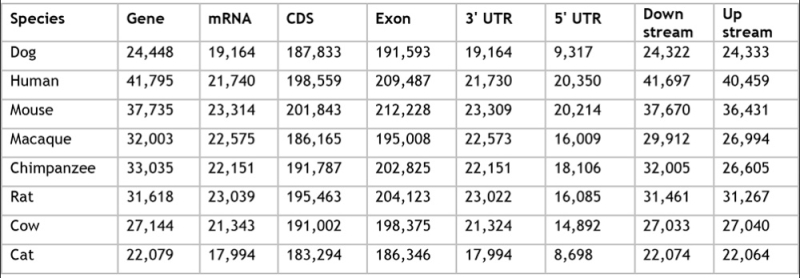
    The report also contained an extensive comparison between domestic cats and other species ("reference genomes") in terms of gene numbers, using genes with the longest mRNA and corresponding coding sequences (click on table to expand).

    Table
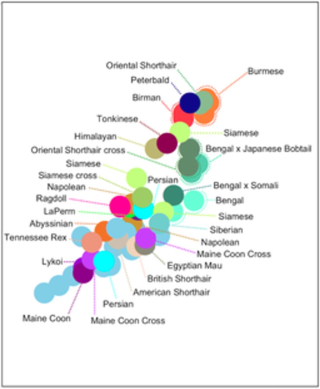
    More recently, further results of applications of improved genomic sequencing methods and technologies have provided a more comprehensive elucidation of the feline genome and insights into genetic bases for disease.  A paper published in the Public Library of Science, entitled "A new domestic cat genome assembly based on long sequence reads empowers feline genomic medicine and identifies a novel gene for dwarfism," PLoS Genetics 16(10): e1008926 on October 20, 2020, reported a revisit of the genomic sequence of Cinnamon, an Abyssinian breed domestic cat previously sequenced.  Rather than focusing on one cat, this group* performed whole genome sequencing (WGC) of 54 domestic cats and aligned the sequences to detect single nucleotide variants (SNVs) and structural variants (SVs).  The distribution and relatedness of the cats in this study is shown in this graphic:

    Image 1
    Their aim was to identify the sequence comprising the ~300,000 gaps in the annotated sequence reported to the Cinnamon Abyssinian, to produce a new reference cat genome denoted in relevant databases as Felis_catus_9.0.  This genome comprised 2.84 gigabasepairs (Gb), of which only 1.8% (1.38 megabasepairs, Mb) was not assigned to a specific chromosomal location.  The sequencing and comparison identified 19,748 genes, 376 of which were novel (i.e., had not been identified in Cinnamon's DNA) and 178 genes found in the original annotations but not found here.  (The authors note the presence of 54 diverse individual cats from which the genes were determined as a possible source of this disparity.)  A greater extent of LINE/L1 repetitive elements were detected, which these researchers attributed to better assembly (i.e., the repetitiveness and gaps did not mask these elements in the latest assembly).  The average number of SNVs detected per cat was 9.6 million (for comparison humans have ~5 million); inbred cats showed a lower number (~8 million) while outbred cats showed a higher number (> 10.5 million).  Of these, researchers detected 128,844 synonymous SNVs in protein-coding sequences (i.e., where the two sequence encoded proteins having the same amino acid sequence), 77,662 missense SNVs (wherein the protein encoded differed in amino acid sequence, including truncated sequences and out-of-frame mutants), and 1,179 loss-of-function (LoF) SNVs.  LoF and missense SNVs were associated with depletion in comparisons between orthologous cat and human DNA sequences, whereas synonymous SNVs were enriched by 19.2%.  Statistical analyses found that in cats and humans there was selection against missense and LoF SNVs in genes under selective pressure (i.e., where the genetic changes resulted in phenotypes deleterious to individuals carrying them).  These results further indicated that these classes of SNVs were not distributed randomly in the cat or human genome.

    Turning to structural variants, these researchers detected an average of 44,900 SVs per cat (a frequency four-fold higher than in humans), comprising 134.3 Mb; of the structural variant types, deletions averaged 905 bp, duplications 7,497 bp, insertions 30 bp, and inversions 10,993 bp.  In total they reported 208,135 SVs detected in 54 sequenced cat genomes, with 123,731 (60%) were deletions, approximately 39,955 insertions, 35,427 inversions, and 9,022 duplications were identified.  The majority of these were common across cat breeds, indicating tolerance. 58.15% of these SVs were intergenic in location, 40.22% intronic, and only 1.06% found in exons, "potentially impacting 217 different protein coding genes.  As the scientists noted:

    Conversely, the proportion of some SV types found in certain gene regions varied from their genome-wide averages.  For example, in regions 5 kb upstream and downstream of genes, duplications were increased approximately two-fold.  For exonic regions, 74% of SVs were deletions, an increase from the genome wide level of 59.45%.  For 5' untranslated regions (UTRs), the majority of SVs were inversions, which only represent 17.02% of total SVs.  These results suggest an interaction between the impact of SV types and the potential function of the gene regions they are found in.

    Sixteen of the identified variants were predicted to cause disease, based on comparisons with human genome sequences known to be sufficiently similar.  These included one involving a tumor suppressor gene FBXW7 associated with feline mediastinal lymphoma, prevalent in Siamese cats and Oriental shorthaired cats.  Other variants detected and their related diseases were in the FAM13B gene, resulting in ectodermal dysplasia (in a random-bred cat); the CYFIP2 gene associated with urate stones (Egyptian mau); and the SH3PXD2A gene, associated with feline infectious peritonitis (random bred cat).

    The genetic roots of dwarfish more complicated according to these researchers, involving "a complex deletion coupled with a nearby potential duplication event" on cat chromosome B1, that disrupted the gene for UDP-glucose-6-dehydrogenase (UGDH).  This trait is inherited as an autosomal dominant mutant and a breed-standard for Munchkins, characterized by shortened limbs and anormal torso.  Here, the scientists report that:

    SV analysis within the critical region previously identified by linkage and GWAS on chromosome B1:170,786,914–175,975,857 revealed a 3.3 kb deletion at position chrB1:174,882,897–174,886,198, overlapping the final exon of UDP-glucose 6-dehydrogenase (UGDH).  Upon manual inspection of this SV, a 49 bp segment from exon 8 appeared to be duplicated and inserted 3.5 kb downstream, replacing the deleted sequence.  This potentially duplicated segment was flanked by a 37 bp sequence at the 5`end and a 20 bp sequence at the 3' end, both of unknown origin.

    (This topography is illustrated in the Figure below.)  The scientists further hypothesized that the known activity of the affected gene, UGDH, which is involved in "proteoglycan synthesis in chondrocytes" could effect this phenotype by interfering with development.  Evidence for this mechanism was observed in the epiphyseal plate, which in Munchkins showed "a disorganized columnar arrangement" and proteoglycan depletion.  They report that sequencing the mRNA produced by the mutant UGDH is yet to be reported, which would perhaps shed light on whether the role of this mutation was as they propose it to be.

    Image 2
    This group published a more recent paper in March 2021, entitled "Ultracontinuous Single Haplotype Genome Assemblies for the Domestic Cat (Felis catus) and Asian Leopard Cat (Prionailurus bengalensis)," in the Journal of Heredity, 112(2): 165–73, providing additional details relating to its analysis of the domestic cat and leopard cat components of the hybrid genome.

    The results reported in these papers illustrated how far we have come and perhaps how far we have to go in using genetic methods for identifying the causes and possible cures for a variety of diseases.

    *Reuben M. Buckley, Brian W. Davis, Wesley A. Brashear, Fabiana H. G. Farias, Kei Kuroki, Tina Graves, LaDeana W. Hillier, Milinn Kremitzki, Gang Li, Rondo P. Middleton, Patrick Minx, Chad Tomlinson, Leslie A. Lyons, William J. Murphy, Wesley C. Warren

  • By Kevin E. Noonan

    Broad InstituteOn May 28th, Junior Party the Broad Institute, Harvard University, and MIT (collectively, "Broad") filed its Substantive Preliminary Motion No. 3 in CRISPR Interference No. 106,126 (where ToolGen is the Senior Party).  This motion, pursuant to 37 C.F.R. §§ 41.121(a)(1)(iii) and 41.208(a)(1) requested that the Board de-designate Broad claims in these five categories as not corresponding to either Count 1 or proposed Count 2 (A-E) or Count 1 (F):

    • Category A: use of vectors for RNA expression;
    • Category B: Staphylococcus aureusCas9 protein ("SaCas9");
    • Category C: Cas9 chimeric CRISPR enzyme;
    • Category D: Cas9 with two or more nuclear localization signals ("NLSs");
    • Category E: Cas9 fused to specified protein domains; and
    • Category F: Claims not limited to single-molecule RNA.

    On August 6th ToolGen filed its Opposition and on September 24th Broad filed its Reply.

    In its Motion, Broad asserted that, should the Board grant its motion and deny Broad Substantive Motion No. 1 to Substitute the Count (see "Broad Files Substantive Preliminary Motion No. 1 in CRISPR Interference"), these of the Broad claims would correspond to Count 1:

    [C]laim 18 of U.S. Patent No. 8,697,359, claims 26-30 of U.S. Patent No. 8,795,965, claims 2 and 5 of U.S. Patent No. 8,906,616, and claim 16 and 27 of U.S. Patent No. 9,840,713 [exhibit references omitted].

    On the other hand, should the Board grant both Broad's Motion No. 3 and Broad's Motion No. 1, these of Broad's claims would remain in the interference as corresponding to Proposed Count 2:

    [C]laims 15-20 of the '359 patent, claims 26-29 of U.S. Patent No. 8,771,945, claims 26-30 of the '965 patent, claims 24-30 of U.S. Patent No. 8,889,356, all claims of the '616 patent, claims 21-28 of U.S. Patent No. 8,945,839, and claims 15-17, 20-24, 26-28, 31-35, and 38-39 of the '713 patent, as well as allowable claims 1, 40, and 41 of Application 15/160,710 and allowable claims 74, 94, and 95 of Application 15/430,260 should the Board also grant Broad's Contingent Substantive Motion No. 2 [see "Broad Files Contingent Preliminary Motion No. 2 in CRISPR Interference"; exhibit references omitted].

    ToolGen's Opposition took each of these categories and Broad's arguments in turn:

    • With regard to claims directed to use of vectors for RNA expression, ToolGen argued that Broad failed to satisfy the relevant standard under 37 C.F.R. § 41.207(b)(2) that either Count 1 as declared or Count 2 as proposed by Broad (see "Broad Files Substantive Preliminary Motion No. 1 in CRISPR Interference") would not have anticipated nor rendered obvious the "vector claims" Broad now asks the Board to de-designate. 

    • Regarding Broad's challenge to claims reciting Staphylococcus aureus Cas9 protein (SaCas9), ToolGen argued that the skilled worker would have been motivated to use it in the eukaryotic CRISPR-Cas system recited in either alterative Count due to its small size (the advantages of CRISPR embodiments using this Cas9 species being recognized in the prior art according to ToolGen) and that the nucleotide sequence encoding it was known in the art.

    • ToolGen also argued that the skilled worker would have been motivated to use SaCas9 in adeno-associated virus (AAV) vectors due to their being "available and commonly used in the art—particularly for 'human therapeutics'" due to their lack of pathology to humans and their capacity for "long-term gene expression."

    • For claims reciting the use of chimeric Cas9 species, ToolGen first argued waiver, based on the paucity of the support ToolGen alleges Broad submitted regarding this argument.

    • ToolGen also argued that a POSA would have been motivated to use chimeric SaCas9 proteins, due to the "vast array of prior-art references disclosing the use and numerous benefits of chimeric proteins."

    • With regard to Broad's arguments involving use of two nuclear localization signals (NLS) to target SaCas9 to the eukaryotic cell nucleus, ToolGen argued the skilled worker would have been motivated to use two or more NLSs with Cas9 to make CRISPR-Cas9 complexes in eukaryotic cells, with a reasonable expectation of success, inter alia because use of NLS sequences was routine in the art prior to the priority date.

    • ToolGen also set forth its arguments in contradiction to Broad's arguments that "Cas9 fused to specified protein domains or including heterologous domains" correspond to either of the alternative Counts, on the basis that Broad had waived this argument and, more substantively, that the skilled worker would have understood Cas9 species joined with one or more NLS to be "fused" (and thus known in the art).

    ToolGen then turned to Broad's arguments that certain of its claims having been designating as corresponding to Count 1 do not recite single-guide RNA (sgRNA) with regard to "three sets of claims":

    (1) those "that do not require an RNA component at all";

    (2) those "that are generic as to the RNA component and do not use the term 'guide RNA'"; and

    (3) those "that are generic as to the RNA component and that use the term 'guide RNA.'"

    ToolGen's argument was that by their own specifications Broad's patents-in-interference rebut this argument, citing in particular U.S. Patent No. 8,697,359 for the teachings that:

    In aspects of the invention the terms "chimeric RNA", "chimeric guide RNA", "guide RNA", "single guide RNA" and "synthetic guide RNA" are used interchangeably and refer to the polynucleotide sequence comprising the guide sequence, the tracr sequence and the tracr mate sequence [emphasis on brief].

    Particularly with regard to claims 15, 17–26, and 28–41 of the '713 patent and claims 1–24 of the '418 patent, ToolGen argued that the species recited in Count 1 anticipates these generic claims under 37 C.F.R. § 41.207(b)(2).

    In its Reply, Broad argues that the methods it set forth in its earliest priority document (the NIH grant proposal) constitute conception of CRISPR species for eukaryotic applications that do not correspond to the Count and should be excluded.  According to Broad's Reply, "ToolGen also does not dispute that Broad could lose its generic RNA claims even if Broad was the first to conceive and reduce to practice the generic RNA invention."  Broad further asserts:

    The response is that, while Broad proffered proof that it was the first to invent the generic RNA invention in connection with Motion 1, it was not necessary to prove that its dual-molecule RNA proofs came before its experiments with single-molecule RNA as in Count 1 at this time.  Unless Motion 1 is granted, if ToolGen successfully attacks Broad's single-molecule RNA proofs, Broad would lose its generic RNA claims even if Broad's dual-molecule RNA experiments were successful and came before ToolGen's single-molecule RNA work [emphasis added].

    Which is of course true.  Notably, however, nowhere in its Reply does Broad does say that it is the case that they had reduced to practice dual-molecule guide RNA CRISPR embodiments in eukaryotic cells prior to the priority dates asserted by ToolGen and granted by the Board in the Interference Declaration herein.  While conception and a description of such embodiments in some instances might be sufficient (i.e., it is not the case that a party in an interference must show actual reduction to practice), Broad itself has argued, extensively, that the complicated nature of performing CRISPR successfully in eukaryotic cells makes this a case for a "simultaneous conception and reduction to practice" standard (at least as applied to CVC or ToolGen; see "Broad Files Priority Motion in CRISPR Interference" and "Broad Files Opposition to ToolGen Substantive Preliminary Motion No. 1").  The Cong et al. reference discloses such successes, and as Broad has previously argued the submission date of this paper antedates ToolGen's earliest priority date in this interference.  That may be enough for the Board to conclude that Broad had an earlier invention date for the dual-molecule guide RNA CRISPR species in eukaryotic cells; the question then would be whether the Board will excise claims to eukaryotic CRISPR generic for guide RNA configuration but that would effectively leave Broad in a position to preclude ToolGen (or CVC) from practicing sgRNA-comprising eukaryotic CRISPR embodiments.  This outcome would be analogous to the outcome of Interference No. 105,048, where CVC was deemed entitled to claims generic as to cell type while Broad was entitled to eukaryotic CRISPR embodiments (see "Regents of the University of California v. Broad Institute, Inc. (Fed. Cir. 2018)").

    Briefing on the parties' Preliminary Motions being completed, the Board will hold a final hearing sometime within the next several months.


  • CalendarOctober 25, 2021 – "Don't End Up Like the Owner of That CRISPR Patent" (Oppedahl Patent Law Firm LLC) – 3:00 to 4:30 pm (Mountain Time)

    October 26, 2021 – "Patent Purgatory: How the USPTO Puts Patent Applications on Hold, and How One Inventor Is Fighting Back" (IPWatchdog and Triangle IP) – 12:00 pm (ET).

    October 27, 2021 – "How Corporations Can Manage IP Budgets to Reduce Unnecessary Spend" (IPWatchdog and Questel) – 11:00 am (ET)

    October 28, 2021 – "Breaking Global Developments (AI, UPC)" (Federal Circuit Bar Association) – 11:00 am to 12:00 pm (ET)

    October 28, 2021 – "The Good, the Bad, and the Ugly: Outlook for the U.S. Patent System" (IPWatchdog and Innovation Alliance) – 1:00 pm (ET)

    November 4-5, 2021 – 65th Annual Intellectual Property Conference (UIC Law Center for Intellectual Property, Information & Technology Law)

    November 9-10, 2021 – Paragraph IV Disputes Conference (American Conference Institute) – 8:00 am until 6:00 pm (EST) on November 9 and 7:50 am until 5:15 pm (EST) on November 10, 2021