• Biotechnology Industry OrganizationThe Biotechnology Innovation Organization IP Counsels Committee will be offering the next installment in its webinar series on January 26, 2022 at 1:00 pm (ET).  In the webinar, entitled "Navigating Parallel BPCIA and PTAB Proceedings – Recent Developments and Strategic Considerations," Matthew A. Pearson and Rachel J. Elsby of Akin Gump will moderate a panel consisting of Paul Golian of Bristol Myers Squibb and Paula Fritsch of Amgen.  The panel will discuss recent developments in BPCIA litigation, PTAB practice, and potential legislative and policy reforms that may be on the horizon, including strategic considerations that influence how to approach the "patent dance" and parallel PTAB proceedings, as well as the impact of Fintiv on parallel proceedings.  The panel will also provide a high-level overview of relevant case law and trends in BPCIA litigation and related PTAB proceedings, followed by a "roundtable" discussion of the factors that may influence litigation strategy, early case resolution, and market entry.

    The webinar is complimentary for BIO members and $99 for non-members.  Those interested in registering for the program, can do so here.

  • IPO #2The Intellectual Property Owners Association (IPO) will offer a one-hour webinar entitled "2021 PTAB Year in Review" on January 27, 2022 from 2:00 pm to 3:00 pm (ET).  Tom Irving, Mark Feldstein, and Joshua Goldberg of Finnegan, Henderson, Farabow, Garrett & Dunner, LLP; Jessica Marks of Unified Patents; and Nichole Valeyko of Merck & Co. will highlight important PTAB decisions from 2021, as well as impacts on PTAB practice from external sources such as the Supreme Court, Federal Circuit, and Congress, and what to watch out for in 2022.

    The registration fee for the webinar is $150 for non-members or free for IPO members (government and academic rates are available upon request).  Those interested in attending the webinar should register here.

  • By Kevin E. Noonan

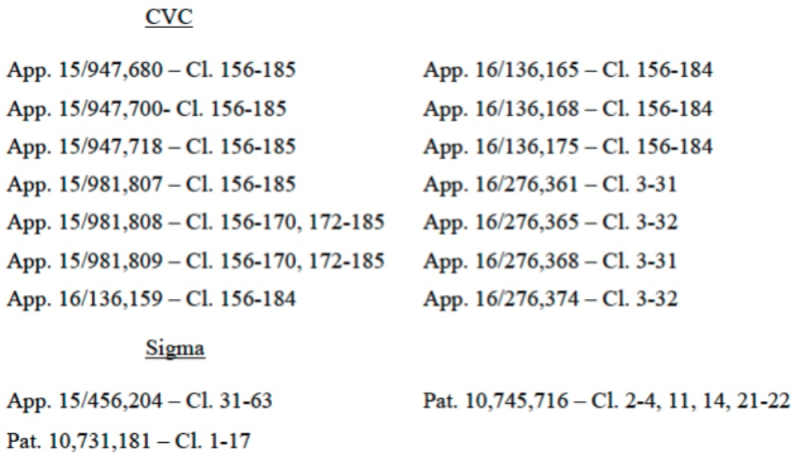
    University of California-BerkleyOn November 19th, Junior Party the University of California, Berkeley; the University of Vienna; and Emmanuelle Charpentier (collectively, "CVC") filed its Substantive Miscellaneous Motion No. 4 in Interference No. 106,132 (which names Sigma-Aldrich as Senior Party), asking the Patent Trial and Appeal Board to add Sigma-Aldrich's U.S. Patent Nos. 10,731,181 and 10,745,716 to the interference and designate claims 1-17 of the '181 patent and claims 2-4, 11, 14, and 21-22 of the '716 patent as corresponding to the Count, pursuant to 37 C.F.R. §§ 41.121(a)(1)(i) and 41.208(a)(2) and Standing Order ("SO") 203.2.  CVC's substantive argument is that these claims would have been obvious over Count 1 and the Jinek 2012 reference (Jinek et al., 2012, "A Programmable Dual-RNA–Guided DNA Endonuclease in Adaptive Bacterial Immunity," Science 337(6096): 816-21) in light of the Krebber 2000 reference (Krebber and Silver, 2000, "Directing Proteins to Nucleus by Fusion to Nuclear Localization Signal Tags," Methods in Enzymology 327: 283-96) or the Lange 2007 reference (Lange, 2007, "Classical Nuclear Localization Signals: Definition, Function, and Interaction with Importin α," J. Biol. Chem. 282(8): 5101–05).

    CVC identifies what it characterizes as "nominal differences" between the Count and the claims to be designated in these two patents as "the recitation of the well-established Cas9 protein (from S. pyogenes), a well-known nuclear localization signal (a C-terminal SV40 NLS), and the natural and previously disclosed location for the DNA-targeting region (at the 5' end of the guide RNA).  None of these differences render these claims patentably distinct from the Count, as evidenced CVC argued by "highly similar claims already being involved in this proceeding as part of Sigma's U.S. Application No. 15/456,204."  These claims satisfy the test set forth under 37 C.F.R. § 41.207(b)(2) and Standing Order ¶ 208.3.1 that claims correspond to the Count where "the subject matter of the count, if treated as prior art, would have anticipated or rendered obvious the subject matter of [each] claim."  This test is satisfied if additional references are relied upon to make out a prima facie case of obviousness CVC argues, citing Desjardins v Wax, Interference No. 105,915, Paper 125, 17-20 (P.T.A.B. Jan. 21, 2014).  The basis for CVC's argument that the distinctions set forth above do not render these clams patentably distinct is that these distinctions are found in the cited prior art or were otherwise "well known for year," the brief the setting forth reasons for the Board to reach this conclusion.  Finally, CVC argues there are no objective indicia (or secondary considerations) that would provide the missing distinctions.

    The brief then explicates with particularity the disclosures in the cited references which in combination with the limitations in the Count satisfy the requirements for obviousness.  These include 1) disclosure of dual-guide (dgRNA) and single-guide (sgRNA) RNA embodiments of CRISPR in the Jinek 2012 reference; and 2) the use of the nuclear localization signal from SV40 T antigen as the "canonical NLS for targeting proteins to the nucleus" in the prior art, citing references in exhibits.  The brief then subjects each of the claims CVC asks the Board to designate as corresponding to the count to the test established by the Supreme Court in Graham v. John Deere and KSR v. Teleflex  Int'l to support its obviousness argument with regard to those claims.

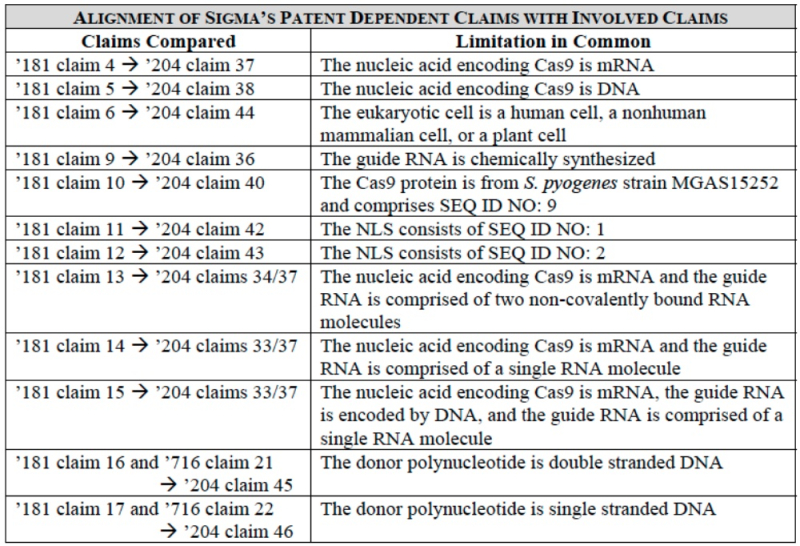
    In addition, the brief sets forth a comparison between the claims CVC asks the Board to designate as corresponding to the Count with Sigma-Aldrich's claims already involved in the interference the inclusion of which the Senior Party has not contested:

    Table
    Finally, CVC argues that it should prevail against Sigma-Aldrich in this interference based on nothing more than the disclosures in U.S. Provisional Application No. 61/652,086, filed May 25, 2012 ("P1"), and U.S. Provisional Application No. 61/716,256, filed October 19, 2012, ("P2"), the benefit of priority to which CVC argued in its Substantive Preliminary Motion No. 1.

  • By Kevin E. Noonan

    University of California-BerkleyOn November 19th, Junior Party the University of California, Berkeley; the University of Vienna; and Emmanuelle Charpentier (collectively, "CVC") filed its Substantive Preliminary Motion No. 3 in Interference No. 106,132 (which names Sigma-Aldrich as Senior Party), asking the Patent Trial and Appeal Board to substitute the Count of the interference pursuant to 37 C.F.R. §§ 41.121(a)(1)(iii) and 41.208(a)(1).

    The present Count is set forth in the alternative either as Claim 156 on CVC's application-in-interference No. 15/981,807 (which claim also has been a portion of the Count in Interference No. 106,127 naming ToolGen as Senior Party) or Claim 31 in Sigma-Aldrich's involved Application No. 15/456,204*:

    31.  (previously presented) A method for modifying a chromosomal sequence in a eukaryotic cell by integrating a donor sequence, the method comprising introducing into the eukaryotic cell:
        (i) a Clustered Regularly Interspersed Short Palindromic Repeats (CRISPR)/CRISPR-associated (Cas) (CRISPR-Cas) type II protein linked to only one nuclear localization signal (NLS) or a nucleic acid encoding the CRISPR-Cas type II protein linked to only one NLS, wherein the CRISPR-Cas type II protein is a Cas9 protein, and the nucleic acid encoding the CRISPR-Cas type II protein is codon optimized for expression in the eukaryotic cell;
        (ii) a guide RNA or DNA encoding the guide RNA, wherein the guide RNA comprises a first region that is complementary to a target site in the chromosomal sequence, which target site in the chromosomal sequence is immediately followed by a protospacer adjacent motif (PAM), and a second region that interacts with the CRISPR-Cas type II protein, and wherein the guide RNA comprises a crRNA and a tracrRNA; and
        (iii) a donor polynucleotide comprising the donor sequence and upstream and downstream sequences;
        wherein the guide RNA guides the CRISPR-Cas type II protein to the target site in the chromosomal sequence, the CRISPR-Cas type II protein introduces a double stranded break at the target site, and repair of the double-stranded break by a DNA homology-directed repair (HOR) process leads to integration or exchange of the donor sequence into the chromosomal sequence.

    In its motion, CVC proposes that this claim be substituted for claim 33, which has the additional limitation that "the guide RNA is a single molecule."  CVC argues that substituting this Count is more symmetrical with CVC's portion of the Count and "avoids inconsistency" with the Counts in related interferences (see "CRISPR Battle Joined Again"; "The CRISPR Chronicles: Enter Toolgen"; and "Sigma-Aldrich Joins the CRISPR Interference Fray").

    This "consistency" CVC seeks is that the Count reflect the limitation that the CRISPR complex recited therein comprise a single-molecule RNA species ("sgRNA") comprising the structural tracrRNA and the sequence-specific crRNA that, in combination with Cas9 protein introduces double-stranded breaks in DNA at specific sites in a target DNA.  CVC notes that this consistent recitation of sgRNA species in Counts of the pending interferences is present whether the claims corresponding to the Count in each interference are limited to sgRNA or encompass "dual-molecule" RNA species (termed "generic-guide" claims).  CVC argues that Sigma-Aldrich's claims are "outliers" in this regard, and that the Board has discretion to substitute the Count under appropriate circumstances (like these, according to CVC), citing Hitzman v. Rutter, 243 F.3d 1345, 1359 (Fed. Cir. 2001), without abusing its discretion.

    In CVC's view, the benefits of substituting the Count as they suggest are "[e]fficiency, uniformity, and clarity" consistent with 37 C.F.R. § 41.1(b), while on the other hand "there are significant negative consequences of proceeding with this Interference if the Sigma side of the count is not conformed to the other pending interferences and continues to recite something other than a single guide system," naming two such negative consequences:

    • First, proceeding with the existing count in this interference invites the parties to submit proofs that are different than those in the co-pending interferences.  The inconsistency between the count in this interference and the co-pending interferences creates the possibility of irreconcilable decisions among interferences that involve the same claims for each party.  Such inconsistency would be prejudicial to any party in CVC's position, and the public.

    • Second, this uncertainty is magnified where the Sigma side of the count is subject to a disputed construction and is, as discussed in detail below, ambiguous as to whether it covers RNAs other than single-guide RNA.  To avoid this ambiguity, the Board should substitute dependent claim 33 because it clearly recites a single-guide RNA molecule.

    The brief explicates the details of these benefits and negative consequences with reference to the co-pending Interferences, their subject matter as defined by their Counts and the claims-in-interference in each, noting in addition that "[t]he PTAB chose to declare multiple, co-pending two-party interferences as an alternative to managing a single, multi-party interference" which would have avoided the possibility of [unnecessary differences in scope across the various counts [that] could lead to inconsistent results and . . . create uncertainty among the parties and the public."

    In addition, CVC argues that the best use of so-called "McKelvey counts" as here is to choose claims from each party's pending or granted claims that are "as balanced and similar in scope as possible" (as, CVC argues, the Board has done in the '115, 126, and 127 interferences).

    CVC argues that "Sigma will suffer no prejudice" by this substitution because its first provisional application (corresponding to the earliest priority date for which the Declaration of Interference gives the benefit of priority and Senior Party status) discloses sgRNA species-comprising CRISPR complexes (as well as dual-molecule species).  Further, substituting this Count does not require the Board to de-designate any of the claims corresponding to the Count contained in the Interference Declaration, nor would substitution prevent the Board from granting (or denying) CVC's Motion No 4 to designate claims in Sigma-Aldrich's U.S. Patent Nos. 10,731,181 and 10,745,716 (arguing separately that these claims correspond to the Count).  Nor would the substitution affect limitations in certain of Sigma-Aldrich's claims (using a codon-optimized nucleic acid to encode Cas9 protein having a nuclear localization sequence, for example), according to CVC.

    The brief sets forth the claims of each party corresponding to Proposed Substitute Count 2 as follows:

    Image
    CVC also notes that it is entitled to priority benefit as set forth in its Preliminary Motion No. 1 setting forth a table of correspondence between the express embodiments set forth in these provisional applications (U.S. Provisional Application 61/652,086 ("P1"), filed May 25, 2012 and, in the alternative, U.S. Provisional Application 61/716,256 ("P2"), filed October 19, 2012) and the limitations recited in Proposed Count 2:

    Table
    as supported by particular disclosure in the specification and drawings as they would be understood by the skilled artisan in view of the teachings of the prior art.

    Finally, pursuant to 37 C.F.R. § 41.208(c)(2), CVC argues that its proposed Substitute Count 2 is patentable over the prior art, inter alia, because it "is narrower than Count 1, and therefore does not raise any issues regarding patentability over the prior art."

  • By Donald Zuhn –-

    FireworksAfter reflecting upon the events of the past twelve months, Patent Docs presents its 15th annual list of top patent stories.  For 2021, we identified nine stories that were covered on Patent Docs last year that we believe had (or are likely to have) a significant impact on patent practitioners and applicants.  On Monday, we counted down stories #9 to #7, and today we count down stories #6 to #4, as we work our way towards the top three stories of 2021.  As with our other lists (2020, 2019, 2018, 2017, 2016, 2015, 2014, 2013, 2012, 2011, 2010, 2009, 2008, and 2007), links to our coverage of these stories (as well as a few links to articles on related topics) have been provided in case you missed the articles the first time around or wish to go back and have another look.  As always, we love to hear from Patent Docs readers, so if you think we left something off the list or disagree with anything we included, please let us know.  In addition, we will be offering a live webinar on the "Top Patent Law Stories of 2021" on January 19, 2022 from 10:00 am to 11:15 am (CT).  Details regarding the webinar, which will focus on a few of the most important stories on this year's list, can be found here.


    6.  Patent Community Living with Subject Matter Eligibility Status Quo Nearly a Decade after Mayo v. Prometheus

    It has been almost a decade since the Supreme Court issued its decision in Mayo v. Prometheus, and in the time that has passed since that decision, the current subject matter eligibility standard has become the status quo with little prospect for change.  Notwithstanding the subject matter status quo, subject matter eligibility once again made our top stories list — as has been the case in seven of the past eight years.  In particular, stories involving subject matter eligibility took the #2 and #3 spots on our list last year after taking the #2 and #5 spots on our 2019 list; the #2 spot on our 2018 list; the #1, #2, and #4 spots on both our 2016 and 2015 lists; the #1 and #2 spots on our 2014 list; and the #1 spot on our 2013 list.

    The year started with Patent Docs authors Kevin Noonan and Michael Borella joining two other Chicago patent attorneys in filing an amicus brief supporting Supreme Court review of the Federal Circuit's decision to invalidate claims of American Axle's U.S. Patent No. 7,774,911 under 35 U.S.C § 101 (our #3 story in 2020 was the Federal Circuit's decision in American Axle & Manufacturing, Inc. v. Neapco Holdings LLC).  In May, the Supreme Court requested the views of the Solicitor General in its consideration of American Axle's certiorari petition, which asks the Court to reverse the Federal Circuit's decision in American Axle.

    And then in June, a divided Federal Circuit panel affirmed a District Court determination that claims directed to a digital camera were invalid under § 101 in Yu v. Apple.  A few months earlier, Senators Thom Tillis (R-NC), Mazie K. Hirono (D-HI), Tom Cotton (R-AR), and Chris Coons (D-DE) wrote to Drew Hirschfeld, current Commissioner of Patents and Acting Director of the U.S. Patent and Trademark Office, asking the USPTO to publish a request for information on the current state of patent eligibility jurisprudence in the United States, evaluate the responses, and provide Congress with a detailed summary of the Office's findings, particularly with regard to how the current jurisprudence has adversely impacted investment and innovation in critical technologies like quantum computing, artificial intelligence, precision medicine, diagnostic methods, and pharmaceutical treatments.  The Senators asked for a response by March 2022, so subject matter eligibility is likely to keep its top stories streak going in 2022.

    For information regarding this and other related topics, please see:

    • "CardioNet, LLC v. InfoBionic, Inc. (Fed. Cir. 2021)," November 16, 2021
    • "On the Nature of Prior Art in the 35 U.S.C. § 101 Inquiry," August 10, 2021
    • "Yu v. Apple (Fed. Cir. 2021)," June 13, 2021
    • "Supreme Court Requests View of Solicitor General in American Axle v. Neapco," May 3, 2021
    • "Could Alice Be Used to Invalidate Diehr? Of Course It Could," April 20, 2021
    • "In re Board of Trustees of the Leland Stanford Junior University (Fed. Cir. 2021)," March 28, 2021
    • "On the Patent Eligibility of Information Processing," March 15, 2021
    • "In re Board of Trustees of the Leland Stanford Junior University (Fed. Cir. 2021)," March 14, 2021
    • "Senators Request USPTO to Provide Information on Subject Matter Eligibility," March 9, 2021
    • "Chicago Patent Attorneys File Supreme Court Amicus Brief in American Axle," February 4, 2021


    5.  Federal Circuit Continues to Develop (and Limit) Section 112

    In 2017, the Federal Circuit's decision in Amgen Inc. v. Sanofi, which brought clarity to how the Court (and U.S. Patent and Trademark Office) should apply the written description requirement in 35 U.S.C. § 112(a) to properly circumscribe the scope of claims to monoclonal antibodies, made it to #11 on our top stories list.  In February, the Federal Circuit took aim at the enablement requirement for antibody claims in Amgen, Inc. v. Sanofi, with similar, scope-limiting results.

    The Federal Circuit followed that decision with several other decisions implicating the written description and enablement requirements, including Bayer Healthcare LLC v. Baxalta Inc. (enablement); Raytheon Technologies Corp. v. General Electric Co. (enablement); Pacific Biosciences of California, Inc. v. Oxford Nanopore Technologies, Inc. (enablement); Juno Therapeutics, Inc. v. Kite Pharma, Inc. (written description); Indivior UK Ltd. v. Dr. Reddy's Laboratories S.A. (written description); and Biogen Int'l GmbH v. Mylan Pharmaceuticals Inc. (written description).  As a result of the Federal Circuit's decision in Juno Therapeutics, the scope of claims relating to antibodies (as well as other chemical species) will likely be limited to a "what you see (i.e., disclose expressly) is what you get (patented)" model, which will no doubt (by reducing valid claim scope) allow copyists to piggyback on others' inventions to make their own competing species of valuable therapeutic agents.

    For information regarding this and other related topics, please see:

    • "Biogen Int'l GmbH v. Mylan Pharmaceuticals Inc. (Fed. Cir. 2021)," December 1, 2021
    • "Indivior UK Ltd. v. Dr. Reddy's Laboratories S.A. (Fed. Cir. 2021)," November 28, 2021
    • "Juno Therapeutics, Inc. v. Kite Pharma, Inc. (Fed. Cir. 2021)," August 26, 2021
    • "Pacific Biosciences of California, Inc. v. Oxford Nanopore Technologies, Inc. (Fed. Cir. 2021)," May 20, 2021
    • "Raytheon Technologies Corp. v. General Electric Co. (Fed. Cir. 2021)," April 18, 2021
    • "Bayer Healthcare LLC v. Baxalta Inc. (Fed. Cir. 2021)," March 8, 2021
    • "Amgen Inc. v. Sanofi (Fed. Cir. 2021)," February 21, 2021


    4.  Supreme Court Reaffirms (But Limits Application of) Assignor Estoppel Doctrine

    In June, a five-justice majority of the Supreme Court reaffirmed the doctrine of assignor estoppel, while at the same time limiting its application, in Minerva Surgical, Inc. v. Hologic, Inc.  Assignor estoppel prohibits an inventor or other owner of rights in a patent from selling that patent to another party, then practicing the invention while attempting to avoid infringement liability by claiming the patent was invalid from the start.  The Minerva majority found that the doctrine was well-established in the law and thus was unwilling to abandon it.  However, consistent with the equitable nature of the doctrine, the Court limited the doctrine to those instances where the assignor could be fairly understood to have warranted (either expressly or implicitly) the validity of the claims that ultimately issued.  Thus, in many circumstances — such as when an inventor assigns rights to a patent application that issues with significantly broader claims — the doctrine will not apply.

    For information regarding this and other related topics, please see:

    • "Minerva Surgical, Inc. v. Hologic, Inc. (2021)," June 30, 2021
    • "Oral Argument in Minerva Surgical Inc. v. Hologic, Inc.," April 25, 2021

  • By Kevin E. Noonan

    On November 19th, Junior Party the University of California, Berkeley; the University of Vienna; and Emmanuelle Charpentier (collectively, "CVC") filed its Substantive Preliminary Motion No. 1 in Interference No. 106,132 (which names Sigma-Aldrich as Senior Party), asking the Patent Trial and Appeal Board for benefit of priority to U.S. Provisional Application No. 61/652,086, filed May 25, 2012 ("P1"), U.S. Provisional Application No. 61/716,256, filed October 19, 2012, ("P2"), and U.S. Provisional Application No. 61/757,640, filed January 28, 2013 ("Provisional 3"), pursuant to 37 C.F.R. §§ 41.121(a)(1)(ii) and 41.208(a)(3) and Standing Order ¶ 208.4.1.  The relationships between the patents and applications in the '132 interference are set forth in this chart (filed in CVC's earlier preliminary motion in Interference No. 106,115):
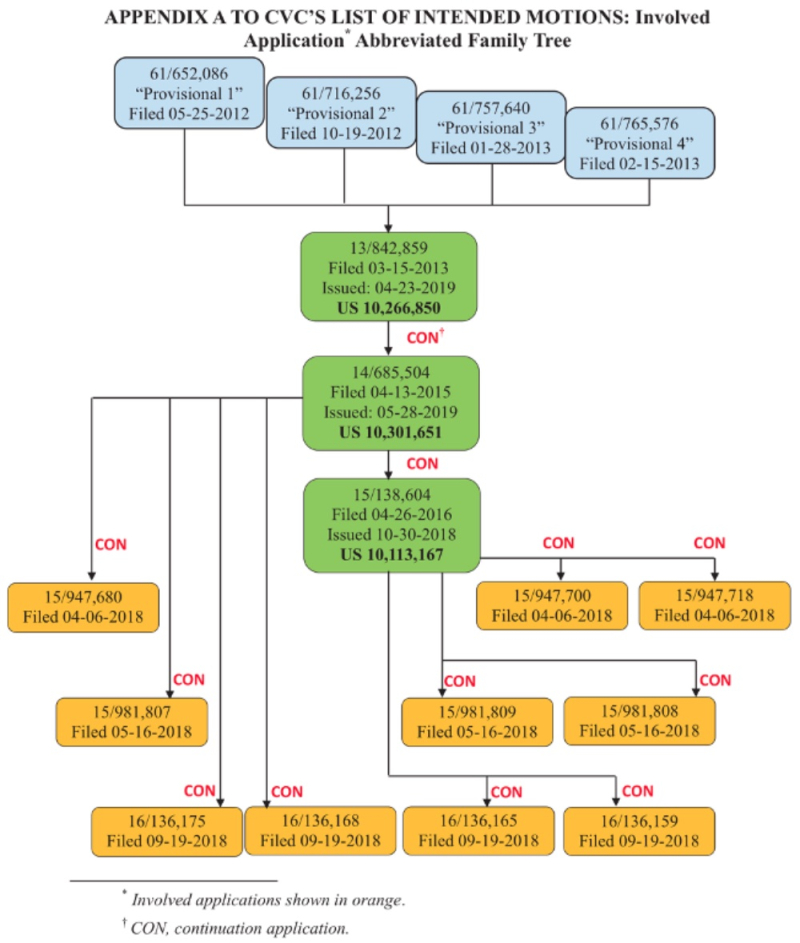
    Image 1
    The significance of the Board granting this motion with regard to the P1 or P2 provisional applications would be that CVC would be Senior Party, with all the presumptions and benefits of Senior Party status.

    CVC has filed similar motions in earlier Interferences (in the '115 Interference and in Interference No. 106,127) without (at least complete) success (as to the '115 Interference; the Board has not yet ruled on the corresponding motion in the '127 Interference).  Benefitting perhaps from these experiences, CVC argues immediately that "CVC invented a eukaryotic cell comprising a single-molecule guide RNA ("sgRNA") CRISPR-Cas9 system capable of cleaving or editing target DNA, as defined by the count" to define the issue, and then gives the Board a basis for coming to a different conclusion here.  Specifically, CVC argues that (as a result of the '115 Interference) it now has additional evidence in support of this motion.  (CVC made a similar argument in the '127 Interference.)

    Before getting to this additional evidence, CVC argues that its inventors' invention of eukaryotic cell CRISPR using a single-molecule guide RNA (sgRNA) is described in each of the three provisional applications.  Reiterating earlier arguments, CVC argues that once this breakthrough had been achieved, adapting CRISPR to eukaryotic cell environment would have been "pretty straightforward" (quoting Dr. Luciano Marraffini, who purportedly informed the Broad inventors of the sgRNA embodiment in June, 2012 (see "CVC Files Motion in Opposition to Broad Priority Motion").  CVC supports this assertion with contemporaneous consistent statements from Rodolphe Barrangou, Erik Sontheimer, Samuel Sternberg, and Dana Carroll, as well as Jennifer Doudna; by the existence of "existing platforms that had already been successfully used with the two incumbent systems: zinc-finger nucleases ("ZFNs") and transcription activator-like effector nucleases ("TALENs")"; and by the successful practice of CRISPR by several groups (including Sigma-Aldrich) "[j]ust months after CVC presented this work" and the absence in the reports from any of these groups of "any 'special' adaptations or conditions needed" to achieve CRISPR gene editing in eukaryotic cells.

    CVC also addresses the PTAB's decision not to grant CVC's patents and applications the benefit of priority to the P1 and P2 provisional applications sought herein in the '115 Interference.  The basis for this decision, according to CVC, was that it was made "without the benefit of the now well-developed evidentiary record."  Specifically, CVC argues that "[t]he prior decision credited assertions that have been seriously undermined by evidence presented during the priority phase of the '115 interference" (because those assertions had been made in the Preliminary Motions phase that preceded the Priority Phase of the '115 Interference).  That record is cured herein, CVC argues, because the motion "presents new evidence and highlights the  specific description in P1 (all of which is carried over to P2) not addressed in the PTAB's prior decision on motions," the focus being on the P1 provisional application because an affirmative decision in this priority document would made CVC the Senior Party.  Part of that evidence is that the P1 provisional "contemplates and teaches that the sgRNA CRISPR-Cas9 system can be microinjected as a pre-assembled ribonucleoprotein ("RNP") complex into embryos, including fish cells ("E1"), which obviates the concerns alleged in the '115 interference" (emphasis in brief).  Why these aspects of the P1 disclosure are significant, CVC explains, is that the concerns raised by Broad regarding eukaryotic CRISPR embodiments ("RNA and protein expression, co-localization, and assembly") are avoided because the CRISPR-Cas9 complex is already formed in vitro prior to being microinjected into the embryo.  RNA degradation would also not have been a concern because it was known that sgRNA was protected from degradation in the complex by the Cas9 protein.  Nuclear localization, another putative concern, is avoided by direct microinjection into the nucleus, nor would chromatin structure impede CRISPR gene editing activity in embryonic cell because eukaryotic DNA adopts an "open conformation" during cell division in embryos, according to CVC.  Finally, the skilled worker would not expect there to be toxicity of CRISPR complex in eukaryotic cells because, according to the brief, microinjection is known to be a "low toxicity" procedure.

    It should be noted that these arguments take advantage of the principle that reduction to practice requires only one embodiment falling within the scope of the claims and this argument does not address introduction of CRISPR-Cas9 components into non-embryonic eukaryotic cells.  Such embodiments are addressed in the separate argument CVC makes with regard to introduction of CRISPR-Cas9 components into human cells using expression vectors; CVC states that "the alleged concerns have been overstated in [this] context."  For example, CVC notes that P1 discloses use of Cas9 from Streptococcus pyogenes, which causes strep throat and thus "flourishes within the same temperature, pH, and ion concentration ranges as most mammalian cells."  Also disclosed in P1 is the use of nuclear localization signals to facilitate proper location within a eukaryotic cell.

    As to the significance of the Board's earlier decision in the '115 Interference, CVC argues that this decision is non-final (that Interference is on-going and the Board's decisions subject to appeal).  In addition, CVC argues that "[t]he PTAB's decision also gave undue weight to certain statements by Doudna, which were misinterpreted as expressing doubt about whether the system would work in eukaryotes."  Somewhat cleverly (because those statements have proven to be compelling before the Board both in the '115 Interference and earlier Interference No. 106,048), CVC argues that they are not relevant evidence, because the extent to which CVC's priority applications disclose at least one operative embodiment within the scope of the Count "is an 'objective' assessment of what is disclosed within the 'four corners' of the specification," viewed "from the perspective of a person of ordinary skill in the art," citing Ariad Pharms., Inc. v. Eli Lilly and Co., 598 F.3d 1336, 1351 (Fed. Cir. 2010) (en banc).  To further provide the Board with evidence contrary to these statements by Inventor Doudha, CVC submits a declaration by Inventor Doudna herself that places the statements in "proper" context according to the brief.  And CVC provides authority for the proposition that an inventor's "acknowledgement of the complexities of the science does not negate the disclosure" in Frazer v. Schlegel, 498 F.3d 1283, 1288-89 (Fed. Cir. 2007), in which an inventor admitted a subjective lack of certainty regarding his invention that the Court held did not "negate or contradict" constructive reduction to practice.  Under these circumstances, CVC argues that the Board must "consider the merits anew" in deciding that CVC is entitled to priority benefit to the P1 and P2 provisional applications.

    The brief sets forth the "new evidence" presented in support of their motion:

    • First, the PTAB's decision on motions in the '115 interference did not address whether direct injection of a pre-assembled RNP complex into an embryo, as contemplated by P1, would trigger the same alleged concerns as embodiments relying on vector expression.

    • Second, the PTAB's decision on motions did not address description in P1 regarding: the analogous nature of ZFNs and TALENs; routine uses of nuclear localization signals and codon selection; and the inventors' appreciation of the dynamic nature of chromatin.

    • Third, the PTAB's decision on motions did not consider evidence that has since come to light that undermines the initial allegations by Broad that P1 fails to disclose necessary "special" instructions and adaptations for applying CRISPR-Cas9 in eukaryotic cells.

    • Fourth, Broad's arguments in the '115 interference relied on a misinterpretation of quotes by Doudna and Carroll.  Testimony from Doudna, Carroll, and others with first-hand knowledge (Marraffini, Sontheimer, Barrangou, Sternberg) is provided here, to inform what people in the field thought and the expectation that CRISPR-Cas9 would work in eukaryotes.

    The brief then applies each of these new items of evidence to the disclosure of the P1 and P2 provisional applications in making CVC's argument that both priority documents satisfy the disclosure requirements for CVC to be entitled to priority benefit.  This argument involves a comparison between eukaryotic CRISPR and successful microinjection of ZFNs and TALENS known in the prior art; that the skilled worker would have considered these systems to be the closest analogous systems to CRISPR-mediated gene editing in eukaryotic cells; that third parties (including inter alia ToolGen) had admitted the similarities between CRISPR-, ZFN-, and TALEN-mediated gene editing in eukaryotic cells; and that the other systems used by the Board as (negative) comparators in the '115 Interference (such as Group II introns, ribozymes, and riboswitches) were not apposite.  Adapting its brief to the current interference CVC notes at appropriate intervals how the disclosures in Sigma-Aldrich's '204 application-in-interference support its arguments with regard the expectations of the skilled worker for eukaryotic CRISPR in view of what was known in the prior art.

    Moreover, CVC asserts once again the evidence that, once sgRNA was disclosed by Doudna et al., several (six) groups used it to achieve successful CRISPR-mediated gene editing in eukaryotes.  The brief sets out relevant details of each of these groups' successes:  for Broad:
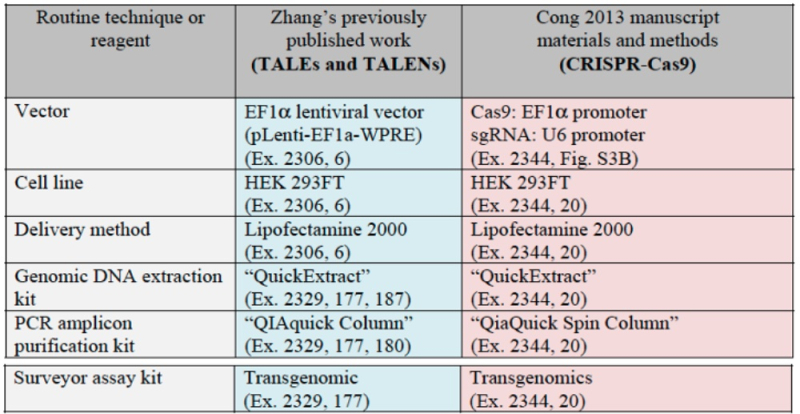
    Table 1
    for ToolGen:

    Table 2
    for Harvard:

    Table 3
    and for Sigma:

    Table 4
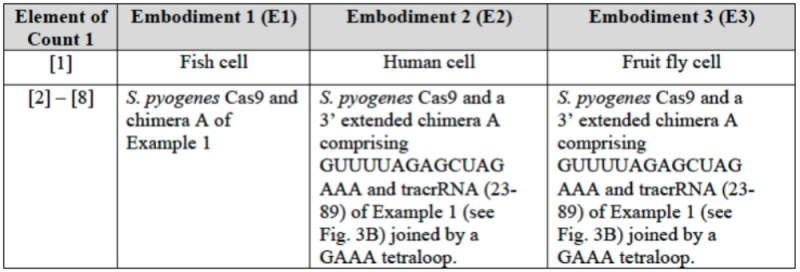
    The brief also sets forth in detail the correspondence between the elements of the Count in the Interference and the disclosure in the P1 (and P2) references for each of these embodiments (E1, E2, and E3):

    Table 5
    wherein CVC asserts (as it did in the '115 Interference; see "Berkeley Files Substantive Motion No. 2 to be Accorded Benefit to Earlier Priority Application in Interference" and '127 Interference, see "CVC Substantive Preliminary Motion No. 1 for Priority Benefit") the three embodiments CVC contends fall within the scope of the Count (designated E1 for introduction into fish embryos; E2 for introduction into human cells; and E3 for introduction into fruit fly cells) and that the P1 (and P2) provisional applications thus disclose constructive reduction to practice of CRISPR-Cas9 gene editing in eukaryotic cells.  The brief illustrates disclosure in its P1 provisional application of the sgRNA embodiments that form the basis for its priority claim:

    Image 2
    and sets forth element-by-element its arguments that these disclosures satisfy Count with express citation to the P1 specification.  CVC further sets forth enablement of each CRISPR aspect relied upon in its argument (RNP complexes, microinjection methods) and satisfaction of the factors recited in In re Wands (amount of guidance provided, presence of working examples, state of knowledge and level of skill in the art, predictability) regarding these elements.  CVC also sets forth examples of third parties using similar embodiments of their CRISPR technology published after the filing date (May 25, 2012) of the P1 provisional application:

    Table 6
    The brief also addresses the "concerns alleged in the '115 interference" and attempts to allay them for the Board, enumerating protection in the CRISPR complex from RNA degradation; co-localization of the components of the CRISPR-Cas9 complex; cellular conditions; nuclear localization; codon optimization; and the effects of chromatin structure and toxicity, none of which are relevant, as CVC argues, for eukaryotic CRISPR-Cas9 embodiments using microinjection of in vitro assembled CRISPR-Cas9 complexes.  These concerns are allayed in the brief specifically with respect to fish cell and human cell CRISPR embodiments.

    CVC's brief also argues that the disclosure in P1 satisfies the additional limitations in "Sigma's half of the count," i.e., embodiments comprising the step of both cleaving a DNA molecule and then integrating a donor sequence.  This is done in part by asserting that the same cellular repair enzymes that effect the insertion processes using TALEN and ZFN would be expected by the skilled worker to achieve insertion into CRISPR-mediated cleavage sites.

    Similar explication and explanation is provided in the brief for the E2 embodiment introducing CRISPR-Cas9 into human cells using an expression vector are set forth in CVC's brief; in this regard the brief similarly addresses the "concerns" asserted against the P1 and P2 provisional applications in the '115 Interference, while at the same time discounting these concerns as "(i) . . . not [being] recited elements of the count and (ii) . . . not [being] required for practicing an embodiment within the scope of the count."  Much of these arguments rely on what the person of ordinary skill in the art would have understood at the time, such as using strong promoters to produce effective amounts of the sgRNA and Cas9 protein; using NLSs to increase nuclear localization likelihood; using S. pyogenes-derived Cas9 that purportedly "flourish" under eukaryotic cellular conditions; and that the P1 (and P2) disclosure recognize that chromatin structure is sufficiently "dynamic" for the CRISPR-Cas9 complex to gain access to portions of the genome targeted by the sgRNA for CRISPR-mediated gene editing to be achieved.

    CVC argues in the alternative that should the Board find wanting its disclosure evidence in the P1 provisional application, the P2 application contains additional disclosure that satisfies the requirements for constructive reduction to practice of at least one embodiment of the invention falling within the scope of the interference Count.

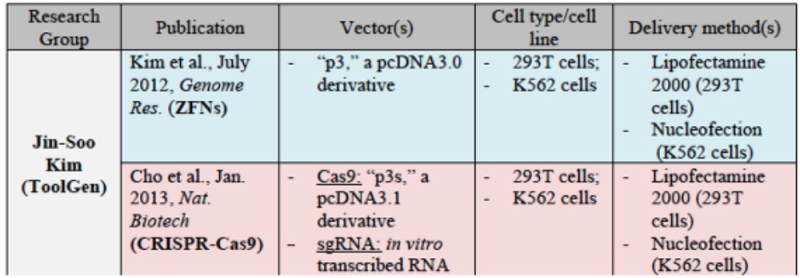
    And CVC sets forth in its brief a particular explication of enablement for what is termed "the human cell embodiment" in the P1 provisional application, and also with examples of post-filing evidence both by CVC's inventors and third parties, including ToolGen's inventors (Kim) as illustrated by:

    Image 3
    In a separate section, prefaced by the assertion that it is "not required," CVC sets forth statements contemporaneous with the P1 and P2 provisional application filing dates that eukaryotic embodiments of CRISPR using sgRNA were expected to be operative in eukaryotic cells.  These statements were made, according to CVC, by Luciano Marraffini; Erik Sontheimer; Rodolphe Barrangou (wherein each of the foregoing were present and heard Jennifer Doudna's disclosure of sgRNA CRISPR embodiments at the Fifth Annual CRISPR Research Conference held at Berkeley in June of 2012); Dana Carroll, editor of a review article on CRISPR; Samuel Sternberg (a graduate student in the Doudna laboratory); and Jennifer Doudna herself (offering the "context" CVC intends to use to rebut Broad's negative interpretations of her statements regarding prospects for eukaryotic CRISPR embodiments).

    Finally, CVC sets out the continuous priority chain from the P1 provisional application through the applications and patents at issue in this interference, as set forth in the diagram above.  CVC concludes its brief by asserting that the Board's decision denying priority on similar arguments in the '115 Interference does not preclude the Board from arriving at a contrary conclusion in this interference inter alia because the Board's decision on the '115 interference is not final and remains subject to appeal.

  • By Donald Zuhn –-

    FireworksAfter reflecting upon the events of the past twelve months, Patent Docs presents its 15th annual list of top patent stories.  For 2021, we identified nine stories that were covered on Patent Docs last year that we believe had (or are likely to have) a significant impact on patent practitioners and applicants.  Today, we count down stories #9 to #7, and later this week we will count down the top six stories of 2021.  As with our other lists (2020, 2019, 2018, 2017, 2016, 2015, 2014, 2013, 2012, 2011, 2010, 2009, 2008, and 2007), links to our coverage of these stories (as well as a few links to articles on related topics) have been provided in case you missed the articles the first time around or wish to go back and have another look.  As always, we love to hear from Patent Docs readers, so if you think we left something off the list or disagree with anything we included, please let us know.  In addition, we will be offering a live webinar on the "Top Patent Law Stories of 2021" on January 19, 2022 from 10:00 am to 11:15 am (CT).  Details regarding the webinar, which will focus on a few of the most important stories on this year's list, can be found here.

    9.  FDA Approves First Interchangeable Biosimilars

    In August, the U.S. Food and Drug Administration approved an interchangeable biosimilar to insulin glargine, an approval that was notable because it was the first approved interchangeable biosimilar product under the Biological Price Competition and Innovation Act of 2009 (BPCIA), enacted with the Affordable Care Act (commonly known as "Obamacare").  The approved interchangeable product is Semglee (insulin glargine-yfgn), produced by Mylan Pharmaceuticals, Inc., and under this approval, it is interchangeable with Lantus (insulin glargine) made by Sanofi.  While there has been some concern with the perceived slow pace of biosimilar uptake by physicians and patients, one of the benefits of interchangeability is that physicians' input (and approval) is not needed and can be implemented at the pharmacy level.  The approval of Semglee was followed by the approval a few weeks later of the interchangeable biosimilar drug Cyltezo (adalimumab-adbm), which is produced by Boehringer Ingelheim.  Whether a dam-burst of interchangeable biosimilar drug products will now arise remains to be seen.

    For information regarding this and other related topics, please see:

    • "FDA Issues Final and Draft Guidances on Biosimilar Development under BPCIA," November 7, 2021
    • "FDA Approves Another Interchangeable Biosimilar Drug," October 21, 2021
    • "FDA Approves Biosimilar Drug for Treating Macular Degeneration," September 20, 2021
    • "FDA Approves First Interchangeable Biological Product," August 5, 2021

    8.  CRISPR Interference(s) Move Forward

    Six years ago, the journal Science picked the CRISPR (clustered regularly interspaced short palindromic repeats) technology as its "Breakthrough of the Year," declaring that the technology had "matured into a molecular marvel."  Not surprisingly, CRISPR's status as breakthrough molecular marvel has resulted in a battle over who has the best patent position with respect to this technology.  And despite the continuing pandemic, Interference No. 106,115 between the Broad Institute, Harvard University, and the Massachusetts Institute of Technology (as Senior Party) and the University of California/Berkeley, the University of Vienna, and Emmanuelle Charpentier (as Junior Party) continued to move forward in 2021 with the two Parties presenting various motions and oppositions to those motions.

    Meanwhile, in February the U.S. Patent and Trademark Office Patent Trial and Appeal Board declared two additional interferences between Toolgen as Senior Party and the parties in Interference No. 106,115 as Junior Parties.  And then in June the Board declared two more interferences naming Sigma-Aldrich as Senior Party and the parties in Interference No. 106,115 as Junior Parties.  CRISPR interferences have now made four of our last five top stories lists, and with five pending interferences, the dispute over the protection of this technology could very well be on next year's list as well.

    For information regarding this and other related topics, please see:

    • "PTAB Sets Motions and Times in CVC vs. Sigma Interference No. 106,132," December 28, 2021
    • "PTAB Sets Motions and Times in Broad vs. Sigma Interference No. 106,133," December 26, 2021
    • "Sigma-Aldrich and CVC Propose Preliminary Motions in CRISPR Interference No. 106,132," December 19, 2021
    • "Sigma-Aldrich and Broad Propose Preliminary Motions in Recent CRISPR Interference No. 106,133," December 15, 2021
    • "Sigma-Aldrich Joins the CRISPR Interference Fray," December 13, 2021
    • "Inequitable Conduct by Senior Party Broad Alleged in Interference No. 106,115 (and PTAB May Finally Hear Evidence About It)," December 6, 2021
    • "SNIPR Technologies Ltd. v. The Rockefeller University (PTAB 2021)," December 6, 2021
    • "ToolGen Files Motion to Exclude Evidence, Broad Opposes, and ToolGen Replies in Interference No. 106,126," November 23, 2021
    • "ToolGen Files Motion to Exclude Evidence, CVC Opposes, and ToolGen Replies in Interference No. 106,127," November 21, 2021
    • "CVC Files Motion to Exclude Evidence, ToolGen Opposes, and CVC Replies in Interference No. 106,126," November 18, 2021
    • "Broad Files Reply to ToolGen Opposition to Broad Preliminary Motion No. 1," November 1, 2021
    • "Broad Files Reply to ToolGen's Opposition to Broad's Preliminary Motion No. 3," October 24, 2021
    • "CVC Files Reply to ToolGen's Opposition to CVC's Substantive Preliminary Motion No. 2," October 20, 2021
    • "Broad Files Reply to ToolGen Opposition to Broad's Contingent Preliminary Motion No. 2," October 18, 2021
    • "ToolGen Reply to Broad Opposition to ToolGen Preliminary Motion No. 1," October 12, 2021
    • "CVC Files Reply to ToolGen's Opposition to CVC Preliminary Motion No. 3," October 3, 2021
    • "CVC Files Reply to ToolGen's Opposition to CVC's Responsive Motion No. 1," September 29, 2021
    • "CVC Files Reply to ToolGen Opposition to CVC Preliminary Motion No. 1," September 26, 2021
    • "ToolGen Files Reply Brief to CVC's Opposition to its Substantive Preliminary Motion No. 2," September 22, 2021
    • "ToolGen Files Reply to CVC Opposition to ToolGen Substantive Motion No. 1," September 21, 2021
    • "CVC Files Opposition to ToolGen Substantive Motion No. 1," September 19, 2021
    • "ToolGen Files Opposition to Broad Contingent Preliminary Motion No. 2 to Add Claims Corresponding to the Count," September 15, 2021
    • "ToolGen Files Opposition to Broad Preliminary Motion No. 3 to De-Designate Claims as Corresponding to Either Interference Count," September 14, 2021
    • "ToolGen Files Opposition to Broad Preliminary Motion No. 1 to Change Interference Count," September 9, 2021
    • "Broad Files Opposition to ToolGen Substantive Preliminary Motion No. 1," September 7, 2021
    • "ToolGen Files Opposition to CVC Contingent Responsive Preliminary Motion No. 1," September 1, 2021
    • "ToolGen Files Opposition to CVC Substantive Preliminary Motion No. 3 to Add Claims in ToolGen Patent," August 31, 2021
    • "ToolGen Files Opposition to CVC Substantive Preliminary Motion No. 2 to Deny Priority Benefit," August 24, 2021
    • "ToolGen Files Opposition to CVC Substantive Preliminary Motion No. 1 for Priority Benefit," August 17, 2021
    • "CVC Files Opposition to ToolGen's Substantive Preliminary Motion No. 2," August 15, 2021
    • "Broad Files Substantive Preliminary Motion No. 3 in CRISPR Interference," August 11, 2021
    • "Broad Files Cont
    ingent Preliminary Motion No. 2 in CRISPR Interference
    ," August 8, 2021
    • "Broad Files Substantive Preliminary Motion No. 1 in CRISPR Interference," August 2, 2021
    • "PTAB Denies Two CVC Requests Regarding Motions," July 27, 2021
    • "CVC Files Responsive Preliminary Motion No. 1 Contingent on Grant of ToolGen Substantive Preliminary Motion No. 2," July 11, 2021
    • "CVC Substantive Preliminary Motion No. 3 To Add Claims in ToolGen Patent," July 8, 2021
    • "News from Abroad: European CVC CRISPR Patent Revoked Because of Invalid Priority Claim," July 6, 2021
    • "CVC Substantive Preliminary Motion No. 2 to Deny Priority Benefit," July 4, 2021
    • "CVC Substantive Preliminary Motion No. 1 for Priority Benefit," June 29, 2021
    • "ToolGen Files Substantive Preliminary Motion No. 2 to Deny CVC of Priority Benefit," June 27, 2021
    • "Meanwhile . . . ToolGen Files Substantive Motion No. 1 in Interference with CVC," June 22, 2021
    • "CVC Opposes Broad's Motion to Exclude Evidence and Broad Files Reply," June 17, 2021
    • "Broad Opposes CVC's Motion to Exclude Evidence and CVC Files Reply," June 15, 2021
    • "CRISPR Interference Parties File Motions to Exclude Evidence and for Oral Hearing," June 9, 2021
    • "Broad Files Reply to CVC's Opposition to Broad's Priority Motion," June 6, 2021
    • "Broad Files Reply to CVC's Opposition to Broad's Contingent Motion to Correct Inventorship," June 1, 2021
    • "CVC Files Reply to Broad's Opposition to CVC Motion for Misjoinder of Inventorship under 35 U.S.C. § 102(f)," May 27, 2021
    • "CVC Files Reply to Broad's Opposition to CVC's Priority Motion," May 25, 2021
    • "ToolGen Files Proposed Protective Orders in CRISPR Interferences," April 14, 2021
    • "CVC Files Motion Opposing Broad Motion to Correct Inventorship," April 11, 2021
    • "Broad Files Motion Opposing CVC Motion for Misjoinder of Inventorship under 35 U.S.C. § 102(f)," April 7, 2021
    • "CVC Files Motion in Opposition to Broad Priority Motion," April 6, 2021
    • "Broad Files Motion in Opposition to CVC Priority Motion," April 4, 2021
    • "Time Periods in Toolgen Interferences Extended by Party Stipulation," April 1, 2021
    • "CRISPR Chronicles Continue," March 16, 2021
    • "PTAB Sets Preliminary Motions in Broad v. ToolGen Interference," March 10, 2021
    • "PTAB Sets Preliminary Motions in CVC v. ToolGen Interference," March 4, 2021
    • "The Toolgen Interference: Broad Preliminary Motions List," February 14, 2021
    • "The Toolgen Interference: Preliminary Motions Lists," February 10, 2021
    • "The Toolgen Interference: CVC Preliminary Motions List," February 7, 2021
    • "The CRISPR Chronicles: Enter Toolgen," February 3, 2021
    • "PTAB Grants CVC Motion for Marraffini Deposition," January 27, 2021
    • "Separate Interferences Declared between Toolgen and Broad and CVC over CRISPR Priority Question," January 13, 2021
    • "CVC Files Reply to Broad's Opposition to CVC's Miscellaneous Motion No. 6; Board Issues Orders," January 10, 2021

    7.  Congress Discussing Proposals to Change U.S. Patent System

    In November, Representatives Thomas Massie (R-KY), Louie Gohmert (R-TX), Paul Gosar (R-AZ), and Tom McClintock (R-CA) introduced the "Restoring America's Leadership in Innovation Act of 2021" (H.R. 5874).  The bill recites Congress' findings that the Leahy-Smith America Invents Act (along with "several decisions by the Supreme Court") have harmed the progress of Science and the useful Arts by eroding the strength and value of the patent system, and proposes to rectify the situation by restoring the U.S. patent system to be one that awards a patent to the "first to invent," complete with the one-year grace period and having the same definitions of the terms "in public use" and "on sale in this country" as they had before enactment of the AIA.  The bill would also abolish the inter partes and post-grant review provisions of the AIA and the Patent Trial and Appeal Board and resurrect interferences.  In addition, the bill would abrogate the Supreme Court's recent jurisprudence regarding subject matter eligibility and revise 35 U.S.C. § 101, restore 35 U.S.C. § 102 (for the most part) to its pre-AIA contours, and end the automatic publication of pending U.S. patent applications.

    Although we referred to passage of H.R. 5874 as a "pleasant fantasy," Senators Thom Tillis (R-NC) and Tom Cotton (R-AR) in March made a more reasonable request of Drew Hirshfeld, the Commissioner for Patents at the U.S. Patent and Trademark Office, to conduct a pilot program on a sequenced approach to patent examination, in which applications are first examined for compliance with 35 U.S.C. §§ 102, 103, and 112, and then for compliance with 35 U.S.C. § 101.  The Senators sugested that a sequenced approach to patent examination could "avoid unnecessary and inefficient rejections on grounds of patent eligibility."  Last week, the Patent Office announced that the Deferred Subject Matter Eligibility Response (DSMER) Pilot Program would launch on February 1, 2022 (see "USPTO Announces Deferred Subject Matter Eligibility Response Pilot Program").

    For information regarding this and other related topics, please see:

    • "Congressional Republicans Propose to Abolish America Invents Act (and a Bit More)," November 10, 2021
    • "Senate Passes the Endless Frontier Act," June 21, 2021
    • "Senators Ask President to Prioritize Appointment of IP Officials," April 13, 2021
    • "Senators Tillis and Cotton Propose Sequenced Examination Approach," March 24, 2021

  • By Michael Borella

    USPTO SealOn January 6, 2022, the U.S. Patent and Trademark Office announced a new program with the goal of increasing examiner efficiency.  The Deferred Subject Matter Eligibility Response (DSMER) Pilot Program will launch on February 1, 2022 and end on July 30, 2022, unless extended.[1]  The Program allows applicants to, in certain circumstances, not include a substantive reply to a 35 U.S.C. § 101 rejection in an Office action response.  The USPTO initiated the Program at the suggestion of Senators Thom Tillis and Tom Cotton (see "Senators Tillis and Cotton Propose Sequenced Examination Approach").

    In order for an application to quality for the Program, it must meet the following requirements:

    • Assignment to a participating examiner.  All primary examiners can participate in the Program, but participation is not mandatory.

    • Be of the proper application type and status.  All original non-provisional utility applications (including those in national stage) that do not claim priority to an earlier non-provisional application are candidates.  These applications may claim priority to an earlier effective priority date than their own, such as to a U.S. provisional or a PCT application.  Further, candidate applications cannot also participate in expedited prosecution programs (e.g., Track 1), though expedited after-final program (e.g., AFCP2.0 and QPIDS) participation is allowed.

    • The claims are subject to rejection on the basis of both subject matter eligibility (35 U.S.C § 101) and one or more additional conditions for patentability (e.g., 35 U.S.C. §§ 102, 103, and/or 112, utility, inventorship, or double patenting).  No one claim needs to be rejected under both § 101 and any of these other grounds.  Further, both types of § 101 rejections qualify — claims that fail to be of one of the four statutory categories as well as those that are directed to a judicial exception without reciting significantly more than that exception.

    A qualifying application will be identified in the first Office action on the merits (restriction or election requirements are not considered first actions on the merits), thus limiting the program to otherwise unexamined applications.  In this Office action, the examiner will invite the applicant to participate in the Program.  If the applicant agrees to participate, it must electronically file a form PTO/SB/456 concurrently with a timely response to the Office action.[2]  If the applicant does not file the form, the application will not be in the Program and normal prosecution will continue.  While participation in the Program cannot be withdrawn, the applicant may at any time choose not to avail itself of the Program's provisions (i.e., the applicant can file a substantive reply to a § 101 rejection if desired).

    For a participating application, the applicant may file a response that defers "presenting arguments, evidence, or amendments in response to the SME rejection(s) until the earlier of final disposition of the participating application or the withdrawal or obviation of all other outstanding rejections."  But, the applicant must respond to all other objections and rejections in the Office action.  In other words, if the claims are rejected on the grounds of subject matter eligibility and obviousness, the applicant must respond to the obviousness rejections and can choose whether to respond to the eligibility rejections.

    The "final disposition" above is when the earliest of any of the following events occurs: (i) mailing of a notice of allowance, (ii) mailing of a final Office action, (iii) filing of a notice of appeal, (iv) filing of an RCE, or (v) abandonment of the application.[3]  In the case that the applicant receives a subsequent non-final Office action in which only the § 101 rejection remains, the applicant must respond to this rejection even though the application has not reached a final disposition.

    Further, the applicant's deferral of § 101 responses can be on a rejection-by-rejection basis.[4]  For instance, if an Office action contains two different § 101 rejections, the applicant may defer one, the other, or both.  The USPTO also contemplates removing an application from the Program in certain rare situations, such as when a participating examiner resigns or retires and the application is not reassigned to another participating examiner.

    Even when § 101 issues are deferred by the applicant, the examiner must consider whether the applicant's responses made to address other rejections (e.g., claim amendments in response to obviousness rejections) overcome the § 101 rejections.  Additionally, § 101 issues can be made of record in interview summaries, should these issues be discussed by the examiner and the applicant's representative, as well as in an examiner's reasons for allowance.

    On paper, the Program appears to be a positive step forward, albeit a small one.  With very few exceptions, the Program only applies when an application qualifies and the applicant is responding to a first action on the merits.[5]  Nonetheless, it does simplify the response process for the applicant (in some cases, responding to a § 101 rejection atop responding to a prior art rejection can double the amount of time and cost of preparing the response).

    Moreover, many attorneys and agents have already adopted the practice of focusing on prior art rejections over § 101 rejections until the former are overcome.  This is because for §§ 102 and 103 rejections, whether the applicant should make claim amendments is usually more cut and dry than for § 101 rejections.  And, if amendments are made to overcome prior art, then this narrowing may also place the claims in a more favorable light with respect to § 101.

    The USPTO is inviting comments on the Program until March 7, 2022.

    [1] The USPTO really needs to work on its acronyms.  DSMER?  It had the opportunity to go with the "Subject Matter Eligibility Laying Low (SMELL) Pilot Program" . . . but no.

    [2] The announcement states that the "form must be signed, in accordance with 37 CFR 1.33(b), by a person having the authority to prosecute the application."  This implies that a power of attorney from the applicant to the attorney or agent should not be required for this form to be effective. 

    [3] In the case of revival of an abandoned application with pending § 101 rejections, the applicant must include a response to these rejections even if the application was in the Program.

    [4] It is not clear whether the applicant can choose to defer § 101 rejections on a claim-by-claim basis.

    [5] It would be interesting to know whether the USPTO considered opening the program to post-RCE non-final Office actions, and if so, why applications with such a status do not qualify. 

  • By Kevin E. Noonan

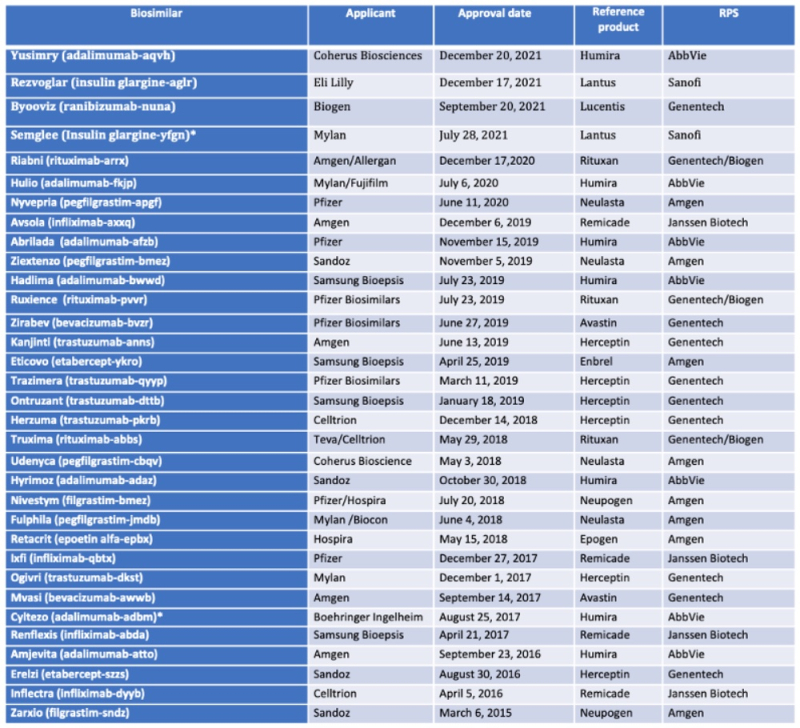
    FDAThe U.S. Food and Drug Administration approved four biosimilar drugs in 2021 under the provisions of the Biologics Price Competition and Innovation Act (BPCIA, codified at 42 U.S.C. § 262) as part of the Affordable Care Act of 2010 (colloquially known as "Obamacare").  This brings to 33 the total number of approved biosimilars, although the effects of the pandemic has been felt in the last two years.  From 2015 (when there was only a single approved biosimilar, Sandoz’s Zarxio®, see chart below), the rate of approvals rose every year (3 in 2016, 5 in 2017, 7 in 2018, and 10 in 2019), but 2020 saw only 3 approvals.  The roster of approved drugs is in this table:

    Table 1
    One bright spot in the approval trend is denoted by asterisks in the table, where this year, the FDA approved the first interchangeable biosimilar, Mylan Pharmaceutical’s Semglee® (insulin glargine-yfgn) followed by the FDA granting interchangeability to an earlier-approved biosimilar drug, Cyltezo® (adalimumab-adbm), produced by Boehringer Ingelheim.  The two most recent approvals include Eli Lilly & Co.'s Rezvoglar®, an injectable insulin glargine and the Coherus Bioscience's Yusimry®, a Humira® biosimilar.

    In contrast, the FDA approved fifty new drugs in 2021, including New Molecular Entities (NME) and biologic products regulated under the FDA's Center for Drug Evaluation and Research (CDER), as well as thirteen approvals for vaccines, allergenic products, blood and blood products, plasma derivatives, cellular and gene therapy products approved by FDA's Center for Biologics Evaluation and Research (CBER).

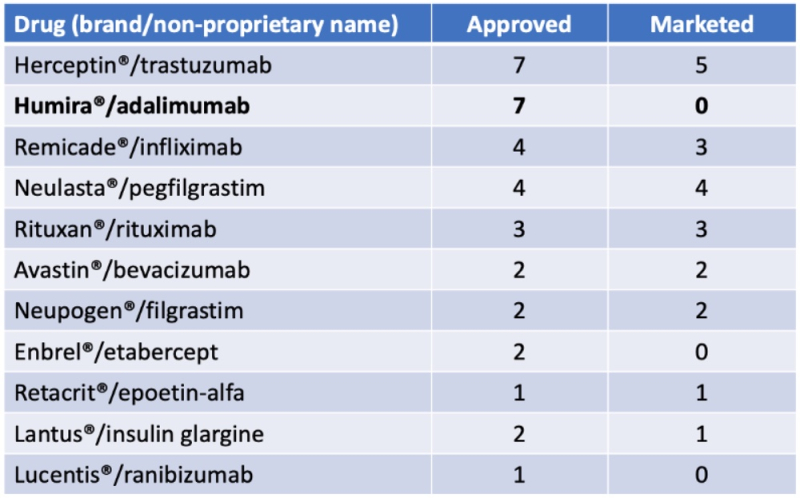
    While encouraging, only one of these products, Semglee®, is yet on the market, and Byooviz®, approved earlier this year, will not enter the market place until June 2022.  These occurrences exacerbate a trend set forth in the following table:

    Table 2
    As this table shows, almost one third of approved biosimilar products are not yet on the market and the ones that are cluster among seven reference products.  There are many reasons for these delays, some relating to disputes arising under the BPCIA involving patent litigation.  While legislators (see "Senators Ask FTC to Investigate Biosimilar Litigation Settlement Agreement") and legislation (see "A Solution in Search of a Problem") concerning the relatively slow pace of approval (and the pandemic hasn't helped) it is most likely the case simply that the complexity of the process, patient and physician resistance to change, and other factors are responsible and can be expect to ameliorate over time.

  • By Kevin E. Noonan

    Federal Circuit SealWhen does the absence of evidence turn into evidence of absence, and when does such absence amount to an adequate written description of the absence of a step of a method claim?  This is a question that comes readily to mind when reading the Federal Circuit's opinion (and Chief Judge Moore's dissent) in Novartis Pharmaceuticals Corp. v. Accord Healthcare, Inc. (Fed. Cir. 2022).

    The case arose in ANDA litigation over U.S. Patent No. 9,187,405, which recites methods for treating recurring remitting multiple sclerosis (RRMS), a degenerative disorder of the myelin surrounding nervous tissue, with fingolimod (2-amino-2-[2-(4-octylphenyl)ethyl]propane-1,3-diol) sold by Novartis under the brand name Gilenya®.  Claim 1 was included in the opinion as representative:

    A method for reducing or preventing or alleviating relapses in Relapsing-Remitting multiple sclerosis in a subject in need thereof, comprising orally administering to said subject 2-amino-2-[2-(4-octylphenyl)ethyl]propane-1,3-diol, in free form or in a pharmaceutically acceptable salt form, at a daily dosage of 0.5 mg, absent an immediately preceding loading dose regimen.

    The italicized limitation in this claim was the focus of the appeal, the Court's opinion, and Chief Judge Moore's dissent.  As set forth therein, the practice in the prior art had been (for drugs having a necessary therapeutic threshold) to administer a "loading dose," defined as "a higher-than-therapeutic level dose, usually given . . . as the first dose in order to get therapeutic levels up quickly" by undisputed expert testimony.  Similarly undisputed was that loading dose regimens had been used in the prior art for treating multiple sclerosis (MS).  Defendant HEC Pharm Co. Ltd. (the only remaining defendant at trial from more than two dozen generic drug makers and ANDA filers sued by Novartis under 35 U.S.C. § 271(e)(2)) maintained that the '405 patent was invalid because its specification and its priority British patent application filed eight years before did not provide an adequate written description of an invention comprising the "absent an immediately preceding loading dose regimen" limitation under 35 U.S.C. § 112(a).  As the Federal Circuit's opinion sets out, these applications both disclosed results of an animal model of MS by treatment by oral administration of a hydrochloride salt of fingolimod at 0.3 mg/kg/week dosages.  Both also recited a prophetic example of a human clinical trial using "preferred daily dosage range [of] about from 0.1 to 100 mg" and "a dose of 0.5 to 30 mg [of fingolimod hydrochloride] every other day or once a week" and specifically "0.5, 1.25, or 2.5mg[/day]."  Nowhere in either specification was there express disclosure that a loading dose was to be avoided (but similarly nowhere in either specification was administration of a loading dose expressly taught).

    The District Court found that HEC's ANDA product would infringe the '405 patent and that HEC had not shown by clear and convincing evidence that the '405 patent failed to satisfy the written description provisions of § 112(a).  The Court found that the skilled worker would "make the leap" of increasing the dose from 0.3 mg in a rat to 0.5 mg in a human based on expert testimony, and that this specific dosage was found in the recited range of "from 0.1 to 100 mg."  Regarding the absence of a loading dose in the claimed regimen, the District Court found persuasive expert testimony that "'[i]f a loading dose were directed, the Patent would say that a loading dose should be administered 'initially.'"  This was enough for the District Court to find that the specification provided an adequate written description of this negative limitation.  This appeal followed.

    The Federal Circuit affirmed, in an opinion by Judge O'Malley joined by Judge Linn; Chief Judge Moore dissented.  The majority made short work of HEC's argument regarding the purported inadequacy of the written description of the 0.5 mg/day fingolimod hydrochloride dose, finding the District Court's decision regarding the adequacy of the '405 patent specification's disclosure of this limitation was supported by substantial evidence including expert testimony.  With regard to that expert testimony (and its consistency with the disclosure in the '405 specification), the Court noted that "[a] 'disclosure need not recite the claimed invention in haec verba,'" citing Ariad Pharms., Inc. v. Eli Lilly & Co., 598 F.3d 1336, 1351 (Fed. Cir. 2010), and held that "[t]o accept HEC's argument would require us to ignore the perspective of the person of ordinary skill in the art and require literal description of every limitation, in violation of our precedent."  Furthermore, the majority rejected HEC's assertion that the '405 specification contained insufficient "blazemarks" regarding the 0.5 mg/day dose because the blazemarks considerations are only relevant "where the specification describes a broad genus and the claims are directed to a single species or a narrow subgenus"; in such cases "'blazemarks' . . . would lead an ordinarily skilled investigator toward such a species among a slew of competing possibilities," citing Novozymes v. DuPont Nutrition Biosciences APS, 723 F.3d 1336, 1349 (Fed. Cir. 2013).  But the need for blazemarks does not arise "where the claimed species is expressly described in the specification, as the 0.5 mg daily dosage is here," according to the majority citing Snitzer v. Etzel, 465 F.2d 899, 902 (C.C.P.A. 1972).  The absence of "laundry-list-type disclosure" (which Judge O'Malley discussed in her dissent in Biogen Int'l GmbH v. Mylan Pharmaceuticals Inc.) made a difference in this regard, further supporting the majority's decision against HEC's argument.  Finally, the majority opinion noted that the specification has literal description support for the 0.5 mg/day dose.  Accordingly, the majority held that the District Court's determination that HEC failed to show inadequate written description on these grounds was supported by both the specification and "ample expert testimony" and thus affirmed.

    Turning to the negative limitation regarding the absence of a loading dose, the majority opinion began by noting that, under Inphi Corp. v. Netlist, Inc., 805 F.3d 1350, 1356 (Fed. Cir. 2015), there is no "new and heightened standard for negative claim limitations" and supported the continued vitality of this principle by citation to several Federal Circuit opinions including Santarus, Inc. v. Par Pharmaceutical, Inc., 694 F.3d 1344, 1350–51 (Fed. Cir. 2012); In re Bimeda Research. & Development Ltd., 724 F.3d 1320, 1324 (Fed. Cir. 2013); and Nike, Inc. v. Adidas AG, 812 F.3d 1326, 1348 (Fed. Cir. 2016).  The majority perceived HEC's argument as "attempt[ing] to create a new heightened written description standard for negative limitations" contrary to the "central tenet of [the Court's] written description jurisprudence—that the disclosure must be read from the perspective of a person of skill in the art" as well as specific precedent such as All Dental Prodx, LLC v. Advantage Dental Prod., Inc., 309 F.3d 774, 779 (Fed. Cir. 2002).  The majority opinion distinguished HEC's argument (and Chief Judge Moore's dissent, vide infra) that "[t]he mere absence of a positive recitation is not a basis for an exclusion" (M.P.E.P. § 2173.05(i)), and "silence alone is insufficient" (citing the dissent) with the concept of context, specifically "how a skilled artisan reads a disclosure" which is what "matters" to the majority.  For Judges O'Malley and Linn, both HEC and the Chief Judge "urge us to elevate form over substance by creating a new rule that a limitation which is not expressly recited in the disclosure is never adequately described, regardless of how a skilled artisan would read that disclosure."  The adequacy of the '405 specification's written description regarding the negative loading dose limitation was supported, according to the majority, by the District Court who "correctly, and quite carefully, conducted 'an objective inquiry into the four corners of the specification from the perspective of a person of ordinary skill in the art'" (which the opinion then summarized and quoted).  Based on this analysis, the majority stated that they could find no clear error and thus affirmed.

    Chief Judge Moore's dissent, as foreshadowed in the majority opinion, focused on the adequacy vel non of the written description of the negative limitation regarding the absence of a loading dose of fingolimod hydrochloride.  Perhaps sensitized to the issue by the Court's recent Biogen decision, the Chief Judge asserted that "[t]he majority dramatically expands a patentee's ability to add, years after filing a patent application, negative claim limitations that have zero support in the written description" (emphasis added), summarizing her position with appropriate pith as "[s]ilence is not disclosure."  The dissent illustrates how readily answers to questions like the one before the Court can be completely divergent depending on which "policy lever" (as legal academics might call them) are considered most relevant.  The Chief focused on disclosure, which carries with it a requirement for affirmative statements and definitions that without question are not found in the '405 specification (although it can be appreciated that there must be a limit to the requirement for affirmatively disclosing what an invention does not comprise, lest a specification become overburdened with unnecessary verbiage directed to irrelevancies).  The dissent provided a basis for the Chief's apprehension that in this case the question of whether the absence of an initial loading dose was not so straightforward when it noted that the limitation was added in response to an obviousness rejection asserted against claims in a co-pending priority application to the '405 patent.  The Chief Judge found support for her position in many of the same cases cited by the majority or distinguished them, to the point that these cases require that a patent specification must "describe[] a reason to exclude the relevant limitation," citing Sartorius (emphasis in dissent).  And the Chief parsed the specification and the testimony to support her conclusion that the District Court's interpretation of the adequacy of the written description regarding the negative limitation concerning a loading dose, and the majority's affirmance thereof, was error.  According to the dissent "the district court (and now the majority) [engaged in] rewriting the specification with expert testimony" to arrive at their conclusion regarding such adequacy.  The Chief concluded her dissent by stating:

    The inventors do not get to claim as their invention something they did not disclose in the patent.  There are no fact findings here to defer to—the patent is silent as to loading doses.  The district court relied upon that silence: "The absence of an immediately preceding loading dose from the specification, and from the Prophetic Trial, would tell a person of skill that loading doses are excluded from the invention."  . . .  This is not a finding of fact; it is a misunderstanding of the law.  An inventor cannot satisfy the written description requirement through silence.  And when the majority concludes otherwise, it creates a conflict with our long-standing, uniformly-applied precedent . . . .  While the negative limitation need not be recited in the specification in haec verba, there must be something in the specification that conveys to a skilled artisan that the inventor intended the exclusion:  disadvantages, alternatives, inconsistencies, just something.  This specification is entirely silent and ambivalent about loading doses.  These inventors did not disclose treatment that must exclude a loading dose, and the district court's finding to the contrary is clearly erroneous.  After this case, negative limitations are supported by a specification that simply never mentions them [citations to the record and precedent omitted].

    Novartis Pharmaceuticals Corp. v. Accord Healthcare, Inc. (Fed. Cir. 2022)
    Panel: Chief Judge Moore and Circuit Judges Linn and O'Malley
    Opinion by Circuit Judge O'Malley; dissenting opinion by Chief Judge Moore