• Federal Circuit Bar Association_2The Federal Circuit Bar Association (FCBA) Rules Committee will be offering a remote program entitled "A Conversation with the Federal Circuit Clerk's Office" on February 16, 2022 from 2:00 pm to 3:00 pm (ET).  Erik R. Puknys of Finnegan, Henderson, Farabow, Garrett & Dunner, LLP will moderate a panel consisting of Peter Marksteiner, Circuit Executive and Clerk of Court, U.S. Court of Appeals for the Federal Circuit; and Jarrett Perlow, Chief Deputy Clerk, U.S. Court of Appeals for the Federal Circuit.  The webinar will provide an introduction to the role of the Clerk's Office, an overview of the Federal Circuit Rules of Practice, and practical advice for complying with the Rules and interacting with the Clerk's Office.

    The webinar is complimentary for FCBA members and students, $50 for government/academic/retired non-members, and $175 for private practitioner non-members.  Those interested in registering for the program, can do so here.

  • By Donald Zuhn

    Updated First Office Action Estimator Tool Now Available

    USPTO SealIn a Patent Alert email distributed earlier today, the U.S. Patent and Trademark Office announced that an updated First Office Action Estimator online tool is now available to Applicants for use in obtaining time estimates for the issuance of first Office actions in applications.  The updated First Office Action Estimator online tool can be accessed here.

    In announcing the availability of the updated tool, the Office noted that the methodology for assigning patent applications to Examiners had changed in FY 2021, and as a result, the First Office Action Estimator tool was updated to account for the new methodology.  The Office also noted that the estimates provided by the First Office Action Estimator are not guaranteed, and that a first Office action estimate will not be available for an application if the application has not yet been classified under the Cooperative Patent Classification (CPC).


    USPTO Extends Modified COVID–19 Prioritized Examination Pilot Program

    In a notice published last month in the Federal Register (86 Fed. Reg. 74406), the U.S. Patent and Trademark Office announced that it was extending the modified COVID–19 Prioritized Examination Pilot Program, and that requests to participate in the pilot program would be accepted until March 31, 2022.  The pilot program, which was implemented in May of 2020, allows applicants that qualify for small or micro entity status to request prioritized examination without paying the fees typically associated with such prioritized examination (see "USPTO Announces COVID-19 Prioritized Examination Pilot Program").

    In addition to the requirement that applicants qualify for small or micro entity status, the claims of a participating application must cover a product or process related to COVID–19, and such product or process must be subject to an applicable FDA approval for COVID–19 use.  Such approvals may include, for example, an Investigational New Drug (IND) application, an Investigational Device Exemption (IDE), a New Drug Application (NDA), a Biologics License Application (BLA), a Premarket Approval (PMA), or an Emergency Use Authorization (EUA).  Other requirements for participating in the pilot program include making the request at the time of filing of a non-continuing original utility or plant nonprovisional application; at the time of filing of an original utility or plant nonprovisional application claiming the benefit of an earlier filing date under 35 U.S.C. §§ 120, 121, or 365(c) of one prior nonprovisional application or one prior international application designating the United States; or at the time of filing or after the filing of a Request for Continued Examination of a plant or utility application or a national stage of an international application.  However, any application that claims the benefit of the filing date of two or more prior filed nonprovisional U.S. applications or international applications designating the United States under 35 U.S.C. §§ 120, 121, or 365(c) is not eligible for participation in the pilot program.  In addition, requests to participate in the pilot program must include an Application Data Sheet, be made via the Office's patent electronic filing systems (EFS-Web or Patent Center), and qualifying applications cannot present more than four independent claims, more than 30 total claims, or any multiple dependent claims.

    In announcing the extension of the pilot program, the Office noted that as November 29, 2021, 180 patents had issued from applications that had been accepted under the pilot program, and the average total pendency, from filing date to issue date, for those applications was 276 days.

    As we reported in our recent "Top Patent Law Stories of 2021" webinar, of the 149 patents that recite "COVID-19" or "SARS-CoV-2" in the claims, 89 issued from applications that had been accepted under the pilot program, and the average total pendency for those applications was 280 days.  This compares favorably with the 41 patents that recite "COVID-19" or "SARS-CoV-2" in the claims where examination was accelerated under the Track One Prioritized Examination Program, and where the average total pendency was 259 days.


    USPTO Announces Change in Electronic Retrieval of Priority Documents Between USPTO and EPO

    In a notice published last month in the Official Gazette (1493 OG 877), the U.S. Patent and Trademark Office announced that as of January 1, 2022, electronic retrieval of priority documents between the USPTO and the European Patent Office will be managed via the World Intellectual Property Organization (WIPO) Digital Access Service (DAS).  As a result, when claiming priority to a European patent application in a U.S. application filed on or after January 1, 2022, Applicants must submit the country code (i.e., EP), application number, filing date, and WIPO DAS access code associated with the European priority application that is to be retrieved from the EPO by the USPTO via the WIPO DAS.  The notice indicates that the foreign priority information section of the Application Data Sheet (form PTO/AIA/14) includes an access code field for providing the WIPO DAS access code.  For applications that were filed prior to January 1, 2022, Applicants are encouraged to voluntarily provide the WIPO DAS access code for EPO priority applications when submitting an Application Data Sheet for such applications.

    Acknowledgement of WIPO DAS access codes will appear on U.S. application filing receipts.  The Office encourages Applicants to review filing receipts to verify that the Office has acknowledged submission of a WIPO DAS access code.  The Office's notice reminds Applicants that they continue to bear the ultimate responsibility for ensuring that the priority document is filed by the time limit set forth in 37 C.F.R. § 1.55.

    The Office notes that the certified copy requirement of 35 U.S.C. § 119(b) and 37 C.F.R. § 1.55 is satisfied when a foreign priority document is retrieved electronically via the WIPO DAS during the pendency of the U.S. application.  The Office's notice also indicates that as of June 30, 2023, the USPTO will be unable to retrieve European priority applications without a WIPO DAS access code.

    Further information on priority document exchange via WIPO DAS can be found on the USPTO's Electronic Priority Document Exchange (PDX) Program webpage.

  • By Donald Zuhn

    HarrityFollowing the release earlier this month of its annual list of the top 300 organizations receiving U.S. utility patents (which Harrity Analytics compiles with the Intellectual Property Owners Association (IPO)), Harrity Analytics announced the release of its 2022 College, University & Institute Patent 100 earlier today.  Harrity Analytics notes that the 2022 list is a compilation of the top 100 colleges, universities, and other educational institutes based on the number of issued U.S. patents those entities received in 2021.

    Patent Docs readers may recall that we have reported on a similar list of the top 100 worldwide universities receiving U.S. utility patents that has been published annually by the National Academy of Inventors (NAI) and the Intellectual Property Owners Association (IPO).  Over the past few years, the NAI/IPO list has been released in the summer.  Our report on the 2020 NAI/IPO list can be found here.

    The top 25 universities on the Harrity Analytics listing are as follows (click on table to expand):

    Top 25 2022 Patentees
    The complete list of the top 100 colleges, universities, and other educational institutes can be found here.

    For additional information regarding this and other related topics, please see:

    • "IPO & Harrity Analytics Release List of Top 300 Patent Holders for 2021," January 23, 2022
    • "NAI & IPO Release List of Top 100 Universities Receiving Patents in 2020," July 14, 2021
    • "IPO & Harrity Analytics Release List of Top 300 Patent Holders for 2020," February 18, 2021
    • "NAI & IPO Release List of Top 100 Universities Receiving Patents in 2019," June 3, 2020
    • "IPO & Harrity Analytics Release List of Top 300 Patent Holders for 2019," May 25, 2020
    • "IPO Releases List of Top 300 Patent Holders for 2018," August 7, 2019
    • "IPO Releases List of Top 300 Patent Holders for 2017," July 4, 2018
    • "Top 100 Universities Worldwide Granted U.S. Patents in 2016," June 15, 2017
    • "IPO Releases List of Top 300 Patent Holders for 2016," June 14, 2017
    • "NAI & IPO Release List of Top 100 Universities Receiving Patents in 2014," July 5, 2015
    • "IPO Releases List of Top 300 Patent Holders for 2014," July 1, 2015
    • "IPO Names Top 100 Patenting Universities," July 24, 2014
    • "IPO Releases List of Top 300 Patent Holders for 2013," July 7, 2014
    • "NAI & IPO Release List of Top 100 Universities Receiving Patents in 2012," January 7, 2014
    • "Brookings Paper Calls for Technology Transfer Model Based on University Start-ups," December 12, 2013
    • "IPO Releases List of Top 300 Patent Holders for 2012," June 24, 2013
    • "Another Look at IPO Top 300 and Life Sciences Top 53," June 11, 2012
    • "IPO Releases List of Top 300 Patent Holders for 2011," June 7, 2012
    • "IPO Releases List of Top 300 Patent Holders for 2010," June 30, 2011
    • "IPO Releases List of Top 300 Patent Holders for 2009," May 26, 2010
    • "IPO Releases List of Top 300 Patent Holders for 2008," May 14, 2009
    • "IPO Releases List of Top 300 Patent Holders," May 22, 2008
    • "IPO Posts List of Top 300 Patent Holders," April 20, 2007

  • Life Sciences "Top 55"

    By Donald Zuhn

    IPO #2Earlier this month, the Intellectual Property Owners Association (IPO) and Harrity Analytics announced the release of the 39th annual list of the top 300 organizations receiving U.S. utility patents (see "Top 300 Organizations Granted U.S. Patents in 2021").  Patent Docs readers may recall that the U.S. Patent and Trademark Office stopped releasing its annual list of top patent recipients in 2006 in order to "discourag[e] any perception that we believe more is better."

    HarrityAs with the 2020 report, the 2021 report was compiled in collaboration with Harrity Analytics, based on data obtained from the U.S. Patent and Trademark Office.  The IPO and Harrity Analytics noted that patents reported on the 2021 list are utility patents granted during the 2021 calendar year that listed the organization or a subsidiary as the owner on the printed patent document.  Harrity Analytics then used organization and subsidiary data provided to two independent third-party data providers and reviewed over 200,000 assignments to attribute ownership to the correct organizations, where applicable.  The report notes that patents that were granted to two or more organizations jointly are attributed to each organization separately, and that companies for which patents were granted to subsidiaries are combined with patents granted to the parent.

    The IPO and Harrity Analytics also noted that 327,798 patents were issued in 2021, down nearly 7% from the 352,469 patents that issued in 2020.  The top fifteen companies on the Top 300 are listed below (click on table to expand):

    2021 Top 15
    Dell Technologies, General Electric Co., and Alphabet Inc. fell out of the Top 15 in 2021.  Dell Technologies dropped from 12th to 16th, General Electric Co. dropped from 14th to 21st, and Alphabet Inc. dropped from 15th to 17th in 2021.  Jumping into the Top 15 were Qualcomm (17th to 12th), BOE Technology Group (18th to 14th), and Amazon.com, Inc. (16th to 15th).

    As in past years, Patent Docs used the IPO's list of top patent holders to compile a list of the top "life sciences" companies and organizations receiving U.S. utility patents in 2021.  Each organization's top 300 ranking for 2021 is indicated in the "2021 IPO Rank" column; the top 300 ranking for 2020 (if available) is indicated in the "2020 IPO Rank" column; and the change in number of patents from 2020 is indicated in "% Change from 2020."  The Life Sciences Top 55 is listed below (click on table to expand):

    2021 Top 55
    Please note that some of the companies and organizations listed above may be involved in work outside the life sciences sector, and therefore, a portion of the patents granted to these companies and organizations may be directed to other than life sciences-related inventions.  Our list also includes medical device companies.

    For additional information regarding this topic, please see:

    • "IPO & Harrity Analytics Release List of Top 300 Patent Holders for 2020," February 18, 2021
    • "IPO & Harrity Analytics Release List of Top 300 Patent Holders for 2019," May 20, 2020
    • "IPO Releases List of Top 300 Patent Holders for 2018," August 7, 2019
    • "IPO Releases List of Top 300 Patent Holders for 2017," July 4, 2018
    • "IPO Releases List of Top 300 Patent Holders for 2016," June 14, 2017
    • "IPO Releases List of Top 300 Patent Holders for 2014," July 1, 2015
    • "IPO Releases List of Top 300 Patent Holders for 2013," July 7, 2014
    • "IPO Releases List of Top 300 Patent Holders for 2012," June 24, 2013
    • "Another Look at IPO Top 300 and Life Sciences Top 53," June 11, 2012
    • "IPO Releases List of Top 300 Patent Holders for 2011," June 7, 2012
    • "IPO Releases List of Top 300 Patent Holders for 2010," June 30, 2011
    • "IPO Releases List of Top 300 Patent Holders for 2009," May 26, 2010
    • "IPO Releases List of Top 300 Patent Holders for 2008," May 14, 2009
    • "IPO Releases List of Top 300 Patent Holders," May 22, 2008
    • "IPO Posts List of Top 300 Patent Holders," April 20, 2007

  • CalendarJanuary 25, 2022 – "User Interfaces — What Can You Patent?" (J A Kemp) – 4:00 pm to 5:00 pm (GMT)

    January 27, 2022 – "Damage Calculations in Intellectual Property Infringement Cases in Canada: The Non-Infringing Alternative in Monetary Remedies in Canadian Patent Law" (OxFirst Limited) – 15:00 to 16:00 (GMT)

    January 27, 2022 – "Patent Activity and Trends in Emerging Markets" (Moeller IP) – 1:00 pm to 1:30 pm (ET)

  • OxFirstOxFirst Limited will be offering a webinar entitled "Damage Calculations in Intellectual Property Infringement Cases in Canada: The Non-Infringing Alternative in Monetary Remedies in Canadian Patent Law" on January 27, 2022 from 15:00 to 16:00 (GMT).  Professor Norman Siebrasse of the University of New Brunswick will address the role of the "non-infringing alternative" in assessing damages and an accounting of profits in Canadian intellectual property cases, and will show how the doctrine is based in traditional principles of "but for" causation, illustrate its application in some of the leading cases, discuss some of the main objections, and discuss some of the fine points that have emerged from Canadian caselaw.

    While there is no cost to participate in the program, those interested in attending the webinar can register here.

  • Moeller IPMoeller IP will be offering a webinar entitled "Patent Activity and Trends in Emerging Markets" on January 27, 2022 from 1:00 pm to 1:30 pm (ET).  Mariano Municoy of Moeller IP will focus on patent activity and trends seen in emerging markets during 2021 and earlier, and will cover multiple jurisdictions in Africa, Asia-Pacific, and Latin America.  The webinar will address the following questions:

    • How much have patent protection (filings and enforcement) moved to the East and to which countries other than China?
    • Which have been the most relevant patent discussions/litigations occurring in those emerging markets?
    • Are the most innovative companies such as Apple, Ford, Ericsson, Microsoft, Mitsubishi, and Pfizer litigating patents cases in emerging markets?

    While there is no cost to participate in the program, those interested in attending the webinar can register here.

  • By Kevin E. Noonan

    Sigma-AldrichOn November 19th, Senior Party Sigma-Aldrich filed its Substantive Preliminary Motion No. 1 in CRISPR Interference No. 106,133 (where the University of California, the University of Vienna, and Emmanuelle Charpentier, collectively "CVC" is Junior Party) asking the Board to substitute the Count pursuant to 37 C.F.R. §§ 41.121(a)(1)(iii) and 41.208(a)(1).

    In its Statement of Precise Relief Requested, Sigma-Aldrich sets forth its proposed Count 2 as, in the alternative, CVC Application No. 15/947,680, claim 164 or Sigma-Aldrich Application No. 15/456,204, claim 31 (the latter alternative Count based on Sigma-Aldrich's claim remains the same as in the Count as the interference was declared).  Claim 164 of CVC's '680 patent recites (dependent on claims 156 and 157):

    156.  A method of cleaving or editing a target DNA molecule or modulating transcription of at least one gene encoded thereon, the method comprising:
        contacting a target DNA molecule having a target sequence with an engineered and/or non-naturally-occurring Type II Clustered Regularly Interspaced Short Palindromic Repeats (CRISPR)—CRISPR associated (Cas) (CRISPR-Cas) system comprising:
        a) a single molecule DNA-targeting RNA comprising
            i) a targeter-RNA that hybridizes with the target sequence, and
            ii) an activator-RNA that hybridizes with the targeter-RNA to form a double-stranded RNA duplex of a protein-binding segment,
        wherein the targeter-RNA and the activator-RNA are covalently linked to one another with intervening nucleotides; and
        b) a Cas9 protein,
        wherein the single molecule DNA-targeting RNA forms a complex with the Cas9 protein, thereby targeting the Cas9 protein to the target DNA molecule,
        whereby said target DNA molecule is cleaved or edited or transcription of at least on gene encoded by the target DNA molecule is modulated, and
        wherein said contacting occurs in a eukaryotic cell.

    157.  The method of Claim 156, wherein, prior to the contacting step, the method comprises:
    introducing into the eukaryotic cell containing the target DNA molecule:
        1) the single molecule DNA-targeting RNA, or a DNA molecule comprising  a nucleotide sequence that
            (i) encodes the single molecule DNA-targeting RNA and
            (ii) is operably linked to a regulatory element operable in said eukaryotic cell; and
        2) the Cas9 protein, an RNA molecule comprising a nucleotide sequence encoding the Cas9 protein, or a DNA molecule comprising a nucleotide sequence that
            (i) encodes the Cas9 protein and
            (ii) is operably linked to a regulatory element operable in said eukaryotic cell.

    164.  The method of Claim 157, wherein the method comprises creation of a double strand break in the target DNA molecule which is repaired by a homology-directed repair mechanism which incorporates a sequence of a donor polynucleotide into the target DNA molecule, thereby editing the target DNA molecule (emphasis in brief).

    Sigma-Aldrich's argument in favor of substituting the Count is that the so-called McKelvey count as declared encompasses two patentably distinct inventions:  "(1) CRISPR-Cas9 in a eukaryotic cell to cleave a target DNA; and (2) CRISPR-Cas9 in a eukaryotic cell to cleave a target DNA and subsequently to integrate a donor DNA sequence into the target DNA via homology-directed repair ("HDR)" (emphasis in brief).  According to Sigma-Aldrich, this second, subsequent step is not obvious over merely cleaving a DNA target and thus claims to these embodiments are patentably distinct.

    Citing 37 C.F.R. § 41.201, Sigma-Aldrich maintains that an interference count should not encompass two patentably distinct inventions.  This principle is supported by Judge McKelvey's and subsequent Board decisions, citing Ashurst v. Brugger, Int'f No. 105,482 (McK), 2008 Pat. App. LEXIS 5953, *51-52 (BPAI July 16, 2008), and Edelman v. Stomp, Int'f No. 105,261 (SGL), 2006 Pat. App. LEXIS 17, *18-19 (PTAB Apr. 14, 2006).  CVC's portion of the Count as declared encompasses "cleaving or editing the target DNA molecule or modulating transcription of at least one gene encoded by the target DNA molecule" whereas Sigma-Aldrich's portion of the Count as declared is expressly limited to "modifying a chromosomal sequence in a eukaryotic cell by integrating a donor sequence" (emphasis in brief).  (And, facing inventors who were awarded the Nobel Prize for their achievements it is perhaps understandable that Sigma-Aldrich characterizes "its" portion of the Count as "this final integration step represents a milestone accomplishment in CRISPR-Cas9 genome engineering—not simply cleaving a DNA strand, but thereafter actually modifying the chromosomal sequence by integrating into that cleaved strand a donor polynucleotide by HDR.")  And importantly for arguments set forth later in the brief (and the non-obviousness argument supporting patentable distinctiveness), Sigma-Aldrich states that at the time of its first filing date, December 6, 2012, "while . . . a POSITA would have hoped that this advance in genome engineering could be accomplished, whether such an achievement would be accomplished remained speculative."

    The brief then explicates what it recited in its portion of the Count as declared and makes its argument that "current Count 1 permits CVC to submit proofs of invention for cleavage alone [based on its claims encompassing "cleaving or editing the target DNA molecule or modulating transcription of at least one gene encoded by the target DNA molecule"], which do not constitute proofs of invention for the separately patentable cleavage plus integration invention."  Permitting CVC to prevail on this basis would be contrary to the "fundamental purposes of a first-to-invent patent interference" as well as being "manifestly unfair to Sigma," the brief asserts because it would deprive Sigma-Aldrich of patent protection for "its distinct and more technically challenging invention based on CVC's proofs for a different and considerably simpler invention."  In addition, Sigma-Aldrich asserts that none of CVC's applications disclose embodiments for cleavage + integration methods (even if their claims encompass such CRISPR methods in eukaryotic cells).  "CVC's evidence in CVC P3 that CRISPR-Cas9 could cleave a DNA strand in a eukaryotic cell — full stop — should not entitle CVC to an invention that CVC did not demonstrate that it actually possessed, namely, preparing a donor polynucleotide, introducing that donor polynucleotide into the cell, and actually modifying the chromosomal sequence by integrating that donor polynucleotide into the cleaved DNA strand by HDR," Sigma-Aldrich argues.  CVC disclosure of potential uses of CRISPR for integrating DNA into a targeted site should not entitle CVC to claims for such embodiments that they did not possess (particularly under circumstances where Sigma-Aldrich achieved such inventive embodiments first, Sigma-Aldrich argues).  And the brief notes that there are three other interferences before the Board, none of which involve a priority dispute as to which party showed the "further technological advance of integrating a donor polynucleotide into the cleaved target DNA via HDR."

    In the remainder of the brief Sigma-Aldrich sets forth the distinctions between "cleavage" embodiments of CRISPR in eukaryotic cells and "cleavage + integration" methods.  These include that "DNA integration via HDR in eukaryotes was known to be a complex and minimally understood biological process that required significant experimental effort" precluding the skilled worker from having a reasonable expectation of success in achieving it.  Sigma-Aldrich supports these assertions with quotations from contemporary statements by CVC inventors in publications such as Jinek et al. (2012, "A Programmable Dual-RNA–Guided DNA Endonuclease in Adaptive Bacterial Immunity," Science 337(6096): 816-21) emphasizing characterizations such as "possibility" and "potential" which Sigma-Aldrich maintains illustrate what was holed might be possible.  Sigma-Aldrich contends that in light of these statements a "POSITA, understanding the complexity and uncertainty of HDR repair in eukaryotic cells, would have been concerned whether integrating donor DNA into a target chromosome using a CRISPR-Cas9 system would be successful, and would not have had a reasonable expectation of success in doing so."  In contrast, in the same timeframe Sigma-Aldrich argues that its P1 provisional application, filed December 6, 2012, actually demonstrated use of CRISPR in eukaryotic cells to achieve "cleavage + integration" results.  In an argument reminiscent of Broad's success in Interference No. 106,048 in convincing the Board (and Federal Circuit) that eukaryotic cells are sufficiently complex that the skilled worker would not have had a reasonable expectation of success in achieving targeted DNA cleavage in eukaryotic cells, Sigma-Aldrich asserts considerations including:

    (1) in eukaryotic cells, the available and competing DNA repair pathways for [double-stranded breaks] DSBs are highly complex and not well understood;

    (2) DNA repair in higher eukaryotic cells especially favors the competing nonhomologous end joining ("NHEJ") repair pathway over HDR;

    (3) the window for successful HDR is limited to only certain stages of the cell cycle (late S and G2), while the competing NHEJ repair pathway is always available;

    (4) "error-prone" repair of a DNA break by the preferred NHEJ pathway creates indels that destroy the DNA target sequence and thereby halt successive rounds of DNA cleavage and further attempts at HDR integration;

    (5) prior experience using nuclease-generated DNA breaks for genome editing purposes (e.g., ZFNs and TALENs) had consistently shown significantly greater frequencies of NHEJ-mediated repair outcomes than HDR-mediated outcomes in higher eukaryotes[;]

    (6) HDR in eukaryotes is an extremely complicated and highly regulated DNA repair process that involves a cascade of events initiating at the ends of the DNA break, and that process could be disrupted by the introduction of the barely understood prokaryotic CRISPR-Cas9 system into eukaryotic cells;

    (7) in particular, inherent characteristics of the chromatin environment of a cleaved DNA site could limit its ability to support HDR integration, and CRISPR-Cas9 could adversely influence the chromatin environment and/or the regulatory proteins that were known to play essential roles in regulating DNA repair pathway choice;

    (8) cleavage by CRISPR-Cas9 was understood to create blunt ends (i.e., without overhangs) on the cleaved DNA strands, which are distinct from the staggered overhangs present at the DSBs generated by other nuclease cleavage systems that had been shown to be compatible with HDR-mediated integration (e.g., ZFNs, TALENs, and SceI meganuclease), creating concerns that such different DNA ends might not be compatible with HDR-mediated donor integration for genome editing purposes;

    (9) the Cas9 protein was known to remain bound to the cleaved DNA ends, which could physically interfere with DNA repair in general, and more specifically with the selection of the HDR pathway which requires the initial steps of forming a specific protein complex at the DNA ends and thereafter resecting the DNA ends;

    (10) it was unknown whether CRISPR-Cas9 could create cleavage at the target site in a eukaryotic genome with enough specificity that would allow a site-specific HDR-mediated integration application;

    (11) unpredictable off-target effects (e.g., multiple DNA breaks at untargeted loci) would be expected to occur with CRISPR-Cas9 as they did in other nuclease cleavage systems (e.g., ZFNs and TALENs), and perhaps at higher levels, and those off-target effects could arrest the cell and prevent its entry into the specific stages of the cell cycle where HDR is possible (late S/G2); and

    (12) it would be expected that Cas9, a large prokaryotic enzyme, would not be able to access the eukaryotic nucleus outside of the stage in the cell cycle where the nuclear membrane is dissolved, thereby imposing a potential temporal restriction on Cas9's access to the nucleus and  preventing the creation and persistence of an unrepaired (by NHEJ) DNA break until the stages of the cell cycle that could support HDR-mediated integration.

    Followed by a detailed consideration of these potential effects and the state of the art as of December 2012, supported by citations to myriad exhibits illustrating the art (an important assertion being that in eukaryotic cells the NHEJ repair mechanism was "far more common[ly]" used than the HDR mechanism Sigma-Aldrich's CRISPR-mediated] "cleavage + integration" mechanism.

    Sigma-Aldrich also addresses an expected counterargument that HDR-mediated integration of heterologous DNA occurs in ZFN and TALEN systems, arguing that these characteristics of very different DNA editing methods would not have engendered a reasonable expectation of success in the skilled worker regarding CRISPR-mediated cleavage.  These arguments are supported by evidence from the Board's determination of no interference-in-fact in the '048 Interference related to expectations arising from ZFN and TALEN prior art with regard to eukaryotic CRISPR.  And Sigma-Aldrich asserts, "[i]ntegrating a donor polynucleotide into a target site of a cleaved DNA in a eukaryotic cell by HDR-mediated integration was an additional challenge to overcome even when mechanisms to create site-specific DNA breaks had been developed."  The brief sets forth the extended history of using ZFN and TALEN for integrating DNA at target sites, and notes that Doudna herself did not publish "using CRISPR-Cas9 for successful HDR integration in a eukaryotic cell until more than two years after Jinek."

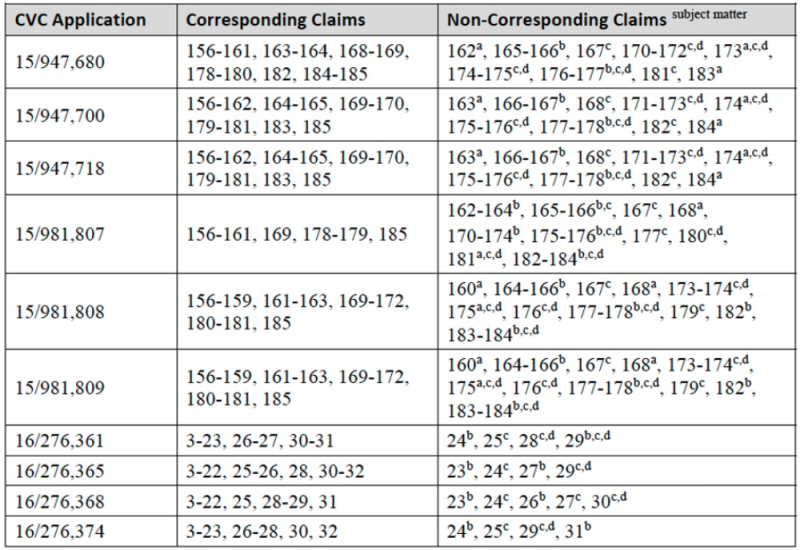
    Having made its case for the patentable distinctions between cleavage by CRISPR and CRISPR-mediated cleavage and HDR-mediated integration at a target site, Sigma-Aldrich then sets out the basis for their assertion that all their own claims-in-interference correspond to Proposed Substitute Count 2, based in part on the Sigma-Aldrich portion of the Count as declared.  For CVC's claims, the brief argues that "many, but not all, of CVC's involved claims (a total of 412 according to the brief) correspond to Proposed Substitute Count 2.  Which claims should remain in this interference is set forth in the following tables:

    Table 1Table 2

    Where a-e designations correspond to the following characteristics for claims not corresponding to Proposed Substitute Count 2:

    (a) > 1 targeting RNA (aka "multiplexing");

    (b) a Cas9 protein that includes a Protein Transduction Domain (PTD);

    (c) one or more mutation(s) in the Cas9 RuvC/HNH domain(s);

    (d) a nickase for a creating a "nick" or a single stranded break in the target DNA; and

    (e) a chimeric Cas9 protein.

    Finally, with regard to four pending CVC applications directed to "chimeric and mutated Cas9 protein," Sigma-Aldrich proposes these claims and applications be designated as not corresponding to Proposed Substitute Count 2:

    Table 3
    The brief concludes with Sigma-Aldrich's arguments regarding entitlement to their earliest P1 provisional application and all intervening applications, as set forth in this diagram:

    Image 1
    Specifically relied upon for priority entitlement are Examples 4 and 5 of the '256 provisional application as illustrated (albeit somewhat faintly) in Figure 5:

    Image 2
    And perhaps cautioned by arguments raised in earlier interferences, Sigma-Aldrich sets forth the priority relationships between its applications with regard to the effects on entitlement to interference practice by enactment of the Leahy-Smith America Invents Act:
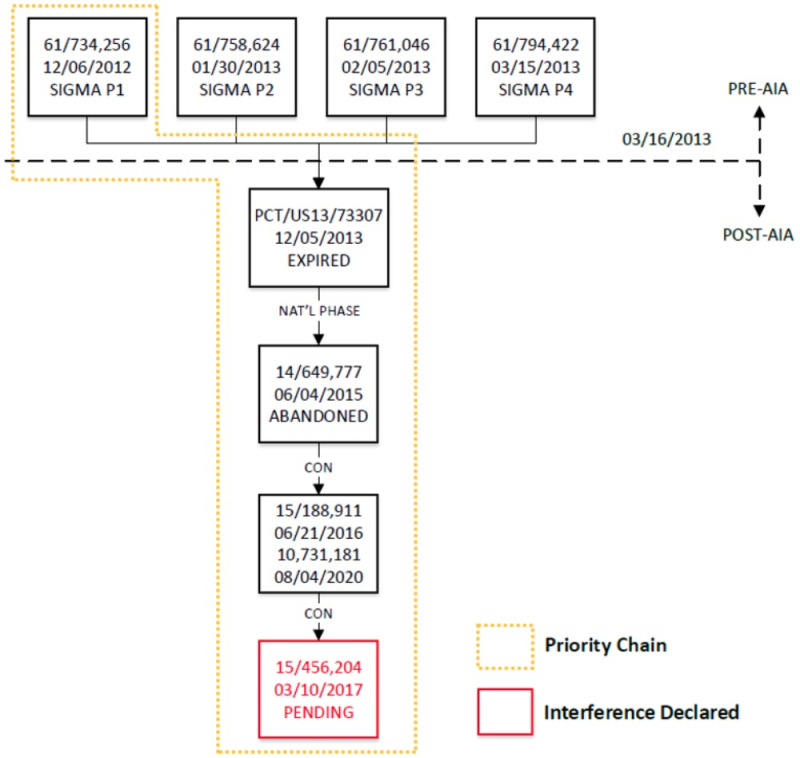
    Image 3
    The brief then sets forth Sigma-Aldrich's arguments regarding why CVC is not entitled to priority benefit of its January 28, 2013 provisional application filing ("P3") or Provisional Application No. 61/765,576 (filed Feb. 15, 2013) ("P4") which, while containing dependent claims that encompass "cleavage + integration" embodiments of eukaryotic CRISPR, do not contain any disclosure showing that CVC's inventors possessed them.

    Finally, Sigma-Aldrich closes the brief with its bases for asserting that Proposed Substitute Count 2 is patentable over the prior art, based on arguments similar to the reasoning regarding the patentable distinctions between CVC's invention  and the Sigma-Aldrich claims-in-interference discussed above including the Board's determination of the limits of the reasonable expectations for success set forth in the '048 Interference.


  • By Donald Zuhn –-

    FireworksAfter reflecting upon the events of the past twelve months, Patent Docs presents its 15th annual list of top patent stories.  For 2021, we identified nine stories that were covered on Patent Docs last year that we believe had (or are likely to have) a significant impact on patent practitioners and applicants.  Last week we counted down stories #9 to #7 and stories #6 to #4 and today we count down the top three stories of 2021.  As with our other lists (2020, 2019, 2018, 2017, 2016, 2015, 2014, 2013, 2012, 2011, 2010, 2009, 2008, and 2007), links to our coverage of these stories (as well as a few links to articles on related topics) have been provided in case you missed the articles the first time around or wish to go back and have another look.  As always, we love to hear from Patent Docs readers, so if you think we left something off the list or disagree with anything we included, please let us know.  In addition, we will be offering a live webinar on the "Top Patent Law Stories of 2021" on January 19, 2022 from 10:00 am to 11:15 am (CT).  Details regarding the webinar, which will focus on a few of the most important stories on this year's list, can be found here.


    3.  Supreme Court Vacates and Remands U.S. v. Arthrex

    Last year, the Supreme Court's decision to review the Federal Circuit's decision in Arthrex, Inc. v. Smith & Nephew, Inc., in which the Court of Appeals determined that the manner in which administrative patent judges were appointed to the Patent Trial and Appeal Board violated the Appointments Clause of the Constitution (Art. II, sec. 2, cl. 2), made it to #4 on our Top Stories list.  We noted at the time that a decision in the case was likely to be issued by the Supreme Court in June, and that Arthrex would likely make our 2021 list.

    In June, the Supreme Court determined that "the unreviewable authority wielded by APJs [Administrative Patent Judges] during inter partes review is incompatible with their appointment by the Secretary [of Commerce] to an inferior office," and the Court vacated the judgment of the Federal Circuit and remanded for further proceedings consistent with its opinion.  Chief Justice delivered the opinion of the Court and was joined with respect to Parts I and II by Justices Alito, Gorsuch, Kavanaugh, and Barrett, and with respect to Part III by Justices Alito, Kavanaugh, and Barrett.  Justice Gorsuch filed an opinion concurring in part and dissenting in part; Justice Breyer filed an opinion concurring in the judgment in part and dissenting in part, and was joined by Justices Sotomayor and Kagan; Justice Thomas filed a dissenting opinion, and was joined as to Parts I and II by Justices Breyer, Sotomayor, and Kagan.  In Part III of his opinion, which was only joined by Justices Alito, Kavanaugh, and Barrett, the Chief Justice addressed "the appropriate way to resolve this dispute given this violation of the Appointments Clause," and indicated that "the structure of the PTO and the governing constitutional principles chart a clear course: Decisions by APJs must be subject to review by the Director."  In his opinion, however, Justice Gorsuch noted that without some direction from Congress, the dispute cannot be resolved as a matter of statutory interpretation.  Although Justice Breyer did "not agree with the Court's basic constitutional determination," he wrote that:

    Under the Court's new test, the current statutory scheme is defective only because the APJ's decisions are not reviewable by the Director alone.  The Court's remedy addresses that specific problem, and for that reason I agree with its remedial holding.

    Following the Supreme Court's decision in Arthrex, the U.S. Patent and Trademark Office, in a series of Arthrex Q&As, outlined an interim internal process by which an advisory committee established by the Director will evaluate requests for Director review made by parties to a PTAB proceeding or reviews initiated sua sponte by the Director.

    For information regarding this and other related topics, please see:

    • "U.S. v. Arthrex: Is Historical Practice of the USPTO Relevant?" March 3, 2021
    • "U.S. v. Arthrex: Supreme Court Oral Argument," March 2, 2021


    2.  Increased Focus on Closing Diversity Gap in Innovation and Patent Practice

    In December 2020, the Intellectual Property Owners Association wrote to then President-Elect Joe Biden and Vice President-Elect Kamala Harris "to recommend that intellectual property (IP) law and policy be priorities in your administration."  In its letter, the IPO declared that "[c]losing the diversity gap in innovation is also vitally important to our economic growth and global competitiveness," noting that women, people of color, and other minority groups are vastly underrepresented in the patent system.  The letter also pointed out that recent "scholarship indicates that increasing participation in inventing by underrepresented groups could increase U.S. GDP by as much as 4.4%," and suggested that "[i]t is imperative that the public and private sectors work together to close this gap and harness our country's potential to innovate at greater levels than ever before."  The IPO's letter at the close of 2020 led to an increased focus in the patent community last year on closing the diversity gap in innovation and patent practice.

    In one such example, Sen. Thom Tillis (R-NC), the Ranking Member of the Senate Subcommittee on Intellectual Property, wrote to President Biden in March regarding the selection of the next Under Secretary of Commerce for Intellectual Property and Director of the U.S. Patent and Trademark Office.  Sen. Tillis declared that the nominee "must be committed to increasing diversity in our nation's intellectual property system," stating that "[f]or too long, too many women and people of color have been underrepresented in our innovation ecosystem," and noting that "[t]hese individuals often face unique barriers to engaging in the intellectual property system and their lack of access costs our economy billions of dollars every year." On October 26, 2021, President Biden announced the nomination of Kathi Vidal, managing partner of Winston & Strawn’s Silicon Valley Office, for Under Secretary for Intellectual Property and Director of the USPTO.  The White House announcement stated that:

    Kathi is a recognized leader in diversity and women's issues.  She is one of four law firm advisory board members for ChIPs, a non-profit organization committed to advancing women at the intersection of law, technology, and regulatory policy.  She founded the Next Gen initiative and actively advocates for training and opportunities for junior lawyers.  She is also a member of Winston & Strawn's Executive Committee and Diversity.  At her prior firm, Fish & Richardson, Kathi was the Litigation Chair and sat on the firm's management committee.  She has a strong technical background, having practiced in industry for five years at General Electric and Lockheed Martin in circuit, systems, software and artificial intelligence.

    Ms. Vidal's nomination was placed on the Senate Executive Calendar on January 13.

    For information regarding this and other related topics, please see:

    • "USPTO News Briefs," November 22, 2021
    • "USPTO to Host Event Celebrating LGBTQ+ Innovators," June 26, 2021
    • "Sen. Tillis Sends Letter to President Regarding Next USPTO Director," March 7, 2021
    • "USPTO Responds to Congressional Request for Information Regarding Criteria for Registration Examination for Admission to Patent Bar," January 21, 2021
    • "IPO Sends Letter on IP Law and Policy to President-Elect and Vice President-Elect," January 4, 2021


    1.  Pandemic Continues to Impact Patent Practice & Ongoing Discussions Regarding WTO Waiver Proposal

    On March 11, 2020, World Health Organization Director-General Tedros Adhanom declared that the COVID-19 outbreak "can be characterized as a pandemic," cautioning that the WHO has "rung the alarm bell loud and clear."  At the time of the announcement, the WHO noted that there were 118,000 cases reported globally in 114 countries.  By January 12, 2021, the WHO indicated that there had been 88,387,352 cases globally.  And in its latest report, issued on January 11, 2022, the WHO indicates that there have been 304,350,207 cases globally.

    As it has for nearly every single industry, the COVID-19 pandemic continues to have a profound impact on patent practice.  In the more than two years since the SARS-CoV-2 virus was first detected in a patient sample, the pandemic has changed how most of us work, where most of us work, and what many of us work on.  However, as the Pharmaceutical Research and Manufacturers of America (PhRMA) noted in a letter the organization sent to the Biden Administration in March, over that same two year period "[p]erhaps more than any other time in history, society is seeing and benefiting from the innovation supported by intellectual property."  For example, the U.S. Food and Drug Administration granted an Emergency Use Authorization (EUA) for Gilead Sciences' remdesivir 123 days after the virus was first detected in a patient sample, granted an EUA for convalescent plasma 237 days after the virus was first detected, granted an EUA for Eli Lilly's antibody treatment 315 days after the virus was first detected, granted an EUA for the Pfizer-BioNTech vaccine 347 days after the virus was first detected (and then followed with two more EUAs for Moderna's vaccine and Johnson & Johnson's vaccine), and approved Pfizer's antiviral PAXLOVID 723 days after the virus was first detected.

    Last year also saw an ongoing debate over a proposal by India and South Africa to waive implementation, application, and enforcement of Sections 1, 4, 5, and 7 of Part II of the Trade-Related Aspects of Intellectual Property Rights (TRIPS) Agreement in relation to the prevention, containment, or treatment of COVID-19.  Despite receiving letters opposing the proposed waiver from the Biotechnology Innovation Organization (BIO), PhRMA, other industry and trade organizations, IP organizations, and members of Congress, U.S. Trade Representative Katherine Tai announced In May that the Biden Administration supported the proposed TRIPS waiver, noting that "the extraordinary circumstances of the COVID-19 pandemic call for extraordinary measures."  While a revised version of the waiver proposal was to be discussed during the 12th Ministerial Conference (MC12) of the WTO in Geneva beginning November 30, the MC12 was postponed due to the omicron outbreak.  That postponement marked the second time the pandemic had forced postponement of the Ministerial Conference, and no new date has been set for the MC12.  The hope is that the coming spring will see the pandemic finally recede such that we can all return to something very close to "normal".

    For information regarding this and other related topics, please see:

    • "Sen. Tillis Writes to U.S. Trade Representative (Again) Regarding TRIPS Waiver," December 12, 2021
    • "U.S. Trade Representative Responds to Letters from Senators Regarding TRIPS Waiver," November 14, 2021
    • "U.S. Chamber of Commerce Urges Administration to "Double Down" on Global Vaccine Distribution," November 3, 2021
    • "Is This the WTO Waiver End Game?" July 25, 2021
    • "BIO Declaration on Global Access to COVID-19 Vaccines and Treatments and Role of IP," June 24, 2021
    • "GOP Legislators Write in Opposition to Proposed TRIPS Waiver," May 16, 2021
    • "Science Does Not Support the Latest COVID Hysteria," May 13, 2021
    • "Population of Patents at Risk from Proposed WTO Patent Waiver," May 12, 2021
    • "Sen. Daines Urges Biden Administration to Withdraw Support for COVID-19 IP Waiver," May 12, 2021
    • "Pfizer CEO Pens Open Letter on COVID-19 Vaccine IP Waiver," May 10, 2021
    • "If the Devil of the WTO IP Waiver Is in the Details, What Are the Details?" May 9, 2021
    • "The Road to Hell Is Paved with What Everybody Knows," May 6, 2021
    • "BIO & IPO Issue Statements on Biden Administration's Support for Proposed WTO Waiver," May 6, 2021
    • "Biden Administration Supports Waiver of IP Protection for COVID-19 Vaccines," May 5, 2021
    • "Suspending IP Protection: A Bad Idea (That Won't Achieve Its Desired Goals)," April 26, 2021
    • "Sen. Tillis Asks Biden Administration to Oppose WTO Waiver Proposal," April 21, 2021
    • "IP Organizations Support Continued Opposition to Waiver Proposal," April 5, 2021
    • "Evolution of SARS-CoV-2 from Bat to Human Pathogen," March 31, 2021
    • "Industry Coalition Supports Continued Efforts to Oppose Waiver Proposal," March 29, 2021
    • "Neanderthal Ancestors Can Be Human Guardian Angels for COVID Infection, Too," March 18, 2021
    • "BIO and PhRMA Urge Biden Administration to Oppose Proposed WTO TRIPS Waiver," March 11, 2021
    • "Do mRNA-based COVID Vaccines Have an Achilles Heel?" January 26, 2021
    • "Going from Bad to Worse: Evidence for Neuro-COVID Infections," January 17, 2021
    • "USPTO Provides Update on COVID-19 Prioritized Examination Pilot Program," January 3, 2021

  • IPO #2The Intellectual Property Owners Association (IPO) will offer a one-hour webinar entitled "2021 Year-End Case Law Review" on January 21, 2022 from 12:00 pm to 1:00 pm (ET).  Paul Berghoff of McDonnell Boehnen Hulbert & Berghoff LLP, Gregory Castanias of Jones Day, and Wendy Larson of Pirkey Barber will review the most significant intellectual property decisions of 2021 and give a sneak peek at coming attractions.

    The registration fee for the webinar is $150 for non-members or free for IPO members (government and academic rates are available upon request).  Those interested in attending the webinar should register here.