• The Metes and Bounds of Obviousness-type Double Patenting

        By Kevin E. Noonan

    Obvious-type double patenting has become an
    important issue in patent litigation (Amgen Inc.
    v. F. Hoffman-La Roche Ltd.
    , Pfizer, Inc. v. Teva Pharmaceuticals USA, Inc., Proctor & Gamble Co. v. Teva Pharmaceuticals USA, Inc.) and in the
    Patent Office (In re Fallaux).  While in many ways an anachronism with
    the change in U.S. patent term to 20 years from earliest priority date, the
    doctrine is still viable as a way to prevent third parties from having
    to defend related patents against different patent assignees, due to the
    provision that terminally-disclaimed patents be commonly assigned.

    Boehringer Ingelheim The Federal Circuit had occasion to opine on the
    doctrine once again in Boehringer
    Ingelheim Int'l. v. Barr Laboratories, Inc
    .  The patent at issue, U.S. Patent No. 4,866,812, was found
    invalid by the District Court under the doctrine of obviousness-type double patenting.  This patent claimed priority as a
    divisional application to U.S. Patent No. 4,843,086, which in turn claimed
    priority as a divisional application to U.S. Patent No. 4,731,374.  The subject matter was directed to tetrahydrobenzthiazoles,
    particularly pramipexole, marketed as Mirapex for the treatment of Parkinson's
    disease.

    During prosecution of the grandparent '374 patent,
    the examiner imposed a restriction requirement listing 10 overlapping groups of
    15 originally-filed claims.  These groups comprised product (Groups I-V), "utility" (VIII-X) or process
    (VI) claims.  The examiner
    permitted applicant to pick one group from the product and utility groups or
    the process group, and the applicant picked Group II and IX for prosecution
    that resulted in the '374 patent.  The first filed divisional application, that resulted in the '086
    patent, encompassed claims from Groups VIII, IX and X, but "none of the
    claims [in this divisional] covered subject matter claimed [in the '374
    patent]."  The second-filed divisional
    application encompassed claims from Groups I, III, IV and V "
    and [did] not cross the examiner's
    lines of demarcation with either the claims of the grandparent '947 application
    (the '374 patent) or those of the parent '197 application (the '086 patent)."
      The applications "were therefore
    divided as between applications along the lines of demarcation drawn by the
    examiner in the restriction requirement."  The '812 patent received a patent term extension under 35
    U.S.C. § 156 of 1,564 days (4 years
    and about 15 weeks), which extended the expiration date from December 12, 2006
    to March 25, 2011.

    Barr Pharmaceuticals Litigation ensued as the result of ANDAs being
    filed by Barr (the original filer) and Mylan, and during the ensuing bench
    trial Boehringer filed a terminal disclaimer of the '812 patent over the '086
    patent (which had expired by that time).  In doing so, "
    Boehringer
    sought to disclaim the approximately six months of the '812 patent's original
    term that extended beyond the term of the '086 patent, and then to apply its
    1,564-day extension to this shortened original term."
      The District Court held that this terminal
    disclaimer was ineffective, since the '086 had expired, and also rejected Boehringer's claim that 35
    U.S.C. § 121 "safe harbor" precluded application of the '086 patent
    against the '812 patent for obviousness-type double patenting.

    Consequently, the District Court found the patent
    invalid for obviousness-type double patenting:  "
    On the merits, the district court
    concluded that the compound claims of the '812 patent were obvious in view of
    the method-of-use claims of the '086 patent."

    Federal Circuit Seal The Federal Circuit reversed and remanded (and
    awarded costs to Boehringer) in an opinion by Judge Linn, joined by Judge Prost
    and joined in part by Judge Dyk, who also filed a dissent-in-part.  The Court opined on two issues raised
    by Boehringer:  Was the terminal
    disclaimer effective?  Do the
    safe-harbor provisions of 35 U.S.C. § 121 apply?

    As to the first issue, the Court rejected
    Boehringer's characterization of the District Court's decision, saying that the
    basis was not that Boehringer attempted to disclaim term during litigation, but
    that the terminal disclaimer was filed after the expiration of the '086
    patent.  The issue was
    retroactivity — the opinion "agree[s] with Boehringer . . . t
    hat a patentee may file a disclaimer
    after issuance of the challenged patent or during litigation, even after a
    finding that the challenged patent is invalid for obviousness-type double
    patenting."  The problem with permitting such
    retroactive terminal disclaimers, according to the Court, is that:

    [T]he later patent purports to
    remain in force even after the date on which the patentee no longer has any
    right to exclude others from practicing the claimed subject matter.  By
    permitting the later patent to remain in force beyond the date of the earlier
    patent's expiration, the patentee wrongly purports to inform the public that it
    is precluded from making, using, selling, offering for sale, or importing the
    claimed invention during a period after the expiration of the earlier patent.

    This constitutes "an unjustified advantage"
    for the patentee, the Court opined, that cannot be undone by retroactive
    disclaimer "
    because it
    has already enjoyed rights that it seeks to disclaim" (emphasis
    in original)
    For
    this reason, and that permitting such retroactive terminal disclaimer "
    would be inconsistent with '[t]he
    fundamental reason' for obviousness-type double patenting, namely, 'to
    prevent unjustified timewise extension of the right to exclude'," Boehringer
    argued that the patent term extension vitiated any such "unjustified
    advantage" because the '812 patent enjoyed a patent term extension that
    covered the term after the '086 patent expired.  The Court disagreed, distinguishing "the
    rights enjoyed by a patentee during the term of a patent" from "the
    rights enjoyed by a patentee during the term of an extension under § 156."  The Court says these are "not the
    same" because "the rights of a patentee during a term extension are
    limited in ways that do not normally apply to granted patents."  In this regard the Court cited the
    provisions of 35 U.S.C.
    § 156(d)(5)(F):

    The rights derived from any patent the
    term of which is extended under this paragraph shall, during the period of
    interim extension —
        (i)
    in the case of a patent which claims a product, be limited to any use then
    under regulatory review
    ;
        (ii)
    in the case of a patent which claims a method of using a product, be limited
    to any use claimed by the patent then under regulatory review
    ; and
        (iii)
    in the case of a patent which claims a method of manufacturing a product, be limited
    to the method of manufacturing as used to make the product then under
    regulatory review
    .

    (emphases
    added). 
    The
    point is that the claims extended under § 156 are only those claims identified
    by Boehringer as reading on "
    the use of pramipexole for the treatment of the 'signs and
    symptoms of idiopathic Parkinson's disease.'"  Since there were claims (5 and 6) that were not
    eligible for extension, the pubic would have been misinformed that Boehringer
    was entitled to exclude the practice of these claims after the '086 patent
    expired — constituting an "unjustified advantage":

    [A] competitor that performed a
    patent search on June 28, 2006 would have wrongly been led to believe that the '812
    patent continued to cover the specific compounds claimed in claims 5 and 6, and
    that it precluded use of pramipexole for treatment of conditions beyond those
    approved by the FDA.  This is precisely the type of "unjustified timewise
    extension of the right to exclude" that the doctrine of obviousness-type
    double patenting is designed to prevent.

    Turning to
    the safe-harbor issue, the Court noted that the safe-harbor is available when
    the claims of a patent are divided by the Patent Office, and "is not lost
    if an applicant does not file separate divisional applications for every
    invention or when independent and distinct inventions are prosecuted together" — it is not limited to filing "only one divisional application":

    [W]here the third sentence of § 121
    refers to a patent issuing on an application filed as a result of a restriction
    requirement, it is referring to patents issuing from any number of multiple
    divisional applications and precludes any one from being used as a reference
    against any other.

    The opinion states that the basis of the District Court's decision (that the safe harbor did not apply) was that the application
    that resulted in the '812 patent was not filed "as the result of" a
    restriction requirement in the '086 (parent) patent, but in the '374
    (grandparent) patent.  The Federal Circuit characterizes the questions raised regarding the safe harbor as "
    (1) whether § 121 can ever apply to a
    divisional of a divisional of the application in which a restriction
    requirement was entered; and (2) whether the 'as a result of' requirement of §
    121 applies to the '812 patent and is satisfied here," which the Court
    reviewed de novo.

    With regard
    to the first question, the Court construed the safe-harbor provisions of 35 U.S.C.
    § 121:

    A patent issuing on an application with
    respect to which a requirement for restriction under this section has been
    made, or on an application filed as a result of such a requirement, shall not
    be used as a reference either in the Patent and Trademark Office or in the
    courts against a divisional application or against the original application or
    any patent issued on either of them, . . .

    as meaning
    that the safe harbor applies "when the PTO issues a restriction
    requirement that leads to more than two separate applications."  In addition, the Court noted that
    § 121 refers broadly to "a divisional application," and does not
    state that the divisional must be a direct divisional of the original
    application, and that Congress could have worded the statute to be
    limited to "a divisional application of the original application" if
    that was its intention.  The Court
    noted that in other situations the safe harbor has been applied to applications
    "sharing a common lineage (Geneva
    Pharms., Inc. v. GlaxoSmithKline PLC
    , 349 F.3d 1373, 1378 (Fed. Cir. 2003))
    or to continuation applications of divisional applications (Amgen Inc. v. F. Hoffman-La Roche Ltd.,
    580 F.3d 1340, 1354 (Fed. Cir. 2009)).Thus, the Court held that there is no basis to
    conclude that the safe harbor does not apply to "a divisional of a
    divisional" as here.

    With regard
    to the "as a result of" provision of the statute, the Federal Circuit agreed
    with the District Court that this provision must be satisfied by both the '086
    ('reference") and '812 ("challenged") patents, citing Pfizer, Inc. v. Teva Pharm. USA, Inc.,
    518 F.3d 1353, 1360 (Fed. Cir. 2008).  In this case, the Court
    agreed with Boehringer that "so long as consonance is met, it makes no
    difference in terms of compliance with the 'as a result of' requirement whether
    the applicant responds to the examiner's restriction requirement by filing one
    or more divisional applications from the original application, or instead files
    a single divisional application followed by successive additional divisionals,"
    where "consonance" is defined as the situation where "the line of
    demarcation between the 'independent and distinct inventions' that prompted the
    restriction requirement be maintained."  Here, Boehringer filed two divisionals encompassing various
    combinations of claims comprising the "different inventions" set
    forth as being distinct in the restriction requirement assessed against the
    (grandparent) '374 application, but not overlapping any of these different
    classes between the different patents.  In the way Boehringer prosecuted these patents it "neither violated
    the examiner's restriction requirement nor risked loss of the safe harbor of §
    121."  In making this
    determination, the Court rejected defendant's argument that the safe harbor
    only applies where an applicant "strictly follow[s] an examiner's election
    procedure and [does] not overlap claims to independent and distinct inventions
    in any single divisional application":

    An overlap of claims to independent and
    distinct inventions within a given divisional application is neither contrary
    to the restriction requirement nor relevant to the requirements of the third
    sentence of § 121.  Rather, what consonance requires is that the claims
    prosecuted in two or more applications having common lineage in a divisional
    chain honor, as between applications, the lines of demarcation drawn by the
    examiner to what he or she considered independent and distinct inventions in
    the restriction requirement.

    Because "[n]one
    of the inventions claimed as between the '374 original patent, the '086
    division, and the '812 division of the division, crosses the examiner's lines
    of demarcation of inventions identified in the restriction requirement, . . . consonance
    is met and the '086 patent cannot be used as a reference against the '812
    patent any more than if both patents had issued from direct divisions from the
    application in which the restriction requirement was made."

    Judge Dyk While this
    decision appears to be a straightforward (and sensible) application of the
    statute (as well as the policy concerns behind the statute and a common-sense
    approach to how patent prosecution is performed), Judge Dyk (at left) dissented to this
    aspect of the Court's opinion.  In
    Judge Dyk's opinion, the majority opinion "significant expands" the
    scope of the safe harbor.  His
    interpretation of the safe harbor is as a narrow exception to the general rule
    precluding unwarranted extension of patent term for closely-related inventions
    that are obvious variants.  His objection is not that the majority's determination that the safe
    harbor applies to "later" divisional applications filed as the result
    of a restriction requirement.  Rather, his dissent is based on consonance, which he defines as
    requiring a complete adherence with the contours of the restriction.  His reasoning is that Federal Circuit
    precedent was based on an applicant being "compelled to comply with a
    restriction requirement" and
    who "faithfully follows" the requirement.

    In Judge Dyk's
    view, neither the '086 patent nor the '812 patent are consonant with the
    restriction requirement, because while the claims prosecuted in these patents
    did not overlap with the claims in the '374 patent or each other, they were not
    limited to one of the groups of claims set forth in the original
    restriction.  Rather, each of the '086
    and '812 patents contained non-overlapping combinations of claims from several
    of these groups.  It is not enough
    that there is no overlap — Judge Dyk believes that "preserving the lines
    of demarcation" requires applicants to file divisional applications for
    each of the groups set forth in the restriction requirement asserted in the
    grandparent '374 application.  He
    supports his position by citing several cases that he contends are inconsistent
    with the majority opinion.  These include
    Gerber Garment Tec., Inc. v. Lectra Sys.
    Inc
    ., 916 F.2d 683, 688 (Fed. Cir. 1990); Symbol Techs., Inc. v. Opticon, Inc., 935 F.2d 1569, 1569 (Fed.
    Cir. 1991); Texas Instruments Inc. v.
    U.S. International Trade Commission
    , 988 F.2d 1165 (Fed. Cir. 1993); and Applied Materials, Inc. v. Advanced
    Semiconductor Materials America, Inc.
    , 98 F.3d 1563 (Fed. Cir. 1996).

    Judge Dyk
    also believes that a proper interpretation of the statute would preclude the '812
    (daughter) patent from the benefit of the safe harbor from the '086 (parent)
    patent regardless of whether the '812 patent was entitled to the benefit of the
    safe harbor over the '374 (grandparent) application, because the '812 patent
    was not filed "as the result of" a restriction requirement imposed
    against the '086 patent.  This
    portion of his dissent seems to imply that divisional applications would need
    to be filed on the same date to maintain the safe harbor, and seems to contradict
    his apparent agreement with the majority that "a divisional of a
    divisional" was entitled to safe harbor protection.  His rationale is that "the child
    was not separated from the parent 'as a result of' the restriction requirement,
    but rather as the result of the applicant's voluntary choice" and "[s]ince
    the separation was not 'due to the administrative requirements imposed by the
    Patent and Trademark Office,' . . . the child application should not be
    afforded the protections of section 121 with respect to the parent application."  This situation would permit a patentee to
    file successive applications, none of which could be asserted against each other
    due to the safe harbor, resulting in "multiple unjustified extensions of
    the patent term."  He
    characterizes this as "abuse," saying that "[t]he majority's
    opinion is devoid of any justification for this untenable result.  It hardly
    requires argument to demonstrate that Congress could not have intended section
    121 to operate in this perverse fashion."

    Boehringer Ingelheim Int'l. v. Barr Laboratories, Inc. (Fed. Cir. 2010)
    Panel:  Circuit Judges Linn, Dyk, and Prost
    Opinion by Circuit Judge Linn; opinion dissenting-in-part by Circuit Judge Dyk

  •     By
    Donald Zuhn

    Adelman, David In
    a paper published earlier this month, David Adelman and Christopher Holman assert
    that in the debate on follow-on biologics legislation, "the controversy over
    regulatory 'data exclusivity
    ' is
    a sideshow."  The authors
    argue that policymakers should instead "focus on mitigating the systemic
    barriers to entry that pose much greater and longer-term obstacles to
    lower-cost biotech drugs." 
    Dr. Adelman (at right)
    the Harry Reasoner Regents Chair in Law at the University of Texas School of
    Law, and Dr. Holman (below left), Associate Professor of Law at the University of
    Missouri-Kansas City School of Law (and author of Holman's Biotech IP blog),
    discuss these assertions in a paper entitled "Misplaced Fears in the
    Legislative Battle Over Affordable Biotech Drugs
    ."

    Holman, Chris The
    authors begin with several observations regarding data exclusivity.  First, they note that "data
    exclusivity would neither create restrictions on the use of the [biologic]
    itself, nor would it preclude FOB makers from conducting their own studies to
    obtain FDA approval."  Next,
    the authors note that the inclusion of a twelve-year data exclusivity period in both
    the House and Senate health care bills was "driven by concerns that patent
    protection is less effective for biotech drugs than it is for conventional
    drugs."  While acknowledging
    that "[p]revailing uncertainties provide grounds for and against Congress
    legislating a twelve-year term of data exclusivity for biotech drugs," the
    two professors contend that:

    What is unequivocal, though, is that
    the effects either way on health care expenditures would be modest.  According to a 2007 estimate by the
    Congressional Budget Office, establishing an abbreviated FDA approval process
    for FOBs would reduce national spending on prescription drugs by just 0.5
    percent over the first ten years of the program.  The impact of a shortened data exclusivity period would be a
    fraction of this estimate, since competitive market entry by FOBs would still
    face [] barriers to market entry . . . 
    .  Overall the health care
    savings would be nominal, as drugs account for only about ten percent of total
    health care expenditures in the United States.

    As
    a result, the authors conclude that "on balance, the potential benefit to
    patients that might result from a shortened period of data exclusivity for
    innovators is outweighed by the financial risks to the biotech industry, and
    particularly the negative impacts on investments in research and development."

    Regarding
    the limitations of the patent system for biologics, the paper points to the
    complexity of biologics as creating two mutually reinforcing problems for
    innovators.  First, "[t]he
    size and complexity of biotech drugs affords competitors many molecular degrees
    of freedom, which opens [u]p many opportunities to design around an original
    innovator's patents."  Second,
    "the scientific uncertainties surrounding the relationship between changes
    in structure and protein function bounds the original inventors' capacity to
    draft and support broad patent claims."  The paper next focuses on the limited success innovators
    have had in enforcing biologic patents, particularly composition-of-matter
    patents.  The authors note,
    interestingly, that:

    The history of cases involving
    enforcement of composition-of-matter patents on biotech drugs paints a
    decidedly negative picture.  There
    does not appear to be a single appellate-level decision in which a patent on
    the active ingredient of a biotech drug has been found valid and infringed.

    According
    to the authors, the problems associated with securing broad biologic patent
    protection and then enforcing such patents means that "[a]n abbreviated
    FDA approval process could permit FOB producers to have their cake and eat it."  In other words, generic manufacturers
    "could benefit not only from the research conducted by the original
    innovator but also from its clinical data to gain rapid, low-cost FDA approval
    — and all while circumventing the patent on the active ingredient."

    For
    the authors, the real obstacle to low-cost follow-on biologics is not a
    twelve-year data exclusivity period, but rather barriers to entry that would
    prevent follow-on biologics from reaching the market even after patent and data
    exclusivity protection expires. 
    For example, the paper notes that:

    Recent studies have developed models to
    estimate the number of FOB producers and price reductions of biologics once FOB
    entry occurs.  Using conservative
    R&D costs assumptions for drugs with mid-level markets (i.e., ~$500 million
    annually), one study estimated that the average number of FOB entrants would be
    just two, as opposed to nine for traditional drugs, and that on average FOB
    prices would remain at eighty-two percent of the brand price.

    The
    authors argue that if such numbers turn out to be accurate, "this
    translates into a negligible impact on total health care costs, as biotech
    drugs generate about fourteen percent of the total revenues for
    pharmaceuticals, which in turn account for only about ten percent of total
    health care costs."  More
    importantly, the authors argue that "[t]he low sensitivity of aggregate
    health care expenditures to the presence or absence of a data exclusivity term
    contrasts the heavy reliance of biotech drug makers on profits from successful
    drugs."  The paper also contends
    that:

    Limiting the term of data exclusivity
    could also be counterproductive for everyone.  Although counterintuitive, safeguarding high short-term
    profits through a twelve-year data exclusivity term stands to mitigate the
    difficulties of balancing innovation and patient access.  Owing to the huge upfront costs of drug
    development, the optimal temporal profile of drug prices arguably favors high
    initial prices followed by a dramatic drop after patent protection (or data
    exclusivity) ends.

    The
    authors conclude the paper by stating that:

    [W]e find reasonable grounds for a
    twelve-year term of data exclusivity for biotech drugs, but this issue is
    ultimately secondary.  The most
    important problem to address is the multiple barriers to entry of FOB
    manufacturers.  Designing effective
    policies to overcome them warrants much greater attention and careful economic
    analysis, as reducing barriers to entry holds out the promise of dramatically
    lowering prices of biotech drugs over the long run.

    Additional information regarding Dr. Adelman's and Dr. Holman's article can be found on Holman's Biotech IP blog.

  •     By
    Donald Zuhn –-

    NVCA On
    Friday, the National Venture Capital Association (NVCA), a trade association
    representing the U.S. venture capital industry, released the results of its
    latest MoneyTree Report on venture funding.  The study, conducted with PriceWaterhouseCoopers and Thomson
    Reuters, indicates that venture capitalists invested $5.0 billion in 794 deals
    in the fourth quarter of 2009, a 2% decrease in dollars and 15% increase in
    deals as compared to the third quarter of 2009, when $5.1 billion went into 689
    deals.  Interestingly, the NVCA had
    indicated back in October that $4.8 billion had gone into 637 deals in the
    third quarter (see "NVCA Study
    Shows Increase in Third Quarter Venture Funding
    "),
    numbers which would have placed the fourth quarter results in a more positive light.

    Total Venture Capital Investment (Quarterly) Q4 2009.

    PricewaterhouseCoopers (PWC) Over the entire year, the NVCA report indicated that venture
    capitalists invested $17.7 billion in 2,795 deals in 2009, which marked the
    lowest level of funding in twelve years. 
    The 2009 totals also represented a 37% decrease in dollars and a 30%
    decrease in deals as compared with 2008 — the second consecutive year of declines
    in deals and dollars invested.

    Total Venture Capital Dollars Annually 2009

    Thomson ReutersWhile
    the overall investing numbers were down slightly in the fourth quarter, biotech
    investing saw a 10% increase in dollars in the fourth quarter, with $1.0
    billion being invested in 108 deals. 
    As a result, the biotech sector was the number one sector for dollars
    invested in the fourth quarter and the only sector to receive more than $1
    billion in the quarter.

    Investment Activities - Top Industries Q4 2009

    The
    biotech sector was also the top sector for the whole of 2009, drawing $3.5
    billion in 406 deals for the year. 
    Despite the top ranking, however, biotech investing declined by 19% in
    both dollars and deals in 2009.  The
    Life Sciences sector, which comprises the biotechnology and medical device
    industries, accounted for 34% of all venture capital dollars invested in 2009 as
    compared to 28% in 2008.

    In
    a press release announcing the release of the new MoneyTree Report, the NVCA pointed
    to fourth quarter increases in the number of first-time and early stage deals
    completed as "potentially marking the beginning of an uptick in investment
    levels for 2010."  NVCA
    president Mark Heesen predicted that "[n]ow that the economy has begun to
    show signs of improvement, we expect to see dollars flow more freely back into
    those sectors that offered the most promise before the recession began — clean
    technology, life sciences and IT." 
    Tracy Lefteroff, the global managing partner of the venture capital practice
    at PricewaterhouseCoopers, noted that "[d]espite the overall drop in funding
    in 2009, VCs placed more bets in the fourth quarter of 2009 than we've seen all
    year," adding that venture capitalists were "investing fewer dollars
    in these companies but the fact remains that there are still entrepreneurs out
    there with great ideas who are getting the opportunity to take the next step
    forward with their businesses."

    Additional
    information regarding the latest report can be found here.

    For
    additional information on this and other related topics, please see:

    "Biotech/Pharma Companies Look to Market for Capital," December 29,
    2009

    "NVCA Study Shows Increase in Third Quarter Venture Funding," October
    23, 2009

    "Biotech/Pharma Financing Improving, R&D Spending Up," August 31,
    2009

    "Investors Saw Biotech Rebound Coming," August 17, 2009

    "Is Biotech/Pharma Beginning to Bounce Back?" August 12, 2009

    "First Quarter Venture Capital Funding at 12-Year Low," April 23,
    2009

    "NVCA Study Shows Decline in 2008 Investment; BIO Study Predicts Biotech
    Rebound in 2009
    ," February 16, 2009

  • Calendar

    January 25, 2010 – "Are Genes Patentable?" (Intellectual Property Litigation Committee, American Bar Association) – Atlanta & Seattle

    January 25-26, 2010 – European Pharmaceutical Regulatory Law Boot
    Camp
    (American Conference
    Institute) – New York, NY

    January 26-27,
    2010 –
    Advanced In-House Counsel Forum on China IP Law (C5) – Shanghai, China

    January 27-30, 2010 – Mid-Winter Institute (American
    Intellectual Property Law Association) –
    La Quinta, CA

    January 27-28, 2010 – Pharma & Biotech Patent Litigation (C5) – Amsterdam, Netherlands

    January 28, 2010 – "Are Genes Patentable?" (Intellectual Property Litigation Committee, American Bar Association) – Memphis

    January 29, 2010 – "Are Genes Patentable?" (Intellectual Property Litigation Committee, American Bar Association) – Wilmington

    February 4, 2010 – "Are Genes Patentable?" (Intellectual Property Litigation Committee, American Bar Association) – Chicago

    February 4, 2010 – Bay Area Pharma and Life Sciences IP Summit (Fish
    & Richardson and Berkeley Center for Law & Technology) –
    San Mateo, CA

    February 9, 2010 – Patent
    Prosecution: Best Practices for Reducing Costs While Improving Patent
    Quality
    (
    Technology
    Transfer Tactics) –
    1:00 – 2:30 PM (EST)

    February
    17-18, 2010 –
    Biotech & Pharmaceutical Patenting (IIR) – Munich, Germany

    February 24-25, 2010 – 2nd Expert Forum on ITC Litigation &
    Enforcement
    (
    American Conference
    Institute) –
    New York, NY

    March 1-2, 2010 – 4th Annual Patent Law Institute (Practising
    Law Institute) –
    New York, NY

    March 2-4, 2010 – 6th Annual Biosimilars Conference (Visiongain) – Boston,
    MA

    March 17-18, 2010 – 18th Forum on Biotech Patenting (C5) – Munich,
    Germany

    March 18-19, 2010 – 4th Summit on Biosimilars and
    Follow-on Biologics
    (
    Center for
    Business Intelligence) –
    Washington, DC

    March 22-23, 2010 4th Annual Patent Law Institute (Practising
    Law Institute) –
    San Francisco,
    CA

    March 24-25, 2010 – FDA Boot Camp*** (American Conference
    Institute) –
    New York, NY

    ***Patent Docs is a media partner of this conference or CLE

  • New York #1 American Conference
    Institute (ACI) will be holding the spring session of its FDA Boot Camp
    conference on March 24-25, 2010 in New York, NY.  ACI faculty will help attendees:

    • Master the basics
    of the application and approval processes for drugs, biologics, and devices;
    • Comprehend the
    structure of the FDA and the roles of the three major agency centers:  CDER, CBER, and CDHR;
    • Develop a
    practical working knowledge of clinical trials for drugs and biologics and the
    clearance process for devices;
    • Learn how devices
    are classified, monitored, and regulated;
    • Appreciate the
    complexities of pharmaceutical IP and the regulatory balance between brand name
    and generic products;
    • Recognize the
    pivotal role of labeling in the drug and biologics approval process;
    • See the
    importance of cGMPs to the post-approval regulatory process; and
    • Navigate the
    protocols of adverse events monitoring, signal detection, product withdrawals,
    and recalls.

    FDA Boot Camp In particular,
    ACI's faculty will offer presentations on the following topics:

    • The basics:  Understanding and working with the FDA
    — Jurisdiction, functions, organization, and operations;
    • The nature of the
    approval process;
    • Understanding the
    clinical trial process for drugs and biologics;
    • Patent and IP
    overview for drugs and biologics: 
    Hatch-Waxman, trade dress, and more;
    • Drugs and
    biologics:  Labeling;
    • cGMPs:  Drugs and biologics (current good
    manufacturing practices);
    • Non-patent
    exclusivity (part of the conference's patent track);
    • Bioequivalence:  What patent lawyers need to know
    (patent track);
    • Follow-on
    (comparable or biosimilar) biologics (patent track);
    • Adverse events
    monitoring, pharmacovigilance, and risk management;
    • Medical
    devices:  Classification and the
    essentials of the device premarket review process;
    • Post-market
    requirements and concerns for medical devices;
    • Medical device
    labeling and advertising; and
    • Recall guidance
    for drugs, biologics, and medical devices:  What you need to know.

    A complete brochure
    for this conference, including an agenda, list of speakers, and registration
    form can be obtained here.

    ACI - American Conference Institute The registration
    fee for this conference is $2,195. 
    Those registering on or before February 19, 2010 will receive a $200
    discount.  Those interested in
    registering for the conference can do so here,
    by calling 1-888-224-2480, or by faxing a registration form to 1-877-927-1563.

    Patent Docs is a media partner of ACI's FDA Boot Camp conference.

  • Munich, Germany C5 (UK) will be
    holding its 18th Forum on Biotech Patenting on March 17-18, 2010 in Munich,
    Germany.  C5 faculty will provide
    information and insights into:

    • Strategies for
    adapting your patent practice to EPO rule changes;
    • The latest EPO
    requirements for the patentability of biotechnological inventions;
    • The practical
    impact of major EPO and national court cases;
    • Disclosure
    requirements for gene patents — what is patenable?  From T1329/04 to Eli Lily vs. HGS;
    • Second Medical
    Use Claims:  How to draft your
    claims in light of the Enlarged Board's Decision and national case law;
    • The evolving
    landscape for stem cell patentability in Europe; and
    • Ground-breaking
    decisions from U.S. courts and major U.S. policy and legislative initiatives.

    Biotech Patenting In particular, C5
    faculty will offer presentations on the following topics:

    • Keynote
    address:  The judicial view — Dr.
    Klaus Grabinski, Judge at the German Federal Court of Justice;
    • EPO examiner's
    perspective on patenting biotechnological inventions;
    • Panel
    discussion:  Raising the bar —
    Examining and debating EPO's new standards and rule changes;
    • An overview of
    the year's most important biotech cases and other landmark decisions;
    • The Enlarged
    Board's decision on second medical use claims and dosing regimens and its
    relationship to national case law;
    • The disclosure
    requirements for gene patents: 
    From T 1329/04 to T 18/09 (Eli Lilly v. HGS);
    • New life breathed
    into gene patenting debate;
    • The current state
    of play for biosimilars in Europe;
    • Major case law
    and policy developments in the U.S.;
    • Patenting and
    protecting treatment/diagnostic methods: 
    Comparing and contrasting European and U.S. standards;
    • Maximising patent
    protection — Developments in SPCs with a critical review of recent case law;
    • Patent strategies
    for antibodies:  How to draft your
    claim to meet heightened patentability requirements;
    • Freedom to
    operate — Strategies for the biotech practitioner;
    • The evolving
    landscape of stem cell patentability in Europe; and
    • Developments in
    patent litigation procedure and cross-jurisdictional litigation management
    strategies.

    A pre-conference
    workshop, entitled "Drafting Successful Patent Applications for
    Biotechnology Related Inventions," will be offered from 2:00 to 5:00 pm on
    March 16, 2010.  During this
    workshop, C5 faculty will walk attendees through the process of drafting claims
    and specifications for increasingly complex biotechnology applications, and
    provide attendees with the tools needed to draft strong applications that will
    be well-positioned to withstand future challenges.

    In addition, a
    post-conference workshop, entitled "Managing Due Diligence: Scrutiny of
    Your Patent Portfolio," will be offered from 9:00 am to 12:30 pm on March
    19, 2010.  This workshop will focus
    on the key areas attendees need to consider with regard to due diligence.

    C5 A complete brochure
    for this conference, including an agenda, list of speakers, and registration
    form can be requested here.

    The registration
    fee for the conference is £1399 ($
    2,241.69), for the conference and one workshop £1798
    ($
    2,897.21), for the conference and both workshops £2197
    ($
    3,540.14), and for one workshop alone £499 ($1,322.56).  Those interested in
    registering for the conference can do so here.

  •     By James DeGiulio —

    RBC Capital Markets With very little downside
    and huge upside, exclusivity is the driving force to the huge increase in
    first-to-file Paragraph IV filings.
      Adam Greene and D. Dewey Steadman, both at RBC Capital Markets Corp., conducted
    a recent study where they analyzed over 370 court rulings since the beginning
    of 2000 to establish the "success rates" of generics (as defined by
    the authors).  Using PACER, company reports, and RBC Capital Markets estimates
    as their sources, the authors looked at company, district court, and judge, as
    well as other relevant trends in the industry such as at-risk launches,
    authorized generics, and the number of patent settlements.  The authors
    hypothesize that, based on the incentives of the Hatch-Waxman first-to-file
    structure, every patented product would be challenged. 
    As expected, the authors
    saw an increase in first-to-file lawsuits in each year since 2003, reaching a
    record high of 65 in 2009 (see chart below).

    Firsttofile (Exhibit 2: First-to-File Lawsuits, Greene and Steadman, "Pharmaceuticals: Analyzing Litigation Success Rates," January 15, 2010)

    Perhaps the most
    intriguing finding of the study, the authors determined the "success rate"
    of generics for Paragraph IV challenges was a healthy 76% (282/370) (see chart below
    ).  Importantly, the authors consider a settlement as a "success" for the
    generic, as it eliminates uncertainty and expensive legal costs.  Dropped cases
    were also considered a successful outcome for generics, though the reasoning
    for this is not provided in the study.  Thus, as long as settlements and dropped
    cases are considered a "success" for generics, the study supports the
    authors' hypothesis that every patent would be challenged by a generic.  With a
    76% success rate, the potential payoff of a first-to-file Paragraph IV
    challenge is worth the risk of litigation.  However, the study finds generics
    fare much worse at trial.  Of the 171 cases resolved at trial, generics won 82
    rulings while losing 89 (48%).

    SuccessRate
    (Exhibit 3: Generic Drug Industry: Litigation Success Rate, Greene and Steadman, "Pharmaceuticals: Analyzing Litigation Success Rates," January 15, 2010)

    The authors next
    analyzed the track records of generics
    with five or more resolved Paragraph IV challenges
    between 2000 and 2009. 
    Perrigo was found
    to have a perfect success record, with a single case won and seven settlements,
    once again reflecting the author's classification of all settlements as a
    successful outcome.  Apotex was
    found to have the worst success rate at 43%, but was also the least likely to
    settle or have a case dropped.  All
    company data is presented in the table below.

    Generics (Exhibit 4: Best Generic Challengers 2000-2009, Greene and Steadman, "Pharmaceuticals: Analyzing Litigation Success Rates," January 15, 2010)

    The authors next evaluated which federal districts
    and which judges have the best success rates for generics. 
    A few districts have
    never found against generics, though these districts have not heard many cases.  These include the Central District of California (8/8), the Eastern District of
    New York (2/2), Minnesota (2/2), and the Eastern District of Missouri (1/1).  However, the most popular districts (
    New
    Jersey, Delaware, and the Southern District of New York)
    ,
    which heard nearly 70% of all generic challenges, resulted in a generic winning
    percentage of only 36% (see table below). 
    This winning percentage is on par with the authors'
    analysis of individual judges.  For
    judges who have issued 5 or more decisions, the winning rate for generics is
    37%.

    Districts
    (Exhibit 6: Decisions By Court, Greene and Steadman, "Pharmaceuticals: Analyzing Litigation Success Rates," January 15, 2010)

    The authors noticed a small increase in at-risk
    launches (
    defined as any launch without a lower court
    ruling) and authorized generics.  Further, the authors noticed the number of
    non-authorized generic launches doubled from 2008-2009, from 6 to 12, which the
    authors hypothesize is due to the increase in settlement agreements a few years
    ago.

    Finally, the authors
    note a trend of increasing settlements from 2003-2009, reaching an all-time
    high of 54 in 2009 (see chart below).  Teva accounted
    for nearly one third of all settlements. 
    On the brand side, Glaxo and Novartis have settled the most.

    Settlements
    (Exhibit 10: Number of Patent Settlements 2003-2009, Greene and Steadman, "Pharmaceuticals: Analyzing Litigation Success Rates," January 15, 2010)

    The authors expect
    settlements to remain fairly common, despite the passing of the Kohl Bill by
    the Senate Judiciary Committee in October 2009.  Their prediction is not surprising, since the authors assume
    that settlements are always good for the generic company.  From an investment
    perspective, this assumption may have merit, since settlements provide clarity
    for the company (and shareholders) and avoid the expense and risk of
    litigation.  However, in practice,
    there will certainly be settlements that would not be considered a success for
    the generic.

    James DeGiulio has a doctorate in molecular biology and genetics from Northwestern University and is a third-year law
    student at the Northwestern University School of Law.  Dr. DeGiulio
    was a member of MBHB's 2009 class of summer associates, and he can be contacted at degiulio@mbhb.com.

  •     By
    Donald Zuhn

    USPTO Seal The
    U.S. Patent and Trademark Office has announced that the Office and Department of Justice will not be seeking further review of
    the Federal Circuit's decision in Wyeth
    v. Kappos
    .  In announcing this decision,
    the Office also stated that it is in the midst of "preparing guidance for
    expediting requests for recalculation of patent term adjustment by the USPTO in
    light of the Wyeth decision," and that such guidance "will be issued
    as soon as possible.

    As
    in its January 10th announcement regarding the Wyeth decision, the Office noted that:

    Applicants
    and Patent Owners dissatisfied with a patent term adjustment determination by
    the agency are reminded of the requirement to seek review of that determination
    within 180 days of patent issuance and the time periods set in the implementing
    regulations. See 35 U.S.C. sec. 154(b)(4) and 37 CFR 1.705.

    Department of Justice (DOJ) Seal For
    additional information regarding this and other related topics, please see:

    • "USPTO Posts Notice Regarding Wyeth Decision," January 11, 2010
    • "The Federal Circuit's Wyeth v. Kappos Decision," January 10, 2010
    • "Wyeth v.Kappos (Fed. Cir. 2010)," January 7, 2010

    "Patent Term Adjustment: 37 C.F.R. § 1.704(b)'s Three-Month Provision,"
    November 17, 2009

    "USPTO Says Some Requests for PTA Reconsideration Are Premature,"
    September 7, 2009

    "Fish & Richardson Catches Error in Patent Office's PTA Calculation,"
    July 30, 2009

    "More § 154(b)(4)(A) Actions Filed against Director," February 8,
    2009

    "Three More Patentees File § 154(b)(4)(A) Actions against Director Dudas,"
    January 12, 2009

    "More Patentees Follow Wyeth's Lead in Seeking Additional PTA,"
    December 3, 2008

    "USPTO to Appeal Wyeth v. Dudas," December 2, 2008

    "Two Patentees Follow Wyeth's Lead in Seeking Additional PTA,"
    November 12, 2008

    "Wyeth v. Dudas (D.D.C. 2008)," October 16, 2008

  •     By
    Donald Zuhn

    Presidential Seal On
    Saturday, reports began to circulate regarding President Obama's recent
    interest in "renegotiating" the data exclusivity provisions of the
    health care bills that were passed in the House and Senate late last year (see "Snatching Defeat from the Jaws
    of Victory?
    ").  In a discussion at the White House, the
    President informed Rep. Anna Eshoo (D-CA) that he did not support the 12-year
    period in both bills and would prefer that the bills specify a shorter period
    instead.

    The
    President's position was not too surprising, given the Administration's assertion
    in a letter to House Energy and Commerce Chairman Henry Waxman (D-CA) last June
    that a 7-year data exclusivity period would "strike[] the appropriate
    balance between innovation and competition" (see "White House Recommends 7-Year Data Exclusivity Period for
    Follow-on Biologics
    ").  However, the President's last-minute
    efforts to convince the House and Senate to change their bills startled many in
    the biotech/pharma industry. 
    Writing in the congressional daily The
    Hill
    , Jeffrey Young opined that by "jettisoning" the 12-year data
    exclusivity period in the bills, President Obama would be "ignoring one of
    the few substantive bipartisan amendments approved during committee consideration
    of healthcare reform" ("Obama at odds with some Dems on key provision
    in healthcare
    ").  In mid-July, the Senate Health,
    Education, Labor and Pensions (HELP) Committee rejected an amendment for a
    5-year data exclusivity term, and instead voted 16-7 in favor of an amendment
    providing a 12-year term (see "Senators
    Champion 12-Year Data Exclusivity in Senate
    ").  At the end of July, the House Committee
    on Energy and Commerce approved an amendment to its health care bill that would
    provide a 12-year data exclusivity period (see
    "House Committee Approves Health Care Reform Bill Calling for 12-Year
    Exclusivity Period
    ").  While the House health care bill itself
    was passed out of Committee by a narrow 31-28 margin, the biosimilar licensure
    pathway amendment, including its 12-year data exclusivity provision, sailed
    through the Committee in a 47-11 vote.

    Maryland State Seal On
    Tuesday, in response to the President's comments last week, six Governors sent
    a
    letter to the President, "to express [their] concern about recent
    proposals that have been made to provisions that relate to biosimilars in the
    health reform bill."  In the
    letter, which was sent by Gov. Martin O'Malley (D) of Maryland, Gov. Bill
    Ritter (D) of Colorado, Gov. Jack Markell (D) of Delaware, Gov. Deval Patrick
    (D) of Massachusetts, Gov. Beverly Perdue (D) of North Carolina, and Gov. Donald
    Carcieri (R) of Rhode Island, the signatories told the President that:

    Colorado State Seal We oppose limiting the period of data
    exclusivity for developers of biosimilar products as well as any revision to
    the "evergreening" language contained in both House and Senate passed
    bills.  The balance struck by
    Congress — both through the Senate Health, Education, Labor and Pensions
    Comminee and House Energy and Commerce Comminee — on 12 years of data
    exclusivity for biologics and reasonable "evergreening" language
    represents a critical element needed to ensure appropriate incentives for continued
    biomedical innovation.  We urge you
    to continue working with the congressional leaders to carefully evaluate the
    product of the extensive work that they have already done on this matter and
    retain the provisions that were passed in both chambers of Congress.

    Delaware State Seal The
    Governors reminded the President about the economic impact of the bioscience
    industry, noting that "[t]he biopharmaceutical and life sciences workforce
    in this country is nearly 700,000 strong and supports more than 3.2 million
    total jobs in associated sectors," and that "employment in the
    biopharmaceutical sector grew more than twice as fast as all other sectors
    combined between 1996 and 2006." 
    The Governors also argue that:

    The high risk and uncertain nature of biologics R&D, combined with the economic
    downturn, underscores the sector's vulnerabilities.  Thus this critically important issue has a direct economic
    impact on our states, our nation 's public health, our economic success, and our
    global leadership in innovation in biomedical research.

    Massachusetts State Seal In
    support of the data exclusivity period in the House and Senate bills, the
    letter notes that:

    With biotechnology products in
    particular, data exclusivity provides a critical incentive for innovation, as
    patent protections may be limited by the highly complex nature of these
    products, which are produced from living cells.  Economic modeling has shown that a provision of at least 12
    years of non-patent data exclusivity allows innovator companies to recover
    their original investment in the marketed therapy.  Equally important, however, revenues from successful marketed
    therapies offset the hundreds of millions of dollars spent on drug discovery
    R&D on candidates that do not make it to market.  Thus, these revenues support pipeline drug candidate development
    and investments in costly and complex manufacturing facilities for FDA approved
    therapies.  In order to assure
    these companies continue to make investments in medical innovation and take the
    risks necessary to bring these important products to patients, innovators should
    be provided with appropriate incentives, including data exclusivity and
    protections for their patents.

    North Carolina State Seal The
    Governors conclude the letter by asking the Administration to "work closely with
    Members of Congress to gain a better understanding of the complexity of this
    issue before making a decision that could hinder scientific innovation and
    jeopardize our nation's role as a leader in the development and delivery of
    lifesaving therapeutics."

    Rhode Island State Seal Tuesday's letter marks the second time these Governors have addressed the issue
    of data exclusivity.  In a letter sent
    to Congressional leaders in September,
    Governors O'Malley, Ritter, Markell, Patrick, Perdue, and
    Carcieri
    were joined by Gov. M.
    Jodi Rell (R) of Connecticut, Gov. Theodore Kulongoski (D) of Oregon, Gov. Luis
    Fortuño (R) of Puerto Rico, and Gov. Christine Gregoire (D) of Washington in asserting
    that "the balance struck in the Senate Health, Education, Labor and
    Pensions Committee on 12 years of data exclusivity for biologics represents a
    critical element needed to ensure appropriate incentives for continued
    biomedical innovation" (see
    "Governors Send Letter to Congressional Leaders in Support of 12-Year Data
    Exclusivity Period
    ").

    For information regarding this and other related topics, please see:

    • "Data Exclusivity Follow-up: More of the Same," January 18, 2010
    • "Snatching Defeat from the Jaws of Victory?" January 17, 2010

    "Follow-on Biologics News Briefs – No. 11," December 30, 2009


    "Follow-on Biologics News Briefs – No. 10," November 30, 2009

    "House Health Care Bill Includes Biosimilar Licensure Pathway,"
    November 3, 2009

    "12 Senators Write in Support of 12-Year Data Exclusivity Period,"
    November 3, 2009

    "Four Senators Write in Support of 12-Year Data Exclusivity Period,"
    October 19, 2009

    "Governors Send Letter to Congressional Leaders in Support of 12-Year Data
    Exclusivity Period
    ," October 2, 2009

    "Follow-on Biologics News Briefs – No. 8," August 19, 2009

    "House Committee Approves Health Care Reform Bill Calling for 12-Year
    Exclusivity Period
    ," July 31, 2009

    "Follow-on Biologics News Briefs – No. 5," July 19, 2009

    "House Subcommittee Holds Hearing on Follow-on Biologics," July 14,
    2009

    "Senators Champion 12-Year Data Exclusivity in Senate," July 14, 2009

    "Senator Kennedy Weighs in on Biosimilar Data Exclusivity Period,"
    July 9, 2009
    • "White House Recommends 7-Year Data Exclusivity Period for Follow-on
    Biologics
    ," June 26, 2009

    "No One Seems Happy with Follow-on Biologics According to the FTC,"
    June 14, 2009

    "Third Follow-on Biologics Bill Introduced in 111th Congress," April
    1, 2009

    "Second Follow-on Biologics Bill Is Introduced in House," March 18,
    2009

    "Waxman Introduces Follow-on Biologics Bill," March 11, 2009

    "Congressman Waxman Tells GPhA Meeting that Hatch-Waxman Model Will Work
    for Follow-on Biologics
    ," February 25, 2009

  •     By Kevin E. Noonan

    USPTO Seal Several weeks ago, U.S. District Court Judge Robert
    W. Sweet denied the U.S. Patent and Trademark Office's motion to dismiss the
    ACLU-sponsored lawsuit aiming for a human gene patenting ban (see "BRCA Patent Suit to Continue in Southern District of New York").  Just before Christmas, the Office
    filed another
    motion with the District Court, for judgment on the pleadings (as well as
    opposition to Plaintiffs' summary judgment motion).

    The brief, by Preet Bharara, U.S. Attorney for the
    Southern District of New York and Ross E. Morrison, Assistant U.S. Attorney, is
    broadly based on jurisprudential principles of avoiding a constitutional issue
    when possible, citing Allstate Ins. Co. v. Serio, 261 F.3d 143, 149-150 (2d Cir. 2001), and Spector Motor Serv. Inc. v. McLaughlin, 323 U.S. 101 (1944) ("'If
    there is one doctrine more deeply rooted than any other in the process of
    constitutional adjudication, it is that we ought not to pass on questions of
    constitutionality . . . unless such adjudication is unavoidable.'")

    Accordingly, the brief argues, Plaintiffs' remedy is to prevail against the other
    defendants on the grounds that the patents-in-suit are invalid.  The Office asserts that the Patent Act
    gives plaintiffs' a statutory basis for challenging the patents-in-suit, on the
    grounds that the claims do not recite patent-eligible subject matter under § 101.  Thus, the brief argues, should the District Court find that the Myriad patents were improperly granted under 35 U.S.C. § 101
    (as being subject matter not eligible for patenting), there will be no need to
    address the constitutional aspects of the patent-eligibility issue.  Moreover, the Office contends it cannot
    be haled into court for granting a patent in contravention of the Patent Act,
    citing Syntex (USA), Inc. v. U.S. Patent
    and Trademark Office
    , 882 F.2d 1570, 1572-1574 (Fed. Cir. 1989).

    The office then argues that for the District Court to reach the constitutional issues
    raised in the complaint, it must first decide that the Patent Office properly applied the relevant provisions
    of the Patent Act, and thus that the Patent Act itself, not just the Office's
    implementation of it, is unconstitutional.  With that, the brief turns to the substantive
    constitutional questions raised in the lawsuit, identifying two:

    1.  That granting gene
    patents are contrary to Article I, section 8, clause 8 (termed "the IP
    Clause" in the brief); and

    2.  That
    granting gene patents violates the First Amendment.

    With regard to the IP Clause argument, the brief points
    out plaintiffs' unfamiliarity with, or ignorance of, the meaning of the
    Constitutional language reciting the copyright and patent clause.  Plaintiffs allege in their summary
    judgment brief that the claims "impede rather than promote the progress of
    science."  But the language of
    the Constitution that mentions "science" does not refer to patents
    but rather to copyrights, since in the 18th Century the term "science"
    was associated with "learning or knowledge," and what we think of as
    technology (what is eligible for patenting) was termed "the Useful Arts."  Thus, the brief contends that allegations
    that the Patent Act does not promote "science" are "not relevant"
    to the patent system, citing
    Graham v. John Deere Co., 383 U.S. 1, 5 (1966) (the brief also cites Eldred v. Ashcroft, 537 U.S. 186, 192-92
    (2003), which concerned a challenge to revisions to the Copyright Act).

    The Office also argues that it is "far from clear"
    that the preamble to the IP Clause limits the power of Congress in establishing
    the patent laws.  The brief cites
    the Eldred case for this proposition,
    as well as the Supreme Court's Second Amendment decision (District of Columbia v. Heller, 128 S. Ct. 2783, 2789 (2008)), where
    the Court held that, outside a "clarifying function, a prefatory clause
    does not limit or expand the scope of the operative clause" in the Second
    Amendment.

    Continuing, the brief further argues that there are
    limits to the extent of review the District Court can give to the
    constitutional question even if it were to reach it, saying it is well
    established that "Congress has the power to establish a patent system as
    it [sees] fit."  This is
    essentially an argument for deference, the brief citing in support Graham as well as Bonito Boats, Inc. v. Thunder Craft Boats, Inc., 489 U.S. 141
    (1989).  While this power of
    Congress may not be "absolute," the brief contends that at most
    Congress' implementation of the IP Clause is subject to rational basis review,
    again citing Eldred:  "[u]nder
    that standard," the brief asserts, "courts 'accord great deference to
    Congress's policy determinations,' and judicial review 'is limited to whether
    Congress's actions were 'a rational exercise in the legislative authority
    conferred by the [Patent] Clause,'" citing Figueroa v. United States, 466 F.3d 1023 (Fed. Cir. 2006).

    Answering its own question in this regard, the
    Office contends that there is no doubt that Congress had "a rational basis
    to believe that a statutory scheme that established broad categories of subject
    matter eligible for patenting . . . would promote innovation and research."  Further, whether the patents-in-suit
    were properly granted does
    not implicate the constitutionality of the Patent Act:  "[t]he fact that some patents
    issued under the patent system can be argued not to 'promote progress' has no
    bearing on the question of whether the system as a whole has a rational basis"
    and is "simply not relevant," citing Eldred ("
    In sum, we find that the [Copyright Term Extension Act] is a
    rational enactment; we are not at liberty to second-guess congressional
    determinations and policy judgments of this order, however debatable or
    arguably unwise they may be.")

    The
    proper question in this regard, the Office contends, is
    whether
    permitting patents on compositions of matter and processes have a rational
    relationship to "Congress's legitimate objectives under the IP Clause."  Here, the brief asserts, there are
    "multiple plausible bases" upon which Congress could have enacted § 101.  These include that "[c]hoosing
    broad categories of subject matter ensured that the Patent Act would not have
    to be repeatedly amended to accommodate new and emerging technologies,"
    citing Diamond v. Chakrabarty for
    the proposition that the Supreme Court had "specifically found that broad
    statutory categories fulfill the constitutional goal."  Even limiting the question to the gene
    patents at issue, the brief argues that Congress had a rational basis for
    permitting patenting in "a field of technology [that] can be expected to
    stimulate investment, research and innovation within this area, all to the benefit
    of the national economy," citing the House of Representative report on the
    Hatch-Waxman Act.

    The brief also cites numerous academic sources for
    the proposition that biotechnology required intensive investment and thus
    patent protection to promote such investment.  The brief then cites the benefits of disclosure as a
    rational basis for patenting, because "other researchers learn what has
    been patented, and therefore are able to focus their research dollars on areas
    that have yet to be explored."  "
    Under rational basis
    review, the task of performing the 'careful balance between the need to promote
    innovation and the recognition that imitation and refinement through imitation
    are both necessary to invention itself and the very lifeblood of a competitive
    economy,' must be left to Congress," the Office asserts, citing Bonito
    Boats
    , 489 U.S. at 146.

    Finally, the brief reminds the District Court that Congress
    had recently considered, and did not deign to pass, a bill prohibiting gene
    patenting, asserting that this constitutes a suggestion "that courts
    should tread lightly in this area."

    Regarding the First Amendment argument, the brief
    contends that the First Amendment does not provide a substantive limitation on
    Congress' authority to enact patent laws.  Indeed, the Office argues that the Patent Act actually
    supports the concerns motivating the First Amendment, since it "promote[s]
    the dissemination of knowledge."  Citing Kewanee Oil Co. v. Bicron, 416 U.S. 470 (1974) for support, the
    brief asserts that:

    [T]he
    Patent Act promotes free speech and general dissemination of information
    because it grants a temporary exclusive right to an invention in exchange for
    disclosure of information that might otherwise have remained secret.  By making
    the information about the invention available, it creates the possibility for
    stimulating further research in a related area as well as for one who wants to
    practice the invention to seek a license.
      If the information were
    kept secret — potentially in perpetuity, depending on the nature of the
    technology — no such opportunity would arise.

    The brief then contends that patents are fully
    compatible with free speech rights, noting that Congress enacted the first
    Patent Act "in close proximity" to adoption of the First Amendment. 
    Indeed, the Office argues, the Framers did not seem to believe
    there was any "tension" between the IP Clause and the First
    Amendment, "given the proximity in time between the establishment of the
    patent system and the ratification of the First Amendment."

    The
    Office also argues that any purported impact on free speech is not unique to
    the patents-in-suit.  The brief mentions
    in particular Morse's patent on the telegraph and Bell's patent on the
    telephone as patents impacting "free" speech, specifically by
    charging a fee for speech:  "[i]n each case, individuals wishing to use
    these devices to communicate their thoughts or to gain access to new knowledge
    could do so only subject to the rights of the patentholder."
      In a footnote, the brief makes this
    point more forcefully:

    "Nothing
    in the First Amendment requires that the exercise of First Amendment rights be
    cost-free.  Those who wish to publish must pay for the equipment and labor (or
    internet access) required for publication; indeed, even parade demonstrators
    may be required to pay to exercise their First Amendment right to march,"
    citing Cox v. New Hampshire, 312 U.S. 569, 576-77 (1941) and, more
    generally, Eric Neisser, Charging for Free Speech: User Fees and Insurance
    in the Marketplace of Ideas
    , 74 Geo. L.J. 257 (1985).

    Even
    the portion of the statutes providing for remedies for infringement could, the
    brief asserts, "be said to regulate speech and thus, according to
    plaintiffs' theory, to violate the First Amendment."
      Any "incidental limitation" of unfettered speech is just
    "a temporary burden on the public that Congress has deemed necessary to
    encourage invention and disclosure of inventions that inure to the public
    benefit," the brief contends, and it characterizes such limitation as ones on conduct, not speech,
    thus not implicating the First Amendment. 
    Making the point more strongly, the Office argues
    that
    "[t]here
    are few restrictions on action which could not be clothed by ingenious argument
    in the garb of decreased data flow.  For example, the prohibition on
    unauthorized entry into the White House diminishes the citizen's opportunities
    to gather information he might find relevant to his opinion of the way the
    country is being run, but that does not make entry into the White House a First
    Amendment right.  The right to speak and publish does not carry with it the
    unrestrained right to gather information," citing Zemel v. Rusk,
    381 U.S. 1, 16-17 (1965).

    The brief's conclusion is that:

    [T]he
    free-speech interests here — if any — are subordinate to the interest in a
    working patent system that provides complete remedies to patentholders.  The
    question is not whether any given patent might inhibit more speech than it
    promotes, but rather whether in establishing a patent system that awarded such
    a patent, Congress somehow violated the First Amendment.  Because Congress did not, plaintiffs'
    First Amendment claim should be dismissed.

    The Office then goes on the offensive in this
    regard, stating that the Supreme Court has held the patent statutes to "promote
    free speech interests," notably by Supreme Court decisions precluding information
    and abstract ideas from being patent-eligible (citing Gottschalk v. Benson).  Using Eldred as an
    illustration, the brief illustrates the infirmities of plaintiffs' First
    Amendment case:  the plaintiffs in Eldred raised similar First Amendment
    allegations against the 1998 Copyright Term Extension Act, and the Supreme
    Court held that the Copyright Act and the First Amendment were compatible on
    historical grounds (closeness in time of adoption).

    The brief also rebuts the
    argument that patenting genes is the same as patenting information, citing Amgen Inc. v. Chugai Pharmacutical Co. ("A gene is a
    chemical compound"), and reminding the District Court that chemical compounds have
    been patent-eligible subject matter since the first Patent Act. 
    "[P]laintiffs attempt to blur the line between genes, which
    are chemical compounds, and genetic sequences, which are human-created
    representations that identify one of the gene's properties:  the arrangement of
    nucleic acids in the gene.  . . .  Plaintiffs fail to cite — nor is the USPTO
    aware of — any case law supporting the notion that a chemical (or machine or
    any other physical structure) that is capable of conveying information no
    longer qualifies for patent protection based on the fact that it has
    informational content."  This
    distinction between chemistry and information is accommodated by the Office,
    according to the brief, citing specifically the Utility Guidelines (wherein the
    Office does not grant patents on the nucleotide sequence but on the chemical),
    and that use of the sequence per se is not patent infringement.  Regarding Plaintiffs' argument that
    genes can be represented by "a series of letters" and hence comprise
    information, the brief also reminds the court that "[a]ll chemicals
    can be described in letter and number format."

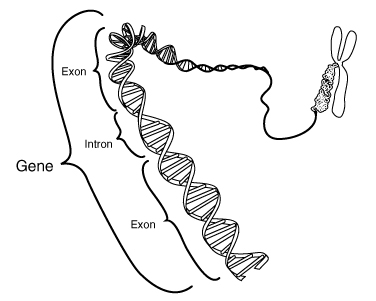
    The brief provides a good example of the constitutional and
    jurisprudential deficiencies in the Plaintiffs' arguments.  The risk, of course, is that Judge Sweet
    will grant the Office's motion, thus removing any incentive for the Office to
    weigh in on the substantive question raised in Plaintiffs' summary judgment
    brief — that the patents on the BRCA1 and BRCA2 genes were improperly
    granted.  No matter what decision
    the parties receive from the Judge, the case will be appealed and eventually
    reach a petition for certiorari.  At that point, it is likely that the Solicitor General will set out the
    Administration's position on the patent-eligibility of isolated human DNA.  But it could be helpful to have the
    Office's arguments before the case gets to that point.

    For
    information regarding this and other related topics, please see:


    "Gene Patenting: Australian Potpourri," December 28, 2009

    "Science Progress Article Examines Impact of Gene Patents on Research,"
    December 21, 2009

    "Gene Patenting Debate Continues – Round Three," December 17, 2009

    "BRCA Patent Suit to Continue in Southern District of New York,"
    November 2, 2009

    "Empirical Research Fails to Support Gene Patenting Ban," October 22,
    2009

    "The Tragedy of a Bad Idea," August 25, 2009

    "Gene Patenting Debate Continues – Round Two," August 4, 2009

    "The Unwanted Consequences of Banning Gene Patenting," June 16, 2009

    "Falsehoods, Distortions and Outright Lies in the Gene Patenting Debate,"
    June 15, 2009

    "Gene Patenting Debate Continues," June 9, 2009

    "Association for Molecular Pathology v. U.S. Patent and Trademark Office,"
    May 17, 2009

    "Court Report: Special Edition," May 13, 2009

    "BIO IP Policy Briefing," May 11, 2009

    "Gene Patenting and the Wisdom of Judge Lourie," April 12, 2009

    "The Effects of Intellectual Property Protection on Agricultural Research:
    Patents Are Not The Problem
    ," February 3, 2009

    "Newsweek Joins the Anti-patent Bandwagon," January 26, 2009