• By Donald Zuhn

    Earlier today, the American Intellectual Property Law Association (AIPLA), Intellectual Property Owners Association (IPO), Licensing Executives Society (LES) International, LES USA & Canada, and New York Intellectual Property Association (NYIPLA) issued a joint statement expressing their concern regarding reports that the European Union, India, South Africa, and United States had reached a tentative compromise on a proposed TRIPS waiver of intellectual property rights (see "More on Leaked WTO COVID-19 Vaccine Patent Waiver Compromise").  The group indicated that they "strongly support equitable, widespread and successful distribution of vaccines necessary to meet the challenges of COVID-19," but argued that "the proposal currently being reported incorrectly portrays IP as a barrier to production and supply of COVID-19 vaccines," adding that they "know of no evidence to support that IP is such a barrier."  Instead, the group cites a recent statement from the World Health Organization (WHO) that "there is enough [vaccine] supply to achieve our targets . . . [and that t]his is not a supply problem; it's an allocation problem."  The group then suggests that "[s]olving the allocation problem is best accomplished by focusing on improvements to supply chain and distribution issues, rather than by concentrating on the red herring of intellectual property as an alleged barrier."

    IP Associations

    For additional information regarding this topic, please see:

    • "More on Leaked WTO COVID-19 Vaccine Patent Waiver Compromise," March 21, 2022
    • "Compromise Reportedly Reached on COVID-19 Vaccine Patent Waiver," March 16, 2022
    • "Sen. Tillis Writes to U.S. Trade Representative (Again) Regarding TRIPS Waiver," December 12, 2021
    • "U.S. Trade Representative Responds to Letters from Senators Regarding TRIPS Waiver," November 14, 2021
    • "U.S. Chamber of Commerce Urges Administration to 'Double Down' on Global Vaccine Distribution," November 3, 2021
    • "Is This the WTO Waiver End Game?" July 25, 2021
    • "BIO Declaration on Global Access to COVID-19 Vaccines and Treatments and Role of IP," June 24, 2021
    • "GOP Legislators Write in Opposition to Proposed TRIPS Waiver," May 16, 2021
    • "Population of Patents at Risk from Proposed WTO Patent Waiver," May 12, 2021
    • "Sen. Daines Urges Biden Administration to Withdraw Support for COVID-19 IP Waiver," May 12, 2021
    • "Pfizer CEO Pens Open Letter on COVID-19 Vaccine IP Waiver," May 10, 2021
    • "If the Devil of the WTO IP Waiver Is in the Details, What Are the Details?" May 9, 2021
    • "The Road to Hell Is Paved with What Everybody Knows," May 6, 2021
    • "BIO & IPO Issue Statements on Biden Administration's Support for Proposed WTO Waiver," May 6, 2021
    • "Biden Administration Supports Waiver of IP Protection for COVID-19 Vaccines," May 5, 2021
    • "Suspending IP Protection: A Bad Idea (That Won't Achieve Its Desired Goals)," April 26, 2021
    • "Sen. Tillis Asks Biden Administration to Oppose WTO Waiver Proposal," April 21, 2021
    • "IP Organizations Support Continued Opposition to Waiver Proposal," April 5, 2021
    • "Industry Coalition Supports Continued Efforts to Oppose Waiver Proposal," March 29, 2021
    • "BIO and PhRMA Urge Biden Administration to Oppose Proposed WTO TRIPS Waiver," March 11, 2021
    • "IPO Sends Letter on IP Law and Policy to President-Elect and Vice President-Elect," January 4, 2021

  • By Michael Borella

    Federal Circuit SealThere is a theme running through many patent-eligibility disputes that is analogous to baiting-and-switching.  One party has claims that recite an invention.  The other party characterizes those claims at a high level or generalizes them to the point that much of the actual claim language is largely ignored.  Then, the other party argues that the claims as generalized — their patent-eligibility alter ego — are invalid under 35 U.S.C. § 101 for whatever reason.

    This technique can be remarkably effective.  It is also intellectually dishonest, as the thing that is rendered invalid is not what the patentee has claimed, it is the alter ego.  But the alleged invalidity of a claim's alter ego is imputed to the actual claim.  Thus, a claim can be invalid if it can be made to look like something that is invalid, rather than actually being invalid itself.  In the worst case, an otherwise valid claim can be rendered invalid through this argumentative technique.

    One might think that patent challengers would not get away with such pulling of the wool over a court's eyes very often.  But that would be incorrect.  This dubious practice has been a winning argument in the Federal Circuit so many times that it is now firmly baked into § 101 jurisprudence.

    Case in point, Repifi sued Intellicentrics in the Eastern District of Texas, alleging infringement of U.S. Patent No. 10,304,268.  The District Court found the claims ineligible for patenting under § 101, and dismissed the case on the pleadings.  Repifi appealed.

    In Alice Corp. v. CLS Bank Int'l, the Supreme Court set forth a two-part test to determine whether claims are directed to patent-eligible subject matter under § 101.  One must first decide whether the claim at hand involves a judicially-excluded law of nature, a natural phenomenon, or an abstract idea.  If so, then one must further decide whether any element or combination of elements in the claim is sufficient to ensure that the claim includes an inventive concept amounting to significantly more than the judicial exclusion.  But elements or combinations of elements that are well-understood, routine, and conventional will not lift the claim over the § 101 hurdle.  While this inquiry is generally carried out as a matter of law, factual issues can come into play when determining whether something is well-understood, routine, and conventional.

    In practice, either part of the Alice test can be satisfied when a claim recites a specific, technical advance over the prior art.  The Federal Circuit made this explicitly clear for part two in Dropbox Inc. v. Synchronoss Techs. Inc., holding that "an inventive concept exists when a claim recites a specific, discrete implementation of the abstract idea where the particular arrangement of elements is a technical improvement over the prior art."  Similar reasoning can be pieced together for part one through a synthesis of Federal Circuit decisions since 2014.

    Claim 1 of the '268 patent was deemed representative.  Its actual claim language recites:

    1.  A method for credentialing visitors to an access-controlled environment by an access administrator, comprising the steps of:
        (a) providing a smart-phone based credentialing platform having global positioning system (GPS) capability;
        (b) providing an electronic badge having a display having electronically controlled and changeable indicia thereon, the badge adapted communicate with a smart-phone;
        (c) enrolling a visitor into the credentialing platform by entering visitor information based on requirements of the administrator;
        (d) approving, by the administrator, that the requirements of the step of enrolling are met;
        (e) requesting, by the visitor, at least one location for which access is desired and submitting the at least one location to the administrator via the credentialing platform, said location having a pre-defined area;
        (f) approving, by the administrator, the request for access at the at least one location;
        (g) checking in on the smart-phone, by the visitor, via the credentialing platform, to establish check-in data including check-in time and date by the visitor, wherein the check-in data is recorded by the credentialing platform;
        (h) communicating between the smart-phone and the electronic badge, indicia data for forming a display image on the display on the electronic badge;
        (i) displaying on the badge display indicia showing access by the visitor is authorized to the location during the specific time interval;
        (j) recording, by the credentialing platform, geo-location data of the visitor during the visitor's presence in the pre-defined area;
        (k) checking out of the system when the visitor departs the pre-defined area of the at least one location, establishing check-out data, including checkout time and date and geo-location;
        (l) recording, by the credentialing platform, the check-in data, the geo-location data and the checkout data of the visitor; and
        (m) removing from the badge display, the indicia showing access by the visitor is authorized.

    Right out of the gate, the Court noted that "[t]he parties agree that the claimed invention relates to the field of managing visitor access to access-controlled environments like hospitals, health care facilities, office buildings, and the like."  That characterization should send off warnings to the § 101-cautious, as it describes the invention's business and administrative contribution rather than its technical contribution.

    Nonetheless, the Federal Circuit went on to apply part one of Alice.  In doing so, it agreed with the District Court that the patent is directed to "the abstract idea of credentialing visitors and checking them in and out of an access-controlled environment."

    And there we have the alter ego.  The Court found that this alter ego of the claims was "a well-established business practice, a method for organizing human activity, and an abstract idea."  The Court went on to state "the automation of the credentialling process using existing technology such as smart phones and electronic badges . . . does not save claim 1 from targeting an abstract concept," and that "the automation of this conventional human process to make it more efficient is itself an abstract idea."

    And that was it for part one.  When viewed at such a high level, the claim's alter ego does seem abstract.  But that abstraction was introduced by the Court rather than the claim itself.  Do conventional credentialing processes include the checking in, communicating, and displaying steps as claimed?  If findings of fact were made, they are not in this decision.  Consequently, we are left with circular reasoning — the claim is abstract because the Court only considers an abstracted version of it.

    Moving on to part two of Alice, the Court — to its credit — considered at least some of the claim language.  It noted that "the '268 patent specification acknowledges that an electronic badge is a well-known device that can, for example, be implemented using a commercially available smart card" and that these devices could communicate with smartphones.  But then the Court concludes that "the claims merely recite the use of conventional abilities of a conventional electronic badge."

    On its face, the Court's reasoning is problematic and conclusory.  The mere existence of smart cards that can communicate with smartphones does not establish that that all features of the checking in, communicating, and displaying are well-understood, routine, or conventional.  The Court goes on to dismiss Repifi's arguments regarding the improvements provided by the invention stating "we agree with the district court that these advantages and improvements identified in the specification all stem from the automation of a historically human process and cannot save the claims at Alice step two."

    In other words, even if the invention does provide improvements over the prior art, the improvements are still abstract.  Or, you don't get an inventive concept from the combination of abstract ideas.

    So the Court finds the alter ego invalid, and the claim falls with it.  The suit was dismissed on a Rule 12(b)(6) motion, with the asserted claims affirmed as invalid.  Their crime?  Being able to be too easily fictionalized.

    Repifi Vendor Logistics, Inc. v. Intellicentrics, Inc. (Fed. Cir. 2022)
    Nonprecedential disposition
    Panel: Circuit Judges Taranto, Hughes, and Stoll
    Opinion by Circuit Judge Stoll

  • By Donald Zuhn –-

    USPTO SealEarlier this month, the U.S. Patent and Trademark Office announced that it was terminating engagement with officials from the Russian Federal Service for Intellectual Property (Rospatent) and Eurasian Patent Organization (EAPO), per guidance issued by the U.S. Department of State (see "USPTO Terminates Engagement with Rospatent and EAPO").  Nearly a week later, the USPTO announced that it would no longer grant requests to participate in the Global Patent Prosecution Highway (GPPH) at the USPTO when such requests are based on work performed by Rospatent as an Office of Earlier Examination under the GPPH (see "USPTO Terminates PPH with Rospatent and Terminates Engagement with NCIP").  The USPTO also announced at that time that it had terminated engagement with officials from the national intellectual property office of Belarus (i.e., the National Center of Intellectual Property (NCIP)).

    In a USPTO Alert email distributed earlier today, the Office advised stakeholders that questions regarding dealings with Rospatent should be directed to the U.S. Department of the Treasury's Office of Foreign Assets Control (OFAC) via email at OFAC_Feedback@treasury.gov.  The Office also advised Applicants filing international applications under the Patent Cooperation Treaty (PCT) to exercise caution before selecting Rospatent as an International Searching Authority (ISA) or International Preliminary Examining Authority (IPEA), explaining that "[d]oing so may prevent successful processing of international applications under the PCT, including the transmittal of fees through financial institutions."  The USPTO updated its guidance statement regarding engagement with Rospatent, EAPO, and NCIP to include the above advice.

    For additional information regarding this and other related topics, please see:

    • "Georgian and Estonian Patent Offices Join Other IP Offices in Expressing Support for Ukraine," March 13, 2022
    • "Several Law Firms Close Russian Offices," March 13, 2022
    • "Russia Permits Uncompensated Use of Certain Patents without Patentee Consent," March 11, 2022
    • "Lithuanian Patent Office and EUIPO Join Other Patent Offices in Expressing Support for Ukraine," March 10, 2022
    • "USPTO Terminates PPH with Rospatent and Terminates Engagement with NCIP," March 10, 2022
    • " Life Sciences Business Leaders Call for Immediate and Complete Economic Disengagement from Russia," March 9, 2022
    • "PRH Joins Other Patent Offices in Expressing Support for Ukraine," March 9, 2022
    • "USPTO Terminates Engagement with Rospatent and EAPO," March 7, 2022
    • "Ukrpatent Continues Normal Operations Despite Russian Aggression," March 6, 2022

  • By Kevin E. Noonan

    Sigma-AldrichOn February 18th, Senior Party Sigma-Aldrich filed its Opposition to Substantive Preliminary Motion No. 4* from the University of California, Berkeley; the University of Vienna; and Emmanuelle Charpentier (collectively, "CVC"), Junior Party in Interference No. 106,132, wherein CVC moved to add Senior Party Sigma-Aldrich's U.S. Patent Nos. 10,731,181 and 10,745,716 to the interference and designate claims 1-17 of the '181 patent and claims 2-4, 11, 14, 21, and 22 of the '716 patent as corresponding to the Count, pursuant to 37 C.F.R. §§ 41.121(a)(1)(i) and 41.208(a)(2) and Standing Order ("SO") 203.2.  The basis for CVC's Motion No. 4 was that these claims would have been obvious over Count 1 and the Jinek 2012 reference (Jinek et al., 2012, "A Programmable Dual-RNA–Guided DNA Endonuclease in Adaptive Bacterial Immunity," Science 337(6096): 816-21) in light of the Krebber 2000 reference (Krebber and Silver, 2000, "Directing Proteins to Nucleus by Fusion to Nuclear Localization Signal Tags," Methods in Enzymology 327: 283-96) or the Lange 2007 reference (Lange, 2007, "Classical Nuclear Localization Signals: Definition, Function, and Interaction with Importin α," J. Biol. Chem. 282(8): 5101–05).

    CVC identified what it characterizes as only "nominal differences" between the Count and the claims to be designated in these two patents as "the recitation of the well-established Cas9 protein (from S. pyogenes), a well-known nuclear localization signal (a C-terminal SV40 NLS), and the natural and previously disclosed location for the DNA-targeting region (at the 5' end of the guide RNA)."  None of these differences render these claims patentably distinct from the Count, as evidenced CVC argued by "highly similar claims already being involved in this proceeding as part of Sigma's U.S. Application No. 15/456,204."  These claims satisfy the test set forth under 37 C.F.R. § 41.207(b)(2) and Standing Order ¶ 208.3.1 that claims correspond to the Count where "the subject matter of the count, if treated as prior art, would have anticipated or rendered obvious the subject matter of [each] claim."  This test is satisfied if additional references are relied upon to make out a prima facie case of obviousness CVC argued, citing Desjardins v Wax, Interference No. 105,915, Paper 125, 17-20 (P.T.A.B. Jan. 21, 2014).  The basis for CVC's argument that the distinctions set forth above do not render these clams patentably distinct was that these distinctions are found in the cited prior art or were otherwise "well known," the brief setting forth reasons for the Board to reach this conclusion.  Finally, CVC argued there are no objective indicia (or secondary considerations) that would provide the missing distinctions.

    Sigma-Aldrich's Opposition contends that CVC failed to apply the proper "two-way test" for determining whether a claim corresponds to an interference Court.  Sigma-Aldrich cites a decision from the PTAB's predecessor, the Board of Patent Appeals and Interferences, for the definition of "the same patentable invention" as requiring a "two-way obviousness test," citing Winter v. Fujita, 1999 Pat. App. LEXIS 7, *49-50, 53 U.S.P.Q.2d (BNA) 1234, 1248 (BPAI Nov. 16, 1999).  Noting that the rules for patent interferences were changed in 2004, Sigma-Aldrich sets forth the current rules as follows:

    • A party may suggest the addition of a patent or application to the interference or the declaration of an additional interference.  The suggestion should make the showings required under §41.202(a) of this part.  37 C.F.R. §41.203(d) [emphasis added].

    • For each count, provide a claim chart comparing at least one claim of each party corresponding to the count and show why the claims interfere within the meaning of §41.203(a).  37 C.F.R. §41.202(a) [emphasis added].

    • Interfering subject matter.  An interference exists if the subject matter of a claim of one party would, if prior art, have anticipated or rendered obvious the subject matter of a claim of the opposing party and vice versa.  37 C.F.R. §41.203(a) [second emphasis added].

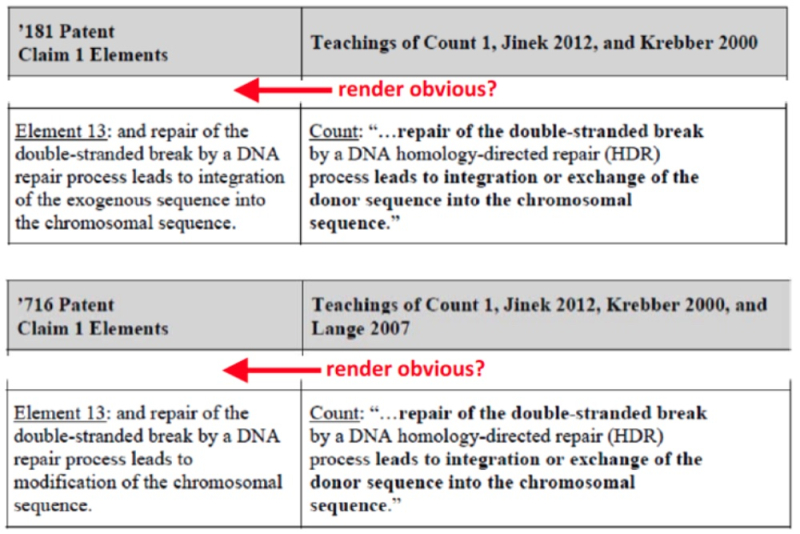
    And illustrates application of these rules in Ledenev v. Adest, 2020 Pat. App. LEXIS 6912, *35-36, Decision on Motions, at 31, 35 (PTAB Mar. 25, 2020) (JTM) (In moving to add patents to an interference, "[t]he standard to be applied is whether the claim is patentably distinct from the Count . . . .  [T]he burden placed upon movant [is] to compare the claims to the count in the required two way analysis.").  Sigma-Aldrich also notes (in a footnote) in this regard that "[t]he authority cited by CVC [37 C.F.R. § 41.207(b)(2) ("Claim correspondence"); Standing Order 208.3.1 ("Claim correspondence")] is directed to the analysis of whether a claim of an already involved patent or application corresponds to the interference count."  Such a one-way test would be appropriate, Sigma-Aldrich argues, only for showing claim correspondence to an interference Count for claims of an already-involved patent or application.  Applying the two-way obviousness test, Sigma-Aldrich's brief illustrates CVC's purported error with regard to "Element 13" for claims in both Sigma-Aldrich's '181 and '716 patents:

    Image 1
    Sigma-Aldrich further argues in this regard that what CVC set forth in its Motion No. 4 is whether the narrower interference Count would render obvious the '181 or '716 patent claims.  What CVC failed to do was the converse assessment, whether "the broader claim render[s] obvious the narrower Count" (emphasis in brief).

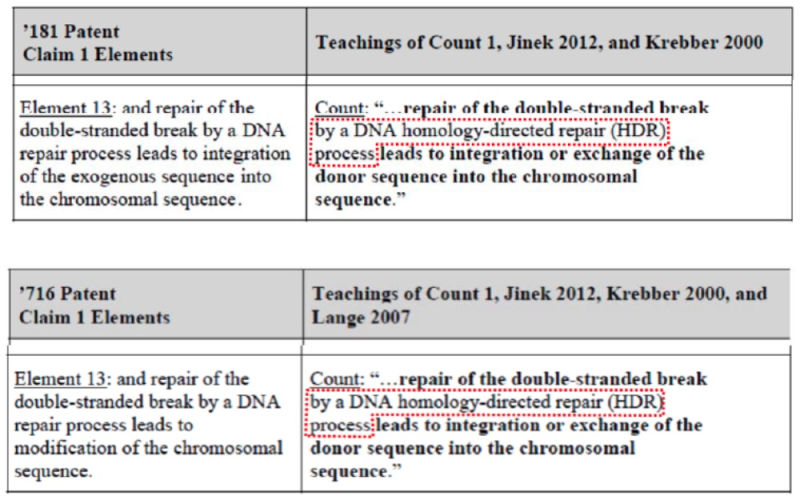
    In addition, Sigma-Aldrich argues that CVC failed to assert whether the "homology-dependent repair (HDR)" aspects of the Count would have been non-obvious when considered in view of Element 13 of the '181 and '716 patent claims:

    Image 2
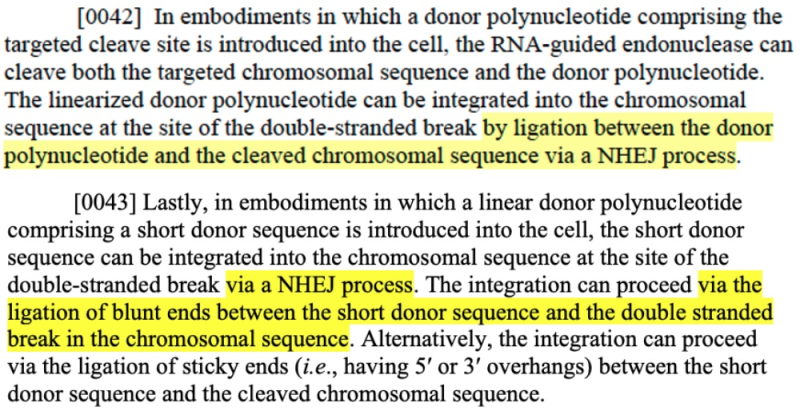
    (Sigma-Aldrich noting that, unlike other portions of the Count and prior art, CVC did not emphasize language relating to this aspect in its analysis.)  Sigma-Aldrich also asserts that "none of the Sigma Patents claims recite a homology-directed repair (HDR) process," being directed (more broadly) to "repair of the double-stranded break by a DNA repair process" and, in its P1 provisional (Application No/ 61/734,256, filed December 6, 2012) disclosing "non-HDR processes" involved in DNA repair (emphasis in brief).  These processes included non-homologous end joining (NHEJ), illustrated with these examples:

    Image 3
    Sigma-Aldrich also criticizes CVC's description of the contents of the Jinek (2012) reference, which Sigma-Aldrich contends contain "no teachings about cleaving eukaryotic DNA."

    Sigma-Aldrich also argues that CVC has been "on notice" from both its positions in its List of Proposed Motions and the Board regarding the patentable distinctions between what it terms "cleavage" embodiments of eukaryotic CRISPR and "cleavage + integration" embodiments.  Similarly, Sigma-Aldrich contends, the Board in its "Order Authorizing Motions" drew similar distinctions with regard to its basis for authorizing Sigma-Aldrich to file its Motion No. 1 to Substitute Proposed Count 2.  And, Sigma-Aldrich argues, both CVC Claim 164 and Sigma Claim 31 (comprising separate portions of the McKelvey Count in the Interference as declared) "expressly recite [a] limitation directed to cleavage plus integration via HDR."  In view of such notice, Sigma-Aldrich argues that "CVC has no justifiable excuse for failing to address that fundamental issue in its CVC Motion 4."

    Sigma-Aldrich also contends that CVC's Motion No. 4 would become moot should the Board grant its Preliminary Motion No. 1 to change the Count.  This is because, inter alia, CVC did not address Sigma-Aldrich's Proposed Count 2 in its Motion No. 4 nor did CVC file a responsive motion to add Sigma-Aldrich's U.S. Patent Nos. 10,731,181 and 10,745,716.

    The brief concludes with citations to the interference rules and the regard showing that the Board can in its discretion under the circumstances in this interference deny CVC's Motion No. 4, which Sigma-Aldrich asks them to do.

    * CVC captioned this as a Miscellaneous Motion.

  • By Donald Zuhn

    WTO logoA Reuters report published last week indicated that the United States, European Union, India, and South Africa had reached an agreement on a waiver with respect to patents for COVID-19 vaccines.  The text of the compromise proposal, however, was not released.  Following the announcement of the compromise, both the Biotechnology Innovation Organization (BIO) and U.S. Chamber of Commerce issued statements on the reported compromise (see "Compromise Reportedly Reached on COVID-19 Vaccine Patent Waiver").

    Earlier today, BIO provided a link to the alleged compromise in its daily email newsletter.  The "TRIPS COVID-19 solution," if approved by World Trade Organization (WTO) members, would allow "an eligible Member [to] authoriz[e] the use of patented subject matter required for the production and supply of COVID-19 vaccines without the consent of the right holder to the extent necessary to address the COVID-19 pandemic."  The compromise defines "eligible Member" as "any developing country Member that exported less than 10 percent of world exports of COVID-19 vaccine doses in 2021," and defines "patented subject matter" as "includ[ing] ingredients and processes necessary for the manufacture of the COVID-19 vaccine."

    Under the compromise, eligible Members could authorize the use of patented subject matter "through any instrument available in the law of the Member such as executive orders, emergency decrees, government use authorizations, and judicial or administrative orders, whether or not a Member has a compulsory license regime in place."  The compromise permits "a single authorization to use the subject matter of multiple patents necessary for the production or supply of a COVID-19 vaccine," and would require eligible Members to "communicate to the Council for TRIPS any . . . granting of an authorization," and "list all patents covered" by the authorization.  Eligible Members would not have to require "the proposed user of the patented subject matter to make efforts to obtain an authorization from the right holder," and could "allow any proportion of the authorized use to be exported to eligible Members," provided that they "undertake all reasonable efforts to prevent the re-exportation of the COVID-19 vaccine that has been imported into their territories."  The compromise proposal also states that "[n]o later than six months from the date of this Decision, Members will decide on its extension to cover the production and distribution of COVID-19 diagnostics and therapeutics."

    In a statement issued by WTO Director-General Ngozi Okonjo-Iweala on March 16, the Director-General "warmly welcomed the breakthrough," calling the compromise "a major step forward," but cautioning that "not all the details of the compromise have been ironed out."

    A statement from the Office of the U.S. Trade Representative indicated that the compromise proposal "offers the most promising path toward achieving a concrete and meaningful outcome," noting that "[w]hile no agreement on text has been reached and we are in the process of consulting on the outcome, the U.S. will continue to engage with WTO Members as part of the Biden-Harris Administration's comprehensive effort to get as many safe and effective vaccines to as many people as fast as possible."

    In its latest report regarding the waiver compromise, BIO provided reactions from Steve Bates, CEO of the UK Bioindustry Association and Chair of the International Council of Biotechnology Associations (ICBA), which includes BIO, who argued that the proposal would "have a chilling impact on investment into the small companies that have been at the heart of the solutions to COVID-19," adding that the proposal "directly threatens this innovative ecosystem's ability to attract the capital needed to develop next generation of vaccines whilst doing nothing to solve the access challenges we have in 2022."  Mr. Bates also noted that the biotech industry manufactured more than 11 billion vaccine doses in 2021, and stated that "[w]eakening IP rights does nothing to facilitate the distribution of these manufactured vaccines to people around the world who most need them—rather prioritizing addressing healthcare infrastructure and vaccine hesitancy in the developing world would lead to more shots in arms."  BIO Deutschland Chair Oliver Schacht suggested that the proposal "would jeopardize drug development with respect to other research areas, since drugs and vaccines are protected not only by one patent but by a whole bundle of patents, with individual patents in such a bundle in turn often protecting other drugs and vaccines."  BIO noted that the waiver compromise was "not a done deal," and that BIO would be "keeping a close eye on it."

    The Pharmaceutical Research and Manufacturers of America (PhRMA) and Médecins Sans Frontières have also provided statements on the compromise proposal.  PhRMA stated that:

    The fact remains that efforts to waive intellectual property commitments are unnecessary and harmful to our collective work to end the pandemic.  Strong intellectual property protections, voluntary technology transfers and partnerships are on target to facilitate the production of more than 20 billion doses in 2022 – more than enough to vaccinate the world – without confiscating intellectual property.  Global leaders should now focus on the real challenges of distributing and administering vaccines to people around the world.

    Médecins Sans Frontières (Doctors Without Borders) contended that "WTO members should remain vigilant to the fact that this leaked text contains considerable limitations, and needs to be urgently improved," arguing that "[i]t is incredibly concerning that the leaked text currently only covers vaccines, but neither treatments nor diagnostics."

    For additional information regarding this topic, please see:

    • "Compromise Reportedly Reached on COVID-19 Vaccine Patent Waiver," March 16, 2022
    • "Sen. Tillis Writes to U.S. Trade Representative (Again) Regarding TRIPS Waiver," December 12, 2021
    • "U.S. Trade Representative Responds to Letters from Senators Regarding TRIPS Waiver," November 14, 2021
    • "U.S. Chamber of Commerce Urges Administration to 'Double Down' on Global Vaccine Distribution," November 3, 2021
    • "Is This the WTO Waiver End Game?" July 25, 2021
    • "BIO Declaration on Global Access to COVID-19 Vaccines and Treatments and Role of IP," June 24, 2021
    • "GOP Legislators Write in Opposition to Proposed TRIPS Waiver," May 16, 2021
    • "Population of Patents at Risk from Proposed WTO Patent Waiver," May 12, 2021
    • "Sen. Daines Urges Biden Administration to Withdraw Support for COVID-19 IP Waiver," May 12, 2021
    • "Pfizer CEO Pens Open Letter on COVID-19 Vaccine IP Waiver," May 10, 2021
    • "If the Devil of the WTO IP Waiver Is in the Details, What Are the Details?" May 9, 2021
    • "The Road to Hell Is Paved with What Everybody Knows," May 6, 2021
    • "BIO & IPO Issue Statements on Biden Administration's Support for Proposed WTO Waiver," May 6, 2021
    • "Biden Administration Supports Waiver of IP Protection for COVID-19 Vaccines," May 5, 2021
    • "Suspending IP Protection: A Bad Idea (That Won't Achieve Its Desired Goals)," April 26, 2021
    • "Sen. Tillis Asks Biden Administration to Oppose WTO Waiver Proposal," April 21, 2021
    • "IP Organizations Support Continued Opposition to Waiver Proposal," April 5, 2021
    • "Industry Coalition Supports Continued Efforts to Oppose Waiver Proposal," March 29, 2021
    • "BIO and PhRMA Urge Biden Administration to Oppose Proposed WTO TRIPS Waiver," March 11, 2021
    • "IPO Sends Letter on IP Law and Policy to President-Elect and Vice President-Elect," January 4, 2021

  • By Kevin E. Noonan

    Sigma-AldrichOn February 18th, Senior Party Sigma-Aldrich filed its Opposition to Substantive Preliminary Motion No. 3 from the University of California, Berkeley; the University of Vienna; and Emmanuelle Charpentier (collectively, "CVC"), Junior Party in Interference No. 106,132, wherein the Junior Party moved to change the interference Count pursuant to 37 C.F.R. §§ 41.121(a)(1)(iii) and 41.208(a)(1).

    The basis for CVC's motion was to change the Count to be limited to so-called "single (RNA) molecule guide RNA (sgRNA) species."  CVC argued that substituting this Count is more symmetrical with CVC's portion of the Count and "avoids inconsistency" with the Counts in related interferences (see "CRISPR Battle Joined Again"; "The CRISPR Chronicles: Enter Toolgen"; and "Sigma-Aldrich Joins the CRISPR Interference Fray").

    Sigma-Aldrich responds in its Opposition that, contrary to any nebulous (and "self-serving") "inconsistency," what CVC is actually trying to accomplish is to prevent Sigma-Aldrich from asserting its "best proofs" in the interference.  Sigma-Aldrich contends it is the only party in any of the pending interferences — CVC, ToolGen, and Broad — having proofs of reducing to practice CRISPR in eukaryotic cells having both single-molecule RNA (sgRNA) and dual-molecule ("dgRNA") RNA species.  CVC's proposed motion on its face and according to its arguments in its Motion No. 3 would change the Count to exclude dual-molecule RNA-comprising eukaryotic CRISPR.  Sigma-Aldrich argues that any concerns CVC asserts regarding "inconsistency" and "the public interest" would be served by the Board granting its own Motion No. 1 (while characterizing CVC's concerns in this regard as being "á la Chicken Little's dire predictions, . . . highly remote and purely speculative at best."  Also raising questions about CVC's "ulterior motives," Sigma-Aldrich contends that CVC's proposed Count would "not []enable CVC to better make out CVC's priority case, but instead [would] hamstring Sigma from making out Sigma's priority case" which "is not a legitimate basis to seek to change the count."

    CVC has not carried its burden in making a showing that they are entitled to the relief sought, Sigma-Aldrich argues, because they have failed to assert the conventional basis for such a motion — that it would enable CVC to proffer its best proofs in the interference.  Instead, CVC asks the Board to alter the Count on the portion of the "McKelvey" Count taken from Sigma-Aldrich's claims, which request is but a "strategic maneuver to try to prejudice Sigma's ability to proffer its proofs of invention."  And there is no dispute raised by CVC that Sigma-Aldrich's best proofs encompass eukaryotic CRISPR claims generic to the type of guide RNA molecule it contains, Sigma-Aldrich notes, because CVC's own Motion No. 3 expressly recites such a concession.  These purported proofs comprise data in addition to FACS data provided for both guide RNA types, data which Sigma-Aldrich describes as "additional and confirmatory PCR data" (emphasis in brief) which is specifically provided for dgRNA (and not sgRNA) embodiments.  According to Sigma-Aldrich, "CVC's strategic goal of its Motion 3 is an unfair (and thinly disguised) attempt to prejudice Sigma's ability to rely upon Sigma's dgRNA PCR confirmation data as a component of Sigma's proofs of invention," and "[t]he remainder of CVC's arguments, directed to supposed 'uniformity' among the various interferences, and the 'public interest,' are all smoke and mirrors designed to disguise CVC's true objective here, namely, to unfairly preclude Sigma from relying upon the entirety of the data from Sigma's successful experiments."

    Sigma-Aldrich also asserts that there is a bit of rhetorical legerdemain in CVC's arguments to the extent CVC argues that "Sigma's proofs appear to be identical either way" (which Sigma-Aldrich disputes) (emphasis in brief).  Sigma-Aldrich contends that CVC is well aware that its proofs regarding sgRNA and dgRNA are not "identical" based on an Opposition between the parties in a European Opposition, captioned thusly:
    Image 1
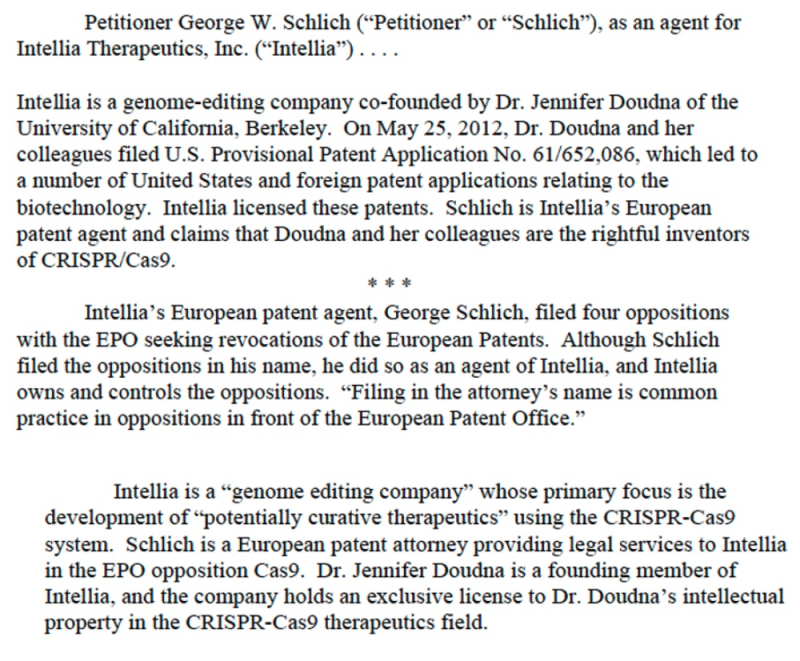
    CVC's European representative, Mr. Schlich, was a "strawman" in the Opposition (which is perfectly acceptable in EPO practice).  But Sigma-Aldrich sets out evidence (from "U.S. litigation proceedings," In re Schlich, Case No. 16-MC-319 (VSB) (S.D.N.Y. Sept. 18, 2017)) that he was in fact representing a CVC licensee, Intellia, a company having CVC inventor Jennifer Doudna as a principal:

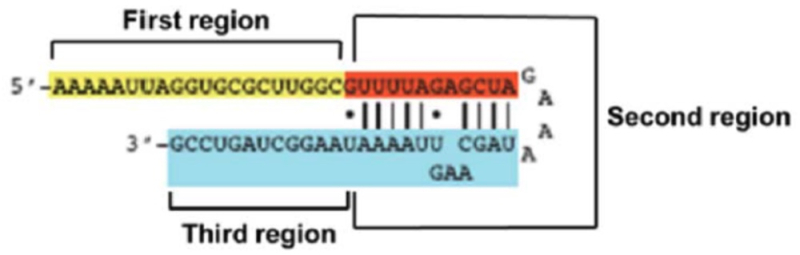
    Image 2Tying up this evidence neatly, Sigma-Aldrich shows that, in the European Opposition CVC was well aware of the dgRNA embodiments it contends "apparently" are not at issue in this interference with regard to CVC's motion to change the Count, particularly with reference to "Lane A" which involves eukaryotic CRISPR results obtained using dgRNA:

    Image 3
    Sigma-Aldrich also asserts that CVC's arguments regarding its eukaryotic CRISPR embodiments incorrectly ascribe to Sigma's disclosure sgRNA species that are actually disclosed in its own Jinek et al. Science article (and will be familiar to readers following Interference No. 106,115, wherein the Board recently awarded priority to Broad), as shown in this figure:

    Image 4
    Sigma-Aldrich further contends that CVC's expert, Dr. Bailey conceded during cross-examination that Sigma-Aldrich's P1 application (61/734,256) disclosed dgRNA embodiments of eukaryotic CRISPR used to practice CRISPR in eukaryotic cells.

    Sigma-Aldrich also argues that CVC's Motion No. 3 would be moot should the Board grant Sigma-Aldrich's own motion (No. 1) to change the Count, providing a colorful comparison regarding CVC's portion of the Count in this interference between CVC's proposed Count and Sigma-Aldrich's:

    Image 5 Image 6
    Sigma-Aldrich takes the time in its Opposition to distinguish CVC's citation to precedent, In re Vivint, 14 F.4th 1342 (Fed. Cir. 2021), as being unavailing because that case was not an interference case and involved denial of an ex parte reexamination request that was "essentially identical" to a denied inter partes review petition.

    Finally, Sigma-Aldrich argues that neither CVC's P1 nor P2 provisional applications provide a constructive reduction to practice of any embodiment falling within the scope of the proposed substitute Count in its Motion No. 3, citing Sigma-Aldrich's Opposition to CVC's Motion No. 1 (which recites many of the same arguments the Board found persuasive in awarding priority to Broad in the '115 Interference).

    Sigma-Aldrich accordingly asks the Board to deny CVC's Substantive Preliminary Motion No. 3.

  • CalendarMarch 22, 2022 – "The European Unitary Patent and Unified Patent Court: What Are They, When Are They Happening, and How Should I Prepare?" (Schwegman Lundberg & Woessner) – 12:00 pm (CT)

    March 23, 2022 – "Getting Your First Filing Right" (HGF Ltd) – 3:00 pm (GMT)

    March 23, 2022 – "Advanced Patent Search Strategies: What to Use When All Else Fails," Part I (Patent Information Users Group, Inc.) – 11:00 am to 12:00 pm (EDT)

    March 24, 2022 – "China IP: Quarterly Legislation and Case Law Update" (U.S. Patent and Trademark) – 1:00 pm to 2:00 pm (ET)

    April 6, 2022 – "Advanced Patent Search Strategies: What to Use When All Else Fails," Part II (Patent Information Users Group, Inc.) – 11:00 am to 12:00 pm (EDT)

    April 26-27, 2022 – Paragraph IV Disputes Conference (American Conference Institute) – New York City

  • Schwegman Lundberg WoessnerSchwegman Lundberg & Woessner will be offering a webinar entitled "The European Unitary Patent and Unified Patent Court: What Are They, When Are They Happening, and How Should I Prepare?" on March 22, 2022 at 12:00 pm (CT).  Jeff Cobia and Paul Urbanski of Schwegman Lundberg & Woessner will moderate a presentation by Tom Hamer and Emily Collins of Kilburn & Strode LLP, who will cover the basics of the UP/UPC, the decision points to take into account when planning your UP/UPC strategy, and the actions that should be taken now to prepare for the new system.  The webinar will cover:

    • UP and UPC: the basics and the background
    • Should applicants request Unitary Patents?
    • Should applicants opt out of the jurisdiction of the UPC?
    • What should applicants be doing now to prepare

    While there is no cost to participate in the program, those interested in attending the webinar can register here.

  • HGFHGF Ltd will be offering a webinar entitled "Getting Your First Filing Right" on March 23, 2022 at 3:00 pm (GMT).  Claire Irvine and Kerry Rees of HGF will cover the considerations required at the first filing stage to align patenting strategy with commercial strategy and minimise problems arising from both formal and content issues; cover such issues as the evidence required to get over the plausibility hurdle in relation to inventive step and sufficiency as applied to compound and therapeutic use claims, as well as formal considerations such as where to file and who should file, often especially important considerations in the case of collaborative projects involving inventors outside the UK; and also deal with how to ensure you keep priority of a first filing both legally and to maximise disclosure benefit.

    Those wishing to register can do so here.

  • PIUGPatent Information Users Group, Inc. (PIUG) will be offering a two-part webinar series entitled "Advanced Patent Search Strategies: What to Use When All Else Fails" on March 23 and April 6, 2022.  Both sessions will be held from 11:00 am to 12:00 pm (EDT).  Ron Kaminecki will discuss advanced search strategies to try when you have used the typical search methods and you want to make sure you did not miss something important — typical search methods including keywords, classification codes, citations, and advanced systems will be briefly reviewed, with the main focus being what to do after using these initial strategies.  The two-part webinar covers multiple techniques including:

    • The Building Block Approach: categorizing concepts to modify a strategy
    • Successive Fractions: paring a search down by concepts
    • Recombination of Elements:  narrowing  piecemeal results to avoid duplicates
    • Terms of Art: identifying the most important terminology
    • Linking: extending the search to  other database sources
    • Pearl Growing: expanding results starting with only a single result
    • Cherry Picking: using a few documents to locate more information
    • Analogous Arts: using alternative sources to locate the information

    The registration fee for the webinar is $199 for non-members or $159 for PIUG members.  Those interested in attending the webinar should register here.