•     By Sherri
    Oslick

    Gavel_2About
    Court
    Report:  Each week we will report briefly on recently filed
    biotech and pharma cases.


    Pfizer Inc. et al. v. Mylan Inc. et al.
    1:10-cv-00528; filed June 16, 2010 in the District
    Court of Delaware

    • Plaintiffs:  Pfizer Inc.; Pharmacia & Upjohn
    Co.; Pharmacia & Upjohn Co. LLC; Sugen Inc.; C P Pharmaceuticals
    International CV
    • Defendants:  Mylan Inc.; Mylan Pharmaceuticals
    Inc.

    Infringement of U.S. Patent Nos. 6,573,293 ("Pyrrole
    Substituted 2-Indolinone Protein Kinase Inhibitors," issued June 3, 2003),
    7,125,905 (same title, issued October 24, 2006), and 7,211,600 ("Methods
    of Modulating c-kit Tyrosine Protein Kinase Function with Indolinone Compounds,"
    issued May 1, 2007) following a Paragraph IV certification as part of Mylan's
    filing of an ANDA to manufacture a generic version of Pfizer's Sutent®
    (sunitinib malate, used to treat gastrointestinal stromal tumor and advanced
    renal cell carcinoma).  View the
    complaint
    here.


    Allergan, Inc. v. Apotex, Inc. et al.
    2:10-cv-00200; filed June 15, 2010 in the Eastern
    District of Texas

    • Plaintiff:  Allergan, Inc.
    • Defendants:  Apotex, Inc.; Apotex Corp.

    Infringement of U.S. Patent Nos. 7,030,149 ("Combination
    of Brimonidine Timolol For Topical Ophthalmic Use," issued April 18,
    2006), 7,320,976 ("Combination of Brimonidine and Timolol For Topical
    Ophthalmic Use," issued January 22, 2008), 7,323,463 (same title, issued
    January 29, 2008) and 7,642,258 (same title, issued January 5, 2010) following
    a Paragraph IV certification as part of Apotex's filing of an ANDA to
    manufacture a generic version of Allergan's Combigan® (brimonidine
    tartrate/timolol maleate ophthalmic solution, used to treat glaucoma).  View the complaint
    here.


    Bayer Schering Pharma AG et al. v. Teva Pharmaceuticals USA,
    Inc. et al.

    1:10-cv-03697; filed June 15, 2010 in the Northern
    District of Illinois

    • Plaintiffs:  Bayer Schering Pharma AG; Bayer
    Healthcare Pharmaceuticals Inc.
    • Defendants:  Teva Pharmaceuticals USA, Inc.; Barr
    Pharmaceuticals LLC; Barr Laboratories, Inc.

    Infringement of U.S. Patent No. 5,569,652 ("Dihydrospirorenone
    as an antiandrogen," issued October 29, 1996) as well as false advertising
    based on defendants' manufacture and sale of its Gianvi product, a generic
    version of Bayer's Yaz® (drospirenone & ethinyl estradiol, used for oral
    contraception).  View the complaint
    here.


    Abbott Laboratories et al. v. Anchen Pharmaceuticals, Inc.
    2:10-cv-03015; filed June 14, 2010 in the District
    Court of New Jersey

    • Plaintiffs:  Abbott Laboratories; Fournier
    Laboratories Ireland Ltd.
    • Defendant:  Anchen Pharmaceuticals, Inc.

    Infringement of U.S. Patent No. 7,259,186 ("Salts
    of Fenofibric Acid and Pharmaceutical Formulations Thereof," issued August
    21, 2007) following a Paragraph IV certification as part of Anchen's filing of
    an ANDA to manufacture a generic version of Abbott's Trilipix® (choline
    fenofibrate delayedrelease, used to treat increased triglyceride levels).  View the complaint
    here.


    Medicis Pharmaceutical Corp. v. Mylan Inc. et al.
    1:10-cv-00524; filed June 14, 2010 in the District
    Court of Delaware

    • Plaintiff:  Medicis Pharmaceutical Corp.
    • Defendants:  Mylan Inc.; Matrix Laboratories
    Ltd.

    Infringement of U.S. Patent No. 5,908,838 ("Method
    for the Treatment of Acne," issued June 1, 1999) following a Paragraph IV
    certification as part of defendants' filing of an ANDA to manufacture a generic
    version of Medics' Solodyn® (minocycline hydrochloride extended release
    tablets, used to treat acne).  View
    the complaint
    here.


    Genzyme Corp. v. Anchen Pharmaceuticals Inc. et al.
    1:10-cv-00512; filed June 10, 2010 in the District
    Court of Delaware

    • Plaintiff:  Genzyme Corp.
    • Defendants:  Anchen Pharmaceuticals Inc.; Anchen
    Inc.

    Infringement of U.S. Patent No. 5,602,116 ("Method
    for Treating and Preventing Secondary Hyperparathyroidism," issued
    February 11, 1997) following a Paragraph IV certification as part of Anchen's
    filing of an ANDA to manufacture a generic version of Genzyme's Hectorol®
    (doxercalciferol, used to treat secondary hyperparathyroidism in patients with
    chronic kidney disease).  View the
    complaint
    here.


  • Calendar

    June
    21-22,
    2010 –
    Follow-on
    Biologics
    (
    American
    Conference
    Institute) –
    New
    York, NY

    June
    20-22,
    2010 –
    IP
    Business Congress
    (
    Intellectual
    Asset
    Management (IAM) magazine) –
    Munich,
    Germany

    June
    23,
    2010 –
    Regulatory
    and Intellectual Property Opportunities and
    Challenges for Life Science Companies Entering the U.S. Market
    (
    American
    Bar Association) –
    12:00
    – 1:30 PM (EST)

    June
    23-24, 2010 –
    Maximising
    Pharmaceutical Patent Life
    Cycles
    (C5) –
    London,
    England

    June
    24, 2010 –
    "Molecular Pathology v. U.S. PTO on Gene Patents" (Law
    Seminars
    International) –
    1:00-2:00
    PM (EDT)

    June
    28-30, 2010 –
    3rd
    Annual Product and Pipeline Enhancement for Generics
    (
    marcus
    evans) –
    Washington,
    DC

    June
    29, 2010 –
    Navigating
    the U.S. Biosimilar Pathway
    (
    American
    Bar Association) –
    1:00
    – 2:30 PM (EST)

    June
    30, 2009 –
    Markman
    Hearings and Claim Construction
    in Patent Litigation 2010
    (
    Practising
    Law
    Institute) –
    New
    York, NY (
    with groupcasts in Atlanta, GA;
    Mechanicsburg, PA; Philadelphia, PA; and
    Pittsburgh, PA)

    July
    7, 2010 –
    Prior
    Art &
    Obviousness 2010: Current Trends
    in Sections 102 & 103
    (
    Practising
    Law
    Institute) –
    New
    York, NY

    July
    7-9, 2010 –
    Fundamentals
    of Patent Prosecution
    2010: A Boot Camp for Claim Drafting & Amendment Writing
    (Practising
    Law
    Institute) – San Francisco, CA

    July
    19-20,
    2010 –
    Hatch-Waxman
    Boot Camp
    *** (
    American
    Conference
    Institute) –
    Boston,
    MA

    July
    29-31, 2010 –
    Intensive
    Patent Law
    Training Workshop
    (Chisum
    Patent Academy) –
    Seattle,
    WA

    August
    18-19, 2010 –
    The
    Life Sciences
    Lawyer's Guide to Patent Term Adjustment and Patent Term Extensions
    ***
    (American
    Conference
    Institute) –
    New
    York, NY

    September
    15, 2010
    Prior
    Art &
    Obviousness 2010: Current Trends
    in Sections 102 & 103
    (
    Practising
    Law
    Institute) –
    San
    Francisco, CA

    ***Patent Docs is a media partner of this conference or CLE


  • LSI - Law Seminars International - red Law
    Seminars International (LSI) will be offering a one-hour telebriefing entitled:
    "Molecular Pathology v. U.S. PTO
    on Gene Patents" on June 24, 2010 from 1:00-2:00 PM (EDT).  Elizabeth Howard of Orrick Herrington
    & Sutcliffe LLP will moderate a panel including Sandra Wells, VP and Chief
    IP Counsel at Affymetrix, and Hans Sauer, Deputy General Counsel for
    Intellectual Property for the Biotechnology Industry Organization (BIO).  The panel will address the recent
    decision in Association for Molecular
    Pathology v. U.S. Patent & Trademark Office
    , specifically discussing
    the implications of this landmark decision and offering practical advice for
    the IP and life sciences communities.

    The
    registration fee is $125 per caller and $50 each additional person on the same
    line who desires continuing education credit.  Those interested in registering for the telebrief, can do so
    here, or by calling
    800-854-8009.


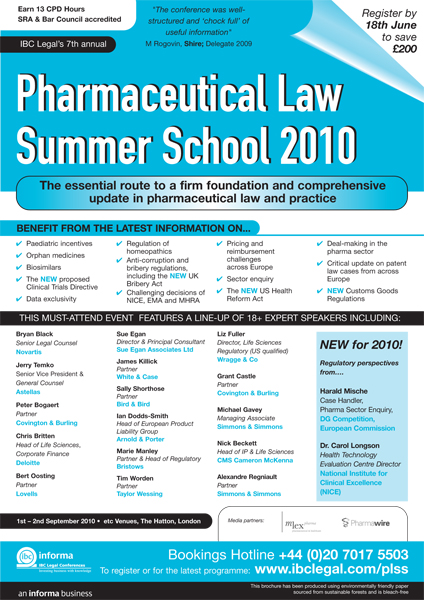
  • Washington - Monument #2 Marcus evans will
    be holding its 3rd Annual Product and Pipeline Enhancement for Generics
    conference on "Navigating Regulatory Pathways and Patent Strategies to
    Ensure Market Sustainability" on June 28-30, 2010 in Washington, DC.  The conference will enable attendees
    to:

    • Achieve effective
    patent strategies and gain knowledge on the most recent cases regarding
    Hatch-Waxman litigation;
    • Hear the latest
    regulations from the U.S. regarding product quality for imported materials;
    • Obtain a better
    understanding on the evolving niche opportunities within the generic
    pharmaceutical market; and
    • Implement a
    global market plan to remain competitive.


    Brochure In particular, the
    conference will offer presentations on the following topics:

    • Modeling a
    settlement of a Hatch-Waxman litigation taking into account any new provisions
    due to the health care effort (conference workshop);
    • Assessing the
    changes within the industry to gauge the new direction of generic
    pharmaceuticals;
    • Highlights of
    recent developments in patent law and generic exclusivity;
    • The MMA "NCE
    minus 1" Hatch-Waxman litigation;
    • Reviewing the
    most recent advancements in patent litigation and determining the impact on the
    generics industry;
    • Use of pharma's
    almanac for opinions to support Paragraph IV certification;
    • Effective
    strategic planning when writing your ANDA to assure approval;
    • Examining the law
    impacting hatch-Waxman litigation: Including significant Federal Circuit
    decisions;
    • Challenges due to
    globalization in the pharmaceutical industry;
    • Employing strong
    market forecasting skills to develop a specialty product portfolio;
    • Role of R&D
    in the evolving generic business scenario;
    • Hosting an FDA
    audit of finished dose manufacturing in China;
    • OK, you have an
    opinion, now how do you evaluate the risk?
    • Delving into
    recent issues with APIs and understanding the instrumental perspective;
    • Recent
    developments in generic first-to-file exclusivity forfeiture decisions;
    • Examining the
    global marketplace for biosimilars to determine viability;
    • Prioritizing
    opportunities and challenges for biosimilars to assess the potential market;
    • Established
    products overview through innovator perspective


    Marcus evans A brochure for this
    conference can be requested here.  The registration fee for the conference
    is $2,500.  Those interested in
    registering for the conference can do so here.

    Patent Docs is a blogging partner of marcus evans' 3rd Annual Product and
    Pipeline Enhancement for Generics conference.

  •     By Donald Zuhn


    Chakrabarty, Ananda In a press release
    issued on Wednesday, the Biotechnology Industry Organization (BIO) recalled the
    Supreme Court's landmark decision in Diamond
    v. Chakrabarty
    ,
    which was issued thirty years ago on June 16, 1980.  In Chakrabarty,
    the Court determined (by a 5-4 vote) that a genetically engineered Pseudomonas bacterium capable of
    breaking down multiple components of crude oil "plainly qualifies" as
    patentable subject matter under 35 U.S.C. § 101 (at right, Dr. Ananda Chakrabarty).  Citing the Senate and House Committee Reports that
    accompanied the 1952 Patent Act, the Court explained that "Congress intended
    statutory subject matter to 'include anything under the sun that is made by
    man," and determined that "[Chakrabarty's] discovery is not nature's
    handiwork, but his own," and therefore constituted patentable subject
    matter under § 101.


    Biotechnology Industry Organization (BIO) In
    BIO's release, BIO President and CEO Jim Greenwood that the Chakrabarty decision "was instrumental
    in spurring the creation of a dynamic and flourishing biotech industry,"
    adding that the decision "provided assurance to biotech companies and
    their investors that emerging technologies are protected by the patent system
    even if they could not have been foreseen when the system was created 200 years
    earlier."  Mr. Greenwood noted
    that in the thirty years that have passed since the Court decided Chakrabarty,
    "the biotechnology industry in the United States has improved and saved
    lives around the world through breakthrough medical therapies, increased crop
    yields, and renewable fuels," and has been "a key component of the
    nation’s innovation economy, supporting more than 7.5 million jobs throughout
    the country and providing the United States with a global competitive advantage."

    Coincidentally,
    while the biotech industry celebrated the 30th anniversary of the Chakrabarty decision, Myriad Genetics
    and the Directors of the University of Utah Research Foundation spent part of
    the day filing their notice of appeal in the Association for Molecular Pathology v. U.S. Patent and Trademark Office
    gene patenting case (see "Myriad
    Appeals AMP v. USPTO Decision
    ").

  •     By
    James DeGiulio —

    Medicis'
    Solodyn Patent Upheld on Reexamination


    Medicis The
    U.S. Patent and Trademark Office has issued a reexamination certificate
    reaffirming Medicis' U.S. Patent No. 5,908,838 covering the skin treatment Solodyn.  The '838
    patent, which issued in June 1999 and has been asserted in several infringement
    suits, covers a slow-dissolving form of tetracycline, a class of oral
    antibiotics that are commonly used to treat acne.  According to a Medicis SEC filing, the USPTO confirmed the
    patentability of claims 3, 4, 12, and 13, as well as new claims 19-34.

    Medicis
    has launched litigation against several drug companies over its Solodyn drug
    and the '838 patent, including Lupin Ltd., Mylan Inc., and Novartis AG unit
    Sandoz International GmbH (see "Court Report," January 18, 2009).  Recent developments in the Solodyn litigation
    include an amended complaint filed in the District of Maryland which broadened
    Medicis' claims against Lupin for patent infringement.  In May, Medicis reached
    consent and licensing agreements with Ranbaxy, settling patent infringement
    claims over Solodyn and enjoining Ranbaxy from continuing to market the generic
    without a license (see "Biotech/Pharma Docket," May 13, 2010).


    Apotex Found Not to Have Willfully Infringed AstraZeneca Prilosec Patents


    Apotex #1 AstraZeneca
    was precluded from receiving increased damages in its infringement win against
    Apotex concerning Prilosec, as Apotex was found not to have willfully infringed two patents held by
    AstraZeneca when Apotex began selling a generic version of Prilosec in 2003.


    AstraZeneca Logo AstraZeneca sued several generic drug makers in
    2000, accusing them of infringing U.S. Patent Nos. 4,786,505 and 4,853,230, covering the
    gastric-acid inhibitor Prilosec.  AstraZeneca brought suit against Apotex in April
    2001 after Apotex's ANDA filing, which was approved by the FDA in October 2003.  In March 2005, AstraZeneca amended its complaint to add a claim of willful
    infringement, alleging that Apotex lacked a meritorious defense and engaged in
    litigation misconduct.  At trial in
    May 2006, Judge Barbara Jones of the U.S. District Court for the Southern
    District of New York found that defendant Apotex was liable for
    infringement.

    On
    May 9, Judge Jones found that AstraZeneca had failed to prove Apotex's willful
    infringement.  Apotex based its argument on In re Seagate Technology, LLC, a 2007 Federal Circuit ruling where the Court found
    that a patent holder that does not attempt to stop an infringer cannot get
    increased damages based on the infringer's post-filing conduct.

    In
    the instant case, Judge Jones noted the filing at issue here was not the original
    complaint, but the amended complaint where the claims for willful infringement
    were added.  Those claims, she noted, were based on Apotex's sale of generic
    drugs, which occurred before the complaint was amended.  Thus, Judge Jones found
    that AstraZeneca's claims were not based solely on the infringer's post-filing
    conduct, and enhanced damages were unavailable.

    Judge
    Jones' order can be found
    here.


    Sanofi-Aventis
    Secures Injunction against Dr. Reddy's over Generic Allegra


    Dr. Reddy's Just
    a few days after Dr. Reddy's agreed to hold off selling a generic form of
    Allegra, Sanofi-Aventis and Albany Molecular Research, Inc. (AMRI) conclusively
    blocked such action by successfully securing a preliminary injunction against
    Dr. Reddy's.


    Sanofi-Aventis_small Sanofi
    and AMRI launched the current suit in September 2009, accusing Dr. Reddy's of
    infringing U.S. Patent No. 7,390,906, which issued in
    June 2008 and which covers Allegra-D (see "Court Report," September 27, 2009).  Dr. Reddy's generic fexofenadine hydrochloride was approved in March
    2010.  Soon after the approval, on
    June 2, Dr. Reddy's agreed not to sell generic Allegra in the U.S. before June
    25, or until the judge handed down his decision on Sanofi's request for
    preliminary injunction.  This order
    can be found here.

    Albany Molecular Research On
    June 12, Judge Garrett E. Brown Jr. of the U.S. District Court for the District
    of New Jersey enjoined Dr. Reddy's from commercial sales of its generic version
    of Allegra.  The Court found that AMRI and Sanofi had successfully established that
    they were likely to succeed on the merits and likely to suffer irreparable harm
    in the absence of injunctive relief.  The Court also found that the balance of
    equities was in the plaintiff's favor, and further that an injunction was in
    the public interest.  Dr. Reddy's
    said it intended to appeal the verdict.

    Judge
    Brown's order granting the injunction can be found here.

    James
    DeGiulio has a doctorate in molecular biology and genetics from
    Northwestern University and
    is a third-year law
    student at the Northwestern University School of Law.  Dr. DeGiulio
    was a member of MBHB's 2009 class of summer associates, and he can be
    contacted at degiulio@mbhb.com.

  •     By Kevin E. Noonan


    Myriad Myriad Genetics, for itself as well as the named
    defendant Directors of the University of Utah Research Foundation, filed a
    Notice of Appeal today in Association for Molecular Pathology v. U.S. Patent and Trademark Office.  As a
    consequence, the decision by Judge Robert Sweet holding that patents to human
    genes were not statutory subject matter as being the "physical embodiment
    of genetic information" will be reviewed by the Federal Circuit, and
    perhaps ultimately, the U.S. Supreme Court.

    The Federal Circuit has not yet set a briefing schedule,
    which Patent Docs will post when it
    becomes available.  It can be
    expected that the Court will be the beneficiaries of several amicus briefs.  It will be interesting to see if amici include universities, whose patent portfolios will be the
    most harmed by affirmance of the gene patenting ban promulgated by Judge
    Sweet.

    For
    additional information regarding this and other related topics, please see:

    • "AMP v. USPTO: What Everyone Else Is Saying – Part II," June 8, 2010
    • "AMP
    v. USPTO
    : What Everyone Else Is Saying
    ," April 6, 2010
    • "'60
    Minutes' and 'Newshour' Take Different Apporaches to Covering Gene
    Patenting Story
    ," April 5, 2010

    • "AMP
    v. USPTO
    : What the Parties Are Saying About the Decision
    ,"
    April 1, 2010

    • "Caught
    in a Time Warp: The (In)validity of BRCA1 Oligonucleotide Claims
    ,"
    March 30, 2010

    "Round
    One
    Goes to the ACLU
    ,"
    March 29, 2010

    "Debating
    Gene Patents – Round Four
    ," February 10, 2010

    • "Newsweek
    = Newspeak on Gene Patenting
    ," February 8, 2010

    • "Everybody
    Knows — The Boston Globe Weighs in on Gene Patenting
    ,"
    February 1, 2010

    • "The
    USPTO Asks out of Gene Patenting Case (Again)
    ," January 19, 2010


    "Top
    Stories of 2009: #4 to #1
    ," January 4, 2010


    "Gene
    Patenting: Australian Potpourri
    ," December 28, 2009


    "Science
    Progress
    Article Examines Impact of Gene Patents on Research
    ,"
    December 21, 2009


    "Gene
    Patenting Debate Continues – Round Three
    ," December 17, 2009


    "BRCA
    Patent Suit to Continue in Southern District of New York
    ,"
    November 2, 2009


    "Empirical
    Research Fails to Support Gene Patenting Ban
    ," October 22,
    2009


    "The
    Tragedy of a Bad Idea
    ," August 25, 2009


    "Gene
    Patenting Debate Continues – Round Two
    ," August 4, 2009


    "The
    Unwanted Consequences of Banning Gene Patenting
    ," June 16, 2009


    "Falsehoods,
    Distortions and Outright Lies in the Gene Patenting Debate
    ,"
    June 15, 2009


    "Gene
    Patenting Debate Continues
    ," June 9, 2009


    "Association
    for Molecular Pathology v. U.S. Patent and Trademark Office
    ,"
    May 17, 2009


    "Court
    Report: Special Edition
    ," May 13, 2009

  •     By Andrew Williams


    PhotoCure Last month, in Photocure
    ASA v. Kappos
    , the Federal Circuit affirmed the decision by the U.S. District Court for the Eastern District of Virginia that methyl
    aminolevulinate hydrochloride ("MAL hydrochloride"), brand name
    Metvixia®, is entitled to patent term extension pursuant to 35 U.S.C. §
    156.  Metvixia® was approved by the
    FDA for use in photochemistry or photodynamic therapy to treat actinic
    keratoses — precancerous cell growths on the skin.  MAL hydrochloride is the methyl ester of aminolevulinic acid
    hydrochloride ("ALA hydrochloride").  However, MAL hydrochloride received patent protection (U.S.
    Patent No. 6,034,267 ("the '267 patent")), in part because the
    patentees demonstrated its improved therapeutic properties as compared to ALA
    hydrochloride.  In addition, even
    though the FDA had previously approved ALA hydrochloride for the same use, MAL
    hydrochloride was considered a "new drug," and therefore required
    full FDA approval.

    After receiving FDA approval of MAL hydrochloride,
    Photocure applied for patent term extension of the '267 patent pursuant to 35
    U.S.C. § 156(a).  In pertinent
    part, the statue reads:

    35 U.S.C. §156(a) The term of a patent which claims a product, a method
    of using a product, or a method of manufacturing a product shall be extended in
    accordance with this section . . . , if–

    * * * *

        (a)(4) the product has been subject to a regulatory
    review period before its commercial marketing or use;
        (a)(5)(A) except as provided in subparagraph (B) or
    (C) [not here relevant], the permission for the commercial marketing or use of
    the product after such regulatory review period is the first permitted
    commercial marketing or use of the product under the provision of law under
    which such regulatory review period occurred . . .  .


    USPTO Seal - background The FDA pointed out that the MAL hydrochloride is
    an ester of ALA hydrochloride, and proposed that 35 U.S.C. § 156(a)(5)(A) was
    not met.  The PTO, in turn, denied
    the requested term extension on the basis that the two molecules are the same
    product, because the underlying molecule (ALA) is the same.  Therefore, according to the Patent
    Office, the molecule was simply formulated differently in the two drugs.  And, because the "product"
    had previously been approved by the FDA, the '267 patent, claiming MAL
    hydrochloride, was not entitled to patent term extension.

    35 U.S.C. § 156 further defines "product"
    as:

    §156(f) For purposes of this section:
        (1) The term "product" means:
            (A) A drug product.

    * * * *

        (2) The term "drug product" means the
    active ingredient of—
            (A) a new
    drug
    , antibiotic drug, or human biological product (as those terms are used
    in the Federal Food, Drug, and Cosmetic Act and the Public Health Service Act),
    . . .
    including
    any salt or ester of the active ingredient
    , as a single entity
    or in combination with another active ingredient.

    (emphasis added).  Therefore, to understand what "products" are
    eligible for patent term extension, it is useful to look at 35 U.S.C. §
    156(a)(5)(A) with the definition substituted for the term "product":

    35 U.S.C. §156(a)(5)(A): except as
    provided in subparagraph (B) or (C) [not here relevant], the permission for the
    commercial marketing or use of the [new
    drug, including any salt or ester of the active ingredient
    ,] after
    such regulatory review period is the first permitted commercial marketing or
    use of the [new drug, including
    any salt or ester of the active ingredient
    ,] under the provision of
    law under which such regulatory review period occurred . . . .

    The Patent Office interpreted "active ingredient"
    to mean "active moiety" — in this case, the same underlying molecule
    ALA.  Therefore, because MAL
    hydrochloride is an ester of an active ingredient/moiety that had already been
    approved, it was not entitled to the patent term extension provisions of § 156.


    Federal Circuit Seal The Federal Circuit rejected this interpretation,
    stating that the statute is unambiguous.  The Federal Circuit found that the active ingredient was MAL, and
    because ALA hydrochloride is not a salt or ester of MAL hydrochloride, the '267
    patent coving MAL hydrochloride was entitled to term extension.  In truth, however, MAL hydrochloride is
    the ester of ALA hydrochloride.  Nevertheless, this decision was not entirely surprising, because in
    1990, the Federal Circuit had an almost identical case in Glaxo Operations UK Ltd. v. Quigg, 894 F.2d 392 (Fed. Cir. 1990).

    Interestingly, even though the Federal Circuit
    relied entirely on statutory interpretation, the Court appeared persuaded by
    the fact that MAL hydrochloride was both separately patentable and required
    separate regulatory approval.  Of
    course, in these cases, the second approved drug is always going to be
    separately patentable — otherwise there will be no patent whose term would need
    to be extended.  So, how important
    was the fact that separate regulatory approval was required.  It is perhaps telling to analyze this
    case from the hypothetical situation where the ester was instead the first
    approved product.  For example, using
    the present case, if MAL hydrochloride had first obtained FDA approval, could
    Photocure have obtained patent term extension for claims to ALA hydrochloride upon
    FDA approval?  Applying the
    calculus of the Photocure case, the
    second active ingredient would be ALA.  MAL hydrochloride is an ester of ALA hydrochloride.  Therefore, substituting these terms
    into 35 U.S.C § 156 (in pertinent part):

    The term of a patent . . . shall be extended . . .
    if . . . the permission for the commercial marketing or use of ALA
    hydrochloride, including MAL hydrochloride (the ester of ALA hydrochloride) . .
    . is the first permitted commercial marketing or use of ALA hydrochloride,
    including MAL hydrochloride (the ester of ALA hydrochloride) . . .  .

    And because, according to this hypothetical, MAL
    hydrochloride had already been approved by the FDA, no patent covering ALA
    hydrochloride would be entitled to patent term extension.  In other words, in the present case, the
    '267 patent was entitled to term extension because ALA hydrochloride is not an
    ester of MAL hydrochloride, but, in reverse situation, MAL hydrochloride is an
    ester of ALA hydrochloride, and therefore the patent would not be entitled to
    term extension.  It would logically
    appear from this decision that no one should be able to obtain term extension
    for a patent covering a drug product if the ester of that drug product had been
    approved first.  And, this should
    be true even if separate regulatory review was required for the second product.

    Of course, it is not entirely clear that this makes
    sense.  Nor is it clear that the
    Federal Circuit would actually arrive at such a conclusion because it is
    unclear if they would ignore the fact that such a drug underwent separate
    regulatory approval.  One possible
    out would be if the active ingredient in the hypothetical was determined to be
    ALA, not ALA hydrochloride.  Thus,
    MAL hydrochloride would be the ester and the salt of the active ingredient.  The statute clearly reads "ester or salt," so the patent would be
    eligible for term extension.  Still, it will be interesting to see what happens if, and/or when, such
    a situation occurs.

    Photocure ASA v. Kappos (Fed. Cir. 2010)
    Panel: Circuit Judges Newman, Rader, and Linn
    Opinion by Circuit Judge Newman

  •     By
    Donald Zuhn


    USPTO Seal In
    a press conference held earlier this month, U.S. Patent and Trademark Office
    Director David Kappos presented a proposal for a new patent examination initiative
    — the "Three-Track" program — for which the Office has begun seeking
    comment (see "USPTO Director
    Announces New Examination Options
    ").  Following the press conference, the
    Office published a notice in the Federal Register (75 Fed. Reg. 31763)
    providing additional details concerning the Three-Track program, or Enhanced Examination Timing Control
    Initiative.

    According
    to the notice, the Three-Track program will apply to U.S. applications that do
    not claim the benefit of a foreign-filed application under 35 U.S.C. §
    119(a)-(d).  For such applications,
    applicants will be able to (1) request "prioritized examination"
    (Track I examination), (2) request a delay of up to 30 months in the docketing
    of a non-continuing application (Track III examination), or (3) make neither of
    these requests and receive the current application processing (Track II
    examination).

    The
    notice indicates that under the initiative, a request for Track I examination will
    be permitted at any time in a USPTO first-filed application (and in U.S.
    applications claiming the benefit of a foreign-filed application as specified
    below).  The Office notes that the
    fee for Track I examination "would be set at a level to provide the
    resources necessary to increase the work output of the USPTO so that the
    aggregate pendency of nonprioritized applications would not increase due to
    work being done on the prioritized application."  According to the notice, statutory changes would be needed
    before the Office could provide a discounted fee for Track I examination to
    small entities.  The notice also
    indicates that Track I examination may involve claim limits (4 independent
    claims and 30 total claims) and early publication of applications (i.e., shortly after a request for Track
    I examination is granted).  For
    Track I examination, the Office has set a goal of providing a first Office
    action on the merits within four months and a final disposition within twelve
    months of the grant of a Track I request.

    Requests
    for Track III examination may be made at the time the application is filed or
    in a reply to a notice of missing parts. 
    Applications in Track III will still be published 18 months from the
    earliest priority date.  For
    applications granted Track III status, applicants will be required to request examination
    and pay the examination fee with the surcharge "within thirty months of
    the actual filing date of the application or any relied-upon provisional
    application (i.e., to which benefit is claimed under 35 U.S.C. 119(e))."  Under the Three-Track program, failure
    to make such a request would result in abandonment of the application.  However, the notice indicates that the
    request for examination, examination fee, and surcharge could be submitted
    early with an additional request that the application not be examined until a
    specified date (that is no later than the 30-month period specified
    above).  The Office notes that it is
    considering a rule that "would offset any positive PTA accrued in a Track
    III application when applicant requests that the application be examined after
    the aggregate average period to issue a first Office action on the merits."  For example, where the aggregate
    average period to issue a first Office action is 20 months and an applicant
    requests examination at 30 months, the PTA for that application would be
    reduced by 10 months.

    Under
    the Three-Track program, U.S. applications claiming the benefit of a
    foreign-filed application would be held until the USPTO receives a search
    report (to the extent one is issued) and a first office action from the foreign
    office in which the application was filed as well as an "appropriate reply"
    to the foreign office action.  After the USPTO receives the search report, foreign office action, and
    appropriate reply, applicants prosecuting such applications will be permitted to request
    Track I examination.  According to
    the notice, where the foreign office action contains one or more rejections, an
    "appropriate reply" for submission with the U.S. application would
    "include arguments regarding why the claims in the USPTO-filed application
    were allowable over the evidence relied upon in the foreign office action."  As with Track III applications, the
    Office is considering a rule "to offset positive PTA accrued in the
    application when applicant files the required documents [i.e., search report, foreign office action, and appropriate reply]
    after the aggregate average period to issue a first Office action on the merits."

    The
    notice indicates that the Three-Track proposal would increase the efficiency of
    the examination of U.S. applications claiming the benefit of a foreign-filed
    application by avoiding or reducing duplication of efforts by the office of first
    filing and the USPTO.  The Office
    also notes that "major patent filing jurisdictions like the Japanese and
    European patent office have already adopted office-driven systems in which they
    address first the applications for which they are the office of first filing."  Among the specific questions the Office
    seeks comment on, are whether the requirement to submit a search report,
    foreign office action, and appropriate reply (1) should be limited to first
    filings at offices that have qualified as international searching authorities
    under PCT Article 16, and (2) should be limited to applications that are
    published.  The Office also seeks
    comment as to whether the above procedures will result in a larger number of applications
    being filed first in the USPTO rather than in an applicant's national office.

    The
    Office is soliciting comment regarding the proposed Three-Track program.  Additional specific questions for which
    the Office seeks comment (including 33 numbered questions on pages 31767-68) are
    presented in the Federal Register notice. 
    Written comments, which must be submitted by August 20, 2010, can be
    sent by e-mail to 3trackscomments@uspto.gov
    or by regular mail to Mail Stop Comments-Patents, Commissioner for Patents,
    P.O. Box 1450, Alexandria, VA 22313–1450, marked to the attention of Robert A.
    Clarke.  The Office has also
    announced that a public meeting regarding the Three-Track program will be held
    on July 20, 2010 at 1:30 pm (EST) in the USPTO South Auditorium of Madison
    West, 600 Dulany Street, Alexandria, VA 22314.  Those wishing to attend the meeting must register by 5 pm
    (EST) on July 16, 2010 (additional information regarding registration can be
    found on page 31678 of the notice). 
    In addition, those wishing to make an oral presentation at the meeting
    must register by sending an e-mail to 3trackscomments@uspto.gov by 5 pm (EST) on
    July 13, 2010.  A webcast of the
    meeting will also be available (Patent
    Docs
    will provide details regarding the webcast in a subsequent post).

  •     By
    James DeGiulio —


    NaturecoverMay27 Recently,
    we reported that a research team led by Dr. Craig Venter had developed a "synthetic
    cell" controlled by purely synthetic DNA (see "Dr. Craig Venter Creates
    First Cell Controlled Entirely by Synthetic DNA
    ").  To evaluate the significance of the
    discovery, the journal
    Nature
    asked eight synthetic-biology experts about the implications
    for science and society of the "synthetic cell" made by the Dr.
    Venter's research team ("
    Life after the synthetic cell").  Generally, most commentators downplayed
    the gravity of Dr. Venter's discovery, most finding the synthetic cell as
    falling short of "artificial life."  The following is a summary of each expert's commentary, to
    illustrate the variety of reactions to Dr. Venter's synthetic cell:


    Bedau, MarkDr. Mark Bedau,
    professor of philosophy and humanities at Reed College in Oregon, noted
    four issues to keep in mind when forming opinions on Venter's discovery. 
    First, we now have an
    unprecedented opportunity to learn about life.  Second, even the simplest forms
    of life have unpredictable, emergent properties.  Third, these new powers create
    new responsibilities, since we cannot be sure about the consequences of making
    new forms of life, and we must "expect the unexpected and the unintended."  Finally, Dr. Bedau notes that we are moving ever-closer to creating life.  Dr. Bedau also notes "a prosthetic genome
    hastens the day when life forms can be made entirely from nonliving materials."


    Church, GeorgeDr. George Church, a geneticist at Harvard Medical
    School, is of the view that no artificial life was created.  Dr. Church notes that the new bacterium is
    not
    changed from the wild-type state in any fundamental sense.  Dr. Church relies on the
    metaphor that "[p]rinting out a copy of an ancient text isn't the same as
    understanding the language."  He notes that geneticists already had the
    ability to make synthetic DNA and get it to function in cells, and that Venter's
    discovery was exercising that ability on a grander scale.  Dr. Church was interested, however, in the
    research potential of trimming down genomes, as Dr. Venter did, in order to understand
    what elements of the genome are essential for speed, efficiency, and robustness.


    Rasmussen, SteenDr. Steen Rasmussen, a professor of physics at the University of Southern Denmark,
    disputes even calling the discovery a "synthetic cell" because
    Dr. Venter has only
    rewritten the genetics "program" running
    on the "hardware" of the modern cell.  Dr. Rasmussen contrasts the "top-down"
    approach, which Dr. Venter's discovery represents, and "bottom-up"
    approaches, which Dr. Rasmussen practices.  According to Dr. Rasmussen, a true synthetic
    cell can only be created using the "bottom-up" approach, which aims
    to "assemble life — including the hardware and the program — as simply as
    possible, even if the result is different from what we think of as life."


    CaplanDr. Arthur Caplan, a professor of bioethics at the University of Pennsylvania, stands
    out from the other commentators by ruling the magnitude of Dr. Venter's discovery
    as immense, declaring it as "
    one of the most important
    scientific achievements in the history of mankind."  Dr. Caplan's commentary is more
    philosophical than scientific, describing the achievement as undermining a
    fundamental belief about the nature of life — that no manipulations of the
    inorganic would permit the creation of any living thing.  Dr. Caplan fears Dr. Venter's achievement would
    seem to "extinguish the argument that life requires a special force or
    power to exist."

    • Dr. Steven Benner, of the Foundation for Applied
    Molecular Evolution, viewed the magnitude of the discovery as mere "
    synthesis" — a research strategy that can be applied to any field in which technology
    allows scientists to design new subject matter.  Dr. Benner finds the discovery analogous to chemical synthesis.  Nonetheless, Dr. Benner was impressed
    with the discovery, rejecting it as a trivial enhancement of previous gene
    synthesis.  Dr. Benner also noted the
    potential to resurrect species of ancient bacteria, so that evolutionary
    sciences, among others, may benefit from the work.


    Fussenegger, MartinDr. Martin Fussenegger, a professor of biotechnology
    and bioengineering at ETH Zurich, finds that Dr. Venter's discovery is a "technical
    tour-de-force," but
    not much of a conceptual advance.  Indeed,
    chimera organisms have long been created through breeding and through the
    transfer of native genomes into denucleated target cells.  Dr. Fussenegger does note, however, that
    this latest technology will increase the speed with which new organisms can be
    generated, a thought that he acknowledges as "discomforting."


    Collins, JimDr. Jim Collins, professor of biomedical engineering
    at Boston University, echoes the commentary downplaying the advancement as
    revolutionary.  His view is that
    Dr. Venter has made an
    important advance in our ability to re-engineer organisms, yet it does not
    represent the making of new life from scratch.  Dr. Collins finds Dr. Venter's
    microorganism to be analogous to a patient who has received an artificial,
    synthetic heart.  Dr. Collins admits that scientists simply do not know enough about
    biology to create life.  He states:  "It is like trying to assemble an operational jumbo jet from its
    parts list — impossible."


    Deamer, DavidDr. David Deamer,
    professor of biomolecular engineering at University of California, Santa
    Cruz, also states that Dr. Venter has not created artificial life, noting that the
    cytoplasm of the recipient cell, among other things, is not synthetic.  However,
    Dr. Deamer is encouraged that the discovery has the potential for
    understanding the "origin of life" as we know it.  Dr. Deamer notes that currently "
    all
    life arises from existing life.  But perhaps not for much longer."


    New York Times As
    can be seen, it appears generally that Dr. Venter's discovery is not going to
    incite the bioethical pushback it potentially could have, for most scientists
    surveyed in the Nature article have
    recognized that DR. Venter has not actually "created" life.  Fortunately, the popular media has also
    noted this distinction.  In a May 30th New York Times editorial entitled "One Cell Forward,"
    Dr. Venter's discovery of a "synthetic cell" was lauded as "overstated,"
    because it "makes it sound as though [Dr.] Venter had constructed the
    entire cell, molecule by molecule.  What he has done is create a synthetic
    genome — the longest string of DNA to be assembled in a laboratory — and place
    it in a bacterium."  Nonetheless, the editorial recognizes that Dr. Venter's discovery is another
    step closer to artificial life, albeit not as large of a step as claimed, and
    recognizes that "[t]his newest step in [D]r. Venter's research brings a
    fresh urgency to the debate — and the need for some profound decisions."

    Patent Docs will continue to update
    our readers on the debate and decisions regarding Dr. Venter's "synthetic
    cell" technology.

    For additional information
    regarding this and other related topics, please see:

    • "Venter Denies Synthetic Cell Discovery Is Artificial Life, Vatican Agrees," June 6, 2010
    • "Dr. Craig Venter Creates First Cell Controlled Entirely by Synthetic DNA," June 1, 2010
    • "Playing
    the Bioterror Card in the Synthetic Biology Debate
    ," December 19,
    2007
    • "The
    Synthetic Biology Sky Is Not Falling
    ," December 16, 2007
    • "Patenting
    Life (Really)
    ," June 11, 2007

    James
    DeGiulio has a doctorate in molecular biology and genetics from
    Northwestern University and
    is a third-year law
    student at the Northwestern University School of Law.  Dr. DeGiulio
    was a member of MBHB's 2009 class of summer associates, and he can be
    contacted at degiulio@mbhb.com.