• London SMi Conferences
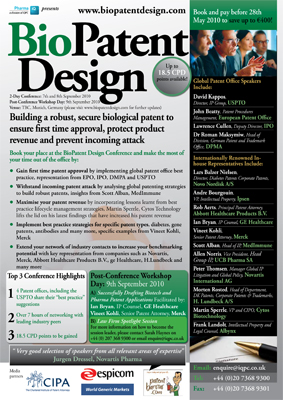
    will be holding its inaugural "Biosimilars & Biobetters: Aligning
    Business & Science for Success" conference on September 22-23, 2010 in
    London.  SMi faculty will discuss
    the latest developments in legislation, regulation, technology, and emerging
    commercial strategies in the highly competitive biosimilar market, including
    the following topics:

    • Worldwide
    regulatory updates;
    • The developing
    U.S. follow-on biologics framework;
    • The challenges in
    biosimilar commercialization;
    • Legal and IP
    developments;
    • Biosimilar and
    biobetter monoclonal antibodies;
    • Opportunities
    to drive a long term commercial strategy;
    • Effectively
    leveraging licensing opportunities; and
    • Biosimilar
    quality aspects.

    In particular, SMi's
    faculty will offer presentations on the following topics:

    • Biosimilars — A
    global opportunity?
    • Challenges in the
    commercialization of biosimilars;
    • The developing
    biosimilars regulatory framework in the U.S.;
    • EU guidelines and
    biosimilar development strategies;
    • EU legal
    developments and strategies for biosimilar medicines;
    • Biosimilars as a
    new business opportunity;
    • Clinical
    comparability and European biosimilar regulations;
    • Leveraging
    biosimilars licensing opportunities;
    • Biosimilars in
    the clinic;
    • EMA guidelines
    for biosimilar monoclonal antibodies;
    • Developing
    "biosuperior" monoclonal antibodies;
    • Biosimilar
    quality aspects;
    • Biosimilar CMC
    development — an innovator's point of view;
    • Improving
    biosimilar delivery systems to compete with second-gen innovator products;
    • Opportunities to
    drive your longer term biosimilars strategy; and
    • Immunogenicity of
    biosimilars and biobetters.

    A pre-conference
    workshop, entitled on "Biosimilars: Understanding the Regulatory Processes
    and the Commercial Realities," will be offered on September 21, 2010.  The workshop is intended to give
    attendees:

    • A good overview
    of the biosimilars picture across the world;
    • Insight into the
    varying regulatory approaches prevailing in different regions;
    • An understanding
    of the commercial situation as it is now and likely to develop in the future;
    and
    • Enough background
    to determine whether entering the biosimilars market is an appropriate strategy.

    A complete brochure
    for this conference can be obtained here.


    SMi Group The registration
    fee is £1,399.00 ($2,126.46) for the conference and £599.00 ($910.47) for the
    workshop; alternative registration packages and discounts can be found on the
    conference website.  Those interested in registering for the
    conference can do so here.

    Patent Docs is a media partner of SMi's Biosimilars & Biobetters conference.


  • IPO #1 The
    Intellectual Property Owners Association (IPO) will offer a one-hour webinar on
    the "Bilski Decision" on
    Thursday, July 8, 2010 beginning at 2:00 PM (EDT).  The IPO webinar will present a panel of experts — including
    a lawyer for the inventors in Bilski,
    the author of an amicus brief in the
    case, and an experienced and "neutral-on-the-issue" IP litigator —
    that will discuss what the Bilski v.
    Kappos
    decision means for inventors of business methods, software, and
    innovations in other important areas such as personalized medicine.  The panel will also discuss what the
    Federal Circuit and district courts will do next.  The speakers include Erika Arner of Finnegan, Henderson, Farabow,
    Garrett & Dunner LLP, Gary Hoffman of Dickstein Shapiro LLP, and Donald
    Steinberg of WilmerHale.  The
    registration fee for the webinar is $100 (government and academic rates are
    available upon request).  Those
    interested in registering for the webinar, can do so here.

  •     By Kevin E. Noonan


    Supreme Court Seal Although long-anticipated, the Supreme Court's
    opinion in Bilski v. Kappos did not
    provide much in terms of "pellucid" teachings regarding the metes and
    bounds of patent-eligible subject matter.  Against this backdrop, the Court decided on Tuesday to grant certiorari, vacate the Federal Circuit's
    decision below, and remand to the appellate court two cases related to medical
    diagnostic claims:  Prometheus Laboratories, Inc.  v. Mayo Collaborative Services and Classen Immunotherapies, Inc. v. Biogen Idec.  On earlier appeals, the Federal Circuit
    decided that the claims in Prometheus
    were patent-eligible under the "machine-or-transformation" (MOT) test, and
    that the claims in Classen were
    not.  How the Federal Circuit
    decides these cases on remand, and whether its decision(s) change, will provide
    the first inklings of how the CAFC will implement whatever insights the Bilski decision may provide.


    Federal Circuit Seal The types of claims in these cases and the grounds
    for the Federal Circuit's disparate decisions may be informative.  In Prometheus,
    the claims recited methods for determining whether treatment for immune-related
    gastrointestinal disorders needed adjustment, i.e., whether the amount of a drug administered to treat the
    disorder should be changed.  The
    asserted claims of the patents-in-suit specifically relate to methods for
    identifying the administered drug, thiopurine, or metabolites thereof, in red
    blood cells of a patient.  Claim 1
    of the '623 patent was cited in the Federal Circuit opinion as being
    representative:

    A method of optimizing therapeutic
    efficacy for treatment of an immune- mediated gastrointestinal disorder,
    comprising:

        (a) administering
    a drug providing 6-thioguanine to a subject having said immune-mediated
    gastrointestinal disorder; and

        (b) determining the level
    of 6-thioguanine in said subject having said immune-mediated gastrointestinal
    disorder,

        wherein the level of
    6-thioguanine less than about 230 pmol per 8×10⁸ red blood cells
    indicates a need to increase the amount of said drug subsequently administered
    to said subject and

        wherein the level of
    6-thioguanine greater than about 400 pmol per 8×10⁸ red blood cells
    indicates a need to decrease the amount of said drug subsequently administered
    to said subject.

    The Federal Circuit reversed a finding by the District Court on summary judgment that the claims were not patent-eligible
    under 35 U.S.C. § 101 (as expressly influenced by Justice Breyer's dissent in
    Laboratory
    Corp. v. Metabolite Labs., Inc.
    ("LabCorp")
    ).  The Federal Circuit (in an opinion by Judge Lourie, joined
    by (then) Chief Judge Michel and
    the
    Honorable Ron Clark, District Judge of the U.S. District Court for the Eastern
    District of Texas, sitting by designation
    ) held that the administering and determining steps, dismissed by the
    District Court as constituting mere "necessary data-gathering steps,"
    were instead transformative and thus satisfied the transformation prong of the Bilski
    MOT test.  Judge Lourie's opinion stated that "[t]he transformation
    is of the human body following administration of a drug and the various
    chemical and physical changes of the drug's metabolites that enable their
    concentrations to be determined."  The Court found that these steps
    were essentially "method of treatment" steps, "which are always
    transformative
    when a defined group of drugs is administered to a body to
    alleviate the effects of an undesired condition" (emphasis added).  A human body to which drugs such as
    thiopurines are administered "necessarily undergoes a transformation,"
    the Court said, since "the drugs do not pass through the body untouched
    without affecting it," something the Court characterized as "the
    entire purpose of administering the drugs."  The opinion rejected
    Mayo's contention that the transformations are the result of "natural
    processes" because "quite literally every transformation of physical
    matter can be described as occurring according to natural processes and natural
    law."  But this transformation encompassing the administering step of
    the asserted claims are not "natural processes" according to the Court:  "[i]t is virtually self-evident that a process for a chemical or physical
    transformation of physical objects or substances is patent-eligible
    subject matter (emphasis in the original text).  Finally, the Federal Circuit opined
    that the District Court erred in deciding that Prometheus' asserted claims "wholly
    preempted" the use of correlations between metabolites of thiopurine drugs
    and their toxicity and efficacy.  Rather, according to the Court, the
    claims utilize, not preempt, the correlations of natural processes "in a
    series of specific steps" that are patent-eligible subject matter
    according to the statute, citing Diehr and its analogous use of the
    Arrhenius equation for curing rubber (a transformative step).  "Regardless"
    of this issue, the Court held, satisfaction of the MOT test renders the claims
    patent-eligible and thus "they do not preempt a fundamental principle."

    In Classen,
    on the other hand, the Federal Circuit summarily rejected the claims based on failure to
    satisfy the Bilski MOT test (in a
    69-word opinion that was shorter than the claims at issue).  The claims
    in Classen's U.S. Patent No. 5,723,283 were directed to methods
    for determining whether an immunization schedule affects the incidence or
    severity of a chronic immune-mediated disorder in a treatment group of mammals,
    relative to a control group of mammals.  Although the Classen claims
    recited "immunizing" steps (that could be considered to be analogous
    to the "administering" steps in the Prometheus claims), they also recited a step of "comparing"
    the "incidence, prevalence, frequency or severity" of the
    immune-mediated disorder between the experimental and control groups, making it
    easier to characterize the immunization step as a mere "data-gathering"
    step.

    The use of the "comparing" language was reminiscent
    of the claims in the LabCorp case, which was criticized by Justice Breyer in his dissent from
    the Court's decision not to decide the patent-eligibility of claims for
    determining whether a patient had a vitamin deficiency.  In LabCorp, the claim at issue was directed to a method for
    detecting a deficiency of cobalamin (vitamin B12) or folate having the steps of
    assaying a body fluid for an elevated level of total homocysteine and
    correlating an elevated level of total homocysteine in said body fluid with a
    deficiency of cobalamin or folate.  There are clear parallels between the structure of the LabCorp claim and the Classen
    claim.  Each recites a preamble directed to identifying a biological
    phenomenon (a vitamin deficiency in LabCorp, a chronic immune-related
    disorder related to a acute immunization schedule in Classen),
    comprising an unambiguous diagnostic/tangible step (assaying a bodily fluid to
    detect elevated homocysteine levels in LabCorp, immunizing mammals
    with one or more doses of one or more immunogens, according to an immunization
    schedule in Classen), followed by an interpreting step (correlating
    elevated homocysteine with the vitamin deficiency in LabCorp,
    comparing the incidence, prevalence, frequency or severity of chronic
    immune-mediated disorders in mammals immunized according to the immunization
    schedule in Classen).

    The Supreme Court's Bilski decision provides no clear instruction for resolving the
    different results in the Prometheus and
    Classen cases; indeed, the Court (for the first time
    since the Hilton Davis case) appears
    content to let the Federal Circuit develop its case law on the extent to which
    tests other than the MOT test are used to determine patent-eligibility.  For biotechnology, it remains the case
    that including active, technology-dependent steps in method claims is prudent,
    and to draft claims that minimize the likelihood that the invention will be
    characterized as merely an "abstract idea."  In this regard, dicta
    from the Bilski opinion provides a
    certain level of comfort that the Court (or at least some members of the Court)
    understand the proper protocol for performing claim analysis.  For example, the opinion noted that the
    judiciary "does not have carte
    blanche
    to impose other limitations that are inconsistent with the text and
    the statute's purpose and design."  And in a portion of the "majority" opinion joined by Justice
    Scalia, Justice Kennedy reminds us that a court "needs to consider the
    invention as a whole, rather than 'dissect[ing] the claims into old and new
    elements and then . . . ignor[ing] the presence of the old elements in the
    analysis,'" citing Diamond v. Diehr.  However, this is arguably just the
    analytic mistake Justice Breyer made in his LabCorp
    dissent, where he argued that:

    [H]ere, aside from the unpatented test, [the claims] embody
    only the correlation between homocysteine and vitamin deficiency that the
    researchers uncovered.  In my view, that correlation is an unpatentable "natural phenomenon," and I can find nothing in claim 13 that adds anything
    more of significance.

    (emphasis
    added
    ).  On the other hand, the four "concurring"
    Justices clearly believe that the scope of patent eligibility is (and must be)
    limited by the Constitutional prescription that a patent "Promote the
    Progress of . . . the Useful Arts," and that Justice Breyer's antipathy to
    medical diagnostic patents retains some currency on the Court:

    For even when patents encourage
    innovation and disclosure, "too much patent protection can impede
    rather than 'promote the Progress of . . . useful Arts.'" Laboratory
    Corp. of America Holdings
    v. Metabolite Laboratories, Inc., 548 U.
    S. 124, 126–127 (2006) (B
    REYER, J., dissenting from
    dismissal of certiorari).  . . .  Patents "can discourage research by
    impeding the free exchange of information," for example, by forcing people
    to "avoid the use of potentially patented ideas, by leading them to
    conduct costly and time-consuming searches of existing or pending patents, by
    requiring complex licensing arrangements, and by raising the costs of using the
    patented" methods.  Id., at 127.

    Thus, even as the Federal Circuit develops
    additional tests for patent-eligibility of method claims, it is incumbent on
    patent applicants and their lawyers to recognize these tensions in the High
    Court's attitudes about patenting and to ensure that their claims are clearly
    directed to patent-eligible subject matter.  This is difficult to do prospectively, and there is little
    comfort that the Federal Circuit will soon provide more concrete standards for
    satisfying the rather nebulous test enunciated by the Supreme Court (at least
    until the Court decides the time has come to once again administer some
    corrective patent jurisprudence to the appellate court).  However, unless the Supreme Court (by
    inclination or constitution of new Justices) changes its rather 19th Century attitude regarding patents (something that Justice Kennedy's
    distinctions between patents from the Industrial Age and those from the
    (current) Information Age suggests may be possible), applicants will continue
    to need to use the few distinctions the Court has provided to protect
    biotechnology inventions.

  •     By James DeGiulio —

    Midland
    Settles with Life Technologies in Fluorescence Probe Infringement Suit


    Midland Midland
    Certified Reagent Co. Inc. has resolved an infringement suit brought by Applied
    Biosystems LLC and parent company Life Technologies Corp. over five patents
    covering a fluorescence probe used in biotechnology assays.


    Applied-biosystems Applied
    Biosystems and Life Technologies originally filed suit against Biosearch
    Technologies Inc. in September, alleging that it had infringed U.S. Patent Nos. 5,538,848,
    5,723,591, 5,876,930, 6,030,787, and 6,258,569 (see "Court Report," September 27, 2009).  The plaintiffs amended their
    complaint in November by adding defendants Bio-Synthesis Inc., Eurofins MWG
    Operon Inc., and Midland.  The amended complaint claimed that each defendant
    manufactured self-quenching fluorescence probes that infringe the asserted
    patents.  Biosearch, Eurofins, and Bio-Synthesis responded to the complaint in
    January, raising affirmative defenses and counterclaims for declaratory
    judgments of invalidity, noninfringement, and unenforceability of the asserted
    patents.  Later, Midland responded
    by arguing that the amended complaint failed to state a claim on which relief
    could be granted and requested similar declaratory judgment relief.

    On
    June 24, Midland and Applied Biosciences' joint motion to dismiss all claims
    and counterclaims between them with prejudice was granted by Judge T. John Ward
    of the U.S. District Court for the Eastern District of Texas.  Each side was
    ordered to bear its own costs and attorneys' fees.

    Judge
    Ward's order can be viewed
    here.


    Zydus
    Admits Infringing Meda's Astelin Patent, Agrees Not to Market Generic


    Zydus-logo Zydus
    Pharmaceuticals USA Inc. has admitted to infringing Meda Pharmaceuticals Inc.'s
    patent covering nasal spray Astelin, and has consented not to attempt to market
    a generic version without Meda's consent.


    Meda_logo The
    litigation began when Meda filed a complaint on March 22, following Zydus' ANDA
    seeking approval to bring their azelastine hydrochloride generic to market
    before the expiration of Meda's U.S. Patent No. 5,164,194 (see "Court Report," March 28, 2010).

    According
    to the June 24 order, approved by Judge Mary L. Cooper of the U.S. District
    Court for the District of New Jersey, Zydus admitted that its ANDA filing was a
    technical act of patent infringement.  The order enjoins Zydus from making or
    selling the proposed generic during the life of the '194 patent without Meda's
    consent, unless all of the '194 
    patent claims are deemed invalid or unenforceable in a final court
    decision.

    Judge
    Cooper's order can be found
    here.


    AstraZeneca's
    Crestor Patent Found Valid


    AstraZeneca_small AstraZeneca
    enjoyed a major victory in its Crestor patent infringement dispute following a
    ruling that the company's reissued patent covering the cholesterol drug is valid and
    enforceable.

    The
    litigation began in December 2007, when AstraZeneca filed suits against several
    generics, including Mylan, Teva, Sun, Aurobindo, Par, Cobalt, Sandoz, and
    Apotex, claiming their plans for marketing a generic rosuvastatin would
    infringe AstraZeneca's U.S. Patent No. RE37,314 (see "Court Report," December 16, 2007).  In June 2008,
    these suits were consolidated into multidistrict litigation in the District of
    Delaware.  Defendants Mylan, Sun, Par, Aurobindo, Cobalt, and Teva admitted that
    they had infringed claims 6 and 8 of the '314 patent, but they contended that
    these claims were invalid and unenforceable since the patent claims were
    obvious, fraudulently obtained, and improperly reissued.

    On
    June 29, Judge Joseph Farnan of the U.S. District Court in Delaware ruled that
    the defendants had failed to prove any of their allegations, finding that the '314
    patent was valid and enforceable.  Judge
    Farnan rejected the defendant's obviousness argument, noting evidence that
    significant work was needed to develop rosuvastatin and instead finding that the
    defendants' obviousness arguments were driven by hindsight.

    Judge
    Farnan also ruled that defendants failed to establish invalidity due to
    improper reissue of U.S. Patent No. 5,260,440.  Judge Farnan found that that the plaintiff's broad claim in
    the original patent was due to mere mistake or oversight rather than deliberate
    conduct.  Finally, Judge Farnan
    found that the defendants failed to show that the patent is unenforceable due
    to inequitable conduct.  He
    rejected the argument that three individuals intentionally failed to disclose
    to the U.S. Patent and Trademark Office two highly material prior art patent applications, instead finding
    that inexperience and overburdening workload was an equally plausible
    explanation for the failure to cite these references.

    Judge
    Farnan's order can be found
    here.

    James
    DeGiulio has a doctorate in molecular biology and genetics from
    Northwestern University and
    a graduate of Northwestern University School of Law.  Dr. DeGiulio
    was a member of MBHB's 2009 class of summer associates, and he can be
    contacted at degiulio@mbhb.com.

  •     By
    Donald Zuhn


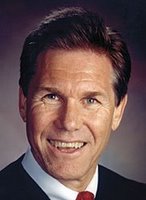
    Kucinich, Dennis Last
    week, Representative Dennis Kucinich (D-OH) (at right) introduced three bills in the House related
    to the labeling of food containing genetically engineered material, the cultivation
    and handling of genetically engineered crops, and the establishment of a set of farmer
    rights regarding genetically engineered animals, plants, and seeds:


    The "Genetically Engineered Food Right to Know Act" (H.R. 5577)
    would amend the Federal Food, Drug, and Cosmetic Act, the Federal Meat
    Inspection Act, and the Poultry Products Inspection Act to require that food
    that contains a genetically engineered material, or that is produced with a
    genetically engineered material, be labeled accordingly.  The bill states that "[t]he
    process of genetically engineering foods results in the material change of such
    foods," and asserts that "Federal agencies have failed to uphold Congressional
    intent by allowing genetically engineered foods to be marketed, sold and
    otherwise used without labeling that reveals material facts to the public."  The bill, which
    has
    been referred to the
    House Committees on Agriculture and Energy and Commerce,
    was co-sponsored by Rep.
    Peter DeFazio (D-OR), Barney Frank (D-MA), Raul Grijalva (D-AZ), Barbara Lee
    (D-CA), Jim McDermott (D-WA), Pete Stark (D-CA), and Lynn Woolsey (D-CA).


    The "Genetically Engineered Safety Act" (H.R. 5578)
    would "prohibit the open-air cultivation of genetically engineered
    pharmaceutical and industrial crops, . . . prohibit the use of common human food
    or animal feed as the host plant for a genetically engineered pharmaceutical or
    industrial chemical, . . . establish a tracking system to regulate the growing,
    handling, transportation, and disposal of pharmaceutical and industrial crops
    and their byproducts to prevent human, animal, and general environmental
    exposure to genetically engineered pharmaceutical and industrial crops and
    their byproducts, [and] amend the Federal Food, Drug, and Cosmetic Act with
    respect to the safety of genetically engineered foods."  Noting that "[m]any of the novel
    substances produced in pharmaceutical crops and industrial crops exhibit high
    levels of biological activity and are intended to be used for particular
    medical or industrial purposes, under very controlled circumstances," and
    that "[n]one of these substances is intended to be incorporated in food or
    to be spread into the environment," the bill declares that the risks of
    contamination "necessitate a zero tolerance standard for the presence of
    pharmaceutical crops and industrial crops and their byproducts in crops used to
    produce human food or animal feed." 
    The bill, which
    has
    been referred to the
    House Committees on Agriculture and Energy and Commerce, was
    co-sponsored by Rep. Peter DeFazio (D-OR), Barney Frank (D-MA),
    Raul Grijalva (D-AZ), Barbara Lee (D-CA), Pete Stark (D-CA), and Lynn Woolsey (D-CA).


    The "Genetically Engineered Technology Farmer Protection Act" (H.R.
    5579
    )
    would "provide additional protections for farmers and ranchers that may be
    harmed economically by genetically engineered seeds, plants, or animals, . . . ensure
    fairness for farmers and ranchers in their dealings with biotech companies that
    sell genetically engineered seeds, plants, or animals, [and] assign liability
    for injury caused by genetically engineered organisms."  The bill states that "[p]olicies
    promoted by biotech corporations, such as patenting of seeds, depriving farmers
    the right to save seed, unreasonable seed contracts, and intrusion into
    everyday farm operations, have systematically acted to remove basic farmer
    rights enjoyed since the beginning of agriculture and essential for
    agricultural sustainability and the survival of family farms," and asserts that "[t]he introduction of genetically engineered crops has also
    created obstacles for farmers, including the loss of markets and increased
    liability concerns."  The
    purpose of H.R. 5579 is "[t]o mitigate the abuses upon farmers, a clear
    set of farmer rights must be established."  Among the rights that would be created by the bill are (1) a requirement for
    biotech companies to fully disclose the risks of using genetically engineered
    animals, plants, or seeds, and (2) the prohibition of certain terms and limitations
    in contracts for the sale of genetically engineered animals, plants, or seeds,
    including a provision that would "prohibit[] the purchaser from retaining
    a portion of the harvested crop for future crop planting by the purchaser or
    that charge[] a fee to retain a portion of the harvested crop for future crop
    planting."  H.R. 5579 would
    allow for a maximum $100,000 penalty to be assessed for violations of the
    Act.  The bill, which
    has
    been referred to the
    House Agriculture, Energy and Commerce, and Judiciary Committees, was
    co-sponsored by Rep. Peter DeFazio (D-OR), Barney Frank (D-MA), Raul Grijalva (D-AZ),
    Barbara Lee (D-CA), Pete Stark (D-CA), and Lynn Woolsey (D-CA).

    In
    a press release posted on Rep. Kucinich's website, the Congressman stated that:

    To
    ensure we can maximize benefits and minimize hazards, Congress must provide a
    comprehensive regulatory framework for all Genetically Engineered
    products.  Structured as a common-sense
    precaution to ensure [Genetically Engineered] foods do no harm, these bills
    will ensure that consumers are protected, food safety measures are
    strengthened, farmers’ rights are better protected and biotech companies are
    responsible for their products.

    The
    release noted that Rep. Kucinich had introduced similar bills in previous
    sessions of Congress.

  •     By
    Donald Zuhn

    The
    Supreme Court waited until the eleventh hour to issue its long-awaited decision
    in Bilski v. Kappos, affirming the
    Federal Circuit's determination that an application directed to hedging risk in
    energy commodities was not patent eligible while determining that the Federal
    Circuit's machine-or-transformation test is not the sole test for assessing patent
    eligibility under 35 U.S.C. § 101 (see Patent Docs report on decision).  Reaction to the Supreme Court's
    decision in Bilski has, not
    surprisingly, come much quicker.


    USPTO Seal - background In
    a brief statement posted on the
    U.S. Patent and Trademark Office website, the Office noted that:

    The Supreme Court [on Monday] affirmed the
    USPTO's decision that Mr. Bilski's invention was not patentable subject matter
    as his claims were drawn to an abstract idea.  Significantly, the Court ruled that the "machine or
    transformation" test is not the sole determinant of patent eligible
    subject matter for process claims, but is nevertheless an important "investigative
    tool" for evaluating their patent eligibility.  The Court also indicated that a business method is, at least
    in some circumstances, eligible for patenting under Section 101.

    The USPTO will be issuing guidance
    further interpreting the decision as soon as possible.  The USPTO is distributing interim
    guidance for the examining corps today.


    Biotechnology Industry Organization (BIO) The
    Biotechnology Industry Organization (BIO), which along with the Advanced
    Medical Technology Association, Wisconsin Alumni Research Foundation (WARF),
    and the Regents of the University of California, submitted an amici brief
    in the case, issued a press release in which BIO President and CEO Jim
    Greenwood said the organization was "pleased that the Justices crafted a
    narrow opinion" in which the Court "overturn[ed] the lower court's rigid
    new test for determining whether a method or process is eligible for patenting."  Noting that this was the position BIO
    had advocated for in its amici brief,
    Mr. Greenwood stated that "[t]he Court was clearly conscious of the
    potential negative and unforeseeable consequences of a broad and sweeping
    decision" and "recognized that the lower court's ruling could have
    created uncertainty in fields such as advanced diagnostic medicine techniques."

    Pointing
    to the Supreme Court's decision in Diamond
    v. Chakrabarty
    — which coincidentally celebrated its thirtieth anniversary
    on June 16th (see "BIO
    Celebrates Anniversary of Chakrabarty Decision
    ")
    — Mr. Greenwood observed that in that case the Court had "defined
    patent-eligible subject matter in a flexible and inclusive way that has
    fostered the tremendous growth of biotechnology for the benefit of millions of
    patients, farmers, and other consumers around the world."  Mr. Greenwood offered that in Bilski, "the
    Court made it clear . . . that the patent system was designed to be broad and
    inclusive in order to promote innovation."


    AIPLA In
    a
    release issued by the American Intellectual Property Law Association
    (AIPLA), the national bar association, which also submitted an amicus brief
    in the case, said it was "gratified that the Supreme Court in its Bilski
    decision . . . continues to interpret the Patent Act as open to the broadest
    range of subject matter, preserving the incentives for yet unknown areas of
    innovation."  AIPLA Executive
    Director Q. Todd Dickinson stated that the organization was "generally
    pleased that the Court's majority today confirmed that broad patent protection
    is critical to innovation and economic growth," and that "[t]hey
    recognized that the patentability of next generation technology should not be
    judged by a last century view of the law."  Mr. Dickinson noted that this was the position that the
    AIPLA had advocated for in its own amicus
    brief.  The AIPLA release also notes
    that "like many others filing amicus (i.e., "friend of the court")
    briefs, [the AIPLA] believes that excluded subject matter must be kept to a
    minimum because this is the only way to keep the patent system open to crucial
    but unforeseen innovations of the future," adding that "because the
    course of technology can take an unexpected path, the threshold test for
    patentable subject matter ought not become a barrier to the next life-altering
    innovation."


    LES The
    Licensing Executives Society (LES) offered its comments on the "long-awaited"
    decision in a
    release issued on Monday.  Noting that "[t]he decision has important implications
    for industries from health care to high tech," the professional society whose
    members are engaged in the transfer, use, development, and marketing of
    intellectual property, said that "[m]any throughout the industry,
    including a strong representation of our membership, have expressed the view
    that a rigid application of that test might stifle both innovation and business
    on a global scale, particularly in the Information Age."  LES Public Policy Chair Brian O'Shaughnessy
    stated that "[o]verall, we believe the Supreme Court's decision represents
    an important step towards maintaining a balanced, effective patent system that
    promotes innovation and opportunity for both inventors and consumers."

  •    By Sarah Fendrick


    USPTO Seal The U.S. Patent and Trademark Office announced in a notice published in the
    Federal Register (75 Fed. Reg. 33584) that it is considering
    changes to restriction practice aimed at improving the quality and consistency
    of restriction requirements made by Office personnel.  The USPTO has begun
    to solicit public comment regarding these potential changes.  In particular,
    the Office is seeking comments on what should be included in an Office action
    that requires restriction, methods to expedite the process of traversing or
    requesting reconsideration of a restriction requirement, the treatment of Markush claims, rejoinder of non-elected
    claims, and other areas that could be improved upon with respect to current
    restriction practice.

    The first issue for which comments are being sought is what should be included
    in an Office action that sets forth a restriction requirement.  Currently,
    the M.P.E.P. requires that inventions must be independent or distinct as
    claimed and that there must be a serious burden on the examiner in order to
    require a restriction.  To clarify the requirements for a restriction, the
    Office is considering that a restriction requirement must always articulate
    reasons why the inventions are independent and distinct and why there would be
    a serious burden on the examiner.  In addition, the Office is considering
    a change to the serious burden prong of a restriction requirement.  In
    particular, the Office is considering whether to specify that a serious burden
    would be present when the prior art applicable to one invention would not be
    applicable to another invention.  Further changes include revision of the
    M.P.E.P to specify that a serious burden on the examiner encompasses search
    burden and/or examination burden.  The examination burden encompasses
    non-prior art issues such as a § 112, first paragraph, issue.

    The second area where the Office is seeking comments is the effectiveness of
    traversing or requesting reconsideration of a restriction requirement. 
    The public has expressed dissatisfaction with the process of requesting
    reconsideration or traversing a restriction, and now the Office is inviting the
    public to comment on better methods to improve accurate, timely, and cost
    effective review.

    The third topic for which the Office is seeking comment regards restriction
    between related product inventions or related process inventions. 
    Currently, there is no M.P.E.P. section that addresses this topic and the
    Office is considering adding a section that would address restriction between
    related product inventions and related process inventions.  The new
    section would specify that there must be two-way distinctness and a serious
    burden for a restriction requirement to be issued.

    The fourth area of potential change is the revision of Markush practice.  The Office is considering a number of
    changes with respect to this practice.  First, if the examiner determines
    that the elected species is allowable, the Office is considering specifying
    that the examination of the Markush-type
    claim will be extended to the extent necessary to determine the patentability
    of the claim.  Also under consideration are situations where restriction
    may be proper between a subcombination and a combination when a subcombination
    sets forth a Markush grouping of
    alternatives.

    The fifth area of interest is how the Office could improve rejoinder
    practice.  The Office is considering changes to the rejoinder practice
    that would facilitate more uniform treatment of claims directed to non-elected
    subject matter following allowance of elected claims.  In particular, the
    Office is considering whether to redefine rejoinder as:

    [T]he practice of withdrawing a restriction
    requirement as between some or all groupings of claims and reinstating certain
    claims previously withdrawn from consideration that occurs when the following
    conditions are met:  (1) All claims to the elected invention are allowable;
    and (2) it is readily apparent that all claims to one or more nonelected
    inventions are allowable for the same reasons that the elected claims are
    allowable.

    In addition, the Office is
    considering whether examiners should be instructed to rejoin nonelected claims
    when the elected claims are found to be allowable and withdraw the restriction
    requirement.  

    Finally, the Office is
    seeking comment on any areas that are not directly addressed in the notice, but
    which would improve restriction practice.

    Comments must be received by August 13, 2010 and can be submitted to
    electronically to Restriction_Comments@uspto.gov or by regular mail addressed
    to Mail Stop Comments — Patents, Commissioner for
    Patents, P.O. Box 1450, Alexandria, VA 22313–1450 and marked to the attention
    of Linda S. Therkorn.

  •     By Kevin E. Noonan

    Supreme Court Building #1 The Supreme Court decided Bilski v. Kappos today and, as anticipated, agreed with the Federal Circuit that Bilski's claims to methods for "hedging" risk in commodities trading are not patent-eligible subject matter.  After that, the opinion elevates the analysis to nothing short of advanced tea-leaf reading (including ample evidence regarding the prejudices and opinions of the various members of the Court on the topic of patent-eligibility).

    The "majority" (comprising Justice Kennedy, who wrote the opinion, joined by the Chief Justice and Justices Alito, Thomas, and Scalia, the latter parting company on one aspect of the decision) takes the more conservative approach, deciding narrowly as to the claims before the Court.  Somewhat predictably, and consistent with the Court's treatment of other "bright line" rules crafted by the Federal Circuit (KSR, eBay, Quanta), the Court teaches that while the "machine or transformation" test is a useful test, it is not the only test for patent-eligibility of process claims.  The Court notes that while this test may have been sufficient for determining patent-eligibility in the "Industrial Age," it may be less useful in the (present) "Information Age" (although Justice Scalia not joining this part of the opinion robs it of any precedential value).  As a consequence, the Court believes it best to be cautious in crafting preclusive tests that could prevent patenting new, unforeseen technologies.  The Court does provide a measure of clarity in one aspect:  it states that "nothing in today's opinion should be read as endorsing interpretations of §101 that the Court of Appeals for the Federal Circuit has used in the past," specifically the "useful, concrete and tangible result" test enunciated by the Federal Circuit in State Street Bank & Trust Co. v. Signature Financial Group, Inc. and repudiated by the en banc court in Bilski (while particularly recommending to "[s]tudents of patent law" that they would be "well advised to study the [Federal Circuit's five] scholarly opinions" in Bilski).

    Supreme Court Seal In its analysis, the Court's opinion follows the well-established framework of starting with the expansive language of § 101, as limited by earlier precedent to exclude "laws of nature, physical phenomena, and abstract ideas," citing Diamond v. Chakrabarty.  These categories are "'part of the storehouse of knowledge of all men . . . free to all men and reserved exclusively to none,'" the Court reiterates using the language from Funk Bros. Seed Co. v. Kalo Inoculant Co.  And the opinion notes that patent-eligibility is merely a threshold inquiry, patentability depending on satisfaction of the other statutory requirements.  In the case of processes, what Congress meant is defined by § 100(b), which the opinion says should be interpreted using the "ordinary, contemporary, common meaning" of the words of the statute.  Accordingly, the opinion rejects the "atextual" categorical exclusion of business method patents from patent eligibility, as well as exclusive use of the Federal Circuit's "machine or transformation" test.  In doing so, the opinion rejects alternative canons of statutory interpretation advanced by the government in favor of the "ordinary, contemporary, common meaning" standard.  And the Court expressly characterized as "incorrect" the Federal Circuit's reasoning that prior precedent established the "machine or transformation" test as the exclusive test.  Indeed, the Court used its "more recent" decisions in Gottschalk v. Benson, Parker v. Flook, and Diamond v. Diehr as establishing that the Federal Circuit's test was not the exclusive test (ironically citing statements in those cases cited in dissent by Judge Newman below).  Expressly:

    This Court's precedents establish that the machine-or-transformation test is a useful and important clue, an investigative tool, for determining whether some claimed inventions are processes under §101.  The machine-or-transformation test is not the sole test for deciding whether an invention is a patent-eligible "process."

    In making distinctions between the "Industrial Age" and the "Information Age," the Court seemed to credit several amici who made this argument, and to be convinced that the more prudent approach was to avoid setting forth exclusionary rules based on current or foreseeable technology.  The Court was careful, however, to avoid any implication that its opinion endorsed the "patentability of any particular invention" or that any of the putative Information Age technologies "should or should not receive patent protection."

    On the other hand, the opinion did firmly reject the idea that business method patents should be outside the scope of patent-eligibility per se, saying that "at least some" business method patents could be patent-eligible (although Bilski's was not).  The Court based this conclusion in part on consistency in statutory interpretation, in view of Congressional recognition of business method patents in the "prior user defense" provisions of 35 U.S.C. § 273.  Instead, the opinion turned to prior precedent on the patent-ineligibility of abstract ideas to provide "useful tools" for its analysis (Justice Scalia did not join this part of the opinion, either).  Here, the Court suggested that the Federal Circuit could use such tools to distinguish business method claims on grounds "in accord with controlling precedent."  But the Court provided no further guidance on how the Federal Circuit might achieve that goal.

    The Court dispatched the Bilski claims in the final portion of its opinion, using the Benson/Flook/Diehr cases to determine that Bilski's claims were directed to "an unpatentable abstract idea" and that "[a]llowing petitioners to patent risk hedging would preempt use of this approach in all fields, and would effectively grant a monopoly over an abstract idea."

    The "minority" (comprising Justice Stevens, who wrote a concurring opinion joined by Justices Breyer, Ginsberg, and Sotomayor) believe that business methods are not patent-eligible subject matter and would have overruled the Federal Circuit's State Street Bank decision expressly.  In an extensive opinion, Justice Stevens reviews the history of the Patent Act, both in this country and under the Statute of Monopolies in England, to find no basis for including business methods as patent-eligible subject matter.  Indeed, the opinion cites commentators and judicial decisions alike as believing (prior to State Street) that business methods were not patent-eligible.  The opinion asserts that such a decision by the Court would "restore patent law to its historical and constitutional moorings" which have been loosed by consideration of business methods as being patent-eligible.  These four Justices take a much more restrictive view of patent-eligibility than the "majority," stating that "it would be a grave mistake to assume that anything with a 'useful, concrete and tangible result' . . . may be patented."  Justice Stevens warns that insofar as the Court's opinion may be read to conclude that "any series of steps that is not itself an abstract idea or law of nature may constitute a 'process' within the meaning of §101" it can "only cause mischief."  For this group of Justices, the determination is definitional:  business methods are not patent-ineligible per se, they are patent-ineligible because they describe a method of doing business that is not a process under § 101.

    Justice Stevens criticizes the Court's opinion for construing the statute based on the "ordinary, contemporary, common" meaning of the words, which is "a deeply flawed approach to a statute that relies on complex terms of art developed against a particular historical background."  In this regard, the concurrence cites a number of "comical" types of methods that could be patent-eligible under the Court's approach, including "[a] process for training a dog, a series of dance steps, a method for shooting a basketball, maybe even words, stories or songs if framed as the steps of typing letters or uttering sounds."  Justice Stevens believes it improper to make the "industrial":"information" distinctions, which introduces an unprecedented disparate application of the law to different technologies.  He also believes that the Court's opinion does not provide "a satisfying account of what constitutes an unpatentable abstract idea," which analysis ("or lack thereof") he says "may have led to the correct outcome in this case but . . . means that the Court's musings on this issue stand for very little."

    The concurrence further makes a constitutional argument related to the requirement that patents "promote the Progress of the Useful Arts."  Justice Stevens opines that business methods by their nature are "sequential and complementary," intended to stimulate imitation as a "spur to innovation," citing Bessen & Maskin ("Sequential Innovation, Patents and Imitation," 2009, 40 RAND J. Econ. 611, 613).  The concurrence posits the case of frequent-flyer miles offered by airlines, imitation of which could have been prevented if the first airline to offer them had obtained a patent (presumably on a method for engendering customer loyalty by providing this perk).  Citing Dreyfuss ("Are Business Method Patents Bad for Business?," 2000, 16 Santa Clara Computer & High Tech. L.J. 263, 274-277), business methods are closer to the "top" of a hypothetical pyramid of ideas where exclusivity incurs greater social cost and hinders innovation.  This, the concurrence states, makes these methods more akin to phenomena of nature, mental processes and abstract ideas that should not be patent-eligible.  And the danger lurks that "many business decisions, no matter how small, could be potential patent violations" (emphasis in original) should business method claims get the Court's imprimatur as patent-eligible subject matter.

    In perhaps the most interesting part of the Court's decision, Justice Breyer writes separately, joined in part by Justice Scalia, to set forth the "substantial agreement among many Members of the Court on many of the fundamental issues of patent law raised by this case" (emphasis in original).  These include:

    • First, "although the test of §101 is broad, it is not without limit," citing Chakrabarty, Benson, and Diehr.

    • Second, the "machine-or-transformation" test "has repeatedly helped the Court to determine what is 'a patentable process.'"

    • Third, while the "machine-or-transformation" test "has always been a 'useful and important clue,' it has never been the 'sole test' for determining patentability."  It is rather "an important example of how a court can determine patentability under 101"; the Federal Circuit's mistake was in treating it as the "exclusive test" (emphases in original).

    • Fourth, "although the machine-or-transformation test is not the only test for patentability, this by no means indicates that anything which produces a "useful, concrete and tangible result' . . . is patentable."  Indeed, Justice Breyer states that insofar as the Federal Circuit repudiated that standard from State Street, "nothing in today's decision should be taken as disapproving of that determination."

    With these insights in mind, it is clear that the Court as currently constructed will continue to apply a patent-limiting approach to these types of questions.  It is equally evident that the Court is not inclined to make sweeping pronouncements or establish bright-line tests on patenting matters, preferring to take a case-by-case approach to developments in this area and to restrict the Federal Circuit when it strays from this path.

    Bilski v. Kappos (2010)
    Opinion of the Court by Justice Kennedy, joined in full by Chief Justice Roberts and Justices Thomas and Alito and in part by Justice Scalia;
    Opinion concurring in the judgment by Justice Stevens, joined by Justices Ginsberg, Breyer, and Sotomayor;
    Opinion concurring in the judgment by Justice Breyer, joined in part by Justice Scalia.

  •     By Sherri
    Oslick

    Gavel_2About
    Court
    Report:  Each week we will report briefly on recently filed
    biotech and pharma cases.


    AstraZeneca Pharmaceuticals LP et al. v. Glenmark Generics Inc.
    USA

    1:10-cv-00543; filed June 21, 2010 in the District
    Court of Delaware

    • Plaintiffs:  AstraZeneca Pharmaceuticals LP;
    AstraZeneca UK Ltd.; IPR Pharmaceuticals Inc.; Shionogi Seiyaku Kabushiki
    Kaisha
    • Defendant:  Glenmark Generics Inc. USA

    Infringement of U.S. Patent No. RE37,314 ("Pyrimidine
    Derivatives," issued August 7, 2001) following a Paragraph IV
    certification as part of Glenmark's filing of an ANDA to manufacture a generic
    version of AstraZeneca's Crestor® (rosuvastatin calcium, used to treat high
    cholesterol).  View the complaint
    here.


    Pfizer Inc. et al. v. Mylan Inc. et al.
    1:10-cv-00094; filed June 18, 2010 in the Northern
    District of West Virginia

    • Plaintiffs:  Pfizer Inc.; Pharmacia & Upjohn
    Co.; Pharmacia & Upjohn Company LLC; Sugen, Inc.; C.P. Pharmaceuticals
    International C.V.
    • Defendants:  Mylan Inc.; Mylan Pharmaceuticals
    Inc.

    Infringement of U.S. Patent Nos. 6,573,293 ("Pyrrole
    Substituted 2-Indolinone Protein Kinase Inhibitors," issued June 3, 2003),
    7,125,905 (same title, issued October 24, 2006), and 7,211,600 ("Methods
    of Modulating c-kit Tyrosine Protein Kinase Function with Indolinone Compounds,"
    issued May 1, 2007) following a Paragraph IV certification as part of Mylan's
    filing of an ANDA to manufacture a generic version of Pfizer's Sutent®
    (sunitinib malate, used to treat gastrointestinal stromal tumor and advanced
    renal cell carcinoma).  View the
    complaint
    here.


    Abbott Laboratories et al. v. Sandoz Inc.
    1:10-cv-00538; filed June 18, 2010 in the District
    Court of Delaware

    • Plaintiffs:  Abbott Laboratories; Abbott
    Respiratory LLC
    • Defendant:  Sandoz Inc.

    Infringement of U.S. Patent Nos. U.S. Patent Nos.
    6,080,428 ("Nicotinic Acid Compositions for Treating Hyperlipidemia and
    Related Methods Therefor," issued June 27, 2000), 6,469,035 ("Methods
    of Pretreating Hyperlipidemic Individuals with a Flush Inhibiting Agent Prior
    to the Start of Single Daily Dose Nicotinic Acid Therapy to Reduce Flushing
    Provoked by Nicotinic Acid," issued October 22, 2002), and 6,818,229 ("Intermediate
    Release Nicotinic Acid Compositions for Treating Hyperlipidemia," issued
    November 16, 2004) following a Paragraph IV certification as part of Sandoz's
    filing of an ANDA to manufacture a generic version of Abbott's Niaspan® (niacin
    extended-release tablets, used to treat hypercholesterolemia).  View the complaint
    here.


    Schering Corporation et al. v. Mylan Pharmaceuticals Inc. et
    al.

    2:10-cv-03085; filed June 16, 2010 in the District
    Court of Delaware

    • Plaintiffs:  Schering Corp.; MSP Singapore
    Co. LLC
    • Defendants:  Mylan Pharmaceuticals Inc.; Mylan
    Inc.

    Infringement of U.S. Patent Nos. RE37,721 ("Hydroxy-substituted
    Azetidinone Compounds Useful as Hypocholesterolemic Agents," issued May 8,
    2002) and 5,846,966 ("Combinations of Hydroxy-Substituted Azetidinone
    Compounds and HMG CoA Reductase Inhibitors," issued December 8, 1998)
    following a Paragraph IV certification as part of Mylan's filing of an ANDA to
    manufacture a generic version of Plaintiffs' Zetia® (ezetimib, used to treat
    elevated cholesterol levels).  View
    the complaint
    here.


  • Calendar

    June
    28-30, 2010 –
    3rd
    Annual Product and Pipeline Enhancement for Generics
    (
    marcus
    evans) –
    Washington,
    DC

    June
    29, 2010 –
    Navigating
    the U.S. Biosimilar Pathway
    (
    American
    Bar Association) –
    1:00
    – 2:30 PM (EST)

    June
    30, 2009 –
    Markman
    Hearings and Claim Construction
    in Patent Litigation 2010
    (
    Practising
    Law
    Institute) –
    New
    York, NY (
    with groupcasts in Atlanta, GA;
    Mechanicsburg, PA; Philadelphia, PA; and
    Pittsburgh, PA)

    July
    7, 2010 –
    Prior
    Art &
    Obviousness 2010: Current Trends
    in Sections 102 & 103
    (
    Practising
    Law
    Institute) –
    New
    York, NY

    July
    7-9, 2010 –
    Fundamentals
    of Patent Prosecution
    2010: A Boot Camp for Claim Drafting & Amendment Writing
    (Practising
    Law
    Institute) – San Francisco, CA

    July
    19-20,
    2010 –
    Hatch-Waxman
    Boot Camp
    *** (
    American
    Conference
    Institute) –
    Boston,
    MA

    July 22, 2010 – "Protect
    Your
    Patents from Inequitable Conduct Charges
    "
    (Technology
    Transfer
    Tactics) –
    1:00
    – 2:30 PM (EDT)

    July 26-27, 2010 – Advanced
    Patent
    Prosecution Workshop 2010: Claim Drafting & Amendment Writing
    (
    Practising
    Law
    Institute) –
    New
    York, NY

    July
    29-31, 2010 –
    Intensive
    Patent Law
    Training Workshop
    (Chisum
    Patent Academy) –
    Seattle,
    WA

    August
    5-10, 2010 – 2010 ABA Annual Meeting
    (American
    Bar
    Association) –
    San
    Francisco, CA

    August
    16-17, 2010
    Advanced
    Patent
    Prosecution Workshop 2010: Claim Drafting & Amendment Writing
    (
    Practising
    Law
    Institute) –
    San
    Francisco,
    CA

    August
    18-19, 2010 –
    The
    Life Sciences
    Lawyer's Guide to Patent Term Adjustment and Patent Term Extensions
    ***
    (American
    Conference
    Institute) –
    New
    York, NY

    August
    25-26, 2010 –
    FDA
    Boot Camp
    ***

    (American
    Conference
    Institute) –
    San
    Francisco, CA

    September
    15, 2010
    Prior
    Art &
    Obviousness 2010: Current Trends
    in Sections 102 & 103
    (
    Practising
    Law
    Institute) –
    San
    Francisco, CA

    ***Patent Docs is a media partner of this conference or CLE