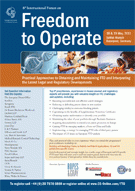
• Seattle #2 The Biotechnology Industry Organization (BIO) will be holding its Intellectual Property Counsels Committee (IPCC) Spring Conference & Meeting on April 13-15, 2011 in Seattle, WA.  The semi-annual IPCC conference will once again be open to the public.

    The conference will offer presentations on the following topics:

    Wednesday, April 13:

    • Supreme Court Practice: An Insider's View of the Supreme Court and the Solicitor General's Office

    Thursday, April 14:

    • Whose Rights Are They, Anyway? Implications from and a Discussion on Stanford v. Roche
    • A Landmark Case: The Aftermath of Myriad
    • The Business Case for International Humanitarian Approaches to IP Management and Collaborations
    • Best Practices in Research Collaborations: Joint Inventorship Pitfalls and Ethical Issues in Joint Representation
    • How to Stay in the Frying Pan and Out of the Fire: Hot Topics in Ethics for In-House IP Attorneys

    Friday, April 15:

    • Learning How to Navigate IP Landscape in Emerging Markets
    • To Disclaim or Not: An Update on the Law & Practice of Obviousness-Type Double Patenting
    • The Next Chapter: Biosimilars Beyond the Health Care Reform Act

    In addition, there will be a welcome reception on Wednesday, April 13 from 5:30 pm to 8:00 pm at 1924 Post Alley in Pike Place Market, and a dinner reception at the Space Needle from 5:30 pm to 9:00 pm on Thursday, April 14.

    A program agenda for this conference, including a list of speakers and descriptions of the presentations and events can be obtained here.

    The registration fee for the conference is $475 (core R&D companies that are BIO members), $875 (core R&D companies that are not BIO members), $1,100 (service providers that are BIO member), or $1,600 (service providers that are not BIO members).  Those interested in registering can do so here or by faxing a registration form to 202-488-0650.  Additional information can be found at the conference website.

    BIO IPCC

  • IPO #2 The Intellectual Property Owners Association (IPO) will offer a one-hour webinar entitled "Antibody Patents after Centocor" on Wednesday, March 23, 2011 beginning at 2:00 PM (ET).  The IPO webinar will examine how much descrioption is enough when it comes to written description for antibody patents as well as discuss the obviousness challenges antibody patents face since KSR.  The speakers include Jack Brennan of Fish & Richardson, Nicholas Groombridge of Weil Gotshal, and Jane Gunnison of Ropes & Gray.  The registration fee for the webinar is $120 (government and academic rates are available upon request).  Those interested in registering for the webinar, can do so here.

  • By Kevin E. Noonan

    Senate Seal S. 23 (the "America Invents Act" or, colloquially the patent reform bill) contains additional provisions for the U.S. Patent Office to obtain information related to patentability, both pre- and post-grant, as well as establishing a replacement for the Board of Patent Appeals and Interferences called the Patent Trial and Appeal Board.

    Section 7(a) of the bill amends 35 U.S.C. § 122 by adding new subsection (e), permitting any third party to submit "for consideration and inclusion in the record" of a pending application "any patent, published patent application or any other printed publication of potential relevance to the examination of the patent," subject to certain time limitations (§ 122(e)(1)).  These are that the submission must be done before the earlier of the date a Notice of Allowance is mailed (§ 122(e)(1)(A)) or the later of six months after the patent application is first published and the date of the first rejection by the Examiner (§ 122(e)(1)(B)).

     Any submission must include:  "a concise description of the asserted relevance of each submitted document (§ 122(e)(2)(A)); the fee set by the Director (§ 122(e)(2)(B)); and a statement that the individual making the submission "affirm[] that the submission was made in compliance with this section" (§ 122(e)(2)(C)).  Under Section 7(b), the effective date of these provisions is one year after the date of enactment, and will apply to all patent applications filed "before, on or after that effective date."  Since the amendment is limited to information readily at hand to the patent examining corps (unlike the on sale allegations raised in the Microsoft v. i4i case presently before the Supreme Court), it appears not to address any real or perceived information imbalance between the applicant and the Office, and implies that the Senate has been convinced by the plethora of industry and academic advocates that Patent Office personnel are incompetent (without any real evidence to support that view).  More importantly, the amendment does little to nothing to solve the real institutional problems that prevent effective examination in some art units.

    Post-grant, Section 10 provides additional, streamlined avenues for a patentee to provoke an ex parte reexamination.  Section 10(a) amends Chapter 25 of Title 35 to add a new § 257 for this purpose.  The new § 257 permits a patent owner to request "supplemental examination" to permit the Office to "consider, reconsider or correct information believed [by the patent owner] to be relevant to the patent" (§ 257(a)).  The standard for granting such a request is that the information raises a "substantial new question of patentability" (i.e., the current ex parte standard), but in this new § 257 the patent owner does not have the right to file a statement under § 304 (which right would be illogical, since only a patent owner can file such a request).  The Director "shall" conduct the supplemental examination upon three months of the request being granted (§ 257(a)).  Supplemental examination will be performed according to the procedures set forth in Chapter 30 (the current ex parte reexamination), i.e., by the examining corp (§ 257(b)).

    The revision does contain a significant new benefit for patentees in new § 257(c)(1), wherein:

    A patent will not be held unenforceable on the basis of conduct relating to information that had not been considered, was inadequately considered, or was incorrect in a prior examination of the patent if the information was considered, reconsidered, or corrected during a supplemental examination of the patent.  The making of a request under subsection (a), or the absence thereof, shall not be relevant to enforceability of the patent under section 282.

    The exceptions to this "get out of jail free" card regarding prior potential inequitable conduct is when there has been an allegation plead "with particularity" in an ANDA Notice letter under § 505(j)(2)(B)(iv)(II) of the Federal Food, Drug, and Cosmetic Act (21 U.S.C. § 355(j)(2)(B)(iv)(II)) prior to submission of the supplemental examination request (§ 257(c)(2)(A)), or as a defense in an enforcement action under § 337 of the Tarriff Act or plead as an affirmative defense under § 281 of the Patent Act unless the supplemental examination was concluded prior to the date when the action was brought (§ 257(c)(2)(B)).  As with other provisions, the Director is mandated to establish fees for supplemental examination and to consider requests therefor, and the fees due and owing for ex parte reexamination if ordered can be required in addition to the supplemental examination fee established by the Director (§ 257(d)).  The new § 257 also contains a provision establishing that this new § 257 does not preclude imposition of sanctions under the antitrust laws (§ 257(e)(1)), or "limit the authority of the Director" to investigate potential misconduct of applicants or their representatives before the Office  (§ 257(e)(2) or (3)).  Under Section 10(b), the effective date of these provisions is one year after the date of enactment, and will apply to all patent applications filed "before, on or after that effective date."

    Section 6 of the bill establishes the Patent Trial and Appeal Board, amending 35 U.S.C. § 6.  The Board is to be constituted with the Director, the Deputy Director, the Commissioner for Patents, the Commissioner for Trademarks, and the administrative patent judges in the Office (§ 6(a)).  The duties of the PTAB are to:

    (1)  on written appeal of an applicant, review adverse decisions of examiners upon applications for patents pursuant to section 134(a);

    (2)  review appeals of reexaminations pursuant to section 134(b);

    (3)  conduct derivation proceedings pursuant to section 135; and

    (4)  conduct inter partes reviews and post-grant reviews pursuant to chapters 31 and 32.

    (§ 6(b)) by panels of at least three administrative patent judges (§ 6(c)).  Duly constituted panels of APJs are the only fora empowered under the new § 6 to grant rehearings (§ 6(c)).  This portion of the bill also provides a correction for situations as occurred in the previous administration where there was a question of whether certain APJs were constitutionally appointed; § 6(d) provides that it will be considered a defense to any challenge that an APJ was not properly appointed that the APJ was acting as a "de facto officer."

    Section 6(b) of S. 23 amends § 134 to remove reference to third party requestor rights to appeal an adverse decision by the Director not to grant an inter partes reexamination (pursuant to the changes in inter partes reexamination rules; see "Post-grant Review Provisions of S. 23") and Section 6(c)(1) amends § 141 to be consistent with provisions of the revised inter partes reexamination rules and the new post-grant review rules, and includes ex parte and supplemental examinations under Sections 7 and 10 of the bill, that appeals from adverse decisions in those proceedings can only be appealed to the Court of Appeals for the Federal Circuit (§ 141(c)).  For derivation proceedings, the revised § 141 provides that appeals be heard by the Federal Circuit, but "such appeal shall be dismissed if any adverse party to such derivation proceeding, within 20 days after the appellant has filed notice of appeal in accordance with section 142, files notice with the Director that the party elects to have all further proceedings conducted as provided in section 146" (§ 141(d)).  However, "[i]f the appellant does not, within 30 days after the filing of such notice by the adverse party, file a civil action under section 146, the Board's decision shall govern the further proceedings in the case."  Section 6(c)(2) amends 28 U.S.C. § 1295(a)(4)(A) to include the jurisdiction of the PTAB under the provisions granting a right to a civil action under 35 U.S.C. §§ 145 or 146, and Section 6(c)(3) of the bill grants the Director the right to intervene in an appeal under 35 U.S.C. § 143 from a decision of the PTAB in a derivation proceeding, an inter partes reexamination or a decision on post-grant review, as well as the obligation to submit to the appellate court in writing "the grounds for the decision of the Patent and Trademark Office, addressing all of the issues raised in the appeal."

    The effective date of these provisions under Section 6(d) is one year after the date of enactment of the bill into law, with the exceptions that the jurisdiction of the Federal Circuit over appeals of reexamination decisions extends to any decisions of the current BPAI "with respect to a reexamination that is entered before, on, or after the date of the enactment of this Act" (Section 6(d)(1)); the amendments of §§ 6, 134, and 141 shall not go into effect for any inter partes reexaminations requested prior to one year after the enactment date (Section 6(d)(2)); (curiously), "the Patent Trial and Appeal Board may be deemed to be the Board of Patent Appeals and Interferences for purposes of appeals of inter partes reexaminations that are requested under section 311 prior to the date that is 1 year after the date of the enactment of this Act" (Section 6(d)(3)); and the right of the Director to intervene in an appeal under 35 U.S.C. § 143 from a decision of the PTAB in a derivation proceeding, an inter partes reexamination or a decision on post-grant review will extend to inter partes reexaminations requested "prior to the date that is 1 year after the date of the enactment of this Act" (Section 6(d)(4)).

    Since the amendment is limited to information readily at hand to the patent examining corps (unlike the on sale allegations raised in the Microsoft v. i4i case presently before the Supreme Court), it appears not to address any real or perceived information imbalance between the applicant and the Office, and implies that the Senate has been convinced by the plethora of industry and academic advocates that Patent Office personnel are incompetent (without any real evidence to support that view).  More importantly, the amendment does little to nothing to solve the real institutional problems that prevent effective examination in some art units.
  • By Kevin E. Noonan

    Washington - Capitol #5 The "America Invents Act" (S. 23 or the patent reform bill) passed by the Senate contains revisions to current inter partes reexamination as well as provisions for an entirely new post-grant review proceeding.

    Section 5(a) sets forth the revisions to inter partes reexamination.  The most significant of these is a change in the standard for granting a request (now termed a "petition") for inter partes reexamination, from raising a "substantial new question of patentability" under current law to "a reasonable likelihood that the petitioner will prevail with regard to at least one claim" (§ 314(a)).  The proposed revisions to the statute maintain the express prohibition against the patentee requesting inter partes reexamination, as well as limiting the scope of reexamination to patents and printed publications.  To accommodate the new post-grant review proceedings, petitions for inter partes reexamination are permitted at the later of 9 months from the grant date of a patent or reissued patent, or the date of termination of post-grant review (§ 311(c)(1) or (2)).  Also consistent with current law are provisions that the Director's decision whether to grant inter partes reexamination cannot be appealed (§ 314(d)).

    There are additional limits to when post-grant review petitions can be filed.  The bill prohibits a petitioner from having filed a "civil action challenging the validity of a claim of the patent" (§ 315(a)) (which certainly includes declaratory judgment actions but may include counterclaims in patent infringement litigation, depending on how they are characterized).  In addition, an inter partes reexamination proceeding will not be instituted if the petition is filed "more than 6 months after the date on which the petitioner . . . is served with a complaint alleging" patent infringement (§ 315(b)).  The bill grants the Director the authority to consolidate petitions in the case of multiple filings by third parties (§ 315(c)), as well as determining whether to "stay, transfer, consolidate[e] or terminat[e]" ex parte or inter partes reexamination proceedings, interferences or (presumably) derivation proceedings (§ 315(d)).  The bill also contains estoppel provisions, wherein a petition is estopped from "request[ing] or maintain[ing] a proceeding before the Office with respect to any claim on any ground that the petition raised or reasonably could have raised during post-grant review" (§ 315(e)(1), and is also estopped from bringing a declaratory judgment action or an action before the International Trade Commission based on any ground that was raised or reasonably could have been raised during the inter partes reexamination (§ 315(e)(2)).

    Unlike current inter partes reexamination, however, the proceedings are to be held before the Patent Trial and Appeal Board and not replicate ex parte examination under 35 U.S.C. §§ 132-133 (§ 316(c)).  The Director is granted the authority under these provisions of the bill to establish regulations, including:

    (1)  providing that the file of any proceeding under this chapter shall be made available to the public, except that any petition or document filed with the intent that it be sealed shall be accompanied by a motion to seal, and such petition or document shall be treated as sealed pending the outcome of the ruling on the motion;

    (2)  setting forth the standards for the showing of sufficient grounds to institute a review under section 314(a);

    (3)  establishing procedures for the submission of supplemental information after the petition is filed;

    (4)  in accordance with section 2(b)(2), establishing and governing inter partes review under this chapter and the relationship of such review to other proceedings under this title;

    (5)  setting a time period for requesting joinder under section 315(c);

    (6)  setting forth standards and procedures for discovery of relevant evidence, including that such discovery shall be limited to—

    (A)  the deposition of witnesses submitting affidavits or declarations; and

    (B)  what is otherwise necessary in the interest of justice;

    (7)  prescribing sanctions for abuse of discovery, abuse of process, or any other improper use of the proceeding, such as to harass or to cause unnecessary delay or an unnecessary increase in the cost of the proceeding;

    (8)  providing for protective orders governing the exchange and submission of confidential information;

    (9)  allowing the patent owner to file a response to the petition after an inter partes review has been instituted, and requiring that the patent owner file with such response, through affidavits or declarations, any additional factual evidence and expert opinions on which the patent owner relies in support of the response;

    (10)  setting forth standards and procedures for allowing the patent owner to move to amend the patent under subsection (d) to cancel a challenged claim or propose a reasonable number of substitute claims, and ensuring that any information submitted by the patent owner in support of any amendment entered under subsection (d) is made available to the public as part of the prosecution history of the patent;

    (11)  providing either party with the right to an oral hearing as part of the proceeding; and

    (12)  requiring that the final determination in an inter partes review be issued not later than 1 year after the date on which the Director notices the institution of a review under this chapter, except that the Director may, for good cause shown, extend the 1-year period by not more than 6 months, and may adjust the time periods in this paragraph in the case of joinder under section 315(c).

    The only constraint the Section puts on the Director is a consideration of "the effect of any such regulation on the economy, the integrity of the patent system, the efficient administration of the Office, and the ability of the Office to timely complete proceedings instituted under this chapter" (§ 316(b)).

    The patentee is given the right to file one motion to amend one or more of the challenged claims, either by cancelling the claims outright or proposing a "reasonable number" of substitute claims for each cancelled claim (§ 316(d)(1)(B)).  Any further motion to amend can be filed only as an agreed motion between the patentee and the petitioner (§ 316(d)(2)), and any amendments filed in any motion under this section "may not enlarge the scope of the claims . . . or introduce new matter" (§ 316(d)(3)).  The petitioner bears the burden of proof by a preponderance of the evidence (§ 316(e)).

    An inter partes reexamination can be terminated by settlement (§ 317) or decision of the Board (§ 318).  While similar to current provisions for settlement in interferences, the provisions differ in that whether review is terminated or the Board renders a decision is at the discretion of the Director (§ 317(a)).  As with interferences, any such settlement must be in writing and filed with the Office before review will be terminated and, although the settlement will not be published with the remainder of the review proceedings, settlements will be available to Federal Government agencies upon written request, or anyone upon a showing of "good cause" (§ 317(b)).

    The provisions regarding decisions of the Board provide for a certificate "canceling any claim of the patent finally determined to be unpatentable, confirming any claim of the patent determined to be patentable, and incorporating in the patent by operation of the certificate any new or amended claim determined to be patentable" (§ 318(b)).  The Office is tasked with making available the length of time it takes for the Board to complete its review (§ 318(c)).

    Any party is entitled to appeal a "adverse" decision after post-grant review, under any of the provisions of 35 U.S.C. §§ 141-144 (§ 319).

    These amendments are to take effect "not later than" one year after the enactment date of the bill into law (Section 5(c)(1)) and "shall apply to all patents issued before, on or after" the effective date (Section 5(c)(2)(A)), except for inter partes reexamination petitions filed prior to enactment, which will proceed as if the revisions were never passed (Section 5(c)(2)(B)).  The Director also has discretion to limit the number of inter partes reexamination petitions granted for the first four years after enactment, provided that the number is at least as many requests/petitions that were granted "in the last full fiscal year prior to the enactment date" of the revised law (Section 5(c)(2)(C)).  The bill also contains "transition provisions" (Section 5(c)(3)) amending the current statute to incorporate the changed standard (from "substantial new question of patentability" under current law to "a reasonable likelihood that the petitioner will prevail with regard to at least one claim") for inter partes reexamination requests filed between the date of the bill's enactment and the effective date of the revisions.

    Section 5(d) sets forth the new post-grant review provisions of the bill.  As with inter partes reexamination, the new post-grant review provisions (§§ 321-329) are instituted by petition to the Director by any person "not the patent owner" (§ 321(a)).  Unlike inter partes reexamination, however, post-grant review can be based on an allegation that at least one claim is invalid under any of the provisions of 35 U.S.C. § 282(b) and should be cancelled (§ 321(b)).  Inter partes reexamination is available throughout the unexpired term of a patent, while a petition under the new post-grant review provisions of the statute must be filed within 9 months of the patent grant or issuance of a reissue patent (§ 321(c)).

    Post-grant review petitions cannot be filed anonymously, requiring identification of the real party in interest (§ 322(a)(2)), and must identify "with particularity, each claim challenged, the grounds on which the challenge to each claim is based, and the evidence supporting the challenge to each claim" (§ 322(a)(3)).  The petition must be accompanied by copies of all patents or printed publications and any affidavits containing supporting evidence or opinion (§§ 322(a)(3)(A) and (3)(B)), as well as "any other information that the Director may require by declaration" (§ 322(a)(4)).  The petition and all supporting evidence must be supplied to the patent owner or representative (§ 322(a)(5)).  As with other proceedings concerning granted patents, all proceedings are public and made available "[a]s soon as practicable after receipt of a petition" for review (§ 322(b)).

    The patentee has the option of responding to the petition within two months, which response is limited to providing reasons why the petition fails to meet the requirements for its grant (§ 323).  Petitions must put forth evidence, presumably in light of any evidence or argument in the patentee's response, that if unrebutted would make it "more likely than not" that at least one of the challenged claims is unpatentable (§ 324(a)).  Alternatively, a grantable petition may contain a showing that there is a "novel or unsettled legal question that is important to other patents or patent applications (for example, the ACLU's challenge to the patent-eligibility of gene patents; § 324(b)).  The Director must make the determination to institute post-grant review within three months after receiving the patentee's response or when the time for that response has expired (§ 324(c)), by notifying the petitioner and the patentee (and the public), wherein the notice contains the date on which the review will commence (§ 324(d)).  As with reexamination, the Director's decision whether to institute post-grant review cannot be appealed and is final (§ 324(e)).

    There are additional limits to when post-grant review petitions can be filed.  The bill prohibits a petitioner from having filed a "civil action challenging the validity of a claim of the patent" (§ 325(a)) (which certainly includes declaratory judgment actions but may include counterclaims in patent infringement litigation, depending on how they are characterized).  In addition, if a patent infringement suit is brought within three months of the patent grant date, a district court cannot stay its consideration of a motion for preliminary injunction based on the filing (by anyone) of a post-grant review petition (§ 325(b)), but there is nothing in the statute to prevent the court from considering the petition when assessing the likelihood of success on the merits prong of the preliminary injunction standard.  The bill grants the Director the authority to consolidate petitions in the case of multiple filings by third parties (§ 325(c)), as well as determining whether to "stay, transfer, consolidate[e] or terminat[e]" ex parte or inter partes reexamination proceedings, interferences or (presumably) derivation proceedings (§ 325(d)).  For reissue patents, review is limited to broadened claims (§ 325(f)).  The bill also contains estoppel provisions, wherein a petition is estopped from "request[ing] or maintain[ing] a proceeding before the Office with respect to any claim on any ground that the petition raised or reasonable could have raised during post-grant review" (§ 325(e)(1), and is also estopped from bringing a declaratory judgment action or an action before the International Trade Commission based on any ground that was raised during post-grant review (§ 325(e)(2)).  The latter provision does not raise an estoppel against any defense under 35 U.S.C. § 282(b) in infringement litigation, and does not include the "or could have been raised" language contained in the provisions relating to matters before the Office.  As a consequence, petitioners face far lower risks of estoppel from filing post-grant review petitions, and no disincentive against making strategic decisions as to which grounds to assert vel non in those petitions.

    The Director is given broad authority to prescribe regulations for post-grant review proceedings, including:

    (1)  providing that the file of any proceeding under this chapter shall be made available to the public, except that any petition or document filed with the intent that it be sealed shall be accompanied by a motion to seal, and such petition or document shall be treated as sealed pending the outcome of the ruling on the motion;

    (2)  setting forth the standards for the showing of sufficient grounds to institute a review under subsections (a) and (b) of section § 324;

    (3)  establishing procedures for the submission of supplemental information after the petition is filed;

    (4)  in accordance with section 2(b)(2), establishing and governing a post-grant review under this chapter and the relationship of such review to other proceedings under this title;

    (5)  setting forth standards and procedures for discovery of relevant evidence, including that such discovery shall be limited to evidence directly related to factual assertions advanced by either party in the proceeding;

    (6)  prescribing sanctions for abuse of discovery, abuse of process, or any other improper use of the proceeding, such as to harass or to cause unnecessary delay or an unnecessary increase in the cost of the proceeding;

    (7)  providing for protective orders governing the exchange and submission of confidential information;

    (8)  allowing the patent owner to file a response to the petition after a post-grant review has been instituted, and requiring that the patent owner file with such response, through affidavits or declarations, any additional factual evidence and expert opinions on which the patent owner relies in support of the response;

    (9)  setting forth standards and procedures for allowing the patent owner to move to amend the patent under subsection (d) to cancel a challenged claim or propose a reasonable number of substitute claims, and ensuring that any information submitted by the patent owner in support of any amendment entered under subsection (d) is made available to the public as part of the prosecution history of the patent;

    (10)  providing either party with the right to an oral hearing as part of the proceeding; and

    (11)  requiring that the final determination in any post-grant review be issued not later than 1 year after the date on which the Director notices the institution of a proceeding under this chapter, except that the Director may, for good cause shown, extend the 1-year period by not more than 6 months, and may adjust the time periods in this paragraph in the case of joinder under section § 325(c).

    The only constraint the Section puts on the Director is a consideration of "the effect of any such regulation on the economy, the integrity of the patent system, the efficient administration of the Office, and the ability of the Office to timely complete proceedings instituted under this chapter" (§ 326(b)).

    The proceedings are to be conducted by the Patent Trial and Appeal Board (§ 326(c)).  The patentee is given the right to file one motion to amend one or more of the challenged claims, either by cancelling the claims outright or proposing a "reasonable number" of substitute claims for each cancelled claim (§ 326(d)(1)(B)).  Any further motion to amend can be filed only as an agreed motion between the patentee and the petitioner (§ 326(d)(2)), and any amendments filed in any motion under this section "may not enlarge the scope of the claims . . . or introduce new matter" (§ 326(d)(3)).  The petitioner bears the burden of proof by a preponderance of the evidence (§ 326(e)).

    Post-grant review can be terminated by settlement (§ 327) or decision of the Board (§ 328).  While similar to current provisions for settlement in interferences, the provisions differ in that whether review is terminated or the Board renders a decision is at the discretion of the Director (§ 327(a)).  As with interferences, any such settlement must be in writing and filed with the Office before review will be terminated and, although the settlement will not be published with the remainder of the review proceedings, settlements will be available to Federal Government agencies upon written request, or anyone upon a showing of "good cause."  These settlement provisions are curious in view of the avowed basis of the post-grant review proceedings being to cure the "plague" of "bad" or "poor-quality" patents;  just because a petitioner may be willing to settle with the patentee the public's interests are not addressed by such private agreements.

    The provisions regarding decisions of the Board provide for a certificate "canceling any claim of the patent finally determined to be unpatentable, confirming any claim of the patent determined to be patentable, and incorporating in the patent by operation of the certificate any new or amended claim determined to be patentable" (§ 328(b)).  The Office is tasked with making available of the length of time it takes for the Board to complete its review (§ 328(c)).

    Any party is entitled to appeal a "adverse" decision after post-grant review, under any of the provisions of 35 U.S.C. §§ 141-144 (§ 329).

    The Director is compelled ("shall") issue regulations effecting post-grant review "not later than" one year after enactment of the bill into law (Section 5(f)(1)) and shall apply only to patents described in Section 2(o)(1) of the bill (Section 5(f)(2)).  In addition, the Director can "impose a limit on the number of post-grant reviews initiated in the first 4 years following the effective date" (something presumably within the Director's discretion to grant petitions in the first place under (§ 324(e)).  Section 5(f)(3) provides for the Director to determine how to integrate post-grant review provisions with interferences "commenced before the effective date" of the post-grant review provisions.

    Section 5(g) expands the provisions for third party citation of prior art, by amending § 301 to permit "[a]ny person at any time" to submit prior art or patent owner statements made in litigation concerning the scope of any claim.  The third party submitter can also provide an explanation in writing on the "pertinence and manner of applying the prior art or written statements to at least one claim of the patent" as well as additional information ("any other documents, pleadings, or evidence from the proceeding in which the statement was filed that addresses the written statement"), which will become a part of the official file of the patent/application.  However, written statements and any such additional information (but not cited prior art) "shall not be considered by the Office for any purpose other than to determine the proper meaning of a patent claim in a proceeding that is ordered or instituted pursuant to section 304, 314, or 324."  Submissions can be made anonymously, and these revisions (by themselves or as they relate to ex parte reexaminations) become effective one year after the effective date of the bill's enactment but will apply to patents issued "before, on or after that effective date."

  • By Donald Zuhn

    Report In February, inovia released its 2011 report on global IP trends.  In compiling the report, inovia, which produces products for PCT national phase entry, European patent validation, and patent translations, surveyed nearly 150 U.S. companies to examine how the U.S. economy has impacted the foreign filing strategies of U.S. patentees.

    The report notes that survey respondents filed an average of just under 50 patent families last year, with 23% of respondents being involved in the pharmaceutical/biotech sector.  About a third of survey respondents had no in-house patent attorneys or agents, one-third had a single in-house patent attorney or agent, and the remainder had two or more attorneys or agents (only 8% had six or more).

    The report states that "[o]verall, the mood for 2010 was mixed" among survey respondents, with a majority of respondents citing cost containment and U.S. Patent Office reform as the most important issues in 2010.  Despite the mixed mood among respondents, 72% said they filed as many patent applications as they expected in 2010, 9% said they filed more, and only 19% said they filed less.  These results compared favorably with those of the 2010 survey, in which 41% of respondents said they filed fewer applications than expected in 2009.

    While filing expectations appear to have rebounded, the report shows that respondents have become more selective with their global filings.  In particular, respondents filed application families in an average of 5.9 countries in 2010, down from 6.6 countries in 2009.  With regard to the countries in which respondents regularly filed, 17% added new countries to their list, with more than 50% adding China and smaller percentages adding Brazil, India, and Russia.  A quarter of respondents dropped countries from their lists, with 45% deciding not to file in Japan and 20% dropping Europe or individual EPO member states from their lists.  Respondents that dropped Japan from their lists cited high cost and low cost-to-benefit ratios as the reasons for doing so.

    The report notes that a large majority of respondents continue to rely on the PCT for foreign filing.  Of these respondents, 89% selected the EPO as an International Searching Authority, 45% selected the Korean IP Office (KIPO), and 20% selected the Japan Patent Office (JPO).

    With regard to IP budgets, 38% of respondents said their budgets were cut in 2010, down from the 60% of respondents who indicated that their budgets were cut in 2009.  Moreover, 23% of respondents said their budgets were not cut in 2010 or in previous years and 21% said their budgets actually went up in 2010.

    The report concludes by noting that most survey respondents are "cautiously optimistic about 2011," with respondents expecting to file an average of 44.5 patent applications this year.

  • By Kevin E. Noonan

    Senate Floor The "America Invents Act" (S. 23; aka the patent reform bill) makes significant changes in the power of an assignee, or someone who has obligated an inventor to assign, to file an application without obtaining an oath or declaration (or even permission or knowledge) of the inventor, raising an interesting Constitutional question as discussed below.

    This change is effected by Section 3 of the bill as passed by the Senate, which amends 35 U.S.C. § 115.  As in the current version of § 115, new § 115(a) provides that an application requires the name of the inventor or inventors and an oath or declaration stating that the application was made (or was authorized to be made) by the affiant/declarant, and that the individual believes himself/herself to be the original sole or joint inventor of the claimed invention.  In the first of several delegations of authority from the statute to the Director, § 115(c) gives the Director the right to "specify additional information relating to the inventor and the invention that is required to be included in an oath or declaration."

    It is in new § 115(d) that the effects of the changes begin to become evident.  Section 115(d)(1) contains provisions similar to those under the current law, where an assignee can file an application in the name of an inventor who is deceased, "under legal incapacity" or "cannot be found after diligent effort."  Section 115(d)(2) does away with all of these requirements, providing merely that a "substitute statement" can be filed by anyone to whom the inventor is under an obligation to assign but has refused.  The substitute statement under these circumstances must contain the identification of the individual, "set forth the circumstances representing the permitted basis for the filing of the substitute statement in lieu of the oath or declaration" and (again) "any additional information, including any showing, required by the Director.

    New § 115(e) permits the "required statements" of §§ 115(b) and (c) to be included in the assignment document, and new § 115(f) prohibits the Director from issuing a Notice of Allowance unless there has been submitted "each required oath or declaration under subsection (a) or has filed a substitute statement under subsection (d) or recorded an assignment meeting the requirements of subsection (e)."  This language suggests that the assignment document might be substituted for the oath/declaration to satisfy the requirements under circumstances other than those where the inventor is unable, unavailable, or unwilling to sign (provided the assignment document is signed).  Since assignment documents are traditionally not constrained by the limitations of oaths or declarations (i.e., that neither the application nor the oath/declaration can be altered after the oath/declaration is signed), there is at least the possibility (particularly in view of the latitude given the Director) for assignments to be accepted under circumstances where an inventor (or, more likely, a co-inventor) is unaware that an application has been filed.  Similar possibilities exist for later-filed applications (continuations, divisionals, or continuations-in-part), since new § 115(g) provides that a new oath/declaration need not be filed if in the earlier application an oath/declaration pursuant to new § 115(a), a substitute statement under new § 115(d), or an assignment under new § 115(e) has been filed.

    New § 115(h)(1) further provides that "[a]ny person making a statement required under this section may withdraw, replace or otherwise correct the statement at any time" pursuant to regulations established by the Director "under which any such additional statements shall be filed."  In addition, "the Director may not  . . . require that any individual [] make any additional oath, declaration or other statement" once that individual has fulfilled the requirements of §§ 115(a) or (e) (i.e., the assignment shall be sufficient under this section).  This part of the statute also has an express "savings clause" permitting any irregularities in the oath or declaration to be cured by such "corrective statements."  New § 115(i) contains the provision that "any willful false statement made in such declaration or statement is punishable under section 1001 of title 18 by fine or imprisonment of not more than 5 years, or both."

    Section 3 contains several "conforming amendments," to 35 U.S.C. §§ 121, 111(a), and the Table of Sections.

    Section 3(b)(1) amends current 35 U.S.C. § 118 (Filing by other than inventor) as follows:

    A person to whom the inventor has assigned or is under an obligation to assign the invention may make an application for patent.  A person who otherwise shows sufficient proprietary interest in the matter may make an application for patent on behalf of and as agent for the inventor on proof of the pertinent facts and a showing that such action is appropriate to preserve the rights of the parties.  If the Director grants a patent on an application filed under this section by a person other than the inventor, the patent shall be granted to the real party in interest and upon such notice to the inventor as the Director considers to be sufficient.

    Section 3(b)(2) amends 35 U.S.C. § 251 to permit the applicant (assignee) to file a reissue application (and presumably sign the oath/declaration attesting that the patent for reissue is defective).

    In keeping with the reflection of the statute-writing process, Section 3(c) revises 35 U.S.C. § 112 to replace paragraph designations with subsections; thus, § 112, 1st paragraph, is changed to § 112(a), § 112, 2nd paragraph, is changed to § 112(b), etc.  There is no indication why this change has been included in the bill.  Section 3(d) contains conforming amendments to §§ 111(b)(1)(A) and (b)(2) to reflect these amendments to § 112.

    The effective date of these provisions is "1 year after the date of the enactment of this Act and shall apply to patent applications that are filed on or after that effective date" under Section 3(e).

  • By James DeGiulio

    Watson Invalidates Cephalon's Fentora Patents

    Watson Pharmaceuticals Watson Pharmaceuticals won a substantial victory in its lawsuit with Cephalon over Fentora when the generic drugmaker successfully established that two of three asserted patents covering the drug are invalid.  The dispute between the parties began in June 2008, when Cephalon filed suit against Watson in the U.S. District Court for the District of Delaware over Watson's ANDA filing covering a generic version of Fentora (see "Court Report," June 8, 2008).  Cephalon alleged infringement of U.S. Patent Nos. 6,200,604 and 6,974,590.  In September 2009, Cephalon brought another suit against Watson, alleging that Watson also infringed U.S. Patent Number 6,264,981 (see "Court Report," October 4, 2009).  Cephalon has also brought suit against Mylan and Barr, and has reached a settlement with Barr granting Barr a nonexclusive, royalty-free license to market and sell a generic version of Fentora in the U.S. as of October 2018.

    Cephalon #2 In an opinion issued on March 11, Judge Sue L. Robinson determined that Cephalon had failed to prove that Watson infringed the asserted claims of the '604 and '590 patents and that Watson had successfully proven the asserted claims to be invalid for lack of enablement.  In the first section of her opinion, Judge Robinson adopted Watson's proposed claim constructions for the '604 and '590 patents.  Turning to the issue of infringement, the Judge Robinson found that Cephalon had failed to show that a reaction in Watson's product produced an effect that was required to establish infringement.  Judge Robinson also held that bioequivalence was insufficient to establish infringement under the doctrine of equivalents.  Finally, in addressing Watson's invalidity counterclaims, Judge Robinson was persuaded by Watson's expert who indicated that a person of ordinary skill in the art would not be able to practice the invention of the two patents without undue experimentation.  The opinion and accompanying order did not issue a ruling on the '981 patent.


    Sanofi Agrees to Judgment Barring Assertion of Taxotere Patents

    Sanofi-Aventis After a ruling in a related case rendered Sanofi-Aventis' patents covering Taxotere invalid for obviousness and inequitable conduct, the company agreed to a judgment preventing it from asserting these patents against Sandoz.  In January 2011, Sanofi filed suit against Sandoz in the U.S. District Court for the District of Delaware, accusing Sandoz of infringing U.S. Patent Nos. 5,750,561 and 5,714,512 (see "Court Report," January 16, 2011), despite a previous ruling in a related case with Hospira and Apotex that found these two patents invalid (see "Biotech/Pharma Docket," September 30, 2010).  The suit against Sandoz was based on its NDA (under § 505(b)(2) of the Food, Drug and Cosmetic Act) covering a docetaxel injection product.  Sanofi also has a suit pending with Accord Healthcare over its NDA and Paragraph IV certification.  Sanofi has appealed the invalidity ruling from the Hospira and Apotex case.

    Sandoz #1 On March 11, Judge Gregory M. Sleet signed off on a consent order and judgment, which the parties signed to promote efficiency and economy for themselves and the District Court.  The judgment bars Sanofi from asserting the two patents until a decision from the Federal Circuit is issued in the related case.  Plaintiffs reserved all rights to appeal from this final judgment.  The future of the case depends on the action of the Federal Circuit in the related case.  If the Federal Circuit affirms the invalidity ruling in the Hospira and Apotex case, Sanofi waives its righ to appeal or seek modification of the current judgment.  However, if the Federal Circuit vacates or reverses the invalidity ruling, the plaintiffs could reinstate their infringement claims as to the two patents.


    Teva Dismisses Mylan's Inequitable Conduct Defenses in Azilect Dispute

    Mylan #1 Mylan will have to press on without an inequitable conduct defense in its dispute with Teva over the Parkinson's drug Azilect, after Teva successfully moved to dismiss Mylan's defense.  Last October, Teva filed suit in U.S. District Court for the District of New Jersey, alleging that Mylan (and other generic makers) infringed U.S. Patent No. 5,453,446 by submitting ANDAs for generic Azilect (see "Court Report," October 10, 2010).  Mylan raised its inequitable conduct defense in a November 30 response to the complaint, alleging that the '466 patent was unenforceable because the applicants did not disclose to the examiner that both deprenyl and PAI are R-enantiomers.  Mylan alleged that by failing to disclose this information, Teva, which asserted that the invention was "surprising and unexpected," intentionally misled the patent examiner.

    Teva #1 In an opinion issued on February 24, Judge Jose L. Linares granted Teva's motion to dismiss Mylan's counterclaims and affirmative defense alleging inequitable conduct.  Judge Linares found that Mylan had failed to plead the circumstances of inequitable conduct with the requisite particularity under Rule 9(b), which requires that a plaintiff make sufficient allegations of underlying facts from which a court can reasonably infer the requisite intent to deceive the USPTO.  Judge Linares, following Exergen Corp. v. Wal-Mart Stores, Inc., found that Mylan had not sufficiently identified the individuals involved or why the information withheld or misrepresented was material.  Judge Linares also granted Mylan an opportunity to amend its complaint to remedy the shortcomings of its pleadings.

  • By Kevin E. Noonan

    Washington - Capitol #3 The Senate passed S. 23 last week, which will make several significant changes in U.S. patent law if its provisions survive deliberations in the House (which is preparing its own bill).  One of the most fundamental of these is the change from the current "first-to-invent" to a "first-inventor-to-file" system.  In order to implement the changes, the Senate bill revises (and in some cases completely eliminates) portions of current law.

    The provisions of the bill relating to "First-Inventor-to-File" are set forth in Section 2.  Section 2(a) amends definitions relating to inventorship in 35 U.S.C. § 100.  The "inventor" is defined in new § 100(f) as "the individual, or if a joint invention, the individuals collectively who invented or discovered the subject matter of the invention."  A "joint inventor" is defined as "any 1 of the individuals who invented or discovered the subject matter of the joint invention" (§ 100(g)).  This section also defines a "joint research agreement" along current lines (§ 100(h)).  Importantly for the "first-inventor-to-file" regime, Section 2(a) defines the "effective filing date" either as the actual filing date of the invention (§ 100(i)(1)(A)) or "the filing date of the earliest application for which the patent or application is entitled" under §§ 119, 365(a), 365(b), 120, 121 or 365(c) (§ 100(i)(1)(B)).  Finally, this section defines "the claimed invention" as "the subject matter defined by a claim in a patent or application" (§ 100(j)).

    Section 2(b) effects the changes in 35 U.S.C. § 102 that changes U.S. patent law from "first-to-invent" to "first-inventor-to-file."  Instead of subsections § 102(a) through § 102(g), new § 102 provides that:

    A person shall be entitled to a patent unless:

    (1)  the claimed invention was patented, described in a printed publication, or in public use, on sale, or otherwise available to the public before the effective filing date of the claimed invention; or

    (2)  the claimed invention was described in a patent issued under section 151, or in an application for patent published or deemed published under section 122(b), in which the patent or application, as the case may be, names another inventor and was effectively filed before the effective filing date of the claimed invention.

    These provisions eliminate the distinction for public use, on sale or "otherwise available to the public" between acts occurring in the U.S. ("in this country") and acts occurring abroad ("in this or a foreign country") that have long been a feature of defining prior art under § 102; this effect is made explicit under Section 2(d), which repeals 35 U.S.C. § 104.  New § 102(a)(2) expressly defines the "first-inventor-to-file" aspects of the change, by defining as prior art an earlier-filed patent or application that "names another inventor"; it is likely that this provision will include (or be interpreted to include) a definition of "another inventor" as another "inventive entity," i.e., any difference in named joint inventors.

    The grace period that remains under S. 23 is contained in new § 102(b), which provides exceptions that include:

    (1)  DISCLOSURES MADE 1 YEAR OR LESS BEFORE THE EFFECTIVE FILING DATE OF THE CLAIMED INVENTION- A disclosure made 1 year or less before the effective filing date of a claimed invention shall not be prior art to the claimed invention under subsection (a)(1) if–

    (A)  the disclosure was made by the inventor or joint inventor or by another who obtained the subject matter disclosed directly or indirectly from the inventor or a joint inventor; or

    (B)  the subject matter disclosed had, before such disclosure, been publicly disclosed by the inventor or a joint inventor or another who obtained the subject matter disclosed directly or indirectly from the inventor or a joint inventor.

    (2)  DISCLOSURES APPEARING IN APPLICATIONS AND PATENTS- A disclosure shall not be prior art to a claimed invention under subsection (a)(2) if–

    (A)  the subject matter disclosed was obtained directly or indirectly from the inventor or a joint inventor;

    (B)  the subject matter disclosed had, before such subject matter was effectively filed under subsection (a)(2), been publicly disclosed by the inventor or a joint inventor or another who obtained the subject matter disclosed directly or indirectly from the inventor or a joint inventor; or

    (C)  the subject matter disclosed and the claimed invention, not later than the effective filing date of the claimed invention, were owned by the same person or subject to an obligation of assignment to the same person.

    New § 102(b)(1)(A) establishes the one-year grace period for the inventor's own disclosure or disclosure by another who derived the invention ("obtained directly or indirectly") from the "true" inventor.  New § 102(b)(1)(B), on the other hand, relates to a "second" disclosure of the subject matter that had previously been disclosed ("before such disclosure [had] been publicly disclosed") by the inventor or "another" who derived ("directly or indirectly") the invention from the inventor, also presumably less than one year prior to the effective filing date.

    New § 102(b)(2) disqualifies as prior art disclosure in a patent or patent application by another who "obtained [the subject matter] directly or indirectly from the inventor" (§ 102(b)(2)(A)) or wherein the subject matter had been publicly disclosed by the inventor or another who derived the invention from the inventor prior to the effective filing date of the earlier patent or application (§ 102(b)(2)(B)) or there was joint ownership ("not later than the effective filing date of the claimed invention") of the earlier disclosed subject matter and the claimed invention.  These provisions provide an incentive for early disclosure of inventions within the one-year grace period, because the effect of earlier disclosure is to eliminate as prior art any disclosure or patent or patent application that occurs after the first public disclosure by the inventor, provided the inventor files a patent application on the subject matter within the one-year grace period.

    New § 102 also defines common ownership under a joint research agreement (§ 102(c))(which seems to broaden the protections thereof from obviousness currently under § 103 to novelty under the new provisions), and the intent for "continuity" of the treatment of joint research agreements under the new law and the CREATE Act (§ 102(d)).

    Section 2(c) amends current 35 U.S.C. § 103, which sub silentio repeals §§ 103(b) and (c):

    A patent for a claimed invention may not be obtained, notwithstanding that the claimed invention is not identically disclosed as set forth in section 102, if the differences between the claimed invention and the prior art are such that the claimed invention as a whole would have been obvious before the effective filing date of the claimed invention to a person having ordinary skill in the art to which the claimed invention pertains.  Patentability shall not be negated by the manner in which the invention was made.

    Section 2(e) repeals statutory invention registrations, and §§ 2(f) and 2(g) are "conforming" amendments.

    Section 2(h) provides new § 291 defining "derived patents":

    (a)  In General- The owner of a patent may have relief by civil action against the owner of another patent that claims the same invention and has an earlier effective filing date if the invention claimed in such other patent was derived from the inventor of the invention claimed in the patent owned by the person seeking relief under this section.

    (b)  Filing Limitation- An action under this section may only be filed within 1 year after the issuance of the first patent containing a claim to the allegedly derived invention and naming an individual alleged to have derived such invention as the inventor or joint inventor.

    Unlike interferences, the remedy for derivation is by "civil action," a provision seemingly at odds with the concern expressed by the supporters of "first-inventor-to-file" that small inventors are disadvantaged under current law.  While it is certainly true that interference proceedings are costly, "civil actions" are notoriously costlier.

    However, Section 2(i) provides for "derivation proceedings" in the Office by amendment of 35 U.S.C. § 135:

    (a)  Institution of Proceeding- An applicant for patent may file a petition to institute a derivation proceeding in the Office.  The petition shall set forth with particularity the basis for finding that an inventor named in an earlier application derived the claimed invention from an inventor named in the petitioner's application and, without authorization, the earlier application claiming such invention was filed.  Any such petition may only be filed within 1 year after the first publication of a claim to an invention that is the same or substantially the same as the earlier application's claim to the invention, shall be made under oath, and shall be supported by substantial evidence.  Whenever the Director determines that a petition filed under this subsection demonstrates that the standards for instituting a derivation proceeding are met, the Director may institute a derivation proceeding.  The determination by the Director whether to institute a derivation proceeding shall be final and non[-]appealable.

    (b)  Determination by Patent Trial and Appeal Board- In a derivation proceeding instituted under subsection (a), the Patent Trial and Appeal Board shall determine whether an inventor named in the earlier application derived the claimed invention from an inventor named in the petitioner's application and, without authorization, the earlier application claiming such invention was filed.  The Director shall prescribe regulations setting forth standards for the conduct of derivation proceedings.

    (c)  Deferral of Decision- The Patent Trial and Appeal Board may defer action on a petition for a derivation proceeding until 3 months after the date on which the Director issues a patent that includes the claimed invention that is the subject of the petition.  The Patent Trial and Appeal Board also may defer action on a petition for a derivation proceeding, or stay the proceeding after it has been instituted, until the termination of a proceeding under chapter 30, 31, or 32 involving the patent of the earlier applicant.

    (d)  Effect of Final Decision- The final decision of the Patent Trial and Appeal Board, if adverse to claims in an application for patent, shall constitute the final refusal by the Office on those claims.  The final decision of the Patent Trial and Appeal Board, if adverse to claims in a patent, shall, if no appeal or other review of the decision has been or can be taken or had, constitute cancellation of those claims, and notice of such cancellation shall be endorsed on copies of the patent distributed after such cancellation.

    (e)  Settlement- Parties to a proceeding instituted under subsection (a) may terminate the proceeding by filing a written statement reflecting the agreement of the parties as to the correct inventors of the claimed invention in dispute.  Unless the Patent Trial and Appeal Board finds the agreement to be inconsistent with the evidence of record, if any, it shall take action consistent with the agreement.  Any written settlement or understanding of the parties shall be filed with the Director.  At the request of a party to the proceeding, the agreement or understanding shall be treated as business confidential information, shall be kept separate from the file of the involved patents or applications, and shall be made available only to Government agencies on written request, or to any person on a showing of good cause.

    (f)  Arbitration- Parties to a proceeding instituted under subsection (a) may, within such time as may be specified by the Director by regulation, determine such contest or any aspect thereof by arbitration.  Such arbitration shall be governed by the provisions of title 9, to the extent such title is not inconsistent with this section.  The parties shall give notice of any arbitration award to the Director, and such award shall, as between the parties to the arbitration, be dispositive of the issues to which it relates.  The arbitration award shall be unenforceable until such notice is given.  Nothing in this subsection shall preclude the Director from determining the patentability of the claimed inventions involved in the proceeding.

    The right is limited to an "applicant for patent" within one year after first publication of the derived application, thus imposing an obligation to monitor publication databases for any possibly derived patent applications (or patents).  In addition, the petition must be supported by "substantial evidence," but without any of the provisions for discovery (or obligations to provide evidence) currently available under interference provisions of current law.  In addition, the Board is given broad discretion to delay action on any petition until after the putatively derived patent has granted, without capacity to appeal such a decision (other than, perhaps, a "civil action").  And, while other portions of the bill establish the Patent Trial and Appeal Board that will be related to the current Board of Patent Appeals and Interferences, the Office will need to create the infrastructure for this "new" adjudicative body.  Section 2(j) of the bill strips current law of all references to interferences wherever they appear in the statute.

    Finally (and in keeping with the way the bill was amended and passed), Section 2(k) provides for amending the false marking statute (35 U.S.C. § 292) to eliminate action by "private attorneys general," i.e., the public, to bring such actions, except for competitors who can show injury from the false marking, with damages limited to those "adequate to compensate for the injury."  This aspect of the law will apply retroactively to "all cases . . . pending on or after the enactment of [the] Act."

    Section 2(l) introduces a 10-year "statute of limitations" into 35 U.S.C. § 32 regarding disciplinary proceedings before the Office and a biennial description of incidents that were barred from being brought under this section by the statute of limitations.  Section 2(m) relates to a small business study to determine the effects of the change to "first-inventor-to-file," with a Report to be provided to Congress not later than one year after the Act is enacted.  Similarly, Section 2(n) provides for a Report to Congress on prior user rights in the U.S. and abroad in Europe, Japan, Canada, and Australia and their effects "if any[] on small businesses, universities and individual inventors."

    Finally, Section 2(o) provides that the effective date of this bill, if enacted, is 18 months from the date of enactment.

    Analysis of additional provisions of S. 23 will appear in future posts.

  • By Sherri Oslick

    Gavel About Court Report:  Each week we will report briefly on recently filed biotech and pharma cases.

    Braintree Laboratories, Inc. v. Novel Laboratories, Inc.
    3:11-cv-01341; filed March 9, 2011 in the District Court of New Jersey

    Infringement of U.S. Patent No. 6,946,149 ("Salt Solution for Colon Cleansing," issued September 20, 2005) following a Paragraph IV certification as part of Novel's filing of an ANDA to manufacture a generic version of  Braintree's Suprep® (sodium sulfate, potassium sulfate and magnesium sulfate osmotic laxative, used for bowel cleansing prior to an adult patient having a colonoscopy procedure).  View the complaint here.


    Nycomed US Inc. v. Graceway Pharmaceuticals, LLC et al.

    2:11-cv-01295; filed March 8, 2011 in the District Court of New Jersey

    • Plaintiff:  Nycomed US Inc.
    • Defendants:  Graceway Pharmaceuticals, LLC; 3M Innovative Properties Co.

    Declaratory judgment of invalidity and non-infringement of U.S. Patent Nos. 7,902,209 ("Method of Preparing a Pharmaceutical Cream and Minimizing Imiquimod Impurity Formation," issued March 8, 2011), 7,902,210 ("Reduction of Imiquimod Impurities at Two Months Using Refined Oleic Acid," issued March 8, 2011), 7,902,211 ("Method of Inducing Interferon Biosynthesis," issued March 8, 2011), 7,902,212 ("X-Fold Less Imiquimod Impurities at Six Months Between Refined and Compendial," issued March 8, 2011), 7,902,213 ("Pharmaceutical Cream with Reduced Imiquimod Impurities at Four Months Using Refined Oleic Acid," issued March 8, 2011), 7,902,214 ("Method of Treating a Mucosal and/or Dermal Associated Condition," issued March 8, 2011), 7,902,215 ("Pharmaceutical Creams with Reduced Imiquimod Impurities," issued March 8, 2011), 7,902,216 ("Pharmaceutical Creams with Refined Oleic Acid," issued March 8, 2011), 7,902,242 ("Method of Stabilizing Imiquimod," issued March 8, 2011), 7,902,243 ("Methods for Improving Imiquimod Availability at Two Months, Four Months and Six Months Between Refined and Compendial,", issued March 8, 2011), 7,902,244 ("Method of Preparing a Pharmaceutical Cream and Minimizing Imiquimod Impurity Formation (At Least Four Months Storage)," issued March 8, 2011), 7,902,245 (""Methods for Reducing Imiquimod Impurities for Two Months, Four Months, and Six Months," issued March 8, 2011), 7,902,246 ("Methods for Controlling Formation of Imiquimod Impurities for Two Months, Four Months, and Six Months," issued March 8, 2011), and 7,696,159 ("Treatment for Basal Cell Carcinoma," issued April 13, 2010) based on Nycomed's filing of an ANDA to manufacture a generic version of Graceway's Aldara® (imiquimod cream, used for the topical treatment actinic keratoses, superficial basal cell carcinoma, and external genital and perianal warts).  View the complaint here.


    Prometheus Laboratories Inc. v. Roxane Laboratories, Inc.

    2:11-cv-01241; filed March 4, 2011 in the District Court of New Jersey

    Infringement of U.S. Patent No. 6,284,770 ("Medicaments for the Treatment of Non-Constipated Female Irritable Bowel Syndrome," issued September 4, 2001) following a Paragraph IV certification as part of Roxane's filing of an ANDA to manufacture a generic version of Prometheus' Lotronex® (alosetron hydrochloride, used to treat women with severe diarrhea-predominant irritable bowel syndrome).  View the complaint here.


    Takeda Pharmaceuticals Co. Ltd. et al. v. Apotex, Inc. et al.

    1:11-cv-01514; filed March 4, 2011 in the Southern District of New York

    • Plaintiffs:  Takeda Pharmaceuticals Co. Ltd.; Takeda Pharmaceuticals North America, Inc.
    • Defendants:  Apotex, Inc.; Apotex Corp.

    Infringement of U.S. Patent Nos. 5,965,584 ("Pharmaceutical Composition," issued October 12, 1999), 6,329,404 (same title, issued December 11, 2001), 6,166,043 (same title, issued December 26, 2000), 6,172,090 (same title, issued January 9, 2001), 6,211,205 (same title, issued April 3, 2001), 6,271,243 (same title, issued August 7, 2001), and 6,303,640 (same title, issued October 16, 2001) following a Paragraph IV certification as part of Apotex's filing of an ANDA to manufacture a generic version of Takeda's Actos® (pioglitazone hydrochloride, used to treat type II diabetes).  View the complaint here.


    Hoffmann-La Roche Inc. v. Accord Healthcare Inc. et al.

    2:11-cv-01192; filed March 2, 2011 in the District Court of New Jersey

    • Plaintiff:  Hoffmann-La-Roche, Inc.
    • Defendants:  Accord Healthcare Inc.; Intas Pharmaceutical Ltd.

    Infringement of U.S. Patent No. 5,472,949 ("N4-(Substituted-Oxycarbonyl)-5'-Deoxy-5-Fluorocytidine Compounds, Compositions and Methods of Using Same," issued December 5, 1995) following a Paragraph IV certification as part of Accord's filing of an ANDA to manufacture a generic version of Roche's Xeloda® (capecitabine, used to treat breast and colorectal cancer and Dukes' C Stage III colon cancer).  View the complaint here.

  • Calendar

    March 16-17, 2011 – FDA Boot Camp*** (American Conference Institute) – New York, NY

    March 18, 2011 – Intellectual Property Panel Symposium (George Washington University Law School) – San Francisco, CA

    April 5-6, 2011 – International Patent Forum 2011 (Managing Intellectual Property) – London, UK

    April 6-9, 2011 – 26th Annual Intellectual Property Law Conference (American Bar Association Section of Intellectual Property Law) – Arlington, VA

    April 15, 2011 – 2nd Annual John Marshall Law School Review of Intellectual Property Law Symposium – Chicago, IL

    April 27, 2011 – 27th Annual Joint Patent Practice Seminar (Connecticut, New Jersey, New York, and Philadelphia Intellectual Property Law Associations) – New York, NY

    May 3-4, 2011 – Paragraph IV Disputes*** (American Conference Institute) – New York, NY

    ***Patent Docs is a media partner of this conference or CLE