 The authors and contributors of Patent Docs wish their readers and families a Happy Holidays. Publication of Patent Docs will resume on December 26th.

Patent Law Weblog
recent posts
- Judge Newman Suspension Matter Transferred to 11th Circuit
- Ex parte Chowdhury (PTAB 2026)
- Biofer S.P.A. v. Vifor (International) AG (Fed Cir. 2026)
- Exelixis, Inc. v. MSN Laboratories Private Ltd. (Fed. Cir. 2026)
- Patentees File Claim under 28 U.S.C. § 1498 before Court of Federal Claims, and Federal Government Files Motion to Dismiss under 28 U.S.C. § 1500
about
-
-
Technology Transfer Tactics will be offering a webinar entitled "Life Under AIA: Anticipating and Surviving Post Grant Challenges" on January 26, 2012 from 1:00 – 2:00 pm (Eastern). Michael T. Siekman and Ed Walsh of Wolf Greenfield IP Law will provide a detailed review of the post-grant review provisions of the AIA, their likely impact, remaining uncertainties as the USPTO deals with implementation, and strategies to begin planning for now in both patent drafting and responding effectively to post-grant actions. The webinar will cover the following topics:
• The rules for post-grant opposition;
• Differences relative to inter partes reexam, interferences;
• Industry-specific issues;
• Interface with litigation: Estoppel rules and automatic stays;
• Filing a preliminary response;
• The “"more likely than not" standard;
• Discovery rules;
• Amending the patent — Cancelling or modifying claims;
• Appeal procedures;
• Comparison with EPO (European Patent Office) oppositions, and lessons learned from Europe's experience;
• Crystal ball gazing: Implementation by USPTO still to come; and
• Practical issues for TTOs.The registration fee for the webinar is $197. Those interested in registering for the webinar, can do so here.

-
 Strafford will be offering a webinar entitled "Obviousness Standard for Patents: Approaches to Withstand USPTO Obviousness Rejections and Attacks on Patent Validity" on January 31, 2012 from 1:00 – 2:30 pm (EST). Paul Davis of Goodwin Procter; Scott J. Szala of Winston & Strawn LLP; and Thomas L. Irving of Finnegan Henderson Farabow Garrett & Dunner will provide guidance on the changes brought by the America Invents Act, a review of the USPTO's post-KSR guidelines and how the courts and USPTO are applying the obviousness standard. The panel will also outline best practices to avoid obviousness rejections and defend patent validity. The webinar will review the following questions:
• How will patent reform and the AIA impact the application of the obviousness standard?
• Under what circumstances has the obvious-to-try standard supported a finding of obviousness — and when has it worked to nullify such a finding?
• What are the steps that patent applicants can take to stand up to obviousness rejections?An interactive Q&A session will follow the presentation.
The registration fee for the webinar is $297 ($362 for registration and CLE processing). Those registering by January 13, 2012 will receive a $50 discount. Those interested in registering for the webinar, can do so here.
-
By Donald Zuhn —
 In a Federal Register notice published last week (76 Fed. Reg. 78246), the U.S. Patent and Trademark Office announced that the Extended Missing Parts Pilot Program that was implemented last year will be extended for another year. The pilot program "effectively provides a 12-month extension to the existing 12-month provisional application period, providing applicants additional time to find financial help, evaluate a product's worth in the marketplace or further develop the invention for commercialization." In particular, the pilot program modifies the Office's current missing parts practice — which permits an applicant to pay the filing fees and submit an executed oath or declaration after the filing of a nonprovisional application within a two-month time period that is extendable for an additional five months on payment of extension of time fees — such that applicants can file a nonprovisional application with at least one claim within the 12-month statutory period after the provisional application has been filed (as well as pay the basic filing fee, submit an executed oath or declaration, and not file a nonpublication request) and then be given a 12-month period within which to decide whether the nonprovisional application should be completed by paying the required surcharge and the search, examination, and any excess claim fees.
Applicants wishing to participate in the pilot program must file a nonprovisional application within twelve months of the filing date of a provisional application, directly claim the benefit of the provisional application, and submit a certification and request to participate in the program with the nonprovisional application. In the Office's notice regarding the extension of the pilot program, the Office:
[C]autions all applicants that, in order to claim the benefit of a prior provisional application, the statute requires a nonprovisional application filed under 35 U.S.C. 111(a) to be filed within twelve months after the date on which the corresponding provisional application was filed. See 35 U.S.C. 119(e). It is essential that applicants understand that the Extended Missing Parts Pilot Program cannot and does not change this statutory requirement.
The pilot program is not without its drawbacks; for example, the form for requesting participation in the program (PTO/SB/421) outlines the PTA effects of participation in the program, stating that:
Any patent term adjustment (PTA) accrued by applicant based on certain administrative delays by the USPTO is offset by a reduction for failing to reply to a notice by the USPTO within three months. See 37 CFR 1.704(b). Thus, if applicant replies to a notice to file missing parts more than three months after the mailing date of the notice, the additional time that applicant takes to reply to the notice will be treated as an offset to any positive PTA accrued by the applicant.
In addition, under the pilot program, nonprovisional applications are still published according to the existing eighteen-month publication provisions. Most importantly, the Office has advised applicants that:
[T]he extended missing parts period does not affect the twelve-month priority period provided by the Paris Convention for the Protection of Industrial Property. Thus, any foreign filings must still be made within twelve months of the filing date of the provisional application if applicant wishes to rely on the provisional application in the foreign-filed application or if protection is desired in a country requiring filing within twelve months of the earliest application for which rights are left outstanding in order to be entitled to priority.
Where an applicant participating in the program fails to pay the basic filing fee, provide an executed oath or declaration, or submit application papers that are in condition for publication — i.e., comply with the requirements for participation in the program (which are essentially the requirements for publication of the application) — the applicant is given a two-month (extendable) time period within which to supply those items. In the notice regarding the extension of the pilot program, the Office notes that applications that are not filed electronically will still be assessed a $400 additional fee (or $200 for small entities) pursuant to the Leahy-Smith America Invents Act, that this fee will be due within the two-month (extendable) time period to reply to the Notice to File Missing Parts of Nonprovisional Application, and that applicants will not be given the 12-month time period under the pilot program to pay this fee.
The pilot program has been extended until December 31, 2012.
For additional information regarding the pilot program, please see:
• "USPTO Implements Pilot Program Extending Provisional Application Period," December 13, 2010
• "USPTO Seeks to Effectively Double Provisional Application Period," April 4, 2010 -
By Kevin E. Noonan —
 The pros and cons of patenting in the biosimilars scheme recently enacted as part of the Patient Protection and Affordable Care Act have been discussed, here and elsewhere (see "Will Patents Become Irrelevant in a Biosimilars Future?"). Whether envisioned by the bill's drafters or not, the provisions of the Biologics Price Competition and Innovation Act of 2009 (particularly the litigation provisions) contain incentives for biologic drug innovators not to rely on patents to protect these drugs and the return on investment (or at least the reasonable prospect thereof) needed to support the capital-intensive effort that must be exerted to bring such drugs to market. Limitations on claim scope, possibilities of successful "design arounds" and the limited scope available for infringement by equivalents, as well as the uncertainties associated with amino acid sequence and other variants, make biologic drugs different from conventional small molecule drugs, which have been protected by patents under the Hatch-Waxman regime. Also a factor in why small molecule drug innovators have relied more heavily on patent protection that is likely for biologic drugs is the difference in term of exclusivity under the two Acts: Hatch-Waxman gives small molecule drugs only five years of exclusivity while the BPCIA gives biologic drugs twelve years (a term fought by the FTC (who wanted no exclusivity; see "No One Seems Happy with Follow-on Biologics According to the FTC"), Congressman Waxman (5 years; see "Waxman Introduces Follow-on Biologics Bill"), and even President Obama (7 years; see "White House Recommends 7-Year Data Exclusivity Period for Follow-on Biologics"). Patent law provisions (including 35 U.S.C. § 271(e)(2), which make the filing of an Abbreviated New Drug Application an statutory act of infringement) and drug regulatory law (wherein filing a patent infringement lawsuit by an NDA holder after receiving a Paragraph IV letter regarding an Orange Book-listed patent from a generic drug maker provokes a 30-month stay in FDA approval of the ANDA) have made patent litigation the principal battle ground between innovator and generic drug makers for a generation. None of these advantages exist in the biosimilar approval pathway specified under the BPCIA.
Even though patenting may not hold its preeminent place in protecting biologic drugs that it has had in protecting small molecule drugs, it would be a mistake to think that patents have become completely irrelevant to biologic drug deveopment. They may be so with regard to the (generally adversarial) relationship between biologic drug innovators and companies (perhaps including traditional innovator companies) that make biosimilars. But there is another conventional purpose for biologic drug patenting: protecting startup companies early in the development cycle. In this regard, patents continue to serve their purpose of providing exclusivity for further development stages, and in prohibiting larger, better-funded companies from expropriating early-stage technology. Patents also satisfy the requirements imposed on universities under the Bayh-Dole Act, and enable federally funded grantees to reap the benefits of licensing their technology.
 These advantages are unlikely to change even for biologic drugs. But the expected de-emphasis on patent protection for later-stage development (including regulatory approval) can be expected to change the relative importance of patents in the two stages. Such de-emphasis will also change where the valuation in biologic drugs may lie, because there will be a relatively greater advantage in optimizing cell lines and other process parameters (which even today rarely benefit from patenting) than in patents on the biologic drugs per se. That doesn't mean that patents will be any less important for startups, but thirty years of deal-making and negotiating behavior between small companies and their larger brethren will be impacted, probably not in a way that will inure to the benefit of the startups. While patents will remain essential to early-stage companies, their diminished value to larger partners (and the concomitantly greater value of the contributions of such companies) should also diminish the valuation of such deals.
The counter-argument is that startups will play an even more important role in providing the next generation of new potential "blockbuster" drugs, something is short supply from big pharma over the past few years. Whether due to inherent flaws in the "waiting for a blockbuster" drug development model or because the "low-hanging fruit" of small molecule drug development has been expended (or more likely because the diseases of aging garnering the most attention today are particularly intractable to pharmaceutical intervention, i.e., you can't put eating right and regular exercise into pill form), the prospects for startups (particularly university-generated startups) may be rosier than might be expected if patents become less important in protecting biologic drugs.
A good source of information on the interplay between patent protection and statutory protection under the BPCIA comes from Dr. Yaniv Heled, a recent Patent Docs commenter (see "Patents vs. Statutory Exclusivities in Biological Pharmaceuticals – Do We Really Need Both?"). Dr. Heled's paper contains some valuable tables comparing the terms of the two types of exclusivity (patent and statutory) for dozens of biologic drugs. One conclusion from the paper is that patent protection provides (on average) about one additional year (~327 days) of exclusivity past the end of the 12-year exclusivity provided by the BPCIA. (The table also indicates that the average time between patent application filing date and FDA approval is more than ten years (~3728 days).) Dr. Heled's paper (while coming to slightly different conclusions and couched in the language of academic patent law) is consistent with the idea set forth here that the future will be different than the past regarding biologic drug development and efforts to obtain the benefits of biologic drug development at a reduced price. For all these reasons, we may find that for biologic drugs the goals espoused by the proponents of the biosimilar approval pathway may be surprised at how that future turns out.
-
By Donald Zuhn —
USPTO Updates "Track I" Program
 On Monday, the U.S. Patent and Trademark Office announced that it had issued a final rule, changing the Track I prioritized examination program. Under the new rule, applicants can request prioritized examination for "any patent application in which a proper request for continued examination (RCE) has been filed before, on, or after December 19, 2011." Additional information regarding the change was provided in a notice published Monday in the Federal Register (76 Fed. Reg. 78566). After postponing the launch of the Track I program due to funding limitations, the Track I program was finally implemented on September 26 as part of the Leahy-Smith America Invents Act (see "USPTO Implements Prioritized Examination Track under AIA").
USPTO and Rospatent Announce PCT Agreement On Monday, the U.S. Patent and Trademark Office announced the implementation of an agreement with the Russian Federal Service for Intellectual Property (Rospatent), in which Rospatent will act as an available International Searching Authority (ISA) and International Preliminary Examining Authority (IPEA) for international applications filed with the USPTO as the Receiving Office. The agreement will take effect on January 10, 2012. According to the Office's notice on the agreement, "[t]he addition of Rospatent as an available ISA/IPEA choice will allow applicants additional flexibility in choosing a given international authority based on the technology disclosed in the international application, speed of services provided and cost of obtaining searches and examinations of international applications."
Applicants selecting Rospatent as the ISA will pay a search fee of $415, as compared with $2,080 for searches conducted by the USPTO. Applicants selecting Rospatent as the IPEA will pay an international preliminary examination fee of RUB 5400 ($169.41 at the current exchange rate) and a handling fee of $219 when Rospatent was the ISA, as compared with $600 for an examination conducted by the USPTO when the USPTO was the ISA. For examinations conducted by Rospatent where it was not the ISA, the examination fee will RUB 8100 ($254.11 at the current exchange rate), as compared with $750 for an examination conducted by the USPTO when the USPTO was not the ISA.
USPTO Director Davis Kappos noted that "[t]he collaboration between the USPTO and Rospatent will be beneficial for US applicants as it will provide additional choices at a lower cost."
USPTO and IPO Establish PPH Pilot Program Last month, the U.S. Patent and Trademark Office announced the establishment of a new Patent Prosecution Highway (PPH) pilot program with the Icelandic Patent Office (IPO). As with other PPH programs, the USPTO-IPO PPH will permit an applicant having an application whose claims have been allowed in one of the offices to fast track the examination of an application in the other office, such that the latter application is examined out of turn. In particular, an applicant receiving a ruling from either the USPTO or IPO that at least one claim in an application is patentable may request that the other office fast track the examination of corresponding claims in the corresponding application in that office.
The USPTO-IPO PPH pilot program, which began on December 1, 2011, is scheduled to expire on November 30, 2012, but may be extended for up to one year or terminated earlier depending on volume of activity and other factors. USPTO requirements for participation in the USPTO-IPO PPH pilot program can be found here, and IPO requirements can be here.
Since implementing its first Patent Prosecution Highway (PPH) program with the Japan Patent Office (JPO) on July 3, 2006, the U.S. Patent and Trademark Office has established a total of twenty-two PPH programs with other patent offices. Currently the USPTO has PPH programs (full or pilot) in place with the Japan Patent Office (JPO), the Korean Intellectual Property Office (KIPO), the United Kingdom Intellectual Property Office (UK IPO), the Canadian Intellectual Property Office (CIPO), IP Australia (IP AU), the European Patent Office (EPO), the Danish Patent and Trademark Office (DKPTO), the Intellectual Property Office of Singapore (IPOS), the German Patent and Trade Mark Office (DPMA), the National Board of Patents and Registration of Finland (NBPR), the Hungarian Patent Office (HPO), the Russian Federal Service for Intellectual Property, Patents and Trademarks (ROSPATENT), the Spanish Patent and Trademark Office (SPTO), the Austrian Patent Office (APO), the Mexican Institute of Industrial Property (IMPI), the Swedish Patent and Registration Office (PRV), Nordic Patent Institute (NPI), and the Israel Patent Office (ILPO), the Taiwan Intellectual Property Office (TIPO), the Norwegian Industrial Property Office (NIPO), China's State Intellectual Property Office (SIPO), and the Icelandic Patent Office (IPO).
 In other PPH news, the USPTO issued a follow-up notice regarding its launch of new Paris Convention ("Paris Route") and Patent Cooperation Treaty (PCT) Patent Prosecution Highway (PPH) pilot programs with China’s State Intellectual Property Office (SIPO) (see "USPTO News Briefs," November 17, 2011).
USPTO Launches New Website Design
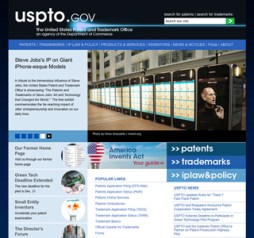 The U.S. Patent and Trademark Office launched a new home page design today. According to a notice regarding the new design, the redesigned website "better presents the activities and services of the USPTO to the public, and is more accessible to [the agency's] user community." The Office noted that the old design, which was launched in June 2009 (see "USPTO Issues Beta Release of New Website"), was criticized as being "too text heavy," and the new site places a greater reliance on graphic cues to help visitors find what they’re looking for. To help users transition to the new site, the old home page will be available until February 29, 2012. The Office is also accepting comments regarding the website at newhomepage@uspto.gov.
 -
By Kevin E. Noonan —
The future is always the undiscovered country. But it tends to be one that people believe they can understand based on what has happened in the past. This is the reason people invest with successful money managers, and why every prospectus carries the disclaimer that "past experience does not ensure future performance." It is also why learned (and not so learned) disquisitions on innovation and innovation policy are so incomplete and unsatisfying — innovation like the future comes from where we least expect it, both in substance and the people who turn out to be the innovators. As Niels Bohr said, "[p]rediction is very difficult, especially about the future."
 But one thing that is predictable is that people will modify their behavior (at least to some extent) to adapt to changing circumstances. One such changing circumstance is the biosimilars provisions of the omnibus health care reform bill enacted into law almost three years ago. As has been discussed here and elsewhere extensively (and won't be repeated here), there are two general provisions to the law: the requirements and procedures for a biosimilar applicant to be granted approval of a biosimilar application (section 7002) and the provisions for litigation between the biosimilar applicant and the reference product sponsor (section 7003). The Food and Drug Administration is charged in large part with determining the requirements and procedures specified broadly by Congress in section 7002. The agency has hinted that it will propose rulemaking and issue guidelines by the end of the year, and these guidelines will not only establish the parameters of the biosimilar pathway but also affect how likely it will be that biosimilar drug manufacturers will apply for approval under the biosimilars provisions (codified under § 351(k) of the Public Health Service Act, codified at 42 U.S.C. § 262(k)) or under other sections (such as a full-blown Biologic License Application under § 505(a) of the Food, Drug and Cosmetics Act, codifed at 21 U.S.C. § 355(a)). These guidelines will also affect the likelihood that the biosimilar applicant will attempt to qualify for interchangeability and the incentives for producing so-called "bio-betters," i.e., biologic molecules having differences in structure and different (preferably improved) biological properties.
The ligation provisions, on the other hand, depend on the existence of patents to protect biologic drugs after expiration of the twelve-year data exclusivity period. Superficially, these provisions are modeled on the Hatch-Waxman regime, insofar as the statute guides how patent infringement litigation will proceed. Superficially is where the resemblance to Hatch-Waxman ends, of course; a significant difference is the absence of an "Orange Book" defining what patents are to be the subject of litigation. In its stead is a complex negotiation protocol by which the parties decide which patents will be the subject of infringement litigation triggered by the filing of a biosimilar application. There has been speculation that the statute was intended to discourage litigation and its labyrinthine, almost Byzantine provisions support this view. It is likely to take at least five years to almost a decade before there is any case law developed enough to test the effectiveness of these provisions.
There is an alternative, however, that may tend to change unpredictably the course of biosimilar development. That alternative is for biologic drug innovators to eschew patenting altogether and thus avoid the possibility of protracted patent infringement litigation under the statute. There are a number of vulnerabilities to patents that claim biologic drugs that are not shared with small molecule drugs and that may make such an approach attractive. Most of these vulnerabilities stem from the greater complexity of biologic drugs; as shown below, biologic drugs have 2-3 orders of magnitude more atoms than small molecule drugs. In addition, biologic drugs are made (generally) in genetically engineered cells that impose their own variabilities (in post-translation modifications such as glycosylation for example) on the processes used to make such drugs. Further, the complexity makes the scope of patent protection on biologic drugs to be less certain than for small molecules, since even small differences in structure (such as the single methylene group that distinguishes valine from isoleucine) may have unpredictable effects on biologic drug structure, biological activity and immunogenicity. As a consequence, broad coverage for even structurally similar species of the same biologic drug are infrequently granted, and even when obtained may be of dubious provenance and reliability.
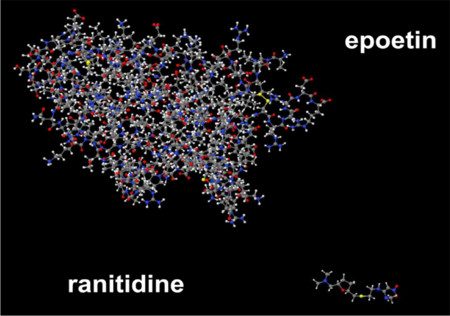
But this very complexity might be a source of an advantage for a biologic drug innovator not to pursue patent protection. In that case, the incentives for the innovator would be to provide as little information as required by the FDA for biologic drug approval. This would of necessity involve disclosure of how the biologic drug was made and its characterization, but would not include disclosure of the cell itself. Even if the disclosure to the agency included a detailed description of the cells, the transgenes and the methods and conditions for producing the recombinant cells, optimization of the particular cell line should not need to be revealed. And the uncertainty that would produce would provide a clear obstacle to a biosimilar manufacturer that might be a disincentive to trying to readily (i.e., predictably) produce a biosimilar version of a biologic drug.The benefits of this approach for biologic drug innovators are evident: producing obstacles to the biosimilar applicant (for whom it would be more difficult to produce a biosimilar drug) as well as avoiding biosimilars litigation under the statute. It is unlikely that the Congressional staffers and their patrons intended this result. It is equally unlikely that the promised benefits of biosimilar availability (and the expected massive cost savings, especially to the government) will be achieved were innovators to eschew patenting. But this is yet another consequence of (mis)applying our experience with small molecule drugs and the Hatch-Waxman regime to biosimilars, and another example of the past not reliably informing the future.
-
By Sherri Oslick —
 About Court Report: Each week we will report briefly on recently filed biotech and pharma cases.
Shire LLC et al. v. Mylan Pharmaceuticals Inc. et al.
1:11-cv-00201; filed December 15, 2011 in the Northern District of West Virginia• Plaintiffs: Shire LLC; Supernus Pharmaceuticals, Inc.; Shire Development Inc.; Shire International Licensing B. V.; Amy F. T. Arnsten, Ph.D.; Robert D. Hunt, M.D.; Pasko Rakic, M.D.
• Defendants: Mylan Pharmaceuticals Inc.; Mylan, Inc.Infringement of U.S. Patent Nos. 5,854,290 ("Use of Guanfacine in the Treatment of Behavioral Disorders," issued December 19, 1998), 6,287,599 ("Sustained Release Pharmaceutical Dosage Forms with Minimized pH Dependent Dissolution Profiles," issued September 11, 2001), and 6,811,794 (same title, issued November 2, 2004) based on Mylan's filing of an ANDA to manufacture a generic version of Shire's Intuniv® (guanfacine, used to treat attention-deficit hyperactivity disorder). View the complaint here.
Cephalon, Inc. et al. v. Celgene Corp. et al.
1:11-cv-12226; filed December 14, 2011 in the District Court of Massachusetts• Plaintiffs: Cephalon, Inc.; Acusphere, Inc.
• Defendants: Celgene Corp.; Abraxis Bioscience, Inc.; Abraxis Bioscience, LLCInfringement of U.S. Patent No. RE40,493 (""Porous Paclitaxel Matrices and Methods of Manufacture Thereof," reissued September 9, 2008) based on Celgene's manufacture and sale of its Abraxane® product (paclitaxel protein-bound particles for injectable suspension; used for the treatment of breast cancer). View the complaint here.
Janssen Pharmaceuticals, Inc. et al. v. Sandoz, Inc.
3:11-cv-07247; filed December 13, 2011 in the District Court of New Jersey• Plaintiffs: Janssen Pharmaceuticals, Inc.; Peninsula Pharmaceuticals, Inc.; Shionogi & Co. Ltd.
• Defendant: Sandoz, Inc.Infringement of U.S. Patent No. 5,317,016 ("Pyrrolidylthiocarbapenem Derivative," issued May 31, 1994) following a Paragraph IV certification as part of Sandoz's filing of an ANDA to manufacture a generic version of Janssen's Doribax® (doripenem injecction, used to treat complicated intra-abdominal infections and complicated urinary tract infections, including pyelonephritis). View the complaint here.
Warner Chilcott Co., LLC v. Lupin Ltd. et al.
3:11-cv-07228; filed December 12, 2011 in the District Court of New Jersey• Plaintiff: Warner Chilcott Co., LLC
• Defendants: Lupin Ltd.; Lupin Pharmaceuticals, Inc.Infringement of U.S. Patent No. 6,667,050 ("Chewable Oral Contraceptive, " issued December 23, 2003) following a Paragraph IV certification as part of Lupin's filing of an ANDA to manufacture a generic version of Warner Chilcott's GeneressTM Fe (norethindrone and ethinyl estradiol, used for oral contraception). View the complaint here.
Alza Corp. v. Mylan Pharmaceuticals Inc. et al.
2:11-cv-07158; filed December 9, 2011 in the District Court of New Jersey• Plaintiff: Alza Corp.
• Defendants: Mylan Pharmaceuticals Inc.; Mylan Inc.Infringement of U.S. Patent No. 5,591,454 ("Method For Lowering Blood Glucose," issued January 7, 1997), licensed to Pfizer, following a Paragraph IV certification as part of Mylan's filing of an amendment to its ANDA (adding additional dosage forms) to manufacture a generic version of Pfizer's Glucotrol XL® (glipizide extended release tablets, used to improve glycemic control in adults with type 2 diabetes mellitus). View the complaint here.
PAMLAB, L.L.C. et al. v. Macoven Pharmaceuticals, L.L.C.
1:11-cv-09022; filed December 9, 2011 in the Southern District of New York• Plaintiffs: PAMLAB, L.L.C.; Metabolite Laboratories, Inc.; Breckenridge Pharmaceutical, Inc.
• Defendant: Macoven Pharmaceuticals, L.L.C.Infringement of U.S. Patent No. 6,528,496 ("Compositions Treating, Preventing, or Reducing Elevated Metabolic Levels," issued March 4, 2003) based on Macoven's manufacture, sale, and offer for sale of folic acid products allegedly represented to be substitutable for plaintiffs' Foltx® and/or Folbic® products (vitamin B12, vitamin B6, and folic acid, used to treat hyperhomocysteinemia). View the complaint here.
-

January 4-8, 2012 – 29th Annual National CLE Conference (Law Education Institute) – Snowmass, CO
January 25-26, 2012 – Biosimilars Forum 2012 (C5) – London, UK
January 31 – February 1, 2012 – Patent Reform for Life Sciences Companies*** (American Conference Institute) – New York, NY
January 31 – February 1, 2012 – Pharma & Biotech Patent Litigation (C5) – Amsterdam, The Netherlands
February 13-14, 2012 – China IP Counsel Forum (C5) – Shanghai, China
February 21-22, 2012 – Biotech & Pharmaceutical Patenting (IBC Legal) – Munich, Germany
February 22-23, 2012 – EU Pharma Law & Regulation*** (C5) – London, England
February 22-24, 2012 – Intensive Patent Law Training Seminar (Chisum Patent Academy) – New York, NY
February 27-29, 2012 – Life Sciences Collaborative Agreements and Acquisitions*** (American Conference Institute) – New York, NY
February 28-29, 2012 – Medical Device Patents*** (American Conference Institute) – Boston, MA
***Patent Docs is a media partner of this conference or CLE
-
 IBC Legal will be holding its 20th annual Biotech & Pharmaceutical Patenting conference on February 21-22, 2012 in Munich, Germany. Conference highlights include:
• Benefit from industry perspectives throughout the day with IBC faculty of experienced corporate counsel;
• Hear the tips and traps of current tactics for maximising patent life cycles and data exclusivity;
• Gain an excellent understanding of the latest SPC position including a consideration of the judgments of key decisions including Novartis v Actavis, Medeva and Georgetown University;
• Analyse the practical implications on everyday work of the recent developments and case law in Europe and the U.S. and the latest on the European Medicines Agency concept paper;
• Examine the EC Bolar implementation and discuss recent developments and trends in avoiding patent infringements in clinical trials;
• Review and discuss the advantages and pitfalls of HGS v Lilly — has it lowered the bar for industrial applicability?
• Obtain cutting-edge advice and insights on patent protection strategies and competitive patent filing, paediatrics and competition issues in patenting. In particular, IBC Legal faculty will offer presentations on the following topics:
• A perspective from industry;
• Developments in European patent law in the last 12 months;
• Second medical use and dosing regimens claims in the UK and at the EPO;
• Functional claims — Ensuring they stand up to scrutiny;
• Patentability and enforcement of research tool patents;
• Patenting genes and theranostics;
• Stem cells: When are they patentable?
• Patent filing in Brazil — Maximising your chances of success;
• Patent filing — An industry perspective;
• Strategies for maximising patent life cycles — Exploring the application of SPCs to extend patent life;
• EPO update;
• Dealing with competition law issues in patenting;
• Avoiding patent infringements in clinical trials and the EC Bolar implementation;
• Comparison of EU biosimilars legislation and Hatch-Waxman act procedures in the U.S.;
• Patent strategies in biosimilars;
• What you need to know about data exclusivity;
• Paediatric extensions — Issues and challenges; and
• SPCs masterclass.A complete brochure for this conference, including an agenda, detailed descriptions of conference sessions, list of speakers, and registration form can be obtained here.
 The registration fee for the conference is £1,499. Those registering by January 27, 2012 will receive a £100 discount. Those interested in registering for the conference can do so here, by calling +44 (0)20 7017 5503, or by faxing a registration form to +44 (0)20 7017 4746.
Patent Docs is a media partner of the Biotech & Pharmaceutical Patenting conference.

