• USPTO SealThe U.S. Patent and Trademark Office, in cooperation with the U.S.-ASEAN Business Council, the U.S. Department of Commerce's International Trade Administration, and the U.S. Commercial Service, will be offering a Southeast Asia intellectual property roadshow on July 18, 2022 from 7:00 pm to 9:00 pm (ET).  Policy makers, thought leaders, and experienced practitioners in the field of intellectual property (IP)—including speakers from the U.S. Patent and Trademark Office (USPTO), the U.S. Association of Southeast Asian Nations (US-ASEAN) Business Council, the U.S. Department of Commerce, and the private sector—will be presenting a free webinar on IP issues in Southeast Asia and the ASEAN Economic Community.  Topics to be covered during the webinar will include:

    • Protecting and enforcing IP in ASEAN Economic Community markets
    • Practical market experiences in Southeast Asia
    • Cross-border e-commerce digital asset protection considerations
    • U.S. government resources

    Those interested in registering for the webinar can do so here

  • By Kevin E. Noonan

    Federal Circuit SealAlmost four years ago, in a relatively rare occurrence based on there being an insufficient factual record to permit proper appellate review, the Federal Circuit vacated a District Court decision rendering invalid the claims in five patents asserted by Tris Pharma, Inc. against Teva Laboratories FL, Inc. and remanded.  The Court has had the opportunity to review the District Court's decision on remand, delayed by the COVID pandemic, and today affirmed the determination that Teva had not shown the claims to be invalid by clear and convincing evidence.

    To recap, the case arose in ANDA litigation regarding Quillivant XR®, an extended release, liquid methylphenidate (MPH) formulation for the treatment of Attention Deficit Hyperactive Disorder (ADHD).  The District Court found the asserted claims of U.S. Patent Nos. 8,465,765 ('765 patent), 8,563,033 ('033 patent), 8,778,390 ('390 patent), 8,956,649 ('649 patent), and 9,040,083 ('083 patent) were invalid as being obvious under 35 U.S.C. § 103.  As explained in the earlier opinion, MPH is a widely used psychostimulant that has been used for treating ADHD since the 1950's.  Both immediate-release (IR) and extended-release (ER) formulations of the drug were also known in the art, and sustained-release (SR) formulations were later developed to overcome drawbacks of both IR and ER formulations.  Unfortunately, prior art SR formulations were disadvantageous for having slow onset action properties.  The claimed invention was a combination formulation comprising an IR component and an SR component that showed "a 45-minute therapeutic onset and 12 hours of therapeutic effect."

    Asserted claim 6 (dependent on claim 1) was at issue in the litigation and was deemed to be representative:

    1.  A methylphenidate aqueous extended release oral suspension comprising (1) an immediate release methylphenidate component, (2) a sustained release methylphenidate component comprising a water-insoluble, water-permeable, pH-independent, barrier coated methylphenidate-ion exchange resin complex, and (3) water, wherein said suspension has a pH of about 3.5 to about 5 and said suspension provides a single mean average plasma concentration peak for methylphenidate and a therapeutically effective plasma profile for methylphenidate for about 12 hours.

    6.  The suspension according to claim 1, wherein the suspension has a pharmacokinetic profile in which the single mean plasma concentration peak for d-methylphenidate has an area under the curve (AUC)0-∞of about 114 ng-hr/mL to about 180 ng-hr/mL, Cmax of about 11 ng/mL to about 17 ng/mL, Tmax of about 4 hours to about 5.25 hours and T1/2 of about 5 hours to about 7 hours following a single oral administration of an aqueous suspension at a dose equivalent to 60 mg racemic methylphenidate HCl in adults.

    The prior art considered by the District Court in the earlier case included several commercially available, extended-release MPH formulations (Concerta®, Daytrana®, Focalin XR®, Metadate CD®, and Ritalin LA®), U.S. Patent Application Publication No. 2010/0260844, and certain scientific publications.  The commercial products all exhibited various pharmacokinetic and pharmacodynamics properties regarding a single or multiple PK peak profile, initial onset time and total duration.  The '844 patent publication disclosed "a formulation of MPH that provides a rapid onset of action within 1 to 1.5 hours, a single Tmax of 5.5 to 7.5 hours, and a therapeutic duration of about 12 to 14 hours."  Actavis relied on the '844 application in combination with Concerta®, Daytrana®, and Metadate CD® as teaching "a single mean peak PK profile, exhibiting an early onset of action, and exhibiting an extended duration of effect" that would have suggested to the skilled worker the early onset and extended duration formulation in the asserted claims.  Tris Pharma argued to the contrary that the prior art taught combinations of IR and ER MPH formulations that resulted in a bimodal PK profile.  This feature of combined IR and ER MPH formulations was designed to "mimic the peaks and valleys of multiple immediate release dosing regimens" which was not a feature of the claimed invention.  In addition, the commercially available formulations showed a later Tmax that was important to achieve the longer duration.

    The District Court found the claims to be obvious and the Federal Circuit disagreed, vacating and remanded, in an opinion by Judge Chen, joined by Judges Newman and O'Malley.  The opinion was based on Fed. R. Civ. P. 52(a)(1), which states that "[i]n an action tried on the facts without a jury or with an advisory jury, the court must find the facts specially and state its conclusions of law separately."  Citing Gechter v. Davidson, 116 F.3d 1454, 1457 (Fed. Cir. 1997), the Federal Circuit stated that "[w]hen the opinion explaining the decision lacks adequate fact-findings, meaningful review is not possible, frustrating the very purpose of appellate review as well as this court's compliance with its statutory mandate."  Such considerations were important in this case because the paucity of the District Court's fact-finding made it impossible for the panel to properly assess the correctness of its legal conclusion of obviousness.

    On remand, the District Court considered dependent claim 10 of the '033 patent to be exemplary:

    1.  A methylphenidate aqueous extended release oral suspension comprising (1) an immediate release methylphenidate component, (2) a sustained release methylphenidate component, and (3) water, said suspension having a pH of about 3.5 to about 5, wherein said suspension provides a single mean average plasma concentration peak and a therapeutically effective plasma profile for about 12 hours for methylphenidate, and wherein the suspension has a pharmacokinetic profile in which the single mean plasma concentration peak for methylphenidate has an area under the curve (AUC)0 ® of about 114 to about 180 ng-hr/mL, Cmax of about 11 to about 17 ng/mL, Tmax of about 4 to about 5.25 hours, and T1/2 of about 5 to about 7 hours following a single oral administration of said suspension at a dose equivalent to 60 mg racemic methylphenidate HCl in adults.

    9.  A method for treating a patient having a condition susceptible to treatment with methylphenidate, the method comprising administering to the patient the suspension according to claim 1, wherein said suspension provides a therapeutically effective amount of methylphenidate within 45 minutes after administering of said suspension and a single average plasma concentration peak.

    10.  The method according to claim 9, wherein the suspension which has a pH from about 4 to about 4.5.

    (In a footnote the opinion notes that claims 6 and 20 of the '765 patent, claims 4 and 10 of the '033 patent, and claims 15, 16, and 20 of the '390 patent were under consideration on appeal.)  The opinion set forth the claim limitations relevant to the issues on appeal to be:

    • "aqueous,"
    • "therapeutically effective plasma profile . . . for about 12 hours" (12-hour duration, relevant to extended-release formulations),
    • "therapeutically effective amount of methylphenidate within 45 minutes" (45-minute onset),
    • "Tmax of about 4 to about 5.25 hours" (early Tmax range), and
    • "single mean plasma concentration peak" (single mean peak).

    All of the claims before the Court recited "a liquid MPH formulation with a 12-hour duration and single mean peak," and claim 6 of the '765 patent, claim 4 of the '033 patent, and claims 15,16, and 20 of the '390 patent recited the early Tmax range.  Claim 10 was considered representative because it was the only claim that recited all these features.

    On remand, Actavis relied upon the same factual evidence it adduced in the earlier trial, relating to five commercially available prior art MPH formulations, prior art patent publication 2010/0260844 and scientific articles.  According to the panel opinion "no single reference disclose[d] all of the limitations in any given claim" (although some references disclosed "various subsets of the claim limitations").  Having considered "the trial record, post-trial record, and the parties' post-remand briefing" the District Court found Actavis failed to show the asserted claims were invalid for obviousness by clear and convincing evidence, and this appeal followed.

    The Federal Circuit affirmed this time around, in an opinion by Judge Chen joined by Chief Judge Moore and Judge Hughes.  Considering the asserted claims seriatim, the Court affirmed the District Court's determination that Actavis failed to prove that "an artisan of ordinary skill would have been motivated to combine with a reasonable expectation of success a liquid MPH formulation with a single mean peak, 12-hour duration, and 45-minute onset" with regard to claim 20 of the '765 patent.  In particular, Actavis did not adduce evidence that "a skilled artisan would have pursued a single mean peak concentration profile," instead merely showing that single or bimodal peaks were potential options and the art taught away from a single mean peak.  These determinations were supported, according to the Court, by objective indicia of non-obviousness, specifically unexpected results, and the existence of a long-felt need for the claimed formulations.

    For claim 6 of the '765 patent, claim 4 of the '033 patent, and claims 15, 16, and 20 of the '390 patent, the Federal Circuit affirmed the District Court's decision that Actavis had not established that "an artisan of ordinary skill would have been motivated to combine with a reasonable expectation of success a liquid MPH formulation with a single mean peak, 12-hour duration, and the claimed Tmax range."  Specifically, the District Court held (and the Federal Circuit agreed) that while one of the references disclosed these features the prior art formulations were not liquid ones, which was required by the asserted claims.  And the District Court found that Actavis failed to establish that claim 10 of the '033 patent was invalid for obviousness because of a failure in showing a motivation to combine these references.

    On appeal, the panel rejected Actavis's arguments that the District Court erred in finding no motivation to combine the asserted references and no reasonable expectation of success.  In the Court's opinion, the lower court's findings were supported by the evidence of record as supplemented by additional evidence required by the Federal Circuit in its remand decision.  The District Court held that Actavis had not met this burden on remand.

    Specifically with regard to the 45-min onset claims, the Federal Circuit held that the District Court properly found Actavis produced insufficient evidence for motivation to combine the single mean peak profile with "a liquid formulation with a 12-hour duration and 45-minute onset" as required in claim 20 of the '765 patent (what evidence there was being "at best, inconsistent").  The Federal Circuit agreed with the District Court's determination that the prior art taught away from "a liquid formulation with a single peak, 12-hour duration, and 45-minute onset," based on expert testimony inter alia that "[t]o achieve both an early onset and longer duration, a formulator would seek a concentration profile with two separate (bimodal) peaks" rather than the single mean peak profile recited in the asserted claims.  And the panel found that the District Court properly did not find the asserted claims obvious over the asserted prior art patent application disclosure because expert testimony characterized these teachings as "aspirational" and "hypothetical."

    Also unpersuasive was Actavis's assertion of U.S. Patent Pub. No. 2007/215511 (Mehta) for teaching "an artisan of ordinary skill how to develop a liquid formulation of MPH with a single mean peak [pharmacokinetic] profile, 12-hour duration, and 45-minute onset."  The District Court found these teachings to be at "too high a level of generality" to supply the requisite motivation to combine and reasonable expectation of success.  Finally, the panel agreed with the District Court's determination that there were secondary indicia factors that supported the District Court's non-obvious determination.

    Regarding claims that recited the "early Tmax" limitation, the District Court found and the Federal Circuit affirmed that the '844 published patent application "presented only a hypothetical formulation without any data or explanation for why or how a formulation with the claimed limitations could be accomplished."  Accordingly, the District Court did not err in finding that claim 6 of the '765 patent, claim 4 of the '033 patent, and claims 15, 16, and 20 of the '390 patent were not obvious because Actavis did not show by clear and convincing evidence a motivation to combine and reasonable expectation of success.

    On this record, the Federal Circuit affirmed.

    Tris Pharma, Inc. v. Actavis Laboratories FL, Inc. (Fed. Cir. 2022)
    Nonprecedential disposition
    Panel: Chief Judge Moore and Circuit Judges Chen and Hughes
    Opinion by Circuit Judge Chen

  • By Kevin E. Noonan

    Federal Circuit SealThe Federal Circuit today affirmed a decision by the District Court denying defendant Thales DIS AIS Deutschland USA's motion for preliminary injunction to prevent patentee plaintiff Koninklijke Philips N.V. from obtaining an exclusion order from the International Trade Commission (ITC) under Section 337 of the Tariff Act of 1930 (19 U.S.C. § 1337), in Koninklijke Philips N.V. v. Thales DIS AIS Deutschland USA LLC.

    The ITC provides relief in the form of an exclusion order against importation of goods shown to infringe a U.S. patent.  After the Supreme Court's decision in eBay v. MercExchange, the more reliable access to injunctions available from the ITC became attractive to patent plaintiffs under circumstances where all or a portion of patented product was imported into the U.S.  Section 337 proceedings are also amenable to motions for preliminary injunction, with all the strategic benefits such motions can have (for a patent holder or, as here, an accused infringer wishing to avoid an injunction that would halt importation until district court litigation was completed or the case settled).  But such injunctions are not automatic, as Thales found in this case.

    The subject matter at issue was telecommunications equipment and technology, including wireless networks.  After fruitless negotiations regarding licensing of Philips' disputed standard essential patents (SEP) and Thales infringement thereof in its products, Philips filed an infringement suit in the U.S. District Court of Delaware and for an exclusion order before the ITC.  Thales counterclaimed for breach of contract and for a declaratory judgment on the FRAND rate determination, as well as a preliminary injunction to bar Philips from seeking a Section 337 exclusion order.  The District Court denied Thales' preliminary injunction motion and this appeal followed.

    The Federal Circuit affirmed, in an opinion by Chief Judge Moore joined by Judges Dyk and Chen.  As the Court explained, whether a preliminary injunction is granted is within the sound discretion of the district court and Federal Circuit review of the district court's decision was for an abuse of discretion.  The Court's assessment of this question was grounded on the sufficiency of Thales' satisfaction of the requirements for a preliminary injunction, which were that the moving party is "likely to succeed on the merits, that [it] is likely to suffer irreparable harm in the absence of preliminary relief, that the balance of equities tips in [its] favor, and that an injunction is in the public interest," citing Luminara Worldwide, LLC v. Liown Elecs. Co., 814 F.3d 1343, 1352 (Fed. Cir. 2016) (quoting Winter v. Nat. Res. Def. Council, Inc., 555 U.S. 7, 20 (2008)).  The basis for the panel's opinion that the District Court found Thales was properly not entitled to a preliminary injunction was the insufficiency of their allegations regarding the likelihood of irreparable harm.  "[M]ere possibility or speculation of harm is insufficient," according to the opinion, citing Winter.  Speculation (exemplified in the opinion as "customers merely expressing concern that a potential future ITC exclusion order could affect Thales' ability to deliver products down the road") does not evince a likelihood of irreparable harm, according to the Court (emphasis in opinion), citing Ferring Pharms., Inc. v. Watson Pharms., Inc., 765 F.3d 205, 219 (Fed. Cir. 2014), and Takeda Pharms. U.S.A., Inc. v. Mylan Pharms. Inc., 967 F.3d 1339, 1349 & n.8 (Fed. Cir. 2020).  The panel found no clear error by the District Court in finding Thales' evidence "conclusory" because it presented no evidence that "[Thales] lost customers, had customers delay purchases, or struggled to acquire new business because of the ongoing ITC proceedings."  Instead, Thales produced affidavits from clients that they had "voice[d] concerns" and "expressed doubt" regarding Thales' continued reliability as a supplier (expressed at oral argument as living under a "cloud on the business").  This is not sufficient evidence to satisfy the likelihood of irreparable prong of the test for obtaining a preliminary injunction, the Court held, citing Takeda Pharms and Celsis In Vitro, Inc. v. CellzDirect, Inc., 664 F.3d 922, 930 (Fed. Cir. 2012).

    Accordingly, the Court affirmed the District Court's denial of Thales' preliminary injunction motion; the opinion also ordered Thales to pay costs.

    Koninklijke Philips N.V. v. Thales DIS AIS Deutschland USA LLC (Fed. Cir. 2022)
    Panel: Chief Judge Moore and Circuit Judges Dyk and Chen
    Opinion by Chief Judge Moore

  • By Kevin E. Noonan

    An international cadre of scientists* from almost 70 institutions worldwide recently reported their findings in the scientific journal Nature that the domesticated dog (Canis familiaris) arose from two populations of ancestral grey wolves (Canis lupus) (see "Grey wolf genomic history reveals a dual ancestry of dogs").

    The grey wolf is recognized as the species that survived the last Ice Age (the last glacial maximum or LGM occurring ~28,000-23,000 years ago) to give rise to domesticated dogs, but little is known about progenitor wolf populations.  Siberian grey wolves are known to have survived from this period but it is unknown the extent to which other grey wolf populations, which were widely distributed in the Northern Hemisphere for the last few hundred thousand years, either went extinct or responded to changes in climate by adaptation.  Archeological evidence places domesticated dog populations arising ~14,000 years ago, and divergence from grey wolf species occurring ~40,000-14,000 years ago.  But analyses of modern grey wolves and dogs have been unable to resolve domesticated dog origins due to, inter alia, dog genetic diversity and local extinction and gene flow occurring after domestication.

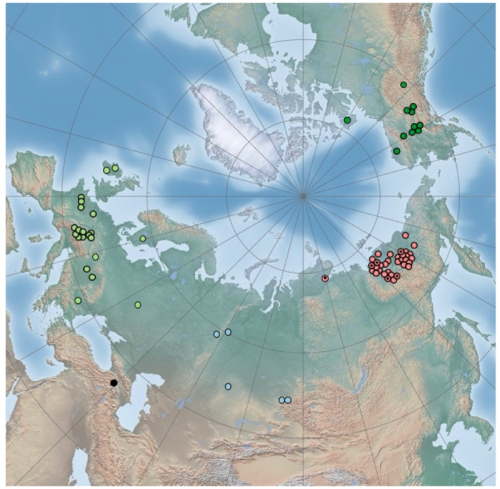
    To attempt to address these deficiencies, the researchers assessed 72 ancient wolf genomes over the past 100,000 years from Europe, Siberia, and North America:

    Image 1Sites of ancient wolf genomes reported in the study

    (consisting of 66 newly sequenced genomes, 5 previously sequenced specimens, and one ancient dhole genome from the Caucasus, dated to be more than 70,000 years old and used as an "outgroup" control).  These samples were ~69% males and through mitochondrial DNA analysis averaged 21,573 ± 5,133 years old.  As explained in the paper, the researchers "merged single-nucleotide polymorphism (SNP) genotypes called from these genomes with those from worldwide modern wolves (n = 68), modern (n = 369) and ancient (n = 33) dogs, and other canid species [and t]he total dataset spans the last 100,000 years."

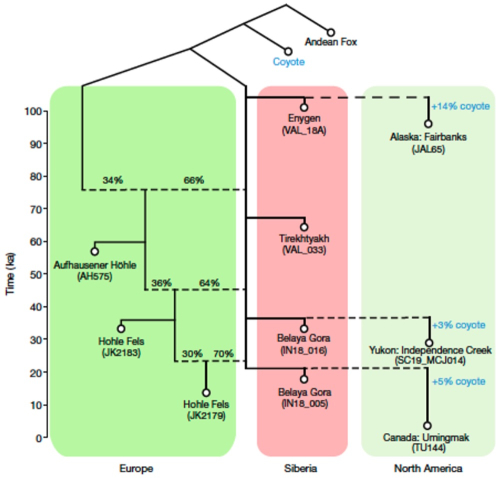
    The results of genetic analyses on these SNPs showed a directionality of gene flow in wolf populations, from the Siberian wolf populations to the European and Central Asian wolves and not vice versa, starting after a time less than ~23,000 years ago; these conclusions were supported by mitochondrial DNA assessments ("our results suggest that Siberia acted as a source and Europe as a sink for migration throughout the Late Pleistocene and show no evidence of gene flow in the other direction").  Paradoxically, these results also showed that there remains what the researchers termed a "minority fraction of deep European ancestry" that has persisted in modern wolf populations, having 10-40% of their ancestry that is more divergent than the oldest Siberian wolves studied.  Some of this diversity was identified as coming from the African grey wolf in the Near East and an unknown canid originating in Tibet.  This persistent evidence indicated to these researchers that grey wolves, unlike other megafauna (e.g., woolly mammoths) did not come close to extinction.  And some North American grey wolf populations show evidence of admixture with coyotes, species that began to diverge from one another ~700,000 years ago (no similar coyote-wolf admixture was seen in Eurasian grey wolf populations).  The genetic relationships between these populations were represented in the paper by this graph:

    Image 2
    And while there is some evidence of Siberian grey wolf genetic admixture in North American wolf populations the genetic evidence reported by these authors showed no reverse admixture of North American grey wolf populations into Siberian grey wolves.  The evidence also suggests local extinction in North American grey wolf populations during the LGM of the last Ice Age.

    In comparing the proportion of genetic variation between rather than within grey wolf populations, the researchers found that wolf populations showed low levels of variation even between populations in distant regions in the Pleistocene.  In the last ~10,000 years, however, (i.e., the Holocene) further gene flow from Siberia was not detected while gene flow from European populations was seen in modern wolves from China and Siberia, with population bottlenecks perhaps (the authors speculate) being due to human "persecution" in the past few centuries (supported by widespread effective population size declines).

    In further analyzing the observed connectivity in grey wolf populations throughout the past 100,000 years the authors report assessment of alleles at specific genetic loci, finding twenty-four regions in grey wolf genomes having some evidence for natural selection.  The observed connectivity between grey wolf populations resulted in mutations becoming fixed in these population between 40,000 and 30,000 years ago in the case of the IFT88 gene (a gene wherein disruption results in craniofacial abnormalities and cleft lips in mice and humans) on wolf chromosome 25, a characteristic shared with domesticated dogs.  (It might be recalled that changes in visage in domesticated dogs has been hypothesized as being relevant to their acceptance by humans; see "Selection for Facial Features in Domestic Dogs: The Evolution of Cuteness").  Additionally, these researchers reported that "[t]hree regions with evidence for selection overlap olfactory receptor genes, with variants on chromosome 15 increasing in frequency from close to 0% to 100%" between 45,000 and 25,000 years ago, "suggesting that olfaction was a recurrent target of adaptation in wolves" and that "[m]ost of the detected selection episodes occurred before the divergence of dogs, and dogs share the selected alleles."  Illustrating how natural selection and intentional breeding can operate on similar phenotypic determinants, the authors report that "a region on chromosome 10, where variation among dogs is associated with body size, drop ears and other traits [has been] under recent selection in specific dog breeds" was also found to have been selected in wolves in the last 20,000 years.

    While the impetus for the reported research was to better understand the origin of domesticated dog species from earlier wolf populations, the results of these studies showed that history is more complex than anticipated.  A closer relationship was observed between modern domesticated dogs from eastern Eurasian wolves than western Eurasian populations, but modern domesticated dogs in the Near East and Africa could trace their ancestral species from a population of grey wolves related to extant southwestern Eurasian populations.  Recent population genetic events, including admixture and population changes further complicate the picture, according to the paper.  As summarized, the authors state that "[t]hese results could be taken to support an eastern or central Eurasian dog origin outside of north-eastern Siberia, but we cannot draw firm geographical conclusions in the absence of ancient wolf genomes from these and other candidate regions."

    To further complicate matters, their results showed that "dogs have variable proportions of two distinct components of wolf ancestry" between Siberian wolf progenitors and European grey wolf populations, as illustrated by this diagram:

    Image 3The authors state that the data were not sufficiently robust to distinguish between there having been an independent domestication event from these population or from admixture of domesticated dogs with local wolf populations.  As a consequence, the researchers failed to find a direct match between either of these ancestral species and these two sources of modern domesticated dogs, concluding that "the exact progenitor populations remain to be located."

    *Anders Bergström, David W. G. Stanton, Ulrike H. Taron, Laurent Frantz, Mikkel-Holger S. Sinding, Erik Ersmark, Saskia Pfrengle, Molly Cassatt-Johnstone, Ophélie Lebrasseur, Linus Girdland-Flink, Daniel M. Fernandes, Morgane Ollivier, Leo Speidel, Shyam Gopalakrishnan, Michael V. Westbury, Jazmin Ramos-Madrigal, Tatiana R. Feuerborn, Ella Reiter, Joscha Gretzinger, Susanne C. Münzel, Pooja Swali, Nicholas J. Conard, Christian Carøe, James Haile, Anna Linderholm, Semyon Androsov, Ian Barnes, Chris Baumann, Norbert Benecke29, Hervé Bocherens, Selina Brace, Ruth F. Carden, Dorothée G. Drucker, Sergey Fedorov, Mihály Gasparik, Mietje Germonpré, Semyon Grigoriev, Pam Groves, Stefan T. Hertwig, Varvara V. Ivanova, Luc Janssens, Richard P. Jennings, Aleksei K. Kasparov, Irina V. Kirillova, Islam Kurmaniyazov, Yaroslav V. Kuzmin, Pavel A. Kosintsev, Martina Lázničková-Galetová, Charlotte Leduc, Pavel Nikolskiy, Marc Nussbaumer, Cóilín O'Drisceoil, Ludovic Orlando, Alan Outram, Elena Y. Pavlova, Angela R. Perri, Małgorzata Pilot, Vladimir V. Pitulko, Valerii V. Plotnikov, Albert V. Protopopov, André Rehazek, Mikhail Sablin, Andaine Seguin-Orlando, Jan Storå, Christian Verjux, Victor F. Zaibert, Grant Zazula, Philippe Crombé62, Anders J. Hansen, Eske Willerslev, Jennifer A. Leonard64, Anders Götherström, Ron Pinhasi, Verena J. Schuenemann, Michael Hofreiter, M. Thomas P. Gilbert, Beth Shapiro, Greger Larson, Johannes Krause, Love Dalén & Pontus Skoglund.

  • IPO #2The Intellectual Property Owners Association (IPO) will offer a one-hour webinar entitled "The Implementation of WIPO Standard ST.26" on July 14, 2022 from 2:00 pm to 3:00 pm (ET).  Anish Gupta, PCT Legal Examiner-International Patent Legal Administration, U.S. Patent and Trademark Office; Wayne Jaeschke of Johnson & Johnson; Hanna Kang, Legal Officer, PCT Legal and User Relations Division, World Intellectual Property Organization; and Mary Till, Senior Legal Advisor in the Office of Patent Legal Administration (OPLA), U.S. Patent Trademark Office will address the implementation of the World Intellectual Property Office (WIPO) Standard ST.26 and discuss the changes to sequence listings filed in patent applications that contain disclosures of nucleotide and/or amino acid sequences.  WIPO Standard ST.26, requiring XML formatting, went into effect worldwide on July 1, 2022.  The panel will provide guidance on how you will be able to prepare and submit a compliant sequence listing in U.S. patent applications and PCT applications filed on or after July 1, 2022.

    The registration fee for the webinar is $150 for non-members or free for IPO members (government and academic rates are available upon request).  Those interested in attending the webinar should register here.

  • By Michael Borella

    Given the recent bust cycle of cryptocurrencies and non-fungible tokens (NFTs), all things blockchain are currently tainted with words such as "bubble", "scam", and "fraud".  But blockchain technology, which is what enables cryptocurrencies and NFTs, remains a remarkably innovative tool.  When implemented properly, it can be used to create an immutable distributed digital ledger of transactions that is highly resistant to most forms of hacking.  Indeed, evidence of the efficacy of blockchain to solve specific real-world problems is beginning to emerge.  If all you can think of is Bitcoin or bored apes when someone mentions "blockchain", perhaps it is time to reconsider your understanding of the field.

    Particularly, the notion of smart contracts — snippets of computer-executed code that can be embedded into a blockchain to control the transfer and use of digital assets — has opened the door to a world of innovation.  NFTs are the most well-known use of smart contracts, but other uses include banking, investing, real estate, gaming, and many more.

    Not unlike the world-wide web circa 1993, blockchain is a new frontier, the applications of which are vast.  It is hard to see where the technology is going or how it will be used in the future.  The most likely outcome is that there will be a large number of spectacular failures, but also a few successes that could potentially be integrated into 80-90% of software moving forward.

    Patent assignments at the U.S. Patent and Trademark Office (USPTO) are stored in a publicly-accessible database operated by the USPTO.  These assignments record various entities' interests in a patent or patent application through a chain of title.

    The initial ownership of a patent asset usually lies in its inventors.  The inventors typically assign their rights to the patent asset to another entity (e.g., an employer).  Liens against these interests can be recorded, as well as further transfers to other entities through sale, mergers and acquisitions, legal proceedings, and so on.

    Could the USPTO implement its assignment database as a privately-controlled blockchain?  In short, the answer is "yes" — and doing so could possibly enable a number of interesting use cases.

    In fact, the USPTO's assignment database is a natural candidate for recording in a blockchain.  It is largely a write-only database of transactions in which records are rarely expunged (see M.P.E.P. § 323).  As new assignments are recorded, they can be added in new blocks.  These blocks can be mined (verified) by USPTO computer systems to ensure than they are proper.  Advantageously, standard smart contracts could be used to make assignment verification automated and effectively instantaneous for the vast majority of transactions.  This would be a significant improvement over today's manual verification process which can take weeks or months in some situations.

    For example, before an assignment transaction is placed in a block on the blockchain, the USPTO could verify that the assignor has the right to assign the patent asset.  Since the blockchain will record each asset's chain of title, the current ownership of the asset is known.  Thus, for instance, if the blockchain specifies that the asset was initially owned by entity A, transferred to entity B, then transferred to entity C, and has no subsequent transfers, entity C is the current owner.  Therefore, only entity C has the authority to transfer the asset to other entity, say entity D.  If some other entity E attempts to transfer or place any type of encumbrance on the asset, this transaction will fail mining procedures and not be placed on the blockchain.  As a consequence, the current ability for erroneous or fraudulent patent assignments to be filed effectively disappears.

    Of course, this means that all entities with interest in a patent asset would need to have an account or identity with the USPTO's assignment blockchain, and keep its credentials secure from conventional hacking attempts (e.g., phishing).  Many patentees already have such accounts in place with the USPTO.  Also, keeping an account secure is already a requirement for any person or entity using online banking, ecommerce, and so on.  The risk is well-understood and widely accepted at this point, and use of blockchain does not make the system any less secure.

    If a patentee's credentials are stolen and fraudulent transactions are successfully placed on the blockchain, this could be resolved in court, as it would be today.  To facilitate correction of such transactions, the USPTO could have the sole authority to place an "override" transaction on the blockchain that nullifies a specific previous transaction, and therefore returns title for an asset to its rightful owner.

    It may not be possible or desirable for all inventors to have their own USPTO assignment blockchain accounts, so an initial assignment agreement from the inventors to an assignee could be verified by including form language in a programmatically-interpretable document.  As long as the names of the inventors match those on the filed application and are accompanied by their verifiable digital signatures on the assignment proper, it would be assumed by smart contract code that this assignment is valid.  Again, disputes to such validity could be challenged in courts, as they are today.

    Further, mechanisms to add inventors to an asset or remove inventors from an asset would need to be supported.

    Another aspect of the proposed mining that would be beneficial is that it would have a low computational load compared to say, Bitcoin mining, since there would be no need to solve proof-of-work puzzles.  There would also be no need to reward the miners with coins or tokens from the blockchain (to be clear, this blockchain need not implement any coins, tokens, or currency — it could be purely a ledger of transactions).  The USPTO's current systems would likely be able to handle the computational cost of mining.  Alternatively, other U.S. government entities (or interested third parties) could offer servers to mine transactions and store their own copies of the assignment blockchain (of course, the blockchain consensus protocol would have to be arranged so that the USPTO has ultimate control over the determination of whether a transaction is valid).

    A USPTO assignment blockchain would have a number of interesting potential properties that could be exploited by way of smart contract.

    As one example, certified copies of a patent asset could be minted on demand as an NFT.  For a small fee, a unique PDF or image file could be generated and digitally signed by the USPTO to verify its authenticity.  This could even be used to replace patent plaques typically given to inventors by their employers with NFT-based awards instead.

    Also, smart contracts could be used to put various types of conditions and obligations on a patent asset.  For example, companies might incentivize their inventors to disclose more inventions by placing an obligation on all future owners of an asset to pay the inventors some percentage of future licensing, sales, settlements, or judgments involving to that asset (e.g., the inventors get 10% of the total value of such transactions).  This would allow inventors of commercially-valuable patents to enjoy the financial benefits of their inventions in a fashion that is more equitable than, say, a one-time nominal payout upon filing or grant.

    Since patents can only be asserted when all owners agree to do so, such contracts would have to clearly separate ownership of a patent asset from an obligation of the owner to compensate a previous owner for the asset's future revenue.

    Another potential use of smart contracts would be for ownership of an issued patent to revert to its previous owner should the current owner fail to pay maintenance fees on time.  Then, the previous owner would have a short grace period in which it could either pay the maintenance fees or let the patent expire.  Or, the initial owners of the patent could specify in a smart contract that the patent will be dedicated to the public within, say, 10 years of issuance regardless of who owns the patent at that time.

    A virtually unlimited number of additional uses for a blockchain-based assignment database may be possible.  As was the case for the web in the early 1990's, there is a "wild west" aspect to blockchain in the early 2020's.  But most experts agree that the underlying technology is sound and highly adaptable.  It remains to be seen if, when, and how, these advances will impact patent operations.

  • By Michael Borella

    Supreme Court Building #1In an order that is clearly less impactful and damaging than a number of opinions that the Supreme Court has disgorged in the last two weeks, the justices have denied certiorari in American Axle & Mfg. Inc. v. Neapco Holdings LLC.  To many, American Axle represented the Gordian Knot in patent-eligibility that had been unartfully tied by the Court with help from the Federal Circuit.  The case was possibly the best opportunity yet to clarify what was meant by the remarkably vague two-part test set forth in Alice Corp. v. CLS Bank Int'l.

    Complaints about the opaque and harmful nature of Alice began shortly after it was issued, and have continued for the eight years since.  Notably, criticisms did not just come from patent attorneys and patentees — federal judges, sitting U.S. senators, and law professors have also spoken up against the opinion and its erratic interpretation by the federal courts and the USPTO.  Former Chief Judge Paul Michel of the Federal Circuit summed the situation up by stating that Alice "created a standard that is too vague, too subjective, too unpredictable and impossible to administer in a coherent consistent way in the patent office or in the district courts or even in the federal circuit."

    The current state of patent-eligibility under 35 U.S.C. § 101 has deviated far afield from the plain language of the statute and even from the less plain language of Alice.  The Federal Circuit has interpreted the eligibility test to require consideration of the daylight between the claimed invention and the prior art, as well as whether the claims sufficiently recite how to practice the invention with enough specificity.  These notions were formerly the exclusive domain of other sections of Title 35 — but no longer.  And the Court is apparently okay with the current state of affairs despite these affairs violating principles of statutory interpretation.

    As a result, garage door openers, electric vehicle charging stations, and mobile phones — inventions that should pass the § 101 inquiry with flying colors — are now too abstract for patenting.  In practice, this means that it can be immensely difficult for an inventor, a business, a patent attorney, a patent examiner, or even a judge to predict whether an invention is viable.  The validity of certain types of claims, those involving software in particular, are perpetually in an indeterminate state until examined in the USPTO or challenged post-issuance.

    Some of us were hoping that the Court might take up American Axle so patent law no longer had to share a box with Schrodinger's Cat.  But now it looks like that will not happen, possibly for a long time.  Fixing Alice has proven remarkably difficult despite its obvious problems.  Congress tried three years ago and gave up.  The USPTO tried to clarify the Alice test through examination guidance but only made it more complicated.

    The vagaries of patent eligibility produce clear winners and losers.  The economics favor patentees with deep pockets who can persist through multiple rounds of examination and litigation.  These large companies can file hundreds of patents per year, with the understanding that even losing 10-20% to Alice is just a cost of doing business.  Individual inventors and startups are budget-constrained, often having to bet the farm on a single patent application.  All it takes is an unreasonable patent examiner at the USPTO to make obtaining protection virtually impossible.

    Viewed this way, there is a throughline in the Court's recent rulings — protecting the interests of the powerful over those of the weak.  This misguided consistency is harmful in general and not what drives an economy that is more and more based on innovation and intangible assets.

    In any event, given that we are where we are and that the current state of § 101 is unlikely to change, what can we do?  Are there any best practices to put into place now that the Court has declined to revisit Alice?  In short, yes, there are a few things that a patentee can do to insulate themselves.

    The easiest way to deal with Alice is to not deal with Alice.  Thus, you should consider the nature of the invention when making the decision of whether to file.  If the invention is not sufficiently technical in nature (where technical inventions improve the operation of machines rather than that of businesses or people) or if the invention is not thoroughly fleshed out, it might not be the best candidate for a patent application.  But if the invention is technical and understood in detail, this technical character and such details should be discretely called out in the specification and recited by the claims, as should the differences between the invention and the prior art.  It has been established that the courts look for these three factors (technicality, specificity, and novelty) in both parts of the § 101 analysis.

    For pending applications under examination, you have to work with what you have.  You cannot modify the specification, but you can amend the claims.  By placing specific, technical features that distinguish over the prior art in the claims (assuming that such features are supported by the specification), you can move the odds in your favor.

    When determining whether to assert a granted patent, the same calculus is involved.  If the claims recite a specific, technical advance over the prior art, then they are in reasonably good shape to survive an eligibility challenge in court.  If not, you may have an uphill battle.

    While these factors are not 100% determinative, they are the best guideposts for navigating the Alice labyrinth.  At this point, we have to assume that the Court and Congress are unlikely to reassess patent eligibility for years.  And given the well-placed lack of faith in these institutions, it is not out of the question that such a reassessment could result in a framework that is even worse than the mess we are stuck with today.

  • By Kevin E. Noonan

    Supreme Court Building #2In a month where the Supreme Court's conservative majority has exercised its judicial muscle by striking down several well-established precedents, one portion of their jurisprudence is as fixed a constant as the North Star:  the Court will not address the morass in patent subject matter eligibility created by the decisions in Bilski, Mayo, Alice, and Myriad, and once again refused to do so in American Axle & Mfg. Inc v. Neapco Holdings LLC.  For a Court whose political inclinations are evident and frequently commented upon, the chorus of dissent regarding the state of subject matter eligibility law from the patent community, industry groups, the U.S. Patent and Trademark Office, members of Congress, half (at last count) of the judges on the Federal Circuit, and the Solicitor General has fallen on particularly deaf ears, this refusal being the latest (along with denial of certiorari today in another, less celebrated subject matter eligibility case, Spireon, Inc. v. Procon Analytics, Inc.) in an increasingly long line.

    Perhaps this is a blessing in disguise, however, because it is possible that the Court recognizes its decisions have backed the Justices into a rhetorical corner (albeit a Minoan labyrinth may be a better analogy) from which there is no doctrinally straightforward way out.  Alternatively, the Court may believe that the district courts and Federal Circuit have more work to do in clarifying (or muddying) subject matter eligibility law before they will revisit the question.  They may be waiting for Congress to step forward, believing that whatever else their decisions have done they have illuminated the divide between stakeholders who need certainty in the law, such as biotechnology and pharmaceutical companies whose products are sufficiently costly that uncertainties in return on investment threaten to impair innovation, and other companies who would rather more readily be able to "efficiently infringe."  Or perhaps it's as simple as the Court, like Professor Quincy Adams Wagstaff in Horse Feathers, having decided that "whatever it is, I'm against it."

    The parlous state of Section 101 remains uncorrected.

  • By Kevin E. Noonan

    Federal Circuit SealIn reviewing (and reversing) the District Court's claim construction in University of Massachusetts v. L'Oreal S.A., the Federal Circuit availed itself of both the disclosure in the specification and the prosecution history to construe a limitation in a wherein clause, based on its determination that the term did not have a plain meaning and thus other indicia of what the claim term at issue meant should be considered.  The Court also reviewed the District Court's favorable consideration of L'Oreal S.A.'s motion to dismiss on jurisdictional grounds, vacating this determination as an abuse of discretion for failure to grant the University jurisdictional discovery.

    The issue arose in the University's lawsuit for patent infringement against L'Oreal S.A. and L'Oreal USA, Inc. over U.S. Patent Nos. 6,423,327 and 6,645,513; the opinion sets forth claim 1 of the '327 patent as representative:

    1.  A method for enhancing the condition of unbroken skin of a mammal by reducing one or more of wrinkling, roughness, dryness, or laxity of the skin, without increasing dermal cell proliferation, the method comprising topically applying to the skin a composition comprising a concentration of adenosine in an amount effective to enhance the condition of the skin without increasing dermal cell proliferation, wherein the adenosine concentration applied to the dermal cells is 10-4 M to 10-7.

    (Where the District Court's construction of the italicized language was the basis for its determination that the claims were invalid for being indefinite.)

    While the District Court proceedings were ongoing, L'Oreal USA petitioned the Patent Trial and Appeal Board (PTAB) for institution of inter partes review, which the Board denied.  However, the Board in making its assessment of the institution petition construed the "wherein" clause of claim 1 of the '327 patent to mean the concentration of adenosine at the dermal cells (located underneath the skin surface) rather that the concentration at the skin surface (which comprises the epidermis) (the opinion noting that under 35 U.S.C. § 314(d) these determinations were "final and unappealable").  The District Court also construed the wherein clause to have this meaning without overt construction, holding that the clause was given its "plain and ordinary meaning without the need for further construction."

    In applying this construction to the question of invalidity under 35 U.S.C. § 112(b), the District Court granted summary judgment for L'Oreal USA that the claim was indefinite in reciting the limitation "topically applying to the skin a composition comprising a concentration of adenosine in an amount effective to enhance the condition of the skin without increasing dermal cell proliferation" because of the perceived distinctness between the amount of adenosine (directly) applied to the epidermis and the amount (indirectly) applied to the dermal cells and the resulting concentration that is sufficient to both enhance the condition of the skin while not increasing dermal cell proliferation.

    The Federal Circuit reversed the District Court's claim construction and vacated summary judgment of indefiniteness in an opinion by Judge Taranto, joined by Judges Mayer and Prost.  The University argued with regard to the claim construction issue that the concentration recited in the wherein clause should be construed to mean the amount of adenosine in the dermis after it has entered the dermal layer, i.e., "the number of moles of adenosine divided by the volume (liters) of the dermis itself."  The Federal Circuit disagreed, holding that the District Court had erred in its construction and vacating and remanding for proceedings based on the Court's construction as set forth in this opinion.  (Review was de novo, because  the District Court relied only upon intrinsic evidence.)  The Court's analysis began with its determination that the meaning of the concentration language in the wherein clause, viewed in the context of the claim as a whole, was not plain and even less plain under the University's construction of it.  The opinion notes that the clause recites adenosine concentration administered to the dermal cells, while the preceding clause relating to skin enhancement recited applying the adenosine-containing composition to the skin (the epidermis). While the way the claim is written with regard of the term "applied" suggested to the panel (as it did to the Board and District Court) a difference in meaning, that is not enough according to the opinion.  The panel recognized that "[t]he same [composition] can be applied directly to one object [(the skin)] and indirectly to the other [(the dermis)]."  Under the Federal Circuit's construction, the concentration of adenosine referenced in the two portions of the claim are the same concentration, which the opinion states is consistent with the language of the dependent claims as well.  The concentration referenced in the skin-enhancement clause refers to the concentration in the composition before it is applied to the skin, which is the same concentration referenced in the wherein clause in the Court's opinion, contrary to the University's proposed construction.  According to the opinion, the University's construction would have the concentration recited in the wherein clause refer to something that does not exist until the composition is applied (and the adenosine absorbed into the skin and the dermal layer).  But if that construction was followed, the wherein clause (in the Court's view) would need to be rewritten to recite "wherein the adenosine permeating to the dermal layer results in a concentration of adenosine in the dermal layer of 10-4 M to 10-7 M."  The need for these linguistic gymnastics was enough for the panel to hold that the claim language at issue had no plain meaning and that resort to the specification and prosecution history was in order.

    In its review of the disclosure in the specification, the many recitations of the concentration of adenosine in the disclosed composition did not set forth this concentration after penetration into the dermal layer; instead they all disclose concentrations before the composition is applied to the skin.  The opinion states that "[t]his is significant evidence that the wherein clause is best read to refer to the concentration of adenosine in the composition applied to the surface of the skin," referencing Phillips v. AWH Corp., 415 F.3d 1303, 1316 (Fed. Cir. 2005) (en banc); VirnetX, Inc. v. Cisco Systems, Inc., 767 F.3d 1308, 1318 (Fed. Cir. 2014); and Netcraft Corp. v. eBay, Inc., 549 F.3d 1394, 1397–98 (Fed. Cir. 2008).  And there is no disclosure of measuring adenosine concentration in the dermis or the need to do so.

    But it is in the prosecution history that the Court found the most persuasive evidence for its construction that the concentration recited in the claims should be construed as the adenosine concentration in the composition before application to the skin.  The Court first looked to the claims as filed, which did not recite the wherein clause present in the claims as granted (that limitation was recited in a dependent claim, but without any mention of dermal cells).  The applicants amended the claim to overcome prior art, and in incorporating the adenosine concentration limitation into the independent claim changed the wording to what was recited in claim 1 of the '327 patent.  However, in their response containing this amendment, the applicants maintained that "[t]his amendment would add no new matter, as it merely includes a range of concentrations of adenosine recited in dependent claims" (emphasis in opinion).  In this response the applicants further distinguished two other prior art references based on concentration of adenosine in the composition before being applied to the skin (as the opinion states, "with no suggestion of a difference in location of concentration measurement").  And the examiner's comments in the reasons for allowance, both in the '327 patent and the '513 patent, contained the statement that the "[i]nstant claims are directed to a method of enhancing the condition of unbroken skin . . . where the method comprises administering adenosine at a concentration of 10-4 M to 10-7 M, to the skin" (emphasis in opinion).  In view of this prosecution history, the Federal Circuit held that "the wherein clause's reference to the recited concentrations being 'applied to the dermal cells' be read as referring to concentrations of the composition applied to the skin's surface."  The construction the University advanced before the District Court and on appeal was inconsistent with this history according to the opinion, and "cannot fairly be squared with the understanding that both [the University] and the examiner expressed during prosecution, and on which skilled artisans are entitled to rely," this latter phrase perhaps providing the impetus for the Court's decision.

    And in remaining unpersuaded by the University's attempts to distinguish the prosecution history, the Court refused to credit statements in the prosecution history made in response to the examiner's reasons for allowance, which merely recited the claim language and asserted that the applicants did not concede that the examiner's reasons were the only reasons the claims should be allowed (illustrating the futility in believing that such statements would be persuasive in actions to enforce the patent).

    The Federal Circuit, applying its construction concluded that the District Court's finding that the claims were indefinite "must be vacated and . . . remanded for the district court to conduct any further proceedings that are necessary" (the panel refusing L'Oreal's suggestion that it enter a judgment of non-infringement directly).

    Regarding the jurisdictional question, the District Court adopted a magistrate judge's recommendation that the Court grant L'Oreal S.A.'s motion to dismiss under Federal Rule of Civil Procedure 12(b)(2) without permitting jurisdictional discovery to the University.  The Federal Circuit disapproved of that action, holding that under Third Circuit law it was an abuse of discretion.  The basis for this holding was that "at the very least" jurisdictional discovery was appropriate under Eurofins Pharma US Holdings v. BioAlliance Pharma SA, 623 F.3d 147, 157 (3d Cir. 2010).  The University had "made more than clearly frivolous, bare allegations that L'Oréal S.A. was subject to personal jurisdiction," these allegations including that "L'Oréal S.A. introduced the accused products into the stream of commerce" and that L'Oreal USA was "L'Oréal S.A.'s agent in certain potentially relevant respects."  There was also evidence that L'Oreal S.A. had performed product research on adenosine-containing compositions for treating skin and may have licensed the technology to L'Oreal USA.  Also telling for the panel was that "L'Oréal S.A. did not specifically deny allegations that it developed and licensed the relevant technology to L'Oréal USA" but instead had rather weakly asserted that it had not "directly developed" any of the skincare products at issue in the lawsuit.  The Federal Circuit held that because "this evidence raises the possibility that discovery might have uncovered the requisite contacts under our precedent" (emphasis in opinion), it vacated the District Court's jurisdictional determinations and held that on remand the University was entitled to jurisdictional discovery before the District Court came to and jurisdictional conclusions.

    University of Massachusetts v. L'Oreal S.A. (Fed. Cir. 2022)
    Panel: Circuit Judges Prost, Mayer, and Taranto
    Opinion by Circuit Judge Taranto

  • By Joshua Rich

    USPTO SealOn June 22, 2022, the U.S. Patent and Trademark Office issued two documents regarding the Patent Trial and Appeals Board's discretionary denials of post-grant challenges based on parallel litigation: a retrospective study of such denials since 2019[1] and a prospective interim guidance memorandum from the Director regarding considerations for future decisions.[2]  Both documents discuss the circumstances in which the PTAB may choose to deny institution of post-grant challenges when the same patent is being asserted in district court or ITC litigation.  In combination, the two documents identify how to narrow the discretion that the PTAB will exercise in determining whether to proceed based on parallel litigation.

    The USPTO's retrospective study identified four cases as causing substantial inflections in discretionary denials of post-grant challenges:  (1) NHK Spring Co., Ltd. v. Intri-Plex Techs., Inc., Case IPR2018- 00752, Paper 8 (Sept. 12, 2018); (2) Apple Inc. v. Fintiv, Inc., Case IPR2020-00019, Paper 11 (March 20, 2020); (3) Sand Revolution II, LLC v. Continental Intermodal Group – Trucking LLC, Case IPR2019-01393, Paper 24 (June 16, 2020); and (4) Sotera Wireless, Inc. v. Masimo Corporation (§ II.A), IPR2020-01019, Paper 12 (Dec. 1, 2020).

    In NHK, the PTAB denied institution both on the basis that the cited prior art had already been considered in the Office and because the same invalidity challenges were being raised in the IPR petition and district court litigation.  NHK was notable as the first decision expressly citing the "advanced state" of the district court litigation as a basis for denying the petition, namely that the trial was scheduled to occur before the inter partes review would have reached a final decision.  But it also served as the catalyst for many others to seek denial of institution on the basis of parallel litigation.

    Fintiv was one of those cases in which the patent owner asked the PTAB to deny institution.  By that time, there had been enough such requests that the PTAB decided to provide some guidance to parties regarding the considerations that would go into the exercise of its discretion.  The PTAB therefore provided a list of six non-exclusive factors that it would consider:
        (1) whether a stay exists in the parallel litigation or would likely be granted if a proceeding is instituted;
        (2) proximity of the court's trial date to the Board's projected statutory deadline;
        (3) investment in the parallel proceeding by the court and parties;
        (4) overlap between issues raised in the petition and in the parallel proceeding;
        (5) whether the petitioner and the defendant in the parallel proceeding are the same party; and
        (6) other circumstances that impact the Board's exercise of discretion, including the merits.

    The promulgation of the Fintiv factors brought increased clarity to whether the PTAB would exercise its discretion to deny institution of a petition, but it also brought a substantial upswing in the percentage of cases in which the argument would arise.  It also led to a similar upswing in the number of cases in which the existence of parallel proceedings would lead to denial of institution.

    The upward trend can be clearly seen in one of the USPTO's graphs of both the number of cases and percentage of cases in which discretionary denial was raised:

    Image 1
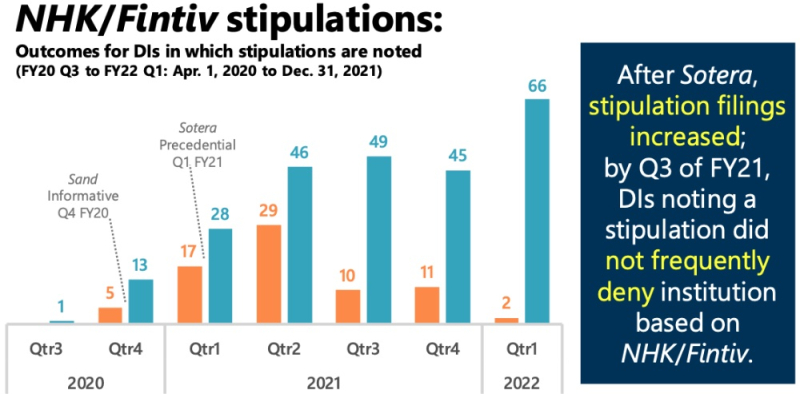
    A little over a year after the Fintiv factors were promulgated, the PTAB decided Sand.  There, the petitioner sought reconsideration of a decision denying institution of an IPR by submitting a stipulation stating that it would not raise the same grounds in the IPR and parallel proceeding.  The Board found that the stipulation, submitted to resolve the fourth Fintiv factor in the petitioner's favor, tipped the balance and instituted the proceeding.  The Sand decision caused the pendulum to swing back toward institution: more parties submitted similar stipulations and the number of discretionary denials based on parallel proceedings eventually shrank.

    The trend downward for discretionary denials really escalated with the Sotera decision.  There, the petitioner filed an even broader stipulation agreeing that it would not assert in the district any grounds "raised or that could have been reasonably raised in an IPR."  The PTAB instituted the review in Sotera, and many petitioners followed Sotera's lead, which has led the Board not to exercise its discretion to reject review of the post-grant challenges.

    Again, the USPTO's statistical picture tells the tale.  Once petitioners began filing robust Sotera-like petitions in the months after the decision, discretionary denials of institution dropped quickly:

    Image 2
    While these cases were being resolved, the USPTO asked for comments to support potential rules on approaches to the exercise of discretion.  It received 822.  So while the Office is sifting through those comments, Director Vidal issued interim guidance to help practitioners.  The guidance came in the form of four practices that the Board will implement.

    First, whether the PTAB will have discretion to deny institution depends on the strength of the petition.  If the petition's evidence is insufficient to justify institution on the merits, the Board will not rely on the Fintiv factors as an alternative ground for denial.  If the petition makes a sufficient showing under the statute — but not a strong one — the Fintiv factors will be in play.  But if the petition's evidence is compelling, the PTAB will not deny institution on the basis of the Fintiv factors.

    Second, the PTAB will consider the Fintiv factors only in relation to parallel district court litigation.  Although it has denied institution based on parallel ITC proceedings in the past, it will no longer do so because the ITC lacks the power to invalidate a patent and its rulings are not binding on the Office or district courts.

    Third, following Sotera, the PTAB will not discretionarily deny institution if the petitioner files a stipulation indicating that it will not pursue in the district court the same invalidity grounds or any grounds that could reasonably be raised before the PTAB.  That is, the Office is making the downward trend its full-time practice based on the overwhelming strength of the fourth Fintiv factor.

    Fourth, in determining the second Fintiv factor (the proximity of the court's trial date to the Board's projected statutory deadline), the PTAB will consider not only scheduled trial date, but also time-to-trial statistics such as number of cases before the judge and speed and availability of other case dispostions.  This is because — as numerous comments pointed out — different courts have different practices regarding the likelihood of extensions of the trial date.  It is a point strongly reflected in the statistics published by the USPTO — in 2021, review of the Fintiv factors led to discretionary denial about 10% of the time when the case was pending in the District of Delaware, about 15% of the time when the case was pending in the Western District of Texas, and almost 65% of the time when the case was pending in the Eastern District of Texas.

    In light of Director Vidal's guidance, practitioners have much greater clarity regarding how to address discretionary challenges based on parallel litigation.  Patent owners know they should not raise the issue based on an ITC proceeding, and likely should not in a slower-to-trial jurisdiction.  But they also know that the argument fits nicely with an argument on the merits, as an attack on the strength of the petition can be couched as a Fintiv argument.  The petitioner, however, can moot the Fintiv argument if it is willing to provide a broad, Sotera-like stipulation not to pursue in the district court any invalidity grounds that it can raise before the PTAB.  As a result, the PTAB's discretion will be much more limited and Fintiv decisions will be far more predictable.

    [1] https://www.uspto.gov/sites/default/files/documents/ptab_parallel_litigation_study_20220621_.pdf
    [2] https://www.uspto.gov/sites/default/files/documents/interim_proc_discretionary_denials_aia_parallel_district_court_litigation_memo_20220621_.pdf