• Calendar

    August 21, 2012 – Mayo v. Prometheus: The Supreme Court's New Methodology for Analyzing Patent Eligibility (American Bar Association) – 1:00 – 2:30 pm (EDT)

    August 24, 2012 – The America Invents Act: The Boundaries of Prior Art (American Bar Association) – 1:00 – 2:30 pm (EDT)

    September 6, 2012 – A Review of the Impact of Recent Supreme Court and Federal Circuit Decisions on Patent Strategy (McDonnell Boehnen Hulbert & Berghoff LLP) – 10:00 – 11:15 am (CT)

    September 9-11, 2012 – IPO Annual Meeting (Intellectual Property Owners Association) – San Antonio, TX

    September 10-12, 2012 – Business of Biosimilars & Generic Drugs (Institute for International Research) – Boston, MA

    September 20-21, 2012 – FDA Boot Camp*** (American Conference Institute) – Boston, MA

    September 24-25, 2012 – Biosimilars and Biobetters*** (SMi) – London, UK

    September 25-26, 2012 – EU Pharma Regulatory Law*** (C5) – Brussels, Belgium

    October 10-11, 2012 – Maximizing Pharmaceutical Patent Lifecycles*** (ACI) – New York, NY

    October 10-11, 2012 – Biotech & Pharmaceutical Patenting*** (C5) – London, UK

    ***Patent Docs is a media partner of this conference or CLE

  • ABAThe American Bar Association (ABA) Section of Intellectual Property Law, Health Law Section, and Center for Professional Development will be offering a live webinar and teleconference entitled "Mayo v. Prometheus: The Supreme Court's New Methodology for Analyzing Patent Eligibility" on August 21, 2012 from 1:00 – 2:30 pm (EDT).  Denise W. DeFranco of Finnegan, Henderson, Farabow, Garrett & Dunner, LLP will moderate a panel including Robert A. Armitage, Senior Vice President and General Counsel for Eli Lilly and Company, and Thomas W. Krauss, Special Counsel for Intellectual Property Litigation for the U.S. Patent & Trademark Office.  The panel will cover the U.S. Supreme Court's recent decision in Mayo Collaborative Services v. Prometheus Laboratories, Inc. regarding the eligibility of inventions directed to personalized medicine and more generally to diagnostic methods for treating disease, and explain the Supreme Court's newly articulated methodology for analyzing patent eligibility of inventions implicating laws of nature and how that methodology might be applied to a broad swath of inventions.

    The registration fee for the webcast is $95 for members of any of the sections sponsoring the webinar, $99 for government attorneys, $150 for ABA members, and $195 for the general public.  Those interested in registering for the webinar, can do so here or by calling 800-285-2221.

  • ABAThe American Bar Association (ABA) Section of Intellectual Property Law, ABA-IPL Young Lawyers Action Group, Young Lawyers Division, and Center for Professional Development will be offering a live webinar and teleconference entitled "The America Invents Act: The Boundaries of Prior Art" on August 24, 2012 from 1:00 – 2:30 pm (EDT).  Janet S. Hendrickson of Senniger Powers LLP will moderate a panel including Steve S. Chang of Banner & Witcoff, Ltd., and Susanne T. Jones of O’Brien Jones PLLC.  The panel will provide practical guidance regarding changes in practice in view of the differences in prior art definitions, discuss traps arising from the one year grace period to an inventor's own disclosures that was retained in the Act while providing ways for applicants to avoid these traps, address the areas of uncertainty in the implementation or interpretation of the AIA prior art provisions, and provide guidance for analyzing various courses of action.

    The registration fee for the webcast is $95 for members of any of the sections sponsoring the webinar, $99 for government attorneys, $150 for ABA members, and $195 for the general public.  Those interested in registering for the webinar, can do so here or by calling 800-285-2221.

  • MBHB Logo 2McDonnell Boehnen Hulbert & Berghoff LLP will be offering a live webinar on the "A Review of the Impact of Recent Supreme Court and Federal Circuit Decisions on Patent Strategy" on September 6, 2012 from 10:00 am to 11:15 am (CT).  MBHB attorney Grantland Drutchas will provide an overview of recent Supreme Court and Federal Circuit decisions and their impact on patent prosecution and litigation in each of the following areas:

    • 35 U.S.C. §101
    • 35 U.S.C. §145
    • Orange Book and Use Codes
    • Injunctions after eBay
    • Inequitable Conduct after Therasense
    • Doctrine of Equivalents
    • Joint Infringement
    • Exceptional Case and Patent Enforcement

    While there is no fee to participate, attendees must register in advance.  Those wishing to register can do so here.  CLE credit is pending for the states of California, Georgia, Illinois, North Carolina, New Jersey, New York and Virginia.

  • By Andrew Williams

    Novo NordiskOn Monday, the Federal Circuit issued an Order in the Novo Nordisk A/S v. Caraco Pharm. Labs. Ltd. case, modifying an injunction against Novo issued by the lower court from one dictating express language to amend its Orange Book use code to one that required Novo to amend the use code.  The Order, however, provides flexibility for the exact language, provided that the language accurately describes the scope of the Orange Book-listed patent claim.  Judge Dyk dissented in part because he believed that the lower court's injunction should not have been modified because district courts are supposed to have broad authority to shape remedial injunctive orders.

    Caraco Pharmaceutical LaboratoriesThe Novo case had an extensive history, with the most recent stop at the Supreme Court, resulting in a reversal of the Federal Circuit's previous opinion and a remand for further proceedings consistent with the Supreme Court's decision.  The history and outcome of the Supreme Court's opinion has been discussed here, and therefore this summary will only provide a brief introduction to provide the proper context for the Federal Circuit's recent order.  Novo markets the drug PRANDIN® for the treatment of Type 2 (adult-onset) diabetes.  Repaglinide, the active ingredient in PRANDIN®, is covered by Reissue Patent No. RE37,035, and the use of repaglinide in combination with metformin is covered by U.S. Patent No. 6,677,358 ("the '358 patent").  However, PRANDIN® was also approved for use as a monotherapy and in combination with thiazolidinediones, and the use code listed in the Orange Book was broad enough to cover these other non-patented uses.  Caraco filed an ANDA to market a generic version of PRANDIN®, and included a Section viii statement to "carve-out" the claimed method of use in an attempt to circumvent the '358 patent.  Nevertheless, because the use code was overly broad, the FDA rejected Caraco's carve out label.  As a result, Caraco sought a court order requiring the FDA to narrow the Orange Book listed use code.  After the District Court granted such an order, and the Federal Circuit vacated the injunction, the Supreme Court held that 21 U.S.C. § 355(j)(5)(c)(ii)(I) provided an ANDA applicant an opportunity to challenge inaccurate use codes and designations.  The current order is a result of Caraco's motion for a summary affirmance of the injunction based on the Supreme Court's remand of the case.

    The first issue raised by Novo's challenge to the motion was whether the current use code was actually incorrect.  All three members of the panel believed that, based on the admitted facts of this case, the Supreme Court's decision foreclosed any argument to the contrary.  Therefore, the only remaining issue advanced by Novo was whether the mandatory injunction of the District Court was in error.

    The majority answered this question in affirmative.  It began with the language of the counterclaim statue, which provides that the court can issue "an order requiring the holder to correct or delete the patent information submitted by the holder" to the FDA.  The Court also noted that the FDA regulations make the branded company responsible for drafting the use code in the first place, and in fact must certify that the information was accurate and complete.  When viewed in combination, these two provisions provide that the only appropriate order would allow the branded company to draft its own corrected use code.  The District Court's injunction, however, dictated the exact language of the modification (even if the exact language was a previously appearing use code for PRANDIN®):

    Novo Nordisk is hereby directed by mandatory injunction under 21 U.S.C. § 355(j)(5)(C)(ii)(1)(bb) to correct within twenty (20) days from the date of this Order and Injunction its inaccurate description of the '358 patent by submitting to FDA an amended form FDA 3542 that reinstates its former U-546 listing for Prandin and describes claim 4 of the '358 patent in section 4.2b as covering the "use of repaglinide in combination with metformin to lower blood glucose."

    As a result, the Court found that the District Court had abused its discretion.  Of course, the Court noted that the use code must accurately describe the patented use, and that it is appropriate for a district court to construe the scope of the patent claims (which will influence the scope of the use code).  Also, in response to the dissent's concerns, the majority pointed out that the district court always has the power to correct any attempt to submit an overly broad revised use code.  Therefore, the majority revised the injunction to read:

    Novo Nordisk is hereby directed by mandatory injunction under 21 U.S.C. § 355(j)(5)(C)(ii)(1)(bb) to correct within twenty (20) days from the date of this Order and Injunction its inaccurate description of the '358 patent by submitting to FDA an amended form FDA 3542 for Prandin that accurately describes the scope of claim 4 of the '358 patent in section 4.2b.  The description shall be clearly limited to use of repaglinide in combination with metformin to treat non-insulin dependent diabetes mellitus.

    In dissent, Judge Dyk also began with the language of the statue, as provided above.  However, he could find no prohibition from allowing the district court to dictate the particular use code as a corrective measure.  The dissent also pointed out that district courts have traditionally had broad authority to shape injunctive orders.  Finally, Judge Dyk pointed out that there is no statute or regulation that says that a district court cannot correct a use code under the counterclaim statute, which would be required to prevent a court from doing so (citing Weinberger v. Romero-Barcelo, 456 U.S. 305, 313 (1982) ("[T]he comprehensiveness of this equitable jurisdiction is not to be denied or limited in the absence of a clear and valid legislative command.")).  By way of illustration, it analogized this current situation to an order from a lower court amending the inventorship of a patent, noting that the Federal Circuit has never limited a lower court to ordering a general correction of an incorrect list of inventors rather than directing exactly how the inventorship should be changed.  This might not be a completely appropriate analogy, but the dissent had a valid point when it noted that a patent holder should not be allowed to continue to "throw a wrench" into the ability of the FDA to approve generic drugs, and such a ruling by the majority would have this effect.  Whether Novo in this case, or some future NDA holder in a separate case, could craft a revised use code that still accurately reflects the patented use but also thwarts the attempts of an ANDA applicant to obtain a "carve out" remains to be seen.

    Novo Nordisk A/S v. Caraco Pharmaceutical Laboratories, Ltd. (Fed. Cir. 2012)
    Panel: Chief Judge Rader and Circuit Judges Clevenger and Dyk
    Order for the court by Chief Judge Rader; opinion concurring in part and dissenting in part by Circuit Judge Dyk

  • By Kevin E. Noonan

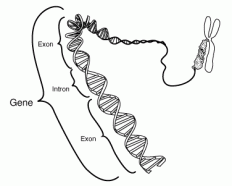
    GeneOne thing has become abundantly clear in the public debate about the patent-eligibility of isolated human DNA.  That something is that there is a great deal of uninformed opinion extant, predominantly by well-educated people with scientific backgrounds, who believe wholeheartedly that patenting genes is pernicious because it has or will inhibit medical science and progress in the diagnosis or treatment of disease.  But that doesn't appear to be the situation to those with a background in biotechnology patent law, and so exploring why the two groups have come to such diametrically opposite conclusions may be informative.

    And, before we start, let's agree that we won't waste time accusing each other of being motivated by "hidden biases" or "self interest."  Precious few doctors, hospitals, or medical societies have called for the practice of human genetic diagnostic methods to be performed free of charge, and it is well to remember that patenting, for all its arcane minutiae, is relatively straightforward.  Protecting intellectual property in other ways, such as by trade secret, requires a great deal more cleverness, and patent lawyers are particularly adept at being clever (if you doubt this, ask Justice Breyer).

    We begin, as we must, with the claims ("The name of the game is the claim," as Judge Rich famously noted).  For most "gene patents," the claims have a canonical format, constructed over the last generation by the U.S. Patent and Trademark Office, on the one hand (who have been generally parsimonious in what is permitted to be patented, accusations by gene patent opponents to the contrary) and by patent applicants, who generally want claims that can be defended in a court of law when asserted against an infringer.  These claims have the format:

    An isolated (human) nucleic acid (or DNA molecule or gene (specified by name), encoding an amino acid sequence identified by SEQ ID NO: X.

    (The portions of this claim in parentheses are optional, used in some cases but not necessary to properly recite the claimed subject matter.)  Certain features of this claim merit further discussion.  First, the Office has required the term "isolated" to be in the claim, for at least two reasons.  First, under Diamond v. Chakrabarty, the claimed DNA must show "the hand of man" and be "markedly different."  That standard was established during times where isolating a human gene was truly analogous to finding a needle in a haystack, where the needle was made of hay.  While not based on a "sweat of the brow" requirement, the necessity for the "hand of man" was more evident during those times than (perhaps) it is now, when the entirety of the human genome exists (representationally at least) in computer databases worldwide.  Second, a DNA molecule was required to be isolated so that the claim would not encompass ("read on" in patent geek speak) the molecule as it exists in nature.  This is not a question, necessarily, of patent eligibility, but rather of novelty; the gene in nature is not novel until is isolated.  This reasoning can be seen in early cases, such as Wood-Paper Patent, 90 U.S. 566 (1874), and Cochrane v. Badische Anilin Soda Fabrik, 111 U.S. 293 (1884).  In the former case, the Supreme Court stated its reasoning for finding the claimed cellulose-based paper as follows:

    It [the isolated cellulose] may have been in existence and in common use before the new means of obtaining it was invented, and possibly before it was known that it could be extracted from the subject to which the new process is applied.  . . .  If, then, the Watt & Burgess patent for a product is sustainable it must be because the product claimed, namely, "a pulp suitable for the manufacture of paper, made from wood or other vegetable substances," was unknown prior to their alleged invention.  But we think it is shown satisfactorily that it had been produced and used in the manufacture of paper long before 1853, the year in which the original patent of Watt & Burgess was dated.

    Similarly, in the Cochrane case the Court said:

    According to the description in [the patents in suit], and the evidence, the article produced by the process described was the alizarine of madder, having the chemical formula C14H8O4.  It was an old article.  While a new process for producing it was patentable, the product itself could not be patented, even though it was a product made artificially for the first time, in contradistinction to being eliminated from the madder root.  Calling it artificial alizarine did not make it a new composition of matter, and patentable as such, by reason of its having been prepared artificially, for the first time, from anthracine, if it was set forth as alizarine, a well-known substance.  Wood Paper Patent, 23 Wall. 566, 593.  There was therefore no foundation for reissue No. 4,321, for the product, because, on the description given, no patent for the product could have been taken out originally.

    The same rationale explains why isolated DNA claims cannot be read to encompass the genes in chromosomal DNA "isolated" from cells (but otherwise unchanged); Frederich Mieschner "isolated" DNA to this level of purification in the 1880's and thus, any such interpretation of the term "isolated" in isolated DNA claims would render them unpatentable for lack of novelty.

    Another feature of the representative claim set forth above is that, to infringe, it requires that the entire amino acid coding sequence be produced.  The reason for this limitation stems from the purpose of such claims from the dawn of the biotechnology age: to be able to produce a protein having therapeutic or other beneficial uses.  If an isolated gene was to be used to produce erythropoietin, or tissue plasminogen activator, or interferon, or insulin, or blood clotting factors VIII or IX, or any of the other patented human genes, it needed to be full-length or otherwise a truncated fragment would be produced that, even if it retained biological activity could perhaps differ in biological half-life, immunogenicity, or other important properties.

    One more claim feature should be mentioned, which is present in almost all but the earliest-filed claims: the nucleic acid is claimed in terms of the protein that it encodes.  This represents a compromise, because although the claim thus encompasses any nucleic acid that encodes a specific protein, the claim encompasses only those DNA molecules that have the specifically recited, identified sequence.  Accordingly, literal infringement does not lie even if there are conservative amino acid substitutions, meaning that a Valine to Isoleucine substitution (a difference of a single methylene group, -CH2-) in a molecule having hundreds of amino acids does not infringe.  In addition, the scope of these claims is further limited by Federal Circuit case law and PTO reactions to it, resulting in claims to unspecified "conservative" substitutions being held unpatentable under 35 U.S.C. § 112, first paragraph.

    There are several consequences of these considerations regarding these claims.  First, the claims are only infringed if someone without authorization makes, uses, sells, offers to sell or imports an isolated nucleic acid encoding the specified amino acid sequence.  Typically, a "gene patent" identifies a cell or tissue source (and, frequently, identifies a plurality of cell or tissue sources as part of its characterization of a gene) that natively expresses the gene.  Thus, anyone who uses such a cell or tissue source to study the gene without isolating it will not infringe.  Second, portions of the gene can be isolated, sequenced, and characterized and not infringe, and such portions can be changed and then introduced into the gene to produce another gene that does not infringe.  (The patentability of primers and probes selected from the gene sequence are not considered here; their patentability, rather than patent eligibility, has been called into question by others; see "Caught in a Time Warp: The (In)validity of BRCA1 Oligonucleotide Claims").  Third, the gene product (typically, a protein) can be isolated from the cell and studied without infringement, as can antibodies raised against the gene product.  These antibodies can be used to detect under- or over-expression of the gene in cell or tissue sources for diagnostic purposes, and mutant forms of the gene product associated with disease can also be produced.  All without infringing the gene claim.

    Fourth, the sequence itself can be identified in individuals and compared to wildtype or disease-associated mutations without infringing unless the entire DNA is isolated intact (something that is unnecessary and unduly burdensome to do; portions can be sequenced and the entire sequence aligned in a computer).  This is because (ACLU arguments to the contrary) the DNA sequence information is not protected by the patent claim.  (Again, whether there can be crafted a valid method claim for making a diagnosis is not within the scope of this discussion; indeed, challenging the "gene" claims while eschewing a challenge to Myriad's several remaining method claims smacks of cynicism in an attempt to garner the most publicity rather than a honest effort to obtain genetic BRCA diagnostic testing for those women who cannot afford it.)  This is also the reason why "whole genome sequencing" and other present or future genetic diagnostic methods are unaffected by the isolated DNA claims:  practice of these diagnostic methods do not infringe the DNA claims.

    The question remains what experiments will be impeded by the existence of claims to isolated human DNA.  (It should be mentioned that there are more than 8,000 scientific research papers published in the BRCA genes since the grant dates of the patents.)  Clinical testing may be one type, where a population is to be assessed for the prevalence of BRCA gene mutations, for example.  Here, there are questions of whether the testing will be performed for free or whether the patients will be charged; it is difficult to defend a "study" where the research subjects pay for the privilege.  But even in cases where there is a need for such a study it seems that countervailing practices should be able to reduce if not eliminate any negative effects of a gene patent claim.  As discussed above, large-scale sequencing can be performed without incurring patent infringement liability as to the isolated DNA claims.  Also, scientific research typically requires specialized reagents and services that are supported by grant monies.  For example, there was a time when restriction endonucleases were not readily available but could be isolated from the particular bacteria that produced them, and lambda phage packaging extracts were routinely (albeit laboriously) produced from complementary cultures of mutant phage (one making the packaging protein but defective phage heads, the other making intact phage heads but not the packaging protein).  The advent of commercially available preparations of more and more restriction enzymes and highly effective packaging extracts made these homemade efforts obsolete; similarly, engaging the patentee to perform the genetic testing would eliminate any risk of patent infringement liability as well as gaining for the project the reliability that such testing services provide.

    Thus, there seems to be little empirical support for the contentions that "gene patents" are inhibiting research, despite the allegations from former Acting Solicitor General Neal Katyal, at this year's BIO conference, that his two weeks with NIH scientists convinced him (and, it seems, the rest of the Department of Justice) that gene patents raised such a "clear and present danger."  However, because no one is infallible (here or at the NIH), it is possible that there are such instances or circumstances that have been overlooked.  If so, please let us know.  If not, perhaps it is time for those who argue without basis that gene patents do not "promote the progress" to make their arguments honestly, based on (legitimate) moral, religious, or political grounds.  There is nothing to be ashamed of in making these types of arguments; but if that is the basis for principled opposition to patenting human DNA then perhaps the issues can be addressed in ways that can foster a solution rather than (as in so many things) mere partisanship.  We welcome a response.

  • By Donald Zuhn

    USPTO SealThe U.S. Patent and Trademark Office published its final rule to implement the statute of limitations provisions for office disciplinary proceedings of the Leahy-Smith America Invents Act (77 Fed. Reg. 45247).  The final rule, which takes effect on August 30, 2012, is the second of several final rule notices that the Office will be publishing in order to implement AIA provisions.

    As we noted when the Office published its notice of proposed rulemaking to implement the statute of limitations provisions for office disciplinary proceedings in January (see "USPTO Proposes Rules Changes for Implementing AIA Provisions — Statute of Limitations Provisions for Office Disciplinary Proceedings"), § 32 of Title 35 — prior to amendment by the AIA — read as follows:

    The Director may, after notice and opportunity for a hearing, suspend or exclude, either generally or in any particular case, from further practice before the Patent and Trademark Office, any person, agent, or attorney shown to be incompetent or disreputable, or guilty of gross misconduct, or who does not comply with the regulations established under section 2(b)(2)(D) of this title, or who shall, by word, circular, letter, or advertising, with intent to defraud in any manner, deceive, mislead, or threaten any applicant or prospective applicant, or other person having immediate or prospective business before the Office.  The reasons for any such suspension or exclusion shall be duly recorded.  The Director shall have the discretion to designate any attorney who is an officer or employee of the United States Patent and Trademark Office to conduct the hearing required by this section.  The United States District Court for the District of Columbia, under such conditions and upon such proceedings as it by its rules determines, may review the action of the Director upon the petition of the person so refused recognition or so suspended or excluded.

    Section 2(b)(2)(D) of Title 35 permits the Office to require "agents, attorneys, or other persons representing applicants or other parties before the Office,  . . . to show that they are of good moral character and reputation and are possessed of the necessary qualifications to render to applicants or other persons valuable service, advice, and assistance in the presentation or prosecution of their applications or other business before the Office."

    Section 3(k) of the AIA amended § 32 by adding the following sentence before the last sentence:

    A proceeding under this section shall be commenced not later than the earlier of either the date that is 10 years after the date on which the misconduct forming the basis for the proceeding occurred, or 1 year after the date on which the misconduct forming the basis for the proceeding is made known to an officer or employee of the Office as prescribed in the regulations established under section 2(b)(2)(D).

    Prior to the AIA's amendment of § 32, disciplinary actions for violations of the USPTO Code of Professional Responsibility were generally understood to be subject to a five-year statute of limitations pursuant to 28 U.S.C. § 2462.  In its proposed rulemaking, the Office noted that with passage of the AIA, "Congress provided the Office with five additional years to bring an action, thus ensuring that the Office had additional flexibility to initiate 'a [disciplinary] proceeding for the vast bulk of misconduct that is discovered, while also staying within the limits of what attorneys can reasonably be expected to remember'" (quoting the Congressional Record S1372–1373 (daily ed. March 8, 2011) (statement of Sen. Kyl)).  The Office also noted that "[t]he one-year limitation period in the AIA reflects that disciplinary actions should be filed in a timely manner from the date when misconduct forming the basis of a disciplinary complaint against a practitioner is made known to 'that section of PTO charged with conducting section 32 proceedings.'"

    The Office's notice of proposed rulemaking indicated that the Office can initiate disciplinary proceedings via three types of disciplinary complaints:  complaints predicated on the receipt of a probable cause determination from the Committee on Discipline; complaints seeking reciprocal discipline; and complaints seeking interim suspension based on a serious crime conviction.  Prior to the filing of a disciplinary complaint against a practitioner, the Office of Enrollment and Discipline (OED) Director: (1) performs a preliminary screening of the allegations made against the practitioner; (2) requests information from the practitioner about the alleged conduct; (3) conducts a thorough investigation after providing the practitioner an opportunity to respond to the allegations; and (4) submits the investigated case to the Committee on Discipline for a determination of whether there is probable cause to bring charges against the practitioner.

    In the final rule notice, the Office indicates that:

    [It] is adopting procedural rules which:  Specify that a disciplinary complaint shall be filed within one year after the date on which the Office of Enrollment and Discipline (OED) Director receives a grievance forming the basis of the complaint, and in no event more than ten years after the date on which the misconduct forming the basis for the proceeding occurred; define grievance as a written submission from any source received by the OED Director that presents possible grounds for discipline of a specified practitioner; and clarify that the one-year time frame for filing a complaint may be tolled by written agreement.

    The Office also made some changes to the proposed rules in response to comments received following publication of the Office's notice of proposed rulemaking.  Although the Office had proposed that the one-year statute of limitations period for complaints predicated on the receipt of a probable cause determination from the Committee on Discipline would begin on the date on which the OED Director receives a complete, written response to a request for information and evidence from the practitioner.  The final rule, however, notes that this regulation is not being adopted, and that a disciplinary proceeding will instead be commenced one year from the date the OED Director receives a grievance.

    The final rule notice also indicates that the Office has adopted three new rules:

    (1) A disciplinary complaint shall be filed within one year after the date on which the OED Director receives a grievance forming the basis of the complaint, and in no event more than ten years after the date on which the misconduct forming the basis for the proceeding occurred, (2) a grievance is defined as a written submission from any source received by the OED Director that presents possible grounds for discipline of a specified practitioner, and (3) the one-year period for filing a complaint may be tolled by written agreement.

  • By Sherri Oslick

    Gavel About Court Report:  Each week we will report briefly on recently filed biotech and pharma cases.

    Alcon Pharmaceuticals Ltd. et al. v. Lupin Ltd. et al.
    1:12-cv-00973; filed July 24, 2012 in the District Court of Delaware

    • Plaintiffs:  Alcon Pharmaceuticals Ltd.; Alcon Research Ltd.
    • Defendants:  Lupin Ltd.; Lupin Pharmaceuticals Inc.

    Infringement of U.S. Patent Nos. 6,716,830 ("Ophthalmic Antibiotic Compositions Containing Moxifloxacin," issued April 6, 2004) and 7,671,070 ("Method of Treating Ophthalmic Infections with Moxifloxacin Compositions," issued March 2, 2010) following a Paragraph IV certification as part of Apotex's filing of an ANDA to manufacture a generic version of Alcon's Moxeza® (moxifloxacin hydrochloride, used to treat bacterial conjunctivitis).  View the complaint here.


    Alcon Pharmaceuticals Ltd. et al. v. Apotex Inc. et al.

    1:12-cv-00960; filed July 20, 2012 in the District Court of Delaware

    • Plaintiffs:  Alcon Pharmaceuticals Ltd.; Alcon Research Ltd.
    • Defendants:  Apotex Inc.; Apotex Corp.

    Infringement of U.S. Patent Nos. 6,716,830 ("Ophthalmic Antibiotic Compositions Containing Moxifloxacin," issued April 6, 2004) and 7,671,070 ("Method of Treating Ophthalmic Infections with Moxifloxacin Compositions," issued March 2, 2010) following a Paragraph IV certification as part of Apotex's filing of an ANDA to manufacture a generic version of Alcon's Vigamox® (moxifloxacin hydrochloride, used to treat bacterial conjunctivitis).  View the complaint here.


    Novartis Pharmaceuticals Corp. v. Lupin Ltd. et al.

    2:12-cv-04552; filed July 20, 2012 in the District Court of New Jersey

    • Plaintiff:  Novartis Pharmaceuticals Corp.
    • Defendants:  Lupin Ltd.; Lupin Pharmaceuticals, Inc.

    Infringement of U.S. Patent No. 6,294,197 ("Solid Oral Dosage Forms of Valsartan," issued September 25, 2001) following a paragraph IV certification as part of Lupin's filing of an ANDA to manufacture a generic version of Novartis' Diovan HCT® (valsartan and hydrochlorothiazide, used to treat hypertension).  View the complaint here.


    Celgene Corp. v. Natco Pharma Ltd. et al.

    2:12-cv-04571; filed July 20, 2012 in the District Court of New Jersey

    • Plaintiff:  Celgene Corp.
    • Defendants:  Natco Pharma Ltd.; Arrow International Ltd.; Watson Pharmaceuticals, Inc.; Watson Laboratories, Inc.

    Infringement of U.S. Patent Nos. 5,635,517 ("Method of Reducing TNFα Levels with Amino Substituted 2-(2,6-dioxopiperidin-3-yl)-1-oxo-and 1,3-dioxoisoindolines," issued June 3, 1997), 6,281,230 ("Isoindolines, Method of Use, and Pharmaceutical Compositions," issued August 28, 2001), 7,189,740 ("Methods of Using 3-(4-amino-1-oxo-1,3 dihydro-isoindol-2-yl)-piperidine-2,6-dione for the Treatment and Management of Myelodysplastic Syndromes," issued March 13, 2007), 7,968,569 ("Methods for Treatment of Multiple Myeloma Using 3-(4-amino-1-oxo-1,3 dihydro-isoindol-2-yl)-piperidine-2,6-dione," issued June 28, 2011), 7,977,357 ("Polymorphic Forms of 3-(4-amino-1-oxo-1,3 dihydro-isoindol-2-yl)-piperidine-2,6-dione," issued July 12, 2011), and 8,193,219 (same title, issued June 5, 2012) following a Paragraph IV certification as part of Natco's filing of an ANDA to manufacture a generic version of Celgene's Revlimid® (lenalidomide, used in the treatment of multiple myeloma patients who have received at least one prior therapy, and in the treatment of patients with transfusion-dependent anemia due to Low- or Intermediate-1–risk myelodysplastic syndromes (MDS) associated with a deletion 5q cytogenetic abnormality).  View the complaint here.

  • By Donald Zuhn

    PPH LogoSince implementing its first Patent Prosecution Highway (PPH) program with the Japan Patent Office (JPO) on July 3, 2006, the U.S. Patent and Trademark Office had established some thirty PPH programs with more than twenty other patent offices.  The USPTO recently increased the number of PPH programs (full or pilot) to thirty-three by establishing a PPH pilot program based on Patent Cooperation Treaty (PCT) work products (PCT-PPH) with the Israel Patent Office (ILPO), and the number of offices with which it has PPH programs to twenty-three by establishing a PPH pilot program with the Colombian Superintendence of Industry and Commerce (SIC).  In addition, the USPTO continued two other PPH programs — PCT-PPH pilot programs with IP Australia and the Nordic Patent Institute (NPI) — and fully implemented two other PPH programs — a PPH program with ILPO and a PCT-PPH program with the Korean Intellectual Property Office (KIPO).

    Last week, the USPTO announced the establishment of a new Patent Prosecution Highway (PPH) pilot program with the Colombian Superintendence of Industry and Commerce (SIC).  As with other PPH programs, the USPTO-SIC PPH will permit an applicant having an application whose claims have been allowed in one of the offices to fast track the examination of an application in the other office, such that the latter application is examined out of turn.  In particular, an applicant receiving a ruling from either the USPTO or SIC that at least one claim in an application is patentable may request that the other office fast track the examination of corresponding claims in the corresponding application in that office.  The USPTO-SIC PPH pilot program, which will begin on September 1, 2012, is scheduled to expire on August 31, 2013, but may be extended for up to one year or terminated earlier depending on volume of activity and other factors.  The USPTO's notice regarding the USPTO-SIC PPH pilot program, including requirements for participation in the program, can be found here.

    Earlier this month, the USPTO announced that it would be launching a new Patent Prosecution Highway (PPH) pilot program with the Israel Patent Office (ILPO) on August 1, 2012.  The pilot program will apply to qualifying patent applications filed under the Patent Cooperation Treaty (PCT).  Under the USPTO-ILPO PCT-PPH, an applicant receiving a positive written opinion or a positive international preliminary report in a PCT application where the USPTO or ILPO was the International Searching Authority or the International Preliminary Examination Authority may request that the other office fast track the examination of corresponding claims in corresponding applications.  The USPTO-ILPO PPH pilot program is scheduled to expire on July 31, 2013, but may be extended for up to one year or terminated earlier depending on volume of activity and other factors.  The USPTO's notice regarding the USPTO-ILPO PCT-PPH pilot program, including requirements for participation in the program, can be found here.  While announcing the new PCT-PPH pilot program with the ILPO, the USPTO also announced that it was fully implementing the PPH program with the ILPO, effective July 1, 2012.  The USPTO's notice regarding the USPTO-ILPO PPH program, including requirements for participation in the program, can be found here.

    The USPTO also announced earlier this month the continuation of a current PPH pilot program with the ILPO (see notice) and a PPH pilot program based on Patent Cooperation Treaty (PCT) work products (PCT-PPH) with the NPI (see notice).  Both PPH programs have been extended indefinitely.

    Finally, the USPTO announced in late June that the USPTO and KIPO had agreed to fully implement their PCT-PPH program on a permanent basis starting on June 1, 2012.  The USPTO noted that "[t]he results of the [USPTO-KIPO] PCT-PPH pilot program showed that applicants have been able to expeditiously obtain a patent at an early stage by utilizing petition to make special procedures," and that "the USPTO and the KIPO have been able to reduce duplication of search efforts by exploiting the search and examination results in PCT applications to the maximum extent practicable."  The USPTO's notice regarding the USPTO-KIPO PCT-PPH program, including requirements for participation in the program, can be found here.

    With the addition of the above programs, the USPTO has twenty-one PPH programs (full or pilot) in place with IP Australia (IP AU), the Austrian Patent Office (APO), the Canadian Intellectual Property Office (CIPO), China's State Intellectual Property Office (SIPO), the Colombian Superintendence of Industry and Commerce (SIC), the Danish Patent and Trademark Office (DKPTO), the European Patent Office (EPO), the National Board of Patents and Registration of Finland (NBPR), the German Patent and Trade Mark Office (DPMA), the Hungarian Intellectual Property Office (HIPO), the Icelandic Patent Office (IPO), the Israel Patent Office (ILPO), the Japan Patent Office (JPO), the Korean Intellectual Property Office (KIPO), the Mexican Institute of Industrial Property (IMPI), the Norwegian Industrial Property Office (NIPO), the Russian Federal Service for Intellectual Property, Patents and Trademarks (ROSPATENT), the Intellectual Property Office of Singapore (IPOS), the Spanish Patent and Trademark Office (SPTO), the Taiwan Intellectual Property Office (TIPO), and the United Kingdom Intellectual Property Office (UK IPO).  The USPTO has also established twelve PCT-PPH programs with other patent offices:  IP AU, APO, SIPO, EPO, NBPR, ILPO, JPO, KIPO, the Nordic Patent Institute (NPI), ROSPATENT, SPTO, and the Swedish Patent and Registration Office (PRV).  Additional information regarding the various PPH and PCT-PPH programs, as well as links to the appropriate request forms to be used for each program, can be found here.

  • By Hal Wegner

    MyriadThe patent challengers in the Myriad case placed great stock in the argument that claims to "isolated DNA" (because of their alleged breadth) created a "research preemption."  The argument is keyed to recent Supreme Court precedent such as Mayo v. Prometheus.  In their certiorari petition a year ago in Myriad, the patent challengers argued that patents "preempt researchers . . . and pose[ ] a serious threat to scientific freedom and advancement."

    The Federal Circuit today, and the Supreme Court the Next Time:  While it appears that a split panel at the Federal Circuit may very well reject this argument, the more fundamental point is not addressed by the patentees that makes appellate proceedings at the merit stage at the Supreme Court problematic.

    To deal with that point, the more fundamental question must be asked:  Given a public right to experiment "on" a patented invention, how then does the grant of any patent "preempt" research?  This issue is addressed in a new paper, Can Any Patent "Preempt" Follow-On Research?

    Hal Wegner is a partner at Foley & Lardner LLP and the former Director of the Intellectual Property Law Program and Professor of Law at George Washington University Law School.

    We thank Mr. Wegner for allowing us to provide a copy of his paper to Patent Docs readers.