• Calendar

    September 10-12, 2012 – Business of Biosimilars & Generic Drugs (Institute for International Research) – Boston, MA

    September 18,
    2012 – New USPTO Rules for Post-Grant Proceedings (Strafford) – 1:00 – 2:30 pm (EDT)

    September 18, 2012 – Supplemental Examination: Rules and Strategy (Intellectual Property Owners Association ) – 2:00 – 3:00 pm

    September 19, 2012 – New Post Grant Proceeding Rules: Adjusting to the New Reality (Technology Transfer Tactics) – 1:00 – 2:15 pm (Eastern)

    September 20-21, 2012 – FDA Boot Camp*** (American Conference Institute) – Boston, MA

    September 24-25, 2012 – Biosimilars and Biobetters*** (SMi) – London, UK

    September 25-26, 2012 – EU Pharma Regulatory Law*** (C5) – Brussels, Belgium

    September 28, 2012 – Focus on Biologics and Biosimilars (Catalyzing Collaboration Between Industry and Academia in the Life Sciences) – Hospira, Inc., Lake Forest, IL

    October 4,
    2012 – Myriad: The Gene Patent Fight Continues . . . (Technology
    Transfer Tactics) – 1:00 – 2:00 pm (Eastern)

    October 10-11, 2012 – Maximizing Pharmaceutical Patent Lifecycles*** (ACI) – New York, NY

    October 10-11, 2012 – Biotech & Pharmaceutical Patenting*** (C5) – London, UK

    October 22-23, 2012 – Tech Transfer Summit North America*** (Tech Transfer Summit Ltd.) – John Hopkins University, Montgomery County, MD

    October 24-25, 2012 – FDA Boot Camp Devices Edition*** (American Conference Institute) – Chicago, IL

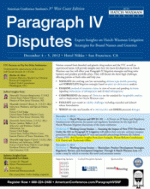
    October 25-26, 2012 – Life Sciences Congress on
    Paragraph IV Disputes
    (Center for
    Business Intelligence) – Washington, DC

    October 25-27, 2012 – AIPLA 2012 Annual Meeting (American
    Intellectual Property Law Association) – Washington, DC

    November 28-29, 2012 – Biotech Patents*** (American Conference
    Institute) – Boston, MA

    November 28-29, 2012 – Orphan Drugs and Rare Diseases*** (American Conference
    Institute) – Boston, MA

    ***Patent Docs is a media partner of this conference or CLE

  • BostonAmerican Conference
    Institute (ACI) will be holding its 14th Advanced Forum on Biotech Patents on
    November 28-29, 2012 in Boston, MA.  The
    conference will allow attendees to:

    • Prepare for the
    impending first-to-file regime and decide whether to file under the old or new
    patent code;
    • Analyze the
    outcome in Prometheus and its impact
    on personalized medicine;
    • Determine the
    implications of the Myriad case for subject matter patentability;
    • Design systems to
    rapidly respond to new post-grant and inter
    partes
    review procedures;
    • Explore ways in
    which the Therasense decision has
    changed how patent attorneys approach inequitable conduct concerns;
    • Utilize superior
    techniques to better protect antibodies and immunological innovations;
    • Scrutinize the
    recently issued biosimilars pathway regulations and craft a winning biologic
    patenting strategy; and
    • Assess how the
    combined evolution of prior art obviousness and obvious-type double patenting
    are influencing the future of secondary patents.

    Brochure Biotech PatentsIn particular,
    ACI's faculty will offer presentations on the following topics:

    • USPTO keynote: A
    primer on the USPTO's efforts to implement the America Invents Act — to be
    presented by Teresa Stanek Rea, Deputy Director of the U.S. Patent &
    Trademark Office;
    • The sky is not
    falling: Protecting your IP after Prometheus
    and Myriad;
    • Scrutinizing the
    CAFC'S decisions in Akamai and McKesson and protecting technology in their
    wake;
    • The complete
    guide to formulating a biosimilars patent strategy following the implementation
    of the FDA's approval pathway;
    • Overcoming the
    challenges and grasping the opportunities presented by the PTO's new post-grant
    review and inter partes review
    procedures;
    • Understanding the
    obligations and defenses afforded biotech patent attorneys post-Therasense — to be presented in part by
    Patent Docs
    author Dr. Kevin Noonan of McDonnell, Boehnen, Hulbert & Berghoff LLP;
    • Producing a robust written description to satisfy
    ever-shifting requirements and ensure patent validity;
    • Crafting a global strategy: Best practices for
    international prosecution and litigation to maximize the value of your biotech
    patent portfolio; and
    • Demystifying the current obviousness standard and
    its implications for biotech patenting.

    An interactive
    working group session entitled: "Integrating Changes at the PTO into
    Biotech Patent Practices" will be offered from 9:00 am to 12:00 pm on November
    28, 2012.  A post-conference master class
    entitled: "Successful and Practical Strategies for Patenting
    Antibodies" will be offered from 9:00 am to 12:00 pm on November 30, 2012.

    The agenda for the
    Biotech Patents conference can be found here.  A complete brochure for this conference,
    including an agenda, detailed descriptions of conference sessions, list of
    speakers, and registration form can be obtained here.

    ACI - American Conference InstituteThe registration
    fee is $2,295 (conference alone), $2,995 (conference plus group session or master
    class), or $3,495 (conference, group session, and master class).  Those registering on or before September 27,
    2012 will receive a $300 discount and those registering by October 26, 2012
    will receive a $200 discount.  Patent
    Docs
    readers who reference the discount code "PD
    200" will receive $200 off the current price tier when registering.  Those
    interested in registering for the conference can do so here,
    by e-mailing CustomerService@AmericanConference.com calling 1-888-224-2480, or
    by faxing a registration form to 1-877-927-1563.

    Patent Docs is a media partner of ACI's Biotech Patents conference.

  • Technology
    Transfer Tactics will be offering a webinar entitled "Myriad: The Gene Patent Fight Continues . . ." on October 4,
    2012 from 1:00 – 2:00 pm (Eastern).  Patent Docs author Dr. Kevin Noonan of
    McDonnell, Boehnen, Hulbert & Berghoff LLP will analyze the most recent
    decision in the AMP v. USPTO case and
    discuss how the opinion affects universities and their relevant IP.  The webinar will cover the following topics:


    What the past has revealed:


    The first CAFC decision


    Enter Prometheus – GVR from the
    Supreme Court

    The second CAFC decision


    What the future holds:


    En banc considerations

    Certiorari petition

    The
    registration fee for the webinar is $197. 
    Those interested in registering for the webinar, can do so here.

    Technology Transfer Tactics

  • Boston SkylineAmerican Conference
    Institute (ACI) will be holding a conference on Orphan Drugs and Rare Diseases:
    Maximizing Opportunities and Overcoming Stumbling Blocks in the Designation and
    Development Process on November 28-29, 2012 in Boston, MA.  The conference will allow attendees to:

    • Understand and
    comply with the FDA's current regulations and policies to gauge the legitimate
    medical plausibility of a population;
    • Prepare an
    airtight orphan-drug designation request and advocate for orphan status in gray
    area situations;
    • Develop global
    regulatory and patent strategies to maximize international market share and
    learn best practices from successful global orphan development;
    • Determine the
    financial viability of orphan drugs and explore new strategic alliances and
    alternative partnerships to facilitate development;
    • Overcome routine
    stumbling blocks in the designation process to proactively combat designation
    rejections; and
    • Adapt a practical
    approach to incorporate orphan drugs into your current patent portfolio
    strategy and brace for the coming wave of orphan drug patent challenges.

    Brochure Orphan DrugsIn particular,
    ACI's faculty will offer presentations on the following topics:

    • Thinking outside
    the pillbox: Exploring successful orphan drug partnerships, collaborations, and
    acquisitions;
    • Demystifying the
    designation submission process: Best practices for working cooperatively with
    the FDA;
    • Orphan drugs
    around the world: Working within the orphan drug framework in major global
    markets;
    • Keynote address:
    State of the market: Evaluating the commercial viability and opportunity in
    orphan drug development;
    • Mastering the
    intricacies of the orphan drug designation process: A step-by-step guide to
    navigating the pathway;
    • Overcoming
    hurdles in the orphan drug designation process: Insider insights into what
    works and what doesn't;
    • Factoring orphan drugs into your broader patent
    portfolio and life cycle strategies; and
    • Protecting orphan drug designation and
    proactively guarding against potential liability downstream.

    A pre-conference
    boot camp entitled: "Intensive Deep-Dive into the Orphan Drug Act:
    Demystifying the Designation Process and Discovering the Accompanying
    Incentives" will be offered from 8:30 to 11:30 am on November 28, 2012.  A post-conference master class entitled:
    "Overcoming Clinical Trials Challenges and Proving Safety and Efficacy for
    Orphan Drugs" will be offered from 3:00 to 5:30 pm on November 29, 2012.

    The agenda for the Orphan
    Drugs and Rare Diseases conference can be found here.  A complete brochure for this conference,
    including an agenda, detailed descriptions of conference sessions, list of
    speakers, and registration form can be obtained here.

    ACI - American Conference InstituteThe registration
    fee is $2,295 (conference plus pre-conference boot camp or post-conference master
    class) or $2,895 (conference, boot camp, and master class).  Those registering on or before September 27,
    2012 will receive a $300 discount and those registering by October 26, 2012
    will receive a $200 discount.  Patent
    Docs
    readers who reference the discount code "PD
    200" will receive $200 off the current price tier when registering.  Those
    interested in registering for the conference can do so here,
    by e-mailing CustomerService@AmericanConference.com calling 1-888-224-2480, or
    by faxing a registration form to 1-877-927-1563.

    Patent Docs is a media partner of ACI's Orphan Drugs and Rare Diseases conference.

  • By Donald Zuhn

    USPTO Building FacadeOn Wednesday, the U.S.
    Patent and Trademark Office published a notice in the Federal Register (77 Fed.
    Reg. 54360
    ) issuing
    a final rule regarding the adjustment of certain patent fee amounts for fiscal
    year 2013 to reflect fluctuations in the Consumer Price Index (CPI).  Pursuant to 35 U.S.C. § 41(f), the Office is
    authorized to adjust patent fees annually based on the CPI in order to recover
    higher costs of providing services, but only if the CPI is higher than 1%.

    In a notice published in
    May, the Office used a hypothetical 2.9% increase in fees to demonstrate the
    impact of the increase, but indicated that the actual fees increases would be
    set prior to publication of the new fees when the real CPI was known (see "USPTO to Raise Patent Fees A
    Bit More
    ").  The current notice explains that the Office
    may adjust patent fees under 35 U.S.C. § 41(a) and (b) to reflect fluctuations in
    the CPI occurring during the twelve-month period prior to publication of the
    final rule implementing the fee adjustment, as measured by the Consumer Price Index
    for All Urban Consumers (CPI–U) as determined by the Secretary of Labor.  The current adjustment in patent fee amounts is
    based on the Administration's CPI–U for the twelve-month period ending June 30,
    2012, which the notice indicates increased by 1.7%.  The fee increases, which are set forth in
    Table 1 of the notice (pages 54362-63), will be implemented on October 1, 2012.

    The notice indicates that
    the Office received one comment in response to its notice of proposed
    rulemaking in May.  The lone commenter suggested
    there should not be more than one fee adjustment per year due to the significant
    administrative burdens on corporations and patent law firms to adjust their
    internal systems for paying fees and correctly advising clients of fee
    increases.  The Office responded that
    "[i]n the future, the USPTO does not anticipate routinely adjusting patent
    fees more than once per fiscal year."

    In justifying the CPI
    adjustment, the Office indicates that "[t]he interim fee increase is a bridge
    to provide resources until the USPTO exercises its fee-setting authority and
    develops a new fee structure that will provide sufficient financial resources
    in the long term."  That new fee
    structure was laid out in a 56-page notice of proposed rulemaking published in
    the Federal Register today (77 Fed. Reg. 55028).  The Office is seeking comments regarding the
    proposed fee structure, which must be submitted on or before November 5, 2012
    to be considered.

    Patent Docs is currently reviewing the new fee structure and will provide
    additional analysis of the proposed new fees — including a comparison with the fees
    proposed last spring; see "USPTO
    Proposes Fees Changes
    "
    — in a subsequent post.

  • By Donald Zuhn

    USPTO Seeks Comments on
    Proposed Fee Schedule

    USPTO SealYesterday, the U.S. Patent
    and Trademark Office announced
    that it would be publishing a notice in the Federal Register on September 6,
    2012, seeking public input on proposed patent fees.  The Office noted that:

    The proposed fees are at least 22 percent lower
    for a routine patent process — i.e., filing, search, examination, publication,
    and issue fees — than the current fee schedule.  The current proposed fees also are lower than
    those originally proposed by the USPTO in February.  The Office acted on extensive public feedback
    solicited in writing and at public hearings held by the Patent Public Advisory
    Committee in Alexandria, Virginia, and Sunnyvale, California.

    An advance copy of the 213-page
    notice to be published on Thursday can be found here.  Publication of the notice will begin a 60-day
    comment period that will conclude on Monday, November 5, 2012.


    USPTO Begins Inter Partes Reexamination Countdown

    Last week, the U.S. Patent
    and Trademark Office published a notice in the Federal Register (77 Fed. Reg.
    52315
    )
    reminding potential third-party requesters that pursuant to § 6(c)(3) of the
    Leahy-Smith America Invents Act, which terminates the authority for inter partes reexamination filings
    effective September 16, 2012, "any original or corrected/replacement request
    for an inter partes reexamination
    submitted on or after September 16, 2012, will not be accorded a filing date,
    and any such request will not be granted." 
    Thus, the last day for filing an inter
    partes
    reexamination request is Saturday, September 15, 2012 (the Office
    notes that September 15, 2012 is the final deadline "even though September
    15, 2012, the last day to file a request, is a Saturday").  The notice advises requesters to file any
    requests as soon as possible in order to give the Office time to receive,
    process, and review such requests, and if necessary, notify requesters of any
    deficiencies via a Notice of Failure to Comply with Inter Partes Reexamination Request Filing Requirements so that the
    requester can submit a corrected/replacement request by September 15,
    2012.  Most importantly, the notice
    states that:

    The Office will make every effort to promptly
    and efficiently process and review all requests for inter partes reexamination.  It
    is to be emphasized, however, that the Office cannot guarantee that a Notice of
    Failure to Comply with Inter Partes
    Reexamination Request Filing Requirements will be issued by the Office prior to
    September 16, 2012, or even if it is so issued, that sufficient time will
    remain for the mailing to reach a requester and allow for response prior to
    September 16, 2012.  While,
    traditionally, the Office has been setting a thirty-day period to respond to
    the Notice of Failure to Comply, this will no longer be possible for any Notice
    of Failure to Comply mailed after August 16, 2012, because the statute which
    provides for the filing of a request for inter
    partes
    reexamination will no longer be in effect as of September 16, 2012.


    USPTO to Host AIA Webinar
    on September 7

    The U.S. Patent and
    Trademark Office announced that
    it will be holding a webinar on September 7, 2012 from 12:30 to 1:30 pm (EDT)
    to discuss all aspects of the AIA. 
    Participants will include USPTO Director David Kappos, Deputy Director
    Terry Rea, Commissioner for Patents Peggy Focarino, General Counsel Bernie
    Knight, Chief Judge James Smith, and Lead Judge Michael Tierney.  Chief Communications Officer Todd Elmer will
    moderate the webinar.

    The roundtable will be
    available via WebEx webinar
    (event number: 990 842 706; password: 123456) or via teleconference at
    +1-408-600-3600 (access code: 990 842 706).

    The September 7 webinar
    will be the Office's second AIA event this week, with a roundtable scheduled
    for tomorrow to obtain public input from organizations and individuals on
    issues relating to the USPTO's proposed implementation of the first-inventor-to-file
    provisions of the AIA (see "USPTO
    News Briefs
    ," August
    27, 2012 for information regarding tomorrow's roundtable).

  • Human Embryonic Stem Cell (Wikipedia Commons)On 8 October 2011, the Court of Justice of the European Union's
    (CJEU) handed down a landmark judgment on the correct interpretation of Article
    6(2)(c) of the Biotechnology Directive (98/44/EC) relating to the patentability
    of human embryonic stem cells.

    The Court of Justice's judgment

    The
    decision excludes an invention from patentability where the technical teaching
    which is the subject-matter of the patent application requires the prior destruction
    of human embryos or their use as base material, whatever the stage at which
    that takes place and even if the description of the technical teaching claimed
    does not refer to the use of human embryos.

    The EPO's position

    Until
    recently, there has been a degree of uncertainty surrounding the EPO's stance
    on the CJEU's judgment, and whether the Office will align their practices by
    shifting to the more restrictive interpretation of the human embryonic stem
    cell exclusion.  A review of the EPO's recently-revised Guidelines for
    Examination appears to have settled the debate.  The Guidelines advise that:

    A claim directed to a product, which at
    the filing date of the application could be exclusively obtained by a
    method which necessarily involved the destruction of human embryos from which
    the said product is derived is excluded from patentability under Rule 28(c),
    even if said method is not part of the claim.  The point in time at which such
    destruction takes place is irrelevant.

    The UK IPO's position

    Perhaps
    less surprising is the reaction of the UK IPO, which, in recognizing that it is
    bound by the guidance provided by the CJEU, has recently issued a Practice
    Note
    for inventions involving human embryonic stem cells.  The relevant
    passage of the Note advises that:

    [T]he Office practice will now
    recognise that where the implementation of an invention requires the use of
    cells that originate from a process which requires the destruction of a human
    embryo, the invention is not patentable according to paragraph 3(d) of Schedule
    A2 [corresponding to Article 6(2)(c) of the Directive].  For example, where the
    implementation of the invention requires the use of a human embryonic stem cell
    line the establishment of which originally required the destruction of a human
    embryo, the invention is not patentable.

    The future

    The recent guidance
    provided by both the EPO and the UK IPO does little more than paraphrase the
    Decision of the CJEU.  It is therefore hoped that the situation for biotech
    innovators operating in this area will become clearer as individual cases are
    deliberated by the EPO's Boards of Appeal and National Courts.

    This report comes from
    European Patent Attorneys at WP Thompson & Co., 55 Drury Lane, London
    UK.  Further details and commentary can
    be obtained from Gill Smaggasgale, a partner at the firm.

  • By
    Kevin E. Noonan

    Federal Circuit SealLast
    Friday, the Federal Circuit reconsidered en
    banc
    the Court's decisions in Akamai
    Technologies, Inc. v. Limelight Networks, Inc.
    and McKesson Technologies, Inc. v. Epic Systems Corp.  Long awaited, the
    decision was handed down "per curiam," with a majority consisting of
    Chief Judge Rader joined by Judges Lourie, Bryson, Moore, Reyna, and Wallach.  Judge Newman wrote her own dissent and Judge Linn authored another, being
    joined by Judges Dyk, Prost, and O'Malley.

    The
    facts of the cases are as follows.  In Akamai, the asserted patent claimed
    methods for delivering web content by placing content on a number of "replication
    servers" and having web browsers access the content by being directed to
    those server pages.  Accordingly there
    is no direct modification of content providers' web pages; the defendant merely
    instructs users how to do so.  In McKesson, the patent claims were
    directed toward electronic communication between patients and healthcare
    providers, whereby portions of defendant's software permitted patients to
    access their healthcare records directly from physicians.  Defendant's software did not perform any of the steps of the method; rather,
    performance of the steps of the patented method was divided between the
    patients and healthcare providers.  Below, both defendants prevailed, on the
    grounds that there was no single, direct (literal) infringer, based on Muniauction,
    Inc. v. Thomson Corp.
    , 532 F.3d
    1318 (Fed. Cir. 2008).

    The
    majority opinion characterizes its decision as being directed to induced
    infringement, where direct infringement (§ 271(a))
    requires that "a single actor commits all the elements of infringement"
    and induced infringement (§ 271(b)) occurs when "a single actor induces another actor to
    commit all the elements of infringement.  Neither is the case here, and "when the
    acts necessary to give rise to liability for direct infringement are shared
    between two or more actors, doctrinal problems arise" according to the
    majority.  The opinion contrasts two
    generic scenarios that illustrate the issues before the Court:  an actor
    performs some of the steps of a claimed method and induces others to commit the
    remaining steps (the fact pattern in Akamai)
    versus an actor inducing multiple
    parties to "collectively perform" all the steps of a claimed method,
    i.e., no single party has performed all of the steps (the fact pattern in McKesson).

    The
    problem (according to the majority):  "[r]ecent precedents of this court
    have interpreted section 271(b) to mean that unless the accused infringer
    directs or controls the actions of the party or parties that are performing the
    claimed steps, the patentee has no remedy, even though the patentee's rights
    are plainly being violated by the actors' joint conduct."  This is the wrong approach, according to the
    opinion, but only a bare majority of the Court decided not to decide the
    question of whether there can be direct infringement when no single actor
    performs all the method steps, stating that induced infringement can be used to
    decide the questions in both cases.

    The
    majority expressly overruled BMC Resources, Inc. v. Paymentech, L.P.,
    498 F.3d 1373 (Fed. Cir. 2007), which held that there must be a single actor
    (or a second actor acting under the control of another) for infringement to
    lie.  All the steps of the claimed method
    still need to be performed, according to the majority opinion, but it is not
    necessary to prove a "single entity" performed them.

    Going
    back to its own case law, the majority states that "for a party to be
    liable for direct patent infringement under 35 U.S.C. § 271(a), that party must
    commit all the acts necessary to infringe the patent, either personally or
    vicariously," citing Cross Med. Prods., Inc. v. Medtronic Sofamor
    Danek, Inc.
    , 424 F.3d 1293, 1311 (Fed. Cir. 2005), and Fromson v. Advance
    Offset Plate, Inc.
    , 720 F.2d 1565, 1568 (Fed. Cir. 1983).  The legal grounds for this position is that
    patent infringement is a "strict liability tort" and being able to
    sue "actors who did not themselves commit all the acts necessary to
    constitute infringement and who had no way of knowing that others were acting
    in a way that rendered their collective conduct infringing" would be
    unfair, citing In re Seagate Tech.,
    497 F.3d 1360, 1368 (Fed. Cir. 2007) (en banc).  While agency principles were used in the past
    to find infringement when a second actor was acting as the accused infringer's
    agent, absent such a relationship infringement liability was not created by the
    acts of independent actors, according to the opinion (citing Cross Med.
    Prods., Inc.
    ).

    The opinion does not address the correctness of
    these precepts in its opinion, because it bases its judgment that defendants in
    the cases at bar are liable for infringement on its interpretation of the
    requirements for induced infringement (a portion of the statute that as written
    requires more than one tortfeasor).  This
    leads the majority into a disquisition on the grounds and bases for induced
    infringement liability under the 1952 Patent Act.  These grounds are expressly that the accused
    party is "a party who advises, encourages, or otherwise induces others to
    engage in infringing conduct."  In a
    footnote, the majority hints at why their result is not tainted by the
    considerations of unfairness that were thought to attach to innocent parties in
    the prior jurisprudence:

    Because liability for inducement,
    unlike liability for direct infringement, requires specific intent to cause
    infringement, using inducement to reach joint infringement does not present the
    risk of extending liability to persons who may be unaware of the existence of a
    patent or even unaware that others are practicing some of the steps claimed in
    the patent.

    Fn. 1.  In addition, induced (like contributory)
    infringement requires intent (or, at minimum, "willful blindness"
    according to the Supreme Court; see Global-Tech Appliances, Inc. v. SEB
    S.A.
    ,
    131 S. Ct. 2060, 2068 (2011)) and thus is not a strict
    liability tort according to the majority, citing DSU Med. Corp. v. JMS Co.,
    471 F.3d 1293, 1306 (Fed. Cir. 2006) (en banc).  The utility of induced infringement doctrines
    in this case arises because there is no requirement for any type of agency
    relationship between infringers, so long as the infringing acts are performed.  (The opinion cites Nat'l Presto Indus.,
    Inc. v. West Bend Co.
    , 76 F.3d 1185, 1196 (Fed. Cir. 1996), for the analogy
    that induced infringement is akin to "aiding and abetting" in the
    criminal context.)  The decision does not
    alter the "well-settled" law that direct infringement must occur for
    there to be indirect infringement, according to the majority.  But the BMC decision "extended
    that principle in an important respect that warrants reconsideration"; specifically,
    by requiring direct infringement in support of induced infringement to be
    performed by a single actor.  Although
    the individual prongs of the analysis was supported by precedent, the majority
    say here that "the conclusion that the [BMC] court drew from them
    was not."  As stated in the opinion (emphasis in original):

    Requiring proof that there has been direct
    infringement as a predicate for induced infringement is not the same as
    requiring proof that a single party would be liable as a direct
    infringer.  If a party has knowingly induced others to commit the acts necessary
    to infringe the plaintiff's patent and those others commit those acts, there is
    no reason to immunize the inducer from liability for indirect infringement
    simply because the parties have structured their conduct so that no single
    defendant has committed all the acts necessary to give rise to liability for
    direct infringement.

    The majority opinion relies on the intent
    requirement to justify extension of infringement liability further than the BMC
    precedent would permit.  In the majority's
    view, a party who induces several other parties to infringe collectively "has
    had precisely the same impact on the patentee as a party who induces the same
    infringement by a single direct infringer" and there is no reason to
    differentiate between the two types of inducing infringers.  Nor is there any reason, according to the
    majority, to treat someone differently who only performs certain steps of a
    claimed method, and has one or more other parties complete infringement by
    performing other steps.  Both scenarios
    are set forth with relation to the harm to the patentee; indeed, the majority
    believes that, if anything, an inducing party that performs some of the steps
    may be even more culpable.

    The en banc majority reads 35 U.S.C. § 271(b) as being "entirely consistent"
    with how they apply it to the two cases under their consideration here.  Perhaps in the face of the strong dissent,
    the majority also sets forth their exegesis of § 271(b) and its historical and legislative history
    predicates.  The opinion notes that,
    prior to the 1952 Act, indirect infringement comprising induced and
    contributory infringement were joined in the same section of the patent law.  Citing the
    legislative history, P.J. Federico (Commentary on the New Patent Act reprinted
    in 75 J. Pat. & Trademark Off. Soc'y 161, 214 (1993)), and Judge (then Mr.) G.S.
    Rich, the "principal architect" of the 1952 Act, the majority contends
    that Congress intended to give induced infringement a broad scope, whereas
    contributory infringement (§ 271(c))
    was drafted more narrowly, reflecting a compromise directed at addressing some
    of the more egregious anti-patent decisions from the Supreme Court at that time
    (as examples, the opinion cites Mercoid Corp. v. Mid-Continent Investment
    Co.
    , 320 U.S. 661 (1944), and Mercoid Corp. v. Minneapolis-Honeywell
    Regulator Co.
    , 320 U.S. 680 (1944)).  The majority finds that the content of the legislative history evinces a
    legislative intent for § 271(b)
    that was "significant" for its analysis here, insofar as it was
    intended to "reach cases of divided infringement, even when no single
    entity would be liable for direct infringement."  According to that legislative history, § 271(b) having a broad scope was necessary to
    protect inventions, inter alia, in the radio and television
    communication arts, which almost by definition encompassed "both
    transmitting and receiving" embodiments (i.e., where both a
    transmitter and a receiver needed to be changed in parallel in order to
    function).  The revised statute was
    needed, according to Judge Rich, because "recent decisions of the Supreme
    Court [the cases targeted by the statutory changes] appear to make it
    impossible to enforce such patents in the usual case where a radio transmitter
    and a radio receiver are owned and operated by different persons, for, while
    there is obvious infringement of the patent, there is no direct infringer of
    the patent but only two contributory infringers
    ," citing Contributory
    Infringement of Patents: Hearings Before the Subcomm. on Patents, Trademarks,
    and Copyrights of the H. Comm. on the Judiciary
    , 80th Cong. 5 (1948) ("1948
    Hearing") (emphasis in original).  The majority thus invoked Judge Rich's considerable authority for their
    proposition that there should be infringement liability under an inducement
    theory even in cases where there was no direct patent infringer.

    The majority then went far afield into other areas
    of tort law, to show (presumably) the reasonableness of their decision and for
    the principle that "courts look to the common law principles of joint
    tortfeasance (Hewlett-Packard Co. v. Bausch & Lomb, Inc., 909 F.2d
    1464, 1469 (Fed. Cir. 1990); see also Aro Mfg. Co. v. Convertible Top
    Replacement Co.
    , 377 U.S. 476, 500 (1964)).  These include the First and Second Restatements of Torts, §§ 876 &
    877(a)(1979) and the Federal Criminal Code (relating to "aiding and
    abetting" criminal activity; 18 U.S.C. § 2(a)).  The Restatements provide the majority with a
    basis and rationale for their opinion, wherein the common law requires that "the
    rule imposing liability for inducement of a tort applies even if the person
    being induced is unaware that his act is injurious and is not liable for that
    reason" (circumstances that exist in the cases under review).  The majority draw from these sources the
    conclusion that:

    The implication of that principle, as applied
    in the divided infringement context, is that a party may be liable for inducing
    infringement even if none of the individuals whose conduct constituted
    infringement would be liable, as direct infringers, for the act of infringement
    that was induced.

    Turning to their review of the decisions at hand,
    the majority reversed the district court in both cases and remand for
    reconsideration.

    Judge NewmanJudge Newman wrote her own dissent, noting that the
    question presented has "split [the Court] into two factions" and acknowledging
    that a "scant majority" recognizes what she terms "a new theory
    of patent infringement, based on criminal law" (something that could also
    be said about the Supreme Court's decision in the Global-Tech
    case).  She characterizes these as "dramatic
    changes" to infringement law, which she states could have been avoided by
    simply applying existing law.  And she characterizes
    the dissent as addressing an issue not raised by the majority ("[a]lthough
    review of the singe-entity rule was the sole reason for this rehearing en
    banc
    , and the sole question briefed by the parties and the amici curiae").  Neither side of the Court "provides a
    reasonable answer" to the question before them in her view, the majority's
    opinion "impos[ing]
    disruption, uncertainty, and disincentive upon the innovation communities."

    For Judge Newman the task is
    straightforward:  the Court should have
    addressed the question posed and briefed, by the parties as well as several amici, relating to whether infringement
    liability can lie under the circumstances in the Akamai or McKesson cases
    below.  She is not persuaded that the
    majority actually overrules the BMC
    Resources
    case, saying that what was ultimately addressed by the majority
    (and overruled) was but a single sentence in the earlier decision, specifically:  "Indirect infringement requires, as a predicate, a finding that some party
    amongst the accused actors has committed the entire act of direct infringement."  While she acknowledges that "this [the
    Federal Circuit's] jurisprudence is in need of correction, clarification, and
    consistency, for neither the single-entity rule nor the majority's newly minted
    inducement-only rule is in accord with the infringement statute, or with any
    reasonable infringement policy," the majority decision is not such a
    solution (it is, she says, "a spontaneous judicial creation.  And it is
    wrong.").  She further acknowledges
    that while "[q]uestions of divided infringement are not new," the "single
    entity rule" espoused in Judge Linn's dissent (representing the status
    quo) "is plainly inadequate" for the task because it "leaves the
    meritorious patentee without redress," citing the McKesson decision below.  She
    identifies the rule, not the statute, as the problem, because in her reading
    the statute is not ambiguous:

    §271(a) Except as otherwise provided in this title, whoever without authority makes,
    uses, offers to sell, or sells any patented invention, within the United States
    or imports into the United States any patented invention during the term of the
    patent therefor, infringes the patent.

    The crux of her argument is that the "whoever"
    in the statute can be singular or plural, citing statutes and case law from
    other areas of the law as well as other portions of the Patent Act.  This interpretation of the statute makes the
    problem posed in these cases disappear:  no matter how many actors are required,
    if all the steps in a method claim are performed direct infringement has been
    established.  In this part of her
    argument, Judge Newman relies on Mowry v. Whitney, 81 U.S. 620, 652
    (1871), Aro Manufacturing Co. v. Convertible Top Replacement Co., 365
    U.S. 336, 342 (1961), and the linkage she perceives between § 154 (defining the
    right to exclude) and § 271 (defining what constitutes infringement), supporting
    this linkage by language from the Supreme Court in Deepsouth Packing Co. v.
    Laitram Corp.
    , 406 U.S. 518, 522 (1972), and comments from Judge Rich ("We
    got along without [a separate infringement provision] for 162 years and we
    could again").

    For Judge Newman, the cases could be
    resolved merely by resolving earlier conflicts in the Court's precedent.  After describing her understanding of this
    precedent (BMC Resources and Muniauction, including the earlier panel
    decisions in these cases), Judge Newman writes that many of the earlier
    decisions were not mandated by the statute or binding precedent.  And she showed little patience for "the
    Linn cadre's argument" that the single-entity rule could be avoided by "ingenious
    patent claim drafting."  "I do
    not discourage ingenuity," she writes, "but the presence or absence
    of infringement should not depend on cleverness or luck to satisfy a malleable
    single-entity rule."  Judge Newman
    also finds "useful guidance" from copyright law, where she cites Metro–
    Goldwyn–Mayer Studios Inc. v. Grokster, Ltd.
    , 545 U.S. 913, 930 (2005), for
    the proposition "that one 'infringes vicariously by profiting from direct
    infringement while declining to exercise a right to stop or limit it,'"
    citing Shapiro, Berstein & Co. v. H.L. Green Co., 316 F.2d 304, 307
    (2d Cir. 1963).  Under these rubrics,
    finding vicarious liability would settle the question before the Court in a way
    that would address infringement as presented by the cases at bar while not
    doing violence to the statutory scheme.  She states:

    The court
    should simply acknowledge that a broad, all-purpose single-entity requirement
    is flawed, and restore infringement to its status as occurring when all of the
    claimed steps are performed, whether by a single entity or more than one
    entity, whether by direction or control, or jointly, or in collaboration or
    interaction.

    The majority, according to Judge
    Newman, erred by "discard[ing] decades of precedent, refus[ing] our en
    banc
    responsibility, and stat[ing] that 'we have no occasion at this time
    to revisit any of those principles regarding the law of divided infringement as
    it applies to liability for direct infringement'" as the basis for
    enunciating their new "inducement only rule."  Judge Newman believes that the better way to
    address the question is utilizing the same analysis used by the Court prior to BMC Resources, i.e., "application of the existing laws of infringement, whether
    direct, induced, or contributory infringement."  This means that "liability for
    inducement requires direct infringement," which for Judge Newman means
    turning to precedent (common law as well as statutory) on contributory
    infringement cases (including NTP, Inc. v. Research in Motion, Ltd., 418
    F.3d 1282, 1318 (Fed. Cir. 2005); Everpure, Inc. v. Cuno, Inc., 875 F.2d
    300, 302 (Fed. Cir. 1989); and National Presto Industries, Inc. v. West Bend
    Co.
    , 76 F.3d 1185 (Fed. Cir. 1996)), all of which required direct
    infringement as a predicate for finding contributory infringement.  (She also
    castigates her brethren in the majority for introducing negligence concepts ("duty,
    breach and causation") into patent law (a strict liability tort).  And she disagrees with the majority's
    selective citation of the legislative history and Judge Rich's contributions,
    finding quotes contrary to the ones cited in the majority opinion to support
    her position.

    Judge Newman then performs her own bit
    of judicial legerdemain by defining away the problem facing the Court.  She states that the problem does not require
    a change in the law so much as a change in definition; she says that "[t]he
    court misconstrues 'strict liability' as requiring that
    every participant in an interactive or collaborative method is fully
    responsible for the entire harm caused by the infringement" and that
    recognizing that the "strict liability" standard is not the standard
    for patent infringement is a legitimate way to permit the Court to find joint
    tortfeasor liability.  Strict liability
    is only required, according to Judge Newman, when there is "an absolute
    duty to make something safe" such as arises with regard to "ultrahazardous
    activities or in products-liability cases," citing Black's Law Dictionary
    998 (9th ed. 2009).  Treating patent
    infringement as a tort, and not requiring strict liability, would permit courts
    to apply traditional remedies (including apportionment of remedies on the bases
    of "relative contribution to the injury to the patentee, the economic
    benefit received by the tortfeasor, and the knowledge and culpability of the
    actor") against two or more tortfeasors required (in some cases) to
    infringe a patent claim.  Thus, "[w]hen
    the several steps of a process claim are performed by more than one entity,
    whether the entities operate under common direction or control, or jointly or
    independently or interactively, remedy for infringement is appropriately
    allocated based on established criteria of culpability, benefit, and the like."

    For Judge Newman, the best and most
    simple course is to acknowledge that the "single entity rule" is
    flawed, and to "restore direct infringement to its status as occurring
    when all of the claimed steps are conducted, whether by a single entity or in
    interaction or collaboration," allocating remedies for infringement
    between the defendants "in accordance with statute and the experience of
    precedent."

    Judge LinnJudge Linn's dissent is based on his
    belief, shared by a significant portion of the Court that the majority engaged
    in judicial policymaking in developing its "inducement only"
    test.  To the dissenting judges, the "plain
    text" of the statute controls and (by implication) the "single entity"
    test is both appropriate and required by the statute.  Citing a plethora of
    Supreme Court cases as well as its own precedent, the dissenting judges argue
    that direct infringement (and thus, a single, direct infringer) must exist in
    order to apply induced or contributory infringement.  "Congress removed joint-actor patent
    infringement liability from the discretion of the courts," according to
    their opinion, "defining 'infringement' in § 271(a) and expressly defining
    the only situations in which a party could be liable for something less
    than an infringement in §§ 271(b) and (c) — clearing away the morass of
    multi-actor infringement theories that were the unpredictable creature of
    common law."  For Judge Linn, the Court should have "adopt[ed] en banc" the Court's earlier BMC Resources and Muniauction decisions requiring "all steps of a claimed method
    be practiced, alone or vicariously, by a single entity or joint enterprise."  These dissenting judges agree with Judge
    Newman that the majority avoided the question presented to the Court en banc.

    Judge Linn's explication of the law
    of infringement is directed to narrowly defining it.  Thus, the opinion speaks about what the
    statute limits infringement to be, and that the statute defines in §§ 271(b)
    and (c) as "the only ways in
    which individuals not completing an infringing act under § 271(a) could nevertheless
    be liable" and in doing so "reject[ed] myriad other possibilities
    that existed in the common law at the time" (emphasis in original).  According
    to Judge Linn and his colleagues in dissent, the statute requires that there be
    direct infringement before a court could find liability for contributory
    infringement or inducing infringement.  The majority errs in "redefining 'infringement' for the purposes of
    establishing liability" for inducement (as well as for writing an opinion that
    is directly contradictory to the Supreme Court's decision in Aro
    Manufacturing Co. v. Convertible Top Replacement Co
    .),
    according to the dissent.

    The dissent also uses Congressional
    approval of additional infringement provisions of the Patent Act enacted since
    1952 (specifically, §§ 271(e), (f) and (g)) as evidence that Congress can, and
    has, amended the patent statute to address policy goals such as the ones
    identified by the majority.  Accordingly,
    because these sections of the statute show that "Congress knows how to create
    alternative forms of infringement" and it has not altered §§ 271(a) and (b),
    the dissent believes that Congress has evinced no intention to change the
    requirement that direct infringement must be shown before indirect infringement
    (here, inducement) can be use to raise infringement liability.  Additionally, the dissent rejects the
    majority's reliance on standards in criminal and tort law, stating that "the
    majority overstates and improperly analogizes to fundamental principles of
    criminal and tort law."  And the
    dissent also disagrees with Judge Newman, believing that direct infringement is
    a strict liability tort having all the requirements that prevent infringement
    except by a single actor.

    For the dissenting judges, "[t]he
    well established doctrine of vicarious liability is the proper test for
    establishing direct infringement liability in the multi-actor context"
    because, inter alia, "[a]bsent
    direct infringement, the patentee has not suffered a compensable harm."  Because a patentee establishes the conditions
    under which it is harmed (by drafting patent claims that describe the patentee's right to
    exclude), the patentee also bears the responsibility to properly draft claims that avoid
    the joint-tortfeasor limitations incumbent upon § 271(a).  Thus, "[a] patentee
    can usually structure a claim to capture infringement by single party,"
    says the dissent, citing BMC Resources.

    Turning to the cases at bar, Judge
    Linn writes that, because they properly found that no one entity directly
    infringed the claims there could be no indirect infringement, he would affirm.

    The decision has implications for
    biotechnology and pharma patent claims, even if (as seems likely) these
    implications will prove ephemeral; it is unlikely that the Supreme Court will
    deny certiorari in a case of statutory construction where the Federal Circuit
    is so plainly fractured.  The majority
    opinion, if upheld, would be a boon for biotechnology, if only because it would
    provide another way for claim drafters to protect diagnostic method
    claims.  These claims, under attack in Mayo v Prometheus and AMP v. USPTO, would be much more robust
    if they could include (as the Prometheus
    claims did not) a treatment step in a diagnostic method claim.  Until last Friday (and most likely someday in
    the not distant future), such claims could not be enforced because the actors —
    the diagnostician or testing lab and the treating physician) were not thought
    to be under each other's control and thus there was no direct infringer who
    practiced every step.  That requirement
    is eliminated under the majority's views, and thus infringement could be found
    under circumstances common in modern medicine — a physician orders an
    infringing diagnostic test and then treats using the diagnostic results as her
    guide.  This outcome will only occur
    should the majority's views ultimately prevail, something that in all candor is
    just not very likely.

    Akamai Technologies, Inc.
    v. Limelight Networks, Inc.
    and McKesson
    Technologies, Inc. v. Epic Systems Corp
    . (Fed. Cir. 2012) (en banc)

    Panel: Chief Judge Rader and Circuit
    Judges Newman, Lourie, Bryson, Linn, Dyk, Prost, Moore, O’Malley, Reyna, and
    Wallach
    Opinion Per Curiam; dissenting opinion by Circuit Judge Newman; dissenting
    opinion by Circuit Judge Linn, joined by Circuit Judges Dyk, Prost, and
    O’Malley

  • By Sherri Oslick

    Gavel About Court Report:  Each week we will report briefly on recently filed biotech and pharma cases.

    GlaxoSmithKline LLC v. Apotex
    Inc.

    1:12-cv-01090; filed August
    31, 2012

    Infringement of U.S. Patent
    Nos. 5,565,467 ("Androstenone Derivative," issued October 15, 1996)
    following a Paragraph IV certification as part of Apotex's filing of an ANDA to
    manufacture a generic version of GSK's Avodart® (dutasteride, used to treat
    symptomatic benign prostatic hyperplasia (BPH) in men with an enlarged
    prostate).  View the complaint here.


    Life Technologies Corp. et
    al. v. Ebioscience, Inc.

    3:12-cv-02156; filed August
    30, 2012 in the Southern District of California

    • Plaintiffs:  Life
    Technologies Corp.; Molecular Probes, Inc.; Regents of the University of
    California
    • Defendant:  Ebioscience, Inc.

    Infringement of U.S. Patent
    Nos. 8,071,359 ("Semiconductor Nanocrystal Probes for Biological
    Applications and Process for Making and Using Such Probes," issued
    December 6, 2011), 8,071,360 (same title, issued December 6, 2011), and
    8,071,361 (same title, issued December 6, 2011) based on Ebioscience's
    manufacture, sale, and offer for sale of certain eFluor® products, including
    eFluor® Nanocrystals Products.  View the
    complaint here.


    Mallinckrodt LLC et al. v.
    Apotex Inc. et al.

    1:12-cv-01087; filed August
    30, 2012 in the District Court of Delaware

    • Plaintiffs:  Mallinckrodt
    LLC; Mallinckrodt Inc.; Nuvo Research Inc.
    • Defendants:  Apotex Inc.;
    Apotex Corp.; Lupin Ltd.; Lupin Pharmaceuticals Inc.

    Infringement of U.S. Patent
    No. 8,217,078 ("Treatment of Pain with Topical Diclofenac," issued
    July 10, 2012) following a Paragraph IV certification as part of defendants'
    filing of an ANDA to manufacture a generic version of Mallinckrodt's Pennsaid® (diclofenac
    sodium topical solution, used for the treatment of signs and symptoms of
    osteoarthritis of the knee(s)).  View the
    complaint here.


    AbbVie Inc. et al. v. Amneal
    Pharmaceuticals LLC et al.

    1:12-cv-01088; filed August
    30, 2012 in the District Court of Delaware

    • Plaintiffs:  AbbVie Inc.;
    Abbott Respiratory LLC
    • Defendants:  Amneal
    Pharmaceuticals LLC; Amneal Pharmaceuticals Co. India Pvt. Ltd.

    Infringement of U.S. Patent
    Nos. 6,080,428 ("Nicotinic Acid Compositions for Treating Hyperlipidemia and
    Related Methods Therefor," issued June 27, 2000) and 6,469,035 ("Methods
    of Pretreating Hyperlipidemic Individuals with a Flush Inhibiting Agent Prior
    to the Start of Single Daily Dose Nicotinic Acid Therapy to Reduce Flushing
    Provoked by Nicotinic Acid," issued October 22, 2002) following a
    Paragraph IV certification as part of Kremers' filing of an ANDA to manufacture
    a generic version of Abbott's Niaspan® (niacin extended-release tablets, used
    to treat hypercholesterolemia).  View the
    complaint here.


    Danisco US, Inc v. Novozymes
    A/S et al.

    3:12-cv-04502; filed August
    27, 2012 in the Northern District of California

    • Plaintiff:  Danisco US, Inc.
    • Defendants:  Novozymes A/S;
    Novozymes North America, Inc.

    Danisco US Inc. v. Novozymes
    A/S et al.

    1:12-cv-00085; filed August
    27, 2012 in the Northern District of Iowa

    • Plaintiff:  Danisco US, Inc.
    • Defendants:  Novozymes A/S;
    Novozymes North America, Inc.

    The complaints in these cases
    are substantially identical.  Declaratory
    judgment of non-infringement, invalidity of U.S. Patent No. 8,252,573 ("Alpha-Amylase
    Variant with Altered Properties," issued August 28, 2012) or in the
    alternative, priority of invention of U.S. Patent No. 8,084,240 ("Geobacillus Stearothermophilus
    Alpha-Amylase (AMYS) Variants with Improved Properties," issued December
    27, 2011) relating to Danisco's Rapid Starch Liquefaction alpha-amylase
    products.   View the Iowa complaint here.


    Genetic Technologies Ltd.
    v. Reproductive Genetics Institute, Inc.

    1:12-cv-06857; filed August 27.
    2012 in the Northern District of Illinois

    Infringement of U.S. Patent
    No. 5,612,179 ("Intron Sequence Analysis Method for Detection of Adjacent
    Locus Alleles as Haplotypes," issued March 18, 1997) based on RGI's
    manufacture, use, sale, and offer for sale of preimplantation genetic diagnosis
    services.  View the complaint here.


    Merck & Co., Inc. et al.
    v. Sun Pharmaceutical Industries, Ltd. et al.

    3:12-cv-05374; filed August
    27, 2012 in the District Court of New Jersey

    • Plaintiffs:  Merck & Co.,
    Inc.; Organon USA Inc.; MSD Oss B.V.; Roche Palo Alto LLC
    • Defendants:  Sun
    Pharmaceutical Industries, Ltd.; Sun Pharmaceutical Industries, Inc.; Caraco
    Pharmaceutical Laboratories, Inc.

    Infringement of U.S. Patent
    Nos. 5,757,082 ("Nonapeptide and Decapeptide Analogs of LHRH Useful as
    LHRH Antagonists," issued June 16, 1998) and 6,653,286 ("Gonadotropin
    Releasing Hormone Antagonist," issued November 25, 2003) following a
    Paragraph IV certification as part of Sun's filing of an ANDA to manufacture a
    generic version of Merck's Ganirelix Acetate Injection  (ganirelix acetate, used for the inhibition
    of premature luteinizing hormone surges in women undergoing controlled ovarian
    hyperstimulation).  View the complaint here.


    Purdue Pharmaceutical
    Products, L.P. et al. v. Watson Pharmaceuticals, Inc. et al.

    2:12-cv-05390; filed August
    27, 2012 in the District Court of New Jersey

    • Plaintiffs:  Purdue
    Pharmaceutical Products L.P.; Purdue Pharma L.P.; Transcept Pharmaceuticals,
    Inc.
    • Defendants:  Watson
    Pharmaceuticals, Inc.; Watson Pharma, Inc.; Watson Laboratories, Inc. –
    Florida

    Purdue Pharmaceutical Products
    L.P. et al. v. Actavis Elizabeth LLC

    2:12-cv-05311; filed August
    23, 2012 in the District Court of New Jersey

    • Plaintiffs:  Purdue
    Pharmaceutical Products L.P.; Purdue Pharma L.P.; Transcept Pharmaceuticals,
    Inc.
    • Defendant:  Actavis Elizabeth
    LLC

    The complaints in these cases
    are substantially identical. 
    Infringement of U.S. Patent No. 7,682,628 ("Compositions for
    Delivering Hypnotic Agents Across the Oral Mucosa and Methods of Use Thereof,"
    issued March 23, 2010) following a Paragraph IV certification as part of
    defendants' filing of an ANDA to manufacture a generic version of Purdue's
    Intermezzo® (sublingual zolpidem tartrate, used to treat insomnia when
    middle-of-the-night awakening is followed by difficulty returning to
    sleep).  View the Actavis complaint here.


    Janssen Products, L.P. et al.
    v. Lupin Ltd. et al.

    2:12-cv-05358; filed August
    24, 2012 in the District Court of New Jersey

    • Plaintiffs:  Janssen Products,
    L.P.; Janssen R&D Ireland; G.D. Searle, LLC
    • Defendants:  Lupin Ltd.;
    Lupin Pharmaceuticals USA, Inc.; Teva Pharmaceuticals USA, Inc.; Teva
    Pharmaceutical Industries, Ltd.; Mylan Pharmaceuticals Inc.; Mylan Inc.

    Infringement of U.S. Patent
    No. RE43,596 ("α- and β-Amino Acid Hydroxyethylamino Sulfonamides Useful
    as Retroviral Protease Inhibitors," issued May 9, 2000) in conjunction
    with defendants' filing of an ANDA to manufacture a generic version of Janssen's
    Prezista® (darunavir, used to treat human immunodeficiency virus (HIV-1)
    infection).  View the complaint here.


    Metabolon, Inc. v. Stemina
    Biomarker Discovery, Inc.

    3:12-cv-00618; filed August
    24, 2012 in the Western District of Wisconsin

    Infringement of U.S. Patent
    Nos. 7,550,258 ("Methods for Drug Discovery, Disease Treatment, and
    Diagnosis Using Metabolomics," issued June 23, 2009) and 7,910,301 (same
    title, issued March 22, 2011) based on Stemina's offer, sale and provision in
    the United States metabolomics services, including services utilizing brain
    tumor stem cells, human embryonic stem cells and human and animal tissue and
    fluid.  View the complaint here.


    Cepheid v. Roche Molecular
    Systems, Inc. et al.

    3:12-cv-04411; filed August
    21, 2012 in the Northern District of California

    • Plaintiff:  Cepheid
    • Defendants:  Roche Molecular
    Systems, Inc.; F. Hoffman-La Roche, Ltd.

    Declaratory judgment of
    invalidity, unenforceability, expiration, and non-infringement of U.S. Patent
    Nos. 5,804,375 ("Reaction Mixtures for Detection of Target nucleic Acids,"
    issued September 8, 1998) and 6,127,155 ("Stabilized Thermostable Nucleic
    Acid Polymerase Compositions Containing Non-ionic Polymeric Detergents,"
    issued October 3, 2000) based on Cepheid's manufacture and sale of its Xpert®
    diagnostic kits.  View the complaint here.

  • Calendar

    September 5, 2012 – Inter Partes Review: Rules and
    Strategy
    (Intellectual Property Owners Association ) – 2:00 – 3:00 pm

    September 6, 2012 – A Review of the Impact of Recent Supreme Court and Federal Circuit Decisions on Patent Strategy (McDonnell Boehnen Hulbert & Berghoff LLP) – 10:00 – 11:15 am (CT)

    September 9-11, 2012 – IPO Annual Meeting (Intellectual Property Owners Association) – San Antonio, TX

    September 10-12, 2012 – Business of Biosimilars & Generic Drugs (Institute for International Research) – Boston, MA

    September 18,
    2012 – New USPTO Rules for Post-Grant Proceedings (Strafford) – 1:00 – 2:30 pm (EDT)

    September 18, 2012 – Supplemental Examination: Rules and Strategy (Intellectual Property Owners Association ) – 2:00 – 3:00 pm

    September 19, 2012 – New Post Grant Proceeding Rules: Adjusting to the New Reality (Technology Transfer Tactics) – 1:00 – 2:15 pm (Eastern)

    September 20-21, 2012 – FDA Boot Camp*** (American Conference Institute) – Boston, MA

    September 24-25, 2012 – Biosimilars and Biobetters*** (SMi) – London, UK

    September 25-26, 2012 – EU Pharma Regulatory Law*** (C5) – Brussels, Belgium

    September 28, 2012 – Focus on Biologics and Biosimilars (Catalyzing Collaboration Between Industry and Academia in the Life Sciences) – Hospira, Inc., Lake Forest, IL

    October 10-11, 2012 – Maximizing Pharmaceutical Patent Lifecycles*** (ACI) – New York, NY

    October 10-11, 2012 – Biotech & Pharmaceutical Patenting*** (C5) – London, UK

    October 22-23, 2012 – Tech Transfer Summit North America*** (Tech Transfer Summit Ltd.) – John Hopkins University, Montgomery County, MD

    October 24-25, 2012 – FDA Boot Camp Devices Edition*** (American Conference Institute) – Chicago, IL

    October 25-26, 2012 – Life Sciences Congress on
    Paragraph IV Disputes
    (Center for
    Business Intelligence) – Washington, DC

    October 25-27, 2012 – AIPLA 2012 Annual Meeting (American
    Intellectual Property Law Association) – Washington, DC

    ***Patent Docs is a media partner of this conference or CLE