• Calendar

    November 27, 2012 – Patents and the Written Description Requirement: Navigating
    Section 112 Disclosure Obligations and Withstanding Invalidity Challenges
    (Strafford) – 1:00 – 2:30 pm (EST)

    November 28-29, 2012 – Biotech Patents*** (American Conference
    Institute) – Boston, MA

    November 28-29, 2012 – Orphan Drugs and Rare Diseases*** (American Conference
    Institute) – Boston, MA

    December 3-5, 2012 – Drug and Medical Device
    Litigation
    *** (American Conference
    Institute) – New York, NY

    December 4-5, 2012 – Paragraph IV Disputes*** (American Conference
    Institute) – San Francisco, CA

    December 11, 2012 – Preissuance Prior Art Submissions at the USPTO — Best Practices
    for Third-Party Challenges to Patent Applications and Monitoring
    Competition
    (Strafford) – 1:00 – 2:30 pm (EST)

    December 12, 2012 – Saving the Best for Last: Top 10 Things In-House Counsel Need to Do to
    Prepare for the AIA's March 2013 Deadline
    (McDonnell
    Boehnen Hulbert & Berghoff LLP) – 10:00 to 11:15 am (CT)

    January 23-24, 2013 – The Comprehensive Guide to Patent Reform*** (American Conference
    Institute) – New York, NY

    January
    29-30, 2013 – Biotech & Pharma Patent Litigation*** (C5) – Amsterdam, Netherlands

    February 20-22, 2013 – Intensive Patent Law Seminar (Chisum Patent Academy) – New York, NY

    ***Patent Docs is a media partner of this conference or CLE

  • MBHB Logo 2McDonnell
    Boehnen Hulbert & Berghoff LLP will be offering a live webinar entitled
    "Saving the Best for Last: Top 10 Things In-House Counsel Need to Do to
    Prepare for the AIA's March 2013 Deadline" on December 12, 2012 from 10:00
    am to 11:15 am (CT).  Grantland Drutchas
    and Patent Docs author Dr. Donald
    Zuhn
    will discuss some of the things that you can do while you still have time
    before the March 2013 deadline:


    Prepare for the pitfalls of first-to file

    Establish new priorities with your employees and with outside counsel

    Assess commercialization/trade secret strategies

    Consider the impact on your budgets

    While
    there is no fee to participate, attendees must register in advance.  Those wishing to register can do so here.  CLE credit is pending for the states of
    California, Georgia, Illinois, North Carolina, New Jersey, New York, and
    Virginia.

  • The
    Chisum Patent Academy will be offering its next Intensive Patent Law Seminar from
    February 20-22, 2013 in New York City (Midtown Manhattan).  The three-day seminar will focus in great
    depth on two timely and controversial patent law topics:  patent claim interpretation and active
    inducement (particularly in the context of multi-actor method claims).  The seminar will also cover America Invents
    Act developments including the USPTO's final rules on first inventor to file
    (taking effect three weeks after our seminar); preliminary injunctions and
    design patents; and inequitable conduct decisions post-Therasense.

    The
    seminar is co-taught by Donald Chisum,
    author of the treatise Chisum on Patents
    (LexisNexis), and Janice Mueller,
    who was a tenured full Professor at the University of Pittsburgh School of Law
    from 2004-2011.  The registration fee for
    the seminar is $2,750; a maximum of ten registrations will be accepted for the
    seminar.  Those interested in registering
    for the seminar can do so here.  Additional information regarding the seminar
    can be obtained here
    or by e-mailing info@chisum.com.

    Chisum Patent Academy

  • By Donald Zuhn

    ASTAThe Biotechnology Industry
    Organization (BIO) and American Seed Trade Association (ASTA) announced
    today that the Generic Event Marketability and Access Agreement (GEMAA)
    has received four signatories, and as a result is now effective.  The GEMAA is one of two agreements — the
    Data Use and Compensation Agreement (DUCA) being the other — that form the
    Accord, a private-sector driven framework for
    dealing with the transition of regulatory and stewardship responsibilities for genetically
    modified seed technology (i.e., seed
    varieties containing "biotechnology events"), after patent
    expiration.  The GEMAA, which was
    launched late last month,
    has thus far been signed by five agricultural biotech companies:  BASF Plant Science, Bayer Crop Science, Dow
    Agro Sciences, DuPont Pioneer, and Monsanto Company.

    Biotechnology Industry Organization (BIO)According to BIO's
    statement on the GEMAA taking effect, the agreement "will provide
    confidence to growers, breeders and grain handlers in the use of generic
    biotechnology events [and] benefit the entire agriculture value chain by
    ensuring the maintenance of foreign regulatory authorizations and stewardship
    obligations following the expiration of patents for biotechnology events
    utilized in seed varieties."  The
    Accord website (www.AgAccord.org) notes that nearly 90% of cotton, corn, and
    soybean acreage in the U.S. is planted with seed varieties containing
    biotechnology events, and that grain from these crops accounts for more than
    $40 billion in global trading annually, making the U.S. the largest global producer
    and exporter of crops and grain derived from biotechnology.  With the first genetically modified seed
    patents set to go off patent by 2015, such patent expirations present challenges
    such as the maintenance of global regulatory authorizations for biotechnology
    events and associated stewardship obligations so that farmers can continue to
    cultivate seed varieties containing off-patent events without jeopardizing U.S.
    export markets.

    Under the GEMAA, companies
    that have developed proprietary regulatory information to support the global authorizations
    for biotechnology events (known as Proprietary Regulatory Property (PRP)
    Holders under the agreement) will provide notice of patent expiration three
    years before the last patent on the biotechnology event expires, provide access
    to the biotechnology event at patent expiration, and opt for one of three
    choices with respect to regulatory responsibility.  Those choices include Independently maintaining
    regulatory responsibility for the event at no cost to users of the generic
    event for at least four years after the last sale of the product, seeking to share
    regulatory responsibility, or discontinuing regulatory responsibility (If no
    interest is expressed by other signatories).

    The GEMAA will be overseen
    by a Committee of Signatories that will be formed, and will hold its first
    meeting, within three months.

    Additional information
    regarding the Accord can be found here.

  • By Donald Zuhn

    IPO #2In September, the
    U.S. Patent and Trademark Office published a notice of proposed rulemaking in
    the Federal Register (77 Fed. Reg. 55028) presenting its proposal
    for setting and adjusting patent fees. 
    According to the notice, the Office's proposal would set or adjust 352
    patent fees.  Given that the notice was one
    of proposed rulemaking, the Office invited the public to submit comments
    regarding the proposed new fees, with such comments due by November 5, 2012.  The Intellectual Property Owners Association
    (IPO) recently published its letter
    providing comments
    on the Office's proposed fee schedule.

    The IPO notes that after
    reviewing the proposed fee schedule, the organization "generally agree[s]
    with the PTO's overall objectives and goals," and that the proposed fee schedule
    "includes a number of improvements over the PTO's preliminary fee setting
    proposal that was published in the Federal Register on January 30, 2012" (see "USPTO Proposes Fees Changes").  The IPO also noted that it had reviewed the Patent
    Public Advisory Committee's (PPAC) Fee Setting Report (see "PPAC Issues Report
    on USPTO Patent Fees Proposal
    "), and
    that the group "concur[red] with many of the PPAC's findings and recommendations."

    Despite
    agreeing with the Office's overall objectives and goals in proposing the new
    schedule — in particular, the letter notes that the "IPO continues to
    support the PTO's goals for lower pendency and improved quality" — the
    letter states that "[t]he fee increases being proposed will cost our
    members hundreds of millions of dollars and will require difficult spending
    choices within many companies." 
    Although the Office's notice of proposed rulemaking suggests that
    "the routine fees to obtain a patent (i.e., filing, search, examination,
    publication, and issue fees) will decrease by at least 22 percent relative to
    the current fee schedule," the IPO points out that:

    The effects of the Fee Schedule would be very
    different for a patent owner who paid the routine fees to obtain a patent plus
    the three maintenance fees to keep the patent in force for its full term.  We calculate that a patent owner who paid all
    of those fees would face an overall fee increase
    of 26.3 percent at the fee levels proposed for 2013.

    As
    a result, the IPO "urge[s] the PTO to reduce the proposed fee levels as
    much as possible without sacrificing its pendency and quality goals," and
    "questions whether applicants should pay such a significant percentage of
    collected fees to build an operating reserve at the same time that applicants
    are paying increased fees to achieve the PTO's pendency and quality goals."  The organization argues that "[t]he
    pursuit of all of these initiatives at the same time imposes a heavy fee burden
    on IPO members, especially during difficult economic times that continue to
    include work-force reductions."

    In
    the latter half of its letter, the IPO offers comments on nine classes of fees
    that "warrant reevaluation." 
    These classes (with some of the IPO's comments) include:


    Maintenance fees — The IPO is "concerned . . . that the Fee Schedule
    raises maintenance fees so high that too many patent owners will be unable or
    unwilling to pay the fees."  In
    addition, the IPO "urge[s] the Director to  . . . eliminate the 75 percent micro entity
    discount for maintenance fees," stating that "[m]icro entities that
    successfully license or otherwise commercialize a patented invention should be
    expected to pay a fair share of maintenance fees, which are not due until 3-1/2
    years and later after they obtain their patent."


    Appeal fees — The IPO notes that "[a]ccording to recent PTO statistics,
    almost 50 percent of the decisions on appeal reverse an examiner's final rejection,"
    which "suggests that a significant number of appeals are pursued to
    correct improper final rejections." 
    The IPO argues that the 242% increase for appealing a final rejection
    therefore "fails to take into account the practical realities facing
    applicants."


    Post-grant and inter partes review
    fees
    — Noting that "no historical cost information exists" for these
    new proceedings, the IPO expresses the "hope[] that the cost calculations
    for these proceedings will be reevaluated when information from actual
    proceedings becomes available."


    Supplemental examination fees — The IPO "encourage[s] the PTO to consider
    further reducing supplemental examination fees so that the procedure will be
    used by stakeholders."


    Ex parte reexamination fees — The
    IPO notes that "[t]he Fee Schedule proposes a fee of $15,000 for ex parte reexamination, which is almost
    six times more than the fee for the same proceeding at the beginning of
    2012," and declares that "[i]n comparison to other examination fees,
    IPO believes the proposed ex parte
    reexamination fee is far too high." 
    The IPO suggests that "an ex
    parte
    reexamination generally requires the same PTO resources as a typical
    patent application," and notes that "[a]ccording to the Federal
    Register notice, in 2011 the estimated total cost to examine an application was
    $3,569."


    Excess claims fees — Noting that cost of independent claims rises by almost
    70% under the Office's proposal, the IPO points out that "[w]hile many
    independent claims directed to different inventions in one application would
    increase an examiner's burden, such claims would be removed from the
    application through restriction."


    Fees for correction of inventorship — The IPO "questions whether this fee
    is warranted in all cases," noting that "[i]n cases where claims are
    limited by restriction after the first action on the merits or by amendments
    during examination, inventors are almost always removed from the application."  As a result, the IPO "believes this fee
    should be eliminated, or at least reduced, and apply only in situations where
    an inventor is added to the application after the first action on the merits."


    Fee reductions delayed until 2014 — The IPO "suggest[s] that the PTO
    consider implementing these reductions [i.e.,
    for patent issuance, publication, and electronic assignment recordation] earlier."


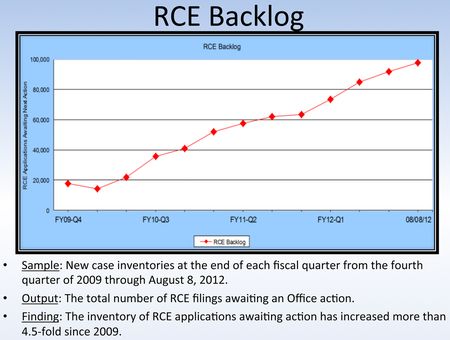
    RCE fees — The IPO states that it "do[es] not believe raising filing fees
    is the solution to the RCE problem." 
    According to the IPO, the proposed RCE fees "are unduly high and,
    like appeal fees, fail to take into account prosecution realities."

    For additional information
    regarding this topic, please see:

    • "PPAC Issues Report
    on USPTO Patent Fees Proposal
    ," October 9, 2012
    • "More on USPTO's
    Proposed New Fees – Part II
    ," September 19, 2012
    • "More on USPTO's
    Proposed New Fees
    ," September 11, 2012
    • "USPTO Proposes New
    Patent Fees and CPI Adjustments to Certain Fees
    ," September 6, 2012
    • "USPTO News Briefs,"
    September 5, 2012
    • "USPTO Posts
    Comments on Proposed Fees Changes
    ," March 19, 2012

    "A Glimpse under the Hood: How the USPTO Proposes to
    Adjust Patent Fees
    ," March 14, 2012

    "USPTO Proposes Fees Changes," March 1,
    2012

    "USPTO News Briefs," February 20, 2012

    "PPAC to Hold Public Hearings on Proposed Fee Schedule,"
    February 1, 2012

  • By Donald Zuhn

    MyriadEarlier today, the Supreme
    Court updated its docket
    for the Association for Molecular Pathology
    v. Myriad Genetics, Inc.
    case to indicate that it has now been distributed
    for conference on November 30.  In
    response to the Petition for a Writ of Certiorari filed in September by the
    Public Patent Foundation (PUBPAT) and the American Civil Liberties Union (ACLU)
    Foundation on behalf of Petitioners Association for Molecular Pathology et al. (see "Plaintiffs (Again) File Certiorari Petition in Myriad
    Case
    "),
    the Court received a brief in opposition from Respondents Myriad
    Genetics, Inc. et al., a reply from
    Petitioners, and seven amici curiae
    briefs.  Patent Docs was graciously provided with copies of two of the seven
    amici briefs:

    Amici Curiae Brief for Academics in Law, Medicine, Health Policy and
    Clinical Genetics in Support of Petitioners — brief

    • Brief Amici Curiae of The National Women's
    Health Network, Reproductive Health Technologies Project, Disability Rights
    Legal Center, Forward Together, The Center for Genetics and Society, The
    Pro-Choice Alliance for Responsible Research, Alliance for Humane Biotechnology,
    G. Michael Roybal, MD, MPH, and Anne L. Peters, MD in Support of Petitioners — brief

    According to the docket, other
    amici briefs were submitted by:

    • AARP
    • Cancer Council Australia et al.
    • Kali N. Murray and Erika
    R. George
    • Canavan Foundation et al.
    • American Medical
    Association et al.

    Patent Docs intends to make copies of the five remaining amici briefs as well as Petitioners'
    reply brief available to the extent that we can secure copies.  In addition, we plan to summarize in
    subsequent posts any of the briefs for which we can secure copies.

  • By Kwame Mensah

    TwitterOn November 6, the U.S. Patent
    and Trademark Office held a live chat on Twitter (@uspto) to discuss some of
    the provisions of the Leahy-Smith America Invents Act.  Highlights of the chat were the inventor's
    oath/declaration provisions, preissuance submissions, supplemental examination,
    and the first-inventor-to-file (FITF) provision.  This chat provided concise and helpful
    descriptions of each of these provisions. 
    Representative tweets included the following:

    Tweets
    The transcript of the
    chat can be found here,
    or by searching the hashtag #InventChat. 
    Additionally, we invite all Twitter users to follow us at @patentdocs
    for breaking patent-related news.

  • By Donald Zuhn

    Impact of Hurricane Sandy
    on USPTO Operations

    USPTO SealOn November 2, the U.S.
    Patent and Trademark Office issued a notice
    that in view of the official closing of Federal Government offices in the
    Washington, D.C. area on October 29 and 30, 2012 as a result of Hurricane Sandy,
    the Office would consider both days to be "Federal holiday[s] within the
    District of Columbia" under 35 U.S.C. § 21 and 37 C.F.R. §§ 1.6, 1.7, 1.9,
    2.2(d), 2.195 and 2.196.  As a result, any
    action or fee due on October 29 or 30, 2012 will be considered as timely for
    the purposes of 15 U.S.C. §§ 1051(b), 1058, 1059, 1062(b), 1063, 1064, and
    1126(d), or 35 U.S.C. §§ 119, 120, 133 and 151, if the action was taken, or the
    fee was paid, on October 31, 2012.

    The Office also issued a
    notice on November
    2, designating the interruption in service of the U.S. Postal Service (USPS) in
    the areas affected by the hurricane including in Connecticut, Delaware,
    Massachusetts, New Jersey, New York, North Carolina, Pennsylvania, Rhode
    Island, Maryland, Virginia, the District of Columbia, and the Appalachian region
    beginning on Monday, October 29, 2012, as a postal service interruption and
    emergency within the meaning of 35 U.S.C. § 21(a) and 37 CFR 1.10(i) and
    2.195(e).  The notice indicates that once
    the USPS has notified the public that the interruption in service has ended,
    the designation of this interruption and emergency within the meaning will
    terminate without further notice from the USPTO.  The Office notes that applicants can
    determine whether a post office has been closed or reopened, or postal services
    have been suspended or resumed in a particular area due to the storms, by visiting
    the USPS's website.  A national mail service disruption report can
    be obtained here.

    With respect to patent-related
    correspondence, the notice indicates that 37 CFR 1.10(i) provides that any
    person attempting to file correspondence by "Express Mail Post Office to
    Addressee" service that was unable to be deposited with the USPS due to an
    interruption or emergency in "Express Mail" service which has been so
    designated by the Director may petition the Director to consider such
    correspondence as filed on a particular date in the Office.  Additional information can be found in the
    Office's notice.


    USPTO Seeks Comments on
    Sequence Listings

    On October 29, the U.S.
    Patent and Trademark Office published a notice in the Federal Register (77 Fed.
    Reg. 65537
    )
    inviting the public to comment on the Sequence Listing requirements.  The Office estimates that the average
    Sequence Listing takes about five hours of paraprofessional time at an
    estimated rate of $122 per hour and one hour of attorney time at $371 per hour,
    for a weighted average rate of $163.50 per hour.  As a result, the Office estimates that the total
    cost burden for this collection is approximately $22,590,450 per year.  The Office is inviting comments on the
    following topics:

    (a) Whether the proposed collection of
    information is necessary for the proper performance of the functions of the
    agency, including whether the information shall have practical utility; (b) the
    accuracy of the agency’s estimate of the burden (including hours and cost) of
    the proposed collection of information; (c) ways to enhance the quality,
    utility, and clarity of the information to be collected; and (d) ways to
    minimize the burden of the collection of information on respondents, e.g., the
    use of automated collection techniques or other forms of information
    technology.

    Comments, which must be
    submitted by December 28, 2012, can be sent to e-mail to InformationCollection@uspto.gov
    (and should include "0651–0024 comment" in the subject line), by
    regular mail to Susan K. Fawcett, Records Officer, Office of the Chief
    Information Officer, United States Patent and Trademark Office, P.O. Box 1450,
    Alexandria, VA 22313–1450, or via the Federal Rulemaking Portal.

    Sequence Listing

    USPTO Offers New Search
    Tool for MPEP

    MPEP Ed. 8, Rev. 7 CoverThe U.S. Patent and Trademark
    Office announced in September
    that it was making the Manual of Patent Examining Procedure (MPEP) more
    accessible to the public through a new search tool.  According to the Office, the new search tool,
    which can be found here,
    works like an Internet search engine.  The
    Office noted that the primary benefit of the new system will be that the MPEP
    can be updated within hours, rather than months.  The MPEP search tool has also been added to
    the Patent Docs "Patent
    Resources" sidebar (under the Google Search box on the right-hand side of
    the site).

  • Unitary European Patent

    European Union (EU) FlagThe European
    Union (EU) Parliament is close to approving new regulations for a single patent
    covering 25 states of the EU.  Under these
    regulations, patents granted by the European Patent Office can cover, and be
    enforceable in, 25 countries of the EU as a single entity.  The patentee will be able to choose if the
    granted patent becomes individual patents in one or more of those 25 countries,
    or the unitary patent covering all 25.  There will be no requirement for the patentee to translate the patent.

    Italy
    and Spain have each launched legal challenges, at the Court of Justice of the
    European Union (CJEU), against these proposals.  However, although these challenges will slow progress, political pressure
    means that the unitary European patent will become a reality in the near
    future.

    The EU
    has set a target date of 1 January 2014 for the unitary patent system to come
    into force.


    Pan-European
    patent litigation system

    Currently, European patents are a bundle of national
    patents, enforced nationally.  For some time the goal of the EU has been central
    enforcement of European patent rights.  The EU has agreed that the unitary
    European patent will come into force alongside a system of central enforcement
    of patent rights in Europe.

    The European Commission is putting in place a court, the EU Unified Patent Court (UPC), which will have exclusive jurisdiction over enforcement
    of both the proposed unitary European patents and national patents
    granted by the EPO.  The proposed court will be set up by agreement between the
    25 member states.

    The UPC will initially have three centres:  Paris, London and Munich.  London will
    have jurisdiction over litigation of patents relating to chemistry and the life
    sciences, including pharmaceuticals, biotechnology and medical devices, Munich
    will have jurisdiction over litigation of patents relating to mechanical
    engineering and Paris will take the remaining technologies.  There will be an Appeal Court in Luxembourg.

    The London cluster is a significant boost
    for the UK, and UK litigants will have easy access to Paris which is only a
    short train ride away.  Forresters has a strong presence in the other two key
    locations, with offices in both London and Munich.

    The EU has yet to decide the exact
    relationship between the courts.  This
    will become clearer as the courts are set up.

    The proposed structure would provide a new
    system of patent litigation in the EU by 1 April 2014.

    We will keep you updated on the progress of both
    proposals.

    This article was reprinted with permission from Forresters life sciences newsletter.

  • By Sherri Oslick

    Gavel About Court Report:  Each week we will report briefly on recently filed biotech and pharma cases.

    Precision
    BioSciences, Inc. et al. v. Cellectis SA et al.

    5:12-cv-00719;
    filed November 5, 2012 in the Eastern District of North Carolina

    • Plaintiffs: 
    Precision BioSciences, Inc.; Duke University
    • Defendants: 
    Cellectis SA; Cellectis bioresearch; Cellectis bioresearch Inc.

    Infringement
    of U.S. Patent No. 8,304,222 ("Methods of Cleaving DNA with
    Rationally-Designed Meganucleases," issued November 6, 2012) based on
    Cellectis' manufacture, use, and sale of certain products, including the
    CLS4617 meganuclease targeting the human CCR5 gene and meganucleases targeting
    the human RAG1 gene.  View the complaint here.


    Astrazeneca
    Pharmaceuticals LP et al. v. Lupin Ltd. et al.

    3:12-cv-06888;
    filed November 5, 2012 in the District Court of New Jersey

    • Plaintiffs: 
    Astrazeneca Pharmaceuticals LP; Astrazeneca UK Ltd.;
    • Defendants: 
    Lupin Ltd.; Lupin Pharmaceuticals, Inc.

    Infringement
    of U.S. Patent No. 5,948,437 ("Pharmaceutical Compositions Using
    Thiazepine," issued September 7, 1999) following a Paragraph IV certification
    as part of Lupin's filing of an ANDA to manufacture a generic version of
    AstraZeneca's Seroquel® XR (quetiapine fumarate, used to treat schizophrenia
    and bipolar disorder).  View the
    complaint here.


    Genetic
    Technologies Ltd. v. PreventionGenetics LLC

    3:12-cv-00792;
    filed November 2, 2012 in the Western District of Wisconsin

    Infringement
    of U.S. Patent No. 5,612,179 ("Intron Sequence Analysis Method for
    Detection of Adjacent Locus Alleles as Haplotypes," issued March 18, 1997)
    based on RGI's manufacture, use, sale, and offer for sale of clinical DNA
    testing services.  View the complaint here.


    Acura
    Pharmaceuticals, Inc. v. Sandoz, Inc.

    3:12-cv-06784;
    filed November 1, 2012 in the District Court of New Jersey

    Infringement
    of U.S. Patent No. 7,510,726 ("Methods and Compositions for Deterring
    Abuse of Opioid Containing Dosage Forms," issued March 31, 2009) following
    a Paragraph IV certification as part of Sandoz's filing of an ANDA to
    manufacture a generic version of Oxecta® (oxycodone hydrochloride, used for the
    management of acute and chronic moderate to severe pain where the use of an
    opioid analgesic is appropriate, marketed by Pfizer).  View the complaint here.


    Purdue
    Pharmaceutical Products L.P. et al. v. Par Pharmaceutical, Inc.

    2:12-cv-06738;
    filed October 25, 2012 in the District Court of New Jersey

    • Plaintiffs:  Purdue
    Pharmaceutical Products L.P.; Purdue Pharma L.P.; Transcept Pharmaceuticals,
    Inc.
    • Defendant:  Par
    Pharmaceutical, Inc.

    Purdue
    Pharmaceutical Products L.P. et al. v. Par Formulations Private Ltd.

    2:12-cv-06741;
    filed October 25, 2012 in the District Court of New Jersey

    • Plaintiffs: 
    Purdue Pharmaceutical Products L.P.; Purdue Pharma L.P.; Transcept
    Pharmaceuticals, Inc.
    • Defendant: 
    Par Formulations Private Ltd.

    The
    complaints in these cases are substantially identical.  Infringement of U.S. Patent Nos. 8,242,131 ("Methods
    of Treating Middle-of-the-Night Insomnia," issued August 14, 2012) and
    8,252,809 ("Compositions for Treating Insomnia," issued August 28,
    2012) following a Paragraph IV certification as part of Par's filing of an ANDA
    to manufacture a generic version of Purdue's Intermezzo® (sublingual zolpidem
    tartrate, used to treat insomnia when middle-of-the-night awakening is followed
    by difficulty returning to sleep).  View
    the Par Pharmaceutical complaint here.


    Mallinckrodt
    Inc. et al. v. Watson Laboratories, Inc.-Florida. et al.

    2:12-cv-06744;
    filed October 25, 2012 in the District Court of New Jersey

    • Plaintiffs: 
    Mallinckrodt Inc.; Mallinckrodt LLC
    • Defendants: 
    Watson Laboratories, Inc.-Florida; Watson Pharma, Inc.; Watson
    Pharmaceuticals, Inc.

    Infringement
    of U.S. Patent No. 5,914,131 ("Hydromorphone Therapy," issued June
    22, 1999) following a Paragraph IV certification as part of Watson's filing of
    an ANDA to manufacture a generic version of Mallinckrodt's Exalgo®
    (hydromorphone hydrochloride, used for the management of moderate to severe
    pain in opioid tolerant patients requiring continuous, around-the-clock opioid
    analgesia for an extended period of time). 
    View the complaint here.


    Gilead
    Sciences, Inc. v. Lupin Ltd.

    1:12-cv-07910;
    filed October 24, 2012 in the Southern District of New York

    Infringement
    of U.S. Patent Nos. 5,922,695 ("Antiviral Phosphonomethoxy Nucleotide
    Analogs Having Increased Oral Bioavailability, issued July 13, 1999), 5,935,946
    ("Nucleotide Analog Composition and Synthesis Method," issued August
    10, 1999), 5,977,089 ("Antiviral Phosphonomethoxy Nucleotide Analogs
    Having Increased Oral Bioavailability, issued November 2, 1999), and 6,043,230
    (same title, issued March 28, 2000), following a Paragraph IV certification as
    part of Lupin's filing of an ANDA to manufacture generic versions of Gilead's
    Viread® (tenofovir disoproxil fumarate, used for the treatment of HIV-1
    infection).  View the complaint here.