• By Michael Borella

    Federal Circuit SealIn a ruling that should surprise absolutely nobody, the Federal Circuit rapidly scrapped an appeal of a PTAB decision that affirmed a 35 U.S.C. § 101 rejection of a business method claim.  This is the latest in a series of cases going back years in which the Court tends to find inventions that improve business processes ineligible for patenting, even if computer implementation is required.

    At issue was representative claim 1 of U.S. Patent Application No. 14/786,244, which recites:

    A method for facilitating asset acquisition, asset management and asset maintenance whereby customers can purchase from multiple vendors comprising:
        providing to vendor and customer users access to consortium management software;
        providing and maintaining in said consortium management software relational data base tables which are linked together, including a vendor/customer database table, whereby vendor users and customer users can enter their identifying and personal data, and a searchable product catalogue database table;
        providing in said searchable product catalogue database for receipt from vendor users, product, product pricing and product maintenance data;
        providing an inventory database table and a customer asset management database table;
        providing customer users access to said searchable product catalogue database, whereby a customer searches the catalogue data base and purchases from any vendor user product selected from said product catalogue database;
        providing for association of any said user's identifying data with information in any database table, which information is pertinent only to a particular said identified user with said users identifying data; [and]
        linking the purchasing customer's identifying information from the customer/vendor database table, and the product, product pricing and product maintenance data for the selected product or products, to one or both of said inventory database table and/or said customer asset management data base table, such that the customer can retrieve, use and manipulate the product, product pricing and product maintenance data in connection with the management of the assets purchased.

    In Alice Corp. v. CLS Bank Int'l, the Supreme Court set forth a two-part test to determine whether claims are directed to patent-eligible subject matter under § 101.  One must first decide whether the claim at hand involves a judicially-excluded law of nature, a natural phenomenon, or an abstract idea.  If so, then one must further decide whether any element or combination of elements in the claim is sufficient to ensure that the claim includes an inventive concept amounting to significantly more than the judicial exclusion.  But elements or combinations of elements that are well-understood, routine, and conventional will not lift the claim over the § 101 hurdle.  While this inquiry is generally carried out as a matter of law, factual issues can come into play when determining whether something is well-understood, routine, and conventional.

    In practice, either part of the Alice test can be satisfied when a claim recites a specific, technical advance over the prior art.  The Federal Circuit made this explicitly clear for part two in Dropbox Inc. v. Synchronoss Techs. Inc., holding that "an inventive concept exists when a claim recites a specific, discrete implementation of the abstract idea where the particular arrangement of elements is a technical improvement over the prior art."  Similar reasoning can be pieced together for part one through a synthesis of Federal Circuit decisions since 2014.

    During prosecution, the Examiner rejected all of Smith's claims as directed to patent-ineligible subject matter.  The Examiner's rationale, tersely set forth, was that the claimed invention was drawn to an abstract method of organizing human activity without reciting significantly more than that.  The PTAB agreed, finding that the claim recited "collection, display, and manipulation of data and was thus directed to an abstract idea, and that it contained no inventive concept that would make it patent eligible."  Regarding the lack of an inventive concept, the PTAB stated that "any such additional elements include only conventional computer components and that these elements, when considered individually and as an ordered combination, are well-understood, routine, conventional activity in the field and are not specified beyond a high level of generality."

    On appeal to the Federal Circuit, the Court found no error in the PTAB's reasoning.  The Court observed that claims "directed to collection of information, comprehending the meaning of that collected information, and indication of the results, all on a generic computer network operating in its normal, expected manner are claims to abstract ideas."  The Court went on to determine that there was no dispute that claim 1 did not improve the functioning of a computer.

    Nonetheless, Smith made an unusual (and ultimately ill-advised) argument that "the first step in analyzing a claim to a new process or an improvement thereof must be to determine whether it is useful" and if so "it is by law patent eligible."  The Court rejected this notion in full, stating that "utility is not the test for patent eligibility" and that this argument was "inconsistent with the framework set out in Alice."

    A somewhat more relevant argument was that the "Board failed to consider the claims as a whole."  The case law has never established exactly what it means to consider claims as a whole.  Often the § 101 inquiry ignores or downplays this requirement, merely allowing conclusory reasoning to win the day.  The PTAB's reasoning was not completely conclusory but it did not go into any significant detail.  Nonetheless, what the Court was likely looking for here is a contention (supported by evidence in the claim itself or in the specification) that the invention improves a computer or some other technological component or process.  Since the PTAB stated that the claim involved, at best, "an improvement in business practice for which generic computer components are used in their ordinary capacity," this was enough for the Court to affirm the rejection.

    In re Smith (Fed. Cir. 2022)
    Nonprecedential disposition
    Panel: Circuit Judges Lourie, Dyk, and Hughes
    Per curiam opinion

  • By Kevin E. Noonan –

    Washington - White House #3On Monday, September 12th, President Biden signed an Executive Order entitled "Advancing Biotechnology and Biomanufacturing Innovation for Sustainable, Safe and Secure American Bioeconomy."

    The Executive Order (in Section 1) set forth policy goals of taking a "whole-of-government" approach for using biotechnology in areas including "health, climate change, energy, food security, agriculture, supply chain resilience, and national and economic security" while ensuring equitable access and ethical practices to develop technologies, products and processed that "benefits all Americans and the global community and that maintains United States technological leadership and economic competitiveness."  It cites as lessons of the COVID-19 pandemic that biotechnology and biomanufacturing had a "vital role" in "developing and producing life-saving diagnostics, therapeutics, and vaccines that protect Americans and the world" that was also relevant for "achiev[ing] our climate and energy goals, improv[ing] food security and sustainability, secur[ing] our supply chains, and grow[ing] the economy across all of America."

    These goals will require investment in "foundational scientific capabilities," including genetic engineering, bioinformatics, and scale-up needed to reduce obstacles to commercialization of these technologies.  Concomitant with these efforts to exploit these technologies, the Order recognizes the need to "reduce biological risk" and for biosafety and biosecurity, including from foreign adversaries and strategic competitors using means legal and illegal to acquire U.S technologies and data in this arena.

    Specifically, the Order contains directives for the Federal government to:

    • Invest and coordinate research and development in biotechnology and biomanufacturing;
    • Foster a secure and ethical "biological data ecosystem";
    • Improve and expand production capacity while accelerating translation of basic research to commercial products;
    • Increase biomass production and "climate-smart" incentive for agriculture;
    • Expand market opportunities for bioenergy;
    • Train a workforce to create, develop, and implement advances in biotechnology and biomanufacturing;
    • Clarify and streamline regulations and make biological risk management a "cornerstone" of biotechnology and biomanufacturing R&D;
    • Promote standard and establish metrics to better inform policy, decision-making and investment;
    • Develop approaches for risk and threat assessment in partnership with private industry; and
    • Engage with the rest of the world to enhance cooperation.

    The agencies and functionalities of the Federal government specifically recited in Section 2 of the Order to be responsible for develop and implement these goals include the "Assistant to the President for National Security Affairs (APNSA), in consultation with the Assistant to the President for Economic Policy (APEP) and the Director of the Office of Science and Technology Policy (OSTP)."  The process will include the Secretaries of Health and Human Services, Energy, Agriculture, Commerce, and the Director of the National Science Foundation, who will within 180 days of the order submit reports on "biotechnology and biomanufacturing to further societal goals related to health, climate change and energy, food and agricultural innovation, resilient supply chains, and cross-cutting scientific advances."  These Reports will also involve the Office of Management and Budget and the Assistant to the President for Domestic Policy.

    Specifically, these agencies and functionalities will provide these Reports (as set forth in Section 3 of the Order):

    • From the Department of Health and Human Services, the Report will assess "how to use biotechnology and biomanufacturing to achieve medical breakthroughs, reduce the overall burden of disease, and improve health outcomes."

    • From the Department of Energy, the Report will assess "how to use biotechnology, biomanufacturing, bioenergy, and biobased products to address the causes and adapt to and mitigate the impacts of climate change, including by sequestering carbon and reducing greenhouse gas emissions."

    • From the Department of Agriculture, the Report will assess "w to use biotechnology and biomanufacturing for food and agriculture innovation, including by improving sustainability and land conservation; increasing food quality and nutrition; increasing and protecting agricultural yields; protecting against plant and animal pests and diseases; and cultivating alternative food sources."

    • From the Department of Commerce, the Report will assess "how to use biotechnology and biomanufacturing to strengthen the resilience of United States supply chains" in consultation with the Secretaries of Defense and HHS and "other appropriate agencies."

    • From the Director of the National Science Foundation, the Report will "identify[] high-priority fundamental and use‑inspired basic research goals to advance biotechnology and biomanufacturing and to address the societal goals identified in this section."

    And 100 days after receiving these Reports, the Director of OSTP, coordinating with the Director of OMB, the APSNA, the APEP, the APDP and "other appropriate agencies" shall develop an implementation plan for these recommendations.  The Director of OMB is charged to provide within 90 days of the Order a budget that identifies the "existing levels of agency spending" to "inform the development of the implementation plan."  The agencies and functionalities identified as being responsible for these implementing actions are charged with reporting the "measures taken and resources allocated to enhance biotechnology and biomanufacturing, consistent with the implementation plan" within 2 years of the Order.

    The Order in Section 4 also announces a "Data for the Bioeconomy" Initiative to "ensure that high-quality, wide-ranging, easily accessible, and secure biological data sets can drive breakthroughs for the United States bioeconomy."  As part of this Initiative, the Order provides for a Report to be provided within 240 days of the Order date that identifies the "most critical" information, provides a plan for "fill[ing] data gaps" and making these data "findable, accessible, interoperable, and reusable."  This Report is also charged with identifying "security, privacy, and other risks" and ways of mitigating or preventing them, including cybersecurity efforts involving the Department of Homeland Security.

    The Order further provides in Section 5 for efforts to expand domestic biomanufacturing capacity and "mitigate risks posed by foreign adversary involvement in the biomanufacturing supply chain," the Order identifying the departments, agencies, and functionalities charged with developing these strategies.  The Order imposes a one-year deadline for a plan to "support the resilience of the United States biomass supply chain for domestic biomanufacturing and biobased product manufacturing" and a 180-day deadline for the Department of Homeland Security to provide vulnerability assessments for "critical infrastructure" associated with the bioeconomy and enhance coordination within the industry on "threat information sharing, vulnerability disclosure, and risk mitigation for cybersecurity and infrastructure risks to the United States bioeconomy."

    Section 6 relates to biobased product procurement by federal agencies, and Section 7 sets forth goals for developing the biotechnology and biomanufacturing workforce, which include expanding training and educational opportunities by, inter alia, coordinating Federal education and training programs by the appropriate Federal departments (e.g., Education and Labor) and agencies, and specifically recites that such efforts will include "Historically Black Colleges and Universities, Tribal Colleges and Universities, and Minority Serving Institutions."

    Section 8 is directed to improving clarity and efficiency of regulations relating to biotechnology and biomanufacturing, specifically aimed at "ambiguity, gaps, or uncertainties" in Federal regulations including the January 2017 Update to the Coordinated Framework for the Regulation of Biotechnology and Executive Order 13874 of June 11, 2019 (Modernizing the Regulatory Framework for Agricultural Biotechnology Products).  This Section also provides that "general public plain-language information" be provided to the public for any of these regulations, as well as plans for regulatory reform, and improvements on the Unified Website for Biotechnology Regulation.

    Section 9 concerns establishment of a Biosafety and Biosecurity Innovation Initiative intended to "reduce biological risks associated with advances in biotechnology, biomanufacturing, and the bioeconomy."  Section 10 directs the Chief Statistician, the Department of Commerce, the Director of NIST and other agencies to measure the bioeconomy with regard to the economic value to the U.S. economy.  Section 11 directs the Director of National Intelligence to be the leader of an interagency effort to provide a comprehensive assessment of "ongoing, emerging, and future threats to United States national security from foreign adversaries against the bioeconomy and from foreign adversary development and application of biotechnology and biomanufacturing, including acquisition of United States capabilities, technologies, and biological data."

    Finally, Section 12 directs the Department of State and other agencies to engage with foreign partner governments to "enhance cooperation," "develop joint training arrangements and initiatives," "promote open sharing of scientific data," specifically including genetic data, "anticipate threats to the global bioeconomy, including national security threats,"  "develop . . . biosafety and biosecurity best practices," and "align international classifications of biomanufactured products."

    As with almost everything done by the Federal government, this ambitious program will be subject to the vagaries of implementation, the political process, and the ever-present law of unintended consequences.  But the Order illustrates one of the benefits and consequences of having government with an Executive Branch that is capable of directing the efforts of the Federal government to establish and achieve broad policy goals.  The devil (insofar as there is or will be one) will be in the details, but for now there has been a decision to emphasize, support, and invest in the bioeconomy that is forward-looking and visionary.  Which should be a good thing.

  • By Michael Borella and Ashley Hatzenbihler* —

    USPTO SealThe U.S. Patent and Trademark Office (USPTO) established its Patent Trial and Appeal Board (PTAB) in September 2012.  As mandated by the America Invents Act, the PTAB conducts administrative trials, such as inter partes reviews, and handles appeals from examiner rejections of patent applications.

    Regarding the trials, former Federal Circuit Judge Randall Rader nicknamed the PTAB a "death squad" for patents, as PTAB judges were tasked with invalidating patents that had been duly issued by the examining corps.  The accuracy of this moniker is debatable, as the latest published trial data for fiscal year 2022 indicates that only 34% of all patents undergoing such a trial eventually have at least some claims invalidated.  But if we eliminate those for which the trial settled or was dismissed early for some reason, this number jumps to 49%.  And if we only consider final written decisions, the number is 83%.

    On the appeals side, the latest published appeal data for fiscal year 2022 indicates that the PTAB affirmed examiners 55.6% of the time, and affirmed examiners in part 9.1% of the time.  Still, there has been growing anecdotal evidence that appeals of rejections made on grounds of subject matter eligibility — addressing the requirements of 35 U.S.C. § 101 as interpreted by the courts — had abysmally low win rates for applicants.  Indeed, Professor Dennis Crouch published a short blog post stating that the PTAB affirmed examiners a whopping 92% of the time for § 101 appeals decided in the June/July 2021 time frame.

    If true, this statistic should give us pause — applicants should be aware that their chances of winning a § 101 appeal are somewhere around that of the proverbial snowball in Hell.  Also, USPTO administrators might want to determine why this number is so extreme.

    Professor Crouch did not provide a description of his methodology for coming up with this 92%, though it appears that he used a third-party analytics tool.  From experience, our gut instinct was that this affirmance rate is higher than expected, and that a larger data set would likely find it to be between 75% and 80%.  So we decided to undertake that analysis.

    We searched the USPTO's PTAB decision database for all § 101 appeals decided in calendar 2021.  When taking a first pass through the data, we found that it needed some filtering to be meaningful.  Using the database's search function resulted in just about any appeal that involved § 101 in some fashion.[1]  Therefore, we only considered appeals that matched the following criteria:

    1.  The decision was published between January 1, 2021 and December 31, 2021.

    2.  The decision was not for a request for rehearing.

    3.  The appeal was over a § 101 rejection that invoked Alice Corp. v. CLS Bank Int'l, and not just a purely statutory or double patenting § 101 rejection.

    4.  The applicant appealed on grounds of § 101 and the PTAB rendered a substantive § 101 opinion.  This eliminates cases where the applicant appealed a § 101 rejection, but the examiner subsequently withdrew the rejection, as well as cases where the applicant did not appeal on § 101 grounds but the PTAB provided new grounds of rejection on the basis of § 101.

    5.  For purposes of categorizing whether an examiner was affirmed, if the PTAB affirmed the examiner's § 101 rejections on as little as one claim, we considered the examiner to be affirmed.  In practice, relatively few decisions resulted in some claims being held ineligible and others eligible.

    Once these criteria are applied, in theory we are left with three possible outcomes of each appeal:  (i) the examiner is affirmed, (ii) the examiner is reversed, or (iii) the examiner's § 101 rejections are reversed but the PTAB issues new grounds of rejection under § 101.  In looking at the decisions, we did not identify any appeals falling into the third category, so the outcomes are either affirmance (applicant loses) or reversal (applicant wins).

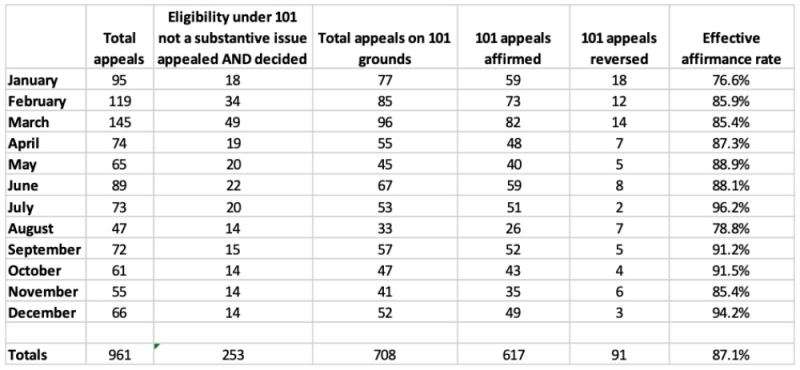
    Our results are in the table below, broken out by month.  For each month, we provide the total number of appeals that came up in our search, and identify those that are disqualified according to our criteria.  The remaining are the total appeals on § 101 grounds.  These are broken out into those that were affirmed and those that were reversed.  The effective affirmance rate is the number of § 101 appeals affirmed divided by the total appeals on § 101 grounds.

    Table
    Jumping straight to the payoff — Professor Crouch's one-month analysis is not far off for 2021 as a whole.  In 2021, the PTAB affirmed § 101 rejections from examiners 87.1% of the time.  Put another way, in about 7 out of every 8 such appeals, the applicant lost.  All things the same, this gives the applicant about the same odds as drawing either three of a kind, a straight, or a flush in 7-card poker.

    But the effective affirmance rate varied from month to month.  It was at a low point in January (76.6%) and a high point in July (96.2%), though there was no clear month-over-month trend.  For the most part, the percent hovered in the mid to high 80s.  On the other hand, the number of total appeals on § 101 grounds trended downward throughout 2021, with the monthly average being 78.25 for the first four months of the year and 49.25 for the last four months of the year.  This suggests that fewer applicants are filing appeals, probably due to the rather disappointingly low likelihood of obtaining a positive outcome.

    So what does this mean for applicants?  One obvious recommendation is to avoid appealing § 101 rejections to the PTAB unless you have a very strong case.  Instead, try to work with the examiner to the extent possible.  The problem with this approach, however, is that some examiners issue § 101 rejections on a regular basis and rarely withdraw such rejections.  Sometimes, this reticence is based on gamesmanship rather than application of the applicable law.[2]  Thus, applicants may be incentivized to file continuations or continuations-in-part in attempts to get another bite at the apple with a new (and hopefully more reasonable) examiner.  Nonetheless, the best way of dealing with § 101 is avoiding having to deal with § 101 altogether.  If possible, drafting claims and a specification that cover the technical aspects of the invention in a specific fashion that sets forth its advances over the prior art is the best way to dance around the Alice quagmire.

    But our observations should be considered by USPTO administration as well.  Is this level of examiner affirmance justifiable given that the affirmance rate for § 103 appeals is around 50%?  Are these § 101 appeals for claimed inventions that clearly do not qualify as patent-eligible under Alice and the subsequent case law (e.g., do the claims lack a specific, technical improvement over the prior art)?  Are PTAB judges under undue pressure to affirm or have they developed a culture that improperly favors affirmances?  Are the judges fully considering the technical advances set forth in the claims and/or the specification?  Are applicants' analogies to patent-eligible cases being given the appropriate amount of weight?

    The bottom line is not good news for anyone dealing with a § 101 rejection.  The usual route that an applicant can take when at an impasse with an examiner is to appeal.  But that route has been narrowed to a dirt road traversing the edge of a cliff with no guardrails . . . and there may be a death squad blocking your path.

    [1] For example, a search by Proceeding Type (Appeal), Decision Type (Decision), and Issue Type (101) results in a list of cases that is overly inclusive and often containing some that had nothing to do with § 101 at all.

    [2] We want to emphasize that the vast majority of examiners are honest, hardworking, and at the very least attempt to apply the law in a cogent, rational, and fair basis.  Nonetheless, the vagary of § 101 in particular opens the door for shenanigans.

    * Ashley Hatzenbihler is an associate with MBHB.  Ashley recently graduated from Loyola University Chicago School of Law, where she was an associate editor of the Loyola University Chicago International Law Review.  Prior to law school, Ashley received a Bachelors in Mechanical Engineering with a minor in Mathematics from Marquette University, and a Masters of Science in Mechanical Engineering from Marquette University.

  • By Michael Borella

    With further apologies to David Letterman.

    Almost two years ago we published Stupid § 101 Tricks, an article discussing some of the annoying, improper, and yet disappointingly common patterns seen in rejection and invalidation of claims for allegedly lacking patentable subject matter.  Moving on from there, Section § 102 of the patent statute sets forth the requirement of novelty.  In sum, it is a rather simple requirement, far easier to determine, less nuanced, and less subjective than the inquiry of § 101 or even the obvious analysis set forth in § 103 and related case law.

    Nonetheless, it is not uncommon to observe deviations from the straight lines of the § 102 analysis.  As § 102 does not lend itself to the same level of shenanigans as § 101, we characterize these tricks as being "silly" rather than "stupid."  Still, they are problematic in practice as they not only are misaligned with the statue and case law, but also unnecessarily increase the cost of patent acquisition.

    Let's start by defining the legal concept of anticipation.  In Verdegaal Bros. v. Union Oil Co. of California, the Federal Circuit stated that "[a] claim is anticipated only if each and every element as set forth in the claim is found, either expressly or inherently described, in a single prior art reference."  The Court has further clarified that "anticipation is not proven by multiple, distinct teachings that the artisan might somehow combine to achieve the claimed invention."  Microsoft Corp. v. Biscotti, Inc.  And, "unless a reference discloses within the four corners of the document not only all of the limitations claimed but also all of the limitations arranged or combined in the same way as recited in the claim, it . . . cannot anticipate under 35 U.S.C. § 102."  Net MoneyIN, Inc. v. VeriSign, Inc.

    This is cut and dry — one reference must disclose all claim elements as arranged in the claim under analysis.  As noted in M.P.E.P. § 2131.01, secondary references can be relied on to establish anticipation when these references "(A) Prove the primary reference contains an 'enabled disclosure;' (B) Explain the meaning of a term used in the primary reference; or (C) Show that a characteristic not disclosed in the reference is inherent."  Nonetheless, the use of secondary references in § 102 considerations remains rare.

    With all this in mind, on to the tricks.  All of these tricks have been observed during patent prosecution at the USPTO, and therefore we focus on how they are used by examiners.  We expect that they are less prevalent at the PTAB and in courts but have not yet made that determination.

    For any of the tricks described below, a recommended course of action is to interview the examiner in a non-confrontational fashion.  It is likely that they simply made an oversight, or that they have interpreted the claim in some fashion that is not explicit in the Office action (more on that later).  In some cases, reminding the examiner of the requirements for anticipation set forth in the M.P.E.P. § 2131 might also help.

    Trick 1: The Ghost Claim Element

    As noted, to anticipate a claim, a prior art reference must recite all of the claim elements.  However, some § 102 rejections silently ignore an entire claim element.  In some cases, the rejection ignores part of a claim element, such as the content of a wherein clause.  While the default is to consider all words of a claim during examination, there are a few oddball instances where the examiner is permitted to ignore part of a claim.  Intended use clauses and certain types of conditional claim language are two examples.  But even in those cases, the examiner is expected to provide a rationale for why a claim element is ignored.  For ghost claim elements, however, there is no rationale at all and the claim element is simply not addressed.

    Trick 2: The Throwaway Claim Element

    Here, the examiner finds a prior art reference that arguably teaches all claim elements except for one.  But for some reason, the examiner really wants to give a § 102 rejection rather than searching for a secondary reference to fill the gap.  Or, maybe the examiner cannot find such a secondary reference.  Regardless, the rejection cites to a passage in the primary reference that has nothing to do with the claim element to which it is being applied.  In many situations, this mapping is so far off base that you end up shaking your head a few times, cleaning your glasses, and questioning your own sanity.  But further analysis and consideration results in the same conclusion.  It is surprising to see this when the examiner otherwise did an admirable job in applying the prior art to the claim.

    Trick 3: The Low-Effort Rejection of Dependent Claims

    A related trick is to find a decent prior art reference for the independent claims — let's say for sake of argument that the reference properly anticipates the independent claims.  But then the rejection uses the same reference as allegedly anticipating all of the dependent claims as well.  While this might be case for a few dependent claims, at least some get the same "throwaway" tactic described above — the reference clearly has nothing to do with what is recited.  This low-effort approach allows the examiner to quickly turn around a rejection without searching for secondary references.  For at least some examiners, this is a pattern of behavior that you will see over and over.

    Trick 4: The Stealth § 103 Rejection

    In this type of rejection, the examiner finds an analogous prior art reference, but one that does not exhibit all claim elements as arranged.  Nonetheless, the examiner formulates a § 102 rejection, using vigorous hand-waving over the missing elements, and arguing that at some high level of abstraction the claim elements and the reference's teachings are the same or at least close.  To paraphrase a cliché, closeness only matters in horseshoes, hand grenades, and obviousness.  The problem is that some examiners will shut their ears to any argument that their rejection is improper — ignoring the M.P.E.P. and case law in the process.  In practice, the applicant often ends up making claim amendments because the reference — while insufficient to establish anticipation — could be used in a single-reference § 103 rejection.  Still, this possibility does not justify an improper § 102 rejection.

    Trick 5: The <Ctrl>-F Rejection

    Earlier this year we published an article on examination annoyances and how to handle them.  One of these annoyances, the <ctrl>-f rejection, applies here as well.  This type of rejection is based on the examiner selecting certain keywords from the claims, finding a prior art reference that contains the same keywords, and stitching the disparate passages in the reference together into an anticipation rejection.  Of course, the context in which the keywords are used in the claim is lost.  The prior art may contain the same language as the claims but is often not otherwise related.  The key to addressing a § 102 <ctrl>-f rejection is to focus on the arrangement of claim elements, as that is likely what the examiner ignored.

    Trick 6: Broadest Unreasonable Interpretation

    It is no secret that an examiner's take on the broadest reasonable interpretation (BRI) of a claim can be quite different from that of an attorney or agent who drafted or is prosecuting the claim.  In most cases, it is helpful to be informed of the examiner's interpretation, and it would be nice for examiners to set forth their BRI explicitly in Office action.  But as noted in the examination annoyances article, BRI can be misused.  BRI is tempered by how claimed elements fit into the overall structure of the claims and how they relate to other claim elements, as well as how the constituent words and phrases are defined in the specification and drawings.  M.P.E.P. § 2111 helps in this regard, stating that BRI is not the broadest possible interpretation, and that examiners must apply the ordinary and customary meaning of claim terms unless these terms have been given special definitions in the specification.  Further, BRI must be consistent with the use of the claim term in the specification and drawings.  Nonetheless, examiners may argue in interviews that their unspecified claim interpretation is proper under BRI, thus allowing them to wedge a § 102 rejection out of a reference that might be better used as just one of a § 103 rejection, if at all.

  • Business Methods Partnership MeetingThe U.S. Patent and Trademark Office will be holding the 2022 Business Methods virtual customer partnership meeting from 10:00 am to 3:00 pm (ET) on September 13, 2022.  The virtual meeting is an opportunity to bring stakeholders together to share ideas, experiences, and insights, and participate in informal discussions on current initiatives, quality, interview practice, petitions, and resources available.  The meeting will also have interactive panels focused on artificial intelligence (AI) and financial technology (fintech).

    Business Methods is a collection of subject matter areas in the USPTO Technology Center that grants patents related to data processing, including financial, business practice, management, and cost/pricing determination.

    Those wishing to register for the meeting can do so here.

  • USPTO SealAs part of the U.S. Patent and Trademark Office's Stakeholder Offerings and Resources (SOaR) virtual training series, the Office will be offering a training session on Patent Center and the Patent Public Search tool from 1:00 pm to 3:00 pm (ET) on September 15, 2022.  The training session will provide:

    • An overview and demonstration of the Patent Center by an expert from the eCommerce Modernization (eMod) team
    • A demonstration on how to use the Patent Public Search tool by an expert from the Patent and Trademark Resource Center (PTRC)

    Those interested in registering for the webinar can do so here

  • NAPP_1The National Association of Patent Practitioners (NAPP) will be offering a webinar entitled "Implications of File History Estoppel During Litigation" on September 16, 2022 from 12:00 pm to 1:00 pm (EDT).  Niky Bagley of Cole Schotz P.C. will, using various examples, provide insights into how statements made and actions taken during prosecution impact litigation, particularly during claim construction and arguments.

    Those interested in registering for the webinar should do so here.

  • By Kevin E. Noonan –

    FDAIt was not so long ago that many, including members of Congress, were bemoaning the slow approval and introduction into the marketplace of biosimilar alternatives to (generally expensive) biologic drugs (see "Trump Administration Considering Reduction in Biologics Exclusivity Period; A Solution in Search of a Problem"; "FDA Issues Plan for Further Facilitating Biosimilar Development"; "Senators Ask FTC to Investigate Biosimilar Litigation Settlement Agreement"; "Biosimilars Action Plan: Balancing Innovation and Competition"; "Congress Jumps on Bandwagon to Reduce Biologic Drug Exclusivity Term").  These sentiments were largely from outcome-oriented groups with little understanding or regard for process or an appreciation of what has been required of the FDA and biosimilar applicants to bring safe and effective biosimilar drugs to market (and to be sure the same chorus would be vocally critical should a biosimilar fail to be safe, effective, and cheaper than the reference biologic drug product).

    Things are looking up, however.  On September 6th, Fresenius Kabi announced FDA approval for its Stimufend® (pegfilgrastim-fpgk) product, as a biosimilar to Amgen's Neulasta® (pegfilgrastim).  This biologic drug is a recombinant human granulocyte colony-stimulating factor (or G-CSF) approved for decreasing the incidence of infection, as manifested by febrile neutropenia, in patients with non-myeloid malignancies receiving myelosuppressive anti-cancer drugs associated with a clinically significant incidence of febrile neutropenia.  Fresenius Kabi plans on marketing the product in a prefilled syringe by early 2023, and further plans to develop an "on-body injector" product to compete with Amgen's Neulasta Onpro (which has captured 45% of the $3.1 billion Neulasta® market as of the fourth quarter 2019).  Previously, Fresenius Kabi received marketing authorization in March 2022 for its Stimufend® product in Europe.

    This approval brings to 38 the number of approved biosimilar products.

    2022-09-08 Table

  • By Donald Zuhn

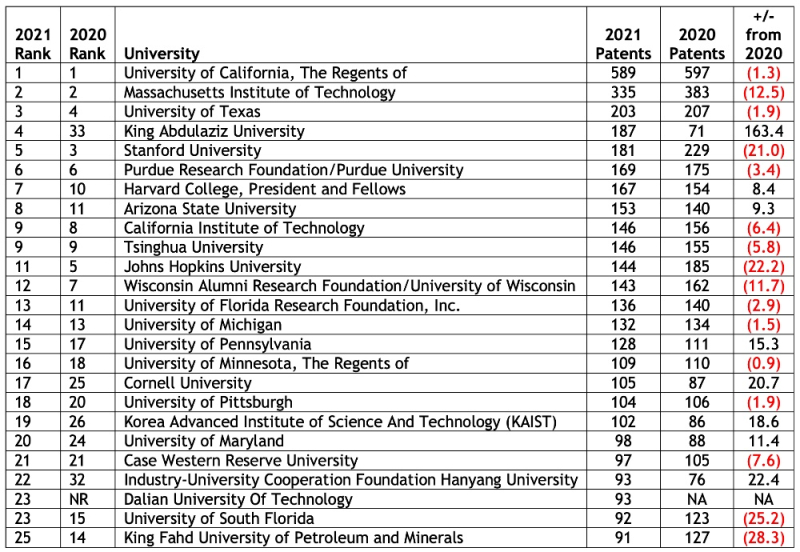
    CoverEarlier today, the National Academy of Inventors (NAI) and the Intellectual Property Owners Association (IPO) published their annual list of the top 100 worldwide universities that received the most U.S. utility patents during the 2021 calendar year.  The NAI is a member organization comprising U.S. and international universities, and governmental and non-profit research institutions, with over 4,000 individual inventor members and Fellows spanning more than 250 institutions.  The organization was founded in 2010 to recognize and encourage inventors with patents issued from the U.S. Patent and Trademark Office, enhance the visibility of academic technology and innovation, encourage the disclosure of intellectual property, educate and mentor innovative students, and translate the inventions of its members to benefit society.  The joint effort by the NAI and IPO is based on data obtained from the U.S. Patent and Trademark Office.  For their report, the NAI and IPO defined a university as an institution that grants undergraduate-level degrees, and when a patent is assigned to one or more entities, credit was given to the first named entity.  The report indicates that the number of patents granted to a particular university does not necessarily indicate the value of a university's technology, the effectiveness of its research, or whether its patents will be successfully licensed and/or brought to market.  The top 25 universities on the NAI/IPO listing are as follows (click on table to expand):

    2021 Top Universities
    The complete list of 100 universities can be found here.

    For additional information regarding this and other related topics, please see:

    • "IPO & Harrity Analytics Release List of Top 300 Patent Holders for 2021," January 23, 2022
    • "NAI & IPO Release List of Top 100 Universities Receiving Patents in 2020," July 14, 2021
    • "IPO & Harrity Analytics Release List of Top 300 Patent Holders for 2020," February 18, 2021
    • "NAI & IPO Release List of Top 100 Universities Receiving Patents in 2019," June 3, 2020
    • "IPO & Harrity Analytics Release List of Top 300 Patent Holders for 2019," May 25, 2020
    • "IPO Releases List of Top 300 Patent Holders for 2018," August 7, 2019
    • "IPO Releases List of Top 300 Patent Holders for 2017," July 4, 2018
    • "Top 100 Universities Worldwide Granted U.S. Patents in 2016," June 15, 2017
    • "IPO Releases List of Top 300 Patent Holders for 2016," June 14, 2017
    • "NAI & IPO Release List of Top 100 Universities Receiving Patents in 2014," July 5, 2015
    • "IPO Releases List of Top 300 Patent Holders for 2014," July 1, 2015
    • "IPO Names Top 100 Patenting Universities," July 24, 2014
    • "IPO Releases List of Top 300 Patent Holders for 2013," July 7, 2014
    • "NAI & IPO Release List of Top 100 Universities Receiving Patents in 2012," January 7, 2014
    • "Brookings Paper Calls for Technology Transfer Model Based on University Start-ups," December 12, 2013
    • "IPO Releases List of Top 300 Patent Holders for 2012," June 24, 2013
    • "Another Look at IPO Top 300 and Life Sciences Top 53," June 11, 2012
    • "IPO Releases List of Top 300 Patent Holders for 2011," June 7, 2012
    • "IPO Releases List of Top 300 Patent Holders for 2010," June 30, 2011
    • "IPO Releases List of Top 300 Patent Holders for 2009," May 26, 2010
    • "IPO Releases List of Top 300 Patent Holders for 2008," May 14, 2009
    • "IPO Releases List of Top 300 Patent Holders," May 22, 2008
    • "IPO Posts List of Top 300 Patent Holders," April 20, 2007

  • By Kevin E. Noonan –

    FDAOn August 2nd, Coherus Biosciences announced FDA approval for its Cimerli™ (ranibizumab-eqrn) product, as an interchangeable biosimilar to Genentech/Roche's Lucentis® (ranibizumab).  This biologic drug is a vascular endothelial growth factor (VEGF) inhibitor having five approved indications for Lucentis:  the retinal diseases age-related macular degeneration, retinal vein occlusion, diabetic macular edema, diabetic retinopathy, myopic choroidal neovascularization.  Cimerli™ has been approved for all of the Lucentis®-approved indications.  FDA approval of Cimerli™ as an interchangeable biosimilar was attributed by Coherus Biosciences to the outcome of a clinical trial, the COLUMBUS-AMD study.

    The FDA had approved another biosimilar, Byooviz (ranibizumab-nuna) from Biogen/Samsung Bioepsis in September 2021 but for only three of the five indications.  As an interchangeable biosimilar, Cimerli™ is entitled to a one-year term of interchangeable exclusivity, which can be expected to have significant economic benefits in the annual $7 billion anti-VEGF ophthalmology market.  Coherus Biosciences is expected to launch Cimerli™ in October 2022 in both 0.3 mg and 0.5 mg dosages.

    This approval brings to 37 the number of approved biosimilar products and is the third interchangeable biosimilar to be approved (the others being Semglee (insulin glargine-yfgn) and Cyltezo (adalimumab-adbm)).

    Table