By
Kevin E. Noonan —
 The
The
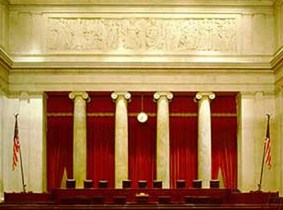
Supreme Court heard oral argument in Federal Trade Commission v. Actavis (the caption for what was Federal
Trade Commission v. Watson Pharmaceuticals, Inc. in the 11th Circuit opinion below) last Monday, with Deputy Solicitor General Malcolm
Stewart arguing for the government and Jeffrey
Weinberger arguing for Respondents. Justice
Alito recused himself from any involvement with this case, raising the
possibility that the Court could not render a decision that would resolve the
circuit split between the 11th Circuit decision at issue here and
the K-Dur case in the Third Circuit (In
re K-Dur Antitrust Litigation).
To
briefly recap, the case involved a reverse payment
settlement between NDA holder Solvay Pharmaceuticals and ANDA filers Watson
Pharmaceuticals and Paddock Pharmaceuticals over AndroGel, a prescription
testosterone formulation prescribed for treating hypogonadism. Unimed (acquired
by Solvay and later acquired by Abbott) and Besins Healthcare S.A. held the
NDA, as well as Orange Book-listed U.S. Patent No. 6,503,894
directed to the formulation; this patent will expire in August 2020.
Watson and Paddock filed separate ANDAs having Paragraph IV certifications that
the '894 patent was invalid or unenforceable, and Unimed/Besins timely filed
suit pursuant to 35 U.S.C. § 271(e)(2) in the U.S. District Court for
the Northern District of Georgia. The lawsuit was pending longer than the
statutory 30-month stay, and the FDA approved Watson's ANDA, but neither Watson
nor Paddock launched "at risk" (i.e., before the lawsuit had
been decided). As part of the suit, both Watson and Paddock did not
contest that their products would infringe the '894 patent, but rather that the
patent was invalid or unenforceable. However, before the District Court could rule
on defendants' summary judgment motions after a Markman hearing, the
parties settled; the Court entered a Stipulation of Dismissal
against Watson and a permanent injunction against Paddock.
The case on appeal arose pursuant to an
investigation by the FTC of these settlement agreements under 21 U.S.C. § 355 (2003). The FTC alleged violations of Section 5a of the Federal
Trade Commission Act under 15 U.S.C. § 45(a)(1). The suit was transferred
from the Central District of California to the Northern District of Georgia,
where the District Court granted defendants' motion to dismiss pursuant to Fed.
R. Civ. Pro. 12(b)(6) (failure to state a claim). In doing so, the
District Court rejected the FTC's contentions in its complaint "(1) that
the settlement agreement between Solvay and Watson is an unfair method of
competition; (2) that the settlement agreement among Solvay, Paddock, and Par
is an unfair method of competition; and (3) that Solvay engaged in unfair methods
of competition by eliminating the threat of generic competition to AndroGel and
thereby monopolizing the market." The basis for the District Court's
action was that, in the 11th Circuit, reverse payments did not constitute
anticompetitive behavior "so long as the terms of the settlement remain
within the scope of the exclusionary potential of the patent, i.e., do
not provide for exclusion going beyond the patent's term or operate to exclude
clearly non-infringing products, regardless of whether consideration flowed to
the alleged infringer."
The 11th Circuit affirmed, and
the FTC convinced the Court to review this decision rather than the Third
Circuit's K-Dur decision (see "FTC Asks Supreme Court to Play Favorites in Reverse Payment Settlement Agreement Cases").
 At
At
oral argument, the government began with its strongest statement of its argument: "a
payment from one business to another in exchange for the recipient's agreement
not to compete is an paradigmatic antitrust trust violation." The question before the Court, according to
the government, is whether the same payments arising in settlement of patent
infringement (ANDA) lawsuits should be permitted, thus pandering to the Court's
displeasure with patents, patent law, and "special rules" for patents.
The government's grounds for its position is that such settlements "subvert
the competitive process by giving generic manufacturers an incentive to accept
a share of their rival's monopoly profits as a substitute for actual
competition in the [marketplace]." This assertion was met by a
question from Justice Scalia, who asked "how is a payment different from a
geographic division of a market via an exclusive license?" The government's first response, that
exclusive licenses are contemplated by the Patent Act, was not convincing
(Justice Scalia said it "doesn't impress"), so the government
enunciated a second rationale (which would resonate with the Justices later in
the argument), that a license "doesn't give the . . . infringement defendant
anything that it couldn't hope to achieve by prevailing in the lawsuit." Justice Scalia said that this is just another
way to say that the defendant would get to make money, and asked why the
patentee could not "short circuit" the process and just give the
defendant the money to make them "go away." The government responded that the difference
is that the payment is "a
substitute for earning profits in a competitive marketplace," reflecting
the FTC's preference for "competition."
The
government seemed to assert a refinement of its position (which, it should be
recalled, began with the proposition that reverse payment settlement agreements
in ANDA litigation should be a per se
violation of the Sherman Act), now arguing that the "logical subject of
compromise" should be that the generic drug maker would be able to enter
the marketplace at some time before it would have if the branded patentee had
won the underlying ANDA lawsuit and after the time it could have entered the
marketplace if the generic drug maker won. "That's an actual subject of compromise and we don't have a problem
with that," according to Mr. Stewart.
Justice
Scalia asked for a case where the patentee has been held liable under the
antitrust laws for doing something within the scope of the patent, and the government
said yes, provided that you define "scope of the patent" the way it
characterized the Respondents' position, that "the goods that are being
restricted are arguably encompassed by the patent and the restriction doesn't
extend past the date when the patent expires." The government also analogized reverse
payment settlement agreements to resale price maintenance agreements (which the
Court held to be illegal in the face of patent protection) because "there's
nothing in the Patent Act that says you can pay your competitor not to engage
in conduct that you believe to be infringing." And the government reminded the Court that
reverse payment settlement agreements involve (typically) a non-sham allegation of infringement rather than a
finding of infringement.
Justice
Ginsberg mentioned that this seems to be a change in the government's position,
and Mr. Steward argued that while the FTC hasn't changed its position, the DOJ had
previously "advocated . . . a test that would focus on the strength and scope
of the patent[, t]hat is, the likelihood that the brand name would . . . ultimately have prevailed if the suit had been litigated to judgment." The government's current position is that
these agreements are "presumptively unlawful with the presumption able to
be rebutted in various ways."
Justice
Kennedy asked whether one of these ways was assessing the "strength"
of the infringement case, something he identified as his "problem,"
because the government's test is "the same for a very weak patent as a
very strong patent," which "doesn't make a lot of sense." In response, the government shifted the focus
of its argument to be whether there has been a payment "that would tend to
skew the parties' choice of an entry date, that would tend to provide an
incentive . . . for the generic to agree to an entry date later than the
one that it would otherwise insist on." Justice Kennedy suggested that the
determination — of how much and in what direction the market entry was "skewed" — would "itself reflect the
strength or weakness of the patent so that the market forces take that into
account." The government's response
was that "legitimate" agreements would be those where an assessment
of the strength of the patent would determine when the generic drug maker entered the marketplace — presumably
such agreements would not involve
payments. But "the problem with the
reverse payment is that it gives the generic an incentive to accept something
other than competition as a means of earning money," Mr. Stewart advocated
as a (the?) principle issue the government had with these settlements.
Justice
Scalia posited that this issue reflected a problem with the Hatch-Waxman Act
(as shown by attempts to "fix" these problems, notably by the
Medicare Prescription Drug, Improvement and Modernization Act of 2003), and the government responded that "these types of payments appear to be
essentially unknown in other lawsuits and other patent infringement cases"
(but Justice Scalia reminded Mr. Stewart that "suits against this kind of payment" also don't exist outside the Hatch-Waxman
context, either). The Justice suggested that
Hatch-Waxman "made a mistake by not foreseeing these types of arrangements,"
further saying:
And in order to rectify the mistake, the FTC comes in and brings in
a new interpretation of antitrust law that did not exist before, just to
make up for the mistake that Hatch-Waxman made, even though Congress has tried
to cover its tracks in later amendments, right, which . . . deter . . . these payments.
Not
surprisingly, the government was not willing to go that far, but Justice Scalia
asked why the Court should be willing to "overturn understood antitrust
law" to fix Congress's mistake in Hatch-Waxman?
Turning
the argument back to antitrust law, the government argued for a hypothetical
where Watson developed a new drug that would compete with AndroGel and Solvay
paid them not to market it; this would be a clear antitrust violation, according
to the government, "even though Watson's ultimate ability to market the
new drug would depend on FDA approval that might or might not be granted." The government's point was that the
underlying illegality should not be vitiated by intervening considerations (FDA
approval, or in this case patent protection, albeit requiring the Court to
ignore the statutory presumption of validity). Mr. Stewart cited Professor Hovenkamp for the proposition that "in
the typical market if a patent holder were known to have paid a large sum of
money to a competitor who had been making a challenge to the patent, if other
competitors knew that that had happened, then they would perceive that to be a
sign that the patent was weak and that they would leap in" (which,
paradoxically is exactly the argument the 11th Circuit made in
deciding that "weak" patents would be more, not less vulnerable if
the patentee made too generous settlements or payments). Specifically:
Although a patent holder may be able
to escape the jaws of competition by sharing monopoly profits with the first
one or two generic challengers, those profits will be eaten away as more and
more generic companies enter the waters by filing their own paragraph IV
certifications attacking the patent.
Herbert Hovenkamp, "Sensible
Antitrust Rules for Pharmaceutical Competition," 39 U.S.F. L. Rev. 11, 25
(2004).
The
government also asserted the "first filer" provisions of the ANDA
statute (which is a red herring after the 2003 amendments where a first filer
loses its ability to block later filers by entering into a reverse payment
settlement agreement), stating that the 180-day exclusivity is "not good in
and of itself for consumers" due to the delay in price erosion during that
period. Justice Breyer seemed
unconvinced ("that's rather thin"), speaking generally about settled
antitrust tools and principles and asking the government's lawyer why this
approach ("Judge, pay attention to the department when it says that these very often can be anticompetitive, and ask the defendant why he's doing it.")
shouldn't be used in assessing the legality vel non of reverse payment
settlement agreements. According to
Justice Breyer, the government asks the Court to "produce some kind
of structure — I don't mean to be pejorative, but it's rigid — a whole set of
complex per se burden of proof rules that I have never seen in other antitrust
cases," and asks the government to provide the antecedents in antitrust
law that would support such a regime. After some colloquy regarding other standards like the "quick look"
rule of reason, Justice Breyer said:
[W]hy isn't the government satisfied with an opinion of this Court that
says, yes, there can be serious anticompetitive effects. Yes, sometimes there
are business justifications, so Judge, keep that in mind. Ask him why he has
this agreement, ask him what his justification is, and see if there's a less
restrictive alternative. In
other words, it's up to the district court, as in many complex cases, to
structure their case with advice from the attorneys.
Mr.
Stewart responded that this would not provide enough guidance, but Justice
Breyer rejoined that it is the same guidance as in any other antitrust case
with regard to anticompetitiveness. He
remarked that he has "32 briefs" supporting the government's position
that the agreements are anticompetitive, and then "four [], maybe five"
briefs supporting Respondents that say there could be "offsetting
justifications." And for Justice
Breyer, district courts can make these distinctions.
The
government countered, saying that its "approach accounts for that,"
wherein it is the payment that "gives rise to the inference that . . . the
delay . . . is longer than the period that would otherwise reflect [the generic's]
best assessment of its likelihood . . . of success in the lawsuit." There are two ways the government proposes that
parties to a reverse payment settlement agreement could rebut the presumption
of illegality: either by a showing that the payment was not for delay in market
entry, or that (unlikely in the government's view) even if the payment was for
delay there is some pro-competitive effect.
Justice
Breyer noted that the briefs in support of the Respondents mention at
least two other possible rebuttals of the government's presumption. The hypothetical is significant due to
Justice Breyer's understanding that it is not anticompetitive:
[B]ecause the person's already in the market thinks that the next year or
two or three years is worth $100 million a year, and the person who's suing
thinks it's worth 30 million a year. And so he says, hey, I have a great idea,
I'll give him the 30 million and keep the 70. And . . . that, I don't see why
that's anticompetitive if that's what's going on.
The
other rebuttal perceived by Justice Breyer is when the market is hard to break
into, and then the brand is helping the generic enter the market in return for
not challenging the patent (which Justice Breyer thought would be procompetitive). But he admitted that parsing this out can be a
nightmare.
The government blamed any nightmarish aspects of the agreements on the branded and
generic parties who make them so, and stated that Respondents' position that it
would be permissible for the branded to delay entry of the generic until patent
expiry upon the payment of sufficient monies "really shows their
anticompetitive potential, i.e., that the payment is what skews the decision to
agree on a time for generic market entry.
Justice
Sotomayor then asked the Deputy SG "why is the rule of reason so bad?,"
apparently agreeing with Justice Breyer that the government is asking the Court
to erect a completely new structure where traditional antitrust principles
should work just fine. She addressed the
problem with the government's position in terms echoing those identified in the
Bender White Paper (see "Academic White Paper Rebuts FTC and S. 214"):
I have difficult[y] . . . understanding why the mere existence of a reverse
payment . . . presumptively . . . changes the burden from the Plaintiff. It would
seem to me that you have to bear the burden . . . of proving that the payment for
services or the value given was too high. I don't know why it has to shift to
the other side.
While
never providing a direct response, the government raised "administrative"
and "conceptual" grounds which
did not convince Justice Breyer, who believed that making these types of
determinations would take a district court "probably 3 minutes or less." The government completed the opening portion
of its argument by reiterating that the ANDA lawsuit could not have resulted in
a reverse payment to the generic company, and thus that the existence of the
payment is enough to raise a presumption of anticompetitive behavior and thus
to be illegal.
Respondents'
attorney Mr. Weinberger began his argument by answering (in the negative)
Justice Scalia's query regarding whether the Court had ever found an antirust
violation resulting from a "patent-based restraint[on trade]," with
the only exceptions being in cases where
the patentee was acting outside the scope of the patent, such as downstream
retail price controls.
Justice
Sotomayor asked why this isn't the case here, because there is no presumption
of infringement, so doesn't the settlement raise the presumption that the
parties are acting outside the scope of the patent? Mr. Weinberger said no, because there is no
basis for assessing whether there has been an antitrust violation based on
whether you could establish in litigation that the patent had been
infringed. But Justice Sotomayor opined
that the Court should not be asked to "accept" that there had been
infringement under circumstances where the patentee has "voluntarily
decided not to pursue his rights." The Justice contrasted the case where the infringer licenses the patent
and gets the right to sell upon payment to the patentee, with the situation
here where the patentee pays the generic putative infringer not to sell,
suggesting to her that the parties are "sharing profits." She also noted that typical licensing
settlements for patent infringement suits don't involve reverse payments.
Justice
Breyer characterized the government's position to be that reverse payment
settlement agreements are not per se
unlawful, but that "they want to cut some kind of line between a per se
rule and the kitchen sink. And if you look at the brief supporting you, it is
the kitchen sink," asking Mr. Weinberger to define the rule. Mr. Weinberger stated that he didn't think
there was any "intermediary" test, because "you can't really
measure whether there were any anticompetitive effects from such a settlement
agreement without determining what would have happened if the case hadn't
settled and it would have been litigated"; if the patentee had won there
would not have been any
anticompetitive effects. This was the
determination of the Second and Federal Circuits in the tamoxifen and Cipro
cases, respectively, where those courts applied the antitrust "rule of
reason" test and required the government to establish anticompetitive
effects, according to Mr. Weinberger.
Justice
Kennedy then asked whether the focus should have been on what the generic could
have lost rather than what the branded gained, and Mr. Weinberger returned to Respondents'
theme that there would have been no gains if the generics had not prevailed,
requiring that patent litigation actually ensued and infringement was found (or
not).
Justice
Kagan asked for clarification with her own hypothetical, which quickly
indicated where her initial inclinations seemed to lie. According to the Justice, what if there is a
lawsuit and the defendant says to the patentee, if I win I reduce your profits
from $100 million to $10 million, but if I go away you continue to make the
$100 million. Thus, if the patentee paid
$25 million to the challenger both parties would be better off, but such an
arrangement would be anticompetitive and an antitrust violation. If that is the case, asked the Justice, why
doesn't that describe the situation before the Court? She added: "It's clear what's going on
here is that they're splitting monopoly profits and the person who's going to
be injured are all the consumers out there" and "I think if we give
you the rule that you're suggesting we give you, that is going to be the
outcome because this is going to be the incentive of both the generic and the
brand name manufacturer in every single case is to split monopoly profits in
this way to the detriment of all consumers." (In this, the Justice ignored,
for the moment, the fact that this hasn't
happened.)
In
response, Mr. Weinberger mentioned the lower entry cost to challenge a patent
under Hatch-Waxman based on certification alone, because a generic challenger
does not need to make the actual investment that a competitor would need to
make in other types of patent infringement litigation. "And the FTC's own studies have shown
that it takes a very small chance of winning, something like 4 percent for a
drug over $130 billion to justify a generic suing a brand name company" he
reminded the Court.
Justice
Sotomayor then raised her own concerns with these agreements. "The Second Circuit recognized,"
said the Justice, "even though it accepted your scope of the patent
[standard], that there was a troubling dynamic in what you're arguing, which is
that the less sound the patent, the more you're going to hurt consumers because
those are the cases where the payoff, the sharing of profits is the greatest
inducement for the patent holder." Mr.
Weinberger responded by arguing that this isn't an issue in practice because of
the "so many potential challengers" to the patent, for all of whom "all
they have to do is file an ANDA, there are 200 generic companies in this
industry, that if you try to adopt that strategy of paying the profits of a
generic, there's going to be a long line of [generics to pay off]."
Justice
Kagan disputed this argument based on the first filer/180-day exclusivity provisions
(which she called a "glitch" in Hatch-Waxman), saying that "once
the 180-day first filer is bought off, nobody else has the incentive to do this"
(which may have been the law before 2003 but is not the law now). Respondents argued that this is not correct "either
by logic or by reference to actual experience" based on the long lifetimes
of the drugs, but Justice Kagan stated she understood that "the huge
percentage of the profits [are made] in the exclusivity period."
Justice
Sotomayor then posed the counter question to Mr. Weinberger that she posed to
the Deputy SG: "what's so bad with banning reverse payment settlements?" Mr. Weinberger responded that while the
parties could "always just litigate," there is no incentive for the generic
not to litigate instead of settling without some financial recompense, i.e., the reverse payment.
Justice
Ginsberg raised the concern that the generic is unjustly enriched, a position
in which Justice Kennedy agreed, to the extent that the generic obtained more
than what it would have gotten if it won the ANDA litigation. Justice Ginsberg stated her interpretation of
the government's position, that generics were getting a windfall, but Mr.
Weinberger noted that the government has not provided any data or examples of
such a situation. Justice Kennedy noted
that "if the generic wins [the ANDA litigation] the brand companies
profits are going to go way, way down right away and generic profits are not
going to be that great. . . . [I]f you key
your payment to what the brand company will make, it's just a much higher
figure, and a greater danger of unreasonable restraint." Mr. Weinberger's response was that while this
may be a hypothetical risk, the reality is that "with the number of
challenges you have here, which is basically unlimited, that if you put a sign
around your neck that says, paying off all generic companies their profits,
whoever wants to challenge my patent come do it, there is going to be a long
line of people, of companies doing it." When Justice Kennedy asked whether this wasn't true in every industry,
Mr. Weinberger reminded him of the low barrier to ANDA status: "They have
nothing at risk. If they lose, they haven't lost any damages. They just walk
away."
In the most cogent few minutes of uninterrupted argument, Mr. Weinberger made the
case that:
I think that the antitrust rule should not be fashioned to deal with a
case on the extreme, which hasn't been shown to happen, which logically from an
economic point of view is highly unlikely to happen. And if for some reason
that starts happening empirically, then Congress — and it is a loophole in
Hatch-Waxman that is causing that, and there is really no evidence that that
extreme example has happened – then Congress can deal with it, just as it
dealt with the exclusivity provision.
Justice
Sotomayor made the most direct argument against reverse payment settlement
agreements from the bench:
I see that as an argument that there is an economic reality in Hatch-Waxman
that would require us not to apply any rule we choose or accept here to other
situations, only here. That's the argument that you're creating for me, that
there's a different economic reality here that requires a different rule [because] in Hatch-Waxman, Congress decided that there was a benefit for
generics entering without suffering a potential loss to enter the market more
quickly [and] any settlement in these cases deprives consumers of the
potential of having the benefit of an earlier entry.
Respondents'
only argument to counter these assertions was that these settlements have not
hindered the rise in generic entry over the past 10 years, and that requiring
generics to litigate to conclusion could restrict generic entry.
In
rebuttal, the government argued that the outcome of patent litigation is irrelevant
because antitrust liability comes from the behavior (not the reality) of the
parties, and that this approach (essentially ignoring the existence of the
patent) avoids the "conundrum" of determining the outcome of patent
litigation. No doubt.
From the oral argument, reading how the Justices may be leaning is easier for some of the Justices than others. Justices Sotomayor
and Kagan (and to a lesser degree, Justice Ginsberg) appeared most enamored of
policy arguments against these agreements and concerned about their negative
effects, while the Chief Justice and Justice Thomas' leanings are incapable
of being determined by their silence. Justices Scalia, Breyer, and Kennedy were apparently concerned (to
varying extents) with whether agreeing with the government would upset settled
antitrust jurisprudence and, paradoxically, itself add another "special"
set of rules for patent cases. On
balance, the Court clearly understood that this case represented another
instance of the interplay between patent, regulatory, and antitrust law, and
while individual Justices appeared uncertain about particular provisions and
their effects (particularly the 180-day exclusivity period) the Court
questioned both the government and Respondents with equivalent intensity. Meaning that there is little prospect of
providing any reasonable conjecture on how this case will come out.
The
Court is expected to render its decision by the end of its term in June.

 The
The