• By Donald Zuhn

    Federal Circuit SealEarlier this month, the Federal Circuit affirmed the grant of summary judgment in favor of the U.S. Patent and Trademark Office by the U.S. District Court for the Eastern District of Virginia, finding that the USPTO did not err in its interpretations of 35 U.S.C. § 154(b)(1)(C)(iii) and did not violate the Administrative Procedure Act by refusing to award additional patent term adjustments for (C) delay for U.S. Patent Nos. 9,522,476 and 9,927,796.  At issue in the consolidated appeal was subsection (C) of § 154(b)(1), which provides patent term adjustments for delays associated with appellate review, and which reads as follows:

    Subject to the limitations under paragraph (2), if the issue of an original patent is delayed due to . . .
        (iii) appellate review by the Patent Trial and Appeal Board or by a Federal court in a case in which the patent was [1] issued under a decision in the review [2] reversing an adverse determination of patentability,
        the term of the patent shall be extended 1 day for each day of the pendency of the proceeding, order, or review, as the case may be.

    (The meanings of the two numbered and italicized were at issue in the consolidated appeal.)

    The issuance of the '476 and '796 patents, which are directed to power saws having a safety feature that stops the saw blade upon contact with flesh, was delayed by appeals to the Patent Trial and Appeal Board before allowance.  With regard to the '476 patent application, claim 11 was finally rejected by the Examiner as being obvious, and SawStop appealed the rejection to the Board.  The Board concluded that the Examiner failed to make the initial factual findings required to demonstrate a prima facie case of obviousness of claim 11, but nevertheless affirmed, finding the claim to be obvious based on a new ground of rejection.  On remand, SawStop reopened prosecution, filed several amendments and a Request for Continued Examination, and eventually secured an allowance of claim 11.  The USPTO did not award any PTA for the time on appeal, SawStop sought reconsideration of the Office's determination, the Office denied that request, and SawStop filed a complaint in the Eastern District of Virginia to challenge the Office's determination.  The District Court granted summary judgment to the USPTO, finding that because claim 11 was subject to a new ground of rejection on appeal, the '476 patent was not "issued under a decision in the review reversing an adverse determination of patentability," and therefore was not eligible for PTA under § 154(b)(1)(C)(iii).

    With regard to the '796 patent, claim 1 was finally rejected by the Examiner for anticipation and provisional non-statutory double patenting, and claim 2 was finally rejected for anticipation.  SawStop appealed the rejections to the Board, which affirmed the rejections of claim 1 and reversed the rejection of claim 2, and SawStop appealed the anticipation rejection of claim 1 to the District Court for the District of Columbia, which reversed that rejection.  On remand, the Board noted that claim 1 remained rejected for provisional non-statutory double patenting, and rather than filing a terminal disclaimer or rewriting claim 2 as an independent claim, SawStop filed an RCE and continued prosecution, filing several amendments to the claims, and eventually secured an allowance.  The USPTO again did not award any PTA for the time on appeal and SawStop filed a complaint in the Eastern District of Virginia to challenge the Office's determination.  The District Court granted summary judgment to the USPTO, finding that because claim 1 remained subject to the outstanding provisional double patenting rejection and was thus unpatentable both before and after appeal to the District Court, the '796 patent was not entitled to PTA for SawStop's appeal because the appeal did not "revers[e] an adverse determination of patentability" as required by 35 U.S.C. § 154(b)(1)(C)(iii).  The District Court also found that because claim 1 was eventually cancelled and thus did not issue in the patent, the '796 patent did not "issue under" an adverse determination of patentability as that phrase is used in 35 U.S.C. § 154(b)(1)(C)(iii).

    SawStop appealed both District Court decisions to the Federal Circuit.  The opinion begins by citing the Federal Circuit's decision in Chudik v. Hirshfeld, 987 F.3d 1033, 1039-40 (Fed. Cir. 2021), for the proposition that:

    [T]he most natural meaning of the words "appellate review by the Patent Trial and Appeal Board or by a Federal court in a case in which the patent was issued under a decision in the review reversing an adverse determination of patentability," when applied to an examiner's unpatentability ruling, requires that "the patent issue under a Board decision that reversed the examiner's unpatentability ruling or under a court decision that reversed a Board unpatentability ruling in the matter."

    Citing Supernus Pharms., Inc. v. Iancu, 913 F.3d 1351, 1353 (Fed. Cir. 2019), the Court also notes that "[t]ype C adjustments are for delays that are . . . due to . . . successful appeals."

    Regarding the '476 patent, SawStop contended that because the Examiner's rejection of claim 11 was overturned on appeal, even though the Board issued a new ground of rejection, this qualified as "a reversal of a determination of patentability."  The USPTO countered that there was "no reversal of an adverse patentability determination" because claim 11 was unpatentable before and after appeal, and because the Board maintained the unpatentability of claim 11, the '476 patent could not have "issued under" the Board's decision.  The Federal Circuit agreed with the USPTO, finding that:

    The adverse determination of unpatentability remained before and after the appeal to the Board.  The appeal thus resulted in no substantive change in the patentability of claim 11.  Such a substantive change is required by the language of the statute itself: the reversal of a "determination of patentability" requires a determination that the claim in question is substantively allowable, not just free of a particular rejection.

    Noting that "the claim as issued was not the same as the claim 'under a decision in the review,'" the Court added that "[t]he statutory requirement [that "the patent was issued under a decision in the review"] is not met if the claim that ultimately issues differs substantively from the claim under review."  "Because claim 11 of the '476 patent application was subject to an adverse determination of patentability both before and after the appeal, and because the claim issued only after significant substantive post-appeal prosecution and amendment," the Federal Circuit affirmed the District Court's determination that the '476 patent did not "issue[] under a decision in the review reversing an adverse determination of patentability" as required by § 154(b)(1)(C)(iii).

    Regarding the '796 patent, SawStop contended that § 154(b)(1)(C)(iii) only requires "an adverse determination of patentability," and not "that 'all' rejections of a particular claim be reversed."  The Court noted, however, that "the singular reversal referenced in the statute is the determination of patentability of the claim under appellate review, not a basis for a rejection or number of rejections" (emphasis in opinion).  The opinion states that:

    The problem with Sawstop's position is that the PTO's "adverse determination of patentability" of claim 1 of the '796 patent was based on two grounds: double patenting and anticipation.  Sawstop only appealed anticipation without addressing the provisional double patenting rejection.  As a result, the District Court for the District of Columbia understandably did not address the double patenting rejection.  Sawstop's success in reversing the anticipation rejection left the provisional double patenting rejection in place.  Claim 1 of the '796 patent was thus unpatentable both before the appeal (because of anticipation and double patenting) and after the appeal (because of double patenting).

    SawStop, however, argued that the remaining rejection did not affect "patentability" because it was non-statutory and provisional, adding that the rejection did not have any force or effect until the obviousness-rendering reference issued and was thus not a rejection that it could appeal or the District Court could affirm or reject.  The Federal Circuit disagreed, noting that SawStop had appealed the double patenting rejection to the Board.  The Court also noted that "the only claim that was subject to the decision under review was claim 1, which was cancelled and thus not part of the issued patent," concluding that "[t]he '796 patent therefore did not issue under a decision in the review."  The Federal Circuit therefore affirmed the District Court's determination that the '796 patent also did not "issue[] under a decision in the review reversing an adverse determination of patentability" as required by § 154(b)(1)(C)(iii).

    Finding that the USPTO did not err in its interpretations of § 154(b)(1)(C)(iii) and did not violate the APA by refusing to award additional patent term adjustments for (C) delay for the '796 and '476 patents, the Federal Circuit affirmed the District Court's decisions granting summary judgment in favor of the USPTO.

    SawStop Holding LLC v. Vidal (Fed. Cir. 2022)
    Panel: Circuit Judges Newman, Linn, and Chen
    Opinion by Circuit Judge Linn
  • By Kevin E. Noonan –

    The Federal Circuit soon will have the opportunity to decide a question left open during a recent spate of opinions involving the judicially created doctrine of obviousness-type double patenting (OTDP):  the effect patent term adjustment (PTA) can (or should) have on creating circumstances where OTDP will operate to find a patent invalid in the absence of a timely filed terminal disclaimer.

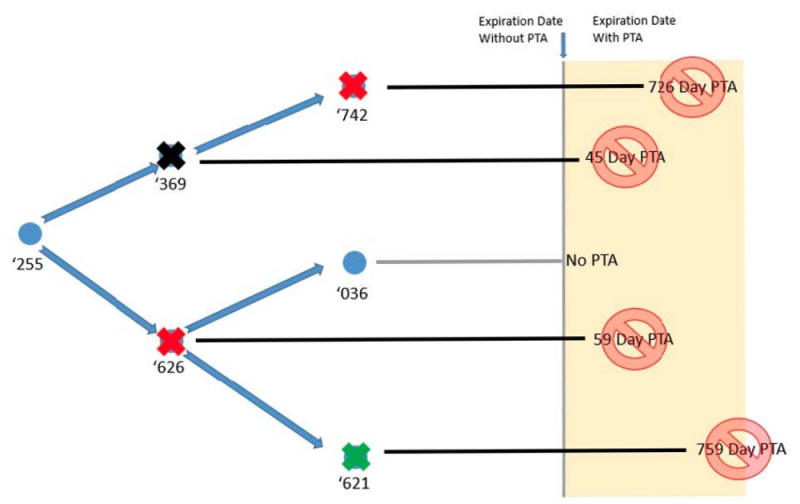
    The issue arose in a series of ex parte reexaminations over five patents owned by Cellect, U.S. Patent Nos. 6,424,369; 6,452,626; 6,982,742; and 7,002,621, that involve "solid state image sensors which are configured to be of a minimum size and used within communication devices specifically including video telephones" according to the '621 patent (only 4 of these patents were invalidated, the fifth not having any PTA that raised the issue).  The chronological situation is set forth in an exhibit from Cellect's brief in its Federal Circuit appeal brief:

    Image
    There was no dispute that the claims in these applications were patentably indistinct.  The Board issued four Decisions on Appeal affirming the reexamination division's invalidation of the '369, '626, '621, and 742 patents, all on the grounds that the provisions of 35 U.S.C. § 154(b)(2)(B),

    "No patent the term of which has been disclaimed beyond a specified date may be adjusted under this section beyond the expiration date specified in the disclaimer"

    mandated that a terminal disclaimer be filed under circumstances where obviousness-type double patenting arose due to extension of patent term as PTA, i.e., that OTDP must be determined after application of PTA.  (It will be recalled that the Federal Circuit reached a different conclusion with regard to patent term extension (PTE) under 35 U.S.C. § 156 in Novartis AG v. Ezra Ventures LLC, the Court expressly refusing to permit "a judge-made doctrine to cut off a statutorily-authorized time extension.")  Because all of these patents had expired (but Cellect retained the right to sue for prior infringement under 35 U.S.C. § 286), the Board's decision invalidated these patents with no available remedy for Cellect.  In its consolidated decision, the Board emphasized the potential inequities to the public due to the possibility of harassment by different parties owning patents to obvious variants of one another (in the absence of a terminal disclaimer preventing this potentiality) as representing an unjust extension of patent term to the public's detriment; see In re Fallaux, 564 F.3d 1313 (Fed. Cir. 2009)).  Finally, the Board rejected arguments that the Federal Circuit's jurisprudence did not rely on whether or not there was gamesmanship or the potential thereof under Gilead Sciences, Inc. v. Natco Pharma Ltd. but that under In re Longi, the public was entitled to the assumption that it is free to practice what is claimed in the patent and obvious modifications and variants thereof once the patent has expired.  759 F.2d 887 (Fed. Cir. 1985).

    The questions before the Court according to Cellect are summarized in five arguments.  The first is based on the Board's putative legal error in interpreting the statute to justify treating term extension under PTA differently from term extension under PTE.  Second, Cellect argued that application of OTDP in this case was inequitable, due to the lack of remedy as well as there being no unjust extension because Cellect had engaged in no gamesmanship.  Third, Cellect argued as a fallback position that OTDP should be used here to cancel the term extended by PTA rather than invalidating the patents in their entirety.  The final two arguments were that the reexamination had been improperly instituted because there was no substantial new question of patentability and that any ancillary obviousness rejections raised in the reexamination was ultimately based on the OTDP of these patents (which argument the Board argued Cellect had waived).

    Cellect's first argument was based on statutory interpretation.  Cellect argues that both PTA and PTE are statutory grounds for extending a patent term and there was no legal nor logical basis for treating them differently, i.e., the Court should interpret the PTA statute here as the Court had interpreted the PTE statute in Ezra.  Further, Cellect argues that the statutory language for PTA is that the term "shall" be extended (although there have been other instances, e.g. regarding provisions of the BPCIA, see Sandoz Inc. v. Amgen Inc., where "shall" has not been given commanding effect).  Cellect argues that the provisions the Board relied upon were intended for situations where a terminal disclaimer had been filed, not one where PTA creates OTDP (compare the language of the statute regarding a "patent the term of which has been disclaimed" to how Cellect argues the Board interpreted the language regarding a "patent the term of which [may need to be] disclaimed [if adjustment is granted]").  The consequence of the Board's interpretation creates a situation requiring "preemptive" terminal disclaimer filings, Cellect argues which Congress had not intended.  Cellect also cited several district court cases, including Amgen, Inc. v. Sandoz Inc. (D.N.J. 2021), and Mitsubishi Tanabe Pharma Corp. v. Sandoz Inc. (D.N.J. 2021), that had interpreted the Court's Ezra decision to support giving statutory deference to respecting PTA over a "judge-made doctrine."

    Regarding the equities, Cellect argues that the purpose of OTDP was to prevent "unjust timewise extension of patent term" and to prevent "harassing litigation filed by multiple patent owners" for patents on "not-patentably-distinct" inventions.  Cellect's argument emphasizes the unjust extension aspect, which Cellect ties to the gamesmanship the Court recognized in Gilead.  And in this case Cellect contends that "[t]he Board used an equitable doctrine to achieve an inequitable result" because the circumstances provided no basis for Cellect to cure.  In an effort to avoid this outcome, Cellect argues that applying the Board's interpretation to retroactively disclaim the PTA-extended term but not invalidate the patents would not only cure the inequitable effects of the Board's decision but also as precedent notify future applicants who could have the opportunity to decline PTA to avoid invalidation on OTDP grounds.

    The Solicitor's argument emphasized the inequities to the public occasioned by any extension of patentably-indistinct inventions (in view of the government's interpretation of the statute).  The brief cites in opposition the Court's decision in Abbvie Inc. v. Mathilda & Terence Kennedy Institute of Rheumatology Trust, 764 F.3d 1366, 1373 (Fed. Cir. 2014), that OTDP apples whenever there is an extension of patent term for patents claiming patentably-indistinct invention.  The Solicitor also notes that under circumstances where OTDP would invalidate a patent having PTE will not save it and that the differences in the statutes permit PTA to produce OTDP where PTE cannot (because § 156 does not contain the "disclaimer" in § 154(b)(2)(B)).  Regarding Cellect's arguments for forswearing PTA but preserving the patent, PTO cites Boehringer Ingelheim Int'l. GmbH v. Barr Laboratories Inc. that a patentee that had benefited from notice to public of the later expiration date has already obtained an "unjustified advantage."  Finally, the Solicitor argues that the term extension issue here is not dispositive because OTDP also prevents potential harassment by multiple assignees.

    A number of amici filed briefs were filed in favor and against the Board's decision.  Briefs in opposition to the Board's application of OTDP in these circumstance were filed by the Intellectual Property Owners (IPO), the Pharmaceutical Research and Manufacturers of America (PhRMA), and the Biotechnology Innovation Organization (BIO).**  The IPO's brief emphasized that the only reason OTDP arose in this case was the application of PTA, and that the statute mandates extension (and accordingly the Board's decision was contrary to congressional intent).  PhRMA's brief focused on the purpose of OTDP that was to avoid unjust enrichment and that the PTO's "speculative" harassment rationale was inconsistent with Federal Circuit precedent.  BIO's brief discussed the Board's statutory interpretation errors and that the inequitable outcome in this case is inconsistent with the equitable underpinnings of OTDP.

    Briefs in favor of the Board's decision were filed by Alvogen, the Association for Accessible Medicines (AAM), and Samsung.  Alvogen's brief argued that there was no reason OTDP should not apply to PTA because the doctrine was intended to establish term limits on patents to patentably-indistinct inventions.  Gamesmanship is not required under the statute and is an "unstable benchmark" in Alvogen's view.  AAM's brief was entirely outcome-oriented, based on the amici's perspective that patents increase drug costs and the Board's decision was a good one because it reduced patent term (no matter that the patents at issue were not related to drug products).  Finally, Samsung's brief argued that the decision was consistent with the policy bases for the OTDP doctrine and that accordingly there was no inequitable result.  (It should be noted that Samsung is a competitor and is involved in litigation with Cellect on other patents.)

    The deadline for Cellect's Reply brief has been extended to October 18th, and barring further delay should be heard at oral argument within the next 4-6 months.  Thus a decision can be expected in the first quarter of next year.

    From a panel discussion with Jeremy Lowe and Steve Horowitz at the 8th Annual Paragraph IV Disputes Master Symposium in Chicago on September 22, 2022

    *On appeal to the Federal Circuit
    **Patent Docs authors Kevin Noonan and Donald Zuhn participated in filing the BIO brief

  • PIUGPatent Information Users Group, Inc. (PIUG) will be offering a webinar series entitled "Best Practices for Patent Searching — Engineering Technologies" at 10:00 am (EDT) on September 28, 2022.  Dominic DeMarco of DeMarcoIP will help attendees utilize their own personal adaptive toolbox to maximize the opportunity to locate particularly relevant art when performing patent searches in the engineering space.

    The registration fee for the webinar is $99 for non-members or $79 for PIUG members.  Those interested in attending the webinar can register here.

  • Fish & RichardsonFish & Richardson will be offering a webinar entitled "Crafting a Comprehensive Trade Secret Strategy" on September 28, 2022 from 1:00 pm to 2:00 pm (ET).  Esha Bandyopadhyay and Katie Prescott of Fish & Richardson will discuss how to craft a robust trade secret strategy that protects a company's trade secrets while also allowing the company to defend itself from accusations of trade secret theft, including strategic considerations:

    • When recruiting, hiring, and onboarding new employees
    • When handling employee departures
    • When collaborating with business partners and prospects

    Those wishing to register for the webinar can do so here.

  • J A KempJ A Kemp will be offering a webinar entitled "Amending Patent Applications in the European Patent Office" on September 29, 2022 from 16:00 pm to 17:00 pm (GMT).  Patrick Campbell and James Cracknell of J A Kemp will discuss the legal issues, considerations for applicants and their attorneys, and best-practice points to adopt when drafting applications and amendments in Europe.  The webinar will address the following topics:

    • The legal framework governing the formal allowability of amendments
    • The approach adopted by the EPO in practice
    • The consequences of making amendments which are found not to comply with EPO practice
    • Specific classes of amendments that can cause difficulties
    • Best-practice points for drafting, prosecuting, and opposing

    There is no registration fee for this webinar.  However, those interested in registering for the webinar, should do so here.

  • ACIAmerican Conference Institute (ACI) will be holding its 2nd Annual Passport to Proficiency on the Essentials of Hatch-Waxman and BPCIA as a VIRTUAL conference from October 11-27, 2022.

    The conference will present different aspects of Hatch-Waxman and BPCIA each day having the following agenda (all times Eastern Standard Time):

    October 11th, 1:00 pm to 4:15 pm:  Agency Overview, including jurisdiction and roles of FDA and PTO in patenting drugs and biologics, and pre-commercialization concerns

    October 12th, 1:00 pm to 5:00 pm:  Links between patenting and FDA approval, patenting and other IP-related protections and mechanisms, and the Orange Book

    October 18th, 1:00 pm to 5:00 pm:  The Hatch-Waxman Landscape, including ANDA and exclusivities, Paragraph IV Disputes and Litigation

    October 20th, 1:00 pm to 4:45 pm:  Biosimilars and Overview of aBLAs, the "patent dance" and pros and cons of participating, and the Purple Book

    October 25th, 1:00 pm to 5:00 pm:  Bioequivalence and interchangeability standards, 180-day exclusivity, and the intricacies of regulatory (non-patent) exclusivities

    October 27th, 1:00 pm to 4:45 pm:  Safe Harbor and patent protection, patent term adjustment (PTA) and patent term extension (PTE)

    The agenda for the conference can be found here.  A complete brochure for this conference, including an agenda, detailed descriptions of conference sessions, list of speakers, and registration form can be obtained here.

    The registration fee for the conference is $1,795 if registered and paid by September 23rd, and $1,895 for registration and payment by October 11th.  Patent Docs readers who reference the discount code "D10-999-PATENTDOCS" will receive a 10% discount.  Those interested in registering for the conference can do so here, by e-mailing CustomerService@AmericanConference.com, by calling 1-888-224-2480, or by faxing a registration form to 1-877-927-1563.

    Patent Docs is a media partner of the Passport to Proficiency on the Essentials of Hatch-Waxman and BPCIA.

  • ACIAmerican Conference Institute (ACI) will be holding its 5th Annual Summit on Life Sciences IP Due Diligence on November 15-16, 2022 at the Westin Copley Place in Boston, MA (there will also be a LiveStream option).

    The conference will begin with a Pre-Conference Workshop on November 14th from 1:00 pm to 4:00 pm, entitled "Life Science Due Diligence 101: Managing the IP Due Diligence Process from Soup to Nuts."

    The conference will begin each day with a Keynote address; on November 15th the address will be by Kendalle Burlin O'Connell, President and COO of MassBio, and on November 16th Julia Tierney, Chief of Staff, Food and Drug Administration will provide an address on "Bridging the Gap between Business and IP."

    The conference will offer presentations on:

    • Tailoring Life Sciences IP Diligence to the Transaction
    • IP Due Diligence Landmines regarding Ownership and Inventorship
    • The Freedom to Operate Opinion" Practical Advice and Winning Strategies
    • Validity, Scope, and Enforceability and the Breadth and Strength of IP Coverage
    • Distressed Assets and Advanced Preparedness in Uncertain Times
    • International Collaboration and Cooperation: Expanding Life Sciences Due Diligence Strategies for Global Deals
    • Navigating Complex Regulatory Pathways in Life Sciences Due Diligence
    • Translating Due Diligence into Business Value through IP Valuation
    • The Investors and Senior Management Speak
    • Retrospective: Lessons Learned though Deals that Fell Through at the Eleventh Hour
    • Ethical Dilemmas Arising in Life Sciences IP Due Diligence: Key Strategies for Identification and Prevention

    A complete brochure for this conference, including an agenda, detailed descriptions of conference sessions, list of speakers, and registration form can be obtained here.

    The registration fee is $2,195 for the in-person conference, and $1,895 for the LiveStream option (registered and paid by October 7th); these prices are $2,395 and $2,095 for the in-person and LiveStream options, respectively.  The Pre-Conference Workshop is priced at $600.  Patent Docs readers are entitled to a 10% discount off of registration using discount code D10-999-PATENTDOCS.  Those interested in registering for the conference can do so here, by e-mailing CustomerService@AmericanConference.com, or by calling 1-888-224-2480.

    Patent Docs is a media partner of ACI's 5th Annual Summit on Life Sciences IP Due Diligence.

  • By Kevin E. Noonan –

    University of California-BerkleyThe PTAB held an Oral Hearing between Junior Party the University of California, the University of Vienna, and Emmanuelle Charpentier (collectively, "CVC") and Senior Party ToolGen on September 12th, bringing to a close proceedings in the Preliminary Motions phase of Interference No. 106,127.

    As a reminder, the parties had filed the following motions at issue at the hearing:

    ToolGenFor CVC, Substantive Motion No. 1 for priority benefit to U.S. Provisional Application No. 61/652,086, filed May 25, 2012 ("P1"), U.S. Provisional Application No. 61/716,256, filed October 19, 2012, ("P2"), and U.S. Provisional Application No. 61/757,640, filed January 28, 2013 ("Provisional 3"); Substantive Motion No. 2 to deny ToolGen benefit of priority to U.S. Provisional Application No. 16/717,324, filed October 23, 2012 ("P1"); Substantive Motion No. 3 asking the Patent Trial and Appeal Board to add claims in ToolGen's U.S. Patent No. 10,851,380 to this interference; and Contingent Responsive Motion No. 1 to be accorded benefit of priority to U.S. Patent Application No. 13/842,859, filed March 15, 2013, or in the alternative U.S. Patent Application No. 14/685,504, filed April 7, 2015, or U.S. Patent Application No. 15/138,604, filed April 26, 2016.

    ToolGen filed Substantive Motion No. 1 for priority to later-filed U.S. Provisional Appl. No. 61/837,481, filed June 20, 2013 ("P3" or "ToolGen P3"), or alternatively, International Appl. No. PCT/KR2013/009488, filed Oct. 23, 6 2013 ("PCT"), contingent on the Board granting CVC Substantive Motion No. 2 to deny ToolGen benefit of priority to U.S. provisional application, Serial No. 61/717,324, filed October 23, 2012 ("P1"), and Substantive Motion No. 2 to deny CVC priority to its U.S. Provisional Application No. 61/757,640, filed January 28, 2013 ("Provisional 3").

    The oral hearing was held before Administrative Patent Judges Sally Gardner Lane, Deborah Katz, and Rachel H. Townsend.  Keith R. Hummel of Cravath, Swaine & Moore LLP argued for CVC, and Anthony M. Insogna of Jones Day argued for ToolGen.  Generally of course the parties made their arguments consistent with their briefs but colloquy with the Board was informative (in this regard Judge Townsend had no questions for the parties).

    Mr. Hummel began his argument regarding denial of priority to ToolGen's P1 provisional application and grant of priority to CVC's earlier provisional applications P1, P2, and/or P3.  (The significance of these Motions would be that the interference would be redeclared with CVC as Senior Party for the Priority Phase of the interference should the Board grant CVC priority to the P1 or P2 priority document.)  The basis for CVC's Motion No. 2 to deny ToolGen priority benefit to its earliest provisional filing was party admission and judicial estoppel, Mr. Hummel argued.  The grounds for this accusation were that ToolGen had argued codon optimization was required for patentability before the PTAB in an appeal resulting in allowance of ToolGen's application in interference.  ToolGen's P1 priority document did not contain such disclosure, Mr. Hummel argued and ToolGen should be held to its prior arguments here. Mr. Hummel argued that contrary to ToolGen's previous representations ex parte to the Board codon optimization was routine and that it was also untrue that it was unpredictable, arguments that Mr. Hummel asserted ToolGen advanced during prosecution supported by an expert declaration in a strategic decision to obtain a notice of allowance.  "And it worked," he stated, saying that these representations were the reason ToolGen in in the interference (and he was careful to say these arguments were asymmetric and did not apply to CVC).

    Judge Katz says this a motion to deny benefit and that CVC's portion of the Count does not require codon optimization.  Mr. Hummel replied that this did not matter because P1 does not disclose codon optimization or how it could be achieved (there being different ways to do it).  He characterized ToolGen's behavior as being akin to "bait and switch" and said it would be unfair to CVC for the Board not to recognize the limitations of ToolGen's P1 priority document with regard to codon optimization.  In response to Judge Katz reminding Mr. Hummel that if this was an argument grounded in written description, that CVC had not made such a motion, and the Count was not limited to CRISPR methods using codon optimized Cas9 proteins, Mr. Hummel returned to his argument that ToolGen had the burden to show that its P1 priority document contained an embodiment having codon optimization, citing (as it had in its brief) In re Alonso, 545 F.3d 1015, 1021 (Fed. Cir. 2008).  Judge Lane asked whether CVC had shown that P1 does not have an embodiment falling within the scope of CVC's side of the Count but Mr. Hummel's response could not maintain that it did not.

    Next Mr. Hummel turned to CVC's Motion No. 1 for priority benefit, a motion Mr. Hummel acknowledged was made (and denied) in Interference No. 106,115 but he argued under different circumstances (although the arguments were substantially the same).  CVC's argument came down to the techniques disclosed in these three priority documents would have been expected to be successful by the person of ordinary skill in the art and that CVC should have priority because they were the innovators.

    For ToolGen, Mr. Insogna began his argument by saying that CVC bore the burden to show that ToolGen's P1 priority document did not show constructive reduction to practice of an embodiment falling within the scope of the Count (which they have not done).  He challenged CVC's estoppel theory as having no basis in precedent, and that ToolGen had disclosed in its P1 priority document what was practiced within the scope of the Count. He further argued that the case law asserted by CVC (specifically Louis v Okada) did not stand for the estoppel principle CVC was arguing.

    Mr. Insogna then turned to CVC's Motion No. 1 for priority, arguing (as Broad had done successfully in the '115 interference) that CVC had not disclosed operative embodiments, based on the fish, human, and fruit fly embodiments shown in the '115 interference to be unsuccessful.  This argument raised a litany of reasons and reasoning, that CVC and anyone paying attention to these interferences has heard before (including statements by Jennifer Doudna regarding the uncertainties of practicing CRISPR successfully in eukaryotic cells).  With regard to the declaration evidence adduced for the first time in this interference (which provided a basis for CVC to distinguish the argument and perhaps the outcome here) Mr. Insogna dismissed it as being outside the scope of the P1, P2, or P3 disclosure and hence not relevant to the issue before the Board.

    Mr. Insogna also dismissed as inadmissible hearsay testimony regarding Dr. Marrafini and his role in the CRISPR saga, including that ToolGen had not had the opportunity to depose him.  Mr. Insogna similarly dismissed a new Doudna declaration, because it contained no testimony specifically related to the disclosure in the P1 or P2 applications and relied on e-mails outside the specification.  And with regard to testimony by Dr. Cohen regarding microinjection of CRISPR-Cas9 into cells, while it was recited in the P1 and P2 specification it was not expressly exemplified, and while Dr. Cohen testified that the technique was within the skill in the art, he admitted at deposition that none of his students knew how to do microinjection as disclosed in P1 or P2.  Mr. Insogna further argued that neither P1 nor P2 satisfied the factors set forth in In re Wands regarding enablement.

    Mr. Hummel in his rebuttal argument returned to CVC's Motion No. 2 and reiterated CVC's position that the Board must consider "questions of proof and prior representations," which are unique in this interference (without affirmatively ascribing any untruthfulness to ToolGen).  Regarding CVC's Motion No. 1 for priority benefit, Mr. Hummel argued that there is no requirement for a working example and Dr. Cohen's testimony regarding not knowing anyone who could perform microinjection was not dispositive.  He further argued that a priority document does not need actual iteration of embodiments that satisfy the count (which is a somewhat dubious assertion).

    Mr. Insogna argued in rebuttal that regarding CVC's P1 application the law is clear that enablement does not lie where a skilled artisan needs to supply elements of the invention, citing Genentech v. Novo Nordisk, 77 F.3d 1364 (Fed. Cir. 1996).

    A decision can be expected any time in the next several months, absent settlement.  Thereafter the parties will enter the Priority phase of the interference when they proffer their evidence of conception and diligence to reduction to practice (constructive or actual).

    A transcript of the hearing will be made public for anyone wishing to hear the argument directly and more thoroughly than could be presented here.

  • By Kevin E. Noonan –

    Broad InstituteThe Patent Trial and Appeal Board held an Oral Hearing between Junior Party the Broad Institute, Harvard University and MIT (collectively, "Broad") and Senior Party ToolGen on September 12th, bringing to a close proceedings in the Preliminary Motions phase of Interference No. 106,126.

    ToolGenAs a reminder, the parties had filed the following motions at issue at the hearing:

    For Broad, Substantive Motion No. 1 to change the Count (a motion similar to the motion denied in Interference No. 106,115); Contingent Motion No. 2 to add U.S. Application Nos. 15/160,710 (having allowable claims 1, 40, and 41) and 15/430,260 (allowable claims 74, 94, and 95); and Substantive Motion No. 3 to de-designate Broad claims as not corresponding to either Count 1 or proposed Count 2.

    ToolGen had a single motion at issue in this interference, Substantive Motion No. 1 for priority to later-filed U.S. Provisional Appl. No. 61/837,481, filed June 20, 2013 ("P3" or "ToolGen 5 P3"), or alternatively, International Appl. No. PCT/KR2013/009488, filed Oct. 23, 2013 ("PCT").

    The oral hearing was held before Administrative Patent Judges Sally Gardner Lane, Deborah Katz, and Rachel H. Townsend.  Raymond N. Nimrod of Quinn Emanuel Urquhart & Sullivan LLP argued for Broad, and Timothy J. Heverin of Jones Day argued for ToolGen.  Generally of course the parties made their arguments consistent with their briefs but colloquy with the Board was informative (in this regard Judge Townsend had no questions for the parties).

    Junior Party's counsel, Mr. Nimrod, went first and began with Broad Motion No. 1 to change the Count.  The basis was that Broad had evidence that would support priority to a "generic" CRISPR RNA count, i.e., one encompassing both single molecule (sgRNA) and dual molecule (dgRNA) CRISPR guide RNA species; the current Count is limited to sgRNA species.  Judge Katz asked if sgRNA and dgRNA were the same invention and when Mr. Nimrod responded "Yes" the Judge asked him for his evidence and argument for this principle?  Mr. Nimrod asserted having the benefit of a presumption that this is the case and cited the decision in Interference No. 104,733.

    The argument then turned to Broad Motion No. 3 to designate Broad claims as not corresponding to either Count.  Judge Lane says the test for claim correspondence is a one-way test which is different than the test for same patentable invention (a two-way test) and noted that cases Mr. Nimrod seemed to rely upon arose before the new interference rules were promulgated and thus these cases may not bind the Board.  Judge Lane also asked about Broad's burden as moving party and Mr. Nimrod cited the rule about substituting a count (Rule 208(c)(2)).  The Judge also mentioned fairness, if the Count is broadened beyond scope of ToolGen's claims, saying "fairness goes both ways."  Mr. Nimrod countered that it is unfair to Broad to lose generic claims based on the current Count and noted that during prosecution ToolGen had claims corresponding to generic CRISPR claims and cancelled them (suggesting implicitly that this was a strategic ploy by ToolGen).

    Before finishing, Mr. Nimrod spoke about Motion 2 and mentioned the outcome of the '115 interference.

    Mr. Insogna began his argument directed to Broad's Motion No. 1, reminding the panel that Broad's burden was to show proposed Count 2 is necessary and proper, which requires a showing that the Count is directed to a single patentable invention, that Broad's proffer be adequate, that the proposed Count not be excessively broad and that it is patentable over the prior art.  Mr. Insogna objected to Mr. Nimrod's assertion of Rule 208(c)(2), saying that there is not proof of the single patentable invention (citing the two-way test and raising a "battle of the citations" with Mr. Nimrod).  Mr. Insogna asserted that Broad erred by trying to have sgRNA in one half of proposed Count 2 and generic RNA in the other, but then failed to show that these were the same patentable invention.  "It's Broad's motion and thus Broad's burden" was the thrust of Mr. Insogna's argument.  He also argued that the presumption Mr. Nimrod asserted under the '733 Interference was new argument that the Board should not consider.  In response to Judge Lane's inquiry, Mr. Insogna stated there was no presumption upon which Broad could rely, mentioning there was no such presumption in prior interference rules under 37 C.F.R. § 1.600 et seq rules and cited Rule 207(c)(2) that there is a difference between claim correspondence and separate patentability.  Broad relied on the one-way test in its Reply brief and Mr. Insogna says they are wrong.

    Judge Katz then asked about Mr. Nimrod's unfairness argument, that Count 1 was too narrow and Broad's generic claims were put in jeopardy.  Mr. Insogna says Broad cited no authority for its position and that the Board had held in prior interferences that it disagreed that a party is entitled to a Count as broad as the broadest patentable claim corresponding to the Count.  Mr. Insogna then noted that of the 480 Broad claims designated as corresponding to Count 1 only 11 claimed generic (dgRNA) embodiments of CRISPR.  Mr. Insogna also mentioned that the Board had rejected Broad's position in the '115 Interference regarding the propriety of substituting a Count that broadly recited a generic RNA CRISPR invention.  Mr. Insogna stated that Count 1 better covers these 480 claims.  He further argued that the Motion makes no argument under Rule 207(b)(2) to de-designate claims and that in Broad's Motion 3 there was no Rule 207(b)(2) analysis on patentability.  Mr. Insogna asserted that under circumstances (such as these) where a party doesn't make an argument under the proper standard it would be unfair for them to be heard on that argument.

    Mr. Insogna finished his principal argument by stating ToolGen relies on their briefing with regard to proffers of evidence.  Specifically with regard to Broad's Exhibit 2454 he argued that the Exhibit was undated and unexplained and that an NIH declaration contradicted that this is sgRNA and not dgRNA.  He also noted that some of Broad's evidence showed cleavage but not editing and that Broad did not establish patentability of embodiments raised in Broad's Reply brief.

    Mr. Nimrod in rebuttal directed the Board's attention to page 2, line 17 of its Reply brief in support of its arguments before the Board.  He reiterated his unfairness argument based on the Count encompassing but one generic RNA CRISPR claim being enough due to the effects of interference estoppel.  Judge Katz asked whether, should Broad lose could they pursue generic RNA CRISPR claims?  Mr. Nimrod distinguished the Board's decision on separate patentability in Interference No. 105,048 and that a decision on  Count 1 would no resolve the issue.  He also mentioned evidence of dgRNA in the 2011-2012 timeframe (relying on specific slides in his presentation) and a January 2012 grant proposal.  In response to Judge Lane's question of whether the proposed Count was unnecessarily broad, Mr. Nimrod did not challenge ToolGen's distinction between cleavage and editing.

    Mr. Insogna's rebuttal argued that Broad improperly relied on several arguments made first in its Reply brief.  He also warned the Board that Broad was attempting to shift the burden of providing evidence to support its Motion No. 1 to ToolGen and that the "explained expansions" of scope were broader that the purported proofs.

    (Somewhat curiously both parties had another "sur-rebuttal" opportunity limited to about a sentence or two but these were without apparent substantive effect.)

    While it is never easy (nor prudent) to attempt to read the judicial tea leaves after oral argument it is certainly the case that Mr. Nimrod and Broad had a "hotter" bench than Mr. Insogna and ToolGen.  If the Board is inclined to follow its decisions in the earlier '115 interference, they will deny Broad's Motion No. 1 and with it Contingent Motion No. 2 and Motion No. 3.  The fate of ToolGen's sole motion, regarding priority to later-filed provisional applications, is less certain but also less significant.

    A decision can be expected any time in the next several months, absent settlement.  Thereafter, the parties will enter the Priority phase of the interference when they will proffer their evidence of conception and diligence to reduction to practice (constructive or actual).

    A transcript of the hearing will be made public for anyone wishing to hear the argument directly and more thoroughly than could be presented here.

  •     By Kevin E. Noonan –

    Presidential SealPresident Biden announced his signing of an Executive Order launching a major effort to enhance U.S. capabilities in biotechnology and biomanufacturing last week (see "President Biden Signs Executive Order on Biotechnology and Biomanufacturing Innovation").  The White House also held a Summit on Biotechnology and Biomanufacturing last week to discuss how these efforts will be funded (accompanied by a Fact Sheet).

    The summit, led by National Security Advisor Jake Sullivan, Director of the National Economic Council Brian Deese, and Director of the Office of Science and Technology Alondra Nelson, Ph.D., was attended by various biotechnology and biomanufacturing stakeholders who spoke to the importance of the initiative and the funding it will provide for its stated goals.  Also participating were Secretary of Health and Human Services Xavier Becerra, Secretary of Energy Jennifer Granholm, Deputy Secretary of Defense Kathleen Hicks, Deputy Secretary of Agriculture Jewel Bronaugh, Under Secretary of Commerce for Standards and Technology and Director of the National Institute for Standards and Technology Laurie Locascio, and Director of the National Science Foundation Sethuraman Panchanathan, as well as Senator Mark Warner (D-VA) and Representative Deborah Ross (D-NC, 2nd).

    This funding, amounting to a $2 billion commitment of Federal money, included:

    • $40 million from the Department of Health and Human Services to expand the role of biomanufacturing for active pharmaceutical ingredients (APIs), antibiotics, and the key starting materials needed to produce essential medications and respond to pandemics.

    • $1 billion from the Department of Defense over five years to improve the bioindustrial domestic manufacturing infrastructure over five years to catalyze the establishment of the domestic bioindustrial manufacturing base that is accessible to U.S. innovators.

    • Also from the Department of Defense is $270 million over five years to commercialize research and "support the advanced development of bio-based materials for defense supply chains, such as fuels, fire-resistant composites, polymers and resins, and protective materials."

    • And also from the Department of Defense is $200 million to "support enhancements to biosecurity and cybersecurity posture" for biomanufacturing facilities and defense supply chains.

    • $500 million from the Department of Agriculture to support "independent, innovative, and sustainable American fertilizer production to supply American farmers" using biotechnology and biomanufacturing advances.

    • $100 million from the Department of Energy for R&D for conversion of biomass to fuels and chemicals, including R&D for improved production and recycling of biobased plastics.

    • Another $60 million from the Department of Energy to "de-risk" scale-up of biotechnology and biomanufacturing to increase commercialization of biorefineries that produce renewable chemicals and fuels that significantly reduce greenhouse gas emissions from transportation, industry, and agriculture.

    • $20 million from the National Nuclear Security Administration in the Department of Energy to "advance U.S. capabilities to anticipate, assess, detect, and mitigate biotechnology and biomanufacturing risks, and . . . integrate biosecurity into biotechnology development."

    • $14 million from the Department of Commerce for the National Institute of Standards and Technology (NIST) for biotechnology research programs to develop measurement technologies, standards, and data for the U.S. bioeconomy.

    In addition to these specific funding announcements, the National Institutes of Health is expanding its biotechnology entrepreneurship bootcamp (the I-Corps program); the National Science Foundation will implement its previously announced competition for funding of regional Innovation Engines; and the FDA will attempt to use regulatory science, technical guidance, and increased engagement with industry to support advanced manufacturing.

    Of course, these commitments reflect current budgets and (to some extent) discretionary spending for these agencies and Executive branch Departments.  Whether and the extent to which President Biden's vision encompassed by the Executive Order will come to fruition will depend on further funding from Congress in the regular budgetary process, and those decisions cannot be other than politically motivated.  In view of the propensity for support or opposition to government policies such as this one to depend on whether the administration is on the "right" side of the aisle illustrates the truth in the adage that elections have consequences, even for programs aiming to enhance and improve the country's competitiveness in important areas like biotechnology and biomanufacturing.